- Market Value (2025): USD 1.49 Bn
- Estimated Value (2026): USD 1.58 Bn
- Forecast Value (2036): USD 2.93 Bn
- CAGR (2026-2036): 6.4%
What is the Optical Coating Systems Market forecast to be worth by 2036?
USD 1.6 Billion in 2026 to USD 2.9 Billion by 2036, at 6.4% CAGR.
- As per Fact.MR analysis, the optical coating systems market reached USD 1.49 Billion in 2025.
- Revenue is forecast to increase from USD 1.58 Billion in 2026 to USD 2.93 Billion by 2036.
- The market is forecast to grow at a 6.4% CAGR across 2026 to 2036 as optical component makers upgrade their coating processes.
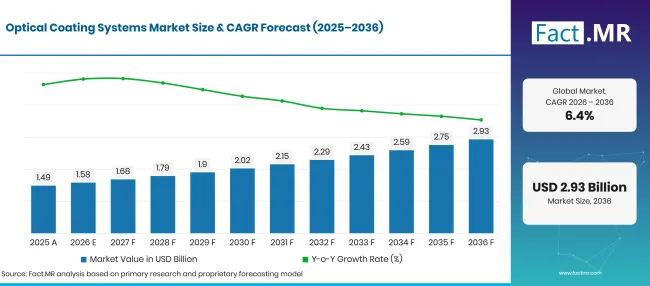
Factmr Optical Coating Systems Market Forecast Global | Source: Fact.MR
| Year | Basis | Market Value (USD billion) |
|---|---|---|
| 2025 | Actual | 1.49 |
| 2026 | Estimate | 1.58 |
| 2036 | Forecast | 2.93 |
| CAGR 2026 to 2036 | Forecast period | 6.4% |
Source: Fact.MR analysis. Updated Oct 13, 2026
What are the defining numbers behind Optical Coating Systems Market growth?
USD 1.3 Billion absolute chance between 2026 and 2036.
- Demand Drivers in the Market
- Display and camera module manufacturers use filter coatings to control specific light wavelengths while maintaining image quality and sensor performance. As devices become smaller, coating suppliers must deliver the same optical performance across every production batch.
- Solar panel manufacturers assess anti-reflective coatings based on how much light passes through the surface and how well the coating performs over time. Suppliers that deliver consistent production quality are more likely to secure repeat business.
- Medical device manufacturers rely on stable optical performance in imaging and diagnostic equipment. Coating consistency affects the amount of light reaching the sensor and helps maintain accurate instrument calibration.
- Key Segments Analyzed
- By Coating Type: Filter Coatings account for 28.5% share in 2026 because wavelength control supports imaging and optical sensing.
- By Application: Consumer Electronics represent 28.1% share in 2026 as camera and display parts require controlled surface reflections.
- By Technology: Sputtering holds 38.3% share in 2026 due to controlled thin-film deposition for repeatable coating properties.
- By End-User: Electronics represent 35.4% share in 2026, reflecting the number of coated optical parts assembled into electronic devices.
- Analyst Opinion at Fact.MR
- Shambhu Nath Jha, Principal Consultant at Fact.MR, states, “Optical coating purchases often begin with sample testing, but buying decisions depend on whether the coating delivers the same results across repeated production runs. Suppliers that maintain consistent coating thickness and provide clear test records are better positioned to work with manufacturers that have strict quality requirements.”
- Strategic Implications
- Coating equipment manufacturers can support customers with clear process records and sample test results, making it easier to compare performance before moving into larger production runs.
- Consumer electronics manufacturers benefit from defining optical quality requirements early in the design stage, helping coating specifications match the needs of the camera or display module.
- Automotive optical teams often test coating durability under actual operating conditions, since real-world use can differ from laboratory testing.
- Healthcare instrument manufacturers can coordinate coating updates with calibration schedules, reducing the effort needed when replacing optical components.
Germany records 7.8% growth, supported by strong demand from precision optics and automotive manufacturing. Brazil reaches 7.1% as solar equipment and imported optical components continue to influence purchasing activity. The United States posts 6.5%, driven by developments in medical optics and electronics. The United Kingdom reaches 5.8%, while Japan records 5.1% as established equipment manufacturers focus on consistent optical performance.
How does the Optical Coating Systems Market break down by segment?
Filter Coatings 28.5%; Consumer Electronics 28.1%; Sputtering 38.3%; Electronics 35.4%.
Which Coating Type leads?
Filter Coatings are estimated to hold 28.5% share in 2026.
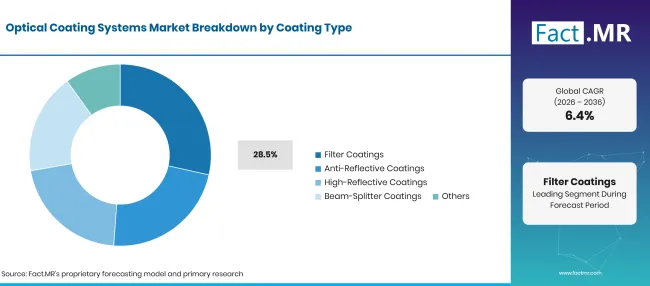
Factmr Optical Coating Systems Market Breakdown Coating Type | Source: Fact.MR
| Coating Type | Share (2026) |
|---|---|
| Filter Coatings (Leading segment) | 28.5% |
| Other segments combined | 71.5% |
| Total | 100.0% |
Source: Fact.MR analysis. Updated Oct 13, 2026
Filter coatings allow specific types of light to pass through or block them in cameras, sensors, and other optical equipment. Production teams match the coating to the sensor and the way light enters the component. Anti-reflective coatings reduce light loss when clear light transmission is important. High-reflective coatings help direct light inside optical equipment, while beam-splitter coatings divide light into separate paths. Each coating type is tested differently depending on the job it needs to perform.
What leads the Application segment?
Consumer Electronics are projected to represent 28.1% share in 2026.
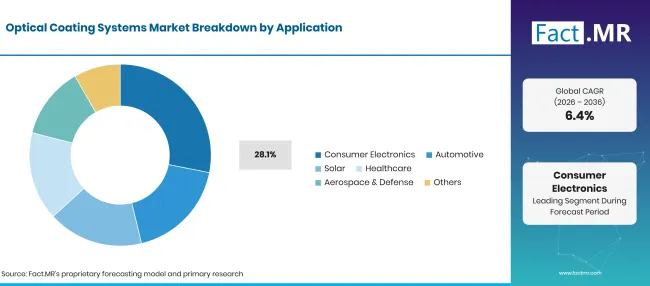
Factmr Optical Coating Systems Market Breakdown Application | Source: Fact.MR
| Application | Share (2026) |
|---|---|
| Consumer Electronics (Leading segment) | 28.1% |
| Other segments combined | 71.9% |
| Total | 100.0% |
Source: Fact.MR analysis. Updated Oct 13, 2026
Consumer electronics products use coated lenses and filters in cameras and displays where space is limited. Manufacturers look for consistent light transmission and uniform colour performance across large production volumes. Automotive applications use coated optical parts in cameras and other vision systems. Solar equipment focuses on reducing surface reflection, while healthcare devices use coated components for imaging and measurement. Aerospace and defence applications often require additional testing before products are approved for use.
How does Technology shape coating purchases?
Sputtering is forecast to account for 38.3% share in 2026.
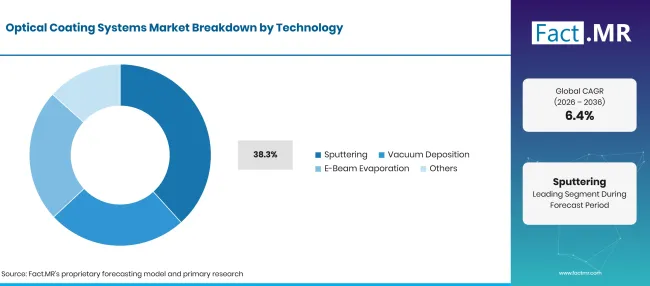
Factmr Optical Coating Systems Market Breakdown Technology | Source: Fact.MR
| Technology | Share (2026) |
|---|---|
| Sputtering (Leading segment) | 38.3% |
| Other segments combined | 61.7% |
| Total | 100.0% |
Source: Fact.MR analysis. Updated Oct 13, 2026
Sputtering applies a coating layer onto an optical surface under controlled production conditions. Equipment selection depends on coating consistency, production volume, and the type of material being coated. Vacuum deposition includes a range of coating methods that take place inside a vacuum chamber. E-beam evaporation uses an electron beam to heat the coating material before it is applied to the surface. Manufacturers choose the coating process based on the optical requirements of the product rather than following one standard method for every application.
Which End-User accounts for the greatest share?
Electronics is anticipated to represent 35.4% share in 2026.
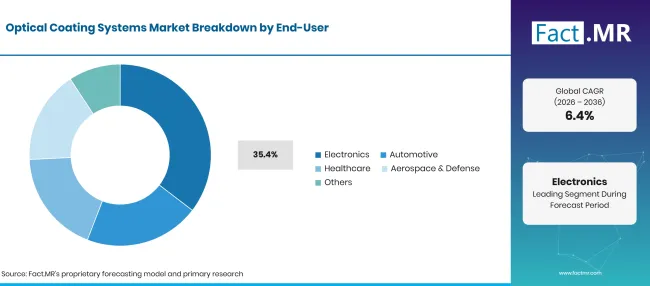
Factmr Optical Coating Systems Market Breakdown End User | Source: Fact.MR
| End-User | Share (2026) |
|---|---|
| Electronics (Leading segment) | 35.4% |
| Other segments combined | 64.6% |
| Total | 100.0% |
Source: Fact.MR analysis. Updated Oct 13, 2026
Electronics manufacturers use coated optical components in displays and imaging systems. They look for consistent performance across production batches because even small changes in light response can affect the final product. Automotive manufacturers evaluate coating durability and performance in cameras and other vehicle sensors. Healthcare companies focus on accurate calibration and clear product records. Aerospace and defence applications often require additional testing and approval, which can extend the time between product development and regular orders.
What is accelerating Optical Coating Systems Market adoption, and what is holding it back?
Stricter optical requirements support demand, while production losses and product approval costs can limit purchasing activity.
Drivers Impact Analysis
| DRIVER | (~) % IMPACT ON CAGR | GEOGRAPHIC RELEVANCE | IMPACT TIMELINE |
|---|---|---|---|
| More camera and display optical surfaces | +1.0% | East Asia, North America | Medium term (2–4 years) |
| Optical sensors in vehicles | +0.8% | Western Europe, North America | Medium term (2–4 years) |
| Solar glass and module processing | +0.7% | Latin America, North America | Medium term (2–4 years) |
| Medical imaging component replacement | +0.5% | North America, Western Europe | Long term (>= 4 years) |
| Wavelength filtering in industrial instruments | +0.4% | Global | Long term (>= 4 years) |
Source: Fact.MR analysis. Updated Oct 13, 2026
Opportunity Impact Analysis
| OPPORTUNITY | (~) % IMPACT ON CAGR | GEOGRAPHIC RELEVANCE | IMPACT TIMELINE |
|---|---|---|---|
| Process qualification services | +0.7% | Global | Short term (<= 2 years) |
| Multi-layer wavelength filters | +0.6% | East Asia, North America | Medium term (2–4 years) |
| Durable sensor cover coatings | +0.5% | Western Europe, North America | Medium term (2–4 years) |
| Local finishing and testing | +0.4% | Latin America, Western Europe | Long term (>= 4 years) |
Source: Fact.MR analysis. Updated Oct 13, 2026
Restraints Impact Analysis
| RESTRAINT | (~) % IMPACT ON CAGR | GEOGRAPHIC RELEVANCE | IMPACT TIMELINE |
|---|---|---|---|
| Batch rejection and rework costs | -0.8% | Global | Short term (<= 2 years) |
| Long qualification cycles | -0.6% | North America, Western Europe | Medium term (2–4 years) |
| Vacuum process operating costs | -0.5% | Global | Medium term (2–4 years) |
| Cross-border component lead times | -0.4% | East Asia, Latin America | Short term (<= 2 years) |
Source: Fact.MR analysis. Updated Oct 13, 2026
Which countries are scaling the Optical Coating Systems Market through 2036?
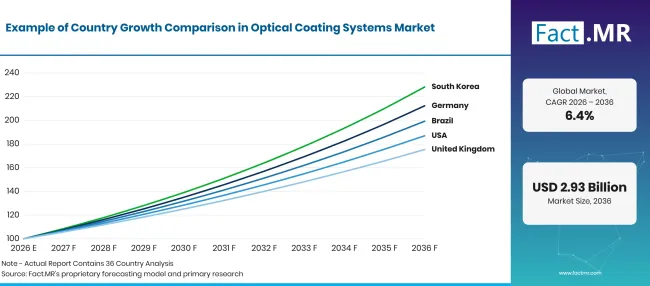
Factmr Optical Coating Systems Market Growth Index | Source: Fact.MR
| Country | CAGR (2026–2036) |
|---|---|
| Germany | 7.8% |
| Brazil | 7.1% |
| United States | 6.5% |
| United Kingdom | 5.8% |
| Japan | 5.1% |
Source: Fact.MR analysis. Updated Oct 13, 2026
Why is Germany leading optical coating growth?
7.8% CAGR, shaped by precision optics and solar-related surface technologies.
German manufacturers of optical equipment use coated lenses and filters that deliver consistent light transmission across production batches. Bundesnetzagentur reported 117 GW of installed solar capacity at the end of 2025 [3]. This also supports demand for anti-reflective coatings used on solar module glass.
How is Brazil expanding coating-system use?
7.1% CAGR, linked to photovoltaic equipment and component supply chains.
Brazil’s solar power sector provides a strong market for anti-reflective coatings used on solar glass. The Energy Research Office reported that photovoltaic capacity reached 64,793 MW in 2025 [4]. Local equipment assemblers also value nearby testing to check light transmission and surface quality.
What is driving optical coating sales in the United States?
6.5% CAGR, associated with instrumentation and precision optical components.
U.S. medical imaging and industrial equipment manufacturers use coated windows and filters where consistent light transmission is important for reliable performance. The U.S. Energy Information Administration reported 43.4 GW of planned utility-scale solar additions for 2026 [1], creating additional demand for anti-reflective coating systems. Suppliers also support equipment designers through sample testing and product evaluation.
How is the United Kingdom developing optical coating demand?
5.8% CAGR, linked to instrumentation and solar-related optical applications.
British instrument manufacturers use coated lenses and windows in measurement and sensing equipment, where local testing helps maintain consistent light performance. The Department for Energy Security and Net Zero reported 269,000 solar installations completed in 2025 [2]. Vehicle camera systems also create demand for durable optical filters.
Why is Japan maintaining steady optical coating adoption?
5.1% CAGR, shaped by optical precision and electronics manufacturing.
Japanese camera and electronics manufacturers use filter coatings that deliver consistent light performance across large production runs. The Japan Electronics and Information Technology Industries Association reported JPY 415,023 million in consumer electronic equipment output in 2025 [5]. Optical companies also support product development through trial production and light-testing activities.
Who leads the Optical Coating Systems Market?
Edmund Optics, Coherent, Materion and ZEISS serve different optical coating needs.
Edmund Optics supplies coated optical components and helps customers choose filters and anti-reflective coatings for different applications. Coherent provides optical products used in laser and photonics equipment. Materion works with precision optical coatings and related materials, while ZEISS focuses on optical quality and overall system performance. These companies serve many of the same customers, but requirements often differ between imaging, laser, and medical applications.
MKS Instruments participates in the optical and photonics market through its Newport product range. Thorlabs supplies coated optical components for laboratories and product developers. Inrad Optics and Janos Technology focus on specialised precision optics applications. Optics Balzers is known for thin-film optical coatings.
Which companies are the key providers?
Key companies include Edmund Optics; Coherent Corp.; Materion Corporation; ZEISS Group; KS Instruments Inc.; Inrad Optics; Janos Technology; and Thorlabs, Inc.
- Edmund Optics
- Coherent Corp.
- Materion Corporation
- ZEISS Group
- MKS Instruments Inc.
- Inrad Optics
- Janos Technology
- Thorlabs, Inc.
Bibliography
- [1] U.S. Energy Information Administration. (2026, February 20). New U.S. electric generating capacity expected to reach a record high in 2026.
- [2] Department for Energy Security and Net Zero. (2026, May 28). Britain continues to break clean power records.
- [3] Bundesnetzagentur. (2026, January 8). Growth in renewable energy in 2025.
- [4] Empresa de Pesquisa Energética. (2026, June 3). EPE publica o Relatório Síntese do Balanço Energético Nacional 2026.
- [5] Japan Electronics and Information Technology Industries Association. (n.d.). December 2025 production by the Japanese electronics industry.
- [6] Statistisches Bundesamt (Destatis). (2026, June 19). Außenhandelsvolumen trotz Anstieg im Jahr 2025 unter dem Vorkrisenniveau des Jahres 2019.
- [7] Instituto Nacional de Metrologia, Qualidade e Tecnologia. (2025, March 12). Registro 002569/2025: Módulo fotovoltaico.
- [8] U.S. Energy Information Administration. (2026, September 24). Electric Power Monthly: Table 6.1.A. Estimated net summer solar photovoltaic capacity from utility and small-scale facilities.
- [9] Office for National Statistics. (2026, July 24). UK manufacturers’ sales by product: 2025.
- [10] Ministry of Economy, Trade and Industry. (2026, January 19). Current Survey of Production: 2025 interim total computation.
- [11] Statistisches Bundesamt (Destatis). (2026, August 6). New orders in manufacturing in June 2026: +3.1% on the previous month.
- [12] Statistisches Bundesamt (Destatis). (2026, March 12). 4,8 Millionen Photovoltaikanlagen zum Jahresende 2025 installiert [4.8 million photovoltaic systems installed at the end of 2025].
- [13] Ministry of Economy, Trade and Industry. (2026, March 31). Indices of Industrial Production: Preliminary Report for February 2026.
- [14] Ministry of Economy, Trade and Industry. (2026, June 30). Indices of Industrial Production: Preliminary Report for May 2026.
This Report Answers
- The report explains how optical coating systems are assessed by coating type, application, technology, end-user, and region.
- Segment analysis identifies the leading 2026 subsegments, including Filter Coatings, Consumer Electronics, Sputtering, and Electronics.
- Country analysis compares Germany, Brazil, the United States, the United Kingdom, and Japan through optical manufacturing, solar, electronics, and instrumentation activity.
- Competitive analysis reviews optical component suppliers and specialist coating companies serving imaging, medical, industrial, photonics, and electronics applications.
- Technology analysis examines how sputtering, vacuum deposition, and e-beam evaporation influence coating consistency, qualification, and suitability for different optical applications.
What does the Optical Coating Systems Market cover?
Systems and coated optical surfaces used to control light reflection, transmission and spectral selection.
The market addresses optical coating systems and coated elements used in devices where light behavior affects performance. Coating types include filter coatings and reflective or anti-reflective films. A system may involve deposition equipment, the process used for a coating run and the coated optical parts delivered to the device manufacturer.
What is included in the scope?
Filter, anti-reflective, high-reflective and beam-splitter coating systems for named optical uses.
Coverage includes sputtering, vacuum deposition and electron-beam evaporation as technology categories. Applications span consumer electronics, automotive devices, solar equipment, healthcare and aerospace and defense. Finished coated components are considered where they form part of optical coating system sales. Electronics customers are distinguished from other end users by device integration and production acceptance needs.
What is excluded from the scope?
Decorative paints and unrelated bulk surface treatments are outside the optical scope.
The market excludes general architectural paint and surface finishes without an intended optical function. It also excludes electronic chips sold without an optical coating system and solar generation equipment sold as a complete power project. General industrial surface treatments are considered only when they meet the defined light-management function.
How Was the Analysis Built?
The analysis draws on 120+ sources, 35+ company portfolios, 25+ countries, and more than 20 industry interviews.
- Primary Research: Primary research includes discussions with manufacturers, service providers, technology developers, distributors, end users, and subject-matter experts. These conversations examine purchasing priorities, product adoption, operational challenges, approval requirements, competitive positioning, and the factors that influence wider market acceptance.
- Desk Research: Desk research covers government statistics, regulatory publications, company filings, trade data, technical studies, industry associations, standards, public policy, and other authoritative sources. Every source used in the analysis is documented in the bibliography.
- Market Sizing and Forecasting: Market estimates combine historical performance, demand indicators, pricing and volume trends, segment shares, company participation, country-level growth, adoption patterns, investment activity, and barriers to market expansion.
- Data Validation and Update Cycle: Findings are validated by comparing primary interviews with public data, company activity, regulatory changes, trade patterns, and industry developments. Regular updates review new product launches, capacity changes, partnerships, approvals, and shifts in commercial adoption.
Segmentation
What is the report’s scope and coverage?
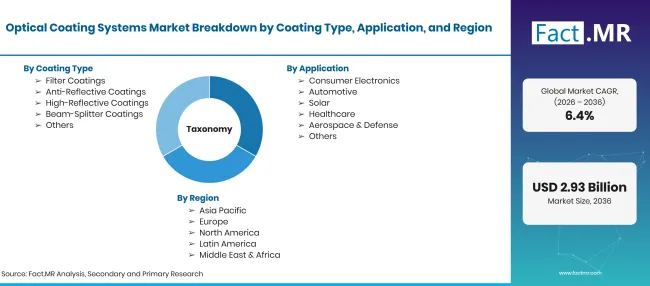
Factmr Optical Coating Systems Market Taxonomy | Source: Fact.MR
| Attribute | Details |
|---|---|
| Quantitative Units | USD billion |
| Market Definition | Thin-film optical coating systems and associated coated optical surfaces for controlled light behavior |
| Coating Type | Filter Coatings; Anti-Reflective Coatings; High-Reflective Coatings; Beam-Splitter Coatings; Others |
| Application | Consumer Electronics; Automotive; Solar; Healthcare; Aerospace & Defense; Others |
| Technology | Sputtering; Vacuum Deposition; E-Beam Evaporation; Others |
| End-User | Electronics; Automotive; Healthcare; Aerospace & Defense; Others |
| Regions Covered | North America; Latin America; Western Europe; Eastern Europe; East Asia; South Asia & Pacific; Middle East & Africa |
| Countries Covered | Germany; Brazil; United States; United Kingdom; Japan |
| Forecast Period | 2026 to 2036 |
| Companies Profiled | Edmund Optics; Coherent Corp.; Materion Corporation; ZEISS Group; MKS Instruments Inc.; Inrad Optics; Janos Technology; Thorlabs, Inc. |
Source: Fact.MR analysis. Updated Oct 13, 2026
How is the market segmented?
-
By Coating Type:
- Filter Coatings
- Anti-Reflective Coatings
- High-Reflective Coatings
- Beam-Splitter Coatings
- Others
-
By Application:
- Consumer Electronics
- Automotive
- Solar
- Healthcare
- Aerospace & Defense
- Others
-
By Technology:
- Sputtering
- Vacuum Deposition
- E-Beam Evaporation
- Others
-
By End-User:
- Electronics
- Automotive
-
By Region:
- North America
- Latin America
- Western Europe
- Eastern Europe
- East Asia
- South Asia & Pacific
- Middle East & Africa
Frequently Asked Questions
How big is the Optical Coating Systems Market in 2026?
What is the CAGR of the Optical Coating Systems Market from 2026 to 2036?
Which coating type leads the Optical Coating Systems Market?
Which application leads the Optical Coating Systems Market?
Who are the leading companies in the Optical Coating Systems Market?
Who worked on this report


Preview the report firsthand - request a free sample
Free SampleGet the brochure for pricing and purchase details
Download PDF