- Market Value (2025): USD 3.0 Bn
- Estimated Value (2026): USD 3.3 Bn
- Forecast Value (2036): USD 10.0 Bn
- CAGR (2026-2036): 11.6%
What is the Data Center Conductive Coating Systems Market forecast to be worth by 2036?
USD 3.3 billion in 2026 to USD 10.0 billion by 2036 at an 11.6% CAGR.
- The Data Center Conductive Coating Systems Market was valued at USD 3.0 billion in 2025.
- Demand is projected to increase from USD 3.3 billion in 2026 to USD 10.0 billion by 2036.
- The market is forecast to record an 11.6% CAGR from 2026 to 2036 as server-site and chip-fab build work adds more ESD-sensitive floor space.
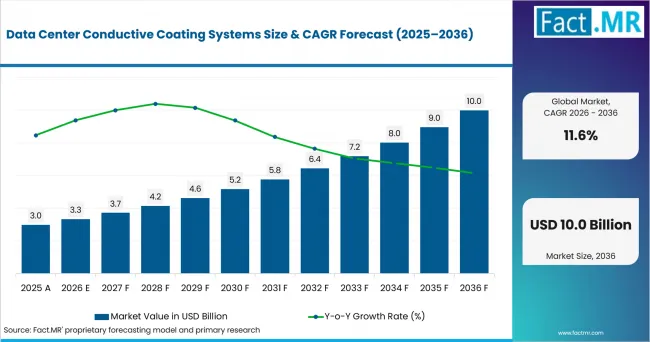
Data Center Conductive Coating Systems Value Analysis | Source: Fact.MR
What are the defining numbers behind Data Center Conductive Coating Systems Market growth?
An absolute opportunity of USD 6.7 billion is expected between 2026 and 2036.
- Demand Drivers in the Market
- Server-site teams are expected to expand ESD specs as rack density rises. The U.S. Department of Energy reported in June 2026 that data centers could account for an estimated 11.8% of total U.S. electricity use by 2030.
- Chip-fab teams are expected to need stable static-safe floors in clean work zones. China’s National Bureau of Statistics reported in February 2026 that integrated-circuit output reached 484.28 billion pieces in 2025.
- AI build work is expected to widen the base of server rooms and high-density IT zones. China's National Data Administration reported in April 2026 that national data production reached 52.26 ZB in 2025, up 27.28% year over year.
- Device-plant spend is projected to add more ESD-controlled work zones. The U.S. Bureau of Economic Analysis reported in June 2026 that greenfield spend in computer and electronic product manufacturing reached USD 2.0 billion in 2025.
- Key Segments Analyzed
- By Conductive Additive: Carbon black is expected to hold 34.0% share in 2026 owing to established use in coatings that need antistatic or dissipative electrical performance.
- By Conductivity Target: Antistatic is projected to account for 31.0% share in 2026 since many facility surfaces focus on limiting charge accumulation around electronic equipment.
- By End-use Facility: Semiconductor fabs are anticipated to capture 36.0% share in 2026 supported by dense concentrations of ESD-sensitive devices and controlled production areas.
- By Coating System: Epoxy is estimated to represent 29.0% share in 2026 because its adhesion and wear performance fit conductive flooring systems used in technical facilities.
- Analyst Opinion at Fact.MR
- Shambhu Nath Jha is Principal Consultant at Fact.MR. He states, “Coat choice is moving toward clear ohm targets and test-backed system results. Demand is expected to broaden as server sites and chip fabs add more ESD-sensitive floor area. Firms are better placed when they pair stable ESD results with hard-wearing resins and clear site guidance.”
- Strategic Implications
- Coating suppliers should publish ohm ranges and test steps in a form that site teams can compare. The PPG Flooring 422 ESD sheet dated August 2025 lists conductive and dissipative floor use for computer rooms and electronic manufacturing sites. Clear limits can speed design review and post-cure checks.
- Server-site teams should link the floor plan with the ground plan early in each build. France’s energy regulator approved a fast-track process in May 2025 for high-power sites from 400 MW to 1 GW. Large IT builds can therefore move through a set grid route while floor work is planned.
- Chip-focused firms should pair ESD control with easy cleaning and wear life. Germany’s federal government adopted its microelectronics strategy in October 2025 to strengthen research and chip output. Clean fab zones need floors that keep their ESD role after wash cycles and cart traffic.
China is projected to record 13.2% CAGR through 2036 as chip output and AI compute sites grow. The USA is expected to post 11.7% as server builds and electronics-plant spend support site work. France is anticipated to advance at 11.7% through new data-center builds. Germany is estimated at 11.5% as IT power grows. Japan is forecast at 10.4% as AI and chip spend continues.
How does the Data Center Conductive Coating Systems Market break down by segment?
Semiconductor fabs are anticipated to lead End-use Facility at 36.0% share in 2026; carbon black is expected to lead Conductive Additive at 34.0% share.
Which Conductive Additive leads?
Carbon black is expected to hold 34.0% share in 2026.
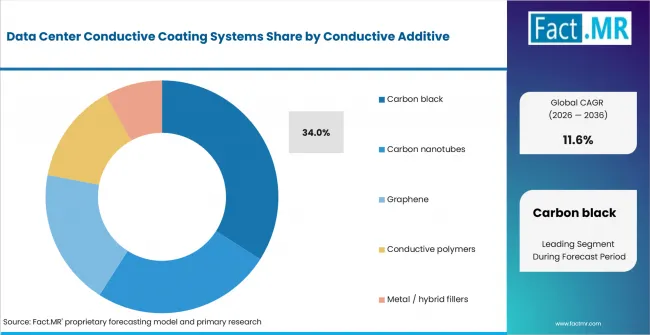
Data Center Conductive Coating Systems Analysis By Conductive Additive | Source: Fact.MR
Carbon black remains widely used because coating suppliers can tune its loading for antistatic or static-safe ohm targets. The conductive carbon black value chain gives formulators a familiar feedstock base. Carbon nanotubes can reach a set charge path at lower filler load. Graphene suits thin conductive networks. Conductive polymers give another route when particle loading is less useful. Metal and hybrid fillers serve lower-ohm and shielding needs.
What leads the Conductivity Target segment?
Antistatic is projected to account for 31.0% share in 2026.
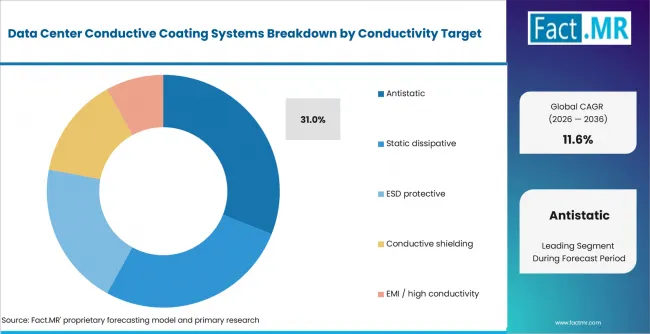
Data Center Conductive Coating Systems Analysis By Conductivity Target | Source: Fact.MR
Antistatic floors are expected to cover broad site zones where the aim is to limit charge near device gear. Static-dissipative systems serve tighter ohm windows and use set ground paths. ESD-protective coats link floor ohms with a wider control plan. Conductive shielding serves lower-ohm needs and links with the EMI shielding material field. EMI coats are used on enclosures and parts where shielding is part of the design.
How does End-use Facility shape demand?
Semiconductor fabs are anticipated to capture 36.0% share in 2026.
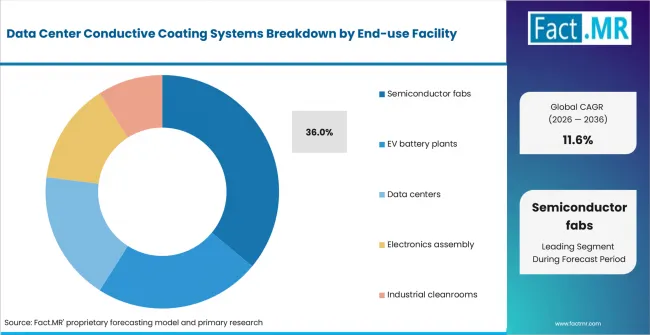
Data Center Conductive Coating Systems Analysis By End Use Facility | Source: Fact.MR
Chip fabs pair clean-room rules with strict ESD control. China’s National Bureau of Statistics reported in January 2026 that industrial-robot output reached 773,074 sets in 2025, up 28.0% from 2024. More automated gear adds dense work zones that need charge-safe floors. EV battery plants and device build sites add the same need. Server rooms add more floor area. Related modular cleanroom solutions place flooring within the wider clean-room build.
What supports Epoxy within Coating System?
Epoxy is estimated to represent 29.0% share in 2026.
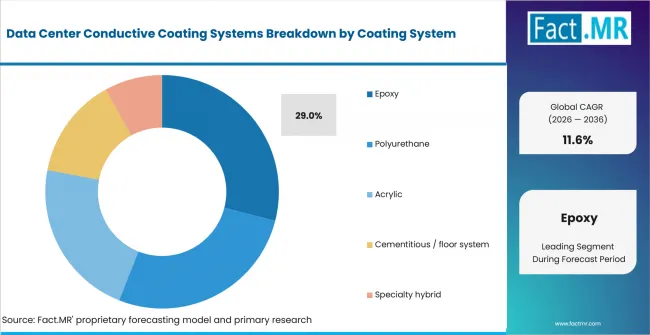
Data Center Conductive Coating Systems Analysis By Coating System | Source: Fact.MR
Epoxy systems fit ESD floors because they bond well to prepared concrete and can hold conductive filler. PPG Flooring 422 ESD is a two-part epoxy system for conductive or dissipative floors in computer and server rooms. PU can suit zones that need more flex. Acrylic can help when fast return to use is needed. Cement-based systems help with thicker builds. Hybrid systems blend resin traits for set cure or ohm goals. The wider epoxy resin base gives coating suppliers a known platform for industrial floors.
What is accelerating Data Center Conductive Coating Systems Market adoption, and what is holding it back?
Facility expansion and ESD control requirements support adoption; qualification effort and installation sensitivity restrain the pace of conversion.
Drivers Impact Analysis
| DRIVER | (~) % IMPACT ON CAGR | GEOGRAPHIC RELEVANCE | IMPACT TIMELINE |
|---|---|---|---|
| Expansion of data center technical floor area | +2.1% | North America, East Asia, Europe | Short term (<= 2 years) |
| Semiconductor fab and cleanroom expansion | +1.8% | East Asia, North America, Europe | Medium term (2-4 years) |
| Higher ESD control requirements around electronics | +1.3% | Global | Short term (<= 2 years) |
| EMI shielding needs for dense electronic systems | +0.9% | North America, East Asia | Medium term (2-4 years) |
| Replacement of worn static-control floors | +0.6% | Global | Long term (>= 4 years) |
Source: Fact.MR analysis. Updated Sep 23, 2026
Opportunity Impact Analysis
| OPPORTUNITY | (~) % IMPACT ON CAGR | GEOGRAPHIC RELEVANCE | IMPACT TIMELINE |
|---|---|---|---|
| Integrated data center coating packages | +1.2% | North America, Europe | Short term (<= 2 years) |
| Conductive systems for semiconductor cleanrooms | +1.0% | East Asia, Europe, USA | Medium term (2-4 years) |
| Low-loading nanotube and graphene formulations | +0.7% | Global | Long term (>= 4 years) |
| Repair and retrofit systems for operating facilities | +0.5% | Global | Medium term (2-4 years) |
Source: Fact.MR analysis. Updated Sep 23, 2026
Restraints Impact Analysis
| RESTRAINT | (~) % IMPACT ON CAGR | GEOGRAPHIC RELEVANCE | IMPACT TIMELINE |
|---|---|---|---|
| Grounding and resistance-test complexity | -0.7% | Global | Short term (<= 2 years) |
| Specialty filler and resin cost | -0.5% | Global | Medium term (2-4 years) |
| Application sensitivity to substrate condition | -0.4% | Global | Short term (<= 2 years) |
| Long qualification cycles in controlled facilities | -0.3% | Semiconductor hubs | Long term (>= 4 years) |
Source: Fact.MR analysis. Updated Sep 23, 2026
Which countries are scaling the Data Center Conductive Coating Systems Market through 2036?
- The displayed country range spans 2.8 percentage points across the 2026 to 2036 forecast period.
- China remains 1.5 percentage points above the USA as chip output and AI compute sites expand.
- The USA and France both record 11.7% CAGR. Their growth paths differ by site mix and capital spend.
- Germany remains 0.2 percentage point below the USA and France as server-site capacity and chip work grow together.
- Japan closes the displayed range at 10.4% as public support directs capital toward AI and chip capacity.
Close CAGR values can come from different site mixes. The country review focuses on the build or plant factor that adds ESD-sensitive floor area. Full report coverage spans North America and Latin America. It also covers Western Europe and Eastern Europe. East Asia and South Asia & Pacific are included. Middle East & Africa completes the region set.
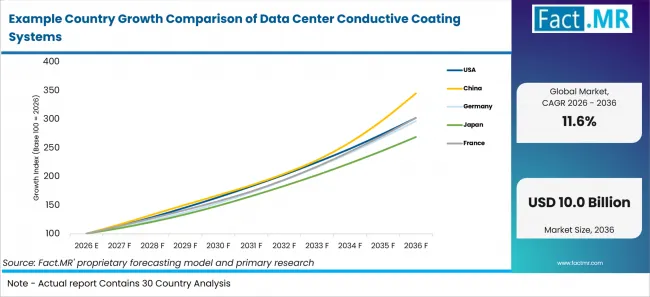
Example Country Growth Comparison Of Data Center Conductive Coating Systems | Source: Fact.MR
| Country | CAGR (2026-2036) |
|---|---|
| China | 13.2% |
| United States | 11.7% |
| France | 11.7% |
| Germany | 11.5% |
| Japan | 10.4% |
Source: Fact.MR analysis. Updated Sep 23, 2026
What supports China adoption?
13.2% CAGR, supported by semiconductor output and AI compute capacity.
China pairs a large electronics-plant base with fast growth in compute and chip work. The Ministry of Industry and Information Technology reported in April 2026 that electronic information manufacturing revenue reached CNY 17.4 trillion in 2025. That base supports new clean work zones and server rooms. Chip fabs add strict ESD needs around tools and service areas. Related semiconductor diffusion equipment adds more context on fab build activity. Coating suppliers can compete through steady ohm results and easy-clean floors.
How is the United States scaling demand?
11.7% CAGR, driven by data center construction and electronics investment.
U.S. demand is expected to grow with server-site builds and electronics-plant spend. The U.S. Energy Information Administration reported in May 2026 that data-center servers accounted for an estimated 7% of commercial-sector electricity use in 2025. Dense server rooms place more gear near staff and service work. That raises the value of ESD-safe floors. The adjacent data center server rack field shows the scale of gear housed in these sites. ESD coats gain value when wear life and ohm results hold through service cycles.
What supports France growth?
11.7% CAGR, supported by large data center projects and grid-connection pathways.
France is adding large server sites and faster routes for high-power grid links. France’s Statistical Data and Studies Department reported in July 2026 that 471 data centers were identified in metropolitan France in 2024; these facilities had exceeded 1 GWh of annual electricity consumption in at least one year between 2018 and 2024. That base creates upkeep and refit work as new sites are built. Dense rooms need floors that can take cart traffic and routine cleaning. Related data center monitoring shows the wider shift toward measured site results. Coating suppliers gain when test records fit site-team needs.
What is supporting Germany adoption?
11.5% CAGR, supported by expanding IT capacity and microelectronics investment.
Germany pairs a growing server-site base with a mature chip cluster. Germany’s Federal Ministry for Economic Affairs reported in July 2025 that data-centre capacity had reached 2,730 MW in 2024. Added power is expected to expand floor area that needs hard-wearing ESD coats. Chip output around Dresden adds clean-room use with tighter ESD needs. The broader cleanroom air handling unit field shows the systems view used in clean rooms. Coating suppliers need steady fit quality and clear test records.
How does Japan perform?
10.4% CAGR, led by AI and semiconductor investment.
Japan is directing state support toward AI sites and chip capacity. METI stated in February 2025 that its Framework for Strengthening the AI and Semiconductor Industrial Infrastructure would provide more than JPY 10 trillion in public support over seven years through FY2030. High-end servers and chip plants both create zones where ESD control is part of the site plan. Server rooms add gear areas while fabs add clean work zones. Related data center accelerator use raises the value of gear housed in compute sites. Firms can improve fit with cleanable and wear-safe ESD coat systems.
Who leads the Data Center Conductive Coating Systems Market?
PPG participates through ESD and conductive flooring systems for electronic manufacturing facilities, computer rooms, and data centers. Parker Chomerics serves part-level EMI control through CHO-SHIELD® electrically conductive coatings for electronic housings and enclosures. AkzoNobel provides an adjacent capability through its Interpon® powder-coating platform, including electrical-grade and data-center-related protective coating applications. These suppliers therefore address different parts of the application boundary, ranging from floor-level electrostatic control to enclosure shielding and protective component coatings.
Henkel and Qnity Electronics broaden the competitive set through functional electronic materials. Henkel announced a new EMI shielding film for automotive electronics in October 2025 and highlighted EMI testing and digital material-validation capabilities. Competitive positioning therefore varies according to the required task, including floor-level ESD control, enclosure shielding, protective component coatings, and transparent conductive device surfaces.
Which companies are the key providers?
Companies profiled include PPG Industries; AkzoNobel; Parker Chomerics; and Henkel.
- PPG Industries
- AkzoNobel
- Parker Chomerics
- Henkel
Bibliography
- U.S. Bureau of Economic Analysis. (2026, June 10). New foreign direct investment in the United States, 2025.
- National Bureau of Statistics of China. (2026, February 28). Statistical communiqué of the People’s Republic of China on the 2025 national economic and social development.
- Federal Ministry for Economic Affairs and Climate Action. (2025, March 31). Status and development of the German data centre landscape—Executive summary.
- Federal Government of Germany. (2025, October 15). Strengthening the business location for microelectronics.
- Ministry of Economy, Trade and Industry. (2025, February 7). Press conference by Minister Muto (excerpt).
- Commission de régulation de l’énergie. (2025, May 7). La CRE approuve la procédure de raccordement « fast track » pour raccorder les sites de consommation de grande puissance au réseau très haute tension (400 kV) de RTE.
- Meilhac, C. (2026, July 2). La consommation d’électricité des data centers en 2024. Service des données et études statistiques.
- PPG. (2026, April 20). PPG introduces end-to-end protective coatings solutions, application services for data centers.
- PPG. (2026, February 13). PPG FLOORING™ 422 ESD waterborne ground plane epoxy [Product data sheet].
- U.S. Energy Information Administration. (2026, May 19). Data center server energy use grows across the commercial building stock.
- Henkel. (2025, October 6). Henkel showcases next-generation electronics solutions with focus on electromagnetic interference (EMI) shielding, thermal management, debonding and pad printing.
- DuPont. (2025, April 16). Transforming the future of mobility: DuPont unveils silver nanowire products in South Korea.
This Report Answers
- The report explains how conductive coat systems are used across additive chemistry and conductivity target. It also covers site type and coat system.
- Segment review identifies the leading subgroups and explains why site teams select conductive or static-safe floors.
- Country review compares China and the United States with France, Germany and Japan complete the country set.
- Competitive review covers direct data-center coating suppliers and device-material firms that serve conductive or EMI-control uses.
- Application review explains how floor ohms and ground design shape coat choice. Wear life and cleaning needs are assessed in the same review.
What does the Data Center Conductive Coating Systems Market cover?
The Data Center Conductive Coating Systems Market covers coats that manage static charge or form a conductive path on floors and gear. It includes floor coats for server rooms and chip clean rooms. Device build zones and battery plants are also in scope. Selected coats for enclosures and parts are included when EMI control is a set need. Related paints and coatings provide the resin base for many of these systems.
The review covers carbon black and carbon nanotubes. It also covers graphene and conductive polymers. Metal or hybrid fillers complete the additive set. The target set includes antistatic and static-dissipative use. ESD protection and conductive shielding are also assessed. Coat systems include epoxy and PU. Acrylic, cement-based floors and hybrid systems complete the group.
What is included in the scope?
The scope includes conductive or static-safe floor coats and ground-plane layers. It covers antistatic floor systems and EMI-shielding coats. New builds and repair work are included when a set ohm range forms part of site approval. Server rooms and technical spaces are in scope. Clean rooms and device build zones are included. Site teams need a clear ground path before coat work starts. Each zone should have a test point that crews can reach after cure.
The scope also covers epoxy and PU systems when the full coat build creates the charge path. Acrylic and hybrid resins are included on the same basis. Conductive carbon black is assessed as part of the coat build. Clean-room demand is viewed beside cleanroom solutions because the floor is one part of the full room design. The base slab and primer must fit the system. Crews should record mix time and cure time.
What is excluded from the scope?
Outside the scope are ordinary floor paints used only for visual finish. Standalone ground hardware and raised-floor panels sold only as structural products are outside the core review. Loose conductive filler for unrelated uses is outside the boundary. General heat-management material is treated separately when heat transfer is its sole role. Server hardware and data-center software are treated as linked markets.
Dielectric coats are treated as linked materials unless they form one layer of a conductive or static-safe system. Adhesives and encapsulants are treated the same way unless they have a defined conductive or EMI-control role.
How Was the Analysis Built?
The analysis draws on 120+ sources, 35+ company portfolios, 25+ countries, and more than 20 industry interviews.
- Primary Research: Primary research includes discussions with manufacturers, service providers, technology developers, distributors, end users, and subject-matter experts. These conversations examine purchasing priorities, product adoption, operational challenges, approval requirements, competitive positioning, and the factors that influence wider market acceptance.
- Desk Research: Desk research covers government statistics, regulatory publications, company filings, trade data, technical studies, industry associations, standards, public policy, and other authoritative sources. Every source used in the analysis is documented in the bibliography.
- Market Sizing and Forecasting: Market estimates combine historical performance, demand indicators, pricing and volume trends, segment shares, company participation, country-level growth, adoption patterns, investment activity, and barriers to market expansion.
- Data Validation and Update Cycle: Findings are validated by comparing primary interviews with public data, company activity, regulatory changes, trade patterns, and industry developments. Regular updates review new product launches, capacity changes, partnerships, approvals, and shifts in commercial adoption.
Segmentation
What is the report’s scope and coverage?
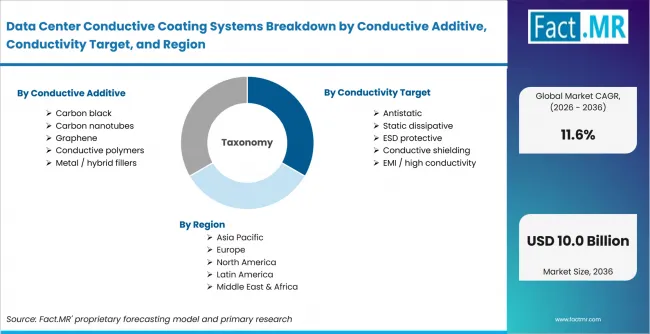
Data Center Conductive Coating Systems Breakdown By Conductive Additive, Conductivity Target, And Region | Source: Fact.MR
| Attribute | Details |
|---|---|
| Quantitative Units | USD billion |
| Market Definition | Conductive coating systems used on facility floors, surfaces, enclosures, and selected electronic components to manage electrostatic charge, provide dissipative or conductive paths, or support EMI shielding in data centers and related precision facilities. |
| Conductive Additive | Carbon black; Carbon nanotubes; Graphene; Conductive polymers; Metal / hybrid fillers |
| Conductivity Target | Antistatic; Static dissipative; ESD protective; Conductive shielding; EMI / high conductivity |
| End-use Facility | Semiconductor fabs; EV battery plants; Data centers; Electronics assembly; Industrial cleanrooms |
| Coating System | Epoxy; Polyurethane; Acrylic; Cementitious / floor system; Specialty hybrid |
| Regions Covered | North America; Latin America; Western Europe; Eastern Europe; East Asia; South Asia & Pacific; Middle East & Africa |
| Countries Covered | China; United States; France; Germany; Japan |
| Key Companies Profiled | PPG Industries; AkzoNobel; Parker Chomerics; Henkel |
| Forecast Period | 2026 to 2036 |
| Approach | Hybrid top-down and bottom-up review using facility construction, data center capacity, semiconductor and electronics activity, coating specifications, company portfolios, and country-level infrastructure indicators. |
Source: Fact.MR analysis. Updated Sep 23, 2026
How is the market segmented?
-
By Conductive Additive:
- Carbon black
- Carbon nanotubes
- Graphene
- Conductive polymers
- Metal / hybrid fillers
-
By Conductivity Target:
- Antistatic
- Static dissipative
- ESD protective
- Conductive shielding
- EMI / high conductivity
-
By End-use Facility:
- Semiconductor fabs
- EV battery plants
- Data centers
- Electronics assembly
- Industrial cleanrooms
-
By Coating System:
- Epoxy
- Polyurethane
- Acrylic
- Cementitious / floor system
- Specialty hybrid
-
By Region:
- North America
- Latin America
- Western Europe
- Eastern Europe
- East Asia
- South Asia & Pacific
- Middle East & Africa
Frequently Asked Questions
How big is the Data Center Conductive Coating Systems Market in 2026?
What is the CAGR of the Data Center Conductive Coating Systems Market from 2026 to 2036?
Which conductive additive leads the market?
Which end-use facility leads the market?
Who are the profiled companies in the market?
Who worked on this report


Preview the report firsthand - request a free sample
Free SampleGet the brochure for pricing and purchase details
Download PDF