Oral Obesity Therapies Market (2026 - 2036)

Oral Obesity Therapies Market Size and Share Forecast Outlook 2026 to 2036

Core Findings

    Oral Obesity Therapies Market Forecast and Outlook 2026 to 2036

    Oral Obesity Therapies Market stands at USD 4.6 billion in 2026 and is projected to reach USD 10.2 billion by 2036, reflecting an 8.30% CAGR.

    Oral Obesity Therapies Market Key Takeaways

    • Oral Obesity Therapies Market Value (2026): USD 4.6 billion
    • Oral Obesity Therapies Market Forecast Value (2036): USD 10.2 billion
    • Oral Obesity Therapies Market Forecast CAGR: 8.3%
    • Leading Drug Class in Oral Obesity Therapies Market: Lipase inhibitors (orlistat)
    • Key Growth Regions in Oral Obesity Therapies Market: North America, Europe, Asia Pacific, Latin America, Middle East & Africa
    • Top Players in Oral Obesity Therapies Market: Currax Pharmaceuticals, Vivus, Roche (Xenical/Alli legacy), Teva Pharmaceutical Industries, Sun Pharmaceutical Industries
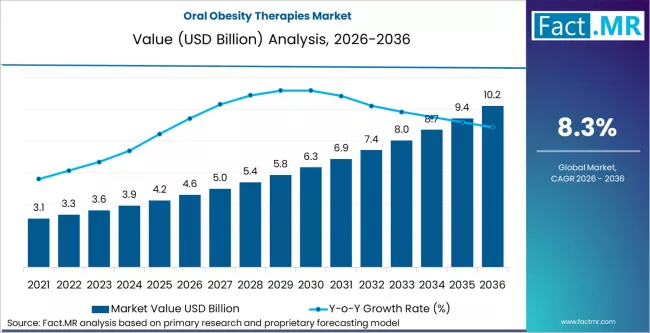
    Oral Obesity Therapies Market Market Value Analysis

    Growth is shaped by adherence patterns and chronic treatment pathways rather than new product launches alone. Prescribers and payers prioritize therapies with predictable dosing, consistent supply, and evidence-backed outcomes. Pharmaceutical manufacturers design production around batch uniformity, stability, and regulatory dossier alignment.

    Distribution planning accounts for pharmacy networks, cold chain integrity when required, and periodic restocking aligned with prescription cycles. Procurement decisions focus on validated supply, delivery predictability, and documented quality compliance. Patient retention drives repeat purchases, while formulary inclusion and reimbursement tiers govern regional uptake. Operational scale arises through multi-country rollouts and synchronized manufacturing campaigns. Volume expansion follows sustained patient adherence and wider institutional coverage, not short-term promotional activity or episodic launches. Cost structures emphasize lifecycle efficiency and supply continuity over unit price competition.

    Oral Obesity Therapies Market

    Metric Value
    Market Value (2026) USD 4.6 billion
    Forecast Value (2036) USD 10.2 billion
    Forecast CAGR (2026-2036) 8.3%

    Category

    Category Segments
    Drug Class Lipase inhibitors (orlistat); Sympathomimetic appetite suppressants; Combination therapies (fixed-dose); Oral GLP-1 / incretin agonists; Other oral mechanisms
    Patient Segment or Indication BMI ≥30 (primary obesity); Overweight with metabolic comorbidities; Short-term weight reduction; Weight maintenance / relapse prevention; Adolescent / special populations
    Sales Channel (Level-1) Retail pharmacies; Mail-order pharmacies; Telehealth prescribing platforms; Hospital outpatient pharmacies; Specialty pharmacies
    Region North America; Europe; Asia Pacific; Latin America; Middle East & Africa

    Segmental Analysis

    By Drug Class, Why Do Lipase Inhibitors (Orlistat) Lead the Oral Obesity Therapies Market?
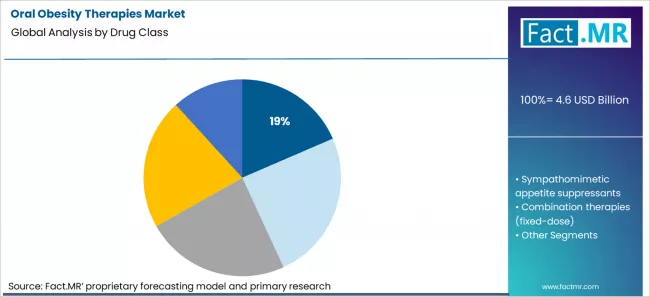
    Oral Obesity Therapies Market Analysis By Drug Class

    Fact.MR data shows that lipase inhibitors hold 18.50% share because they provide a predictable, mechanism-driven effect that fits into established patient routines without requiring behavioral adaptation beyond standard diet. The unmet need is functional: controlling fat absorption to produce measurable weight outcomes without intensive monitoring. Patients perceive the value as tangible and outcome oriented rather than cosmetic or discretionary. Healthcare providers integrate these therapies into long-term care plans because dosing is standardized and compliance can be tracked reliably. Their dominance reflects how interventions succeed when they deliver consistent physiological effects that align with daily patient habits.

    By Patient Segment or Indication, Why Does BMI ≥30 (Primary Obesity) Represent the Largest Target Population in the Oral Obesity Therapies Market?
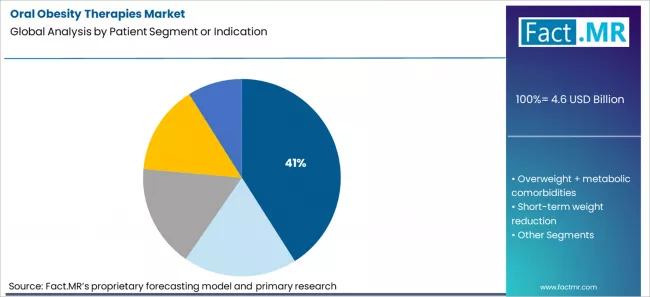
    Oral Obesity Therapies Market Analysis By Patient Segment Or Indication

    Analysis from Fact.MR indicates that individuals with BMI ≥30 account for 41.00% share because this group has the most immediate and measurable need for pharmacological intervention. The unmet need is not elective weight optimization but functional reduction of health risk associated with obesity. Patients experience treatment as part of ongoing health management rather than optional lifestyle modification. The value is strongly functional, addressing cardiovascular, metabolic, and musculoskeletal risks. For healthcare systems, this segment generates predictable treatment demand and standardizes prescribing protocols. Its scale reflects how patient populations with defined thresholds for intervention dominate therapy adoption.

    Country

    Country Driver Restraint Trend
    USA High cardiometabolic disease burden fuels therapy demand Payer reimbursement variability limits access Broader adoption of combination oral therapies
    UK NHS focus on obesity prevention and treatment Resource limits in primary care settings Integration of oral therapies into lifestyle programs
    Germany Strong pharmaceutical R&D base Strict reimbursement assessments Growth in guidelinealigned obesity care pathways
    China Rising obesity prevalence increases clinical demand Urban-rural healthcare access gap Expansion of domestic oral therapy approvals
    India Growing metabolic syndrome cases Affordability and limited obesity care infrastructure Increased use of generic oral agents

    Analysis of the Oral Obesity Therapies Market by Key Country
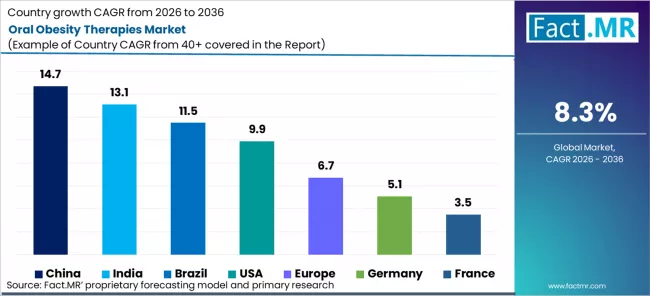
    Oral Obesity Therapies Market Cagr Analysis By Country

    Country CAGR (2026-2036)
    USA 9.9%
    Brazil 11.5%
    China 14.7%
    India 13.1%
    Europe 6.7%
    Germany 5.1%
    France 3.5%
    UK 8.3%

    The report covers an in-depth analysis of 40+ countries; top-performing countries are highlighted below.

    How Is the Oral Obesity Therapies Market Developing in the United States?

    The oral obesity therapies market in the United States grows at 9.9% per year through 2036. Large healthcare systems, specialty clinics, and pharmaceutical providers manage high patient volumes requiring structured treatment plans. Therapy adoption follows clinical guidelines for chronic weight management and comorbidity control. Insurer coverage and employer health programs influence treatment duration and adherence. Pharmaceutical companies standardize distribution and dosing protocols across multiple regions. Growth is driven by increased per patient therapy intensity, higher prescription adherence, and multi-center rollout rather than the creation of new clinical facilities, reflecting steady demand inside existing care infrastructure.

    What Factors Are Driving the Oral Obesity Therapies Market in Brazil?

    The oral obesity therapies market in Brazil advances at 11.5% annually through 2036. Private clinics, hospital networks, and diagnostic chains manage large populations with increasing obesity prevalence. Standardized therapy regimens improve adherence and reduce complications associated with comorbid conditions. Urban centers concentrate patient volume, facilitating distribution and supply chain efficiency. Contract pharmacy programs and employer-sponsored healthcare add further reach. Growth occurs from increased therapy duration and protocol standardization rather than the addition of new treatment centers. Expansion focuses on optimizing existing patient management pathways and improving access inside established urban and regional healthcare networks.

    Why Is the Oral Obesity Therapies Market Expanding Rapidly in China?

    The oral obesity therapies market in China grows at 14.7% per year through 2036. Hospitals, pharmaceutical clinics, and private specialty centers integrate therapy programs into chronic disease management pathways. Patient volumes in urban hospitals allow wide adoption once therapy protocols are standardized. Provincial hospital networks replicate treatment guidelines, creating system-wide consistency. Therapy adherence improves as follow up and monitoring protocols are implemented across multiple centers. Growth comes from infrastructure replication and higher therapy intensity per patient rather than a sudden increase in patient numbers. Expansion is supported by integration into established hospital programs and clinical pathways.

    How Is the Oral Obesity Therapies Market Developing in India?

    The oral obesity therapies market in India advances at 13.1% per year through 2036. Private hospitals, specialty clinics, and contract research networks manage patients with multiple comorbidities, including diabetes and cardiovascular risk. Urban populations drive concentrated adoption of therapy programs. Standardized dosing protocols and monitoring routines increase prescription adherence and treatment duration. Employer health initiatives and urban wellness programs supplement clinical adoption. Growth is based on higher per patient therapy intensity and repeated follow up rather than creation of new facilities. Expansion reflects structured deployment of treatment plans across existing healthcare infrastructure.

    What Is the Growth Outlook for the Oral Obesity Therapies Market in Europe?

    The oral obesity therapies market in Europe grows at 6.7% per year through 2036. Treatment protocols follow established healthcare guidelines and reimbursement schedules. Large hospital systems and specialty clinics already manage most eligible patients. Therapy adoption is concentrated in urban and regional referral centers with sufficient monitoring capacity. Volume growth comes from increased therapy adherence, longer treatment duration, and standardized regimen use rather than new center creation. Incremental expansion occurs through protocol optimization, patient follow up programs, and coordinated deployment of approved therapies across existing healthcare networks.

    Why Is the Oral Obesity Therapies Market Growing Slowly in Germany?

    The oral obesity therapies market in Germany advances at 5.1% per year through 2036. Hospitals, specialized outpatient clinics, and academic medical centers already maintain structured treatment pathways. Therapy adoption follows national clinical guidelines with strict monitoring and reimbursement requirements. Growth comes from optimizing treatment duration, improving adherence, and standardizing therapy regimens rather than from facility expansion. High patient coverage in existing centers limits rapid volume increases. Incremental adoption of new drugs or combination therapies increases utilization inside mature care networks, making expansion steady and predictable.

    What Factors Are Limiting Growth of the Oral Obesity Therapies Market in France?

    The oral obesity therapies market in France grows at 3.5% per year through 2036. Public hospitals, specialist clinics, and academic centers dominate therapy adoption. Long procurement cycles and budget constraints slow the introduction of new treatment options. Therapy adherence and replacement protocols drive incremental growth. Private sector contributions remain limited, and most patients receive treatment in established hospital-linked programs. Expansion is gradual, tied to incremental improvements in treatment protocols and existing infrastructure rather than the creation of new clinical facilities. Growth remains measured and consistent across major metropolitan and regional centers.

    How Is the Oral Obesity Therapies Market Developing in the United Kingdom?

    The oral obesity therapies market in the United Kingdom grows at 8.3% per year through 2036. National health services, private clinics, and specialty centers manage therapy programs for patients with obesity and comorbid conditions. Multi-site adoption of standardized treatment regimens increases prescription adherence and follow up duration. Urban and regional referral centers handle most high-volume cases. Growth comes from higher utilization within existing facilities, protocol standardization, and adherence optimization rather than expansion of healthcare infrastructure. Incremental uptake also reflects systematic integration into public health programs and employer-sponsored wellness initiatives.

    How are pharmaceutical players structuring competitive advantage in the oral obesity therapies market, and where do scale and care pathway integration provide lasting leverage?
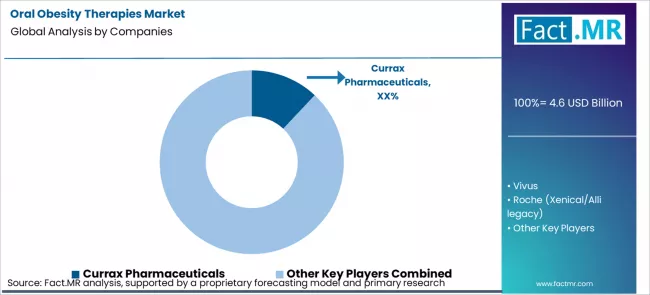
    Oral Obesity Therapies Market Analysis By Company

    Competition in oral obesity therapies is shaped by access to prescribing networks, reimbursement frameworks, and long-term patient management rather than isolated product attributes. Currax Pharmaceuticals and Vivus maintain positions by focusing on targeted obesity treatment programs, integrating patient follow-up and adherence support to reinforce ongoing prescriptions. Roche, through legacy Xenical and Alli brands, leverages historical adoption and clinician familiarity, which reduces barriers for continued use in established weight management protocols. Teva and Sun Pharmaceuticals participate through generic availability and distribution breadth, influencing affordability and geographic coverage. Switching between therapies is constrained by payer approvals, formulary placement, and patient monitoring requirements. Scale enables companies to maintain consistent supply, negotiate reimbursement, and provide multi-location support. Process discipline in patient education, prescription tracking, and adherence monitoring now functions as a stronger competitive barrier than minor differences in molecular formulation or delivery mechanism.

    Key Players in Oral Obesity Therapies Market

    • Currax Pharmaceuticals
    • Vivus
    • Roche (Xenical/Alli legacy)
    • Teva Pharmaceutical Industries
    • Sun Pharmaceutical Industries
    • Others

    Scope of the Report

    Items Values
    Quantitative Units (2026) USD billion
    Drug Class Lipase inhibitors (orlistat), sympathomimetic appetite suppressants, combination therapies (fixed-dose), oral GLP-1 / incretin agonists, other oral mechanisms
    Patient Segment or Indication BMI ≥30 (primary obesity), overweight with metabolic comorbidities, short-term weight reduction, weight maintenance / relapse prevention, adolescent / special populations
    Sales Channel (Level-1) Retail pharmacies, mail-order pharmacies, telehealth prescribing platforms, hospital outpatient pharmacies, specialty pharmacies
    Regions Covered Asia Pacific, Europe, North America, Latin America, Middle East & Africa
    Countries Covered United States, Canada, Mexico, Germany, United Kingdom, France, Italy, Spain, China, Japan, South Korea, India, Australia & New Zealand, ASEAN, Brazil, Chile, Saudi Arabia, Turkey, South Africa, and other regional markets
    Key Companies Profiled Currax Pharmaceuticals, Vivus, Roche (Xenical/Alli legacy), Teva Pharmaceutical Industries, Sun Pharmaceutical Industries
    Additional Attributes Dollar by sales by drug class, patient segment, and channel; focus on adherence, chronic treatment pathways, supply consistency, formulary inclusion, and payer acceptance; growth driven by structured care programs, repeat prescription cycles, and multi-country deployment rather than promotional campaigns

    Oral Obesity Therapies Market Segmentation

    • Drug Class :

      • Lipase inhibitors (orlistat)
      • Sympathomimetic appetite suppressants
      • Combination therapies (fixed-dose)
      • Oral GLP-1 / incretin agonists
      • Other oral mechanisms
    • Patient Segment or Indication :

      • BMI ≥30 (primary obesity)
      • Overweight + metabolic comorbidities
      • Short-term weight reduction
      • Weight maintenance / relapse prevention
      • Adolescent / special populations
    • Sales Channel (Level-1) :

      • Retail pharmacies
      • Mail-order pharmacies
      • Telehealth prescribing platforms
      • Hospital outpatient pharmacies
      • Specialty pharmacies
    • Region :

      • Asia Pacific
        • China
        • Japan
        • South Korea
        • India
        • Australia & New Zealand
        • ASEAN
        • Rest of Asia Pacific
      • Europe
        • Germany
        • United Kingdom
        • France
        • Italy
        • Spain
        • Nordic
        • BENELUX
        • Rest of Europe
      • North America
        • United States
        • Canada
        • Mexico
      • Latin America
        • Brazil
        • Chile
        • Rest of Latin America
      • Middle East & Africa
        • Kingdom of Saudi Arabia
        • Other GCC Countries
        • Turkey
        • South Africa
        • Other African Union
        • Rest of Middle East & Africa

    References

    • Centers for Disease Control and Prevention. (2024). Adult obesity facts. U.S. Department of Health and Human Services.
    • U.S. Department of Health and Human Services, National Institutes of Health, National Heart, Lung, and Blood Institute. (2023). Clinical guidelines on the identification, evaluation, and treatment of overweight and obesity in adults.
    • World Health Organization. (2023). Obesity and overweight. World Health Organization.
    • Office for Health Improvement and Disparities. (2023). Adult obesity: Applying All Our Health. Department of Health and Social Care.
    • Health Canada. (2023). Obesity in Canada. Government of Canada.

    Table of Content

    1. Executive Summary
      • Global Market Outlook
      • Demand to side Trends
      • Supply to side Trends
      • Technology Roadmap Analysis
      • Analysis and Recommendations
    2. Market Overview
      • Market Coverage / Taxonomy
      • Market Definition / Scope / Limitations
    3. Research Methodology
      • Chapter Orientation
      • Analytical Lens and Working Hypotheses
        • Market Structure, Signals, and Trend Drivers
        • Benchmarking and Cross-market Comparability
        • Market Sizing, Forecasting, and Opportunity Mapping
      • Research Design and Evidence Framework
        • Desk Research Programme (Secondary Evidence)
          • Company Annual and Sustainability Reports
          • Peer-reviewed Journals and Academic Literature
          • Corporate Websites, Product Literature, and Technical Notes
          • Earnings Decks and Investor Briefings
          • Statutory Filings and Regulatory Disclosures
          • Technical White Papers and Standards Notes
          • Trade Journals, Industry Magazines, and Analyst Briefs
          • Conference Proceedings, Webinars, and Seminar Materials
          • Government Statistics Portals and Public Data Releases
          • Press Releases and Reputable Media Coverage
          • Specialist Newsletters and Curated Briefings
          • Sector Databases and Reference Repositories
          • FMR Internal Proprietary Databases and Historical Market Datasets
          • Subscription Datasets and Paid Sources
          • Social Channels, Communities, and Digital Listening Inputs
          • Additional Desk Sources
        • Expert Input and Fieldwork (Primary Evidence)
          • Primary Modes
            • Qualitative Interviews and Expert Elicitation
            • Quantitative Surveys and Structured Data Capture
            • Blended Approach
          • Why Primary Evidence is Used
          • Field Techniques
            • Interviews
            • Surveys
            • Focus Groups
            • Observational and In-context Research
            • Social and Community Interactions
          • Stakeholder Universe Engaged
            • C-suite Leaders
            • Board Members
            • Presidents and Vice Presidents
            • R&D and Innovation Heads
            • Technical Specialists
            • Domain Subject-matter Experts
            • Scientists
            • Physicians and Other Healthcare Professionals
          • Governance, Ethics, and Data Stewardship
            • Research Ethics
            • Data Integrity and Handling
        • Tooling, Models, and Reference Databases
      • Data Engineering and Model Build
        • Data Acquisition and Ingestion
        • Cleaning, Normalisation, and Verification
        • Synthesis, Triangulation, and Analysis
      • Quality Assurance and Audit Trail
    4. Market Background
      • Market Dynamics
        • Drivers
        • Restraints
        • Opportunity
        • Trends
      • Scenario Forecast
        • Demand in Optimistic Scenario
        • Demand in Likely Scenario
        • Demand in Conservative Scenario
      • Opportunity Map Analysis
      • Product Life Cycle Analysis
      • Supply Chain Analysis
      • Investment Feasibility Matrix
      • Value Chain Analysis
      • PESTLE and Porter’s Analysis
      • Regulatory Landscape
      • Regional Parent Market Outlook
      • Production and Consumption Statistics
      • Import and Export Statistics
    5. Global Market Analysis 2021 to 2025 and Forecast, 2026 to 2036
      • Historical Market Size Value (USD Million) Analysis, 2021 to 2025
      • Current and Future Market Size Value (USD Million) Projections, 2026 to 2036
        • Y to o to Y Growth Trend Analysis
        • Absolute $ Opportunity Analysis
    6. Global Market Pricing Analysis 2021 to 2025 and Forecast 2026 to 2036
    7. Global Market Analysis 2021 to 2025 and Forecast 2026 to 2036, By Drug Class
      • Introduction / Key Findings
      • Historical Market Size Value (USD Million) Analysis By Drug Class, 2021 to 2025
      • Current and Future Market Size Value (USD Million) Analysis and Forecast By Drug Class, 2026 to 2036
        • Lipase inhibitors (orlistat)
        • Sympathomimetic appetite suppressants
        • Combination therapies (fixed-dose)
        • Oral GLP-1 / incretin agonists
        • Other oral mechanisms
      • Y to o to Y Growth Trend Analysis By Drug Class, 2021 to 2025
      • Absolute $ Opportunity Analysis By Drug Class, 2026 to 2036
    8. Global Market Analysis 2021 to 2025 and Forecast 2026 to 2036, By Patient Segment or Indication
      • Introduction / Key Findings
      • Historical Market Size Value (USD Million) Analysis By Patient Segment or Indication, 2021 to 2025
      • Current and Future Market Size Value (USD Million) Analysis and Forecast By Patient Segment or Indication, 2026 to 2036
        • BMI ≥30 (primary obesity)
        • Overweight + metabolic comorbidities
        • Short-term weight reduction
        • Weight maintenance / relapse prevention
        • Adolescent / special populations
      • Y to o to Y Growth Trend Analysis By Patient Segment or Indication, 2021 to 2025
      • Absolute $ Opportunity Analysis By Patient Segment or Indication, 2026 to 2036
    9. Global Market Analysis 2021 to 2025 and Forecast 2026 to 2036, By Sales Channel (Level-1)
      • Introduction / Key Findings
      • Historical Market Size Value (USD Million) Analysis By Sales Channel (Level-1), 2021 to 2025
      • Current and Future Market Size Value (USD Million) Analysis and Forecast By Sales Channel (Level-1), 2026 to 2036
        • Retail pharmacies
        • Mail-order pharmacies
        • Telehealth prescribing platforms
        • Hospital outpatient pharmacies
        • Specialty pharmacies
      • Y to o to Y Growth Trend Analysis By Sales Channel (Level-1), 2021 to 2025
      • Absolute $ Opportunity Analysis By Sales Channel (Level-1), 2026 to 2036
    10. Global Market Analysis 2021 to 2025 and Forecast 2026 to 2036, By Region
      • Introduction
      • Historical Market Size Value (USD Million) Analysis By Region, 2021 to 2025
      • Current Market Size Value (USD Million) Analysis and Forecast By Region, 2026 to 2036
        • North America
        • Latin America
        • Western Europe
        • Eastern Europe
        • East Asia
        • South Asia and Pacific
        • Middle East & Africa
      • Market Attractiveness Analysis By Region
    11. North America Market Analysis 2021 to 2025 and Forecast 2026 to 2036, By Country
      • Historical Market Size Value (USD Million) Trend Analysis By Market Taxonomy, 2021 to 2025
      • Market Size Value (USD Million) Forecast By Market Taxonomy, 2026 to 2036
        • By Country
          • USA
          • Canada
          • Mexico
        • By Drug Class
        • By Patient Segment or Indication
        • By Sales Channel (Level-1)
      • Market Attractiveness Analysis
        • By Country
        • By Drug Class
        • By Patient Segment or Indication
        • By Sales Channel (Level-1)
      • Key Takeaways
    12. Latin America Market Analysis 2021 to 2025 and Forecast 2026 to 2036, By Country
      • Historical Market Size Value (USD Million) Trend Analysis By Market Taxonomy, 2021 to 2025
      • Market Size Value (USD Million) Forecast By Market Taxonomy, 2026 to 2036
        • By Country
          • Brazil
          • Chile
          • Rest of Latin America
        • By Drug Class
        • By Patient Segment or Indication
        • By Sales Channel (Level-1)
      • Market Attractiveness Analysis
        • By Country
        • By Drug Class
        • By Patient Segment or Indication
        • By Sales Channel (Level-1)
      • Key Takeaways
    13. Western Europe Market Analysis 2021 to 2025 and Forecast 2026 to 2036, By Country
      • Historical Market Size Value (USD Million) Trend Analysis By Market Taxonomy, 2021 to 2025
      • Market Size Value (USD Million) Forecast By Market Taxonomy, 2026 to 2036
        • By Country
          • Germany
          • UK
          • Italy
          • Spain
          • France
          • Nordic
          • BENELUX
          • Rest of Western Europe
        • By Drug Class
        • By Patient Segment or Indication
        • By Sales Channel (Level-1)
      • Market Attractiveness Analysis
        • By Country
        • By Drug Class
        • By Patient Segment or Indication
        • By Sales Channel (Level-1)
      • Key Takeaways
    14. Eastern Europe Market Analysis 2021 to 2025 and Forecast 2026 to 2036, By Country
      • Historical Market Size Value (USD Million) Trend Analysis By Market Taxonomy, 2021 to 2025
      • Market Size Value (USD Million) Forecast By Market Taxonomy, 2026 to 2036
        • By Country
          • Russia
          • Poland
          • Hungary
          • Balkan & Baltic
          • Rest of Eastern Europe
        • By Drug Class
        • By Patient Segment or Indication
        • By Sales Channel (Level-1)
      • Market Attractiveness Analysis
        • By Country
        • By Drug Class
        • By Patient Segment or Indication
        • By Sales Channel (Level-1)
      • Key Takeaways
    15. East Asia Market Analysis 2021 to 2025 and Forecast 2026 to 2036, By Country
      • Historical Market Size Value (USD Million) Trend Analysis By Market Taxonomy, 2021 to 2025
      • Market Size Value (USD Million) Forecast By Market Taxonomy, 2026 to 2036
        • By Country
          • China
          • Japan
          • South Korea
        • By Drug Class
        • By Patient Segment or Indication
        • By Sales Channel (Level-1)
      • Market Attractiveness Analysis
        • By Country
        • By Drug Class
        • By Patient Segment or Indication
        • By Sales Channel (Level-1)
      • Key Takeaways
    16. South Asia and Pacific Market Analysis 2021 to 2025 and Forecast 2026 to 2036, By Country
      • Historical Market Size Value (USD Million) Trend Analysis By Market Taxonomy, 2021 to 2025
      • Market Size Value (USD Million) Forecast By Market Taxonomy, 2026 to 2036
        • By Country
          • India
          • ASEAN
          • Australia & New Zealand
          • Rest of South Asia and Pacific
        • By Drug Class
        • By Patient Segment or Indication
        • By Sales Channel (Level-1)
      • Market Attractiveness Analysis
        • By Country
        • By Drug Class
        • By Patient Segment or Indication
        • By Sales Channel (Level-1)
      • Key Takeaways
    17. Middle East & Africa Market Analysis 2021 to 2025 and Forecast 2026 to 2036, By Country
      • Historical Market Size Value (USD Million) Trend Analysis By Market Taxonomy, 2021 to 2025
      • Market Size Value (USD Million) Forecast By Market Taxonomy, 2026 to 2036
        • By Country
          • Kingdom of Saudi Arabia
          • Other GCC Countries
          • Turkiye
          • South Africa
          • Other African Union
          • Rest of Middle East & Africa
        • By Drug Class
        • By Patient Segment or Indication
        • By Sales Channel (Level-1)
      • Market Attractiveness Analysis
        • By Country
        • By Drug Class
        • By Patient Segment or Indication
        • By Sales Channel (Level-1)
      • Key Takeaways
    18. Key Countries Market Analysis
      • USA
        • Pricing Analysis
        • Market Share Analysis, 2025
          • By Drug Class
          • By Patient Segment or Indication
          • By Sales Channel (Level-1)
      • Canada
        • Pricing Analysis
        • Market Share Analysis, 2025
          • By Drug Class
          • By Patient Segment or Indication
          • By Sales Channel (Level-1)
      • Mexico
        • Pricing Analysis
        • Market Share Analysis, 2025
          • By Drug Class
          • By Patient Segment or Indication
          • By Sales Channel (Level-1)
      • Brazil
        • Pricing Analysis
        • Market Share Analysis, 2025
          • By Drug Class
          • By Patient Segment or Indication
          • By Sales Channel (Level-1)
      • Chile
        • Pricing Analysis
        • Market Share Analysis, 2025
          • By Drug Class
          • By Patient Segment or Indication
          • By Sales Channel (Level-1)
      • Germany
        • Pricing Analysis
        • Market Share Analysis, 2025
          • By Drug Class
          • By Patient Segment or Indication
          • By Sales Channel (Level-1)
      • UK
        • Pricing Analysis
        • Market Share Analysis, 2025
          • By Drug Class
          • By Patient Segment or Indication
          • By Sales Channel (Level-1)
      • Italy
        • Pricing Analysis
        • Market Share Analysis, 2025
          • By Drug Class
          • By Patient Segment or Indication
          • By Sales Channel (Level-1)
      • Spain
        • Pricing Analysis
        • Market Share Analysis, 2025
          • By Drug Class
          • By Patient Segment or Indication
          • By Sales Channel (Level-1)
      • France
        • Pricing Analysis
        • Market Share Analysis, 2025
          • By Drug Class
          • By Patient Segment or Indication
          • By Sales Channel (Level-1)
      • India
        • Pricing Analysis
        • Market Share Analysis, 2025
          • By Drug Class
          • By Patient Segment or Indication
          • By Sales Channel (Level-1)
      • ASEAN
        • Pricing Analysis
        • Market Share Analysis, 2025
          • By Drug Class
          • By Patient Segment or Indication
          • By Sales Channel (Level-1)
      • Australia & New Zealand
        • Pricing Analysis
        • Market Share Analysis, 2025
          • By Drug Class
          • By Patient Segment or Indication
          • By Sales Channel (Level-1)
      • China
        • Pricing Analysis
        • Market Share Analysis, 2025
          • By Drug Class
          • By Patient Segment or Indication
          • By Sales Channel (Level-1)
      • Japan
        • Pricing Analysis
        • Market Share Analysis, 2025
          • By Drug Class
          • By Patient Segment or Indication
          • By Sales Channel (Level-1)
      • South Korea
        • Pricing Analysis
        • Market Share Analysis, 2025
          • By Drug Class
          • By Patient Segment or Indication
          • By Sales Channel (Level-1)
      • Russia
        • Pricing Analysis
        • Market Share Analysis, 2025
          • By Drug Class
          • By Patient Segment or Indication
          • By Sales Channel (Level-1)
      • Poland
        • Pricing Analysis
        • Market Share Analysis, 2025
          • By Drug Class
          • By Patient Segment or Indication
          • By Sales Channel (Level-1)
      • Hungary
        • Pricing Analysis
        • Market Share Analysis, 2025
          • By Drug Class
          • By Patient Segment or Indication
          • By Sales Channel (Level-1)
      • Kingdom of Saudi Arabia
        • Pricing Analysis
        • Market Share Analysis, 2025
          • By Drug Class
          • By Patient Segment or Indication
          • By Sales Channel (Level-1)
      • Turkiye
        • Pricing Analysis
        • Market Share Analysis, 2025
          • By Drug Class
          • By Patient Segment or Indication
          • By Sales Channel (Level-1)
      • South Africa
        • Pricing Analysis
        • Market Share Analysis, 2025
          • By Drug Class
          • By Patient Segment or Indication
          • By Sales Channel (Level-1)
    19. Market Structure Analysis
      • Competition Dashboard
      • Competition Benchmarking
      • Market Share Analysis of Top Players
        • By Regional
        • By Drug Class
        • By Patient Segment or Indication
        • By Sales Channel (Level-1)
    20. Competition Analysis
      • Competition Deep Dive
        • Currax Pharmaceuticals
          • Overview
          • Product Portfolio
          • Profitability by Market Segments (Product/Age /Sales Channel/Region)
          • Sales Footprint
          • Strategy Overview
            • Marketing Strategy
            • Product Strategy
            • Channel Strategy
        • Vivus
        • Roche (Xenical/Alli legacy)
        • Teva Pharmaceutical Industries
        • Sun Pharmaceutical Industries
        • Others
    21. Assumptions & Acronyms Used

    List Of Table

    • Table 1: Global Market Value (USD Million) Forecast by Region, 2021 to 2036
    • Table 2: Global Market Value (USD Million) Forecast by Drug Class, 2021 to 2036
    • Table 3: Global Market Value (USD Million) Forecast by Patient Segment or Indication, 2021 to 2036
    • Table 4: Global Market Value (USD Million) Forecast by Sales Channel (Level-1), 2021 to 2036
    • Table 5: North America Market Value (USD Million) Forecast by Country, 2021 to 2036
    • Table 6: North America Market Value (USD Million) Forecast by Drug Class, 2021 to 2036
    • Table 7: North America Market Value (USD Million) Forecast by Patient Segment or Indication, 2021 to 2036
    • Table 8: North America Market Value (USD Million) Forecast by Sales Channel (Level-1), 2021 to 2036
    • Table 9: Latin America Market Value (USD Million) Forecast by Country, 2021 to 2036
    • Table 10: Latin America Market Value (USD Million) Forecast by Drug Class, 2021 to 2036
    • Table 11: Latin America Market Value (USD Million) Forecast by Patient Segment or Indication, 2021 to 2036
    • Table 12: Latin America Market Value (USD Million) Forecast by Sales Channel (Level-1), 2021 to 2036
    • Table 13: Western Europe Market Value (USD Million) Forecast by Country, 2021 to 2036
    • Table 14: Western Europe Market Value (USD Million) Forecast by Drug Class, 2021 to 2036
    • Table 15: Western Europe Market Value (USD Million) Forecast by Patient Segment or Indication, 2021 to 2036
    • Table 16: Western Europe Market Value (USD Million) Forecast by Sales Channel (Level-1), 2021 to 2036
    • Table 17: Eastern Europe Market Value (USD Million) Forecast by Country, 2021 to 2036
    • Table 18: Eastern Europe Market Value (USD Million) Forecast by Drug Class, 2021 to 2036
    • Table 19: Eastern Europe Market Value (USD Million) Forecast by Patient Segment or Indication, 2021 to 2036
    • Table 20: Eastern Europe Market Value (USD Million) Forecast by Sales Channel (Level-1), 2021 to 2036
    • Table 21: East Asia Market Value (USD Million) Forecast by Country, 2021 to 2036
    • Table 22: East Asia Market Value (USD Million) Forecast by Drug Class, 2021 to 2036
    • Table 23: East Asia Market Value (USD Million) Forecast by Patient Segment or Indication, 2021 to 2036
    • Table 24: East Asia Market Value (USD Million) Forecast by Sales Channel (Level-1), 2021 to 2036
    • Table 25: South Asia and Pacific Market Value (USD Million) Forecast by Country, 2021 to 2036
    • Table 26: South Asia and Pacific Market Value (USD Million) Forecast by Drug Class, 2021 to 2036
    • Table 27: South Asia and Pacific Market Value (USD Million) Forecast by Patient Segment or Indication, 2021 to 2036
    • Table 28: South Asia and Pacific Market Value (USD Million) Forecast by Sales Channel (Level-1), 2021 to 2036
    • Table 29: Middle East & Africa Market Value (USD Million) Forecast by Country, 2021 to 2036
    • Table 30: Middle East & Africa Market Value (USD Million) Forecast by Drug Class, 2021 to 2036
    • Table 31: Middle East & Africa Market Value (USD Million) Forecast by Patient Segment or Indication, 2021 to 2036
    • Table 32: Middle East & Africa Market Value (USD Million) Forecast by Sales Channel (Level-1), 2021 to 2036

    List Of Figures

    • Figure 1: Global Market Pricing Analysis
    • Figure 2: Global Market Value (USD Million) Forecast 2021 to 2036
    • Figure 3: Global Market Value Share and BPS Analysis by Drug Class, 2026 and 2036
    • Figure 4: Global Market Y to o to Y Growth Comparison by Drug Class, 2026 to 2036
    • Figure 5: Global Market Attractiveness Analysis by Drug Class
    • Figure 6: Global Market Value Share and BPS Analysis by Patient Segment or Indication, 2026 and 2036
    • Figure 7: Global Market Y to o to Y Growth Comparison by Patient Segment or Indication, 2026 to 2036
    • Figure 8: Global Market Attractiveness Analysis by Patient Segment or Indication
    • Figure 9: Global Market Value Share and BPS Analysis by Sales Channel (Level-1), 2026 and 2036
    • Figure 10: Global Market Y to o to Y Growth Comparison by Sales Channel (Level-1), 2026 to 2036
    • Figure 11: Global Market Attractiveness Analysis by Sales Channel (Level-1)
    • Figure 12: Global Market Value (USD Million) Share and BPS Analysis by Region, 2026 and 2036
    • Figure 13: Global Market Y to o to Y Growth Comparison by Region, 2026 to 2036
    • Figure 14: Global Market Attractiveness Analysis by Region
    • Figure 15: North America Market Incremental Dollar Opportunity, 2026 to 2036
    • Figure 16: Latin America Market Incremental Dollar Opportunity, 2026 to 2036
    • Figure 17: Western Europe Market Incremental Dollar Opportunity, 2026 to 2036
    • Figure 18: Eastern Europe Market Incremental Dollar Opportunity, 2026 to 2036
    • Figure 19: East Asia Market Incremental Dollar Opportunity, 2026 to 2036
    • Figure 20: South Asia and Pacific Market Incremental Dollar Opportunity, 2026 to 2036
    • Figure 21: Middle East & Africa Market Incremental Dollar Opportunity, 2026 to 2036
    • Figure 22: North America Market Value Share and BPS Analysis by Country, 2026 and 2036
    • Figure 23: North America Market Value Share and BPS Analysis by Drug Class, 2026 and 2036
    • Figure 24: North America Market Y to o to Y Growth Comparison by Drug Class, 2026 to 2036
    • Figure 25: North America Market Attractiveness Analysis by Drug Class
    • Figure 26: North America Market Value Share and BPS Analysis by Patient Segment or Indication, 2026 and 2036
    • Figure 27: North America Market Y to o to Y Growth Comparison by Patient Segment or Indication, 2026 to 2036
    • Figure 28: North America Market Attractiveness Analysis by Patient Segment or Indication
    • Figure 29: North America Market Value Share and BPS Analysis by Sales Channel (Level-1), 2026 and 2036
    • Figure 30: North America Market Y to o to Y Growth Comparison by Sales Channel (Level-1), 2026 to 2036
    • Figure 31: North America Market Attractiveness Analysis by Sales Channel (Level-1)
    • Figure 32: Latin America Market Value Share and BPS Analysis by Country, 2026 and 2036
    • Figure 33: Latin America Market Value Share and BPS Analysis by Drug Class, 2026 and 2036
    • Figure 34: Latin America Market Y to o to Y Growth Comparison by Drug Class, 2026 to 2036
    • Figure 35: Latin America Market Attractiveness Analysis by Drug Class
    • Figure 36: Latin America Market Value Share and BPS Analysis by Patient Segment or Indication, 2026 and 2036
    • Figure 37: Latin America Market Y to o to Y Growth Comparison by Patient Segment or Indication, 2026 to 2036
    • Figure 38: Latin America Market Attractiveness Analysis by Patient Segment or Indication
    • Figure 39: Latin America Market Value Share and BPS Analysis by Sales Channel (Level-1), 2026 and 2036
    • Figure 40: Latin America Market Y to o to Y Growth Comparison by Sales Channel (Level-1), 2026 to 2036
    • Figure 41: Latin America Market Attractiveness Analysis by Sales Channel (Level-1)
    • Figure 42: Western Europe Market Value Share and BPS Analysis by Country, 2026 and 2036
    • Figure 43: Western Europe Market Value Share and BPS Analysis by Drug Class, 2026 and 2036
    • Figure 44: Western Europe Market Y to o to Y Growth Comparison by Drug Class, 2026 to 2036
    • Figure 45: Western Europe Market Attractiveness Analysis by Drug Class
    • Figure 46: Western Europe Market Value Share and BPS Analysis by Patient Segment or Indication, 2026 and 2036
    • Figure 47: Western Europe Market Y to o to Y Growth Comparison by Patient Segment or Indication, 2026 to 2036
    • Figure 48: Western Europe Market Attractiveness Analysis by Patient Segment or Indication
    • Figure 49: Western Europe Market Value Share and BPS Analysis by Sales Channel (Level-1), 2026 and 2036
    • Figure 50: Western Europe Market Y to o to Y Growth Comparison by Sales Channel (Level-1), 2026 to 2036
    • Figure 51: Western Europe Market Attractiveness Analysis by Sales Channel (Level-1)
    • Figure 52: Eastern Europe Market Value Share and BPS Analysis by Country, 2026 and 2036
    • Figure 53: Eastern Europe Market Value Share and BPS Analysis by Drug Class, 2026 and 2036
    • Figure 54: Eastern Europe Market Y to o to Y Growth Comparison by Drug Class, 2026 to 2036
    • Figure 55: Eastern Europe Market Attractiveness Analysis by Drug Class
    • Figure 56: Eastern Europe Market Value Share and BPS Analysis by Patient Segment or Indication, 2026 and 2036
    • Figure 57: Eastern Europe Market Y to o to Y Growth Comparison by Patient Segment or Indication, 2026 to 2036
    • Figure 58: Eastern Europe Market Attractiveness Analysis by Patient Segment or Indication
    • Figure 59: Eastern Europe Market Value Share and BPS Analysis by Sales Channel (Level-1), 2026 and 2036
    • Figure 60: Eastern Europe Market Y to o to Y Growth Comparison by Sales Channel (Level-1), 2026 to 2036
    • Figure 61: Eastern Europe Market Attractiveness Analysis by Sales Channel (Level-1)
    • Figure 62: East Asia Market Value Share and BPS Analysis by Country, 2026 and 2036
    • Figure 63: East Asia Market Value Share and BPS Analysis by Drug Class, 2026 and 2036
    • Figure 64: East Asia Market Y to o to Y Growth Comparison by Drug Class, 2026 to 2036
    • Figure 65: East Asia Market Attractiveness Analysis by Drug Class
    • Figure 66: East Asia Market Value Share and BPS Analysis by Patient Segment or Indication, 2026 and 2036
    • Figure 67: East Asia Market Y to o to Y Growth Comparison by Patient Segment or Indication, 2026 to 2036
    • Figure 68: East Asia Market Attractiveness Analysis by Patient Segment or Indication
    • Figure 69: East Asia Market Value Share and BPS Analysis by Sales Channel (Level-1), 2026 and 2036
    • Figure 70: East Asia Market Y to o to Y Growth Comparison by Sales Channel (Level-1), 2026 to 2036
    • Figure 71: East Asia Market Attractiveness Analysis by Sales Channel (Level-1)
    • Figure 72: South Asia and Pacific Market Value Share and BPS Analysis by Country, 2026 and 2036
    • Figure 73: South Asia and Pacific Market Value Share and BPS Analysis by Drug Class, 2026 and 2036
    • Figure 74: South Asia and Pacific Market Y to o to Y Growth Comparison by Drug Class, 2026 to 2036
    • Figure 75: South Asia and Pacific Market Attractiveness Analysis by Drug Class
    • Figure 76: South Asia and Pacific Market Value Share and BPS Analysis by Patient Segment or Indication, 2026 and 2036
    • Figure 77: South Asia and Pacific Market Y to o to Y Growth Comparison by Patient Segment or Indication, 2026 to 2036
    • Figure 78: South Asia and Pacific Market Attractiveness Analysis by Patient Segment or Indication
    • Figure 79: South Asia and Pacific Market Value Share and BPS Analysis by Sales Channel (Level-1), 2026 and 2036
    • Figure 80: South Asia and Pacific Market Y to o to Y Growth Comparison by Sales Channel (Level-1), 2026 to 2036
    • Figure 81: South Asia and Pacific Market Attractiveness Analysis by Sales Channel (Level-1)
    • Figure 82: Middle East & Africa Market Value Share and BPS Analysis by Country, 2026 and 2036
    • Figure 83: Middle East & Africa Market Value Share and BPS Analysis by Drug Class, 2026 and 2036
    • Figure 84: Middle East & Africa Market Y to o to Y Growth Comparison by Drug Class, 2026 to 2036
    • Figure 85: Middle East & Africa Market Attractiveness Analysis by Drug Class
    • Figure 86: Middle East & Africa Market Value Share and BPS Analysis by Patient Segment or Indication, 2026 and 2036
    • Figure 87: Middle East & Africa Market Y to o to Y Growth Comparison by Patient Segment or Indication, 2026 to 2036
    • Figure 88: Middle East & Africa Market Attractiveness Analysis by Patient Segment or Indication
    • Figure 89: Middle East & Africa Market Value Share and BPS Analysis by Sales Channel (Level-1), 2026 and 2036
    • Figure 90: Middle East & Africa Market Y to o to Y Growth Comparison by Sales Channel (Level-1), 2026 to 2036
    • Figure 91: Middle East & Africa Market Attractiveness Analysis by Sales Channel (Level-1)
    • Figure 92: Global Market - Tier Structure Analysis
    • Figure 93: Global Market - Company Share Analysis

    - FAQs -

    How big is the oral obesity therapies market in 2026?

    The global oral obesity therapies market is estimated to be valued at USD 4.6 billion in 2026.

    What will be the size of oral obesity therapies market in 2036?

    The market size for the oral obesity therapies market is projected to reach USD 10.2 billion by 2036.

    How much will be the oral obesity therapies market growth between 2026 and 2036?

    The oral obesity therapies market is expected to grow at a 8.3% CAGR between 2026 and 2036.

    What are the key product types in the oral obesity therapies market?

    The key product types in oral obesity therapies market are lipase inhibitors (orlistat), sympathomimetic appetite suppressants, combination therapies (fixed-dose), oral glp-1 / incretin agonists and other oral mechanisms.

    Which patient segment or indication segment to contribute significant share in the oral obesity therapies market in 2026?

    In terms of patient segment or indication, bmi ≥30 (primary obesity) segment to command 41.0% share in the oral obesity therapies market in 2026.

    Oral Obesity Therapies Market