GLP-1 Obesity Home Delivery Injectables Market

GLP-1 Obesity Home Delivery Injectables Market Size and Share Forecast Outlook 2026 to 2036

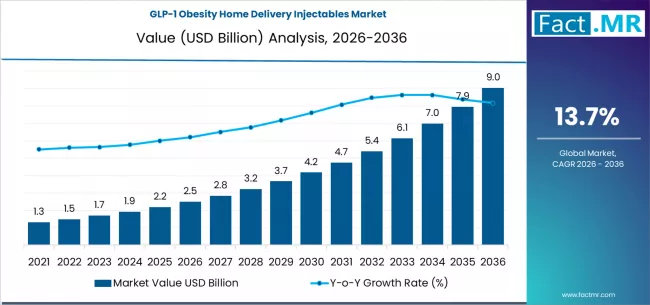
Glp-1 obesity home delivery injectables market is projected to grow from USD 2.5 billion in 2026 to USD 9.0 billion by 2036, at a CAGR of 13.7%. Semaglutide will dominate with a 46.3% market share, while home delivery will lead the distribution channel segment with a 67.2% share.

GLP-1 Obesity Home Delivery Injectables Market Forecast and Outlook 2026 to 2036

The global market for GLP-1 obesity home delivery injectables is projected to total USD 2.49 billion in 2026, advancing to USD 9.04 billion by 2036. A compound annual growth rate of 13.7% is forecast for the period from 2026 to 2036. This expansion is fundamentally driven by the paradigm shift in obesity treatment from lifestyle intervention alone to effective pharmacological management, coupled with the consumer demand for discreet, convenient care delivery.

Key Takeaways from the GLP-1 Obesity Home Delivery Injectables Market

  • Market Value for 2026: USD 2.49 Billion
  • Market Value for 2036: USD 9.04 Billion
  • Forecast CAGR 2026 to 2036: 13.7%
  • Leading Molecule Segment (2026): Semaglutide (46%)
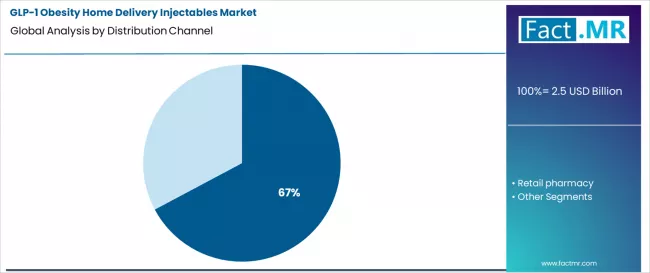
  • Leading Distribution Channel Segment (2026): Home Delivery (67%)
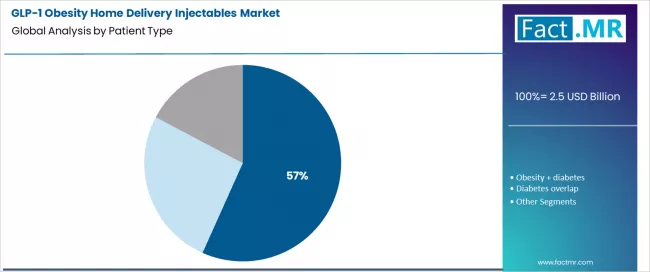
  • Leading Patient Type Segment (2026): Chronic Obesity (57%)
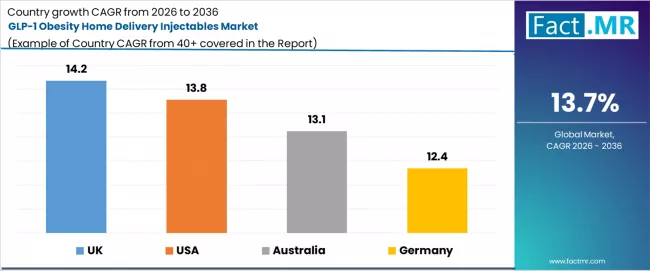
  • Key Growth Countries: UK (14.2% CAGR), USA (13.8% CAGR), Australia (13.1% CAGR), Germany (12.4% CAGR)
  • Key Players in the Market: Novo Nordisk A/S, Eli Lilly and Company, AstraZeneca plc., Pfizer Inc., Amgen Inc., F. Hoffmann-La Roche AG

Glp 1 Obesity Home Delivery Injectables Market Market Value Analysis

The high efficacy of next-generation GLP-1 receptor agonists in achieving significant and sustained weight reduction has created unprecedented patient demand. Traditional pharmacy dispensation models are often inadequate for managing monthly injectable therapies for a chronic condition. Integrated home delivery services have become indispensable, offering automated refills, temperature-controlled logistics, and patient support, thereby improving medication adherence and persistence in long-term weight management.

The market's growth is a direct product of broadening insurance coverage, direct-to-consumer commercialization, and the digitalization of healthcare. This landscape, encompassing telehealth prescriptions, specialty pharmacy networks, and chronic care management, makes the home delivery channel a critical enabler for scaling access to these transformative obesity therapies.

Metric

Metric Value
Market Value (2026) USD 2.49 Billion
Market Forecast Value (2036) USD 9.04 Billion
Forecast CAGR 2026 to 2036 13.7%

Category

Category Segments
Molecule Semaglutide, Tirzepatide, Liraglutide, Next-gen GLP-1s
Distribution Channel Home Delivery, Retail Pharmacy
Patient Type Chronic Obesity, Obesity + Diabetes, Diabetes Overlap
Region North America, Latin America, Western Europe, Eastern Europe, East Asia, South Asia & Pacific, MEA

Segmental Analysis

By Molecule, Which Therapy Currently Dominates the Efficacy and Mindshare?

Glp 1 Obesity Home Delivery Injectables Market Analysis By Molecule

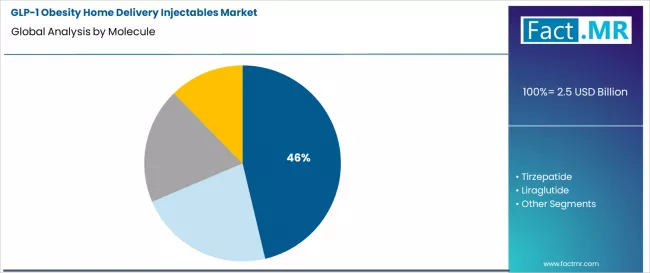
Semaglutide commands a leading 46% share. This segment's dominance is tied to its first-mover advantage in demonstrating high-efficacy weight loss as a primary indication, supported by robust cardiovascular outcome data.

Its strong brand recognition and established prescriber comfort have made it the initial therapy of choice for many patients and healthcare providers initiating pharmacotherapy for obesity, thereby driving the majority of volume through home delivery channels as patients establish long-term treatment routines.

By Distribution Channel, Which Model is Best Suited for Chronic Management?

Glp 1 Obesity Home Delivery Injectables Market Analysis By Distribution Channel

The home delivery channel dominates overwhelmingly with a 67% share. This reflects the inherent suitability of direct-to-patient logistics for managing a chronic condition requiring regular, monthly injectable medication.

Home delivery ensures continuity of supply, enhances adherence through automated refill programs, and provides a discreet solution that aligns with patient preferences. It also allows manufacturers and specialty pharmacies to maintain direct patient relationships for support and education.

By Patient Type, Who is the Core Patient Demographic for This Delivery Model?

Glp 1 Obesity Home Delivery Injectables Market Analysis By Patient Type

Patients with chronic obesity, without concomitant type 2 diabetes, constitute the dominant segment, holding 57% of the market. This large patient population is primarily seeking treatment for weight management alone, and they often interact with digital health platforms and telehealth services that seamlessly integrate with home delivery pharmacy solutions. The convenience factor is paramount for this group, who may prioritize discretion and simplicity in managing a long-term therapeutic regimen.

What are the Principal Drivers, Constraints, and Evolving Dynamics of this Market?

A major driver is the proven high efficacy of GLP-1 therapies in achieving significant weight loss, transforming obesity into a treatable chronic condition and creating massive, sustained patient demand. This demand is amplified by expanding insurance coverage and positive media coverage. The home delivery model directly addresses the need for convenient, reliable access to monthly injectables, improving adherence and enabling scalable management of a large patient population.

A key restraint is the high annual cost of therapy, which can limit access for cash-paying patients and strain healthcare budgets, potentially leading to strict prior authorization or step-edit policies from payers that hinder prescription flow. Supply chain constraints for the active pharmaceutical ingredient and pre-filled pens also periodically restrict availability, challenging the reliability of automated home delivery services.

A significant opportunity lies in the integration of home delivery with comprehensive digital health ecosystems. These platforms can combine medication supply with telehealth consultations, dietary coaching, behavioral support, and biometric tracking, creating a holistic weight management service that improves outcomes and justifies premium value-based care arrangements.

The dominant trend is the vertical integration and partnership between pharmaceutical manufacturers, specialty pharmacies, and digital health companies. Success is moving beyond merely dispensing drugs to creating managed care pathways where the home delivery service is the central touchpoint for patient engagement, adherence monitoring, and data collection, positioning the distributor as a critical partner in value-based healthcare.

Analysis of the GLP-1 Obesity Home Delivery Injectables Market by Key Countries

Glp 1 Obesity Home Delivery Injectables Market Cagr Analysis By Country

Country CAGR 2026 to 2036
UK 14.2%
USA 13.8%
Australia 13.1%
Germany 12.4%

How does the UK's National Health Service Framework Influence Channel Growth?

The UK's leading growth rate of 14.2% CAGR is strongly influenced by the National Health Service's framework for managing high-volume, high-cost specialty medicines. The home delivery model is increasingly adopted as a coordinated, cost-effective method to ensure consistent supply and adherence for patients prescribed GLP-1 therapies, often facilitated through NHS-contracted specialty pharmacy providers. This systemic embrace of direct-to-patient delivery for chronic disease management within a single-payer context creates a powerful growth environment for the channel.

What Factors Underpin the USA's Dominant Market Size and Growth?

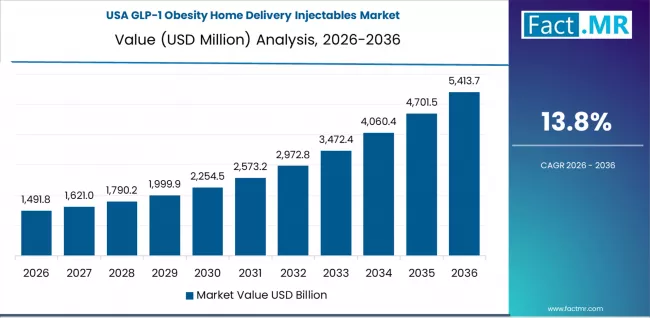
Glp 1 Obesity Home Delivery Injectables Market Country Value Analysis

The USA's substantial growth at 13.8% CAGR is propelled by the high prevalence of obesity, widespread commercial insurance coverage, despite prior authorization hurdles, and a robust ecosystem of telehealth providers and specialty mail-order pharmacies.

The market is characterized by direct-to-consumer advertising, which drives patient demand, and by the competitive strategies of pharmacy benefit managers and insurers who actively promote home delivery to improve adherence and control costs, making it the default channel for many plans.

How is Australia's Healthcare System Adapting to Manage Demand?

Australia's growth at 13.1% CAGR is driven by increasing prescribing within both private and public systems. The home delivery model is gaining traction as a practical solution for managing patient access across a geographically dispersed population.

Growth is facilitated by partnerships between pharmaceutical companies and accredited home healthcare providers to ensure compliant cold-chain logistics, reflecting an adaptive response to integrate these new chronic therapies into existing healthcare delivery infrastructures efficiently.

What Characteristics define Germany's Structured Adoption Pathway?

Stringent regulatory and prescription pathways define Germany’s growth, forecast at 12.4% CAGR. Adoption is carefully managed through specialist physicians, and reimbursement is tightly controlled.

The home delivery channel grows within this structured environment, led by partnerships between manufacturers and established apotheken networks that offer compliant, temperature-controlled direct-to-patient services. This ensures adherence to Germany's high standards for pharmaceutical care while adding the necessary convenience for long-term therapy.

Competitive Landscape of the GLP-1 Obesity Home Delivery Injectables Market

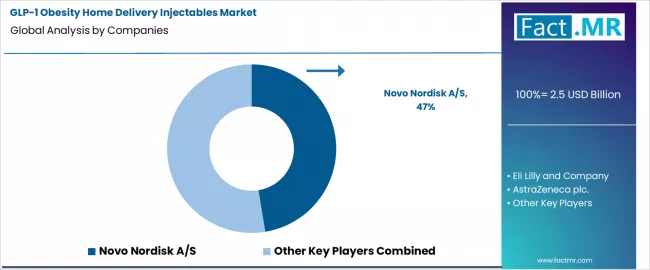
Glp 1 Obesity Home Delivery Injectables Market Analysis By Company

Competition in the GLP-1 obesity home delivery injectables market centers on drug efficacy, supply chain reliability, and the strength of integrated patient support programs. Large pharmaceutical companies like Pfizer, Amgen, and Roche are developing next-generation molecules and will likely emulate this distribution model.

Success depends on securing exclusive or preferred partnerships with major pharmacy benefit managers and building seamless, tech-enabled patient journeys that extend from prescription to front-door delivery.

Key Players in the GLP-1 Obesity Home Delivery Injectables Market

  • Novo Nordisk A/S
  • Eli Lilly and Company
  • AstraZeneca plc.
  • Pfizer Inc.
  • Amgen Inc.
  • F. Hoffmann-La Roche AG

Scope of Report

Items Values
Quantitative Units USD Billion
Molecule Semaglutide, Tirzepatide, Liraglutide, Next-gen GLP-1s
Distribution Channel Home Delivery, Retail Pharmacy
Patient Type Chronic Obesity, Obesity + Diabetes, Diabetes Overlap
Key Countries UK, USA, Australia, Germany
Key Companies Novo Nordisk A/S, Eli Lilly and Company, AstraZeneca plc., Pfizer Inc., Amgen Inc., F. Hoffmann-La Roche AG
Additional Analysis Impact of pharmacy benefit manager contracting on channel access; comparative analysis of adherence rates for home delivery vs. pharmacy pickup; total cost of care analysis incorporating improved health outcomes; data security and privacy in digital health platforms linked to medication delivery; assessment of cold-chain logistics robustness for national-scale distribution.

Market by Segments

  • Molecule :

    • Semaglutide
    • Tirzepatide
    • Liraglutide
    • Next-gen GLP-1s
  • Distribution Channel :

    • Home Delivery
    • Retail Pharmacy
  • Patient Type :

    • Chronic Obesity
    • Obesity + Diabetes
    • Diabetes Overlap
  • Region :

    • North America

      • USA
      • Canada
    • Latin America

      • Brazil
      • Mexico
      • Argentina
      • Rest of Latin America
    • Western Europe

      • Germany
      • France
      • Italy
      • Spain
      • UK
      • BENELUX
      • Rest of Western Europe
    • Eastern Europe

      • Russia
      • Poland
      • Czech Republic
      • Rest of Eastern Europe
    • East Asia

      • China
      • Japan
      • South Korea
      • Rest of East Asia
    • South Asia & Pacific

      • India
      • ASEAN
      • Australia
      • Rest of South Asia & Pacific
    • MEA

      • GCC Countries
      • South Africa
      • Turkiye
      • Rest of MEA

Bibliography

  • American Journal of Managed Care. (2025).The economics and outcomes of GLP-1 receptor agonist therapy in obesity management. AJMC.
  • Davies, M. J., et al. (2024).Management of hyperglycaemia and obesity: New horizons. The Lancet Diabetes & Endocrinology, 12(4), 305-320.
  • International Diabetes Federation. (2025).IDF Diabetes Atlas - 11th Edition. IDF.
  • National Institute for Health and Care Excellence. (2024).Weight management: identification, assessment and management. NICE Guideline [NG7].
  • World Health Organization. (2025).Accelerating action to stop obesity: report of the WHO technical consultation. WHO.

Table of Content

  1. Executive Summary
    • Global Market Outlook
    • Demand to side Trends
    • Supply to side Trends
    • Technology Roadmap Analysis
    • Analysis and Recommendations
  2. Market Overview
    • Market Coverage / Taxonomy
    • Market Definition / Scope / Limitations
  3. Market Background
    • Market Dynamics
      • Drivers
      • Restraints
      • Opportunity
      • Trends
    • Scenario Forecast
      • Demand in Optimistic Scenario
      • Demand in Likely Scenario
      • Demand in Conservative Scenario
    • Opportunity Map Analysis
    • Product Life Cycle Analysis
    • Supply Chain Analysis
    • Investment Feasibility Matrix
    • Value Chain Analysis
    • PESTLE and Porter’s Analysis
    • Regulatory Landscape
    • Regional Parent Market Outlook
    • Production and Consumption Statistics
    • Import and Export Statistics
  4. Global Market Analysis 2021 to 2025 and Forecast, 2026 to 2036
    • Historical Market Size Value (USD Million) Analysis, 2021 to 2025
    • Current and Future Market Size Value (USD Million) Projections, 2026 to 2036
      • Y to o to Y Growth Trend Analysis
      • Absolute $ Opportunity Analysis
  5. Global Market Pricing Analysis 2021 to 2025 and Forecast 2026 to 2036
  6. Global Market Analysis 2021 to 2025 and Forecast 2026 to 2036, By Molecule
    • Introduction / Key Findings
    • Historical Market Size Value (USD Million) Analysis By Molecule, 2021 to 2025
    • Current and Future Market Size Value (USD Million) Analysis and Forecast By Molecule, 2026 to 2036
      • Semaglutide
      • Tirzepatide
      • Liraglutide
      • Next-gen GLP-1s
    • Y to o to Y Growth Trend Analysis By Molecule, 2021 to 2025
    • Absolute $ Opportunity Analysis By Molecule, 2026 to 2036
  7. Global Market Analysis 2021 to 2025 and Forecast 2026 to 2036, By Distribution Channel
    • Introduction / Key Findings
    • Historical Market Size Value (USD Million) Analysis By Distribution Channel, 2021 to 2025
    • Current and Future Market Size Value (USD Million) Analysis and Forecast By Distribution Channel, 2026 to 2036
      • Home delivery
      • Retail pharmacy
    • Y to o to Y Growth Trend Analysis By Distribution Channel, 2021 to 2025
    • Absolute $ Opportunity Analysis By Distribution Channel, 2026 to 2036
  8. Global Market Analysis 2021 to 2025 and Forecast 2026 to 2036, By Patient Type
    • Introduction / Key Findings
    • Historical Market Size Value (USD Million) Analysis By Patient Type, 2021 to 2025
    • Current and Future Market Size Value (USD Million) Analysis and Forecast By Patient Type, 2026 to 2036
      • Chronic obesity
      • Obesity + diabetes
      • Diabetes overlap
    • Y to o to Y Growth Trend Analysis By Patient Type, 2021 to 2025
    • Absolute $ Opportunity Analysis By Patient Type, 2026 to 2036
  9. Global Market Analysis 2021 to 2025 and Forecast 2026 to 2036, By Region
    • Introduction
    • Historical Market Size Value (USD Million) Analysis By Region, 2021 to 2025
    • Current Market Size Value (USD Million) Analysis and Forecast By Region, 2026 to 2036
      • North America
      • Latin America
      • Western Europe
      • Eastern Europe
      • East Asia
      • South Asia and Pacific
      • Middle East & Africa
    • Market Attractiveness Analysis By Region
  10. North America Market Analysis 2021 to 2025 and Forecast 2026 to 2036, By Country
    • Historical Market Size Value (USD Million) Trend Analysis By Market Taxonomy, 2021 to 2025
    • Market Size Value (USD Million) Forecast By Market Taxonomy, 2026 to 2036
      • By Country
        • USA
        • Canada
        • Mexico
      • By Molecule
      • By Distribution Channel
      • By Patient Type
    • Market Attractiveness Analysis
      • By Country
      • By Molecule
      • By Distribution Channel
      • By Patient Type
    • Key Takeaways
  11. Latin America Market Analysis 2021 to 2025 and Forecast 2026 to 2036, By Country
    • Historical Market Size Value (USD Million) Trend Analysis By Market Taxonomy, 2021 to 2025
    • Market Size Value (USD Million) Forecast By Market Taxonomy, 2026 to 2036
      • By Country
        • Brazil
        • Chile
        • Rest of Latin America
      • By Molecule
      • By Distribution Channel
      • By Patient Type
    • Market Attractiveness Analysis
      • By Country
      • By Molecule
      • By Distribution Channel
      • By Patient Type
    • Key Takeaways
  12. Western Europe Market Analysis 2021 to 2025 and Forecast 2026 to 2036, By Country
    • Historical Market Size Value (USD Million) Trend Analysis By Market Taxonomy, 2021 to 2025
    • Market Size Value (USD Million) Forecast By Market Taxonomy, 2026 to 2036
      • By Country
        • Germany
        • UK
        • Italy
        • Spain
        • France
        • Nordic
        • BENELUX
        • Rest of Western Europe
      • By Molecule
      • By Distribution Channel
      • By Patient Type
    • Market Attractiveness Analysis
      • By Country
      • By Molecule
      • By Distribution Channel
      • By Patient Type
    • Key Takeaways
  13. Eastern Europe Market Analysis 2021 to 2025 and Forecast 2026 to 2036, By Country
    • Historical Market Size Value (USD Million) Trend Analysis By Market Taxonomy, 2021 to 2025
    • Market Size Value (USD Million) Forecast By Market Taxonomy, 2026 to 2036
      • By Country
        • Russia
        • Poland
        • Hungary
        • Balkan & Baltic
        • Rest of Eastern Europe
      • By Molecule
      • By Distribution Channel
      • By Patient Type
    • Market Attractiveness Analysis
      • By Country
      • By Molecule
      • By Distribution Channel
      • By Patient Type
    • Key Takeaways
  14. East Asia Market Analysis 2021 to 2025 and Forecast 2026 to 2036, By Country
    • Historical Market Size Value (USD Million) Trend Analysis By Market Taxonomy, 2021 to 2025
    • Market Size Value (USD Million) Forecast By Market Taxonomy, 2026 to 2036
      • By Country
        • China
        • Japan
        • South Korea
      • By Molecule
      • By Distribution Channel
      • By Patient Type
    • Market Attractiveness Analysis
      • By Country
      • By Molecule
      • By Distribution Channel
      • By Patient Type
    • Key Takeaways
  15. South Asia and Pacific Market Analysis 2021 to 2025 and Forecast 2026 to 2036, By Country
    • Historical Market Size Value (USD Million) Trend Analysis By Market Taxonomy, 2021 to 2025
    • Market Size Value (USD Million) Forecast By Market Taxonomy, 2026 to 2036
      • By Country
        • India
        • ASEAN
        • Australia & New Zealand
        • Rest of South Asia and Pacific
      • By Molecule
      • By Distribution Channel
      • By Patient Type
    • Market Attractiveness Analysis
      • By Country
      • By Molecule
      • By Distribution Channel
      • By Patient Type
    • Key Takeaways
  16. Middle East & Africa Market Analysis 2021 to 2025 and Forecast 2026 to 2036, By Country
    • Historical Market Size Value (USD Million) Trend Analysis By Market Taxonomy, 2021 to 2025
    • Market Size Value (USD Million) Forecast By Market Taxonomy, 2026 to 2036
      • By Country
        • Kingdom of Saudi Arabia
        • Other GCC Countries
        • Turkiye
        • South Africa
        • Other African Union
        • Rest of Middle East & Africa
      • By Molecule
      • By Distribution Channel
      • By Patient Type
    • Market Attractiveness Analysis
      • By Country
      • By Molecule
      • By Distribution Channel
      • By Patient Type
    • Key Takeaways
  17. Key Countries Market Analysis
    • USA
      • Pricing Analysis
      • Market Share Analysis, 2025
        • By Molecule
        • By Distribution Channel
        • By Patient Type
    • Canada
      • Pricing Analysis
      • Market Share Analysis, 2025
        • By Molecule
        • By Distribution Channel
        • By Patient Type
    • Mexico
      • Pricing Analysis
      • Market Share Analysis, 2025
        • By Molecule
        • By Distribution Channel
        • By Patient Type
    • Brazil
      • Pricing Analysis
      • Market Share Analysis, 2025
        • By Molecule
        • By Distribution Channel
        • By Patient Type
    • Chile
      • Pricing Analysis
      • Market Share Analysis, 2025
        • By Molecule
        • By Distribution Channel
        • By Patient Type
    • Germany
      • Pricing Analysis
      • Market Share Analysis, 2025
        • By Molecule
        • By Distribution Channel
        • By Patient Type
    • UK
      • Pricing Analysis
      • Market Share Analysis, 2025
        • By Molecule
        • By Distribution Channel
        • By Patient Type
    • Italy
      • Pricing Analysis
      • Market Share Analysis, 2025
        • By Molecule
        • By Distribution Channel
        • By Patient Type
    • Spain
      • Pricing Analysis
      • Market Share Analysis, 2025
        • By Molecule
        • By Distribution Channel
        • By Patient Type
    • France
      • Pricing Analysis
      • Market Share Analysis, 2025
        • By Molecule
        • By Distribution Channel
        • By Patient Type
    • India
      • Pricing Analysis
      • Market Share Analysis, 2025
        • By Molecule
        • By Distribution Channel
        • By Patient Type
    • ASEAN
      • Pricing Analysis
      • Market Share Analysis, 2025
        • By Molecule
        • By Distribution Channel
        • By Patient Type
    • Australia & New Zealand
      • Pricing Analysis
      • Market Share Analysis, 2025
        • By Molecule
        • By Distribution Channel
        • By Patient Type
    • China
      • Pricing Analysis
      • Market Share Analysis, 2025
        • By Molecule
        • By Distribution Channel
        • By Patient Type
    • Japan
      • Pricing Analysis
      • Market Share Analysis, 2025
        • By Molecule
        • By Distribution Channel
        • By Patient Type
    • South Korea
      • Pricing Analysis
      • Market Share Analysis, 2025
        • By Molecule
        • By Distribution Channel
        • By Patient Type
    • Russia
      • Pricing Analysis
      • Market Share Analysis, 2025
        • By Molecule
        • By Distribution Channel
        • By Patient Type
    • Poland
      • Pricing Analysis
      • Market Share Analysis, 2025
        • By Molecule
        • By Distribution Channel
        • By Patient Type
    • Hungary
      • Pricing Analysis
      • Market Share Analysis, 2025
        • By Molecule
        • By Distribution Channel
        • By Patient Type
    • Kingdom of Saudi Arabia
      • Pricing Analysis
      • Market Share Analysis, 2025
        • By Molecule
        • By Distribution Channel
        • By Patient Type
    • Turkiye
      • Pricing Analysis
      • Market Share Analysis, 2025
        • By Molecule
        • By Distribution Channel
        • By Patient Type
    • South Africa
      • Pricing Analysis
      • Market Share Analysis, 2025
        • By Molecule
        • By Distribution Channel
        • By Patient Type
  18. Market Structure Analysis
    • Competition Dashboard
    • Competition Benchmarking
    • Market Share Analysis of Top Players
      • By Regional
      • By Molecule
      • By Distribution Channel
      • By Patient Type
  19. Competition Analysis
    • Competition Deep Dive
      • Novo Nordisk A/S
        • Overview
        • Product Portfolio
        • Profitability by Market Segments (Product/Age /Sales Channel/Region)
        • Sales Footprint
        • Strategy Overview
          • Marketing Strategy
          • Product Strategy
          • Channel Strategy
      • Eli Lilly and Company
      • AstraZeneca plc.
      • Pfizer Inc.
      • Amgen Inc.
      • F. Hoffmann-La Roche AG
  20. Assumptions & Acronyms Used
  21. Research Methodology

List Of Table

  • Table 1: Global Market Value (USD Million) Forecast by Region, 2021 to 2036
  • Table 2: Global Market Value (USD Million) Forecast by Molecule, 2021 to 2036
  • Table 3: Global Market Value (USD Million) Forecast by Distribution Channel, 2021 to 2036
  • Table 4: Global Market Value (USD Million) Forecast by Patient Type, 2021 to 2036
  • Table 5: North America Market Value (USD Million) Forecast by Country, 2021 to 2036
  • Table 6: North America Market Value (USD Million) Forecast by Molecule, 2021 to 2036
  • Table 7: North America Market Value (USD Million) Forecast by Distribution Channel, 2021 to 2036
  • Table 8: North America Market Value (USD Million) Forecast by Patient Type, 2021 to 2036
  • Table 9: Latin America Market Value (USD Million) Forecast by Country, 2021 to 2036
  • Table 10: Latin America Market Value (USD Million) Forecast by Molecule, 2021 to 2036
  • Table 11: Latin America Market Value (USD Million) Forecast by Distribution Channel, 2021 to 2036
  • Table 12: Latin America Market Value (USD Million) Forecast by Patient Type, 2021 to 2036
  • Table 13: Western Europe Market Value (USD Million) Forecast by Country, 2021 to 2036
  • Table 14: Western Europe Market Value (USD Million) Forecast by Molecule, 2021 to 2036
  • Table 15: Western Europe Market Value (USD Million) Forecast by Distribution Channel, 2021 to 2036
  • Table 16: Western Europe Market Value (USD Million) Forecast by Patient Type, 2021 to 2036
  • Table 17: Eastern Europe Market Value (USD Million) Forecast by Country, 2021 to 2036
  • Table 18: Eastern Europe Market Value (USD Million) Forecast by Molecule, 2021 to 2036
  • Table 19: Eastern Europe Market Value (USD Million) Forecast by Distribution Channel, 2021 to 2036
  • Table 20: Eastern Europe Market Value (USD Million) Forecast by Patient Type, 2021 to 2036
  • Table 21: East Asia Market Value (USD Million) Forecast by Country, 2021 to 2036
  • Table 22: East Asia Market Value (USD Million) Forecast by Molecule, 2021 to 2036
  • Table 23: East Asia Market Value (USD Million) Forecast by Distribution Channel, 2021 to 2036
  • Table 24: East Asia Market Value (USD Million) Forecast by Patient Type, 2021 to 2036
  • Table 25: South Asia and Pacific Market Value (USD Million) Forecast by Country, 2021 to 2036
  • Table 26: South Asia and Pacific Market Value (USD Million) Forecast by Molecule, 2021 to 2036
  • Table 27: South Asia and Pacific Market Value (USD Million) Forecast by Distribution Channel, 2021 to 2036
  • Table 28: South Asia and Pacific Market Value (USD Million) Forecast by Patient Type, 2021 to 2036
  • Table 29: Middle East & Africa Market Value (USD Million) Forecast by Country, 2021 to 2036
  • Table 30: Middle East & Africa Market Value (USD Million) Forecast by Molecule, 2021 to 2036
  • Table 31: Middle East & Africa Market Value (USD Million) Forecast by Distribution Channel, 2021 to 2036
  • Table 32: Middle East & Africa Market Value (USD Million) Forecast by Patient Type, 2021 to 2036

List Of Figures

  • Figure 1: Global Market Pricing Analysis
  • Figure 2: Global Market Value (USD Million) Forecast 2021 to 2036
  • Figure 3: Global Market Value Share and BPS Analysis by Molecule, 2026 and 2036
  • Figure 4: Global Market Y to o to Y Growth Comparison by Molecule, 2026 to 2036
  • Figure 5: Global Market Attractiveness Analysis by Molecule
  • Figure 6: Global Market Value Share and BPS Analysis by Distribution Channel, 2026 and 2036
  • Figure 7: Global Market Y to o to Y Growth Comparison by Distribution Channel, 2026 to 2036
  • Figure 8: Global Market Attractiveness Analysis by Distribution Channel
  • Figure 9: Global Market Value Share and BPS Analysis by Patient Type, 2026 and 2036
  • Figure 10: Global Market Y to o to Y Growth Comparison by Patient Type, 2026 to 2036
  • Figure 11: Global Market Attractiveness Analysis by Patient Type
  • Figure 12: Global Market Value (USD Million) Share and BPS Analysis by Region, 2026 and 2036
  • Figure 13: Global Market Y to o to Y Growth Comparison by Region, 2026 to 2036
  • Figure 14: Global Market Attractiveness Analysis by Region
  • Figure 15: North America Market Incremental Dollar Opportunity, 2026 to 2036
  • Figure 16: Latin America Market Incremental Dollar Opportunity, 2026 to 2036
  • Figure 17: Western Europe Market Incremental Dollar Opportunity, 2026 to 2036
  • Figure 18: Eastern Europe Market Incremental Dollar Opportunity, 2026 to 2036
  • Figure 19: East Asia Market Incremental Dollar Opportunity, 2026 to 2036
  • Figure 20: South Asia and Pacific Market Incremental Dollar Opportunity, 2026 to 2036
  • Figure 21: Middle East & Africa Market Incremental Dollar Opportunity, 2026 to 2036
  • Figure 22: North America Market Value Share and BPS Analysis by Country, 2026 and 2036
  • Figure 23: North America Market Value Share and BPS Analysis by Molecule, 2026 and 2036
  • Figure 24: North America Market Y to o to Y Growth Comparison by Molecule, 2026 to 2036
  • Figure 25: North America Market Attractiveness Analysis by Molecule
  • Figure 26: North America Market Value Share and BPS Analysis by Distribution Channel, 2026 and 2036
  • Figure 27: North America Market Y to o to Y Growth Comparison by Distribution Channel, 2026 to 2036
  • Figure 28: North America Market Attractiveness Analysis by Distribution Channel
  • Figure 29: North America Market Value Share and BPS Analysis by Patient Type, 2026 and 2036
  • Figure 30: North America Market Y to o to Y Growth Comparison by Patient Type, 2026 to 2036
  • Figure 31: North America Market Attractiveness Analysis by Patient Type
  • Figure 32: Latin America Market Value Share and BPS Analysis by Country, 2026 and 2036
  • Figure 33: Latin America Market Value Share and BPS Analysis by Molecule, 2026 and 2036
  • Figure 34: Latin America Market Y to o to Y Growth Comparison by Molecule, 2026 to 2036
  • Figure 35: Latin America Market Attractiveness Analysis by Molecule
  • Figure 36: Latin America Market Value Share and BPS Analysis by Distribution Channel, 2026 and 2036
  • Figure 37: Latin America Market Y to o to Y Growth Comparison by Distribution Channel, 2026 to 2036
  • Figure 38: Latin America Market Attractiveness Analysis by Distribution Channel
  • Figure 39: Latin America Market Value Share and BPS Analysis by Patient Type, 2026 and 2036
  • Figure 40: Latin America Market Y to o to Y Growth Comparison by Patient Type, 2026 to 2036
  • Figure 41: Latin America Market Attractiveness Analysis by Patient Type
  • Figure 42: Western Europe Market Value Share and BPS Analysis by Country, 2026 and 2036
  • Figure 43: Western Europe Market Value Share and BPS Analysis by Molecule, 2026 and 2036
  • Figure 44: Western Europe Market Y to o to Y Growth Comparison by Molecule, 2026 to 2036
  • Figure 45: Western Europe Market Attractiveness Analysis by Molecule
  • Figure 46: Western Europe Market Value Share and BPS Analysis by Distribution Channel, 2026 and 2036
  • Figure 47: Western Europe Market Y to o to Y Growth Comparison by Distribution Channel, 2026 to 2036
  • Figure 48: Western Europe Market Attractiveness Analysis by Distribution Channel
  • Figure 49: Western Europe Market Value Share and BPS Analysis by Patient Type, 2026 and 2036
  • Figure 50: Western Europe Market Y to o to Y Growth Comparison by Patient Type, 2026 to 2036
  • Figure 51: Western Europe Market Attractiveness Analysis by Patient Type
  • Figure 52: Eastern Europe Market Value Share and BPS Analysis by Country, 2026 and 2036
  • Figure 53: Eastern Europe Market Value Share and BPS Analysis by Molecule, 2026 and 2036
  • Figure 54: Eastern Europe Market Y to o to Y Growth Comparison by Molecule, 2026 to 2036
  • Figure 55: Eastern Europe Market Attractiveness Analysis by Molecule
  • Figure 56: Eastern Europe Market Value Share and BPS Analysis by Distribution Channel, 2026 and 2036
  • Figure 57: Eastern Europe Market Y to o to Y Growth Comparison by Distribution Channel, 2026 to 2036
  • Figure 58: Eastern Europe Market Attractiveness Analysis by Distribution Channel
  • Figure 59: Eastern Europe Market Value Share and BPS Analysis by Patient Type, 2026 and 2036
  • Figure 60: Eastern Europe Market Y to o to Y Growth Comparison by Patient Type, 2026 to 2036
  • Figure 61: Eastern Europe Market Attractiveness Analysis by Patient Type
  • Figure 62: East Asia Market Value Share and BPS Analysis by Country, 2026 and 2036
  • Figure 63: East Asia Market Value Share and BPS Analysis by Molecule, 2026 and 2036
  • Figure 64: East Asia Market Y to o to Y Growth Comparison by Molecule, 2026 to 2036
  • Figure 65: East Asia Market Attractiveness Analysis by Molecule
  • Figure 66: East Asia Market Value Share and BPS Analysis by Distribution Channel, 2026 and 2036
  • Figure 67: East Asia Market Y to o to Y Growth Comparison by Distribution Channel, 2026 to 2036
  • Figure 68: East Asia Market Attractiveness Analysis by Distribution Channel
  • Figure 69: East Asia Market Value Share and BPS Analysis by Patient Type, 2026 and 2036
  • Figure 70: East Asia Market Y to o to Y Growth Comparison by Patient Type, 2026 to 2036
  • Figure 71: East Asia Market Attractiveness Analysis by Patient Type
  • Figure 72: South Asia and Pacific Market Value Share and BPS Analysis by Country, 2026 and 2036
  • Figure 73: South Asia and Pacific Market Value Share and BPS Analysis by Molecule, 2026 and 2036
  • Figure 74: South Asia and Pacific Market Y to o to Y Growth Comparison by Molecule, 2026 to 2036
  • Figure 75: South Asia and Pacific Market Attractiveness Analysis by Molecule
  • Figure 76: South Asia and Pacific Market Value Share and BPS Analysis by Distribution Channel, 2026 and 2036
  • Figure 77: South Asia and Pacific Market Y to o to Y Growth Comparison by Distribution Channel, 2026 to 2036
  • Figure 78: South Asia and Pacific Market Attractiveness Analysis by Distribution Channel
  • Figure 79: South Asia and Pacific Market Value Share and BPS Analysis by Patient Type, 2026 and 2036
  • Figure 80: South Asia and Pacific Market Y to o to Y Growth Comparison by Patient Type, 2026 to 2036
  • Figure 81: South Asia and Pacific Market Attractiveness Analysis by Patient Type
  • Figure 82: Middle East & Africa Market Value Share and BPS Analysis by Country, 2026 and 2036
  • Figure 83: Middle East & Africa Market Value Share and BPS Analysis by Molecule, 2026 and 2036
  • Figure 84: Middle East & Africa Market Y to o to Y Growth Comparison by Molecule, 2026 to 2036
  • Figure 85: Middle East & Africa Market Attractiveness Analysis by Molecule
  • Figure 86: Middle East & Africa Market Value Share and BPS Analysis by Distribution Channel, 2026 and 2036
  • Figure 87: Middle East & Africa Market Y to o to Y Growth Comparison by Distribution Channel, 2026 to 2036
  • Figure 88: Middle East & Africa Market Attractiveness Analysis by Distribution Channel
  • Figure 89: Middle East & Africa Market Value Share and BPS Analysis by Patient Type, 2026 and 2036
  • Figure 90: Middle East & Africa Market Y to o to Y Growth Comparison by Patient Type, 2026 to 2036
  • Figure 91: Middle East & Africa Market Attractiveness Analysis by Patient Type
  • Figure 92: Global Market - Tier Structure Analysis
  • Figure 93: Global Market - Company Share Analysis

- FAQs -

How big is the glp-1 obesity home delivery injectables market in 2026?

The global glp-1 obesity home delivery injectables market is estimated to be valued at USD 2.5 billion in 2026.

What will be the size of glp-1 obesity home delivery injectables market in 2036?

The market size for the glp-1 obesity home delivery injectables market is projected to reach USD 9.0 billion by 2036.

How much will be the glp-1 obesity home delivery injectables market growth between 2026 and 2036?

The glp-1 obesity home delivery injectables market is expected to grow at a 13.7% CAGR between 2026 and 2036.

What are the key product types in the glp-1 obesity home delivery injectables market?

The key product types in glp-1 obesity home delivery injectables market are semaglutide, tirzepatide, liraglutide and next-gen glp-1s.

Which distribution channel segment to contribute significant share in the glp-1 obesity home delivery injectables market in 2026?

In terms of distribution channel, home delivery segment to command 67.2% share in the glp-1 obesity home delivery injectables market in 2026.
GLP-1 Obesity Home Delivery Injectables Market