- Base Value(2025): 374.0 Mn
- Estimated Value(2026): 394.2 Mn
- Forecast Value (2036): 667.0 Mn
- CAGR (2026 - 2036): 5.4%
Paint Activators Market Overview, Growth Outlook, and Forecast by Fact.MR
- In 2025, the paint activators market was valued at USD 374.0 million.
- Based on market analysis, demand for paint activators is estimated to grow to USD 394.2 million in 2026 and reach USD 667.0 million by 2036.
- The market is projected to expand at a CAGR of 5.4% during the forecast period.
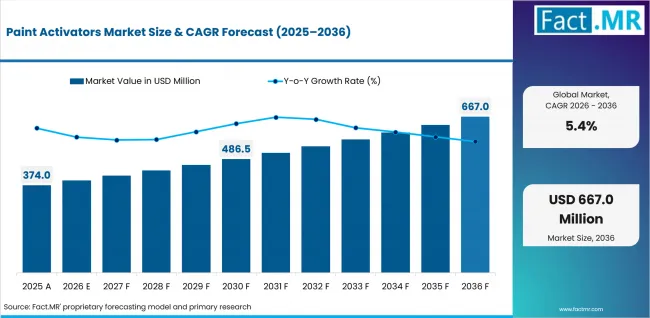
Paint Activators Market Value Analysis | Source: Fact.MR
Summary of the Paint Activators Market
- Market Snapshot
- Global paint activators market revenue stood at USD 394.2 million in 2026 and is forecast to reach USD 667.0 million by 2036.
- At a 5.4% CAGR from 2026 to 2036, the market is expected to expand ~1.7x in value, creating an absolute dollar opportunity of USD 273 million.
- Market expansion is being fueled by the growing demand for quality automotive refinishing and industrial coating systems, the growing application of long-lasting epoxy and urethane coating technologies, as well as the increasing use of environmentally friendly paint activator formulations.
- The growing affinity for low-VOC and water-based coating products in developed and developing regions is fostering demand for the market on a global scale.
- Surging construction and infrastructure development, growing application in marine and aerospace coating, and increasing demand for rapid-curing protective coatings are anticipated to contribute significantly to market growth globally.
- Demand and Growth Drivers
- The world is witnessing increasing demand for advanced performance and long-life coating systems
- Growing penetration of automotive refinishing and industrial coatings
- Increasing preference for low-VOC/eco-friendly paint activators
- Growth in infrastructure, construction and manufacturing work
- Increase in usage of polyurethane and epoxy coating systems
- Needs for:
- Fast Dry/ Cure performance
- Better bonding and durability of coatings
- Protection from rust, chemicals
- Enhanced gloss or surface finish
- Reduction in VOCs, and/or any other environmental compliance
- Aging and UV light resistance improvement
- Solutions for high-performance protective coating applications
- Product and Segment View
- Urethane Activators account for nearly 28.6% of type segment share in 2026, emerging as the leading segment due to strong demand from automotive refinishing and industrial coating applications.
- Solvent-Based formulations hold a significant share of formulation demand in 2026, supported by their widespread use in high-performance coating systems.
- Automotive Refinishing represents a major share of application segmentation in 2026 owing to increasing vehicle repair and repainting activities globally.
- Geography and Competitive Outlook
- Increasing automotive production, infrastructure investments, and industrial coating demand are the key factors fueling strong market growth across Asia Pacific, North America, and Europe.
- Major growth markets in the Paint Activators Market include Mexico (8.6% CAGR), India (6.8% CAGR), Japan (6.6% CAGR), China (6.4% CAGR), United States (5.1% CAGR), Germany (4.2% CAGR), and South Korea (3.1% CAGR) during the forecast period.
- Market growth can be attributed to:
- Increasing adoption of protective and industrial coatings
- Rising automotive refinishing demand
- Growing use of eco-friendly and water-based formulations
- Expanding marine and aerospace coating applications
- Increasing investments in advanced coating technologies and specialty chemicals infrastructure
- Key players operating in the market include PPG Industries, Sherwin-Williams, Axalta Coating Systems, BASF, Akzo Nobel, Nippon Paint Holdings, Kansai Paint, Sika, 3M, and Huntsman Corporation.
- Analyst Opinion
- Shambhu Nath Jha, Principal Consultant at Fact.MR, opines, “The CXO executives need to be aware that the Paint Activators Market competition will be further intensified by the space and performance driven high-performance coating chemistries, development of solvent free and eco-friendly activator formulations, increasing acceptance of fast-curing and high performance coating technologies, and never-ending pursuit of innovation in automotive refinish and industrial coating end-uses to cater to the escalating global demand for green, anti-corrosive, and high-efficiency coating
Paint Activators Market — At a Glance
| Attribute | Details |
|---|---|
| Market Value (2025) | USD 374.0 Mn |
| Market Value (2026) | USD 394.2 Mn |
| Market Value (2036) | USD 667.0 Mn |
| Absolute Dollar Opportunity | USD 273 Mn |
| Total Growth Rate (2026–2036) | 69.30% |
| CAGR (2026–2036) | 5.40% |
| Growth Multiple | 1.7x |
| Key Demand Driver | Rising demand for automotive refinishing and industrial coatings |
| Leading Type Segment | Urethane Activators |
| Type Segment Share | 28.60% |
| Leading Formulation Segment | Solvent-Based |
| Formulation Share | 36.40% |
| Leading Application Segment | Automotive Refinishing |
| Application Share | 31.20% |
| Leading End-Use Industry | Automotive |
| End-Use Industry Share | 35.10% |
| Key Growth Region | Asia Pacific |
| Key Companies | PPG Industries, Sherwin-Williams, Axalta Coating Systems, BASF, Akzo Nobel |
| Segment Covered | Epoxy Activators, Urethane Activators, Acrylic Activators, Polyester Activators |
| Segment Covered | Water-Based, Solvent-Based, Low-VOC / Eco-Friendly Formulations |
| Segment Covered | Cans, Bottles, Drums, Bulk Containers |
| Segment Covered | Automotive Refinishing, Industrial Coatings, Aerospace Coatings, Marine Coatings |
| Segment Covered | Automotive, Construction, Manufacturing, Aerospace & Defense, Marine |
| Regional Coverage | North America, Europe, Asia Pacific, Latin America, Middle East & Africa |
Source: Fact.MR analysis. Updated May 29, 2026
The market is projected to create an absolute dollar opportunity of USD 273 million between 2026 and 2036. Market growth is driven by increasing demand for high-performance automotive refinishing and industrial coating solutions, rising adoption of durable polyurethane and epoxy coating systems, and growing preference for low-VOC and eco-friendly paint activators. Expanding construction and infrastructure activities, increasing marine and protective coating applications, and rising demand for fast-curing coating technologies are further supporting market expansion.
Key Growth Drivers, Constraints, and Opportunities
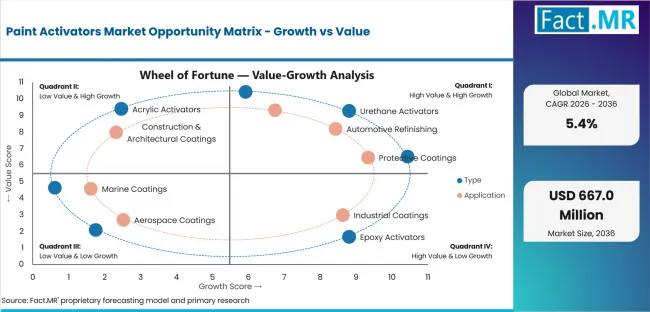
Paint Activators Market Opportunity Matrix Growth Vs Value | Source: Fact.MR
Key Factors Driving Growth
- Growth of the market is anticipated to be driven by the increasing demand for automotive refinishing, industrial and protective coating solutions with high performance in the manufacturing sector, construction sector, aerospace sector and marine sector.
- The demand for paint activators is gaining traction worldwide due to the growing use of epoxy and urethane coating systems as they provide superior durability, corrosion resistance, adhesion performance, and fast-curing.
- Growing demand for low VOC, water based and environmentally friendly coating products is also stimulating commercial potential in high-value coating application worldwide.
| Growth Driver | Demand Impact | Time Horizon | Key Impact Area | Fact.MR Insight |
|---|---|---|---|---|
| Rising demand for automotive refinishing coatings | High | Short–Medium Term | Automotive Coatings | Increasing demand for fast-curing activators |
| Growing adoption of industrial protective coatings | High | Short–Medium Term | Industrial Manufacturing | High consumption of epoxy and urethane activators |
| Expansion of infrastructure and construction activities | Medium | Mid–Long Term | Construction Coatings | Increasing use of protective and architectural coatings |
| Increasing demand for low-VOC and eco-friendly coatings | Medium | Mid–Long Term | Sustainable Coating Technologies | Expansion of water-based activator systems |
| Rising demand for corrosion-resistant marine and aerospace coatings | Medium | Mid–Long Term | High-Performance Coatings | Increasing adoption of advanced activator chemistries |
Source: Fact.MR analysis. Updated May 29, 2026
Key Market Constraints
- The advanced coating chemistries and sustainable activator formulations are costly, which may hamper the adoption by small end users and those who are price sensitive.
- Tight environmental regulations on VOC emissions, hazardous chemicals and occupational safety and health continue to pose compliance difficulties to the manufacturers.
- Curing speed and sensitivity to the environment are among the performance limitations of some low-VOC and water-based activator systems that may limit their broader use in industry.
Key Opportunity Areas
- Growing investments for sustainable coatings and green chemistry technologies will provide lucrative growth opportunities for low-VOC and waterborne paint activators in the coming years.
- The application possibilities for advanced activator systems continues to grow with the increased use of protective coatings in the infrastructure, marine, renewables and industrial equipment markets.
- Increasing requirements for rapid curing, corrosion resistance, and high-performance coatings in automotive refinishing and industrial production are expected to propel the market expansion worldwide.
Segment-wise Analysis of the Paint Activators Market
- Urethane Activators account for nearly 28.6% share of the type segment in 2026, driven by strong demand from automotive refinishing, industrial coatings, and high-performance protective coating applications requiring superior durability and gloss retention.
- Solvent-Based formulations represent approximately 36.4% share of the formulation segment in 2026, supported by widespread usage in industrial and automotive coating systems demanding high curing efficiency and coating performance.
- Automotive Refinishing holds nearly 31.2% share of the application segment in 2026, owing to increasing global vehicle repair, repainting activities, and rising demand for fast-curing premium coating finishes.
- The Automotive industry represents a major share of the end-use industry segment in 2026 due to expanding vehicle production, aftermarket refinishing demand, and increasing adoption of advanced coating technologies worldwide.
Paint Activators Market is segmented by type, formulation, packaging type, application, end-use industry, and region.
Which Type Segment Leads the Market?
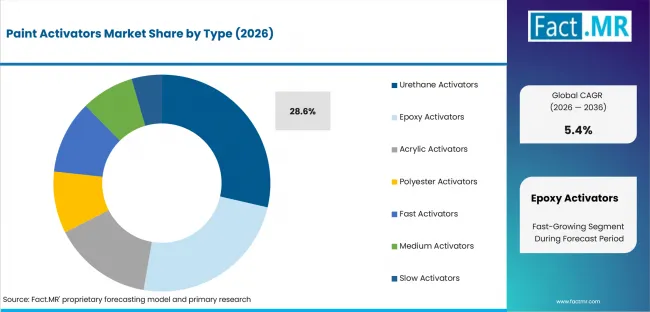
Paint Activators Market Analysis By Type | Source: Fact.MR
The Urethane Activators segment is expected to hold the highest market share of around 28.6% by 2026, owing to growing demand for high-performance automotive refinishing and industrial coating applications. The growing prevalence of urethane based coatings due to better durability, gloss retention, chemical resistance, and quick-curing capabilities is continuously boosting the domination of this segment worldwide.
Which Formulation Segment Holds the Largest Share in the Market?
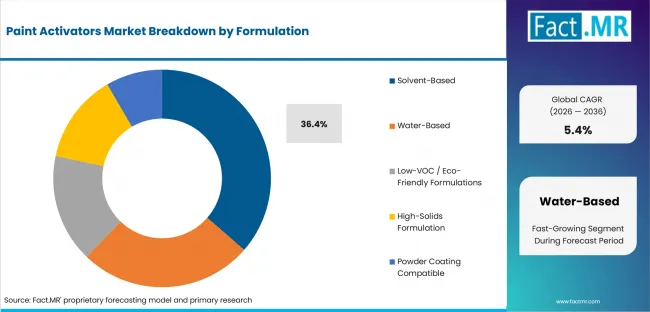
Paint Activators Market Analysis By Formulation | Source: Fact.MR
The Solvent-Based segment is projected to dominate the formulation category, capturing approximately 36.4% share in 2026. This leadership is driven by its strong curing efficiency, excellent adhesion properties, superior coating finish, and widespread usage across industrial and automotive coating systems. Solvent-based activators continue to witness strong commercial adoption in applications requiring high durability, chemical resistance, and rapid drying performance.
Which Application Segment Holds the Largest Share in the Market?
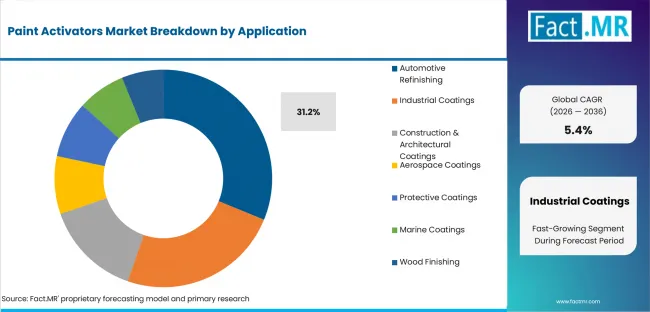
Paint Activators Market Analysis By Application | Source: Fact.MR
The Automotive Refinishing segment is expected to hold the largest application segment share of nearly 31.2% by 2026. This growth is attributed to rising global vehicle repair and repainting activities, increasing demand for premium coating finishes, and expanding automotive aftermarket services. Paint activators are extensively used in automotive refinishing to improve curing performance, gloss retention, adhesion, and durability.
Which End-Use Industry Segment Holds the Largest Share in the Market?
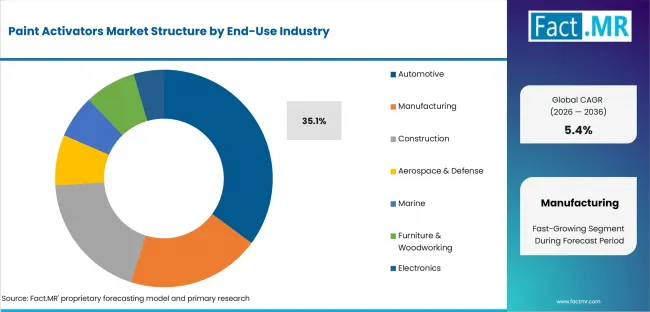
Paint Activators Market Analysis By End Use Industry | Source: Fact.MR
The Automotive industry is projected to lead the end-use industry category with a market share of approximately 35.1% by 2026. This dominance is driven by increasing automotive production, expanding aftermarket refinishing demand, and rising utilization of high-performance coating systems in passenger and commercial vehicles. Growing demand for corrosion-resistant, fast-curing, and durable coatings in automotive manufacturing and repair applications is further strengthening the growth of the automotive end-use segment globally.
Regional Outlook Across Key Markets
This report covers key regions including North America, Latin America, Western Europe, Eastern Europe, East Asia, South Asia & Pacific, and Middle East & Africa. It provides in-depth analysis of trends in automotive refinishing and industrial coating demand, increasing adoption of epoxy and urethane coating systems, rising preference for low-VOC and water-based paint activators, growth in protective and marine coating applications, expanding infrastructure and construction activities, advancements in high-performance coating chemistries, regulatory developments related to VOC emissions and environmental compliance, increasing investments in sustainable coating technologies and specialty chemicals, and shifting industry preference toward fast-curing, corrosion-resistant, durable, and environmentally compliant coating solutions across global paint activators market segments.
.webp "Top Country Growth Comparison Paint Activators Market Cagr (2026 2036)")
Top Country Growth Comparison Paint Activators Market Cagr (2026 2036) | Source: Fact.MR
CAGR Table
| Country | CAGR (%) |
|---|---|
| United States | 5.1% |
| China | 6.4% |
| Germany | 4.2% |
| South Korea | 3.1% |
| India | 6.8% |
| Japan | 6.6% |
| Mexico | 8.6% |
Source: Fact.MR analysis. Updated May 29, 2026
Source: Fact.MR (FMR) analysis, based on proprietary forecasting model and primary research.
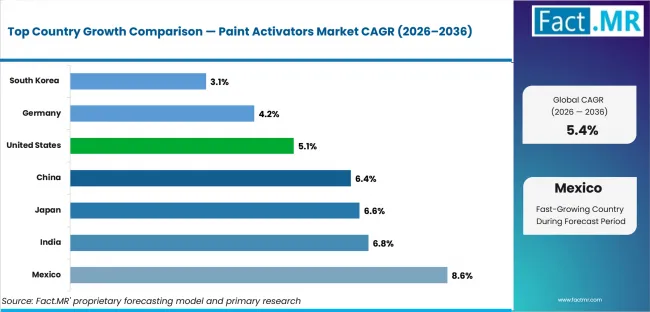
Paint Activators Market Cagr Analysis By Country | Source: Fact.MR
North America Paint Activators Market
The North America Paint Activators Market is projected to hold a considerable share owing to the strong demand for automotive refinishing, growing applications of industrial coatings, increasing usage of high-performance protective coatings, and the preference for low-VOC and environment-friendly coating technologies. Growing investments in innovative coatings chemistries to bring advanced products to the market, increasing infrastructure renovation activities, and demand for long-lasting automotive and industrial coatings are also driving the regional market growth.
- United States: Demand for paint activators in the United States is projected to rise at 5.1% CAGR through 2036. Growth is driven by increasing automotive refinishing activities, rising industrial coating demand, expanding infrastructure maintenance projects, and growing adoption of environmentally compliant coating systems.
- Canada: Demand for paint activators in Canada is projected to grow steadily through 2036, supported by increasing industrial manufacturing activities, rising use of corrosion-resistant protective coatings, and growing demand for low-VOC and water-based coating technologies.
Europe Paint Activators Market
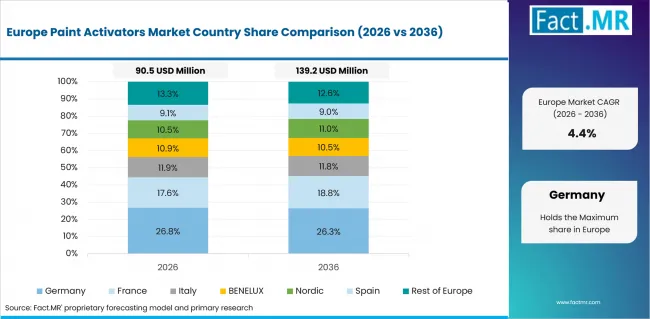
Paint Activators Market Europe Country Market Share Analysis, 2026 & 2036 | Source: Fact.MR
Strong market growth in Europe can be attributed to the growing penetration of sustainable coating solutions, increase in environmental regulations related to VOC emissions, increase in industrial coating applications, and demand for more superior automotive refinishing systems. The regulations on the environment-friendly formulations and worker’s safety requirements have brought low emission paint activators to be widely applied in this region.
- Germany: Demand for paint activators in Germany is projected to rise at 4.2% CAGR through 2036, supported by strong automotive manufacturing activities, increasing demand for industrial coatings, and rising adoption of environmentally compliant coating solutions.
- United Kingdom: Demand for paint activators in the United Kingdom is projected to grow steadily through 2036, driven by increasing infrastructure renovation projects, expanding protective coating applications, and growing use of sustainable coating technologies.
East Asia Paint Activators Market
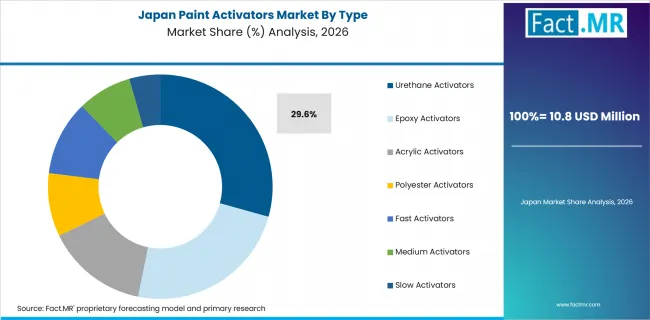
Paint Activators Market Japan Market Share Analysis By Type | Source: Fact.MR
The Paint Activators Market in East Asia is expected to witness high growth during the forecast period owing to rapid industrialization, growing automotive production, increasing construction activities, and growing investments in specialty coatings technologies. The burgeoning demand for protective, marine, and industrial coatings is also propelling the growth of the regional market.
- China: Demand for paint activators in China is projected to rise at 6.4% CAGR through 2036, driven by increasing automotive manufacturing, expanding industrial infrastructure, rising demand for protective coatings, and growing adoption of advanced coating technologies.
- Japan: Demand for paint activators in Japan is projected to rise at 6.6% CAGR through 2036, supported by increasing demand for high-performance industrial coatings, expanding automotive refinishing activities, and growing investments in sustainable coating technologies.
South Asia & Pacific Paint Activators Market
South Asia & Pacific is anticipated to be one of the rapidly expanding regions in the Paint Activators Market due to increasing urbanization, rising infrastructure development, expanding automotive production, and growing manufacturing investments. Rising awareness regarding durable and corrosion-resistant coatings is also supporting regional demand growth.
- India: Demand for paint activators in India is projected to rise at 6.8% CAGR through 2036, driven by increasing construction activities, growing automotive refinishing demand, expanding industrial coating applications, and rising investments in infrastructure development.
Latin America Paint Activators Market
The Latin America Paint Activators Market is estimated to witness robust growth, attributable to the growth in automobile manufacturing activities, escalating demand for industrial coatings, increasing construction activities, and wide application of protective coatings in various end-use industries. Regional players are focusing on developing cost-effective and sustainable coating solutions to enhance long-term market presence.
- Mexico: Demand for paint activators in Mexico is projected to rise at 8.6% CAGR through 2036, supported by expanding automotive production, increasing industrial manufacturing activities, rising demand for protective coatings, and growing investments in industrial infrastructure.
The Fact.MR report analyzes market trends, coating technology advancements, automotive refinishing demand patterns, industrial coating adoption trends, VOC compliance developments, competitive benchmarking, sustainable coating innovations, and long-term growth opportunities across individual countries in North America, Latin America, Europe, East Asia, South Asia & Pacific, and Middle East & Africa. Readers gain detailed insights into coating chemistry innovation, eco-friendly activator adoption, industrial coating expansion, environmental compliance trends, and future opportunities across the global paint activators market.
Competitive Benchmarking and Company Positioning
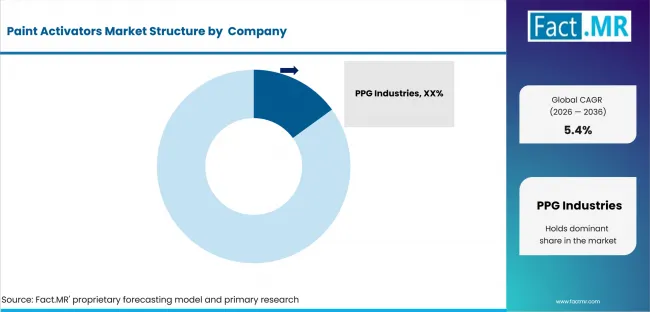
Paint Activators Market Analysis By Company | Source: Fact.MR
Leading Companies Shaping the Paint Activators Market
The paint activators industry is a moderately concentrated with the market participants focusing on the development of high performance coating chemistries, low-volatile organic compound (VOC) formulations, fast-curing technologies, and high-performance coatings solutions to strengthen their position in the market. Leading Market Players Including PPG Industries Sherwin-Williams Axalta Coating Systems BASF Akzo Nobel Nippon Paint Holdings, Kansai Paint Sika 3M Huntsman Corporation are putting their major investments in Automotive Refinish, Industrial Coatings and Protective Coating Application.
Growing focus towards sustainable coating technologies, water based formulations, corrosion protection, and environment friendly activator products is strengthening the market competition worldwide. In addition, new or expanded specialty coatings product offerings designed to enhance curing efficiency, adhesion performance and coating durability are also good strategies to remain competitive on these markets. The global demand for industrial, automotive, marine and aerospace coatings is on the rise, and these requirements are projected to fuel the growth and innovation potential of the global paint activators market over the coming years.
Recent Industry Developments
- AkzoNobel – Proposed Separation of Powder Coatings Business in India (2025)
- AkzoNobel proposed the separation of its Powder Coatings business from its Indian subsidiary to strengthen operational focus and enhance strategic growth opportunities in industrial coatings and specialty coating technologies. The move reflects increasing industry emphasis on advanced coating systems, sustainable coating solutions, and expansion of high-performance industrial coatings applications globally. The initiative is expected to support growing demand for powder coatings, specialty curing systems, and environmentally compliant coating technologies across manufacturing and industrial sectors. [1]
- BASF and Carlyle – Binding Transaction Agreement on Coatings Business (2025)
- BASF and Carlyle reached a binding transaction agreement for BASF’s automotive OEM coatings, automotive refinish coatings, and surface treatment businesses to strengthen strategic expansion in advanced coatings and specialty chemicals markets globally. The transaction supports increasing demand for high-performance automotive coatings, industrial coating technologies, and environmentally compliant coating systems across global manufacturing sectors. The agreement further reinforces growing investments in automotive refinishing innovation, specialty coating chemistries, and sustainable coating technologies within the Paint Activators Market. [2]
- BASF Coatings – Launch of Automotive OEM Coatings Plant in Muenster, Germany (2025)
- BASF Coatings launched a new automotive OEM coatings production plant in Muenster, Germany, to strengthen manufacturing capacity for advanced automotive coating systems and sustainable coating technologies. The facility expansion supports increasing demand for high-performance automotive coatings, fast-curing coating solutions, and environmentally compliant coating applications across Europe. The investment further reinforces BASF’s strategic focus on automotive refinishing, industrial coatings innovation, and advanced coating chemistry development globally. [3]
- PPG Industries – Renewal of India Joint Venture Agreement with Asian Paints (2025)
- PPG Industries renewed its joint venture agreement with Asian Paints for an additional 15 years to strengthen its presence in automotive, industrial, marine, and protective coatings markets in India. The agreement supports increasing demand for advanced coating technologies, high-performance industrial coatings, and automotive refinishing solutions across rapidly growing manufacturing and infrastructure sectors. The partnership further enhances PPG’s long-term strategy focused on sustainable coating technologies and specialty coatings expansion in Asia-Pacific markets. [4]
- Azelis and Milliken – Partnership for Polyurethane Colorant Distribution in India (2025)
- Azelis and Milliken partnered to distribute polyurethane colorant solutions in India to strengthen specialty coatings distribution and support growing demand for polyurethane-based coating technologies. The partnership reflects increasing adoption of advanced polyurethane coatings in automotive, industrial, and protective coating applications requiring high durability, fast curing, and superior chemical resistance. The initiative further reinforces growing investments in specialty coating chemistries and high-performance coating systems across the Indian coatings market. [5]
Leading Companies Shaping the Paint Activators Market
- PPG Industries
- Axalta Coating Systems
- Sherwin-Williams
- BASF
- Akzo Nobel
- Kansai Paint
- Nippon Paint Holdings
- Sika
- 3M
- Huntsman Corporation
Sources and Research References
- [1] AkzoNobel, “AkzoNobel Proposes to Separate Powder Coatings Business from its Indian Subsidiary”, 2025
- [2] Coatings World, “BASF and Carlyle Reach Binding Transaction Agreement on Coatings Business”, 2025
- [3] BASF Coatings, “BASF Coatings Launches New Automotive OEM Coatings Plant in Muenster, Germany”, 2025
- [4] PPG Industries, “PPG, Asian Paints Renew India Joint Venture in 15-Year Agreement”, 2025
- [5] Coatings World, “Azelis and Milliken Partner to Distribute Polyurethane Colorant Solutions in India”, 2025
Paint Activators Market Definition
Paint activators market is a segment of the paints, coatings, and specialty chemicals industry, which pertain to formulations of activator solutions that improve curing performance in coating systems, as well as increase adhesion, hardness, durability, and chemical resistance. Activators for paint are commonly used with epoxy, urethane, acrylic and polyester coatings in the fields of automotive refinishing, industrial coatings, marine coatings, aerospace coatings and protective coating applications. These are provided in water-based, solvent-based and low-VOC options and find end user application in automotive, building, manufacturing, aerospace & defense, marine and furniture among several others globally.
Paint Activators Market Inclusions
Paint activators market information is a comprehensive overview of this industry on a global and regional level and from the 2026-2036 perspective. It offers granular information on the type, formulation, packaging type, end-use industry, application, and region. The high-growth emerging market trends that are covered in this report include/low-VOC and green activator formulations, water-based coating technologies, fast-curing and high-durability coating systems, automotive refinishing and industrial coating market penetration, demand explosion for anti-corrosion protective coatings, and investments increasing in new coating chemistries and green specialty chemical solutions worldwide.
Paint Activators Market Exclusions
The global report on the paint activators market gives a comprehensive analysis of activator formulations for automotive, industrial, marine, aerospace, and protective coating systems that are based on epoxy, urethane, acrylic, and polyester chemistry. The study excludes traditional paints and coatings, which do not contain activator components, simple paint thinners and solvents, pigment and additive products, adhesive curing agents used in non-coating applications, pharmaceutical or chemical accelerators for non-coating, and industrial process chemicals for other applications.
Paint Activators Market Research Methodology
- Primary Research
- Fact.MR has evaluated the paint activators market in terms of value at the global and regional level, and at the country level by market segments. For a better understanding of the market scenario, the report covers the leading stake holders like paint activator manufacturers, coatings companies, specialty chemical suppliers, automotive refinishing companies, industrial coating manufacturers, distributors, raw material suppliers, coating technology experts and industry consultants.
- Desk Research
- The report contains information sourced from company annual reports, investor presentations, reports on coatings industry, journals on specialty chemicals, automotive refinishing, databases on industrial coatings, trade publications by government, and reports on industry of construction and manufacturing. Readers can also refer to studies on epoxy and urethane coating systems, low-VOC and green coating solutions, waterborne paint formulations, anti-corrosive coatings, marine and aerospace coatings and worldwide industrial coating demand patterns driving the growth of the market.
- Market-Sizing and Forecasting
- Fact.MR applies a blended methodology to assess the Paint Activators Market that includes a combination of bottom-up and top-down approaches for market analysis across various countries and associated regions. Information from manufacturers, suppliers, distributors, coating formulators, and specialty chemical companies has been considered to evaluate market potential and segment-wise opportunities.
- Data Validation and Update Cycle
- The market size has been verified through various primary dialogues with paint activator manufacturers, coatings companies, specialty chemical suppliers, distributors, and domain experts, and secondary research through studying company financials, trends in coating demand, activities in automotive refinishing, consumption of industrial coatings, investments in construction and manufacturing, and historical performance of the market.
- The market size has been verified through various primary dialogues with paint activator manufacturers, coatings companies, specialty chemical suppliers, distributors, and domain experts, and secondary research through studying company financials, trends in coating demand, activities in automotive refinishing, consumption of industrial coatings, investments in construction and manufacturing, and historical performance of the market.
Segmentation
Scope of Analysis
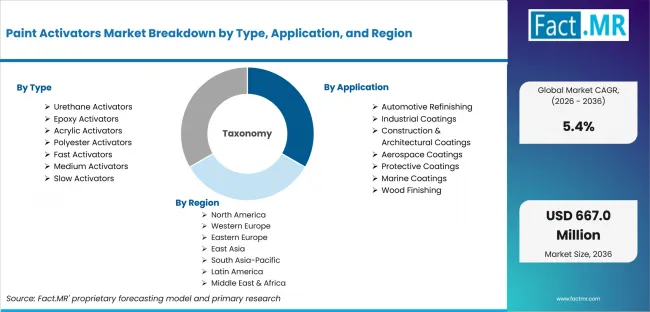
Paint Activators Market Breakdown By Type, Application, And Region | Source: Fact.MR
Parameter |
Details |
|---|---|
| Quantitative Units | USD 374.0 million (2025) to USD 667.0 million (2036), at a CAGR of 5.4% |
| Market Definition | The Paint Activators Market comprises chemical activator solutions used to enhance curing performance, adhesion, durability, gloss retention, and chemical resistance in automotive, industrial, marine, aerospace, and protective coating applications. These products include epoxy activators, urethane activators, acrylic activators, polyester activators, and other specialty curing systems formulated in water-based, solvent-based, and low-VOC formulations for high-performance coating applications across multiple industrial sectors. |
| Regions Covered | North America, Eastern Europe, Western Europe, East Asia, South Asia & Pacific, Latin America, Middle East & Africa |
| Countries Covered | United States, Canada, Germany, United Kingdom, China, Japan, India, Mexico, South Korea, and 20+ countries |
| Key Companies | PPG Industries, Sherwin-Williams, Axalta Coating Systems, BASF, Akzo Nobel, Nippon Paint Holdings, Kansai Paint, Sika, 3M, Huntsman Corporation |
| Forecast Period | 2026 to 2036 |
| Approach | Hybrid demand-side and top-down methodology based on automotive refinishing demand, industrial coating consumption trends, protective coating adoption, epoxy and polyurethane coating penetration, low-VOC and water-based coating technology adoption, infrastructure and manufacturing growth, environmental compliance trends, specialty chemical investments, and increasing demand for high-performance coating systems, validated through primary interviews with coating manufacturers, specialty chemical suppliers, distributors, automotive refinishing companies, industrial coating participants, and industry experts across major global regions. |
Source: Fact.MR analysis. Updated May 29, 2026
Analysis by Type, Formulation, Packaging Type, Application, End-Use Industry, and Region
-
Paint Activators Market by Type:
- Epoxy Activators
- Urethane Activators
- Acrylic Activators
- Polyester Activators
- Others
-
Paint Activators Market by Formulation:
- Water-Based
- Solvent-Based
- Low-VOC / Eco-Friendly Formulations
-
Paint Activators Market by Packaging Type:
- Cans
- Bottles
- Drums
- Bulk Containers
-
Paint Activators Market by Application:
- Automotive Refinishing
- Industrial Coatings
- Aerospace Coatings
- Marine Coatings
- Construction & Architectural Coatings
- Wood Finishing
- Protective Coatings
-
Paint Activators Market by End-Use Industry:
- Automotive
- Construction
- Manufacturing
- Aerospace & Defense
- Marine
- Furniture & Woodworking
- Electronics
-
Paint Activators Market by Region:
- North America
- USA
- Canada
- Mexico
- Latin America
- Brazil
- Chile
- Rest of LATAM
- East Asia
- China
- Japan
- South Korea
- Taiwan
- South Asia & Pacific
- India
- Singapore
- Australia
- ASEAN
- Western Europe
- Germany
- France
- U.K.
- Italy
- Spain
- BENELUX
- Nordic
- Rest of Western Europe
- Eastern Europe
- Poland
- Hungary
- Czech Republic
- Balkan & Baltics
- Rest of Eastern Europe
- Middle East and Africa
- Kingdom of Saudi Arabia
- United Arab Emirates
- South Africa
- Rest of Middle East and Africa
- North America
Frequently Asked Questions
How large is the demand for Paint Activators in the global market in 2025?
What will be the market size of the Paint Activators Market by 2036?
What is the expected demand growth for the Paint Activators Market between 2026 and 2036?
How significant is the growth outlook for India in this market?
Which company is identified as a leading player in the Paint Activators Market?
Who worked on this report


Preview the report firsthand - request a free sample
Free SampleGet the brochure for pricing and purchase details
Download PDF