Repaintable Anti-Graffiti Building Facade Coatings Market
Repaintable Anti-Graffiti Building Facade Coatings Market Size and Share Forecast Outlook 2026 to 2036
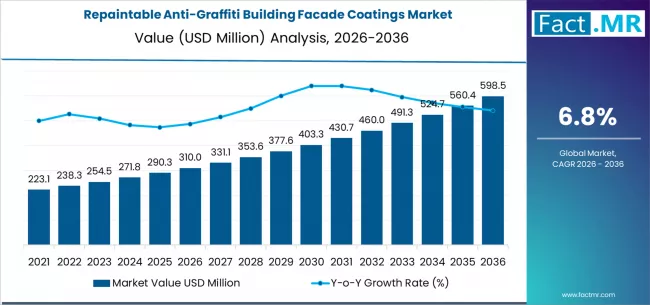
Tepaintable anti-graffiti building facade coatings market is projected to grow from USD 310.0 million in 2026 to USD 598.5 million by 2036, at a CAGR of 6.8%. Water-borne Acrylic Repaintable Systems will dominate with a 46.0% market share, while concrete or masonry facades will lead the surface substrate segment with a 52.0% share.
Repaintable Anti-Graffiti Building Facade Coatings Market Forecast and Outlook 2026 to 2036
The global repaintable anti-graffiti building facade coatings market is projected to reach USD 598.51 million by 2036. The market is valued at USD 310.00 million in 2026 and is set to rise at a CAGR of 6.8% during the assessment period.
By coating type, water-borne acrylic repaintable systems hold a leading 46% share. Concrete or masonry facades represent the dominant surface substrate at 52%, while professional contractor application is the primary method at 63.0%.
Key Takeaways from the Repaintable Anti-Graffiti Building Facade Coatings Market
- Market Value for 2026: USD 310.00 Million
- Market Value for 2036: USD 598.51 Million
- Forecast CAGR (2026-2036): 6.8%
- Leading Coating Type Share (2026): Water-borne Acrylic Repaintable Systems (46%)
- Leading Surface Substrate Share (2026): Concrete or Masonry Facades (52%)
- Leading Application Method Share (2026): Professional Contractor Application (63.0%)
- Key Players in the Market: Akzo Nobel N.V., PPG Industries Inc., RPM International (incl. Rust-Oleum), Sherwin-Williams, Hempel, KEIM Mineral Coatings
Defining trends involve the development of advanced hybrid and silicone-modified chemistries that offer enhanced dirt pickup resistance and long-term weatherability alongside graffiti removal properties. Innovation is focused on creating durable, breathable, and UV-stable coatings that maintain their protective and aesthetic qualities through multiple cleaning cycles. Integration of these coatings into holistic urban maintenance and asset preservation strategies for public and commercial buildings is becoming a key competitive strategy.
The primary market driver is the growing economic and aesthetic necessity for municipalities and property owners to protect valuable building facades from vandalism in urban areas. The demand for cost-effective, long-term solutions that allow for easy graffiti removal without damaging the underlying surface or requiring complete recoating creates sustained demand for high-performance, repaintable protective systems.
Repaintable Anti-Graffiti Building Facade Coatings Market
| Metric | Value |
|---|---|
| Market Value (2026) | USD 310.00 Million |
| Market Forecast Value (2036) | USD 598.51 Million |
| Forecast CAGR (2026-2036) | 6.8% |
Category
| Category | Segments |
|---|---|
| Coating Type | Water-borne Acrylic Repaintable Systems, Polyurethane or Hybrid Repaintable Systems, Silicone-modified Repaintable Systems |
| Surface Substrate | Concrete or Masonry Facades, Brick or Stone Cladding, Metal & Composite Panels |
| Application Method | Professional Contractor Application, Municipal Maintenance Crews, DIY or Small building owners |
| Region | North America, Latin America, Western Europe, Eastern Europe, East Asia, South Asia & Pacific, MEA |
Segmental Analysis
By Coating Type, Which Technology Balances Environmental Compliance with Effective Performance?
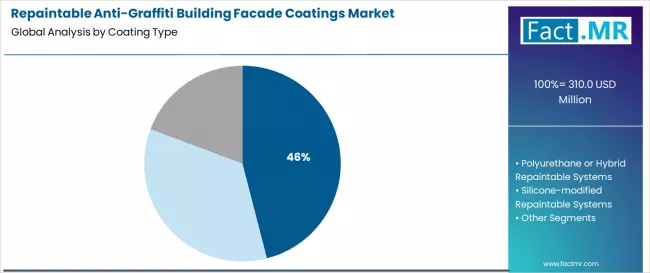
Water-borne acrylic repaintable systems lead the segment with a 46% share. This dominance is due to their low VOC content, ease of application and cleanup, good adhesion to mineral substrates, and ability to form a continuous, durable film that allows graffiti to be removed with appropriate cleaners or mild abrasives. Their balance of regulatory compliance, performance, and cost-effectiveness makes them the default choice for a wide range of public and commercial facade applications.
By Surface Substrate, Which Building Material Represents the Largest Addressable Area?
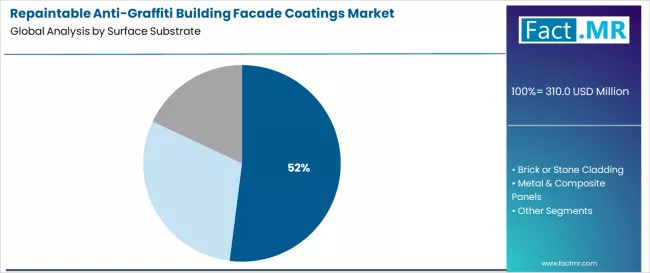
Concrete or masonry facades command the largest surface substrate share at 52%. These materials form the structural fabric of most urban commercial, institutional, and multi-residential buildings. Their porous nature makes them particularly vulnerable to graffiti penetration, necessitating a protective, non-porous coating barrier. The extensive surface area of these buildings in cities worldwide drives consistent, high-volume demand for effective anti-graffiti protection.
By Application Method, Which Channel Guarantees Technical Correctness and Warranty Compliance?
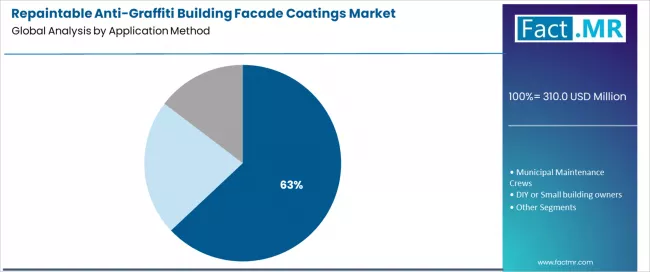
Professional contractor application represents the leading method at 63.0%. The correct performance of anti-graffiti coatings is highly dependent on precise surface preparation and controlled application to achieve the specified film thickness and integrity. Professional contractors possess the necessary skills, equipment, and knowledge of substrate compatibility to ensure the coating system performs as intended, which is critical for long-term protection and maintaining manufacturer warranties.
What are the Drivers, Restraints, and Key Trends of the Repaintable Anti-Graffiti Building Facade Coatings Market?
The increasing incidence of graffiti vandalism in urban centers and the associated high costs of removal drive market growth. Municipal ordinances and property owner mandates to maintain clean, attractive building facades for tourism and commerce create regulatory and economic pull. Furthermore, the rising value of architectural heritage and modern buildings incentivizes investment in protective measures that preserve aesthetic and structural integrity over decades.
A significant restraint is the performance limitation of some coatings in extreme climates or on challenging substrates, which can lead to premature failure. The higher initial cost of premium, multi-cycle repaintable systems compared to simple paints or sacrificial coatings can be a barrier for some budget-conscious projects. There is also a need for ongoing education among specifiers and maintenance teams on the proper selection and cleaning protocols for different coating types to avoid damage.
Key trends include the development of "invisible" or matte-finish coatings that provide protection without altering the facade's original appearance, which is crucial for historical buildings. There is growing integration of anti-graffiti properties with other functional benefits, such as photocatalytic self-cleaning or improved thermal insulation. The market is also seeing a rise in single-source supplier solutions that offer complete systems-including primers, topcoats, and dedicated cleaning agents-to guarantee performance.
Analysis of the Repaintable Anti-Graffiti Building Facade Coatings Market by Key Countries
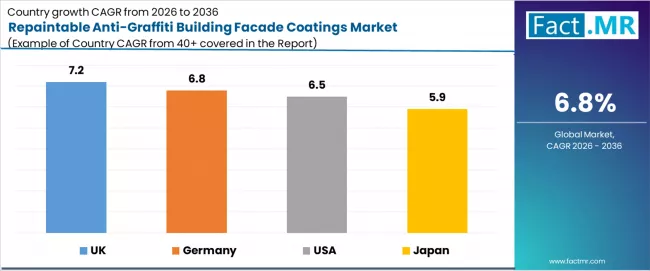
| Country | CAGR (2026-2036) |
|---|---|
| UK | 7.20% |
| Germany | 6.80% |
| USA | 6.50% |
| Japan | 5.90% |
How does the UK's Focus on Urban Regeneration and Heritage Conservation Drive Growth?
Extensive urban regeneration projects and a strong legislative framework for the preservation of historical buildings drive the UK’s 7.20% CAGR. The need to protect both new developments and heritage assets from vandalism in dense cities creates a sophisticated market for high-performance, aesthetically sensitive coating solutions that are endorsed by conservation authorities.
Why is Germany's Stringent Building Maintenance and Regulatory Culture a Key Driver?
Germany’s 6.80% growth reflects its culture of high-quality, long-term building maintenance and stringent product performance standards. German municipalities and property owners proactively invest in durable protective solutions. The country's strong chemical industry also fosters innovation in advanced polymer systems for facade protection.
What Role does the USA's Large Commercial Real Estate Portfolio and Municipal Programs Play?
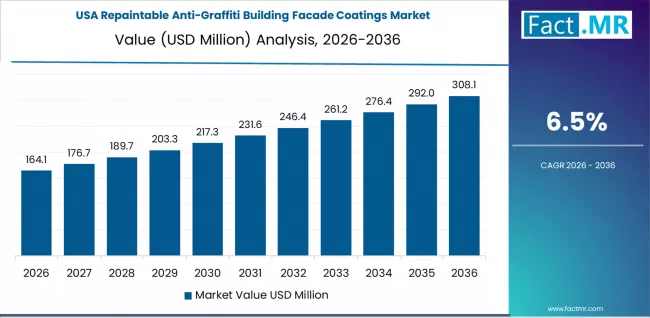
The USA's 6.50% growth is underpinned by its vast inventory of commercial and public buildings and active municipal graffiti abatement programs. Demand is driven by the need to reduce recurring maintenance costs for property owners and cities, fueling adoption of cost-effective, repaintable coatings for both new construction and refurbishment projects.
How does Japan's High Urban Density and Technological Adoption Influence the Market?
Japan’s 5.90% growth is supported by extremely high urban density and a propensity for adopting advanced material technologies. The focus on preserving property value and urban aesthetics in cities like Tokyo and Osaka drives demand for efficient, reliable protective coatings that can withstand frequent cleaning cycles.
Competitive Landscape of the Repaintable Anti-Graffiti Building Facade Coatings Market
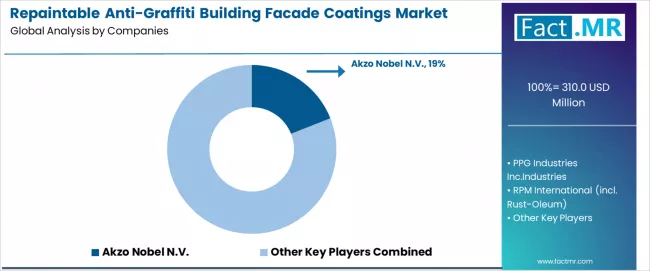
The competitive landscape is composed of global architectural paint majors and specialized protective coating manufacturers. Leading companies like Akzo Nobel N.V., PPG Industries Inc., and Sherwin-Williams compete through their extensive distribution networks, strong brand recognition in the professional painting sector, and broad portfolios that include dedicated anti-graffiti product lines.
Specialist firms like Hempel and KEIM Mineral Coatings compete with deep expertise in specific substrate technologies, such as mineral-based coatings for historical masonry. Competition centers on product performance data (number of guaranteed cleaning cycles), technical support for specifiers, educational resources for contractors, and the development of complete, easy-to-specify system solutions.
Key Players in the Repaintable Anti-Graffiti Building Facade Coatings Market
- Akzo Nobel N.V.
- PPG Industries Inc.
- RPM International (incl. Rust-Oleum)
- Sherwin-Williams
- Hempel
- KEIM Mineral Coatings
Scope of Report
| Items | Values |
|---|---|
| Quantitative Units | USD Million |
| Coating Type | Water-borne Acrylic Repaintable Systems, Polyurethane or Hybrid Repaintable Systems, Silicone-modified Repaintable Systems |
| Surface Substrate | Concrete or Masonry Facades, Brick or Stone Cladding, Metal & Composite Panels |
| Application Method | Professional Contractor Application, Municipal Maintenance Crews, DIY or Small building owners |
| Key Countries | UK, Germany, USA, Japan |
| Key Companies | Akzo Nobel N.V., PPG Industries Inc., RPM International (incl. Rust-Oleum), Sherwin-Williams, Hempel, KEIM Mineral Coatings |
| Additional Analysis | Analysis of cleaning cycle resistance and chemical compatibility; performance on historical vs. modern substrates; total cost of ownership models comparing different coating technologies; review of relevant environmental and safety regulations for urban application; and supply chain analysis for key resin and additive components. |
Repaintable Anti-Graffiti Building Facade Coatings Market by Segments
-
Coating Type :
- Water-borne Acrylic Repaintable Systems
- Polyurethane or Hybrid Repaintable Systems
- Silicone-modified Repaintable Systems
-
Surface Substrate :
- Concrete or Masonry Facades
- Brick or Stone Cladding
- Metal & Composite Panels
-
Application Method :
- Professional Contractor Application
- Municipal Maintenance Crews
- DIY or Small building owners
-
Region :
- North America
- USA
- Canada
- Latin America
- Brazil
- Mexico
- Argentina
- Rest of Latin America
- Western Europe
- Germany
- UK
- France
- Spain
- Italy
- BENELUX
- Rest of Western Europe
- Eastern Europe
- Russia
- Poland
- Czech Republic
- Rest of Eastern Europe
- East Asia
- China
- Japan
- South Korea
- Rest of East Asia
- South Asia & Pacific
- India
- ASEAN
- Australia
- Rest of South Asia & Pacific
- MEA
- Saudi Arabia
- UAE
- Turkiye
- Rest of MEA
- North America
Table of Content
- Executive Summary
- Global Market Outlook
- Demand to side Trends
- Supply to side Trends
- Technology Roadmap Analysis
- Analysis and Recommendations
- Market Overview
- Market Coverage / Taxonomy
- Market Definition / Scope / Limitations
- Market Background
- Market Dynamics
- Drivers
- Restraints
- Opportunity
- Trends
- Scenario Forecast
- Demand in Optimistic Scenario
- Demand in Likely Scenario
- Demand in Conservative Scenario
- Opportunity Map Analysis
- Product Life Cycle Analysis
- Supply Chain Analysis
- Investment Feasibility Matrix
- Value Chain Analysis
- PESTLE and Porter’s Analysis
- Regulatory Landscape
- Regional Parent Market Outlook
- Production and Consumption Statistics
- Import and Export Statistics
- Market Dynamics
- Global Market Analysis 2021 to 2025 and Forecast, 2026 to 2036
- Historical Market Size Value (USD Million) Analysis, 2021 to 2025
- Current and Future Market Size Value (USD Million) Projections, 2026 to 2036
- Y to o to Y Growth Trend Analysis
- Absolute $ Opportunity Analysis
- Global Market Pricing Analysis 2021 to 2025 and Forecast 2026 to 2036
- Global Market Analysis 2021 to 2025 and Forecast 2026 to 2036, By Coating Type
- Introduction / Key Findings
- Historical Market Size Value (USD Million) Analysis By Coating Type, 2021 to 2025
- Current and Future Market Size Value (USD Million) Analysis and Forecast By Coating Type, 2026 to 2036
- Water-borne Acrylic Repaintable Systems
- Polyurethane or Hybrid Repaintable Systems
- Silicone-modified Repaintable Systems
- Water-borne Acrylic Repaintable Systems
- Y to o to Y Growth Trend Analysis By Coating Type, 2021 to 2025
- Absolute $ Opportunity Analysis By Coating Type, 2026 to 2036
- Global Market Analysis 2021 to 2025 and Forecast 2026 to 2036, By Surface Substrate
- Introduction / Key Findings
- Historical Market Size Value (USD Million) Analysis By Surface Substrate, 2021 to 2025
- Current and Future Market Size Value (USD Million) Analysis and Forecast By Surface Substrate, 2026 to 2036
- Concrete or Masonry Facades
- Brick or Stone Cladding
- Metal & Composite Panels
- Concrete or Masonry Facades
- Y to o to Y Growth Trend Analysis By Surface Substrate, 2021 to 2025
- Absolute $ Opportunity Analysis By Surface Substrate, 2026 to 2036
- Global Market Analysis 2021 to 2025 and Forecast 2026 to 2036, By Application Method
- Introduction / Key Findings
- Historical Market Size Value (USD Million) Analysis By Application Method, 2021 to 2025
- Current and Future Market Size Value (USD Million) Analysis and Forecast By Application Method, 2026 to 2036
- Professional Contractor Application
- Municipal Maintenance Crews
- DIY or Small building owners
- Professional Contractor Application
- Y to o to Y Growth Trend Analysis By Application Method, 2021 to 2025
- Absolute $ Opportunity Analysis By Application Method, 2026 to 2036
- Global Market Analysis 2021 to 2025 and Forecast 2026 to 2036, By Region
- Introduction
- Historical Market Size Value (USD Million) Analysis By Region, 2021 to 2025
- Current Market Size Value (USD Million) Analysis and Forecast By Region, 2026 to 2036
- North America
- Latin America
- Western Europe
- Eastern Europe
- East Asia
- South Asia and Pacific
- Middle East & Africa
- Market Attractiveness Analysis By Region
- North America Market Analysis 2021 to 2025 and Forecast 2026 to 2036, By Country
- Historical Market Size Value (USD Million) Trend Analysis By Market Taxonomy, 2021 to 2025
- Market Size Value (USD Million) Forecast By Market Taxonomy, 2026 to 2036
- By Country
- USA
- Canada
- Mexico
- By Coating Type
- By Surface Substrate
- By Application Method
- By Country
- Market Attractiveness Analysis
- By Country
- By Coating Type
- By Surface Substrate
- By Application Method
- Key Takeaways
- Latin America Market Analysis 2021 to 2025 and Forecast 2026 to 2036, By Country
- Historical Market Size Value (USD Million) Trend Analysis By Market Taxonomy, 2021 to 2025
- Market Size Value (USD Million) Forecast By Market Taxonomy, 2026 to 2036
- By Country
- Brazil
- Chile
- Rest of Latin America
- By Coating Type
- By Surface Substrate
- By Application Method
- By Country
- Market Attractiveness Analysis
- By Country
- By Coating Type
- By Surface Substrate
- By Application Method
- Key Takeaways
- Western Europe Market Analysis 2021 to 2025 and Forecast 2026 to 2036, By Country
- Historical Market Size Value (USD Million) Trend Analysis By Market Taxonomy, 2021 to 2025
- Market Size Value (USD Million) Forecast By Market Taxonomy, 2026 to 2036
- By Country
- Germany
- UK
- Italy
- Spain
- France
- Nordic
- BENELUX
- Rest of Western Europe
- By Coating Type
- By Surface Substrate
- By Application Method
- By Country
- Market Attractiveness Analysis
- By Country
- By Coating Type
- By Surface Substrate
- By Application Method
- Key Takeaways
- Eastern Europe Market Analysis 2021 to 2025 and Forecast 2026 to 2036, By Country
- Historical Market Size Value (USD Million) Trend Analysis By Market Taxonomy, 2021 to 2025
- Market Size Value (USD Million) Forecast By Market Taxonomy, 2026 to 2036
- By Country
- Russia
- Poland
- Hungary
- Balkan & Baltic
- Rest of Eastern Europe
- By Coating Type
- By Surface Substrate
- By Application Method
- By Country
- Market Attractiveness Analysis
- By Country
- By Coating Type
- By Surface Substrate
- By Application Method
- Key Takeaways
- East Asia Market Analysis 2021 to 2025 and Forecast 2026 to 2036, By Country
- Historical Market Size Value (USD Million) Trend Analysis By Market Taxonomy, 2021 to 2025
- Market Size Value (USD Million) Forecast By Market Taxonomy, 2026 to 2036
- By Country
- China
- Japan
- South Korea
- By Coating Type
- By Surface Substrate
- By Application Method
- By Country
- Market Attractiveness Analysis
- By Country
- By Coating Type
- By Surface Substrate
- By Application Method
- Key Takeaways
- South Asia and Pacific Market Analysis 2021 to 2025 and Forecast 2026 to 2036, By Country
- Historical Market Size Value (USD Million) Trend Analysis By Market Taxonomy, 2021 to 2025
- Market Size Value (USD Million) Forecast By Market Taxonomy, 2026 to 2036
- By Country
- India
- ASEAN
- Australia & New Zealand
- Rest of South Asia and Pacific
- By Coating Type
- By Surface Substrate
- By Application Method
- By Country
- Market Attractiveness Analysis
- By Country
- By Coating Type
- By Surface Substrate
- By Application Method
- Key Takeaways
- Middle East & Africa Market Analysis 2021 to 2025 and Forecast 2026 to 2036, By Country
- Historical Market Size Value (USD Million) Trend Analysis By Market Taxonomy, 2021 to 2025
- Market Size Value (USD Million) Forecast By Market Taxonomy, 2026 to 2036
- By Country
- Kingdom of Saudi Arabia
- Other GCC Countries
- Turkiye
- South Africa
- Other African Union
- Rest of Middle East & Africa
- By Coating Type
- By Surface Substrate
- By Application Method
- By Country
- Market Attractiveness Analysis
- By Country
- By Coating Type
- By Surface Substrate
- By Application Method
- Key Takeaways
- Key Countries Market Analysis
- USA
- Pricing Analysis
- Market Share Analysis, 2025
- By Coating Type
- By Surface Substrate
- By Application Method
- Canada
- Pricing Analysis
- Market Share Analysis, 2025
- By Coating Type
- By Surface Substrate
- By Application Method
- Mexico
- Pricing Analysis
- Market Share Analysis, 2025
- By Coating Type
- By Surface Substrate
- By Application Method
- Brazil
- Pricing Analysis
- Market Share Analysis, 2025
- By Coating Type
- By Surface Substrate
- By Application Method
- Chile
- Pricing Analysis
- Market Share Analysis, 2025
- By Coating Type
- By Surface Substrate
- By Application Method
- Germany
- Pricing Analysis
- Market Share Analysis, 2025
- By Coating Type
- By Surface Substrate
- By Application Method
- UK
- Pricing Analysis
- Market Share Analysis, 2025
- By Coating Type
- By Surface Substrate
- By Application Method
- Italy
- Pricing Analysis
- Market Share Analysis, 2025
- By Coating Type
- By Surface Substrate
- By Application Method
- Spain
- Pricing Analysis
- Market Share Analysis, 2025
- By Coating Type
- By Surface Substrate
- By Application Method
- France
- Pricing Analysis
- Market Share Analysis, 2025
- By Coating Type
- By Surface Substrate
- By Application Method
- India
- Pricing Analysis
- Market Share Analysis, 2025
- By Coating Type
- By Surface Substrate
- By Application Method
- ASEAN
- Pricing Analysis
- Market Share Analysis, 2025
- By Coating Type
- By Surface Substrate
- By Application Method
- Australia & New Zealand
- Pricing Analysis
- Market Share Analysis, 2025
- By Coating Type
- By Surface Substrate
- By Application Method
- China
- Pricing Analysis
- Market Share Analysis, 2025
- By Coating Type
- By Surface Substrate
- By Application Method
- Japan
- Pricing Analysis
- Market Share Analysis, 2025
- By Coating Type
- By Surface Substrate
- By Application Method
- South Korea
- Pricing Analysis
- Market Share Analysis, 2025
- By Coating Type
- By Surface Substrate
- By Application Method
- Russia
- Pricing Analysis
- Market Share Analysis, 2025
- By Coating Type
- By Surface Substrate
- By Application Method
- Poland
- Pricing Analysis
- Market Share Analysis, 2025
- By Coating Type
- By Surface Substrate
- By Application Method
- Hungary
- Pricing Analysis
- Market Share Analysis, 2025
- By Coating Type
- By Surface Substrate
- By Application Method
- Kingdom of Saudi Arabia
- Pricing Analysis
- Market Share Analysis, 2025
- By Coating Type
- By Surface Substrate
- By Application Method
- Turkiye
- Pricing Analysis
- Market Share Analysis, 2025
- By Coating Type
- By Surface Substrate
- By Application Method
- South Africa
- Pricing Analysis
- Market Share Analysis, 2025
- By Coating Type
- By Surface Substrate
- By Application Method
- USA
- Market Structure Analysis
- Competition Dashboard
- Competition Benchmarking
- Market Share Analysis of Top Players
- By Regional
- By Coating Type
- By Surface Substrate
- By Application Method
- Competition Analysis
- Competition Deep Dive
- Akzo Nobel N.V.
- Overview
- Product Portfolio
- Profitability by Market Segments (Product/Age /Sales Channel/Region)
- Sales Footprint
- Strategy Overview
- Marketing Strategy
- Product Strategy
- Channel Strategy
- PPG Industries Inc.Industries
- RPM International (incl. Rust-Oleum)
- Sherwin-Williams
- Hempel
- KEIM Mineral Coatings
- Akzo Nobel N.V.
- Competition Deep Dive
- Assumptions & Acronyms Used
- Research Methodology
List Of Table
- Table 1: Global Market Value (USD Million) Forecast by Region, 2021 to 2036
- Table 2: Global Market Value (USD Million) Forecast by Coating Type, 2021 to 2036
- Table 3: Global Market Value (USD Million) Forecast by Surface Substrate, 2021 to 2036
- Table 4: Global Market Value (USD Million) Forecast by Application Method, 2021 to 2036
- Table 5: North America Market Value (USD Million) Forecast by Country, 2021 to 2036
- Table 6: North America Market Value (USD Million) Forecast by Coating Type, 2021 to 2036
- Table 7: North America Market Value (USD Million) Forecast by Surface Substrate, 2021 to 2036
- Table 8: North America Market Value (USD Million) Forecast by Application Method, 2021 to 2036
- Table 9: Latin America Market Value (USD Million) Forecast by Country, 2021 to 2036
- Table 10: Latin America Market Value (USD Million) Forecast by Coating Type, 2021 to 2036
- Table 11: Latin America Market Value (USD Million) Forecast by Surface Substrate, 2021 to 2036
- Table 12: Latin America Market Value (USD Million) Forecast by Application Method, 2021 to 2036
- Table 13: Western Europe Market Value (USD Million) Forecast by Country, 2021 to 2036
- Table 14: Western Europe Market Value (USD Million) Forecast by Coating Type, 2021 to 2036
- Table 15: Western Europe Market Value (USD Million) Forecast by Surface Substrate, 2021 to 2036
- Table 16: Western Europe Market Value (USD Million) Forecast by Application Method, 2021 to 2036
- Table 17: Eastern Europe Market Value (USD Million) Forecast by Country, 2021 to 2036
- Table 18: Eastern Europe Market Value (USD Million) Forecast by Coating Type, 2021 to 2036
- Table 19: Eastern Europe Market Value (USD Million) Forecast by Surface Substrate, 2021 to 2036
- Table 20: Eastern Europe Market Value (USD Million) Forecast by Application Method, 2021 to 2036
- Table 21: East Asia Market Value (USD Million) Forecast by Country, 2021 to 2036
- Table 22: East Asia Market Value (USD Million) Forecast by Coating Type, 2021 to 2036
- Table 23: East Asia Market Value (USD Million) Forecast by Surface Substrate, 2021 to 2036
- Table 24: East Asia Market Value (USD Million) Forecast by Application Method, 2021 to 2036
- Table 25: South Asia and Pacific Market Value (USD Million) Forecast by Country, 2021 to 2036
- Table 26: South Asia and Pacific Market Value (USD Million) Forecast by Coating Type, 2021 to 2036
- Table 27: South Asia and Pacific Market Value (USD Million) Forecast by Surface Substrate, 2021 to 2036
- Table 28: South Asia and Pacific Market Value (USD Million) Forecast by Application Method, 2021 to 2036
- Table 29: Middle East & Africa Market Value (USD Million) Forecast by Country, 2021 to 2036
- Table 30: Middle East & Africa Market Value (USD Million) Forecast by Coating Type, 2021 to 2036
- Table 31: Middle East & Africa Market Value (USD Million) Forecast by Surface Substrate, 2021 to 2036
- Table 32: Middle East & Africa Market Value (USD Million) Forecast by Application Method, 2021 to 2036
List Of Figures
- Figure 1: Global Market Pricing Analysis
- Figure 2: Global Market Value (USD Million) Forecast 2021 to 2036
- Figure 3: Global Market Value Share and BPS Analysis by Coating Type, 2026 and 2036
- Figure 4: Global Market Y to o to Y Growth Comparison by Coating Type, 2026 to 2036
- Figure 5: Global Market Attractiveness Analysis by Coating Type
- Figure 6: Global Market Value Share and BPS Analysis by Surface Substrate, 2026 and 2036
- Figure 7: Global Market Y to o to Y Growth Comparison by Surface Substrate, 2026 to 2036
- Figure 8: Global Market Attractiveness Analysis by Surface Substrate
- Figure 9: Global Market Value Share and BPS Analysis by Application Method, 2026 and 2036
- Figure 10: Global Market Y to o to Y Growth Comparison by Application Method, 2026 to 2036
- Figure 11: Global Market Attractiveness Analysis by Application Method
- Figure 12: Global Market Value (USD Million) Share and BPS Analysis by Region, 2026 and 2036
- Figure 13: Global Market Y to o to Y Growth Comparison by Region, 2026 to 2036
- Figure 14: Global Market Attractiveness Analysis by Region
- Figure 15: North America Market Incremental Dollar Opportunity, 2026 to 2036
- Figure 16: Latin America Market Incremental Dollar Opportunity, 2026 to 2036
- Figure 17: Western Europe Market Incremental Dollar Opportunity, 2026 to 2036
- Figure 18: Eastern Europe Market Incremental Dollar Opportunity, 2026 to 2036
- Figure 19: East Asia Market Incremental Dollar Opportunity, 2026 to 2036
- Figure 20: South Asia and Pacific Market Incremental Dollar Opportunity, 2026 to 2036
- Figure 21: Middle East & Africa Market Incremental Dollar Opportunity, 2026 to 2036
- Figure 22: North America Market Value Share and BPS Analysis by Country, 2026 and 2036
- Figure 23: North America Market Value Share and BPS Analysis by Coating Type, 2026 and 2036
- Figure 24: North America Market Y to o to Y Growth Comparison by Coating Type, 2026 to 2036
- Figure 25: North America Market Attractiveness Analysis by Coating Type
- Figure 26: North America Market Value Share and BPS Analysis by Surface Substrate, 2026 and 2036
- Figure 27: North America Market Y to o to Y Growth Comparison by Surface Substrate, 2026 to 2036
- Figure 28: North America Market Attractiveness Analysis by Surface Substrate
- Figure 29: North America Market Value Share and BPS Analysis by Application Method, 2026 and 2036
- Figure 30: North America Market Y to o to Y Growth Comparison by Application Method, 2026 to 2036
- Figure 31: North America Market Attractiveness Analysis by Application Method
- Figure 32: Latin America Market Value Share and BPS Analysis by Country, 2026 and 2036
- Figure 33: Latin America Market Value Share and BPS Analysis by Coating Type, 2026 and 2036
- Figure 34: Latin America Market Y to o to Y Growth Comparison by Coating Type, 2026 to 2036
- Figure 35: Latin America Market Attractiveness Analysis by Coating Type
- Figure 36: Latin America Market Value Share and BPS Analysis by Surface Substrate, 2026 and 2036
- Figure 37: Latin America Market Y to o to Y Growth Comparison by Surface Substrate, 2026 to 2036
- Figure 38: Latin America Market Attractiveness Analysis by Surface Substrate
- Figure 39: Latin America Market Value Share and BPS Analysis by Application Method, 2026 and 2036
- Figure 40: Latin America Market Y to o to Y Growth Comparison by Application Method, 2026 to 2036
- Figure 41: Latin America Market Attractiveness Analysis by Application Method
- Figure 42: Western Europe Market Value Share and BPS Analysis by Country, 2026 and 2036
- Figure 43: Western Europe Market Value Share and BPS Analysis by Coating Type, 2026 and 2036
- Figure 44: Western Europe Market Y to o to Y Growth Comparison by Coating Type, 2026 to 2036
- Figure 45: Western Europe Market Attractiveness Analysis by Coating Type
- Figure 46: Western Europe Market Value Share and BPS Analysis by Surface Substrate, 2026 and 2036
- Figure 47: Western Europe Market Y to o to Y Growth Comparison by Surface Substrate, 2026 to 2036
- Figure 48: Western Europe Market Attractiveness Analysis by Surface Substrate
- Figure 49: Western Europe Market Value Share and BPS Analysis by Application Method, 2026 and 2036
- Figure 50: Western Europe Market Y to o to Y Growth Comparison by Application Method, 2026 to 2036
- Figure 51: Western Europe Market Attractiveness Analysis by Application Method
- Figure 52: Eastern Europe Market Value Share and BPS Analysis by Country, 2026 and 2036
- Figure 53: Eastern Europe Market Value Share and BPS Analysis by Coating Type, 2026 and 2036
- Figure 54: Eastern Europe Market Y to o to Y Growth Comparison by Coating Type, 2026 to 2036
- Figure 55: Eastern Europe Market Attractiveness Analysis by Coating Type
- Figure 56: Eastern Europe Market Value Share and BPS Analysis by Surface Substrate, 2026 and 2036
- Figure 57: Eastern Europe Market Y to o to Y Growth Comparison by Surface Substrate, 2026 to 2036
- Figure 58: Eastern Europe Market Attractiveness Analysis by Surface Substrate
- Figure 59: Eastern Europe Market Value Share and BPS Analysis by Application Method, 2026 and 2036
- Figure 60: Eastern Europe Market Y to o to Y Growth Comparison by Application Method, 2026 to 2036
- Figure 61: Eastern Europe Market Attractiveness Analysis by Application Method
- Figure 62: East Asia Market Value Share and BPS Analysis by Country, 2026 and 2036
- Figure 63: East Asia Market Value Share and BPS Analysis by Coating Type, 2026 and 2036
- Figure 64: East Asia Market Y to o to Y Growth Comparison by Coating Type, 2026 to 2036
- Figure 65: East Asia Market Attractiveness Analysis by Coating Type
- Figure 66: East Asia Market Value Share and BPS Analysis by Surface Substrate, 2026 and 2036
- Figure 67: East Asia Market Y to o to Y Growth Comparison by Surface Substrate, 2026 to 2036
- Figure 68: East Asia Market Attractiveness Analysis by Surface Substrate
- Figure 69: East Asia Market Value Share and BPS Analysis by Application Method, 2026 and 2036
- Figure 70: East Asia Market Y to o to Y Growth Comparison by Application Method, 2026 to 2036
- Figure 71: East Asia Market Attractiveness Analysis by Application Method
- Figure 72: South Asia and Pacific Market Value Share and BPS Analysis by Country, 2026 and 2036
- Figure 73: South Asia and Pacific Market Value Share and BPS Analysis by Coating Type, 2026 and 2036
- Figure 74: South Asia and Pacific Market Y to o to Y Growth Comparison by Coating Type, 2026 to 2036
- Figure 75: South Asia and Pacific Market Attractiveness Analysis by Coating Type
- Figure 76: South Asia and Pacific Market Value Share and BPS Analysis by Surface Substrate, 2026 and 2036
- Figure 77: South Asia and Pacific Market Y to o to Y Growth Comparison by Surface Substrate, 2026 to 2036
- Figure 78: South Asia and Pacific Market Attractiveness Analysis by Surface Substrate
- Figure 79: South Asia and Pacific Market Value Share and BPS Analysis by Application Method, 2026 and 2036
- Figure 80: South Asia and Pacific Market Y to o to Y Growth Comparison by Application Method, 2026 to 2036
- Figure 81: South Asia and Pacific Market Attractiveness Analysis by Application Method
- Figure 82: Middle East & Africa Market Value Share and BPS Analysis by Country, 2026 and 2036
- Figure 83: Middle East & Africa Market Value Share and BPS Analysis by Coating Type, 2026 and 2036
- Figure 84: Middle East & Africa Market Y to o to Y Growth Comparison by Coating Type, 2026 to 2036
- Figure 85: Middle East & Africa Market Attractiveness Analysis by Coating Type
- Figure 86: Middle East & Africa Market Value Share and BPS Analysis by Surface Substrate, 2026 and 2036
- Figure 87: Middle East & Africa Market Y to o to Y Growth Comparison by Surface Substrate, 2026 to 2036
- Figure 88: Middle East & Africa Market Attractiveness Analysis by Surface Substrate
- Figure 89: Middle East & Africa Market Value Share and BPS Analysis by Application Method, 2026 and 2036
- Figure 90: Middle East & Africa Market Y to o to Y Growth Comparison by Application Method, 2026 to 2036
- Figure 91: Middle East & Africa Market Attractiveness Analysis by Application Method
- Figure 92: Global Market - Tier Structure Analysis
- Figure 93: Global Market - Company Share Analysis
- FAQs -
How big is the repaintable anti-graffiti building facade coatings market in 2026?
The global low-temperature cure coil coatings for heat-sensitive substrates market is estimated to be valued at USD 60.0 million in 2026.
What will be the size of repaintable anti-graffiti building facade coatings market in 2036?
The market size for the low-temperature cure coil coatings for heat-sensitive substrates market is projected to reach USD 110.5 million by 2036.
How much will be the repaintable anti-graffiti building facade coatings market growth between 2026 and 2036?
The low-temperature cure coil coatings for heat-sensitive substrates market is expected to grow at a 6.3% CAGR between 2026 and 2036.
What are the key product types in the repaintable anti-graffiti building facade coatings market?
The key product types in low-temperature cure coil coatings for heat-sensitive substrates market are uv or eb-curable (energy-cure) coil coatings, low-temperature polyester (low-bake), low-temperature epoxy (modified resins), powder coatings formulated for low cure (irorinduction assist), sol-gel or ceramic hybrid low-temp systems, waterborne or low-temp aqueous systems and primer or conversion coatings for adhesion on heat-sensitive substrates.
Which surface substrate segment to contribute significant share in the repaintable anti-graffiti building facade coatings market in 2026?
In terms of heat-sensitive substrate, thin gauge plastics or polymer-clad strips segment to command 28.0% share in the low-temperature cure coil coatings for heat-sensitive substrates market in 2026.