- Market Value (2025): USD 193.8 Mn
- Estimated Value (2026): USD 202.1 Mn
- Forecast Value (2036): USD 308.5 Mn
- CAGR (2026-2036): 4.3%
What is the Palm Kernel Fatty Acid Diethanolamide Market forecast to be worth by 2036?
USD 202.1 million in 2026 to USD 308.5 million by 2036, at a 4.3% CAGR.
- According to Fact.MR analysis, the palm kernel fatty acid diethanolamide market reached USD 193.8 million in 2025.
- Demand will increase from USD 202.1 million in 2026 to USD 308.5 million by 2036.
- The market is forecast to record a 4.3% CAGR from 2026 to 2036 as producers serve personal care and selected cleaning formulations.
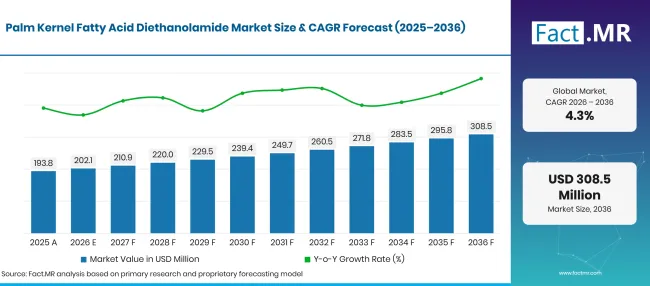
Factmr Palm Kernel Fatty Acid Diethanolamide Market Forecast Global | Source: Fact.MR
| Year | Basis | Market Value (USD million) |
|---|---|---|
| 2025 | Actual | 193.8 |
| 2026 | Estimate | 202.1 |
| 2036 | Forecast | 308.5 |
| CAGR 2026 to 2036 | Forecast period | 4.3% |
Source: Fact.MR analysis. Updated Oct 19, 2026
What are the defining numbers behind Palm Kernel Fatty Acid Diethanolamide Market growth?
USD 106.4 million absolute opportunity by 2036.
- Demand Drivers in the Market
- Formulators of shampoo and hand wash use fatty acid diethanolamides when a product needs predictable thickening and stable foam during normal use.
- Household-cleaning product teams value ingredients that adjust viscosity without requiring a major redesign of their existing liquid base.
- Ingredient buying teams compare available palm-kernel-derived feedstock against the cost of competing surfactant inputs. The Malaysian Palm Oil Board recorded 1,082,925 tonnes of palm kernel oil exports in 2025 [1].
- Cosmetics quality teams check residual amines and controls on nitrosamine formation before approving a diethanolamide ingredient. Clear impurity data and batch records therefore matter alongside foam and thickness performance.
- Key Segments Analyzed
- By Product Type: Liquid PKFAD represents 72.4% share in 2026 as liquid-product formulators favor easier handling during blending.
- By Application: Personal Care and Cosmetics represent 45.3% share in 2026, reflecting its thickening and foam-stabilizing uses.
- By End-User Industry: Cosmetics and Personal Care holds 51.2% share in 2026 as ingredient specifications depend on skin-contact formulations.
- Analyst Opinion at Fact.MR
- Shambhu Nath Jha, Principal Consultant at Fact.MR, states, “For PKFAD buyers, the main question is whether an ingredient delivers consistent results in the finished formula while meeting impurity limits. Suppliers can make approvals easier by connecting feedstock records with batch-specific tests.”
- Strategic Implications
- Ingredient makers should show how their PKFAD grades affect foam and thickness in the cleansing blends for which they are intended. Clear test results give customers a practical basis for comparing suppliers.
- Personal care teams need to review the finished formula for nitrosamine-related restrictions before replacing a raw material. A new ingredient must meet the same safety and performance requirements as the approved blend.
- Distributors should keep batch records available for customers checking the origin of palm-derived ingredients. These records also help manufacturers complete their regular supplier and formulation reviews.
- Cleaning-product brands should compare the cost of the complete formula before switching to a cheaper thickener. Any savings depend on whether the replacement also meets the required performance and quality tests.
The United States may grow at 4.9% CAGR, followed by Brazil at 4.4%. Germany is projected at 3.7%, the United Kingdom at 3.4%, and Japan at 3.0%.
How does the Palm Kernel Fatty Acid Diethanolamide Market break down by segment?
Liquid PKFAD lead with 72.4%; Personal Care and Cosmetics hold 45.3% share in 2026.
Which Product Type holds the larger share?
Liquid PKFAD holds 72.4% share in 2026.
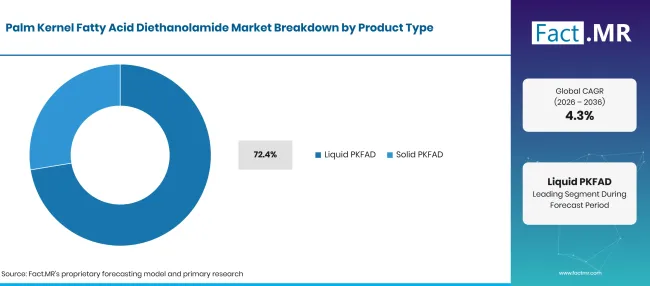
Factmr Palm Kernel Fatty Acid Diethanolamide Market Breakdown Product Type | Source: Fact.MR
| Product Type | Share (2026) |
|---|---|
| Liquid PKFAD (Leading segment) | 72.4% |
| Other segments combined | 27.6% |
| Total | 100.0% |
Source: Fact.MR analysis. Updated Oct 19, 2026
Liquid PKFAD is forecast to take the larger share because it fits routine mixing and transfer practices in liquid cleansing production. Operators can add a fluid ingredient during blending and adjust the concentration against a target viscosity. Solid PKFAD remains another offered physical form where storage or formulation preferences differ. In either case, usable concentration and handling temperature deserve closer attention than the physical form alone.
What leads the Application segment?
Personal Care and Cosmetics account for 45.3% share in 2026.
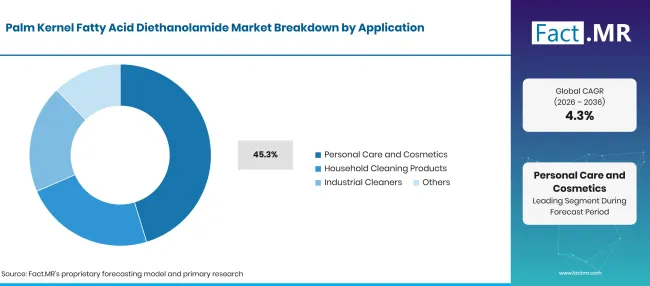
Factmr Palm Kernel Fatty Acid Diethanolamide Market Breakdown Application | Source: Fact.MR
| Application | Share (2026) |
|---|---|
| Personal Care and Cosmetics (Leading segment) | 45.3% |
| Other segments combined | 54.7% |
| Total | 100.0% |
Source: Fact.MR analysis. Updated Oct 19, 2026
Personal Care and Cosmetics is projected to hold the principal application share. Shampoo and hand wash products require a specific balance between foam behavior and pouring thickness, so formulators compare the full ingredient mix before approval. Household Cleaning Products and Industrial Cleaners form the remaining listed applications.
How does End-User Industry affect buying?
Cosmetics and Personal Care leads with 51.2% share in 2026.
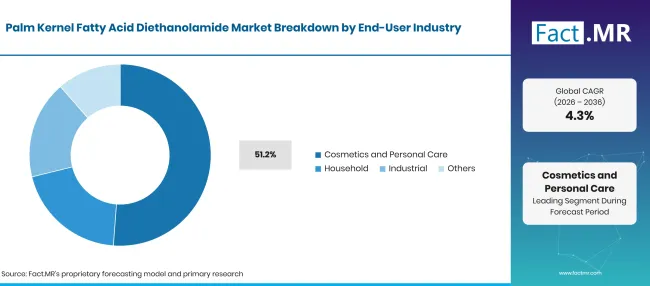
Factmr Palm Kernel Fatty Acid Diethanolamide Market Breakdown End User Industry | Source: Fact.MR
| End-User Industry | Share (2026) |
|---|---|
| Cosmetics and Personal Care (Leading segment) | 51.2% |
| Other segments combined | 48.8% |
| Total | 100.0% |
Source: Fact.MR analysis. Updated Oct 19, 2026
Cosmetics and Personal Care lead the end-use industry in 2026. This buyer group pays attention to consistent viscosity because consumers notice changes in how a cleanser dispenses and foams. Household cleaning manufacturers also use foam-related ingredients where their formulations call for them. Industrial customers tend to evaluate cleaning performance against process requirements and handling costs.
What is accelerating Palm Kernel Fatty Acid Diethanolamide Market adoption, and what is holding it back?
PKFAD sales are supported by the need for stable foam and product thickness, while impurity controls and competing ingredients affect supplier selection.
Drivers Impact Analysis
| DRIVER | (~) % IMPACT ON CAGR | GEOGRAPHIC RELEVANCE | IMPACT TIMELINE |
|---|---|---|---|
| Shampoo viscosity requirements | +1.0% | Global | Medium term (2–4 years) |
| Foam stability in washes | +0.8% | Global | Medium term (2–4 years) |
| Liquid blending convenience | +0.7% | Global | Short term (<= 2 years) |
| Raw-material availability | +0.5% | Asia and importing markets | Medium term (2–4 years) |
| Customer formulation retention | +0.4% | Global | Long term (>= 4 years) |
Source: Fact.MR analysis. Updated Oct 19, 2026
Opportunity Impact Analysis
| OPPORTUNITY | (~) % IMPACT ON CAGR | GEOGRAPHIC RELEVANCE | IMPACT TIMELINE |
|---|---|---|---|
| Verified grade consistency | +0.8% | Global | Medium term (2–4 years) |
| Personal care formulation support | +0.6% | Europe and Americas | Medium term (2–4 years) |
| Distributor technical service | +0.5% | Global | Short term (<= 2 years) |
| Supply-chain visibility | +0.4% | Asia to global markets | Long term (>= 4 years) |
Source: Fact.MR analysis. Updated Oct 19, 2026
Restraints Impact Analysis
| RESTRAINT | (~) % IMPACT ON CAGR | GEOGRAPHIC RELEVANCE | IMPACT TIMELINE |
|---|---|---|---|
| Nitrosamine and amine control | -0.8% | Europe and regulated markets | Short term (<= 2 years) |
| Alternative surfactants | -0.6% | Global | Long term (>= 4 years) |
| Input-price variation | -0.5% | Global | Short term (<= 2 years) |
| Requalification time | -0.4% | Global | Medium term (2–4 years) |
Source: Fact.MR analysis. Updated Oct 19, 2026
Which countries are scaling the Palm Kernel Fatty Acid Diethanolamide Market through 2036?
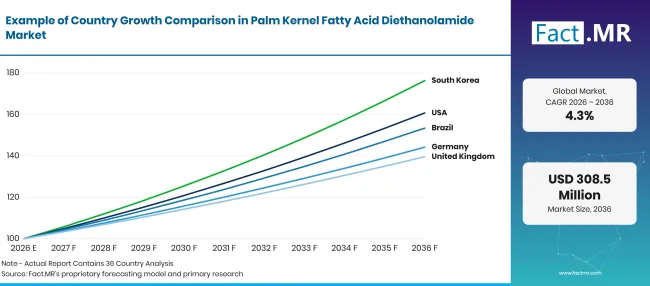
Factmr Palm Kernel Fatty Acid Diethanolamide Market Growth Index | Source: Fact.MR
| Country | CAGR (2026–2036) |
|---|---|
| United States | 4.9% |
| Brazil | 4.4% |
| Germany | 3.7% |
| United Kingdom | 3.4% |
| Japan | 3.0% |
Source: Fact.MR analysis. Updated Oct 19, 2026
What supports PKFAD purchasing in the United States?
4.9% CAGR, linked to quality checks for cleansing ingredients.
American formulators of shampoo and hand wash may keep testing palm kernel fatty acid diethanolamide against the texture and foam requirements of finished products. The United States has established soap and personal care manufacturing activities, giving ingredient distributors an outlet for qualified grades.
How is Brazil shaping PKFAD sales?
4.4% CAGR, influenced by local cosmetics production and ingredient handling.
Brazilian cosmetics manufacturers weigh foam performance against the delivered cost of specialty ingredients when designing liquid cleansing products. In its 2025 management report, Anvisa recorded 72,390 new notifications for cosmetic products exempt from registration [4]. That activity provides a useful view of the local product development environment without treating all notified products as PKFAD customers.
What shapes German ingredient selection?
3.7% CAGR, shaped by cosmetics specifications and EU ingredient rules.
German cosmetics teams examine how a palm-kernel-derived diethanolamide performs alongside the other surfactants in a finished cleanser. Cosmetics Europe reported a German cosmetics and personal care retail market of EUR 18.0 billion in 2025 [2]. Within the European Union, manufacturers must check the conditions applying to fatty acid dialkanolamides and nitrosamine formation.
Why are UK buyers selective about PKFAD?
3.4% CAGR, influenced by formula performance and ingredient qualification.
British personal care producers may judge PKFAD by how reliably it controls the thickness and foaming of a finished cleanser. The Office for National Statistics reported GBP 7,664.1 million in 2025 UK manufacturing turnover for soap, detergents, cleaning and polishing products, and perfumes [3]. That broad production category gives context to the downstream market for cleaning ingredients.
How does Japan approach PKFAD formulation choices?
3.0% CAGR, linked to careful grade selection and stable formulations.
Japanese shampoo and personal wash manufacturers tend to place close attention on repeatable texture and batch performance when assessing a new ingredient. The Japan Cosmetic Industry Association reported in September 2026 that domestic cosmetics shipments reached JPY 1.3907 trillion in 2025 [5]. Those shipments describe the wider cosmetics industry and give context to formulation work, rather than PKFAD sales.
Who leads the Palm Kernel Fatty Acid Diethanolamide Market?
KLK OLEO gives a direct product example through its PALMOCOL palm kernelamide DEA grades, which are offered for thickening and foam control in cleansing formulations. Other businesses across oleochemicals and specialty ingredients include Croda International Plc, BASF SE, and Stepan Company. Product-level participation needs to be distinguished from broader surfactant or fatty acid manufacturing.
Competitive selection depends on whether a supplier can supply an appropriate grade with steady quality and clear batch records. Musim Mas Holdings, and Wilmar International Ltd. form part of the wider oleochemical supply landscape. Their material portfolios illustrate how feedstock and ingredient supply overlap across specialty chemical distribution.
Which companies are the key providers?
Key companies include Croda International Plc; BASF SE; KLK OLEO; Stepan Company; Musim Mas Holdings; Wilmar International Ltd.
- Croda International Plc
- BASF SE
- KLK OLEO
- Stepan Company
- Musim Mas Holdings
- Wilmar International Ltd.
Bibliography
- [1] Malaysian Palm Oil Board. (2026). Overview of the Malaysian oil palm industry in 2025.
- [2] Cosmetics Europe. (n.d.). Our industry.
- [3] Office for National Statistics. (2026, October 15). UKProdTO: 20.4 - Manuf soap/detergents, cleaning/polishing, perfume TOTAL (£m).
- [4] Agência Nacional de Vigilância Sanitária. (2026, April 30). Sumário Executivo 2025.
- [5] Japan Cosmetic Industry Association. (2026, September 17).[Cosmetics shipments].
- [6] KLK OLEO. (n.d.). PALMOCOL Alkanolamides.
- [7] European Parliament & Council of the European Union. (2009, November 30). Regulation (EC) No 1223/2009 on cosmetic products. Official Journal of the European Union, L 342, 59–209.
This Report Answers
- The report reviews how PKFAD grades differ by physical form and their handling during cleansing-product manufacturing.
- Application analysis considers the role of PKFAD in personal care formulas and selected household cleaning products.
- Country comparison relates downstream manufacturing conditions to the approval of palm-derived surfactant ingredients.
- Competitive analysis distinguishes identified diethanolamide products from suppliers active elsewhere in oleochemicals.
- The outlook examines why feedstock sourcing and product testing influence repeat purchases.
What does the Palm Kernel Fatty Acid Diethanolamide Market cover?
The market covers palm kernel fatty acid diethanolamide sold as an ingredient for suitable cleansing and cleaning formulations.
It includes liquid and solid products identified within the report segmentation, while the application categories capture the planned use of the ingredient. A related upstream category is the oleochemicals industry, where fatty acid feedstocks supply several downstream chemical derivatives.
What is included in the scope?
Ingredient sales enter the scope when palm-kernel-derived fatty acid diethanolamide is supplied for an eligible formulation.
Personal care covers cosmetic cleansers within applicable safety requirements. Household and industrial cleaning uses are included where the product is selected as a functional surfactant-related ingredient. The analysis separates ingredient value from sales of finished shampoos or detergents, which would otherwise count downstream value twice.
What is excluded from the scope?
Sales of raw palm kernel oil are outside the finished PKFAD ingredient boundary.
Other fatty acid amides and ethoxylated surfactants remain separate products even when they compete for similar thickening functions. Finished personal care goods and complete household cleaners are excluded unless their ingredient portion is counted within the stated PKFAD measure.
How Was the Analysis Built?
The analysis draws on 120+ sources, 35+ company portfolios, 25+ countries, and more than 20 industry interviews.
- Primary Research: Primary research includes discussions with manufacturers, service providers, technology developers, distributors, end users, and subject-matter experts. These conversations examine purchasing priorities, product adoption, operational challenges, approval requirements, competitive positioning, and the factors that influence wider market acceptance.
- Desk Research: Desk research covers government statistics, regulatory publications, company filings, trade data, technical studies, industry associations, standards, public policy, and other authoritative sources. Every source used in the analysis is documented in the bibliography.
- Market Sizing and Forecasting: Market estimates combine historical performance, demand indicators, pricing and volume trends, segment shares, company participation, country-level growth, adoption patterns, investment activity, and barriers to market expansion.
- Data Validation and Update Cycle: Findings are validated by comparing primary interviews with public data, company activity, regulatory changes, trade patterns, and industry developments. Regular updates review new product launches, capacity changes, partnerships, approvals, and shifts in commercial adoption.
Segmentation
What is the report’s scope and coverage?
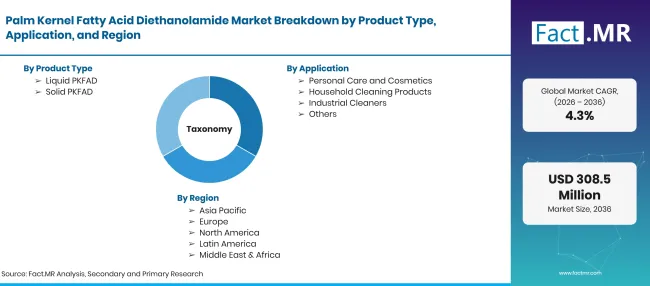
Factmr Palm Kernel Fatty Acid Diethanolamide Market Taxonomy | Source: Fact.MR
| Attribute | Details |
|---|---|
| Quantitative Units | USD million in 2026 to USD million by 2036 at a CAGR |
| Market Definition | Palm-kernel-fatty-acid-derived diethanolamide ingredients sold for use in suitable cleansing, personal care, and cleaning formulations |
| Product Type | Liquid PKFAD; Solid PKFAD |
| Application | Personal Care and Cosmetics; Household Cleaning Products; Industrial Cleaners; Others |
| End-User Industry | Cosmetics and Personal Care; Household; Industrial; Others |
| Regions Covered | North America; Latin America; Europe; East Asia; Other regions |
| Countries Covered | United States; Brazil; Germany; United Kingdom; Japan |
| Companies Profiled | Croda International Plc; BASF SE; KLK OLEO; Stepan Company; Musim Mas Holdings; Wilmar International Ltd. |
| Forecast Period | 2026 to 2036 |
| Approach | Assessment of PKFAD product forms, formulation uses, end-user requirements, feedstock sourcing, ingredient qualification, country outlook, supplier activity, and regulatory considerations |
Source: Fact.MR analysis. Updated Oct 19, 2026
How is the market segmented?
-
By Product Type
- Liquid PKFAD
- Solid PKFAD
-
By Application
- Personal Care and Cosmetics
- Household Cleaning Products
- Industrial Cleaners
- Others
-
By End-User Industry
- Cosmetics and Personal Care
- Household
- Industrial
- Others
-
By Region
- North America
- Latin America
- Europe
- East Asia
- Other regions
Frequently Asked Questions
How big is the PKFAD market in 2026?
What is the CAGR from 2026 to 2036?
Which product type leads?
Which application represents the principal share?
Who are the main companies in the palm kernel fatty acid diethanolamide market?
Who worked on this report


Preview the report firsthand - request a free sample
Free SampleGet the brochure for pricing and purchase details
Download PDF