- Market Value (2025): USD 574.6 Mn
- Estimated Value (2026): USD 620.0 Mn
- Forecast Value (2036): USD 1326.2 Mn
- CAGR (2026-2036): 7.9%
What is the Paper Band Packagers Market forecast to be worth by 2036?
The Paper Band Packagers Market is projected to increase from USD 620.0 million in 2026 to USD 1,326.2 million by 2036 at a CAGR of 7.9%.
- 2025 Market Value: USD 574.6 million
- 2026 to 2036 Market Progression: USD 620.0 million to USD 1326.2 million
- Forecast CAGR (2026-2036): 7.9%
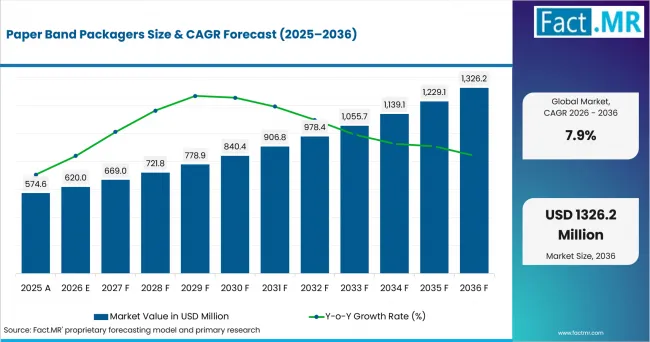
Paper Band Packagers Value Analysis | Source: Fact.MR
What are the defining numbers behind Paper Band Packagers Market growth?
The market adds USD 706.2 million in absolute opportunity between 2026 and 2036.
- Demand Drivers in the Market
- Packaging minimization is creating a direct use case for narrow paper bands. Regulation (EU) 2025/40 requires packaging weight and volume to be reduced to the minimum necessary for functionality, while broader sustainable packaging programs encourage companies to remove secondary material where pack integrity can be maintained.
- Automatic inline banding reduces manual handling between upstream production and secondary packaging. ATS-Tanner states that its US-2500 AD-A can be integrated into automated lines and can process paper or film at up to 38 cycles per minute depending on the application. The same labor and line-balance economics are reshaping adjacent packaging robots and end-of-line automation investments.
- Paper bands can carry branding, barcodes, batch information and other variable data while securing the product. When inline printing removes a separate label or sleeve step, the machine creates value through process consolidation rather than through material substitution alone.
- Fiber-based packaging procurement is becoming more important as buyers examine recyclability and material recovery. Paper banding benefits when the selected paper, coating, ink and seal remain compatible with the intended recovery route, linking equipment demand with wider paper packaging requirements.
- Key Segments Analyzed
- Band Material: Kraft paper band accounts for 42.0% in 2026 because it combines familiar paper converting, printability and sufficient tensile performance for many light and medium bundling duties.
- Machine: Automatic inline bander represents 44.0% in 2026 as plants seek repeatable band placement without a manual transfer between production and secondary packaging.
- Application: Food multipacks account for 28.0% in 2026 because the band can group trays or products while leaving most of the primary pack visible and available for inspection.
- Band Width: 30-50 mm holds 34.0% in 2026 as the range provides useful holding area and printable surface without the material burden of a full paper sleeve.
- Analyst Opinion at Fact.MR
- “Paper band packagers create value when a narrow fiber strip removes a larger packaging component without creating a line-speed penalty. Buyers will test feed stability, seal repeatability and moisture exposure before standardizing the format. Suppliers that combine automated handling with inline printing can move the buying case from material substitution to line consolidation, which improves the economics of multi-line deployment,” notes Shambhu Nath Jha, Principal Consultant, Fact.MR.
- Strategic Implications
- Equipment suppliers should validate the machine and paper band as one operating system. Feed consistency, seal strength, product geometry and changeover settings need to be qualified together before a plant can standardize paper banding across multiple lines.
- Converters can improve adoption by pairing machine specifications with clear material guidance on coatings, inks and recycling routes. That becomes more important as fiber packaging moves toward higher-performance structures rather than simple uncoated paper replacement.
- Food and consumer-goods users should compare the total packaging step being removed rather than only the cost of the band. The strongest economics appear when the paper strip can bundle the product and carry printed information in one pass.
How does the Paper Band Packagers Market break down by segment?
The market is segmented by Band Material, Machine, Application and Band Width.
Why does Kraft paper band lead Band Material?
Kraft paper band accounts for 42.0% of Band Material in 2026.
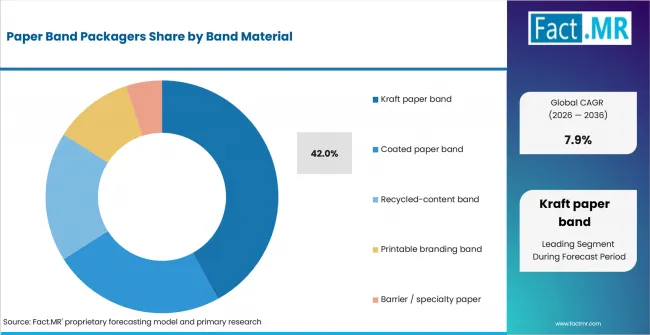
Paper Band Packagers Analysis By Band Material | Source: Fact.MR
Kraft paper gives packagers a familiar fiber substrate that can be printed and converted through established paper-processing routes. Its strength-to-weight balance is suitable for many light and medium bundles without turning the secondary pack into a rigid sleeve.
Bandall markets paper bands for bundling, branding and labelling across food and other packaging applications, while ATS-Tanner supports paper bands on automated and semi-automated equipment. This combination of material familiarity and installed machine support lowers qualification friction for buyers.
Why does Automatic inline bander lead Machine?
Automatic inline bander accounts for 44.0% of Machine in 2026.
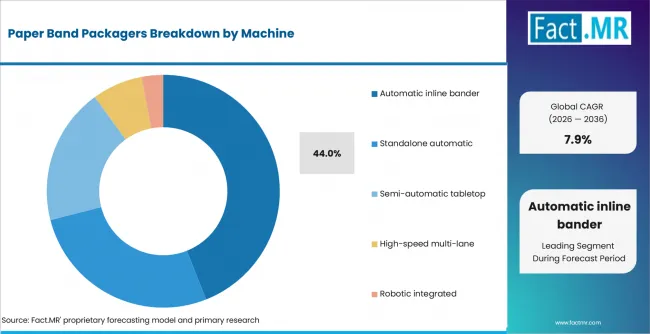
Paper Band Packagers Analysis By Machine | Source: Fact.MR
Automatic inline units remove a manual handoff from repetitive packaging. Products can arrive from an upstream conveyor, be positioned and banded, and return to the line without a separate operator step, which matters where labor availability and line balance determine packaging economics.
ATS-Tanner positions the US-2500 AD-A for automated production lines and supports 30 mm and 50 mm paper or film. Standardized inline integration gives plants a clearer path to repeatable cycle time, print synchronization and multi-shift operation than manually loaded tabletop equipment.
Why do Food multipacks lead Application?
Food multipacks account for 28.0% of Application in 2026.
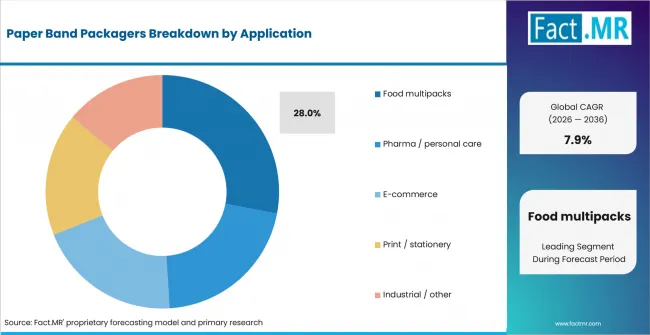
Paper Band Packagers Analysis By Application | Source: Fact.MR
Food multipacks create a strong fit because the band can hold trays or grouped items while leaving much of the primary package visible. That supports branding and product inspection without adding a full secondary carton, a use case that overlaps with wider food packaging efforts to reduce material while retaining pack functionality.
Bandall lists paper-band applications across produce trays, meat, poultry, seafood and ready meals. These applications reward a narrow band when it can replace a sleeve or label without reducing seal reliability or introducing handling problems in chilled distribution.
Why does 30-50 mm lead Band Width?
30-50 mm accounts for 34.0% of Band Width in 2026.
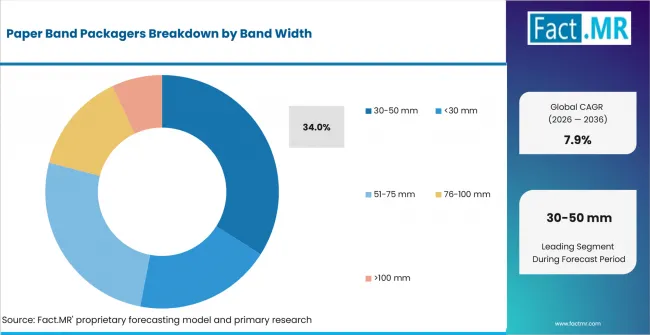
Paper Band Packagers Analysis By Band Width | Source: Fact.MR
The 30-50 mm range balances holding area with material use. It provides enough surface for a logo, barcode, batch information or regulatory text while remaining substantially narrower than a full paper sleeve.
ATS-Tanner lists 30 mm and 50 mm widths on current automated systems, including equipment that can combine banding with inline printing. Standard machine support reduces the need for a custom paper path and simplifies consumable standardization across product formats.
What is accelerating Paper Band Packagers Market adoption, and what is holding it back?
Adoption is being accelerated by packaging-minimization requirements, labor-saving inline automation and the ability to combine bundling with printed information on one paper strip. The main restraints are moisture sensitivity, tension limits on difficult products and the need to qualify paper, ink, seal settings and machine speed together under actual production conditions.
Drivers Impact Analysis
| Factor | (~) % Impact on CAGR | Geographic Relevance | Impact Timeline |
|---|---|---|---|
| Packaging-minimization requirements and material-reduction targets | +1.2% | Europe, UK, USA | Near to Mid-term |
| Automatic inline conversion and labor reduction | +0.9% | Germany, Netherlands, USA | Near-term |
| Bundling plus variable-data printing on one band | +0.7% | Europe, North America, Japan | Near to Mid-term |
Opportunity Impact Analysis
| Factor | (~) % Impact on CAGR | Geographic Relevance | Impact Timeline |
|---|---|---|---|
| Replacement of sleeves and labels in food multipacks | +0.8% | Europe, North America | Near to Mid-term |
| Inline barcode and batch-data printing | +0.6% | Germany, Netherlands, USA | Near to Mid-term |
| Coated and higher-performance paper bands for chilled packs | +0.4% | Europe, Japan, USA | Mid-term |
Restraints Impact Analysis
| Factor | (~) % Impact on CAGR | Geographic Relevance | Impact Timeline |
|---|---|---|---|
| Moisture and tension limits in chilled or heavy applications | -0.8% | Global | Near-term |
| Line qualification for seal and feed consistency | -0.6% | Global | Near to Mid-term |
| Capital cost versus manual or tabletop alternatives | -0.4% | Global small and mid-sized users | Near-term |
Which countries are scaling the Paper Band Packagers Market through 2036?
- Germany: Mature paper-recovery infrastructure and packaging-minimization requirements support machine trials where a narrow fiber band can replace a larger secondary packaging component without lowering line throughput.
- USA: Material-efficiency programs combine with an established service base for paper banding equipment. Buyers place strong weight on labor savings, spare-parts support and proof that the conversion removes a packaging step rather than simply changing consumables.
- Japan: Plastic resource-circulation policy supports substitution toward paper-capable packaging where performance is suitable. Compact tabletop and precision banding systems remain relevant to users that prioritize dependable seals and controlled operation.
- Netherlands: Extended producer responsibility and packaging-minimization rules raise the value of measurable material reduction. A domestic equipment ecosystem around Bandall also gives converters and food packers direct access to paper-band application expertise.
- UK: Extended producer responsibility increasingly links packaging economics with recyclability assessment. Suppliers can improve conversion by documenting band construction, print chemistry and the recycling route alongside machine performance.
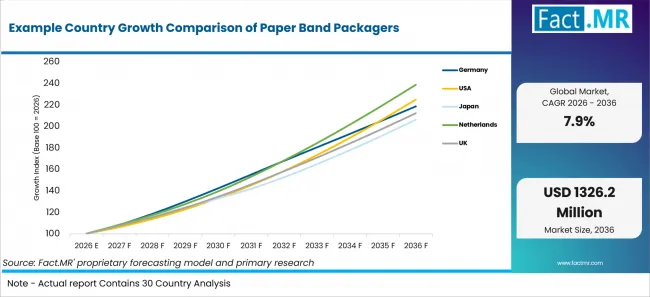
Example Country Growth Comparison Of Paper Band Packagers | Source: Fact.MR
| Country | CAGR (2026-2036) |
|---|---|
| Germany | 8.1% |
| USA | 8.5% |
| Japan | 7.5% |
| Netherlands | 9.1% |
| UK | 7.8% |
What is driving Germany's growth through 2036?
Germany is projected to expand at a CAGR of 8.1% from 2026 to 2036.
- Germany combines a mature paper-packaging system with statutory recycling requirements. The German Environment Agency reported in 2026 that paper and cardboard packaging in the dual system met the applicable recycling target, reinforcing buyer attention to fiber-based secondary packaging formats.
- The commercial decision still depends on line economics. Packaging plants are likely to favor paper banding where application trials show that required pack integrity can be maintained with lower material use and without slowing automated production.
What is driving USA's growth through 2036?
The USA is projected to expand at a CAGR of 8.5% from 2026 to 2036.
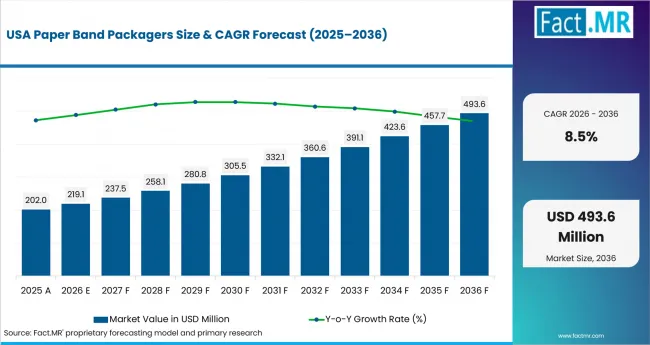
Paper Band Packagers Country Value Analysis | Source: Fact.MR
- The U.S. Environmental Protection Agency continues to emphasize material-efficient packaging and recovery, creating a policy and procurement setting in which narrower secondary formats can receive greater attention when they meet the same functional requirement.
- The market also has established service channels through specialists such as Felins and Wexler Packaging Products. For U.S. plants, labor savings, uptime, consumable availability and service response can determine whether paper banding is standardized across multiple lines.
What is driving Japan's growth through 2036?
Japan is projected to expand at a CAGR of 7.5% from 2026 to 2036.
- Japan's Plastic Resource Circulation framework promotes reduction and recycling across plastic-use products, supporting evaluation of paper alternatives where the application does not require the moisture tolerance or tensile strength of plastic banding.
- Paper-capable tabletop systems such as Akebono machines remain relevant for precision and lower-volume applications. Suppliers compete on compact equipment, dependable seals and local technical support rather than throughput alone.
What is driving Netherlands' growth through 2036?
The Netherlands is projected to expand at a CAGR of 9.1% from 2026 to 2036.
- Dutch packaging rules place extended producer responsibility on manufacturers and importers and require packaging to be minimized and suitable for collection and recycling. This supports applications where a paper band can demonstrably reduce secondary material.
- Bandall is headquartered in the Netherlands and markets paper-band systems across food, produce and other applications. Local equipment and application expertise can shorten trials, although buyers still need to confirm that coatings, inks and sealing choices fit the intended recovery route.
What is driving UK's growth through 2036?
The UK is projected to expand at a CAGR of 7.8% from 2026 to 2036.
- PackUK's extended producer responsibility framework links packaging fees with recyclability assessments, increasing attention to material choice, construction and declarations across secondary packaging.
- Paper band adoption therefore depends on documented material reduction without a loss of production reliability. Suppliers can strengthen the buying case by pairing recyclability information with measured line speed, seal strength and changeover performance.
Who Leads the Paper Band Packagers Market?
Key players in the Paper Band Packagers Market include ATS-Tanner, Bandall, Mosca, Akebono (via Blumer AG), Felins and Wexler Packaging Products.
Competition is shaped by direct paper-band handling capability, inline integration, print and labelling options, service reach and the ability to qualify consumables with the machine. ATS-Tanner and Bandall compete through dedicated banding systems, while Mosca brings broader end-of-line automation and paper strapping experience. Akebono addresses compact tabletop applications through Blumer AG, while Felins and Wexler Packaging Products add distribution, integration and service coverage in the USA.
Recent activity is reinforcing automation depth. ATS-Tanner launched the US-2500 product line in July 2025, including an automatic line-integration configuration. In May 2026, Mosca and SIAT announced strategic cooperation across integrated packaging solutions, while Mosca used its April 2026 Interpack program to emphasize connected end-of-line automation.
Which companies are the key providers?
Key providers include ATS-Tanner, Bandall, Mosca, Akebono (via Blumer AG), Felins and Wexler Packaging Products.
- ATS-Tanner
- Bandall
- Mosca
- Akebono (via Blumer AG)
- Felins
- Wexler Packaging Products
Bibliography
- U.S. Environmental Protection Agency. (2025, October 31). Sustainable Packaging.
- European Parliament and Council of the European Union. (2024, December 19). Regulation (EU) 2025/40 on Packaging and Packaging Waste.
- German Environment Agency. (2026, January 27). Facts against myths: packaging waste recycling in Germany.
- Netherlands Enterprise Agency, RVO. (2026, March 25). Requirements for packaging.
- Ministry of the Environment, Japan. (accessed September 2026). Plastic Resource Circulation.
- PackUK / GOV.UK. (accessed September 2026). Year 2 illustrative waste disposal fees, extended producer responsibility for packaging.
- ATS-Tanner. (accessed September 2026). US-2500 AD-A automatic banding machine.
- ATS-Tanner. (2025, July 18). Three Machines - One Platform. The new US-2500 product line is here.
- ATS-Tanner. (accessed September 2026). US-2500 TTP banding machine.
- Bandall. (accessed September 2026). Paper band packaging.
- Bandall. (accessed September 2026). Banding machines.
- Mosca. (accessed September 2026). Strapping materials.
- Mosca. (2026, May 8). SIAT and Mosca join forces to offer integrated packaging solutions worldwide.
- Mosca. (2026, April 27). Mosca Interpack 2026: Smart End-of-Line for global logistics.
- Blumer AG. (accessed September 2026). Akebono banding machine.
- Felins. (accessed September 2026). Banding machines.
- Wexler Packaging Products. (accessed September 2026). About Wexler.
This Report Answers
- How quickly is revenue from paper band packagers projected to expand through 2036?
- Which band material accounts for the primary share of market revenue?
- Why are automatic inline banders favored in higher-throughput packaging lines?
- Why do food multipacks create a strong application for paper banding?
- Which band width accounts for the primary revenue share in 2026?
- How do packaging-minimization and recyclability requirements influence equipment demand?
- What operating conditions can slow conversion from plastic bands, sleeves or other secondary packaging?
- What market mechanisms support adoption in Germany, USA, Japan, Netherlands and the UK?
- Which suppliers participate across dedicated banding machinery, end-of-line automation and service?
- What should packaging teams test before standardizing a paper-band packager?
What does the Paper Band Packagers Market cover?
The market counts revenue from complete machines and integrated systems whose principal commercial function is to bundle, sleeve, secure, label or group products using a paper band. It covers automatic inline banders, standalone automatic units, semi-automatic tabletop systems, high-speed multi-lane equipment and robotic integrated configurations used across the defined applications.
The market intersects with paper packaging and packaging automation, but revenue remains tied to the paper-band packaging machine or integrated system rather than to general paper, labels, cartons or unrelated strapping equipment.
What is included in the scope?
- Paper-band packaging systems using Kraft paper band, Coated paper band, Recycled-content band, Printable branding band and Barrier / specialty paper.
- Automatic inline bander, Standalone automatic, Semi-automatic tabletop, High-speed multi-lane and Robotic integrated machines.
- Food multipacks, Pharma / personal care, E-commerce, Print / stationery and Industrial / other applications.
- Band widths of 30-50 mm, <30 mm, 51-75 mm, 76-100 mm and >100 mm.
What is excluded from the scope?
- Standalone paper, paperboard, labels, printed sleeves and paper-band consumables when sold without a paper-band packaging machine or integrated equipment system.
- Plastic strapping, steel strapping, stretch wrapping, cartoning and shrink-wrapping equipment whose principal commercial function is not paper banding.
- Manual paper sleeves applied without a banding machine and general labelling equipment that does not also perform the paper-band bundling function.
- Upstream pulp, paper coating, ink and adhesive transactions that are not incorporated into the commercial paper-band packaging equipment offering.
How Was the Analysis Built?
- Primary Research: Primary validation focuses on packaging-line engineers, equipment suppliers, food and consumer-goods packagers, converters, automation integrators, procurement managers and service organizations. Interviews test where paper banding enters the line, what packaging step it replaces and which machine or material conditions determine adoption.
- Desk Research: Desk research uses packaging regulation, government recovery guidance, first-party machine specifications, company disclosures and current technical material from equipment and service providers. Evidence is used to explain adoption mechanisms, application limits and provider positioning.
- Market Sizing and Forecasting: Market sizing maps equipment demand across machine configuration, application, band material and band width. Forecasting considers packaging-line replacement, new automation investment, material-reduction programs, printing integration, service support and the share of applications technically suitable for paper banding.
- Data Validation and Update Cycle: Validation checks machine availability, application fit, country packaging requirements, provider activity and evidence of current commercial deployment. Updates focus on new equipment platforms, automation partnerships, packaging rules and shifts in paper-band material capability.
What is the report's scope and coverage?
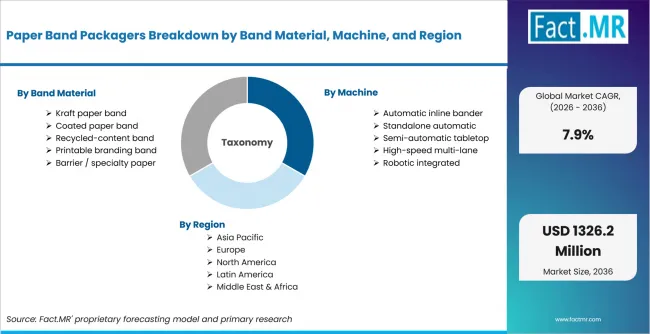
Paper Band Packagers Breakdown By Band Material, Machine, And Region | Source: Fact.MR
| Metric | Value |
|---|---|
| Quantitative Units | USD million |
| Market Definition | Complete machines and integrated systems whose principal commercial function is paper-band bundling, sleeving, securing or labelling |
| Segments | Band Material; Machine; Application; Band Width |
| Countries | Germany; USA; Japan; Netherlands; UK |
| Key Companies | ATS-Tanner; Bandall; Mosca; Akebono (via Blumer AG); Felins; Wexler Packaging Products |
| Forecast Period | 2026-2036 |
| Base Year | 2026 |
| Market Value, 2026 | USD 620.0 million |
| Market Value, 2036 | USD 1,326.2 million |
| CAGR, 2026-2036 | 7.9% |
| Absolute Opportunity | USD 706.2 million |
| Approach | Bottom-up equipment demand by machine and application, adjusted for replacement, line automation and paper-band conversion |
How is the market segmented?
-
By Band Material
- Kraft paper band
- Coated paper band
- Recycled-content band
- Printable branding band
- Barrier / specialty paper
-
By Machine
- Automatic inline bander
- Standalone automatic
- Semi-automatic tabletop
- High-speed multi-lane
- Robotic integrated
-
By Application
- Food multipacks
- Pharma / personal care
- E-commerce
- Print / stationery
- Industrial / other
-
By Band Width
- 30-50 mm
- <30 mm
- 51-75 mm
- 76-100 mm
- >100 mm
-
By Region:
- North America
- Latin America
- Western Europe
- Eastern Europe
- East Asia
- South Asia and Pacific
- Middle East & Africa