- Market Value (2025): USD 1.4 Bn
- Estimated Value (2026): USD 1.5 Bn
- Forecast Value (2036): USD 2.7 Bn
- CAGR (2026-2036): 5.9%
What is the Paper-Based Wraparound Packaging Market forecast to be worth by 2036?
USD 1.5 billion in 2026 to USD 2.7 billion by 2036, recording a 5.9% CAGR.
- The paper-based wraparound packaging market crossed USD 1.4 billion in 2025 as grouped-product programs expanded across consumer-goods manufacturing.
- Market value is expected to increase from USD 1.5 billion in 2026 to USD 2.7 billion by 2036.
- The market is forecast to record a 5.9% CAGR from 2026 to 2036 as brands qualify machine-ready recyclable wraps.
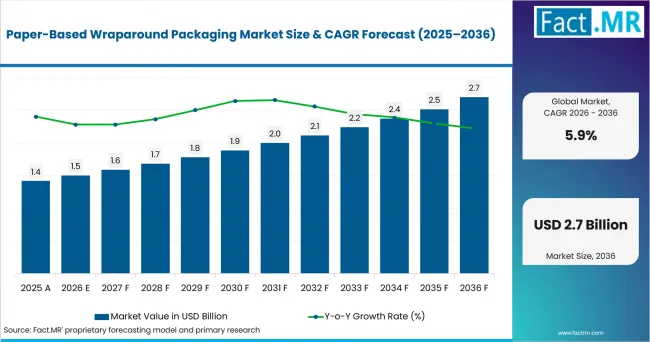
Paper Based Wraparound Packaging Market Value Analysis | Source: Fact.MR
What are the defining numbers behind Paper-Based Wraparound Packaging Market growth?
USD 1.2 billion absolute opportunity by 2036, led by Wraparound Cases and Recycled Paperboard alongside Beverage applications.
- Demand Drivers in the Market
- Packaging engineers require grouped packs that reduce plastic exposure without weakening compression performance during transport and retail handling.
- Beverage plants need wrap structures that maintain registered pack counts during repeated operation on high-speed case packing equipment.
- Food manufacturers need recycled-board specifications that tolerate moisture changes across chilled storage and regional distribution routes.
- Retail teams need preprinted secondary packs that support identification without requiring separate labels or display components.
- Key Segments Analyzed
- By Product Type: Wraparound cases are expected to hold 44.0% share in 2026 supported by repeatable machine formation.
- By Material: Recycled paperboard is projected to account for 48.0% share in 2026 owing to established recovery routes.
- By Print - Finish: Preprinted formats are anticipated to capture 46.0% share in 2026 due to controlled recurring graphics.
- By Application: Beverages are estimated to represent 34.0% share in 2026 attributable to standardized multipack production.
- By End Use: Food & beverage is forecast to account for 62.0% share in 2026 driven by repeat production.
- By Sales Channel: Direct - brand OEM is expected to garner 52.0% share in 2026 supported by centralized qualification.
- Analyst Opinion at Fact.MR
- Shambhu Nath Jha, Principal Consultant at Fact.MR states: “Paper wraps create value once design teams prove line performance and retail handling across programs. Adoption is expected to favor converters that control board quality and support trials near packing lines.”
- Strategic Implications
- Brand owners should test compression and moisture exposure at production speed before replacing established grouping formats across core products.
- Converters should connect board caliper with adhesive patterns since small tolerances alter feeding reliability during extended production runs.
- Retail packaging teams should compare opening features with replenishment time before approving lighter structures across several store formats.
- Regional sales teams should place technical support near large plants since delayed adjustments raise trial costs and postpone orders.
Beverage converters need material reductions that preserve speed and transit performance across recurring multipack programs. Graphic Packaging addressed that operating test in September 2025 with wrap-style systems fitted to existing Marksman equipment. ISTA 3E certification linked the lighter structure with documented distribution performance across palletized transport conditions.
India is expected to record an 8.3% CAGR while China is projected to post 7.5% through 2036. Brazil is anticipated to advance at 6.3% as long routes reward stronger grouped packs. Germany and the United Kingdom are estimated at 5.6% as local corrugated packaging capacity supports qualification.
How does the Paper-Based Wraparound Packaging Market break down by segment?
Wraparound Cases lead at 44.0%, Recycled Paperboard leads at 48.0%.
Which Product Type dominates?
Wraparound Cases hold 44.0% share in 2026.
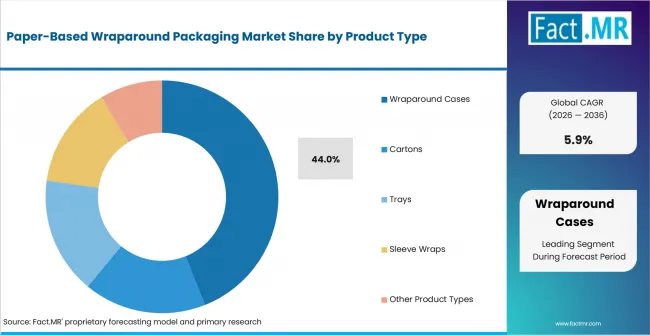
Paper Based Wraparound Packaging Market Analysis By Product Type | Source: Fact.MR
Based on product type, wraparound cases are projected to account for 44.0% share in 2026 due to reliable machine formation. Wraparound cases form around grouped products while balancing board usage with transport protection and printable area. Packaging teams compare retail-ready packaging features with pallet stability before approving formats for repeated store replenishment.
What leads the Material segment?
Recycled Paperboard accounts for 48.0% share in 2026.
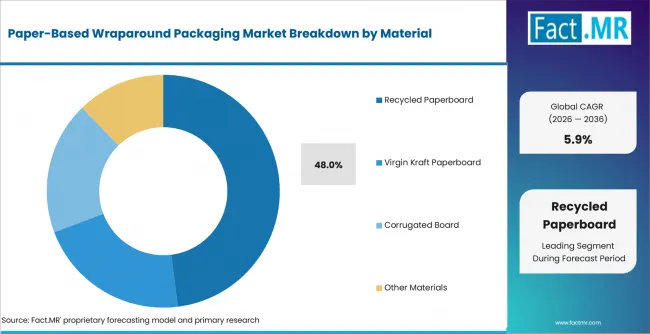
Paper Based Wraparound Packaging Market Analysis By Material | Source: Fact.MR
By material, recycled paperboard is estimated to hold 48.0% share in 2026 owing to established recovery routes and board availability. Recycled paperboard supports high-volume wraps that require stiffness and stable performance during scoring and gluing. Related next-generation fiber packaging programs increase expectations for consistent furnish quality across recurring production batches.
How does Print - Finish shape demand?
Preprinted formats capture 46.0% share in 2026.
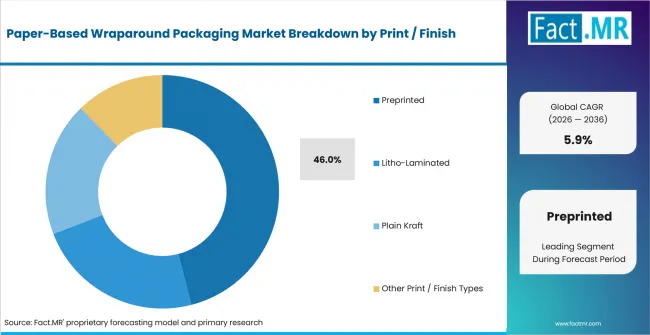
Paper Based Wraparound Packaging Market Analysis By Print Finish | Source: Fact.MR
The print - finish category is forecast to be led by preprinted formats at 46.0% share in 2026 due to controlled graphics. Commercial printing capabilities must preserve color and coding during scoring and distribution across repeat programs. Repeatable color and coding support preprinted adoption, and Graphic Packaging expanded its Poznań printing lines in November 2025.
What supports Beverages within Application?
Beverages represent 34.0% share in 2026.
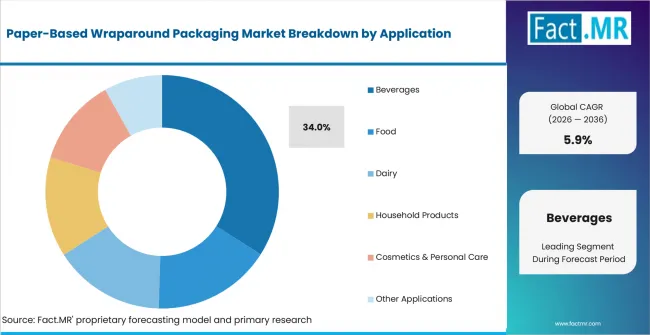
Paper Based Wraparound Packaging Market Analysis By Application | Source: Fact.MR
- Beverages are set to lead application with 34.0% share in 2026 due to standardized multipacks and repeat production. Beverage multipacks globally use standardized counts that suit automated wrap formation and repeated production schedules. Related ready-to-drink packaging programs require bundle restraint with practical carrying and shelf-opening performance through distribution.
What drives Food & Beverage within End Use?
Food & Beverage accounts for 62.0% share in 2026.
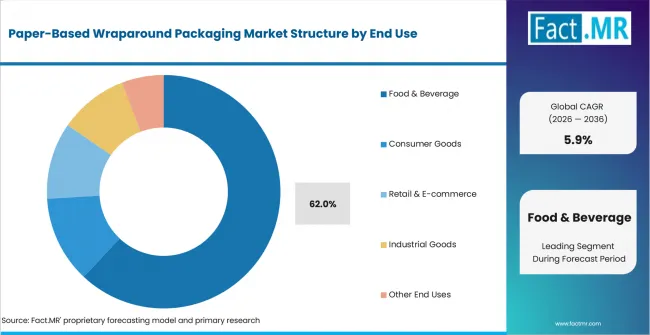
Paper Based Wraparound Packaging Market Analysis By End Use | Source: Fact.MR
Food and beverage plants need secondary packs that remain stable across frequent production and chilled distribution. These operating demands connect wrap design with fresh food packaging requirements for moisture and adhesive performance.
- In 2026, food & beverage is expected to lead end use with 62.0% share because recurring production concentrates converted-pack demand.
- Broader format families support repeat food orders, and Mondi added beverage wraparounds to its packaging portfolio in November 2025.
Why does Direct - Brand OEM lead Sales Channel?
Direct - Brand OEM garners 52.0% share in 2026.
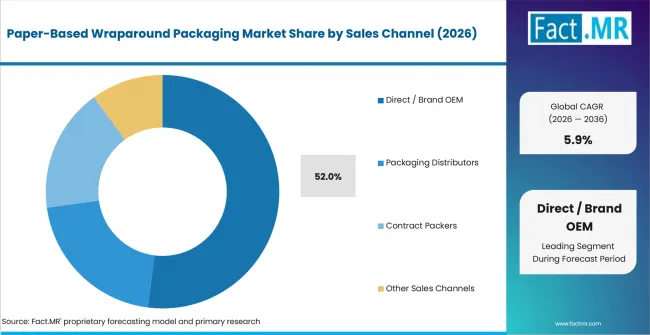
Paper Based Wraparound Packaging Market Analysis By Sales Channel | Source: Fact.MR
Direct - brand OEM is projected to hold 52.0% share in 2026 owing to centralized specifications and plant qualification. Direct programs let brand teams control artwork and plant trials across several product lines globally. The relationship connects packaging adhesives with board behavior and line speed before commercial rollout approval.
What is accelerating Paper-Based Wraparound Packaging Market adoption, and what is holding it back?
Packaging redesign requirements support adoption, while high-speed qualification restrains conversion and machine-ready lightweight structures create opportunity.
Drivers Impact Analysis
| DRIVER | (~) % IMPACT ON CAGR | GEOGRAPHIC RELEVANCE | IMPACT TIMELINE |
|---|---|---|---|
| Recyclability in package design | +0.8% | Europe and UK | Medium term (2-4 years) |
| Plastic packaging responsibility | +0.7% | United States; Brazil | Medium term (2-4 years) |
| Retail-ready grouped handling | +0.5% | North America; Europe | Medium term (2-4 years) |
| Recycled board availability | +0.4% | United States and Europe | Long term (>= 4 years) |
| Integrated print and conversion | +0.3% | Global consumer-goods programs | Long term (>= 4 years) |
Source: Fact.MR analysis. Updated Aug 1, 2026
- Recyclability compliance: European packaging rules place recoverability inside design specifications for grouped-product formats across major consumer programs.
- Plastic reduction: Plastic-reduction obligations reopen grouping specifications and require brands to compare material exposure with line performance.
- Retail handling: Retail teams favor formats that stabilize products and shorten shelf replenishment without separate display components.
- Board consistency: Consistent recycled board reduces qualification risk and supports repeat production across high-volume consumer packaging lines.
Opportunity Impact Analysis
| OPPORTUNITY | (~) % IMPACT ON CAGR | GEOGRAPHIC RELEVANCE | IMPACT TIMELINE |
|---|---|---|---|
| Lightweight beverage wraps | +0.5% | North America; Europe | Medium term (2-4 years) |
| Recycled-board food formats | +0.4% | United States; India | Long term (>= 4 years) |
| Regional plant support | +0.4% | India; Brazil | Medium term (2-4 years) |
| Preprinted retail structures | +0.3% | Europe and Asia Pacific | Long term (>= 4 years) |
Source: Fact.MR analysis. Updated Aug 1, 2026
- Lightweight redesign: Lightweight beverage wraps create value once redesigned panels reduce board use without weakening bundle control.
- Food-program repeatability: Recurring food programs reward recycled-board structures that maintain stiffness across pack counts and production runs.
- Plant-trial support: Nearby technical teams shorten approvals by adjusting scores and adhesive patterns directly during plant trials.
- Preprinted value: Preprinted structures combine transport identification with shelf communication although frequent artwork changes reduce smaller-program efficiency.
Restraints Impact Analysis
| RESTRAINT | (~) % IMPACT ON CAGR | GEOGRAPHIC RELEVANCE | IMPACT TIMELINE |
|---|---|---|---|
| High-speed qualification | -0.5% | Global beverage and food plants | Short term (<= 2 years) |
| Moisture and compression | -0.4% | Chilled and humid distribution routes | Medium term (2-4 years) |
| Board consistency | -0.3% | India; Brazil | Medium term (2-4 years) |
| Artwork and tooling costs | -0.2% | Global branded programs | Long term (>= 4 years) |
Source: Fact.MR analysis. Updated Aug 1, 2026
- Line qualification: Friction or score-depth differences interrupt production feeding and delay conversion until repeated plant trials succeed.
- Moisture exposure: Condensation and humidity weaken corners or adhesives and constrain lighter designs across chilled distribution routes.
- Furnish variability: Recovered-fiber properties vary across mills unless furnish controls maintain caliper and surface consistency across plants.
- Tooling burden: Artwork and cutting tools add expense before volume develops which discourages conversion across smaller families.
Which countries are scaling Paper-Based Wraparound Packaging Market fastest?
Brazil 6.3%, Germany 5.6%, United Kingdom 5.6%.
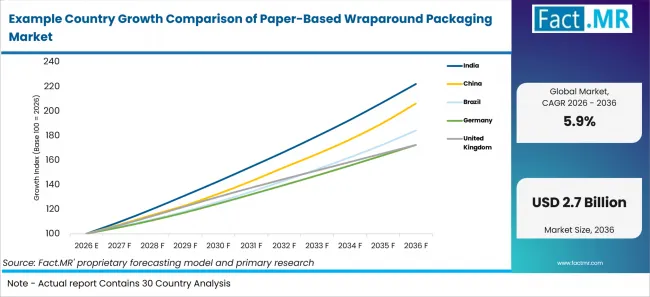
Example Country Growth Comparison Of Paper Based Wraparound Packaging Market | Source: Fact.MR
| COUNTRY | CAGR |
|---|---|
| Brazil | 6.3% |
| Germany | 5.6% |
| United Kingdom | 5.6% |
Source: Fact.MR analysis. Updated Aug 1, 2026
How is Brazil developing Paper-Based Wraparound Packaging demand?
6.3% CAGR, owing to long distribution routes and plastic-packaging obligations.
Brazilian programs require secondary packs that withstand long road routes and humid regional storage conditions. The market is anticipated to advance at a 6.3% CAGR by 2036. This industry growth is also influenced by October 2025 reverse-logistics rules that support paper trials.
What supports Germany’s market outlook?
5.6% CAGR, supported by recyclability documentation and automated packing depth.
German packaging teams require documented recyclability and repeatable performance across automated national consumer-goods plants throughout Germany. The market is estimated to record a 5.6% CAGR through 2036, owing to support from local folding carton packaging expertise.
Why is the United Kingdom market expanding?
5.6% CAGR, shaped by fee modulation and retailer specification control.
United Kingdom brands compare package weight and recyclability ratings alongside conversion cost for retail programs. Wraparound packaging is expected to expand at 5.6% annually through 2036 as fees enter reviews. PackUK's June 2025 policy links fees to recyclability ratings and adds documentation across packaging programs.
Who leads the Paper-Based Wraparound Packaging Market?
Graphic Packaging International and Smurfit Westrock lead direct wraparound coverage, while Mondi Group, Stora Enso, and International Paper expand the provider set.
Competition remains tiered between integrated paperboard groups and regional converters without one controlling format owner. Qualification favors companies that combine board consistency with nearby technical service across recurring multi-plant programs. Graphic Packaging and Smurfit Westrock integrate design with automated packing while Mondi and Stora Enso add testing; International Paper extends industrial packaging coverage across European plants.
Which companies are the key providers?
Graphic Packaging International, Smurfit Westrock, Mondi Group, Stora Enso, and International Paper are the key providers profiled.
- Graphic Packaging International
- Smurfit Westrock
- Mondi Group
- Stora Enso
- International Paper
Bibliography
- Central Agency Packaging Register. (2025, August 29). 2025 minimum standard published - initial touchstone for companies preparing for the EU Packaging and Packaging Waste Regulation (PPWR). ZSVR.
- Graphic Packaging International. (2025, September 10). Graphic Packaging Debuts Duo of Beverage Multipack Innovations at drinktec 2025.
- Graphic Packaging International. (2025, November 5). Graphic Packaging Launches Advanced Recycled Paperboard Facility in Waco, Texas.
- Graphic Packaging International. (2025, November 11). Graphic Packaging Empowers Beauty and Food Brands with High-Tech Poznań Upgrade.
- Ministry of Environment, Forest and Climate Change. (2024, December 18). Environment Protection (Extended Producer Responsibility for Packaging made from paper, glass and metal as well as sanitary products) Rules, 2024. Government of India.
- Mondi Group. (2025, November 18). Mondi launches extended corrugated and solid board portfolio for the food packaging industry.
- PackUK. (2025, June 28). PackUK extended producer responsibility (EPR) for packaging: producer disposal fees modulation statement. GOV.UK.
- Presidency of the Republic of Brazil. (2025, October 21). Decree No. 12,688 of October 21, 2025. Government of Brazil.
- Smurfit Westrock. (2026, July 7). Smurfit Westrock partners with Coca-Cola on World Cup packaging to capture spike in consumer demand.
- Standardization Administration of China. (2024, April 25). GB-T 31268-2024: Restricting excessive packaging for commodity - General rule. National Public Service Platform for Standards Information.
- Stora Enso. (2025, June 25). Stora Enso’s packaging automation boosts production at Lumene Group.
This Report Addresses
- Analysis compares product type and material choices across the paper-based wraparound packaging market.
- Segment positions assess Print - Finish demand alongside Application qualification needs.
- India, China, Brazil, Germany, and United Kingdom outlooks provide the regional comparison base.
- Provider reviews compare conversion capabilities with customer approval requirements in Paper-Based Wraparound Packaging.
- Commercial assessment links End Use conditions to buyer purchasing behavior.
- Forecast inputs combine published indicators with interview-based checks for Paper-Based Wraparound Packaging.
- Scope boundaries separate relevant converted products from adjacent materials.
What does the Paper-Based Wraparound Packaging Market cover?
The market covers converted paper structures formed around grouped products for transport protection and retail handling.
Coverage includes wraparound cases and sleeves while excluding filled products and packing machinery from revenue.
What is included in the scope?
Converted wraps and structures are included when their primary function is grouped-product containment and handling.
Integrated printing remains inside converted-package value while direct and distributor-led sales are counted across applications.
What is excluded from the scope?
Raw board and packing machinery are excluded alongside plastic bundling formats and downstream filled-product revenue.
Conventional cases remain outside scope unless the structure forms around grouped products during packing operations.
How Was the Analysis Built?
The analysis draws on 120+ sources, 35+ company portfolios, 25+ countries, and more than 20 industry interviews.
- Primary Research: Primary research includes discussions with manufacturers, service providers, technology developers, distributors, end users, procurement teams, and subject-matter experts. These conversations examine purchasing priorities, product adoption, operational challenges, approval requirements, competitive positioning, and the factors that influence wider market acceptance.
- Desk Research: Desk research covers government statistics, regulatory publications, company filings, trade data, technical studies, industry associations, standards, public policy, and other authoritative sources. Every source used in the analysis is documented in the bibliography.
- Market Sizing and Forecasting: Market estimates combine historical performance, demand indicators, pricing and volume trends, segment shares, company participation, country-level growth, adoption patterns, investment activity, and barriers to market expansion.
- Data Validation and Update Cycle: Findings are validated by comparing primary interviews with public data, company activity, regulatory changes, trade patterns, and industry developments. Regular updates review new product launches, capacity changes, partnerships, approvals, procurement trends, and shifts in commercial adoption.
Segmentation
What is the report’s scope and coverage?
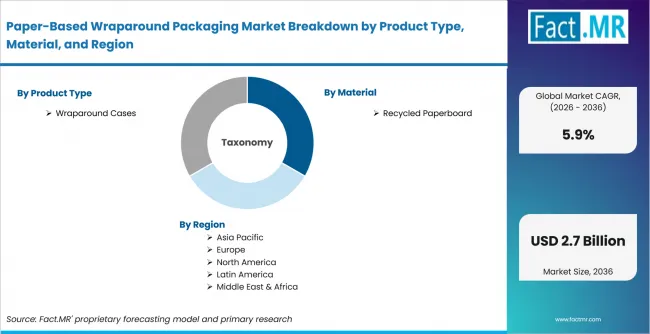
Paper Based Wraparound Packaging Market Breakdown By Product Type, Material, And Region | Source: Fact.MR
| Coverage field | Report scope |
|---|---|
| Quantitative Units | USD Billion and % share / CAGR |
| Market Definition | Converted paper-based structures that wrap around grouped products to provide transport stability, bundle containment, merchandising support, and retail-ready handling while reducing material exposure compared with conventional secondary packaging formats. |
| Product Type | Wraparound Cases, Cartons, Trays, Sleeve Wraps, Other Product Types |
| Material | Recycled Paperboard, Virgin Kraft Paperboard, Corrugated Board, Other Materials |
| Print - Finish | Preprinted, Litho-Laminated, Plain Kraft, Other Print-Finish Types |
| Application | Beverages, Food, Dairy, Household Products, Cosmetics & Personal Care, Other Applications |
| End Use | Food & Beverage, Consumer Goods, Retail & E-commerce, Industrial Goods, Other End Uses |
| Sales Channel | Direct-Brand OEM, Packaging Distributors, Contract Packers, Other Sales Channels |
| Regions Covered | North America, Europe, Asia Pacific, Latin America, Middle East & Africa |
| Countries Covered | United States, Canada, Germany, United Kingdom, France, Italy, Spain, India, China, Japan, South Korea, Australia, Brazil, Mexico, Argentina, Chile, United Arab Emirates, Saudi Arabia, South Africa |
| Key Companies Profiled | Graphic Packaging International, Smurfit Westrock, Mondi Group, Stora Enso, International Paper |
| Forecast Period | 2026 to 2036 |
| Approach | Hybrid analysis using grouped-pack demand trends, packaging conversion activity, board-material adoption, retail-ready packaging requirements, production-line qualification factors, regulatory developments, country-level demand indicators, and provider validation checks. |
Source: Fact.MR analysis. Updated Aug 1, 2026
How is the market segmented?
-
By Product Type:
- Wraparound Cases
- Cartons
- Trays
- Sleeve Wraps
- Other Product Types
-
By Material:
- Recycled Paperboard
- Virgin Kraft Paperboard
- Corrugated Board
- Other Materials
-
By Print - Finish:
- Preprinted
- Litho-Laminated
- Plain Kraft
- Other Print - Finish Types
-
By Application:
- Beverages
- Food
- Dairy
- Household Products
- Cosmetics & Personal Care
- Other Applications
-
By End Use:
- Food & Beverage
- Consumer Goods
- Retail & E-commerce
- Industrial Goods
- Other End Uses
-
By Sales Channel:
- Direct - Brand OEM
- Packaging Distributors
- Contract Packers
- Other Sales Channels
-
By Region:
- North America
- United States
- Canada
- Europe
- Germany
- United Kingdom
- France
- Italy
- Spain
- Asia Pacific
- India
- China
- Japan
- South Korea
- Australia
- Latin America
- Brazil
- Argentina
- Mexico
- Chile
- Middle East & Africa
- UAE
- Saudi Arabia
- South Africa
- North America
Frequently Asked Questions
Which product type leads the Paper-Based Wraparound Packaging Market?
Which material leads the Paper-Based Wraparound Packaging Market?
Which print and finish category leads the market?
Which application accounts for 34.0% share in 2026?
Which end use accounts for 62.0% share in 2026?
Which sales channel leads the market?
Which country records an 8.3% CAGR through 2036?
What most influences adoption across the market?
Who worked on this report


Preview the report firsthand - request a free sample
Free SampleGet the brochure for pricing and purchase details
Download PDF