- Base Value(2026): 421.9 Bn
- Estimated Value(2026): 421.9 Bn
- Forecast Value (2036): 612.8 Bn
- CAGR (2026 - 2036): 3.8%
Next-gen Paper-based and Fiber-based Packaging Market Forecast and Outlook By Fact.MR
Valuation of the next-gen paper-based and fiber-based packaging market stood at USD 406.5 billion in 2025. According to Fact MR, demand for advanced paper and fiber-based packaging formats is expected to reach USD 421.9 billion in 2026 and USD 612.8 billion by 2036. A CAGR of 3.8% is projected for the forecast timeline.
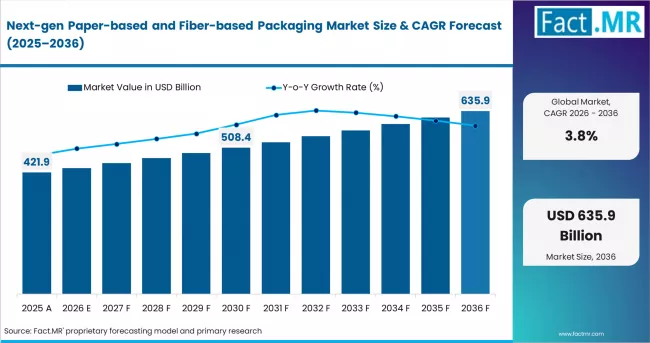
Next Gen Paper Based And Fiber Based Packaging Market Market Value Analysis | Source: Fact.MR
Next-gen Paper-based and Fiber-based Packaging Market
| Metric | Details |
|---|---|
| Industry Size (2026E) | USD 421.9 billion |
| Industry Value (2036F) | USD 612.8 billion |
| CAGR (2026 to 2036) | 3.8% |
Source: Fact.MR analysis. Updated Apr 16, 2026
Summary of Next-gen Paper-based and Fiber-based Packaging Market
- Market Definition
- The market includes advanced packaging materials manufactured from recycled fiber, virgin pulp, molded fiber, and specialty paper designed to provide structural protection, recyclability, and compatibility with modern converting processes across food, e-commerce, healthcare, personal care, and industrial applications.
- Demand Drivers
- Increasing substitution of plastic packaging formats with fiber-based materials across transport and secondary packaging applications.
- Rising regulatory pressure on single-use plastics supporting transition toward recyclable paperboard packaging formats.
- Growing demand for corrugated packaging solutions supporting e-commerce logistics and protective distribution requirements.
- Expansion of molded fiber packaging adoption supporting protective cushioning performance across fragile goods transport environments.
- Increasing integration of recycled fiber feedstock supporting material circularity across paper packaging production workflows.
- Rising investment in barrier-coated fiber materials improving moisture resistance performance across food packaging applications.
- Key Segments Analyzed
- Product Type: Corrugated boxes lead with 42% share supported by structural rigidity and stacking performance across logistics workflows.
- Material: Recycled fiber holds 39% share reflecting integration of recovered pulp across paperboard manufacturing processes.
- Application Role: Food packaging and e-commerce packaging represent primary demand environments requiring protective fiber-based formats.
- Technology Role: Molded fiber processing enables production of rigid packaging structures supporting cushioning and load distribution performance.
- Geography: Asia Pacific and Europe maintain strong adoption supported by regulatory transition toward recyclable packaging materials.
- Analyst Opinion at Fact MR
- Shambhu Nath Jha, Principal Consultant, Fact MR, opines, 'In this updated edition of the Next-gen Paper-based and Fiber-based Packaging Market report, fiber-based material innovation remains essential for supporting recyclable packaging transition across logistics, food distribution, and consumer goods supply chains through 2036.'
- Strategic Implications or Executive Takeaways
- Invest in recycled fiber processing capability supporting stable pulp feedstock availability.
- Strengthen corrugated packaging conversion capability supporting e-commerce logistics demand.
- Improve barrier coating technologies supporting moisture resistance performance across food packaging formats.
- Expand molded fiber production capability supporting protective packaging applications.
- Focus on compatibility with existing converting infrastructure supporting efficient packaging manufacturing workflows.
- Enhance supply chain integration supporting stable fiber sourcing across paperboard production environments.
- Methodology
- Primary interviews conducted with pulp producers, packaging converters, and brand owners evaluating fiber-based packaging adoption trends.
- Benchmarked against packaging consumption indicators influencing demand for recyclable material formats.
- Evaluated production capacity trends across molded fiber and corrugated packaging manufacturing environments.
- Hybrid modeling applied combining top down packaging demand assessment with bottom up fiber material substitution benchmarking.
- Validation conducted using supplier level pulp processing output indicators across global packaging supply chains.
- Peer review applied using Fact MR analytical frameworks linking packaging material transition trends with fiber-based packaging demand patterns.
A CAGR of 3.8% indicates incremental expansion reflecting steady replacement of plastic packaging in selected applications. Growth remains supported by regulatory pressure on single-use plastics, while constraints persist from performance limitations in moisture resistance, cost competitiveness versus flexible plastics, and supply variability in pulp feedstock.
China leads with a projected CAGR of 4.6%, supported by increasing adoption of fiber-based packaging materials across high-volume consumer goods distribution systems. India follows with a CAGR of 4.3%, driven by expanding use of molded fiber packaging formats across food and beverage packaging applications. The United Kingdom records a CAGR of 4.1%, reflecting steady incorporation of paper-based packaging formats across retail packaging operations. Germany shows a CAGR of 4.0%, supported by consistent integration of fiber-based material formats across industrial packaging supply chains. The United States records the slowest growth at 3.8%, reflecting a mature market tied to replacement demand within established paper packaging manufacturing infrastructure.
Segmental Analysis
Next-gen Paper-based and Fiber-based Packaging Market Analysis by Product Type
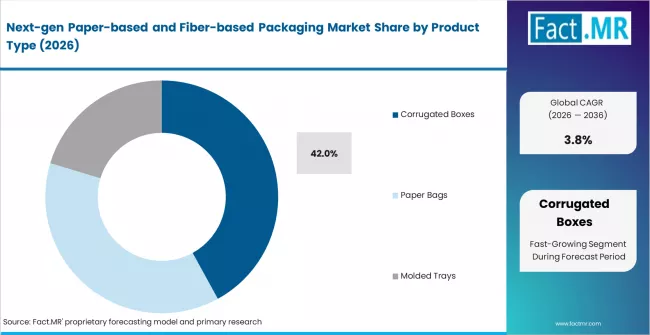
Next Gen Paper Based And Fiber Based Packaging Market Analysis By Product Type | Source: Fact.MR
- Market Overview: Based on Fact MR assessment, corrugated boxes are projected to account for 42% share of the next-gen paper-based and fiber-based packaging market in 2026. Corrugated board structures utilize multi-layer fluted fiber configurations enabling compression strength and shock absorption performance across transport packaging applications. Structural rigidity supports protection of packaged goods during handling, stacking, and distribution processes requiring controlled load bearing characteristics. Conversion processes including die cutting, slotting, and printing support customization of packaging dimensions aligned with product specific logistics requirements across e-commerce distribution and industrial packaging workflows.
- Demand Drivers:
- Compression Strength Requirements: Corrugated structures support load bearing performance enabling protection of packaged products across transport and warehousing environments.
- Structural Adaptability Parameters: Box design flexibility supports customization of packaging dimensions aligned with product specific storage and shipping requirements.
- Logistics Compatibility Needs: Corrugated packaging supports stacking stability enabling efficient palletization across distribution workflows.
Next-gen Paper-based and Fiber-based Packaging Market Analysis by Material
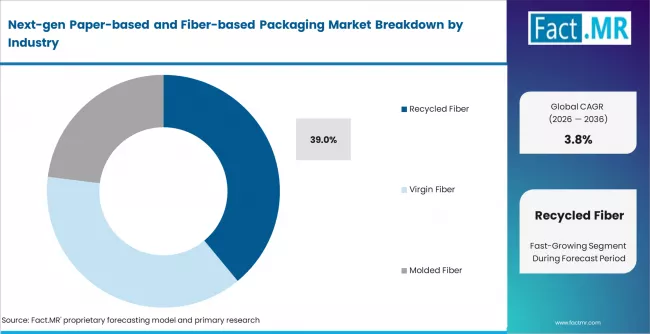
Next Gen Paper Based And Fiber Based Packaging Market Analysis By Material | Source: Fact.MR
- Market Overview: Recycled fiber is estimated to hold 39% share of the next-gen paper-based and fiber-based packaging market in 2026, supported by integration of recovered paper pulp within packaging board manufacturing processes requiring controlled fiber bonding strength and structural stability. Reprocessed cellulose fibers are incorporated into paperboard production enabling formation of rigid and semi-rigid packaging structures aligned with defined mechanical performance characteristics. Fiber processing workflows support compatibility with pulping, refining, and sheet forming operations enabling consistent material quality across packaging conversion applications.
- Demand Drivers:
- Material Processing Requirements: Recycled fiber supports production of paperboard structures requiring controlled fiber bonding characteristics.
- Manufacturing Compatibility Parameters: Fiber recovery processes enable consistent pulp preparation across packaging material production workflows.
- Structural Performance Needs: Recycled fiber based packaging materials demonstrate strength characteristics supporting product protection across handling and transport conditions.
Key Dynamics
Next-gen Paper-based and Fiber-based Packaging Market Drivers, Restraints, and Opportunities
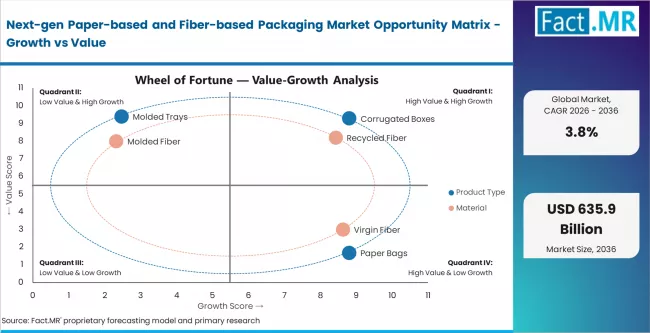
Next Gen Paper Based And Fiber Based Packaging Market Opportunity Matrix Growth Vs Value | Source: Fact.MR
Fact MR analysis indicates historical packaging demand has been structurally anchored in low-cost plastic materials that optimized barrier performance, machinability, and logistics efficiency across food, beverage, and e-commerce distribution systems. The present market size reflects a transition phase driven by regulatory pressure and retailer sustainability commitments that encourage substitution of fossil-based plastics with recyclable fiber-based substrates. Structural reality indicates a growth market because molded fiber, paperboard composites, and cellulose-based films increasingly meet performance thresholds required for protective, secondary, and selected primary packaging formats. Demand expansion remains linked to compliance with recyclability mandates and brand-level packaging reduction targets influencing procurement specifications across consumer goods value chains.
The current structural shift reflects declining use of expanded polystyrene and multilayer plastic laminates as aqueous coatings, molded fiber structures, and mono-material paper solutions improve moisture resistance and mechanical strength. Unit pricing for advanced barrier-coated fiber packaging remains higher than commodity plastics, yet extended producer responsibility fees and plastic taxes narrow cost differentials, supporting value growth despite moderate volume substitution rates. Adoption accelerates where recyclability infrastructure supports fiber recovery streams at industrial scale.
- Plastic Replacement Shift: Fiber-based packaging gains share as molded pulp and paperboard formats replace expanded polystyrene and flexible plastic formats in protective and food packaging applications.
- Regulatory Material Transition: EU Single-Use Plastics Directive and Packaging and Packaging Waste Regulation require recyclability and reduced plastic content, accelerating investment in fiber-based material innovation.
- Europe Policy Influence: Germany, France, and Nordic countries show faster adoption due to extended producer responsibility schemes and recycling targets supporting fiber recovery economics.
Regional Analysis
The next-gen paper-based and fiber-based packaging market is assessed across North America, Europe, and Asia Pacific, segmented by country-level demand in molded fiber packaging, barrier-coated paper materials, recyclable food containers, and sustainable transport packaging formats. Regional demand reflects transition from plastic formats and expansion of fiber-based packaging production technologies. The full report offers market attractiveness analysis.
.webp "Top Country Growth Comparison Next Gen Paper Based And Fiber Based Packaging Market Cagr (2026 2036)")
Top Country Growth Comparison Next Gen Paper Based And Fiber Based Packaging Market Cagr (2026 2036) | Source: Fact.MR
| Country | CAGR (2026–2036) |
|---|---|
| China | 4.6% |
| India | 4.3% |
| United Kingdom | 4.1% |
| Germany | 4.0% |
| United States | 3.8% |
Source: Fact.MR analysis. Updated Apr 16, 2026
Source: Fact MR analysis, based on proprietary forecasting model and primary research
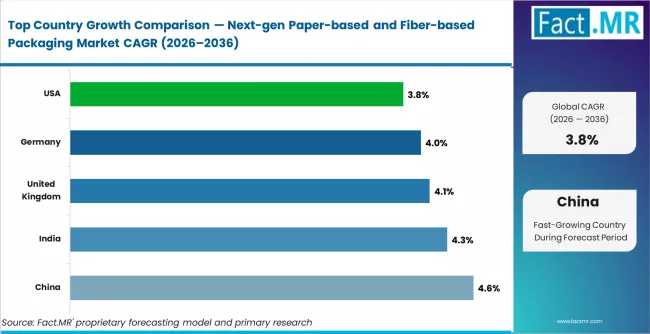
Next Gen Paper Based And Fiber Based Packaging Market Cagr Analysis By Country | Source: Fact.MR
Asia Pacific
Asia Pacific functions as the fiber packaging production expansion hub, supported by increasing paper converting capacity and adoption of molded pulp manufacturing technologies. International Paper Company strengthens fiber packaging material capability. Nine Dragons Paper Holdings Ltd. expands recycled fiber processing capacity. Oji Holdings Corporation supports molded fiber packaging innovation.
- China: China is projected to record 4.6% CAGR in next-gen paper-based and fiber-based packaging through 2036. Plastic pollution reduction action plan update (National Development and Reform Commission, January 2024) supports fiber-based packaging substitution demand. Nine Dragons Paper Holdings Ltd. expanded recycled fiber packaging production capability (June 2023).
- India: Adoption of next-gen paper-based and fiber-based packaging in India is forecast to grow at 4.3% CAGR through 2036. Plastic Waste Management Rules amendment implementation update (Ministry of Environment, February 2024) supports molded fiber packaging demand. ITC Limited expanded sustainable paper packaging manufacturing capability (May 2023).
Europe
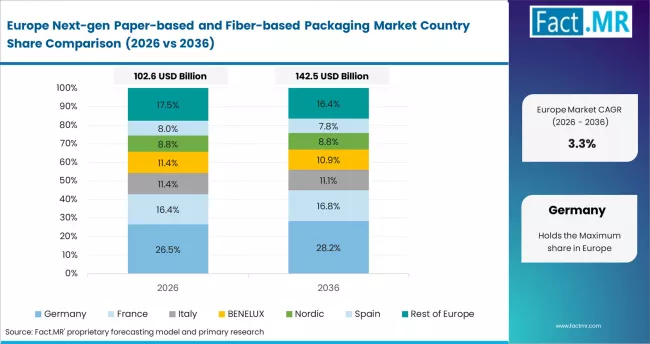
Next Gen Paper Based And Fiber Based Packaging Market Europe Country Market Share Analysis, 2026 & 2036 | Source: Fact.MR
Europe operates as the regulatory compliance benchmark for recyclable packaging materials, supported by structured circular economy frameworks and increasing adoption of fiber-based barrier technologies. Stora Enso Oyj strengthens renewable fiber packaging material capability. Smurfit Kappa Group expands recyclable paper packaging solutions. Mondi plc supports functional fiber packaging innovation.
- United Kingdom: Demand expansion for next-gen paper-based and fiber-based packaging in United Kingdom is expected at 4.1% CAGR through 2036. UK Packaging Waste Regulation update (Department for Environment, Food and Rural Affairs, March 2024) supports recyclable fiber packaging adoption. Mondi plc expanded fiber-based barrier packaging capability (July 2023).
- Germany: Germany is anticipated to observe 4.0% CAGR in next-gen paper-based and fiber-based packaging through 2036. EU Packaging and Packaging Waste Directive compliance update (Federal Environment Agency, October 2023) supports recyclable paper packaging utilization. Smurfit Kappa Group expanded molded fiber packaging production capability (April 2023).
North America
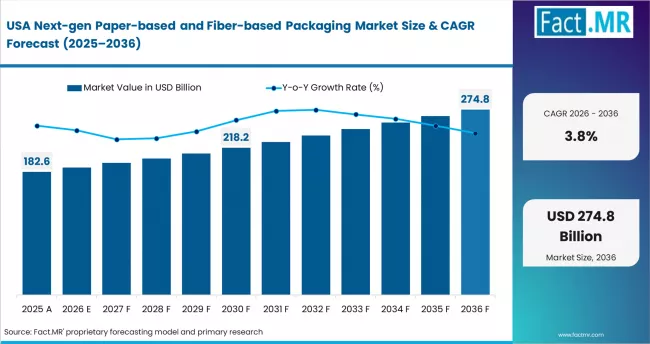
Next Gen Paper Based And Fiber Based Packaging Market Country Value Analysis | Source: Fact.MR
North America represents the fiber packaging material commercialization environment, supported by increasing replacement of rigid plastic packaging and expansion of recyclable material processing infrastructure. WestRock Company strengthens paper packaging conversion capability. International Paper Company expands molded fiber packaging solutions. Graphic Packaging International supports recyclable carton innovation.
- United States: The United States is forecast to witness 3.8% CAGR in next-gen paper-based and fiber-based packaging through 2036. U.S. Plastics Pact recyclable packaging targets update (April 2024) supports paper-based material substitution trends. Graphic Packaging International expanded fiber-based food packaging production capability (August 2023).
Fact MR's analysis of next-gen paper-based and fiber-based packaging market in global regions consists of country-wise assessment that includes China, India, United Kingdom, Germany, and United States. Readers can find recyclable packaging material trends, molded fiber production developments, regulatory signals, and competitive positioning across key markets.
Competitive Landscape
Competitive Structure and Buyer Dynamics in the Next-gen Paper-based and Fiber-based Packaging Market
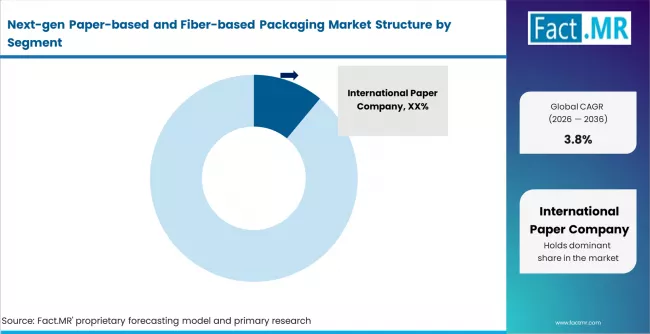
Next Gen Paper Based And Fiber Based Packaging Market Analysis By Company | Source: Fact.MR
The competitive structure of the Next-gen Paper-based and Fiber-based Packaging Market is moderately concentrated, with large integrated pulp and paper companies controlling a significant share of packaging material production. Companies such as International Paper Company, Smurfit Kappa Group plc, WestRock Company, DS Smith plc, Stora Enso Oyj, UPM-Kymmene Corporation, Mondi Group, Oji Holdings Corporation, Packaging Corporation of America, and Nippon Paper Industries Co. Ltd. maintain strong positions through vertically integrated pulp processing and global packaging conversion networks. Competition is primarily influenced by material strength performance, barrier properties, process efficiency, and compatibility with existing packaging production technologies across food, consumer goods, and industrial applications.
Several companies maintain structural advantages through access to fiber resources and large scale paper processing infrastructure supporting stable raw material supply. Firms such as International Paper Company, Stora Enso Oyj, and UPM-Kymmene Corporation benefit from integrated forestry operations and established pulp production capabilities. Smurfit Kappa Group plc and Mondi Group maintain advantages through strong packaging design expertise and global converting networks. Brand owners and packaging users typically adopt multi supplier sourcing strategies to reduce dependence on a single packaging provider and maintain supply continuity. Procurement decisions evaluate suppliers based on material consistency, conversion performance, and long term availability, moderating supplier pricing leverage across fiber based packaging applications.
Key Players of the Next-gen Paper-based and Fiber-based Packaging Market
- International Paper Company
- Smurfit Kappa Group plc
- WestRock Company
- DS Smith plc
- Stora Enso Oyj
- UPM-Kymmene Corporation
- Mondi Group
- Oji Holdings Corporation
- Packaging Corporation of America
- Nippon Paper Industries Co. Ltd.
Bibliographies
- [1] National Development and Reform Commission. (2024, January). Plastic pollution reduction action plan 2024 to 2030 fiber based packaging substitution guidelines. Government of China.
- [2] Ministry of Environment Forest and Climate Change. (2024, February). Plastic waste management rules amendment molded fiber packaging promotion. Government of India.
- [3] Department for Environment Food and Rural Affairs. (2024, March). UK packaging waste regulation update recyclable fiber packaging requirements. UK Government.
- [4] Federal Environment Agency. (2023, October). EU packaging and packaging waste directive compliance recyclable paper packaging utilization guidelines. Government of Germany.
- [5] Ellen MacArthur Foundation. (2024, April). US plastics pact recyclable packaging targets update supporting paper based material substitution. Ellen MacArthur Foundation.
- [6] Nine Dragons Paper Holdings Ltd. (2023, June). Recycled fiber packaging production capacity expansion. Nine Dragons Paper Holdings Ltd.
- [7] ITC Limited. (2023, May). Sustainable paper packaging manufacturing capability expansion. ITC Limited.
This Report Addresses
- Market size forecasts for 2026 to 2036 based on substitution trends from plastic substrates toward fiber-based packaging materials across consumer goods supply chains.
- Opportunity mapping across recycled fiber, virgin fiber, molded fiber, and specialty paper formats supporting structural packaging performance requirements.
- Segment and regional forecasts covering corrugated boxes, paper bags, molded trays, cartons, and flexible paper packs across diverse end-use industries.
- Competition benchmarking based on fiber processing capability, barrier coating performance, and compatibility with high-volume packaging conversion systems.
- Regulatory assessment covering packaging recyclability mandates and extended producer responsibility frameworks influencing material selection across packaging supply chains.
- Report delivery in PDF, Excel, PPT, and dashboard formats supporting packaging manufacturers, material engineers, and supply chain procurement planners.
- Supply chain risk analysis covering pulp feedstock price variability, recycled fiber availability constraints, moisture resistance limitations, and conversion cost sensitivity across packaging production workflows.
Next-gen Paper-based and Fiber-based Packaging Market Definition
Next-gen Paper-based and Fiber-based Packaging Market Definition Paragraph
The Next-gen Paper-based and Fiber-based Packaging Market includes advanced packaging materials made from wood pulp, recycled paper, agricultural residues, and molded fiber that provide recyclable, biodegradable, and lightweight alternatives to plastic packaging across food, beverage, e-commerce, healthcare, and consumer goods applications.
Next-gen Paper-based and Fiber-based Packaging Market Inclusions
The report includes global and regional market size estimates, forecast analysis, and segmentation by material type such as recycled fiber and virgin fiber, product format, application sector, end use industry, pricing structure, and supply chain trade patterns across sustainable packaging value chains.
Next-gen Paper-based and Fiber-based Packaging Market Exclusions
The scope excludes conventional plastic packaging materials, metal or glass containers, finished packaged consumer goods, bio-based polymers not processed into paper or fiber structures, and packaging machinery not directly related to fiber material production.
Next-gen Paper-based and Fiber-based Packaging Market Research Methodology
- Primary Research: Interviews were conducted with packaging manufacturers, pulp producers, converters, brand owners, and sustainability material specialists.
- Desk Research: Public sources included packaging industry publications, company technical literature, regulatory frameworks, and research studies on paper and fiber packaging technologies.
- Market-Sizing and Forecasting: A hybrid model combining top-down packaging demand evaluation and bottom-up analysis of fiber-based material adoption across applications was applied.
- Data Validation and Update Cycle: Outputs were validated through cross comparison of supplier data, expert consultation, and periodic monitoring of packaging material substitution trends.
Segmentation
Report Scope

Next Gen Paper Based And Fiber Based Packaging Market Breakdown By Product Type, Material, And Region | Source: Fact.MR
| Metric | Value |
|---|---|
| Quantitative Units | USD 421.9 billion (2026) to USD 612.8 billion (2036), at a CAGR of 3.8% |
| Market Definition | The next-generation paper-based and fiber-based packaging market includes advanced packaging materials produced from renewable fiber resources designed to provide structural performance, recyclability, and barrier functionality across food, e-commerce, healthcare, and industrial packaging applications. |
| Material Segmentation | Recycled fiber, Virgin fiber, Molded fiber, Specialty paper |
| Application Segmentation | Food packaging, E-commerce packaging, Healthcare packaging, Personal care packaging, Industrial packaging |
| Product Type Segmentation | Corrugated boxes, Paper bags, Molded trays, Cartons, Flexible paper packs |
| Regions Covered | North America, Latin America, Europe, East Asia, South Asia, Oceania, Middle East and Africa |
| Countries Covered | United States, Canada, Germany, France, United Kingdom, Italy, Spain, Sweden, Finland, China, Japan, South Korea, India, Indonesia, Brazil, Mexico, Australia, United Arab Emirates, and 40+ countries |
| Key Companies Profiled | International Paper Company, Smurfit Kappa Group plc, WestRock Company, DS Smith plc, Stora Enso Oyj, UPM-Kymmene Corporation, Mondi Group, Oji Holdings Corporation, Packaging Corporation of America, Nippon Paper Industries Co. Ltd. |
| Forecast Period | 2026 to 2036 |
| Approach | Hybrid top-down and bottom-up market estimation based on fiber packaging consumption ratios, e-commerce packaging demand benchmarking, paperboard production capacity analysis, substitution trends from plastic materials, and validation through primary interviews with packaging manufacturers, converters, and material suppliers. |
Source: Fact.MR analysis. Updated Apr 16, 2026
Next Gen Paper Based and Fiber Based Packaging Market Key Segments
-
Material:
- Recycled Fiber
- Virgin Fiber
- Molded Fiber
- Specialty Paper
-
Application:
- Food Packaging
- E Commerce Packaging
- Healthcare Packaging
- Personal Care Packaging
- Industrial Packaging
-
Product Type:
- Corrugated Boxes
- Paper Bags
- Molded Trays
- Cartons
- Flexible Paper Packs
-
Region:
- North America
- USA
- Canada
- Mexico
- Europe
- Germany
- UK
- France
- Italy
- Spain
- Nordic Countries
- BENELUX
- Rest of Europe
- Asia Pacific
- China
- Japan
- South Korea
- India
- Australia
- Rest of Asia Pacific
- Latin America
- Brazil
- Argentina
- Rest of Latin America
- Middle East and Africa
- Kingdom of Saudi Arabia
- United Arab Emirates
- South Africa
- Rest of Middle East and Africa
- Other Regions
- Oceania
- Central Asia
- Other Markets
- North America
Frequently Asked Questions
How large is the demand for Next-gen Paper-based and Fiber-based Packaging in the global market in 2026?
What will be the market size of Next-gen Paper-based and Fiber-based Packaging in the global market by 2036?
What is the expected demand growth for Next-gen Paper-based and Fiber-based Packaging in the global market between 2026 and 2036?
Which company is identified as a leading manufacturer in the Next-gen Paper-based and Fiber-based Packaging market?
Which product type is projected to dominate next-gen paper and fiber packaging demand by 2026?
Why are corrugated boxes widely used in fiber-based packaging applications?
What is driving demand for next-gen fiber-based packaging in China?
What is the growth outlook for the Next-gen Paper-based and Fiber-based Packaging market in China?
Why is India an important market for fiber-based packaging materials?
What is the growth outlook for the Next-gen Paper-based and Fiber-based Packaging market in India?
How is demand for next-gen paper packaging evolving in the United Kingdom?
What is the growth outlook for the Next-gen Paper-based and Fiber-based Packaging market in the United Kingdom?
What is the growth outlook for the Next-gen Paper-based and Fiber-based Packaging market in Germany?
How is the United States positioned in the Next-gen Paper-based and Fiber-based Packaging market?
What is the growth outlook for the Next-gen Paper-based and Fiber-based Packaging market in the United States?
What is next-gen paper-based and fiber-based packaging and what is it mainly used for?
What does the Next-gen Paper-based and Fiber-based Packaging market include in this report?
What applications are included in the scope of the Next-gen Paper-based and Fiber-based Packaging market?
What is excluded from the scope of the Next-gen Paper-based and Fiber-based Packaging market report?
What does market forecast mean in the Next-gen Paper-based and Fiber-based Packaging market report?
How is the Next-gen Paper-based and Fiber-based Packaging market forecast developed in this report?
What does primary validation indicate in the Next-gen Paper-based and Fiber-based Packaging market analysis?
Who worked on this report


Preview the report firsthand - request a free sample
Free SampleGet the brochure for pricing and purchase details
Download PDF