- Market Value (2025): USD 126.9 Mn
- Estimated Value (2026): USD 135.0 Mn
- Forecast Value (2036): USD 251.0 Mn
- CAGR (2026-2036): 6.4%
What is the Paraffin Colorant Dyes Market forecast to be worth by 2036?
USD 135.0 million in 2026 to USD 251.0 million by 2036, at 6.4% CAGR.
- An estimated USD 126.9 million market in 2025 shows that paraffin coloration already supports a meaningful mix of candles, coatings, paper and board, polish compounds, and lamp oils.
- The outlook advances from USD 135.0 million in 2026 to USD 251.0 million in 2036 as more producers seek controlled shades in decorative and functional paraffin products.
- Expansion at a 6.4% CAGR reflects wider product variety, rising need for color concentrates that fit defined melt ranges, and repeated compliance work in packaging-related uses.
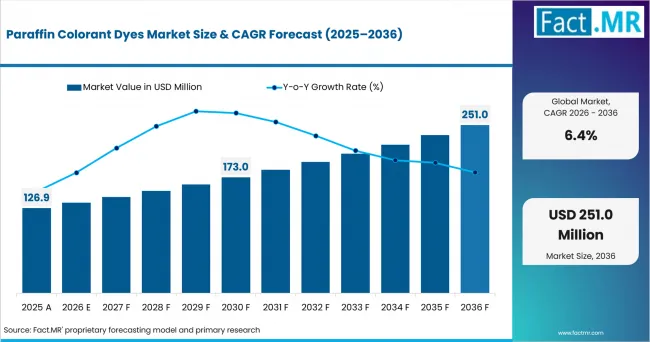
Paraffin Colorant Dyes Market Value Analysis | Source: Fact.MR
What are the defining numbers behind Paraffin Colorant Dyes Market growth?
USD 116.0 million absolute opportunity by 2036, led by Candle-grade wax and Decorative candles within their respective segments.
- Demand Drivers in the Market
- Decorative candle producers use color to organize collections, reinforce scent cues, and create visible differentiation without changing the underlying wax format.
- Packaging and coating users need stable, uniform tint while also protecting the intended barrier or surface function of the paraffin layer.
- Liquid concentrates and wax chips help plants add color with less dust and more predictable dosing than manually handled powders.
- Buyers are asking colorant suppliers for clearer evidence on melt compatibility, migration, storage behavior, and suitability for the exact end use.
- Key Segments Analyzed
- By Paraffin Product: The Paraffin Product segment in 2026 favors Candle-grade wax, the clear leader in demand. Decorative candle production combines substantial wax use with frequent color variation.
- By End Product: No other End Product category comes close to Decorative candles, the clear leader in 2026. Color is renewed across scents, seasons, formats, and brand collections.
- By Color Delivery: Demand for Color Delivery in 2026 is concentrated on Powder dye, which stands well above every other category. Established formulators value high concentration, broad shade flexibility, and low carrier content.
- By Melting Range: Medium-melt paraffin covers the broad central processing window used across candles, packaging, and coatings. That advantage gives Medium-melt paraffin the largest 2026 Melting Range position.
- By Channel: The category's largest 2026 Channel position is captured by Industrial formulators since they aggregate color needs across coatings, oils, polishes, and multiple paraffin blends.
- Analyst Opinion at Fact.MR
- Shambhu Nath Jha, Senior Analyst at Fact.MR, states, "Paraffin gives the colorist a familiar hydrocarbon medium, but the commercial result still changes with melt range, oil content, additives, and cooling. The winning offer is a controlled formula plus usable processing guidance, not a long list of colors without context."
- Strategic Implications
- Dye makers should state the paraffin grades and melt windows used in their color evaluations so customers can judge transferability.
- Packaging suppliers need an early review of colorant identity and intended-use status before approving a tinted food-contact coating.
- Candle companies can reduce development loops by testing color at the same fragrance load, wick, vessel, and cooling conditions planned for production.
- Industrial formulators should separate visual acceptance from barrier, rub, and migration tests because a correct shade does not establish functional performance.
U.S. Food and Drug Administration materials describe paraffin wax entries and a notification covering oxidized paraffin and hydrocarbon waxes for specified coating-related uses. Intended use, composition, and migration review remain practical parts of supplier selection for packaging paraffin.
How does the Paraffin Colorant Dyes Market break down by segment?
The leading segments are Candle-grade wax by Paraffin Product and Decorative candles by End Product.
Why is candle-grade wax the largest paraffin product segment?
In 2026, the leading position goes to Candle-grade wax because decorative candle production combines substantial wax use with frequent color variation.
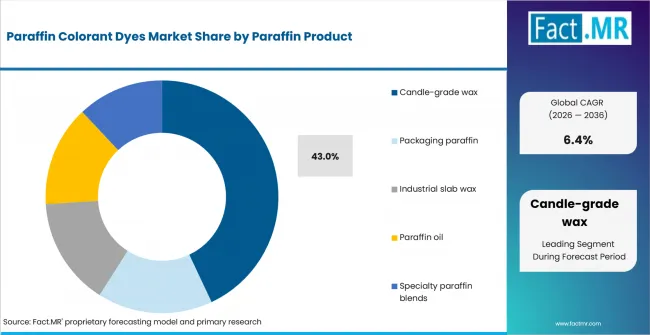
Paraffin Colorant Dyes Market Analysis By Paraffin Product | Source: Fact.MR
Candle-grade wax leads paraffin-product demand, creating the market's deepest pool of recurring shade work. Packaging paraffin and industrial slab wax are more function-led categories, so color often has to coexist with coating, release, or identification requirements. Paraffin oil rounds out the mix, shifting the technical focus from a solidified shade to clarity and solution stability in a liquid medium.
What keeps decorative candles at the center of end-product demand?
The 2026 leader is Decorative candles because color is renewed across scents, seasons, formats, and brand collections.
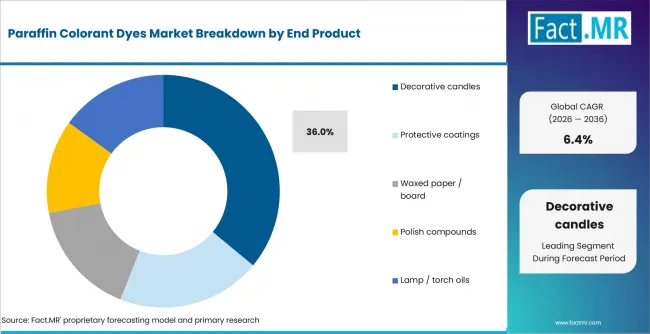
Paraffin Colorant Dyes Market Analysis By End Product | Source: Fact.MR
Decorative candles lead end-product demand and make shade a direct part of consumer presentation. Protective coatings follow, where the dye cannot undermine film behavior or create unwanted transfer. Waxed paper / board and lamp / torch oils each require a distinct qualification path because the colored medium and use conditions are different.
Why does powder dye remain the principal color-delivery form?
Powder dye ranks first in 2026 because established formulators value high concentration, broad shade flexibility, and low carrier content.
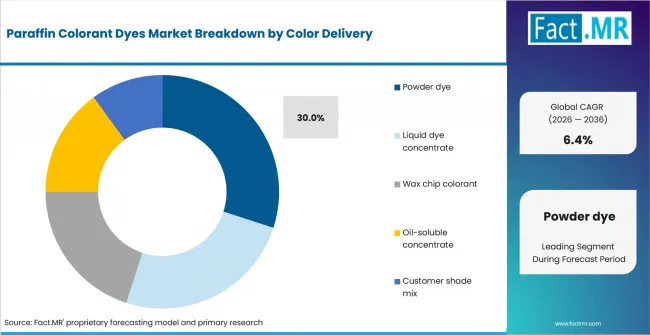
Paraffin Colorant Dyes Market Analysis By Color Delivery | Source: Fact.MR
Powder dye leads the category, supported by experienced processors that can control weighing and mixing. Liquid dye concentrate follows, exchanging some formulation freedom for faster, cleaner addition. Wax chip colorant and oil-soluble concentrate give customers preconditioned forms suited to solid wax or liquid paraffin systems.
Where does low-melt paraffin fit within colorant demand?
For Melting Range, the top 2026 position is Medium-melt paraffin because it covers the broad central processing window most converters run.
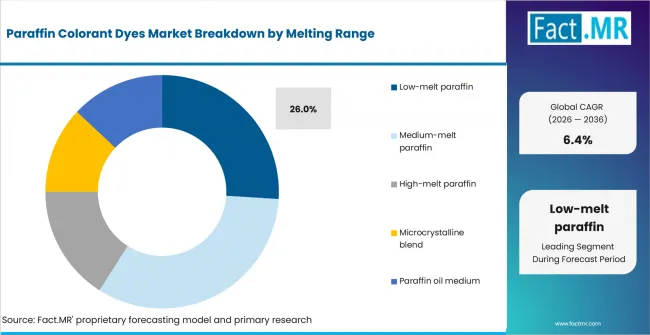
Paraffin Colorant Dyes Market Analysis By Melting Range | Source: Fact.MR
Low-melt paraffin holds a meaningful position in the market mix and is an important target for dyes that dissolve readily without prolonged heating. Medium-melt paraffin is the larger category, covering a broader central processing window. High-melt paraffin places greater emphasis on heat exposure, while paraffin oil medium demands persistent clarity rather than solid-state distribution.
Why do industrial formulators edge ahead of candle producers as a channel?
The leading 2026 position belongs to Industrial formulators because they aggregate color needs across coatings, oils, polishes, and multiple paraffin blends.
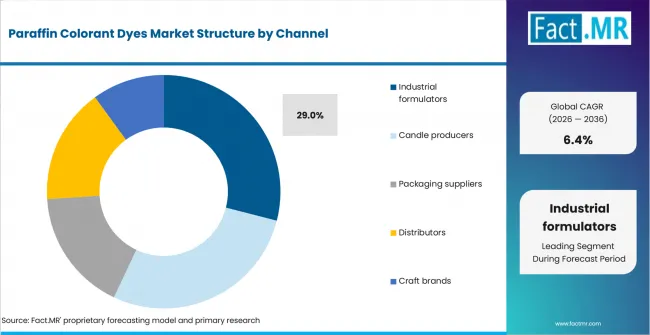
Paraffin Colorant Dyes Market Analysis By Channel | Source: Fact.MR
Industrial formulators lead channel demand, narrowly ahead of candle producers. Packaging suppliers follow and bring a higher burden of intended-use and migration review to colorant approval. Distributors remain important for shade access and sample service across smaller accounts that do not buy directly.
What is accelerating Paraffin Colorant Dyes Market adoption, and what is holding it back?
Growth is accelerated by the need to give paraffin products a controlled visual identity without complicating the process. The chief brake is qualification fragmentation, since melt range, end use, additive package, and regulatory context can each change the acceptable dye choice.
Drivers Impact Analysis
| DRIVER | (~) % IMPACT ON CAGR | GEOGRAPHIC RELEVANCE | IMPACT TIMELINE |
|---|---|---|---|
| Candle range renewal | +1.0% | United States and Europe | Short term (<= 2 years) |
| Tinted protective coatings | +0.8% | Asia Pacific and North America | Medium term (2-4 years) |
| Cleaner plant handling | +0.7% | Japan, South Korea, and Germany | Medium term (2-4 years) |
| Packaging documentation | +0.6% | United States and European Union | Long term (>= 4 years) |
| Regional shade service | +0.4% | South Korea and Japan | Short term (<= 2 years) |
Source: Fact.MR analysis. Updated Jul 18, 2026
- Candle range renewal: Decorative candle collections create repeat demand for standard and custom shades. Color suppliers benefit when they can reproduce a prior appearance across new paraffin lots and fragrance combinations.
- Tinted protective coatings: Some coating applications use color for identification, appearance, or process control. The dye must fit the paraffin layer without weakening its intended surface function.
- Cleaner plant handling: Concentrates and chips reduce airborne powder and simplify addition at the kettle. Adoption depends on whether the carrier remains compatible with the paraffin formula.
Opportunity Impact Analysis
| OPPORTUNITY | (~) % IMPACT ON CAGR | GEOGRAPHIC RELEVANCE | IMPACT TIMELINE |
|---|---|---|---|
| Melt-range product mapping | +0.5% | Global paraffin processors | Medium term (2-4 years) |
| Packaging-ready documentation | +0.4% | United States, Germany, and Japan | Long term (>= 4 years) |
| Wax-chip shade systems | +0.4% | North America and East Asia | Short term (<= 2 years) |
| Paraffin-oil clarity grades | +0.3% | Asia Pacific and Europe | Medium term (2-4 years) |
Source: Fact.MR analysis. Updated Jul 18, 2026
- Melt-range product mapping: Suppliers can group dyes by proven behavior in low-, medium-, and high-melt wax as well as paraffin oil. A practical map helps customers avoid assuming that one solution profile covers every grade.
- Packaging-ready documentation: Colorants with substance identity, purity information, migration support, and change control can enter packaging discussions earlier. The commercial opportunity is technical confidence, not a blanket claim of food-contact approval.
- Wax-chip shade systems: Wax chip colorant already represents a meaningful share of delivery demand. Expanding shade availability and standardizing chip strength can make the format attractive to plants seeking less powder handling.
Restraints Impact Analysis
| RESTRAINT | (~) % IMPACT ON CAGR | GEOGRAPHIC RELEVANCE | IMPACT TIMELINE |
|---|---|---|---|
| Cooling-driven color change | -0.4% | Global | Short term (<= 2 years) |
| Migration concern | -0.4% | Packaging applications | Long term (>= 4 years) |
| Carrier incompatibility | -0.3% | Industrial formulation markets | Medium term (2-4 years) |
| End-use regulatory variation | -0.2% | United States and European Union | Long term (>= 4 years) |
Source: Fact.MR analysis. Updated Jul 18, 2026
- Cooling-driven color change: The perceived shade can change as molten paraffin solidifies and crystallizes. Production teams may need several iterations before the cooled article matches the approved standard.
- Migration concern: A colorant that transfers into adjacent material or contents can make the formulation unacceptable. This risk encourages conservative dosing and extended testing.
- Carrier incompatibility: A liquid concentrate may introduce a carrier that changes hardness, surface, or burning behavior. Convenience alone will not secure approval if the host paraffin is disturbed.
Which countries hold up paraffin colorant demand?
United States 5.4% CAGR. China 6.4% CAGR. Germany 5.1% CAGR. Japan 5.2% CAGR. South Korea 5.6% CAGR.
Regional analysis covers country chapters on United States, China, Germany, Japan, and South Korea. Analysis on more than 30 countries is included in the full report.
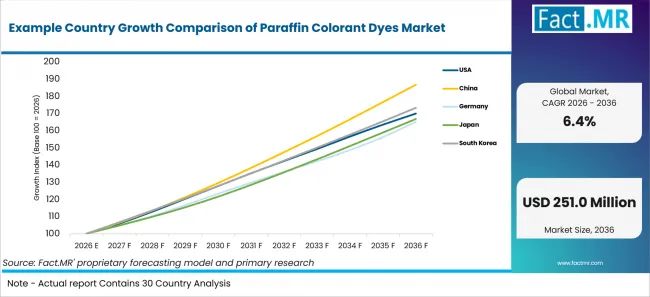
Example Country Growth Comparison Of Paraffin Colorant Dyes Market | Source: Fact.MR
| COUNTRY | CAGR |
|---|---|
| United States | 5.4% |
| China | 6.4% |
| Germany | 5.1% |
| Japan | 5.2% |
| South Korea | 5.6% |
Source: Fact.MR analysis. Updated Jul 18, 2026
How is the United States market likely to develop?
A 5.4% CAGR is projected for United States during 2026-2036.
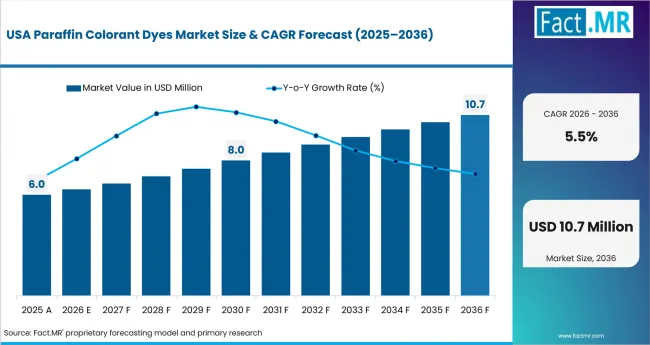
Paraffin Colorant Dyes Market Country Value Analysis | Source: Fact.MR
United States' outlook is shaped by country-specific operating conditions. EPA chemical-management requirements sit alongside a broad and formally measured manufacturing base. Buyers therefore ask for documented application fit, repeatable specifications, and a defensible compliance file before changing a material or display program. For paraffin colorant dyes, that translates into shade repeatability, melt compatibility, and controlled dosing for candle, decorative-wax, and packaging applications. That makes country-specific operating evidence more useful than a broad demand statement: suppliers need to match the offer to local qualification, channel, and service requirements.
How is the China market likely to develop?
A 6.4% CAGR is projected for China during 2026-2036.
China's outlook reflects country-specific operating conditions, industrial policy for resource efficiency and environmental standards shape a high-throughput processing setting. Suppliers must prove that a formulation or system can hold performance at scale while fitting local plant controls and fast product cycles. For paraffin colorant dyes, that translates into shade repeatability, melt compatibility, and controlled dosing for candle, decorative-wax, and packaging applications. That makes country-specific operating evidence more useful than a broad demand statement: suppliers need to match the offer to local qualification, channel, and service requirements.
How is the Germany market likely to develop?
A 5.1% CAGR is projected for Germany during 2026-2036.
REACH restriction duties make substance control a procurement issue, while manufacturing statistics reflect a technically demanding production base. Buyers put weight on traceability, change control, and evidence that a material will behave consistently in qualified processes. For paraffin colorant dyes, that translates into shade repeatability, melt compatibility, and controlled dosing for candle, decorative-wax, and packaging applications. That makes country-specific operating evidence more useful than a broad demand statement: suppliers need to match the offer to local qualification, channel, and service requirements.
How is the Japan market likely to develop?
A 5.2% CAGR is projected for Japan during 2026-2036.
Chemical-management guidance and consumer-product safety controls create a tightly qualified environment. Product changes require careful documentation, repeatable appearance or performance, and technical support that reduces risk in established production lines. For paraffin colorant dyes, that translates into shade repeatability, melt compatibility, and controlled dosing for candle, decorative-wax, and packaging applications. That makes country-specific operating evidence more useful than a broad demand statement: suppliers need to match the offer to local qualification, channel, and service requirements.
How is the South Korea market likely to develop?
A 5.6% CAGR is projected for South Korea during 2026-2036.
South Korea's market direction depends on country-specific operating conditions. Environmental policy and industrial-output reporting point to an export-facing manufacturing environment. Buyers evaluate material consistency, regulatory fit, and the ability to support short product cycles without creating rework or qualification delays. For paraffin colorant dyes, that translates into shade repeatability, melt compatibility, and controlled dosing for candle, decorative-wax, and packaging applications. That makes country-specific operating evidence more useful than a broad demand statement: suppliers need to match the offer to local qualification, channel, and service requirements.
Who leads the Paraffin Colorant Dyes Market?
Solar Organics, Neelikon, Abbey Color, and FastColours address paraffin color programs through oil-soluble chemistry, custom matching, and multiple delivery forms.
Solar Organics and Neelikon are named as the two leading positions in the market evidence, reflecting their established positions. Their opportunity is to convert broad solvent-dye capability into grade-specific evidence for solid paraffin and paraffin oil, especially where a customer needs both standard supply and shade correction.
Abbey Color hold closely matched positions, with FastColours also active in the space. Official material from Abbey and FastColours places solvent dyes in wax or candle-related use; commercial differentiation will depend on melt-window guidance, carrier choice, documentation, and the repeatability of customer matches.
Which companies are the key providers?
The company set includes Solar Organics, Neelikon, Abbey Color, and FastColours.
- Solar Organics
- Neelikon
- Abbey Color
- FastColours
These five suppliers are among the key providers, with more than 30 companies covered in the full competitive chapter.
Bibliography
- National Candle Association. (n.d.). Elements of a Candle: Wax.
- National Candle Association. (n.d.). Elements of a Candle: Colorants.
- U.S. Food and Drug Administration. (2026). Substances Added to Food: Paraffin Wax.
- U.S. Food and Drug Administration. (2021). Food Contact Substance Notification No. 2120.
- U.S. Food and Drug Administration. (n.d.). Food Packaging and Other Food Contact Substances: Information for Consumers.
- Abbey Color. (n.d.). Solvent Dyes.
- FastColours. (n.d.). Solvent Dyes.
- European Chemicals Agency. (n.d.). Registration under REACH.
This Report Addresses
- It establishes the 2025 market reference and the quantified 2026-2036 forecast.
- It reviews United States, China, Germany, Japan, and South Korea, within coverage that reaches more than 30 countries.
- It positions Solar Organics, Neelikon, Abbey Color, and FastColours against the market positions.
- It compares powders, liquids, wax chips, oil-soluble concentrates, and customer shade mixes.
- It follows demand through candles, coatings, waxed paper and board, polish compounds, and lamp or torch oils.
- It links forecast confidence to melt range, cooling behavior, carrier compatibility, migration review, handling preferences, and regional service.
What does the Paraffin Colorant Dyes Market cover?
The scope captures soluble colorant revenue tied specifically to paraffin-based media and products.
The analysis crosses paraffin product, end product, delivery form, melting range, channel, country, and supplier.
It also evaluates process fit, solidification, clarity, handling, regulatory documentation, and custom-shade support.
What is included in the scope?
Qualifying products must be sold for incorporation into solid paraffin, a paraffin blend, or paraffin oil.
Powder, liquid, chip, concentrate, and mixed-shade value is included at the supplier selling level.
Candle, coating, paper and board, polish, and lamp-oil uses remain within scope when paraffin is the colored medium.
What is excluded from the scope?
Finished-product and host-material value is separated from the colorant market.
Paraffin wax, paraffin oil, finished candles, coated packaging, polish compounds, and lamps or torches are not counted.
Non-soluble pigments, unrelated dyes, wax-free coatings, and services that cannot be assigned to colorant sales fall outside the study.
How Was the Analysis Built?
The analysis draws on 120+ sources, 35+ company portfolios, 25+ countries, and more than 20 industry interviews.
- Primary Research: Primary research includes discussions with manufacturers, service providers, technology developers, distributors, end users, procurement teams, and subject-matter experts. These conversations examine purchasing priorities, product adoption, operational challenges, approval requirements, competitive positioning, and the factors that influence wider market acceptance.
- Desk Research: Desk research covers government statistics, regulatory publications, company filings, trade data, technical studies, industry associations, standards, public policy, and other authoritative sources. Every source used in the analysis is documented in the bibliography.
- Market Sizing and Forecasting: Market estimates combine historical performance, demand indicators, pricing and volume trends, segment shares, company participation, country-level growth, adoption patterns, investment activity, and barriers to market expansion.
- Data Validation and Update Cycle: Findings are validated by comparing primary interviews with public data, company activity, regulatory changes, trade patterns, and industry developments. Regular updates review new product launches, capacity changes, partnerships, approvals, procurement trends, and shifts in commercial adoption.
Segmentation
What is the report's scope and coverage?
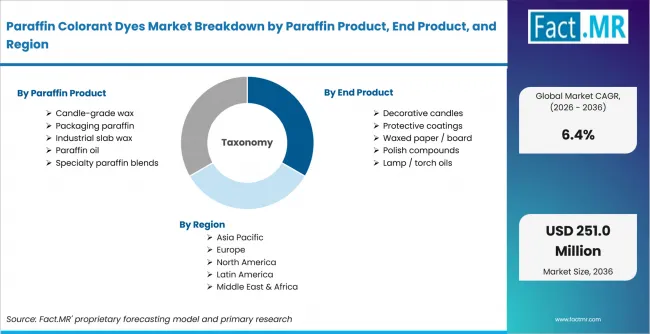
Paraffin Colorant Dyes Market Breakdown By Paraffin Product, End Product, And Region | Source: Fact.MR
| ATTRIBUTE | DETAILS |
|---|---|
| Quantitative Units | USD 135.0 million in 2026 to USD 251.0 million by 2036 at 6.4% CAGR |
| Market Definition | Paraffin colorant dyes are soluble dyes and prepared concentrates sold to impart a controlled color to solid paraffin wax, paraffin blends, or paraffin oil. |
| Paraffin Product | Candle-grade wax; Packaging paraffin; Industrial slab wax; Paraffin oil; Specialty paraffin blends |
| End Product | Decorative candles; Protective coatings; Waxed paper / board; Polish compounds; Lamp / torch oils |
| Color Delivery | Powder dye; Liquid dye concentrate; Wax chip colorant; Oil-soluble concentrate; Customer shade mix |
| Melting Range | Low-melt paraffin; Medium-melt paraffin; High-melt paraffin; Microcrystalline blend; Paraffin oil medium |
| Channel | Industrial formulators; Candle producers; Packaging suppliers; Distributors; Craft brands |
| Regions Covered | North America; Europe; Asia Pacific |
| Countries Covered | United States; China; Germany; Japan; South Korea (analysis extends to 30+ countries) |
| Key Companies Profiled | Solar Organics; Neelikon; Abbey Color; FastColours |
| Forecast Period | 2026 to 2036 |
| Approach | Demand is evaluated using colored paraffin output, application-specific dye loading, concentrate strength, delivery-form mix, supplier pricing, and buyer purchasing patterns. |
Source: Fact.MR analysis. Updated Jul 18, 2026
How is the market segmented?
-
By Paraffin Product
- Candle-grade wax
- Packaging paraffin
- Industrial slab wax
- Paraffin oil
- Specialty paraffin blends
-
By End Product
- Decorative candles
- Protective coatings
- Waxed paper / board
- Polish compounds
- Lamp / torch oils
-
By Color Delivery
- Powder dye
- Liquid dye concentrate
- Wax chip colorant
- Oil-soluble concentrate
- Customer shade mix
-
By Melting Range
- Low-melt paraffin
- Medium-melt paraffin
- High-melt paraffin
- Microcrystalline blend
- Paraffin oil medium
-
By Channel
- Industrial formulators
- Candle producers
- Packaging suppliers
- Distributors
- Craft brands
-
By Region
- North America
- United States
- Europe
- Germany
- Asia Pacific
- China
- Japan
- South Korea
- North America
Frequently Asked Questions
What is the paraffin colorant dyes market forecast?
Which paraffin product leads demand?
What is the largest end product?
Which delivery form has the highest share?
Which melting range is largest?
Which route to market leads?
Which countries hold up demand?
Which suppliers appear in the competitive evidence?
Who worked on this report


Preview the report firsthand - request a free sample
Free SampleGet the brochure for pricing and purchase details
Download PDF