- Market Value (2025): USD 685.3 Mn
- Estimated Value (2026): 750.0 Mn
- Forecast Value (2036): USD 1850.0 Mn
- CAGR (2026-2036): 9.4%
What is the PCR-Compatible Masterbatches Market forecast to be worth by 2036?
USD 750.0 million in 2026 and is on track to reach USD 1,850.0 million by 2036, a 9.4% CAGR.
- In 2025, the PCR-compatible masterbatches market crossed USD 685.3 million as label converters wrapped up early approval work on color masterbatches paired with recycled plastics additives. Those reviews tie appearance back to downstream label release and whether the finished package actually gets accepted.
- Demand is projected to add USD 1,100.0 million through 2036 as use cases built around rPET and Black sharpen. Both give compounders a known starting point, a defined recycled polymer stream they can match the color function to.
- Formulations stay under technical review as long as label release and wash water load remain open questions, which is what underpins the 9.4% CAGR forecast. Adoption tracks reproducible plant evidence, not a single laboratory color reading.
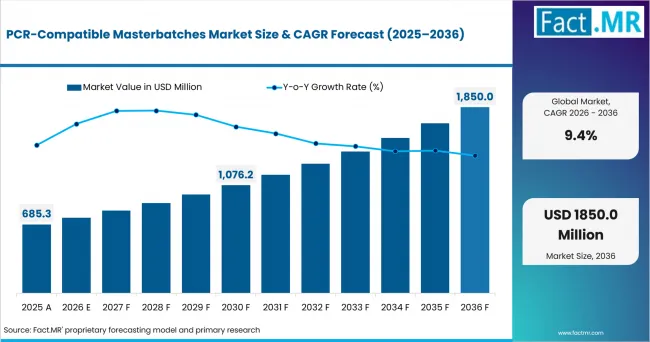
Pcr Compatible Masterbatches Market Market Value Analysis | Source: Fact.MR
What are the defining numbers behind PCR-Compatible Masterbatches Market growth?
USD 1,100.0 million absolute opportunity by 2036, with packaging converters leading the buying route.
Demand Drivers in the Market
- Demand is rising for pigments and additives that reduce wash water use and make production easier to manage.
- Black masterbatch is gaining use because it can correct uneven resin color, reduce rejected material, and lower rework costs.
- Growth in mono-material packaging is increasing demand for masterbatches that work well with recycled resin, labels, filtration systems, and final packaging processes.
- Low-PCR packaging is becoming more common because it gives brands a practical way to reduce plastic waste without making production too difficult.
- Demand from converters is growing because they need materials that can deliver stable color and performance under real production conditions.
Key Segments Analyzed
- By Polymer Base: rPET holds 30% share in 2026. Its lead comes down to a well-defined recycled-polymer route, one where the compounder can line up carrier selection, pigment dispersion, filtration, and color correction against the base resin before it ever reaches converter approval.
- By Color Function: Black leads with 29% share in 2026. It gives customers a correction function they can see and test whenever PCR shade drifts, though the formulation team still has to verify dosage and consistency across finished parts.
- By Application: Packaging holds 49% share in 2026. Packaging trials run the masterbatch through the full approval chain mono-material design wash conditions, and the converter's own production settings.
- By PCR Level: Low PCR holds 31% share in 2026. It keeps the initial change close to an existing recipe, which lets quality teams separate feedstock effects from masterbatch effects before they push PCR use any further.
- By End User: Converters account for 31% share in 2026. Their line conditions and finished-product checks are what decide whether a grade moves from a trial lot into repeat purchasing.
Analyst Opinion at Fact.MR
Shambhu Nath Jha, Senior Analyst at Fact.MR, states that buyers want to know how the material performs with their own recycled plastic. They also want to see how changes in base color and dosing affect the final result. A standard shade card cannot show this. The strongest technical evidence follows the material from the incoming batch to the finished package. The material must allow color correction without harming dispersion or product strength. Production teams need a clear operating range and a record of every change made during testing. End-users and packaging laboratories also need proof that appearance, wash water use, label removal, and mono-material performance remain within approved limits.
Strategic Implications
- Buyers respond better to results from their own production setup than to general product claims. Testing with the actual recycled plastic, equipment and color target gives a clearer picture of performance.
- A direct comparison with the approved material helps show whether a replacement is worth considering. The test should measure color and product strength under the same conditions.
- Safety records and batch tracking are important during approval. Clear records help identify whether a color or processing problem came from the masterbatch or the recycled plastic.
How does the PCR-Compatible Masterbatches Market break down by segment?
rPET leads Polymer Base at 30%, Black leads Color Function at 29%, and Packaging holds 49% by Application.
Where is Polymer Base demand strongest?
rPET holds 30% share in 2026.
End-users favor it when the formulation can clear approval without forcing a full process overhaul. The compounding task starts with the rPET lot's own base color, contamination, melt-flow behavior, and thermal history, and from there the carrier and pigment package have to spread evenly without adding filtration pressure or triggering a property shift nobody wanted. Because recycled input can swing from lot to lot, customers only push an rPET grade forward once finished goods hold steady under their own production conditions. rHDPE, rPP, rLDPE, and Mixed polyolefins still matter when a different resin route offers a better balance of handling and cost. Each one resets the compatibility, dispersion, dosing, and processing-window calculus, so end-users keep qualification narrow until the converted result repeats reliably.
What supports Color Function adoption?
Black leads Color Function with 29% share in 2026.
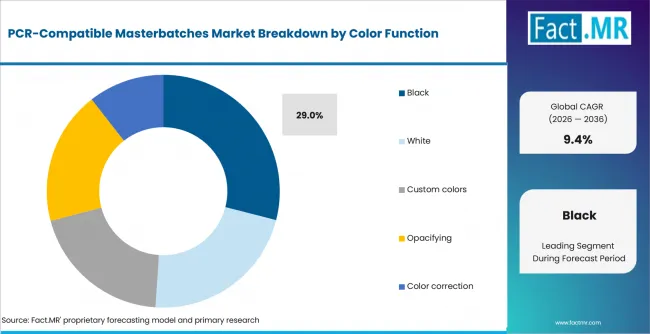
Pcr Compatible Masterbatches Market Analysis By Color Function | Source: Fact.MR
Customers can watch its correction function work in routine trials and tie the result directly to flake quality. A dark base resin doesn't let anyone off the hook, though. Pigment loading and dosing still decide whether the part shows even coverage or gives away streaks and lot-to-lot differences. White, Custom colors, Opacifying, and Color correction each answer appearance targets that call for a different response to the PCR substrate. Bottle washers widen their use of Black once storage and processing results hold up, label release and wash water checks included, which is exactly why application evidence carries more weight here than a color claim made on clean reference resin.
Which Application dominates?
Packaging is expected to hold 49% of the market in 2026.
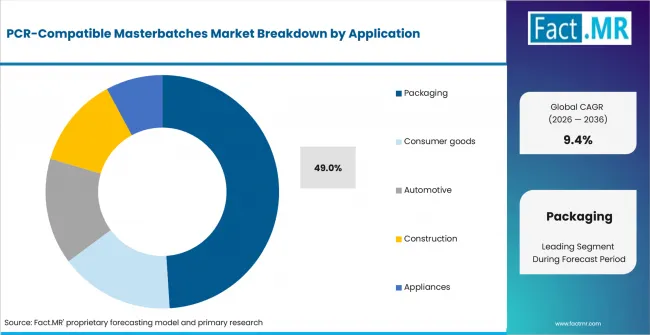
Pcr Compatible Masterbatches Market Analysis By Application | Source: Fact.MR
Its lead comes from the need to meet both appearance and recycling goals in the same product. Packaging also places more demands on the material. Recycled plastic can vary in color and cleanliness. Heat and melt flow can change during production. The final package must still look right and support label removal, lower wash water use, and mono-material recycling. Consumer goods, automotive, construction, and appliances also create demand. Each application has different needs for cost, appearance, strength, and ease of processing. A material gains approval when it gives stable results in the finished package. That approval usually applies only to the recycled plastic, formulation, process conditions, and end use tested.
What leads the PCR Level segment?
Low PCR is expected to hold 31% of the market in 2026.
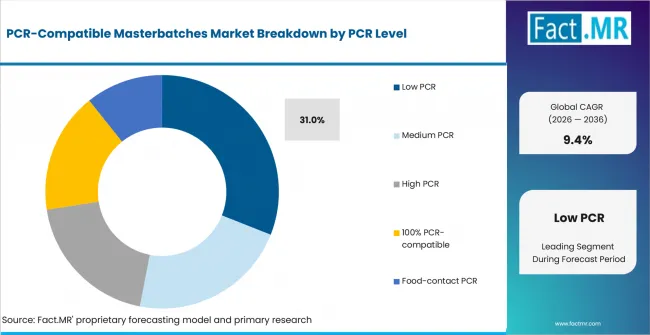
Pcr Compatible Masterbatches Market Analysis By Pcr Level | Source: Fact.MR
Its lead comes from the lower risk of adding a small amount of recycled plastic to an existing product. A low PCR level makes it easier to find the cause of surface defects or changes in melt flow. It also allows production limits to be set before more recycled plastic is added. Medium PCR, High PCR, 100% PCR-compatible, and Food-contact PCR serve applications with higher recycling goals. These options need tighter control over material quality and more testing before approval. Low PCR use grows once the material remains stable during storage and production. Higher PCR levels are harder to manage because changes between recycled-plastic batches can affect color, processing, and product performance.
How does End User shape demand?
Converters hold 31% share in 2026 and lead the early buying route because the line operator can see firsthand whether a material enters the process without forcing a full recipe or equipment change.
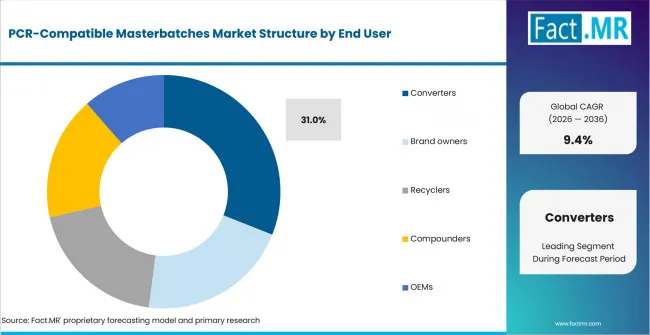
Pcr Compatible Masterbatches Market Analysis By End User | Source: Fact.MR
Label converters also sit close to sorter reading, label release, and wash behavior, so their trial record can link the masterbatch straight to the downstream packaging result. Brand owners, Recyclers, Compounders, and OEMs all carry weight too: Recyclers set the variability entering the formulation, Compounders select and disperse the correction package, Brand owners set appearance and packaging expectations, and OEMs qualify the finished use. Even so, it's Converters who decide whether dosing, melt flow, filtration, thermal exposure, and surface appearance stay controllable at line speed, and they only widen purchasing once finished goods show stable results across repeat production lots.
What is accelerating PCR-Compatible Masterbatches Market adoption, and what is holding it back?
Better flake quality control is the biggest accelerator here, while qualification expense and process fit are what slow things down. Label converters move faster when the evidence they're handed is tied to the exact PCR stream and production route they'll actually use. The technical catch is that a masterbatch can correct one incoming lot and then behave differently once the base-resin shade, contamination, odor, melt flow, or prior heat exposure changes. Adoption ultimately hinges on a correction method that repeats without turning every new lot into its own formulation program.
Drivers Impact Analysis
| DRIVER | (~) % IMPACT ON CAGR | GEOGRAPHIC RELEVANCE | IMPACT TIMELINE |
|---|---|---|---|
| Flake quality control in rPET | +0.8% | China and export suppliers | Medium term (2-4 years) |
| Label release testing | +0.6% | Europe and North America | Short term (<= 2 years) |
| Packaging converters approval programs | +0.5% | Asia Pacific | Medium term (2-4 years) |
| Local support near label converters | +0.4% | Global | Long term (>= 4 years) |
Source: Fact.MR analysis. Updated Jul 15, 2026
- Flake quality control in rPET helps adoption because buyers can trace the masterbatch back to a feedstock problem they can actually see. Incoming inspection sets the shade and contamination baseline, and compounding plus finished-part checks then show whether correction was achieved without unacceptable filtration, appearance, or property fallout.
- Label release testing matters because the resulting evidence can be tied to fewer rejected trials or to savings that are easy to point to. It also keeps color approval from drifting away from the wash and label behavior that ultimately judges the whole package.
- Packaging converters approval programs support growth whenever the product actually solves a tracked production issue. A defined trial plan holds resin lot, dosage, process settings, and inspection criteria together, which makes the supplier's result that much easier to repeat.
- Local support near label converters turns a vague material need into a specific correction response. When a PCR lot changes, nearby technical teams can look at the material, adjust dosing inside the qualified window, and document the resulting package faster.
Opportunity Impact Analysis
| OPPORTUNITY | (~) % IMPACT ON CAGR | GEOGRAPHIC RELEVANCE | IMPACT TIMELINE |
|---|---|---|---|
| Grades tuned for Packaging converters | +0.5% | Global | Medium term (2-4 years) |
| Application labs for Black | +0.4% | Asia Pacific and Europe | Short term (<= 2 years) |
| Rule-ready documentation | +0.4% | Europe and United Kingdom | Medium term (2-4 years) |
| Local trials with bottle washers | +0.3% | India and Brazil | Long term (>= 4 years) |
Source: Fact.MR analysis. Updated Jul 15, 2026
- Packaging converter grades gain value once the supplier delivers a result the customer can actually reproduce. Tuning ties carrier compatibility and pigment dispersion back to the converter's PCR stream, dosing equipment, filtration conditions, processing window, and appearance specification.
- Application labs for Black shorten the path from an incoming flake shade to a plant trial that can actually run. Their value lies in trial notes clear enough for customer teams to check for themselves, including how the dosage responded to base-resin color and whether the result stayed uniform.
- Rule-ready documentation smooths the route whenever laboratory results can be carried straight into plant trials. The record needs to name the approved material combination and spell out the checks used for appearance, label release, wash behavior, and process stability.
- Local trials with bottle washers widen the opportunity once process evidence repeats without special handling. That lets the formulation be judged in the wash route that actually matters to the buyer, rather than through an isolated color test.
Restraints Impact Analysis
| RESTRAINT | (~) % IMPACT ON CAGR | GEOGRAPHIC RELEVANCE | IMPACT TIMELINE |
|---|---|---|---|
| Qualification cost | -0.4% | Global processors | Medium term (2-4 years) |
| Fit limits in Black | -0.3% | Global | Short term (<= 2 years) |
| Documentation burden | -0.3% | Europe and North America | Medium term (2-4 years) |
| Scale-up risk | -0.2% | High-volume plants | Long term (>= 4 years) |
Source: Fact.MR analysis. Updated Jul 15, 2026
- Qualification cost slows things down because material changes eat resin, line time, laboratory work, and approval attention. A new masterbatch also has to be separated from ordinary PCR variation so the customer can tell whether it actually improved the process or just happened to land on an easier feedstock lot.
- Fit limits in Black rule out fast switching whenever carrier compatibility, pigment dispersion, sorter reading, or dosage doesn't line up with the customer's resin and equipment. The process risk stays with the converter, who has to protect the approved appearance and operating window.
- Changing an approved recipe is expensive, and the documentation burden that comes with it pushes scale-up later still. Each correction needs enough traceability to connect the PCR lot, masterbatch lot, process settings, finished result, and relevant packaging checks.
- Even a minor material adjustment can trigger rework once it hits a high-volume plant. Dispersion that looks fine on the lab bench can run into trouble once production residence time, shear, filtration, and thermal exposure expose a narrower fit than expected.
Which countries are scaling PCR-Compatible Masterbatches Market fastest?
Germany at 10.9%, Brazil at 9.9%, and the United States at 9.0%.
.webp "Top Country Growth Comparison Pcr Compatible Masterbatches Market Cagr (2026 2036)")
Top Country Growth Comparison Pcr Compatible Masterbatches Market Cagr (2026 2036) | Source: Fact.MR
The geographical frame spans Asia Pacific, Europe, and North America, with Central and South America and the Middle East and Africa also covered. The assessment through 2036 leans on manufacturing depth, technical approval capability, and regional service to gauge country momentum, and overall plastics consumption is not used as a stand-in for PCR masterbatch qualification.
| COUNTRY | CAGR |
|---|---|
| Germany | 10.9% |
| Brazil | 9.9% |
| United States | 9.0% |
Source: Fact.MR analysis. Updated Jul 15, 2026
What is driving Germany's growth through 2036?
Germany is anticipated to advance at 10.9% CAGR through 2036.
Domestic manufacturing and customer trials for color masterbatches and recycled plastics additives are supporting demand. Keeping technical teams close to users compresses approval work, especially where documentation burden and packaging requirements shape a recipe change. A compounder serving Germany has to connect the incoming PCR lot to carrier fit, pigment dispersion, processing behavior, and the finished article, not just hand the converter a generic shade result. The opportunity is strongest where laboratory and plant records share the same material identity and inspection logic, since that continuity lets the customer protect an approved process while weighing Black, rPET, Packaging, or Low PCR routes under conditions that mirror normal production and downstream package checks.
How is Brazil scaling demand?
Brazil is expected to record 9.9% CAGR.
Sustained by local production and buyer trials for recycled plastics additives and color masterbatches. Brazil also shows up in the opportunity around local trials with bottle washers, which tightens communication between material suppliers and buyers. The real value of that loop is speed and relevance: teams can see how the formulation responds to available PCR feedstock, then carry that same lot into converter and wash testing, closing the gap between a lab color match and the actual package result. Suppliers still have to prove correction doesn't introduce avoidable odor, filtration difficulty, surface variation, or mechanical-property loss, and scale orders only follow once that evidence repeats without unusual handling.
What supports the United States outlook?
The United States is estimated to record 9.0% CAGR
An outlook supported by domestic production and customer testing of color masterbatches and recycled plastics additives. Materials qualify faster when technical teams work alongside processors and respond directly to PCR lot variability. Europe and North America also register as relevant to label release testing and documentation burden, so the local service case involves more than just color matching. Compounders and converters need records tying resin identity, masterbatch dose, process conditions, finished appearance, and packaging checks together. A supplier who can pin a deviation on base-resin color, contamination, melt-flow difference, thermal history, or dispersion gives the customer a much clearer basis for approval than one simply handing over a fixed recipe with no plant support.
Who leads the PCR-Compatible Masterbatches Market?
Avient and Ampacet lead the named provider set, with Cabot, Tosaf, Sukano, and Clariant rounding out the profiled group. Competition here centers on application evidence, source clarity, and technical response during scale-up. A supplier has to help the customer tell normal PCR variation apart from masterbatch performance, then show how the formulation protects appearance and processing inside the approved use case.
Provider assessment ultimately comes down to proof in the customer's own material. Useful support means a documented route running from incoming resin review through dosing, compounding, filtration, conversion, and finished-product inspection. Packaging customers also need the relevant label release, wash water load, and mono-material design checks attached to that record. The strongest position comes from stripping out uncertainty before an approved grade gets replaced, not from broad claims about recycled plastics additives.
Which companies are the key providers?
Avient and Ampacet are key providers, with Cabot, Tosaf, Sukano, and Clariant completing the company set. Buyers weigh whether each supplier can support color correction and additive dispersion in the customer's own PCR stream, define a workable processing range, and hand over enough lot information for repeat qualification.
- Avient
- Ampacet
- Cabot
- Tosaf
- Sukano
- Clariant
Bibliography
- Avient Corporation. (2025, March). Colorants and additives for recycled resins in electrical and electronic applications.
- BASF SE. (2025, June 17). #OurPlasticsJourney: BASF to showcase the sustainable future of plastics at K 2025.
- Plastika Kritis S.A. (2025, February 27). How our masterbatch solutions support plastics recycling.
- RecyClass. (2025, August). RecyClass packaging recyclability evaluation methodology.
- RecyClass & Association of Plastic Recyclers. (2025, April). APR–RecyClass cooperation report.
This Report Addresses
- The report provides strategic intelligence on the PCR-compatible masterbatches market across Polymer Base and Color Function choices, grounding the analysis in recycled-resin variability and the correction work required before conversion.
- Segment analysis identifies rPET and Black as the share leaders for 2026, and every Polymer Base, Color Function, Application, PCR Level, and End User option stays in the defined taxonomy.
- The growth-country set names China and India, with Germany, Brazil, and the United States rounding it out. The full region tree remains in market segmentation.
- Competitive analysis profiles Avient and Ampacet, followed by Cabot, Tosaf, Sukano, and Clariant, with the assessment focused on application proof and support during customer qualification.
- Use-case assessment covers Packaging converters and adjacent applications in Color Masterbatches / Recycled Plastics Additives, examining how base-resin color, contamination, dispersion, dosing, filtration, and process fit affect approval.
What does the PCR-Compatible Masterbatches Market cover?
Coverage includes the leading segment points of rPET, Black, and Packaging converters, along with every other taxonomy option. Inclusion requires a product to be sold for use with post-consumer recycled plastics and for controlling contamination and color variability.
Value comes from solving that defined formulation problem. The masterbatch has to interact with a recycled resin whose shade, odor, contamination, melt flow, and thermal history may not match a clean reference resin at all. That's why the purchasing decision weighs color and additive dispersion, carrier fit, lot-to-lot correction, processing latitude, finished appearance, and mechanical-property protection together.
That precise purchasing function is what separates this market from general chemical supply. A generic colorant or additive doesn't qualify unless the sold grade is positioned and approved for the named PCR-compatible job.
What is included in the scope?
The scope includes color masterbatches formulated to work with post-consumer recycled plastics while managing color variability and contamination.
It spans the listed polymer bases, color functions, applications, PCR levels, and end users wherever customers purchase that same function.
Sales inside the boundary include approved grades, supporting application work, and recurring customer-route supply. Qualification can involve incoming PCR review, formulation and dosing work, compounding, filtration, conversion, appearance inspection, property checks, and whatever downstream packaging tests are relevant to the approved use.
What is excluded from the scope?
Commodity parent grades without the named PCR-compatible color function fall outside the scope.
Equipment alone sits outside the market too, even when a dosing unit, extruder, filter, molding line, or packaging test system plays a part in the result.
Only commodity material sold for a named PCR-compatible masterbatch application counts within the boundary. General recycling activity, unsupported colorants, and unrelated additives don't get counted just because they touch post-consumer resin somewhere else in the value chain.
How was the analysis built?
The analysis combines public reference review, country assessment, supplier coverage, segment shares, and forecast testing, with interpretation following the buyer's technical path from variable PCR feedstock through masterbatch selection, compounding, conversion, and finished-product qualification.
- Primary Research
- Primary research brings together the views of application personnel, buyers, compound formulators, distributors, and suppliers working close to color masterbatches and recycled plastics additives. The discussion framework covers base-resin variability, carrier compatibility, dispersion, dosing, melt flow, processing windows, correction work, and customer approval.
- Desk Research
- Desk research draws on government statistics, public rules, technical papers, standards material, and recycling or safety guidance, used to examine packaging requirements, recycling design, manufacturing signals, country context, and the external checks surrounding converter qualification.
- Market-Sizing and Forecasting
- Forecasting combines the market value and growth rate with segment leaders, company coverage, and country demand.
- Data Validation and Update Cycle
- Validation checks provider presence, official indicators, manufacturing activity, and the approval risk customers carry. Forecast checks weigh whether suppliers can repeat application performance as PCR lots, process settings, and downstream requirements shift, since that repeatability is what decides whether trials turn into approved supply.
Segmentation
What is the report's scope and coverage?
The market covers color masterbatches formulated to work with post-consumer recycled plastics while managing color variability and contamination, and coverage stays inside that purchased function and the buyer routes tied to it. The scope follows formulations used to correct or control PCR resin in compounding and conversion, not every colorant, additive, resin, or piece of processing equipment that happens to sit in the same plant.
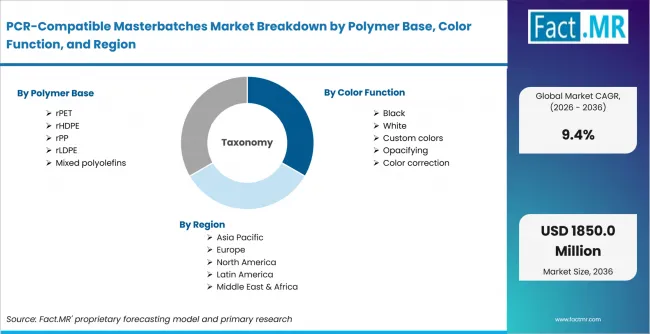
Pcr Compatible Masterbatches Market Breakdown By Polymer Base Color Function And Region | Source: Fact.MR
| Attribute | Details |
|---|---|
| Quantitative Units | USD Million in 2026 to USD Million by 2036 at CAGR |
| Market Definition | Color masterbatches formulated to work with post-consumer recycled plastics while managing color variability and contamination. |
| Polymer Base | rPET, rHDPE, rPP, rLDPE, Mixed polyolefins |
| Color Function | Black, White, Custom colors, Opacifying, Color correction |
| Application | Packaging, Consumer goods, Automotive, Construction, Appliances |
| PCR Level | Low PCR, Medium PCR, High PCR, 100% PCR-compatible, Food-contact PCR |
| End User | Converters, Brand owners, Recyclers, Compounders, OEMs |
| Regions Covered | North America, Europe, Asia Pacific, Central and South America, Middle East and Africa |
| Countries Covered | Germany, Brazil, United States |
| Key Companies Profiled | Avient, Ampacet, Cabot, Tosaf, Sukano, Clariant |
| Forecast Period | 2026 to 2036 |
| Approach | Hybrid top-down and bottom-up approach using Color Masterbatches / Recycled Plastics Additives, segment shares, country growth, supplier mapping, and technical validation |
Source: Fact.MR analysis. Updated Jul 15, 2026
How is the market segmented?
-
By Polymer Base
- rPET
- rHDPE
- rPP
- rLDPE
- Mixed polyolefins
-
By Color Function
- Black
- White
- Custom colors
- Opacifying
- Color correction
-
By Application
- Packaging
- Consumer goods
- Automotive
- Construction
- Appliances
-
By PCR Level
- Low PCR
- Medium PCR
- High PCR
- 100% PCR-compatible
- Food-contact PCR
-
By End User
- Converters
- Brand owners
- Recyclers
- Compounders
- OEMs
-
By Region
- North America
- United States
- Canada
- Europe
- Germany
- United Kingdom
- France
- Italy
- Spain
- Asia Pacific
- China
- India
- Japan
- South Korea
- Australia
- Central & South America
- Brazil
- Argentina
- Mexico
- Chile
- Middle East & Africa
- UAE
- Saudi Arabia
- South Africa
- North America
Frequently Asked Questions
Which Polymer Base leads the PCR-Compatible Masterbatches Market?
Which Color Function leads the PCR-Compatible Masterbatches Market?
Which Application leads the PCR-Compatible Masterbatches Market?
Which PCR Level leads the PCR-Compatible Masterbatches Market?
Which End User leads the PCR-Compatible Masterbatches Market?
What is the primary driver in the PCR-Compatible Masterbatches Market?
What is the main restraint in the PCR-Compatible Masterbatches Market?
Why is rPET important?
Why do buyers continue testing PCR-compatible masterbatches?
Who worked on this report


Preview the report firsthand - request a free sample
Free SampleGet the brochure for pricing and purchase details
Download PDF