- Market Value (2025): USD 680.0 Mn
- Estimated Value (2026): USD 720.8 Mn
- Forecast Value (2036): USD 1290.8 Mn
- CAGR (2026-2036): 6.0%
What is the Paper-Based Sleeve Materials Market forecast to be worth by 2036?
Paper-Based Sleeve Materials Market is forecast to expand from USD 720.8 million in 2026 to USD 1,290.8 million by 2036, recording a 6.0% CAGR.
- The paper-based sleeve materials market crossed a valuation of USD 680.0 million in 2025 across established packaging applications.
- The category is estimated to grow from USD 720.8 million in 2026 to USD 1,290.8 million by 2036.
- The market is forecast to record a 6.0% CAGR from 2026 to 2036 as beverage brands and food processors qualify line-ready fiber formats with packaging converters.
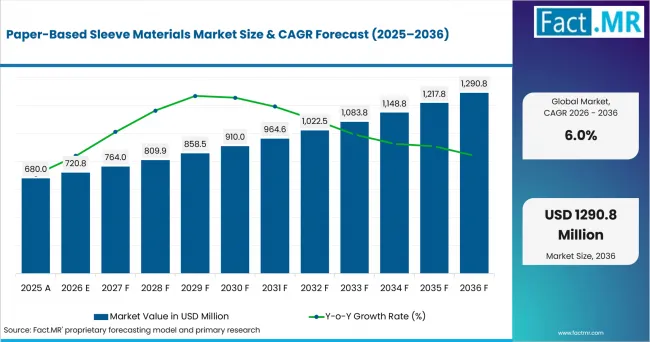
Paper Based Sleeve Materials Market Value Analysis | Source: Fact.MR
What are the defining numbers behind Paper-Based Sleeve Materials Market growth?
USD 570.0 million absolute opportunity by 2036, led by multipack sleeves, recycled paperboard and food & beverage applications.
- Demand Drivers in the Market
- Beverage brands require secure sleeves that replace plastic bundling without reducing filling-line output.
- Packaging engineers need stable board and reliable creasing so sleeves survive commercial distribution.
- Retail teams prefer printable surfaces that preserve required information during frequent artwork changes.
- Converters need recyclability evidence linking complete sleeve design with fees and customer approval.
- Key Segments Analyzed
- By product type: Multipack sleeves are expected to account for 36.0% share in 2026, supported by efficient unitization.
- By material: Recycled paperboard is projected to garner 48.0% share in 2026, owing to established converting routes.
- By printing: Flexographic is anticipated to record 40.0% share in 2026, due to repeatable high-volume graphics.
- By application: Beverage multipacks are estimated to hold 40.0% share in 2026, attributable to plastic-format replacement.
- By end use: Food & beverage is forecast to capture 66.0% share in 2026, driven by recurring packaging cycles.
- By sales channel: Direct / Brand OEM is expected to represent 50.0% share in 2026, shaped by joint qualification.
- Analyst Opinion at Fact.MR
- Shambhu Nath Jha, Sr. Consultant at Fact.MR, opines: “Paper sleeve adoption depends on whether the board, print, adhesive and applicator perform together on the customer’s line. Suppliers that can document carrying strength, runnability and recoverability are better placed to win repeat packaging programs.”
- Strategic Implications
- Brand owners should set plastic-reduction and line-performance criteria before approving each sleeve program.
- Packaging converters must validate board variability before committing to high-volume sleeve performance.
- Equipment teams need to test feeding and gluing under actual customer operating conditions.
- Material producers should document strength, moisture response and recovery compatibility for qualified grades.
Sleeve programs gain recurring volume after the pack and applicator pass one operating test. Graphic Packaging International introduced two lighter Marksman-compatible multipack systems in September 2025 without requiring replacement machinery.
India is projected at 8.4% CAGR as enforcement supports fiber-based packaging formats. China is anticipated at 7.6% CAGR by 2036 as standardization supports production scale. The United Kingdom is estimated at 6.4% CAGR owing to fee modulation. Brazil is forecast at 6.3% CAGR as food and beverage packaging programs balance humidity tolerance, conversion quality and distribution conditions. Germany is expected at 5.5% CAGR as recovery documentation influences paper packaging materials.
How does the Paper-Based Sleeve Materials Market break down by segment?
Multipack Sleeves are projected to account for 36.0% share; Recycled Paperboard is estimated to garner 48.0% share.
Which product type dominates?
Multipack sleeves are projected to account for 36.0% share in 2026
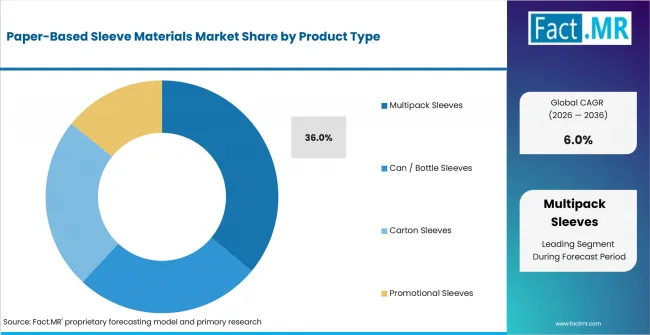
Paper Based Sleeve Materials Market Analysis By Product Type | Source: Fact.MR
Based on product type, multipack sleeves are projected to account for 36.0% share in 2026 due to efficient grouping and branding. Beverage plants compare them with beverage carrier rings according to material use and line compatibility.
What leads the material segment?
Recycled paperboard is estimated to garner 48.0% share in 2026
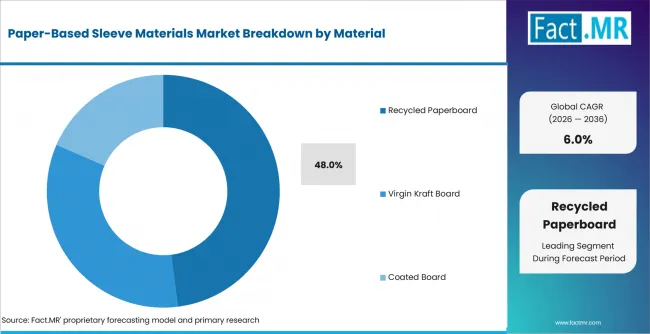
Paper Based Sleeve Materials Market Analysis By Material | Source: Fact.MR
By material, recycled paperboard is estimated to hold 48.0% share in 2026 owing to familiar converting routes. Consistent grades reduce creasing and gluing risk across folding carton packaging and sleeve operations, while virgin kraft supports heavier loads.
How does printing shape demand?
Flexographic is anticipated to record 40.0% share in 2026
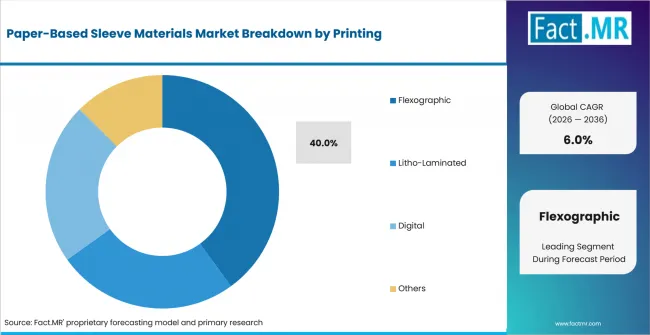
Paper Based Sleeve Materials Market Analysis By Printing | Source: Fact.MR
In 2026, flexographic printing is expected to lead the category with 40.0% share because long runs require economical color control. Digital and litho-laminated processes serve shorter or premium work within broader flexographic printing technology networks.
What supports beverage multipacks within application?
Beverage multipacks are forecast to hold 40.0% share in 2026
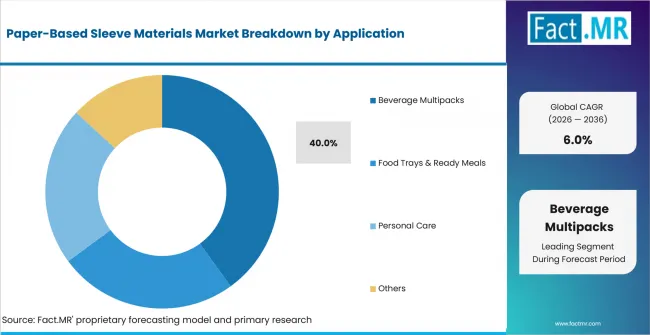
Paper Based Sleeve Materials Market Analysis By Application | Source: Fact.MR
By application, beverage multipacks are forecast to represent 40.0% share in 2026 driven by plastic replacement and carrying performance. Beer packaging requires load stability during filling. Bottled water packaging also needs moisture resistance. Stora Enso expanded board availability through its Oulu line in March 2025.
Why does food & beverage shape end-use demand?
Food & beverage is expected to capture 66.0% share in 2026,
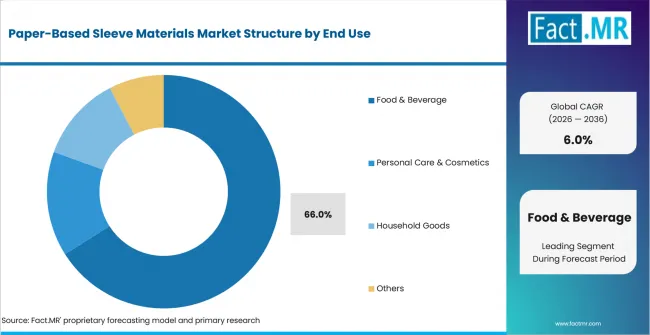
Paper Based Sleeve Materials Market Analysis By End Use | Source: Fact.MR
The end-use category is forecast to be led by food & beverage at 66.0% share in 2026 due to recurring bundle and tray programs. Chilled fresh food packaging also requires print quality and moisture resistance without weakening recovery performance.
How does Direct / Brand OEM purchasing influence sales channel?
Direct / Brand OEM is expected to represent 50.0% share in 2026
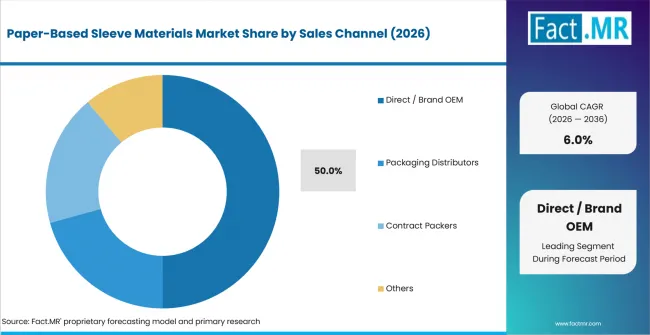
Paper Based Sleeve Materials Market Analysis By Sales Channel | Source: Fact.MR
Direct / Brand OEM is projected to hold 50.0% share in 2026 owing to shared qualification and customer-controlled specifications. Direct collaboration aligns structure and machinery testing across ready-to-drink packaging programs, as Get More Vits' September 2025 EnviroClip Beam adoption demonstrates.
What is accelerating Paper-Based Sleeve Materials Market adoption, and what is holding it back?
Plastic-reduction programs drive it; wet-strength and line-qualification risk restrain it.
Drivers Impact Analysis
| DRIVER | RELATIVE IMPACT | GEOGRAPHIC RELEVANCE | IMPACT TIMELINE |
|---|---|---|---|
| Plastic-reduction rules and brand commitments | High | Europe and Asia Pacific | Medium term (2-4 years) |
| Recyclability-linked producer fees | High | United Kingdom and Europe | Short term (<= 2 years) |
| High-volume beverage multipack conversion | Moderate | Global beverage markets | Medium term (2-4 years) |
| Retail communication and promotional versioning | Moderate | North America and Europe | Medium term (2-4 years) |
| Local board and conversion capacity | Low | India, China, and Brazil | Long term (>= 4 years) |
Source: Fact.MR analysis. Updated Aug 3, 2026
- Plastic-reduction rules: Packaging teams fund sleeve trials as rings and shrink film face scrutiny. The European Commission's February 2025 timetable makes structure and recoverability part of qualification.
- Producer-fee design: Recyclability classification now affects ownership cost. PackUK's June 2025 fee rules are expected to favor sleeves with documented paperboard and adhesive choices.
- Beverage conversion: Large repeat volumes scale validated sleeves quickly. Brand owners are estimated to prefer systems that pair structural design with proven application equipment.
- Retail communication: Sleeves preserve visible information while removing selected overwrap. Growth is forecast to favor converters that manage artwork changes without reducing line output.
Opportunity Impact Analysis
| OPPORTUNITY | RELATIVE IMPACT | GEOGRAPHIC RELEVANCE | IMPACT TIMELINE |
|---|---|---|---|
| Lightweight wrap-style multipacks for existing lines | Moderate | Europe and North America | Short term (<= 2 years) |
| Moisture-tolerant recyclable sleeve structures | Moderate | Beverage and chilled-food markets | Medium term (2-4 years) |
| Digital and flexographic hybrid artwork programs | Low | Europe and Asia Pacific | Medium term (2-4 years) |
| Local conversion for regional brand portfolios | Low | India, China, and Brazil | Long term (>= 4 years) |
Source: Fact.MR analysis. Updated Aug 3, 2026
- Lightweight multipacks: Lower-board designs reduce material use without replacing installed equipment. Commercial value depends on preserving line speed, carrying strength and distribution performance.
- Moisture-tolerant structures: Beverage and chilled-food sleeves require wet strength during handling. Revenue is anticipated to concentrate around structures that also pass conventional mill screening.
- Hybrid print programs: Flexography supports long runs while digital printing serves frequent changes. Adoption is estimated to rise where color control remains consistent across both routes.
- Regional conversion: National brands need approved sleeves near several plants. Opportunity is forecast to expand where local production preserves board quality and artwork control.
Restraints Impact Analysis
| RESTRAINT | RELATIVE IMPACT | GEOGRAPHIC RELEVANCE | IMPACT TIMELINE |
|---|---|---|---|
| Wet-strength and recyclability tradeoffs | High | Beverage and chilled-food markets | Medium term (2-4 years) |
| Board price and grade variability | Moderate | North America and Europe | Short term (<= 2 years) |
| High-speed line qualification cost | Moderate | Global brand-owner plants | Medium term (2-4 years) |
| Fragmented local converting quality | Low | India, China, and Brazil | Long term (>= 4 years) |
Source: Fact.MR analysis. Updated Aug 3, 2026
- Wet-strength tradeoffs: Treatments can improve handling but weaken fiber recovery. Cepi's recyclability test method reinforces testing of the complete printed and glued structure.
- Board variability: Grade changes can disrupt creasing and gluing during production. Demand is estimated to favor converters that control board consistency across qualified runs.
- Qualification expense: Commercial trials consume machine time and delay artwork release. Demand is anticipated to progress slowly where laboratory performance cannot be reproduced on customer lines.
- Conversion inconsistency: Regional capacity does not ensure equal die-cut or print quality. Growth is estimated to favor networks with documented process control and corrective action.
Which countries are scaling Paper-Based Sleeve Materials Market fastest?
India 8.4%; China 7.6%; United Kingdom 6.4%; Brazil 6.3%; Germany 5.5%.
Paper-Based Sleeve Materials Market is segmented into North America, Latin America, Western Europe, Eastern Europe, East Asia, South Asia and Pacific, and Middle East & Africa.
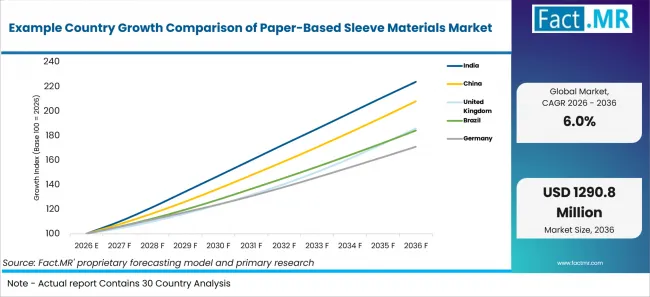
Example Country Growth Comparison Of Paper Based Sleeve Materials Market | Source: Fact.MR
| COUNTRY | CAGR |
|---|---|
| India | 8.4% |
| China | 7.6% |
| United Kingdom | 6.4% |
| Brazil | 6.3% |
| Germany | 5.5% |
Source: Fact.MR analysis. Updated Aug 3, 2026
What supports India’s outlook?
8.4% CAGR over the assessment period, supported by expanding branded food and beverage packaging programs.
India’s outlook reflects branded packaging programs that need locally compatible sleeve conversion. Buyers weigh application reliability, board availability and graphics requirements when evaluating paper-based formats.
How is China developing paper sleeve demand?
7.6% CAGR between 2026 and 2036, shaped by high-volume packaging programs and converter standardization.
China’s growth reflects high-volume packaging programs where converters coordinate board quality, printing and pack-line compatibility. Demand is projected at 7.6% CAGR through 2036.
What supports the United Kingdom outlook?
6.4% CAGR over the assessment period, shaped by recyclability-based fee modulation and reporting duties.
United Kingdom packaging teams classify structures through a methodology linked to future fee exposure. Demand is projected to record a 6.4% CAGR through 2036, aided by PackUK’s Recyclability Assessment Methodology.
How is Brazil developing paper sleeve demand?
6.3% CAGR between 2026 and 2036, shaped by food and beverage packaging requirements and regional conversion capability.
Brazilian food and beverage programs require sleeves that withstand heat and humidity during distribution. Demand is projected to reach a 6.3% CAGR through 2036 as buyers weigh material performance, print quality and converter capability.
What underpins Germany’s steady growth?
5.5% CAGR across the forecast horizon, linked to mature recovery systems and structure-level documentation.
Germany’s mature recovery system makes compatibility records central to packaging approval. Demand is forecast to expand at a 5.5% CAGR through 2036 as paper sleeves are assessed for recovery compatibility.
Who leads the Paper-Based Sleeve Materials Market?
Graphic Packaging International has public evidence of beverage multipack systems. Smurfit Westrock, Mondi Group, Stora Enso, Sonoco Products Company and International Paper provide paperboard, paper-packaging or converting capabilities relevant to sleeve material supply.
Competition spans multipack developers, paperboard producers and converting networks with different qualification strengths. Beverage brands compare board performance, print quality, application fit and recovery compatibility before approving recurring sleeve programs.
Graphic Packaging International combines multipack structures with application machinery. Mondi has public paper-based sleeve and bottle-bundle offerings, while Stora Enso, Sonoco, International Paper and Smurfit Westrock contribute packaging materials or converting capabilities relevant to the market.
Which companies are the key providers?
Graphic Packaging International, Smurfit Westrock, Mondi Group, Stora Enso, Sonoco Products Company, and International Paper are the profiled providers.
- Graphic Packaging International
- Smurfit Westrock
- Mondi Group
- Stora Enso
- Sonoco Products Company
- International Paper
Bibliography
- European Commission. (2025, February 11). Packaging waste.
- PackUK. (2025, June 27). Extended producer responsibility for packaging: Modulated disposal fees.
- PackUK. (2025, April 29). Recyclability Assessment Methodology (RAM) v1.1.
- Presidency of the Republic of Brazil. (2025, October 21). Decreto no. 12.688, de 21 de outubro de 2025.
- Cepi. (2025, March 13). Cepi Recyclability Test Method Version 3.
- Graphic Packaging International. (2025, September 10). Graphic Packaging to debut duo of beverage multipack innovations at drinktec 2025.
- Smurfit Westrock. (2026, July 7). Smurfit Westrock partners with Coca-Cola on World Cup packaging to capture spike in consumer demand.
- Stora Enso. (2025, March 19). Stora Enso’s new consumer board line at the Oulu site in Finland has started operations.
- Graphic Packaging International. (2025, September 17). EnviroClip Beam takes the spotlight at the World Beverage Innovation Awards 2025.
This Report Addresses
- Report coverage tracks Product Type, Material, Printing, Application, End Use and Sales Channel choices in Paper-Based Sleeve Materials.
- Segment analysis identifies Multipack Sleeves, Recycled Paperboard, Flexographic printing, Beverage Multipacks, Food & Beverage, and Direct / Brand OEM as the 2026 share leaders.
- The country outlook evaluates India, China, the United Kingdom, Brazil and Germany.
- Provider comparison assesses sleeve structures, paperboard availability, converting capability, applicator compatibility and customer qualification requirements.
- Market coverage distinguishes sleeve structures and materials from excluded cartons, shipping cases, labels, plastic rings and shrink film.
- The assessment uses the stated market boundary and relevant public regulatory, company and industry evidence.
What does the Paper-Based Sleeve Materials Market cover?
Multipack, can or bottle, carton, and promotional paper sleeves used for product grouping, protection, carrying and communication.
The market covers paper or paperboard sleeves used for carrying, protection and communication. Multipack, bottle, carton and promotional formats define the boundary across beverage, food and personal-care applications.
Commercial value must arise from the sleeve structure or material input. Folding cartons, shipping cases, labels, molded-fiber trays, plastic rings and shrink film remain outside the boundary.
What is included in the scope?
Paper-based sleeve structures used across beverage, food, personal-care, household and promotional packaging programs.
The scope includes recycled, virgin kraft and coated paperboard sold as material or converted sleeves. Printing covers flexographic, litho-laminated and digital processes across beverage, food, personal-care and household applications. Direct brand purchasing, distribution and contract packing remain included when they are part of the completed sleeve sale.
What is excluded from the scope?
Shipping cases, folding cartons, labels, molded-fiber trays, plastic rings and shrink film are outside the scope.
Separately sold machinery, co-packing, filling and logistics services remain excluded from market revenue. Finished consumer products are also excluded from the defined boundary.
How Was the Analysis Built?
The analysis integrates packaging regulations, recycling guidance, paper and board documentation, company disclosures and evidence relevant to sleeve conversion and qualification.
- Evidence Review: The review considers packaging regulations, recycling guidance, paper and board documentation, public company disclosures and evidence relevant to materials, print, conversion and recovery compatibility.
- Market Sizing and Forecasting: Estimates combine sleeve demand, board and conversion pricing, application mix, qualification cycles and country requirements within the stated market boundary.
- Market Monitoring: The analysis is reviewed as packaging rules, buyer specifications, paperboard supply and converting capabilities change.
Segmentation
What is the report’s scope and coverage?
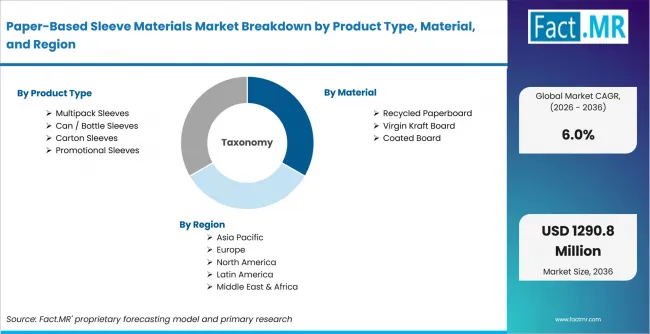
Paper Based Sleeve Materials Market Breakdown By Product Type, Material, And Region | Source: Fact.MR
| Coverage field | Report scope |
|---|---|
| Quantitative Units | USD 720.8 million in 2026 to USD 1,290.8 million by 2036 at 6.0% CAGR |
| Market Definition | Revenue from paper and paperboard materials or converted sleeve structures sold to unitize, overwrap, reinforce, carry, protect or promote goods within the stated segmentation. |
| Product Type | Multipack Sleeves; Can / Bottle Sleeves; Carton Sleeves; Promotional Sleeves |
| Material | Recycled Paperboard; Virgin Kraft Board; Coated Board |
| Printing | Flexographic; Litho-Laminated; Digital; Others |
| Application | Beverage Multipacks; Food Trays & Ready Meals; Personal Care; Others |
| End Use | Food & Beverage; Personal Care & Cosmetics; Household Goods; Others |
| Sales Channel | Direct / Brand OEM; Packaging Distributors; Contract Packers; Others |
| Regions Covered | North America; Latin America; Western Europe; Eastern Europe; East Asia; South Asia and Pacific; Middle East & Africa |
| Key Countries Highlighted | India; China; United Kingdom; Brazil; Germany |
| Key Companies Profiled | Graphic Packaging International; Smurfit Westrock; Mondi Group; Stora Enso; Sonoco Products Company; International Paper |
| Forecast Period | 2026 to 2036 |
| Approach | The forecast evaluates sleeve volumes, paperboard and conversion pricing, application demand, material and print mix, and commercial qualification cycles. |
Source: Fact.MR analysis. Updated Aug 3, 2026
How is the market segmented?
-
By Product Type
- Multipack Sleeves
- Can - Bottle Sleeves
- Carton Sleeves
- Promotional Sleeves
-
By Material
- Recycled Paperboard
- Virgin Kraft Board
- Coated Board
-
By Printing
- Flexographic
- Litho-Laminated
- Digital
- Others
-
By Application
- Beverage Multipacks
- Food Trays & Ready Meals
- Personal Care
- Others
-
By End Use
- Food & Beverage
- Personal Care & Cosmetics
- Household Goods
- Others
-
By Sales Channel
- Direct / Brand OEM
- Packaging Distributors
- Contract Packers
- Others
-
By Region
- North America
- USA
- Canada
- Latin America
- Brazil
- Mexico
- Chile
- Rest of Latin America
- Western Europe
- Germany
- UK
- Italy
- Spain
- France
- Nordic
- BENELUX
- Rest of Western Europe
- Eastern Europe
- Russia
- Poland
- Hungary
- Balkan & Baltic
- Rest of Eastern Europe
- East Asia
- China
- Japan
- South Korea
- South Asia and Pacific
- India
- ASEAN
- Australia & New Zealand
- Rest of South Asia and Pacific
- Middle East & Africa
- Kingdom of Saudi Arabia
- Other GCC Countries
- Türkiye
- South Africa
- Other African Union
- Rest of Middle East & Africa
- North America
Frequently Asked Questions
What share are multipack sleeves expected to capture within product type?
How is recycled paperboard positioned across material demand?
Which printing category is forecast to hold the primary share?
What supports beverage multipacks within the application split?
How much end-use share is food & beverage estimated to represent?
Which sales channel is projected to account for the primary share?
How quickly is India expected to expand?
What is shaping China’s projected pace?
Who worked on this report


Preview the report firsthand - request a free sample
Free SampleGet the brochure for pricing and purchase details
Download PDF