- Market Value (2025): USD 1.7 Bn
- Estimated Value (2026): USD 1.8 Bn
- Forecast Value (2036): USD 3.5 Bn
- CAGR (2026-2036): 6.7%
What is the Permeable Polyamide Films Market forecast to be worth by 2036?
USD 1.8 Billion in 2026 to USD 3.5 Billion by 2036, at a 6.7% CAGR.
- The Permeable Polyamide Films Market crossed a valuation of USD 1.7 Billion in 2025.
- Demand is projected to increase from USD 1.8 Billion in 2026 to USD 3.5 Billion by 2036.
- The market is forecast to record a 6.7% CAGR from 2026 to 2036 as food packers and casing producers specify oxygen, smoke and gauge performance.
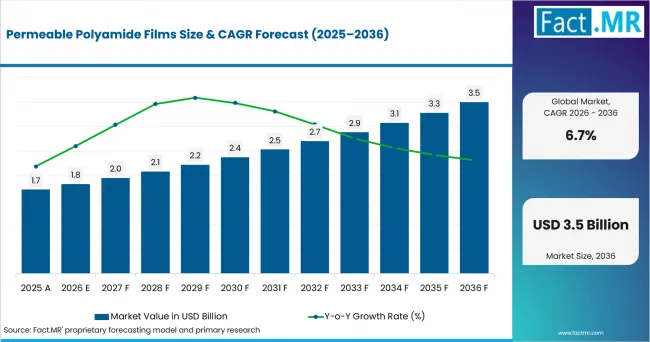
Permeable Polyamide Films Value Analysis | Source: Fact.MR
What are the defining numbers behind Permeable Polyamide Films Market growth?
USD 1.7 Billion absolute opportunity by 2036, led by food packaging, controlled oxygen transmission and 25-50 µm film.
- Demand Drivers in the Market
- Food packers need oxygen-control films supported by longer distribution routes for chilled meat, cheese, seafood and prepared meals.
- Casing producers need smoke and moisture passage due to the shift toward artificial sausage casings with repeatable wall thickness.
- Medical packagers need film structures that combine seal integrity and gas management for sterile blister packs and transfusion packaging.
- Membrane builders need specialty PA layers shaped by chemical resistance, moisture transfer and thin-gauge processing discipline.
- Key Segments Analyzed
- By Film Structure: Monolayer PA is expected to hold 28.0% share in 2026 because processors value a simple film route when strength and permeability are controlled through one polymer layer.
- By Permeability Target: Controlled oxygen transmission is projected to account for 31.0% share in 2026, supported by meat, cheese and ready-meal packs that need slower oxygen ingress.
- By Application: Food packaging is anticipated to capture 36.0% share in 2026 owing to steady use in vacuum packs, retort pouches and casing structures.
- By Film Gauge: 25-50 µm is estimated to represent 32.0% share in 2026 as converters balance puncture resistance with flexible packaging weight.
- Analyst Opinion at Fact.MR
- Shambhu Nath Jha, Principal Consultant at Fact.MR, states, “Permeable polyamide films draw attention because converters qualify a function beyond a resin name. Demand is expected to shift toward grades that prove oxygen, water vapor or smoke behavior under real packing conditions. Suppliers need documented processing windows, repeatable film gauge and application testing that helps converters shorten approval work.”
- Strategic Implications
- Resin suppliers should publish film-grade guidance that links viscosity, extrusion route and permeability behavior for common package structures.
- Film converters should document OTR, WVTR, pinhole resistance and retort stability across the gauges they sell most often.
- Casing producers should test smoke passage and drying behavior on commercial sausage lines before scaling pure PA alternatives.
- Packaging brands should align recyclability, traceability and shelf-life targets before they move from legacy multilayer designs.
The UK is projected to record 8.6% CAGR through 2036, led by food manufacturing scale. Germany is estimated to post 7.4% CAGR, supported by ready-meal output. The USA is anticipated to advance at 6.9% CAGR due to food spending and traceability needs. Japan is forecast at 6.3% CAGR, shaped by local BOPA capability. South Korea is expected to reach 5.2% CAGR as plastic circularity policy reshapes packaging choices.
How does the Permeable Polyamide Films Market break down by segment?
Food packaging leads at 36.0%; 25-50 µm leads at 32.0%.
Which Film Structure dominates?
Monolayer PA holds 28.0% share in 2026.
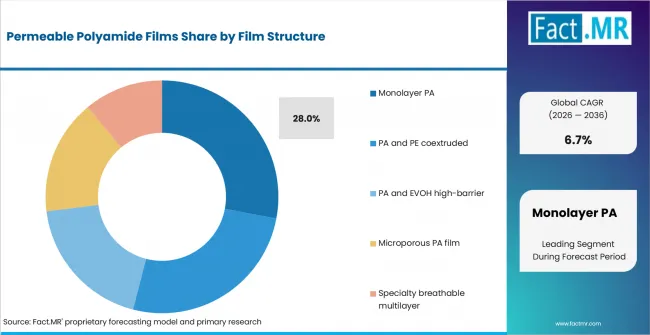
Permeable Polyamide Films Analysis By Film Structure | Source: Fact.MR
Monolayer PA is expected to hold 28.0% share in 2026 because it gives converters strength, clarity and oxygen control. PA/PE and PA/EVOH structures serve stronger moisture or gas-control needs. BASF states that Ultramid works in mono and multilayer film.
What leads the Permeability Target segment?
Controlled oxygen transmission leads with 31.0% share in 2026.
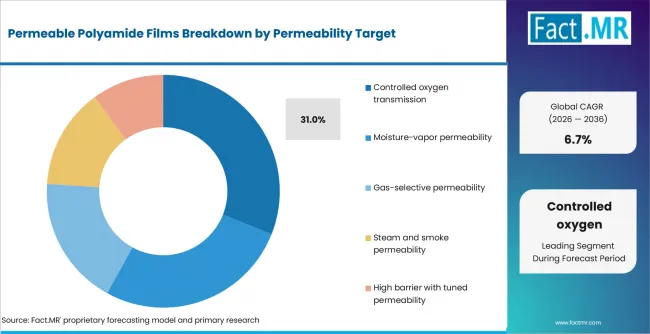
Permeable Polyamide Films Analysis By Permeability Target | Source: Fact.MR
Controlled oxygen transmission is projected to account for 31.0% share in 2026, supported by oxygen-sensitive foods. Moisture-vapor and gas-selective formats serve drying, humidity and membrane uses.
How does Application shape demand?
Food packaging accounts for 36.0% share in 2026.
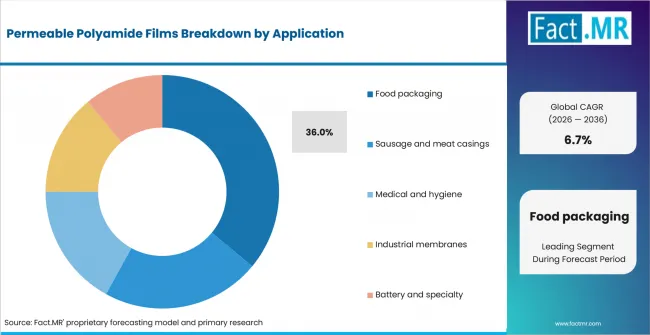
Permeable Polyamide Films Analysis By Application | Source: Fact.MR
Food packaging is anticipated to hold 36.0% share in 2026 owing to vacuum packs, pouches and casing films. Medical and hygiene uses favor clean handling and sealing control. Mitsubishi Chemical lists DIAMIRON for food, medical and industrial applications.
What supports 25-50 µm within Film Gauge?
25-50 µm holds 32.0% share in 2026.
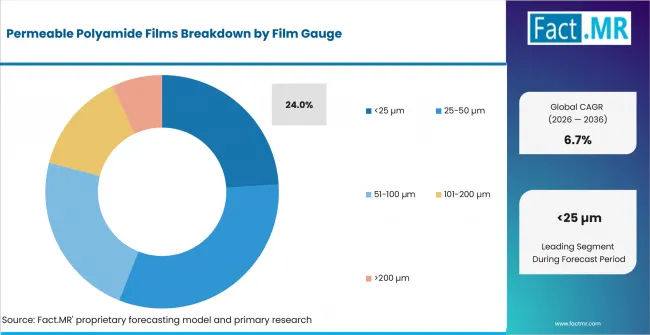
Permeable Polyamide Films Analysis By Film Gauge | Source: Fact.MR
The 25-50 µm gauge class is estimated to represent 32.0% share in 2026 as converters balance strength and material use. Thinner films suit light laminates. BASF states that Ultramid cast film is normally drawn to 20 to 200 µm.
What is accelerating Permeable Polyamide Films Market adoption, and what is holding it back?
Food shelf-life needs drive it; raw-material and compliance costs restrain it.
Drivers Impact Analysis
| DRIVER | (~) % IMPACT ON CAGR | GEOGRAPHIC RELEVANCE | IMPACT TIMELINE |
|---|---|---|---|
| Controlled oxygen needs in chilled and retort food packs | +1.4% | Global | Short term (<= 2 years) |
| Artificial casing shift toward smoke and moisture passage | +1.1% | Europe, Japan, USA | Medium term (2-4 years) |
| Medical and sterile packaging qualification | +0.8% | Japan, USA, Germany | Medium term (2-4 years) |
| High-barrier multilayer redesign using PA and EVOH | +0.7% | East Asia, Europe | Long term (>= 4 years) |
| Industrial membrane and specialty film uses | +0.4% | Global | Long term (>= 4 years) |
- Controlled oxygen needs in food packs: Oxygen control is important for maintaining product quality across meat, seafood, cheese, and prepared meals. Polyamide-based films and casings can support barrier performance where processors need dependable protection during storage and distribution.
- Smoke and moisture passage: Permeable polyamide casings can support smoked sausage applications by allowing controlled moisture loss and smoke transfer. This helps processors manage drying behavior, surface development, and flavor formation while retaining the mechanical strength needed during filling and processing.
- Medical packaging qualification: Medical packaging applications require careful validation of cleanliness, sealing behavior, material consistency, and barrier performance. Suppliers with well-documented quality systems and controlled manufacturing processes are better positioned to support qualification and repeat use in regulated packaging environments.
- PA and EVOH redesign: Polyamide contributes toughness and mechanical strength, while EVOH supports stronger oxygen-barrier performance in multilayer structures. Combining these materials allows converters to balance protection, flexibility, and processing requirements across demanding food and specialty packaging applications.
- Specialty film uses: Nylon films are relevant beyond conventional food packaging because of their oxygen-barrier and mechanical properties. Specialty applications can include vacuum-insulation structures and other technical packaging uses where durability, barrier performance, and dimensional stability are important.
Opportunity Impact Analysis
| OPPORTUNITY | (~) % IMPACT ON CAGR | GEOGRAPHIC RELEVANCE | IMPACT TIMELINE |
|---|---|---|---|
| Pure PA casing films for smoke and drying functions | +0.9% | Europe, Japan | Medium term (2-4 years) |
| Recyclability-led redesign of multilayer food packs | +0.7% | UK, Germany, South Korea | Long term (>= 4 years) |
| Mass-balanced PA grades for approved film recipes | +0.5% | Germany, USA, Japan | Medium term (2-4 years) |
| Medical pouch and sterile blister film applications | +0.4% | Japan, USA, Germany | Long term (>= 4 years) |
- Pure PA casing films: Hydrophilic polyamide expands casing design options beyond collagen and cellulose. Adoption depends on reliable smoke transfer, moisture management, drying behavior, and mechanical performance during filling and processing.
- Recyclability-led pack redesign: Packaging redesign is increasing pressure on converters to justify multilayer structures. Polyamide remains relevant where its strength, puncture resistance, or oxygen-barrier contribution helps protect products and reduce losses across storage and distribution.
- Mass-balanced PA grades: Lower-carbon and mass-balanced polyamide grades give packaging teams additional options when evaluating material sourcing and environmental performance. These grades can support sustainability-focused specifications while retaining the processing and mechanical characteristics required in established packaging applications.
- Medical pouch applications: Medical packaging represents a specialized application where qualification depth, cleanliness, seal integrity, and barrier performance create value. Polyamide-based materials can support sterile pouches, blister structures, and related healthcare packaging where consistent material performance is essential.
Restraints Impact Analysis
| RESTRAINT | (~) % IMPACT ON CAGR | GEOGRAPHIC RELEVANCE | IMPACT TIMELINE |
|---|---|---|---|
| Volatile PA resin and film input costs | -0.6% | USA, Germany | Short term (<= 2 years) |
| Moisture sensitivity during PA film processing | -0.4% | Global | Medium term (2-4 years) |
| Multilayer recycling and fee exposure | -0.3% | UK, Germany, South Korea | Medium term (2-4 years) |
| Long qualification cycles for medical and casing films | -0.2% | Japan, USA, Europe | Long term (>= 4 years) |
- Resin and film costs: Polyamide film economics remain sensitive to resin and conversion costs, which can pressure margins for packaging converters and buyers. Cost fluctuations may slow material substitution, particularly in price-sensitive food and industrial packaging applications.
- Moisture-sensitive processing: Polyamide absorbs moisture, making drying discipline important for extrusion stability, dimensional consistency, and finished-film quality. Processors need controlled handling and storage practices to reduce defects during conversion.
- Recycling and fee exposure: Multilayer polyamide structures face closer scrutiny as packaging systems place more emphasis on recyclability and material accountability. Converters may need to redesign structures, justify barrier layers, and provide clearer end-of-life documentation.
- Long qualification cycles: Medical packaging materials require application-specific validation for sterilization methods, packaging equipment, sealing behavior, and fabrication conditions. These qualification steps can lengthen approval timelines before polyamide films move into routine commercial use.
Which countries are scaling Permeable Polyamide Films Market through 2036?
- The country comparison spans 3.46 percentage points and forms three practical growth bands across the forecast period.
- The UK remains 1.23 percentage points above Germany through food manufacturing scale and packaging reform.
- Germany remains 0.52 percentage point above the USA through ready-meal output and packaging recovery discipline.
- The USA remains 0.54 percentage point above Japan through food-packaging scale and traceability needs.
- Japan remains 1.17 percentage points above South Korea through film-converting depth and BOPA expertise.
- South Korea closes the displayed range through circularity rules and specialty packaging requirements.
Comparable CAGRs create different entry conditions due to film-converting scale, food-packaging demand, recycling rules and qualification timelines. Full report coverage includes North America, Latin America, Western Europe, Eastern Europe, East Asia, South Asia & Pacific, and Middle East & Africa.
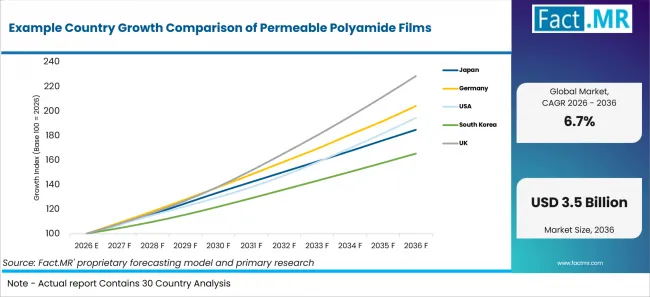
Example Country Growth Comparison Of Permeable Polyamide Films | Source: Fact.MR
| Country | CAGR |
|---|---|
| UK | 8.6% |
| Germany | 7.4% |
| USA | 6.9% |
| Japan | 6.3% |
| South Korea | 5.2% |
What supports the UK outlook?
8.6% CAGR through 2036, driven by food manufacturing scale and packaging reform.
UK converters are expected to approve permeable PA films where chilled meat and prepared-meal packs need puncture strength with controlled oxygen movement. The country is projected to record 8.6% CAGR through 2036, supported by food manufacturing scale. In July 2026, ONS reported that food accounted for 22.9% of UK manufacturers’ sales in 2025.
How is Germany scaling demand?
7.4% CAGR through 2036, supported by ready-meal production and packaging recovery discipline.
German food-packaging converters are expected to use PA films where ready meals and meat packs need reliable sealing under chilled distribution. Germany is estimated to post 7.4% CAGR through 2036, supported by prepared-food output. In January 2026, Destatis reported that Germany produced 1.7 million tonnes of ready meals in 2024.
What supports USA adoption?
6.9% CAGR through 2036, driven by food-packaging scale and traceability pressure.
U.S. food packers are expected to keep permeable PA films in specifications where meat, cheese and prepared meals need oxygen-control performance. The USA is anticipated to advance at 6.9% CAGR through 2036, driven by traceability requirements. In June 2026, FDA reported that most firms participating in its traceability readiness tabletop exercises responded within 24 hours.
What underpins Japan’s growth?
6.3% CAGR through 2036, shaped by film-converting depth and packaged-food exports.
Japanese film converters are expected to favor PA structures where retort pouches and vacuum packs need heat resistance with steady barrier behavior. Japan is forecast to hold 6.3% CAGR through 2036, shaped by domestic packaging depth. Japan Packaging Institute reported an estimated 2025 shipment value of JPY 6,135.7 billion for packaging materials and containers.
How does South Korea perform?
5.2% CAGR through 2036, driven by plastic circularity rules and specialty packaging needs.
South Korean packaging teams are expected to qualify PA films where specialty packs need performance records under circularity rules. South Korea is expected to reach 5.2% CAGR through 2036, driven by plastic-reduction policy. In September 2025, South Korea’s Ministry of Environment announced that, from January 1, 2026, bottled-water and non-alcoholic beverage manufacturers using at least 5,000 tonnes of PET bottles annually would be subject to a 10% recycled-material use requirement for colorless PET bottles.
Who leads the Permeable Polyamide Films Market?
BASF is an active provider through its Ultramid polyamide portfolio, which supports mono- and multilayer film structures. Its positioning also extends to hydrophilic polyamide concepts for applications requiring controlled moisture or smoke passage, giving converters options across food packaging and casing applications.
Arkema is profiled among the key suppliers alongside Viscofan and Kalle GmbH. These companies participate in a market where film strength, controlled oxygen or moisture transfer, smoke permeability, and qualification history shape material selection across packaging and casing applications.
PODANFOL S.A. and Viskase complete the profiled competitive group. The broader supplier landscape serves monolayer, coextruded, high-barrier, microporous, and specialty breathable film structures used in food packaging, sausage and meat casings, medical and hygiene packaging, membranes, and specialty applications.
Which companies are the key providers?
Key companies include BASF, Arkema, Viscofan, Kalle GmbH, PODANFOL S.A., and Viskase.
- BASF
- Arkema
- Viscofan
- Kalle GmbH
- PODANFOL S.A.
- Viskase
Bibliography
- BASF. (2025, September 9). BASF launches the world’s first thermoplastic polyamide with high water permeability.
- BASF. (2025, October 14). BASF expands sustainable polyamide 6 portfolio in North America with launch of Ultramid LowPCF and Ultramid BMB.
- U.S. Bureau of Labor Statistics. (2026, July 15). Producer Price Indexes - June 2026.
- Department for Environment, Food & Rural Affairs, & Environment Agency. (2026, April 7). Extended producer responsibility for packaging: Recycling obligations and waste disposal fees. GOV.UK.
- Zeballos, E., & Sinclair, W. (2026, June 11). Total U.S. food spending reached $2.51 trillion in 2025. Economic Research Service, U.S. Department of Agriculture.
- U.S. Food and Drug Administration. (2026, June 10). FDA releases report on traceability readiness tabletop exercises and updated FAQs.
- Office for National Statistics. (2026, July 24). UK manufacturers' sales by product: 2025.
- Statistisches Bundesamt (Destatis). (2026, January 14). Produktion von Fertiggerichten binnen fünf Jahren mengenmäßig um 25,6 % gestiegen.
This Report Answers
- The report explains permeable PA film use across film structure and permeability target.
- Segment analysis identifies Monolayer PA, controlled oxygen transmission, food packaging and 25-50 µm films.
- Country analysis examines the UK, Germany, USA, Japan and South Korea.
- Competitive analysis reviews BASF, Arkema, Viscofan, Kalle GmbH, PODANFOL S.A. and Viskase.
- Film-structure assessment covers monolayer, coextruded, high-barrier, microporous and breathable multilayer films.
- Application assessment covers food packaging, casings, medical and hygiene, membranes and battery uses.
- The forecast uses interviews, provider checks, official statistics and portfolio evidence.
What does the Permeable Polyamide Films Market cover?
Monolayer, coextruded, high-barrier and breathable PA films used for controlled transmission.
The Permeable Polyamide Films Market covers PA-based films used where packaging or specialty structures need strength and selective passage. The scope includes controlled oxygen transmission, moisture-vapor permeability, gas-selective behavior and smoke or steam passage.
The market differs from the broader polyamide resins business because it covers films and film-ready structures. Related mass-balanced polyamide grades belong inside the boundary when they support film extrusion or qualification work.
What is included in the scope?
Permeable polyamide film systems used in food, casing, medical, membrane and specialty applications.
The scope includes monolayer PA film, PA and PE coextruded film, PA and EVOH high-barrier film, microporous PA film and specialty breathable multilayer film. It includes film sold into food packaging, sausage and meat casings, medical and hygiene packs, industrial membranes and battery specialty uses.
Adjacent flexible packaging substrates are included when the PA layer defines oxygen or moisture performance. Related forming films are included when thermoforming needs PA toughness and controlled permeability.
What is excluded from the scope?
General molded polyamide parts and non-PA flexible films are outside the scope.
Molded nylon components, fibers, engineering compounds and neat resins fall outside the boundary when a film application is absent. Pure PE, PP, PET, PVOH and cellulose films are outside unless a PA layer controls permeability or mechanical strength in the final structure.
General polyfilm applications are outside the scope when PA lacks a defining function. Adjacent BOPP films are covered only when combined with PA layers in a qualifying structure.
How Was the Analysis Built?
The analysis draws on 120+ sources, 35+ company portfolios, 25+ countries, and more than 20 industry interviews.
- Primary Research: Primary research includes discussions with manufacturers, service providers, technology developers, distributors, end users, and subject-matter experts. These conversations examine purchasing priorities, product adoption, operational challenges, approval requirements, competitive positioning, and the factors that influence wider market acceptance.
- Desk Research: Desk research covers government statistics, regulatory publications, company filings, trade data, technical studies, industry associations, standards, public policy, and other authoritative sources. Every source used in the analysis is documented in the bibliography.
- Market Sizing and Forecasting: Market estimates combine historical performance, demand indicators, pricing and volume trends, segment shares, company participation, country-level growth, adoption patterns, investment activity, and barriers to market expansion.
- Data Validation and Update Cycle: Findings are validated by comparing primary interviews with public data, company activity, regulatory changes, trade patterns, and industry developments. Regular updates review new product launches, capacity changes, partnerships, approvals, and shifts in commercial adoption.
What is the report’s scope and coverage?
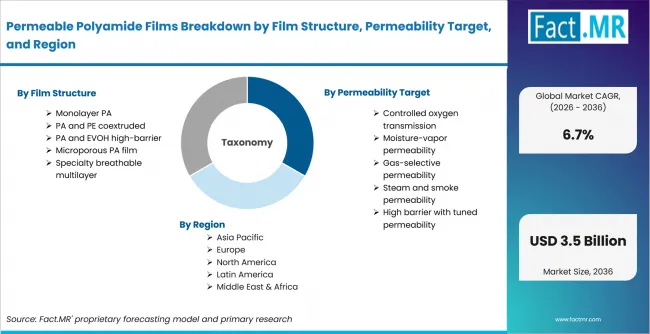
Permeable Polyamide Films Breakdown By Film Structure, Permeability Target, And Region | Source: Fact.MR
| Attribute | Details |
|---|---|
| Quantitative Units | USD Billion in 2026 to USD Billion by 2036 at a CAGR |
| Market Definition | Permeable polyamide films are PA-based films that combine mechanical strength with controlled oxygen, moisture-vapor, gas, steam or smoke transmission. |
| Film Structure | Monolayer PA; PA and PE coextruded; PA and EVOH high-barrier; Microporous PA film; Specialty breathable multilayer |
| Permeability Target | Controlled oxygen transmission; Moisture-vapor permeability; Gas-selective permeability; Steam and smoke permeability; High barrier with tuned permeability |
| Application | Food packaging; Sausage and meat casings; Medical and hygiene; Industrial membranes; Battery and specialty |
| Film Gauge | <25 µm; 25-50 µm; 51-100 µm; 101-200 µm; >200 µm |
| Regions Covered | North America; Latin America; Western Europe; Eastern Europe; East Asia; South Asia & Pacific; Middle East & Africa |
| Countries Covered | UK; Germany; USA; Japan; South Korea |
| Key Companies Profiled | BASF, Arkema, Viscofan, Kalle GmbH, PODANFOL S.A., and Viskase |
| Forecast Period | 2026 to 2036 |
| Approach | Hybrid top-down and bottom-up approach using food packaging demand, casing qualification, film gauge mix, country-level packaging rules and provider portfolio review. |
How is the market segmented?
-
By Film Structure
- Monolayer PA
- PA and PE coextruded
- PA and EVOH high-barrier
- Microporous PA film
- Specialty breathable multilayer
-
By Permeability Target
- Controlled oxygen transmission
- Moisture-vapor permeability
- Gas-selective permeability
- Steam and smoke permeability
- High barrier with tuned permeability
-
By Application
- Food packaging
- Sausage and meat casings
- Medical and hygiene
- Industrial membranes
- Battery and specialty
-
By Film Gauge
- <25 µm
- 25-50 µm
- 51-100 µm
- 101-200 µm
- >200 µm
-
By Region
- North America
- Latin America
- Western Europe
- Eastern Europe
- East Asia
- South Asia & Pacific
- Middle East & Africa