- Market Value (2025): USD 644.6 Mn
- Estimated Value (2026): USD 680.0 Mn
- Forecast Value (2036): USD 1161.5 Mn
- CAGR (2026-2036): 5.5%
What is the Polyamide Casings Market forecast to be worth by 2036?
USD 680.0 million in 2026 to USD 1,161.5 million by 2036 at a 5.5% CAGR.
- The Polyamide Casings Market reached USD 644.6 million in 2025.
- Demand is projected to increase from USD 680.0 million in 2026 to USD 1,161.5 million by 2036.
- The market is forecast to record 5.5% CAGR from 2026 to 2036.
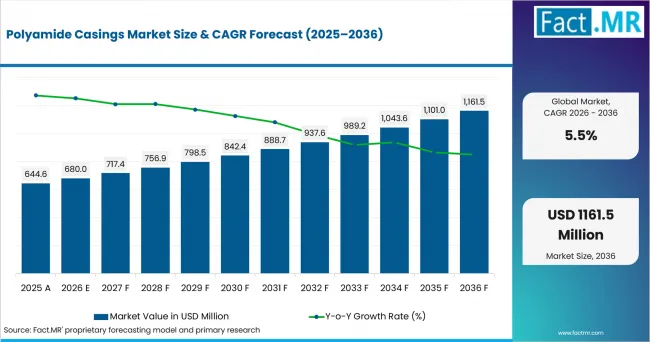
Polyamide Casings Market Value Analysis | Source: Fact.MR
What are the defining numbers behind Polyamide Casings Market growth?
An absolute opportunity of USD 481.5 million is expected between 2026 and 2036.
- Demand Drivers in the Market
- Cooked sausage and deli-meat plants need casings that keep shape during stuffing and heat treatment. Multilayer polyamide structures reduce product losses after chilling.
- Barrier selection is becoming a commercial decision for processors that balance shelf life with surface appearance. High oxygen and moisture barrier formats are expected to remain central where retailers require stable color and clean slicing.
- Smoke-permeable polyamide structures widen material options for processors that need aroma transfer and mechanical strength in the same casing. Specialty grades are expected to support smoked and dried sausage formats.
- Ready-to-fill operations favor shirred sticks and clipped formats when labor planning and filling speed influence batch economics. This preference is expected to support repeat orders.
- Key Segments Analyzed
- By Casing Construction: Multilayer PA and PE is expected to hold 43.00% share in 2026 due to its blend of puncture resistance, oxygen control and process stability in cooked-meat lines.
- By Barrier and Permeability: High oxygen and moisture barrier is projected to account for 42.00% share in 2026 supported by shelf-life needs in chilled sausage and deli-meat distribution.
- By Processing Format: Shirred sticks are anticipated to capture 36.00% share in 2026 owing to faster loading and line-ready handling in industrial stuffing operations.
- By Food Application: Cooked sausage and deli meat is estimated to represent 41.00% share in 2026 as these products use barrier casings across heat-set and chilled retail formats.
- Analyst Opinion at Fact.MR
- Shambhu Nath Jha, Principal Consultant at Fact.MR, states, “Polyamide casing demand is shaped by qualification discipline. Meat processors need casing suppliers that match barrier level, smoke behavior and stuffing performance to each recipe. Suppliers are expected to gain share when they combine food-contact documentation with format reliability and regional service depth.”
- Strategic Implications
- Casing producers should document food-contact status early. FDA’s Inventory of Food Contact Substances Listed in 21 CFR, last updated May 4, 2026, includes specific nylon/polyamide resins linked to 21 CFR 177.1500. Authorization should be checked for the specific resin and intended conditions of use.
- Converters should align barrier-grade casings with the processing line before scale-up so customers avoid repeated trials during sausage, pâté or cheese launches.
- Material suppliers should support smoke-permeable polyamide development with processing guidance that covers drying behavior, flavor transfer and strength retention.
Germany is expected to record 6.2% CAGR through meat-processing depth and polymer casing capability. The USA is projected to reach 5.9% CAGR on the back of red-meat and poultry availability. Brazil is anticipated to post 5.3% CAGR supported by poultry exports and domestic processing scale. Spain is estimated to advance at 5.0% CAGR through pork processing and chilled food consumption. The UK is forecast to reach 4.6% CAGR driven by food manufacturing and packaging compliance needs.
How does the Polyamide Casings Market break down by segment?
Multilayer PA and PE leads Casing Construction at 43.00%; High oxygen and moisture barrier leads Barrier and Permeability at 42.00%.
Which Casing Construction dominates?
Multilayer PA and PE is expected to hold 43.0% share in 2026.
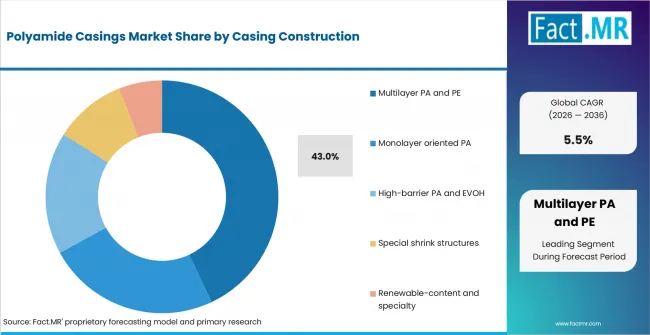
Polyamide Casings Market Analysis By Casing Construction | Source: Fact.MR
Multilayer PA and PE leads because processors need puncture strength and barrier performance in one casing structure. Monolayer oriented PA remains relevant for simpler products where orientation gives toughness and a clean surface. High-barrier PA and EVOH supports products that need longer chilled distribution. Renewable-content and specialty formats are expected to attract trials where brand teams link material selection with mass balanced polyamides and packaging policy goals.
Viskase states in its 2026 Form 10-Q that it operates in the casing product segment of the food industry and supplies cellulosic, fibrous and plastic casings for the processed meat and poultry industry. This positioning confirms its participation in plastic casing applications within industrial meat processing.
What leads Barrier and Permeability?
High oxygen and moisture barrier is projected to account for 42.0% share in 2026.
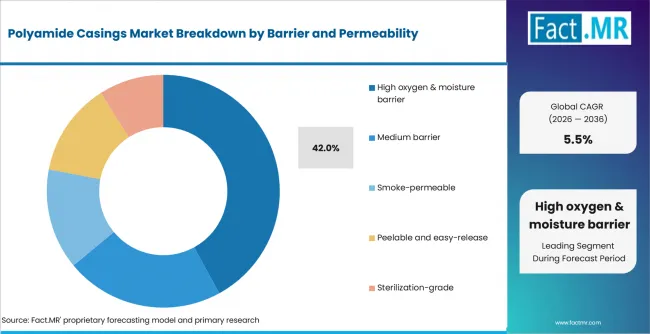
Polyamide Casings Market Analysis By Barrier And Permeability | Source: Fact.MR
High oxygen and moisture barrier is projected to lead because chilled sausage and deli-meat products need color protection and moisture retention. Medium barrier formats serve shorter distribution windows. Smoke-permeable casings address products that need aroma transfer. Peelable structures help processors protect surfaces when slicing quality influences retail acceptance in fresh meat packaging applications.
Permeability is moving from a simple barrier trade-off toward designed water and aroma movement. Specialty casing grades give processors another route for smoked and dried sausage formats.
How does Processing Format shape demand?
Shirred sticks are anticipated to capture 36.0% share in 2026.
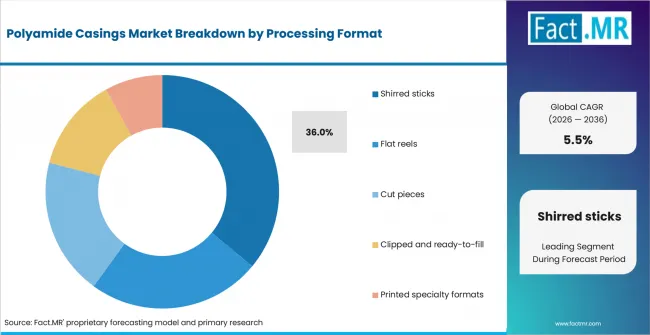
Polyamide Casings Market Analysis By Processing Format | Source: Fact.MR
Shirred sticks are anticipated to lead because they reduce handling time and support automated stuffing on high-throughput sausage lines. Flat reels suit converters and processors that prefer roll-fed flexibility. Cut pieces remain useful where smaller batches or specialty items require pre-sized casing lengths. Clipped and ready-to-fill formats are expected to support customers seeking simpler preparation before filling.
What supports cooked sausage and deli meat within Food Application?
Cooked sausage and deli meat is estimated to represent 41.0% share in 2026.
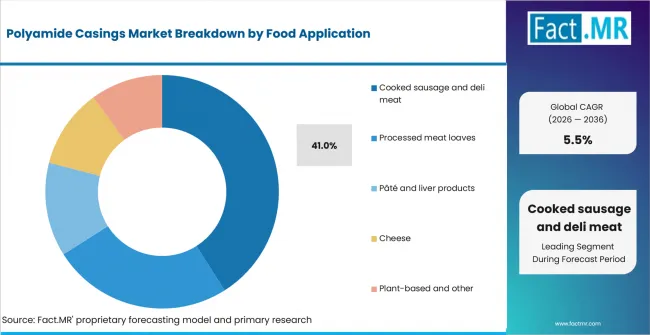
Polyamide Casings Market Analysis By Food Application | Source: Fact.MR
Cooked sausage and deli meat is estimated to lead because these products rely on barrier casings during heat treatment, chilling and retail display. Processed meat loaves need similar dimensional control. Pâté and liver products require casings that protect texture while supporting clean release. Cheese and plant-based products add adjacent use cases where casing performance links with specialty meat ingredients and deli counter presentation.
Excellpack identifies its Flexcell series as a multilayer polyamide casing for sausages, hams and other processed-food applications. Its barrier properties provide direct evidence of polyamide-casing use in cooked sausage, ham and other processed-meat applications.
What is accelerating Polyamide Casings Market adoption, and what is holding it back?
Barrier performance drives it; qualification burden restrains it.
Drivers Impact Analysis
| DRIVER | (~) % Impact on CAGR | Geographic Relevance | Impact Timeline |
|---|---|---|---|
| High-barrier casing use in cooked sausage and deli meat | +1.3% | North America, Western Europe | Short term (<= 2 years) |
| Shift toward line-ready shirred sticks | +0.9% | Global | Medium term (2-4 years) |
| Smoke-permeable polyamide development | +0.7% | Europe, North America | Medium term (2-4 years) |
| Specialty formats for cheese and plant-based products | +0.5% | Europe, North America | Long term (>= 4 years) |
Source: Fact.MR analysis. Updated Sep 3, 2026
- High-barrier casing use in cooked sausage and deli meat: High oxygen- and moisture-barrier casing formats support chilled meat products moving through retail and foodservice channels. Processors use these casings to help manage color, moisture retention, slicing performance, and product quality throughout distribution and storage.
- Shift toward line-ready shirred sticks: Shirred sticks are gaining favor where processors want to reduce casing preparation and improve filling efficiency. Line-ready formats can simplify handling, support faster changeovers, and help meat plants maintain more consistent production workflows.
- Smoke-permeable polyamide development: Smoke-permeable polyamide casings support sausage applications that require controlled transfer of smoke aromas during processing. These materials combine casing functionality with permeability characteristics suited to smoked and dried sausage production.
Opportunity Impact Analysis
| OPPORTUNITY | (~) % Impact on CAGR | Geographic Relevance | Impact Timeline |
|---|---|---|---|
| Permeable polyamide for smoked sausage | +0.8% | Europe, North America | Short term (<= 2 years) |
| Renewable-content specialty casing structures | +0.6% | Europe | Medium term (2-4 years) |
| Printed and ready-to-fill specialty formats | +0.5% | Global | Long term (>= 4 years) |
Source: Fact.MR analysis. Updated Sep 3, 2026
- Permeable polyamide for smoked sausage: Permeable polyamide creates opportunities in smoked sausage applications where processors need casing strength together with controlled moisture movement during drying. The material can support more consistent processing while preserving the functional characteristics required for smoke and moisture transfer.
- Renewable-content specialty casing structures: Renewable-content casing formats can support premium applications where brands want more clearly documented material choices. These structures create opportunities for suppliers that can combine casing performance with traceable material sourcing and application-specific technical support.
- Printed and ready-to-fill specialty formats: Printed specialty casings can strengthen shelf identity for cheese, pâté, and deli-meat products. Ready-to-fill formats also reduce preparation work, making them useful for processors managing mixed production runs and frequent product changeovers.
Restraints Impact Analysis
| RESTRAINT | (~) % Impact on CAGR | Geographic Relevance | Impact Timeline |
|---|---|---|---|
| Food-contact qualification by recipe and use condition | -0.6% | North America, Europe | Short term (<= 2 years) |
| Barrier trade-offs in smoke-permeable formats | -0.4% | Global | Medium term (2-4 years) |
| Resin and conversion cost pressure | -0.3% | Global | Long term (>= 4 years) |
Source: Fact.MR analysis. Updated Sep 3, 2026
- Food-contact qualification by recipe and use condition: Food-contact qualification can slow supplier changes where recipes, temperatures, and contact conditions differ. Clear use-condition documentation remains important for casings used with cooked sausage, deli meat, cheese, and other food products.
- Barrier trade-offs in smoke-permeable formats: Smoke-permeable structures require a careful balance between aroma transfer, moisture movement, and product protection. Processors handling both smoked sausage and chilled deli meat may need different casing properties for each product family.
- Resin and conversion cost pressure: Higher resin and conversion costs can restrain upgrades to premium multilayer casings when processors compare them with lower-cost alternatives. Specialty structures therefore need to demonstrate clear yield, handling, processing, or product-quality benefits.
Which countries are scaling the Polyamide Casings Market through 2036?
- The country comparison spans 1.63 percentage points across the forecast period.
- Germany remains 0.33 percentage point above the USA through meat-processing depth and polymer casing capability.
- The USA remains 0.64 percentage point above Brazil supported by red-meat and poultry availability.
- Brazil remains 0.30 percentage point above Spain on the back of poultry export activity and domestic processing scale.
- Spain remains 0.36 percentage point above the UK through pork-output depth and chilled food manufacturing.
Comparable CAGRs create different entry conditions due to processor scale, meat mix, export exposure and packaging regulation. Full report coverage includes North America, Latin America, Western Europe, Eastern Europe, East Asia, South Asia & Pacific, and Middle East & Africa.
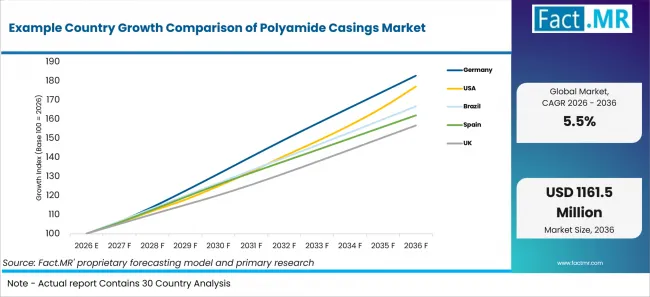
Example Country Growth Comparison Of Polyamide Casings Market | Source: Fact.MR
| Country | CAGR (2026-2036) |
|---|---|
| Germany | 6.2% |
| United States | 5.9% |
| Brazil | 5.3% |
| Spain | 5.0% |
| United Kingdom | 4.6% |
Source: Fact.MR analysis. Updated Sep 3, 2026
What supports Germany adoption?
6.2% CAGR, supported by meat-processing depth and polymer casing capability.
Germany is expected to post 6.2% CAGR from 2026 to 2036 as sausage and deli processors qualify casings for cooked meat, cheese and specialty formats. BMEL Statistik reported in 2026 that German poultry-meat consumption rose to 14.7 kilograms per person in 2025, indicating a substantial consumption base for poultry-related processing and packaging applications. Kalle gives the country local casing depth through polymer and viscose operations around Wiesbaden.
How is the USA scaling demand?
5.9% CAGR, driven by red-meat and poultry availability.
The USA is projected to record 5.9% CAGR as meat processors keep using casings that protect chilled deli, poultry and sausage products. USDA Economic Research Service reported in August 2025 that 226 pounds of red meat and poultry were projected to be available per U.S. consumer in 2025. Viskase strengthens the local supply base through plastic casings for processed meat and poultry applications.
What supports Brazil growth?
5.3% CAGR, supported by poultry exports and domestic processing scale.
Brazil is anticipated to grow at 5.3% CAGR as export-oriented poultry and pork processors keep high-volume casing formats in use. Brazil’s Ministry of Agriculture and Livestock reported on August 28, 2025 that chicken meat and giblet exports exceeded USD 5.47 billion from January through July 2025. That export exposure raises the value of barrier control during chilled and frozen distribution.
What underpins Spain demand?
5.0% CAGR, supported by pork processing and household food consumption.
Spain is estimated to advance at 5.0% CAGR as pork, beef and chilled-food channels sustain casing qualification work. Spain’s Ministry of Agriculture, Fisheries and Food reported in July 2026 that total food and beverage consumption reached 30.798 billion kilos or litres in 2025. Viscofan’s Spanish base gives the market a local supplier with global casing reach.
How does the UK perform?
4.6% CAGR, led by processed meat and food manufacturing needs.
The UK is forecast to reach 4.6% CAGR as processors balance chilled meat output with packaging compliance and cost control. The Office for National Statistics reported in July 2026 that food manufacturing represented 22.9% of total UK manufacturers’ sales in 2025. That manufacturing base supports casing demand across sausage, deli and prepared-meat formats.
Who leads the Polyamide Casings Market?
Viscofan is a major casing supplier with a portfolio spanning cellulose, collagen, fibrous and plastic formats. Its portfolio confirms direct participation in plastic and specialty food-casing applications.
Viskase competes through cellulosic, fibrous and plastic casings for processed meat and poultry. Its range includes polyamide casings and Visflex products for cooked applications.
Kalle is an established provider through polymer casings and specialty casing formats for meat and other protein-processing applications. Kalle Group concluded a long-term refinancing package of EUR-equivalent 290 million in May 2025, strengthening its financial flexibility to support strategic development and future growth opportunities.
Excellpack and PODANFOL provide direct polyamide-casing evidence. Excellpack manufactures multilayer food casings from polyamide and polyethylene, while PODANFOL describes itself as a manufacturer of polyamide sausage casings.
Which companies are the key providers?
Key companies include Viscofan; Viskase; Kalle; Excellpack; and PODANFOL.
- Viscofan
- Viskase
- Kalle
- Excellpack
- PODANFOL
Bibliography
- BASF. (2025, September 9). BASF launches the world’s first thermoplastic polyamide with high water permeability.
- Grossen, G. (2025, August 21). Per capita availability of red meat and poultry projected higher in 2025 and 2026. Economic Research Service, U.S. Department of Agriculture.
- U.S. Food and Drug Administration. (2026, May 4). Inventory of food contact substances listed in 21 CFR: Nylon.
- Ministério da Agricultura e Pecuária. (2025, August 28). Avicultura brasileira já exportou mais de US$ 5,4 bilhões em 2025.
- Ministerio de Agricultura, Pesca y Alimentación. (2026, July 30). El consumo alimentario crece por primera vez en cinco años y roza los 30.800 millones de kilos.
- Office for National Statistics. (2026, July 24). UK manufacturers’ sales by product: 2025.
- Kalle GmbH. (2025, May 23). Kalle Group concludes long-term financing to support its growth strategy.
- Viscofan, S.A. (2026). Annual report 2025.
- Viskase Holdings, Inc. (2026, August 3). Form 10-Q for the quarterly period ended June 30, 2026. U.S. Securities and Exchange Commission.
This Report Answers
- The report explains how polyamide casings are used across casing construction and barrier profile. It covers processing format and food application while linking casing demand with meatainers and downstream chilled distribution needs.
- Segment analysis identifies the leading subsegments and the operational reasons processors prioritize each format.
- Country analysis examines Germany, the USA, Brazil, Spain and the UK through meat-processing depth and food manufacturing indicators.
- Competitive analysis reviews current providers across plastic casings, polymer casing films and adjacent flexible food packaging.
- Application analysis assesses how barrier control, smoke transfer and ready-to-fill formats influence product decisions. It considers adjacent technologies such as active oxygen scavenger labels where oxygen exposure shapes food-packaging performance.
What does the Polyamide Casings Market cover?
The Polyamide Casings Market covers artificial casings and casing films that use polyamide to provide strength, shrink behavior, barrier control or permeability. It includes mono-layer and multilayer casing structures used in cooked sausage, deli meat, pâté, cheese and selected plant-based products.
The assessment covers shirred sticks, flat reels, cut pieces and ready-to-fill formats. It links these formats with broader nylon resin demand where polyamide functions as a casing or food-packaging material.
What is included in the scope?
The scope includes polyamide casings sold for food processing and packaging applications. It covers multilayer PA and PE casings, oriented PA casing films, PA and EVOH barrier structures, smoke-permeable polyamide and specialty shrink casings.
It includes casing products supplied in shirred sticks, flat reels, cut pieces, clipped formats and printed specialty formats. The scope also includes renewable-content and mono material flexible packaging links where material design serves casing qualification and food-contact requirements.
What is excluded from the scope?
The scope excludes natural animal casings, collagen casings and cellulose-only casings when polyamide is absent from the final casing structure. It also excludes general non-food polyamide films and industrial polyamide parts.
Rigid trays, tubs and transport boxes fall outside the scope when they are sold as separate containers. Broader resin markets are considered only where polyamide is converted into casings or casing films for food applications.
How Was the Analysis Built?
The analysis draws on 120+ sources, 35+ company portfolios, 25+ countries, and more than 20 industry interviews.
- Primary Research: Primary research includes discussions with manufacturers, service providers, technology developers, distributors, end users, and subject-matter experts. These conversations examine purchasing priorities, product adoption, operational challenges, approval requirements, competitive positioning, and the factors that influence wider market acceptance.
- Desk Research: Desk research covers government statistics, regulatory publications, company filings, trade data, technical studies, industry associations, standards, public policy, and other authoritative sources. Every source used in the analysis is documented in the bibliography.
- Market Sizing and Forecasting: Market estimates combine historical performance, demand indicators, pricing and volume trends, segment shares, company participation, country-level growth, adoption patterns, investment activity, and barriers to market expansion.
- Data Validation and Update Cycle: Findings are validated by comparing primary interviews with public data, company activity, regulatory changes, trade patterns, and industry developments. Regular updates review new product launches, capacity changes, partnerships, approvals, and shifts in commercial adoption.
Segmentation
What is the report’s scope and coverage?
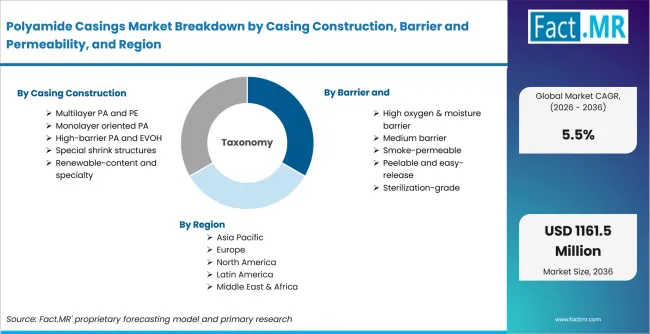
Polyamide Casings Market Breakdown By Casing Construction, Barrier And Permeability, And Region | Source: Fact.MR
| Attribute | Details |
|---|---|
| Quantitative Units | USD million in 2026 to USD million by 2036 at CAGR |
| Market Definition | Polyamide casings cover artificial food casings and casing films made with polyamide materials for processed meat, poultry, cheese, pâté and selected plant-based products. |
| Casing Construction | Multilayer PA and PE; Monolayer oriented PA; High-barrier PA and EVOH; Special shrink structures; Renewable-content and specialty |
| Barrier and Permeability | High oxygen and moisture barrier; Medium barrier; Smoke-permeable; Peelable and easy-release; Sterilization-grade |
| Processing Format | Shirred sticks; Flat reels; Cut pieces; Clipped and ready-to-fill; Printed specialty formats |
| Food Application | Cooked sausage and deli meat; Processed meat loaves; Pâté and liver products; Cheese; Plant-based and other |
| Regions Covered | North America; Latin America; Western Europe; Eastern Europe; East Asia; South Asia & Pacific; Middle East & Africa |
| Countries Covered | Germany; United States; Brazil; Spain; United Kingdom |
| Key Companies Profiled | Viscofan; Viskase; Kalle; Excellpack; PODANFOL |
| Forecast Period | 2026 to 2036 |
| Approach | Hybrid top-down and bottom-up approach using food processing indicators, casing construction mix, application demand, country growth, company participation and product-format review. |
Source: Fact.MR analysis. Updated Sep 3, 2026
How is the market segmented?
-
By Casing Construction
- Multilayer PA and PE
- Monolayer oriented PA
- High-barrier PA and EVOH
- Special shrink structures
- Renewable-content and specialty
-
By Barrier and Permeability
- High oxygen and moisture barrier
- Medium barrier
- Smoke-permeable
- Peelable and easy-release
- Sterilization-grade
-
By Processing Format
- Shirred sticks
- Flat reels
- Cut pieces
- Clipped and ready-to-fill
- Printed specialty formats
-
By Food Application
- Cooked sausage and deli meat
- Processed meat loaves
- Pâté and liver products
- Cheese
- Plant-based and other
-
By Region
- North America
- Latin America
- Western Europe
- Eastern Europe
- East Asia
- South Asia & Pacific
- Middle East & Africa
Who worked on this report


Preview the report firsthand - request a free sample
Free SampleGet the brochure for pricing and purchase details
Download PDF