- Market Value (2025): USD 417.8 Mn
- Estimated Value (2026): USD 445.0 Mn
- Forecast Value (2036): USD 1,150 Mn
- CAGR (2026-2036): 10.0%
What is the Pharmaceutical Manufacturing Fastener Market forecast to be worth by 2036?
USD 162.3 million in 2026 to USD 273.8 million by 2036 at a 5.4% CAGR.
- As peer Fact.MR analysis, the pharmaceutical manufacturing fastener market was valued at USD 154.0 million in 2025.
- Revenue is projected to rise from USD 162.3 million in 2026 to USD 273.8 million by 2036.
- The market is forecast to record a 5.4% CAGR between 2026 and 2036 as pharmaceutical equipment builders and plant maintenance teams replace threaded hardware.
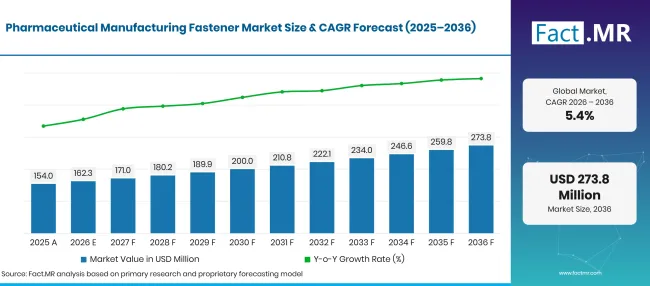
Pharmaceutical Manufacturing Fastener Market Forecast Global | Source: Fact.MR
| Year | Basis | Market Value (USD million) |
|---|---|---|
| 2025 | Actual | 154.0 |
| 2026 | Estimate | 162.3 |
| 2036 | Forecast | 273.8 |
| CAGR 2026 to 2036 | Forecast period | 5.4% |
Source: Fact.MR analysis. Updated Oct 26, 2026
What are the defining numbers behind Pharmaceutical Manufacturing Fastener Market growth?
The forecast adds USD 111.5 million in annual market value between 2026 and 2036.
- Demand Drivers in the Market
- Equipment maintenance teams need replacement screws and washers that fit established machine drawings. Consistent thread sizes and traceable materials help teams return production lines to service without redesigning an assembly.
- Pharmaceutical plant engineers put cleaning access at the center of hardware decisions. Exposed threads and awkward joints receive closer review where equipment has repeated contact with washdown fluids.
- Contract manufacturers often maintain different equipment generations under one quality system. Stocking repeatable fastening sizes helps reduce the number of parts needed during routine repairs.
- Key Segments Analyzed
- By Product Type: Screws account for 38.6% share in 2026, because they suit frequent access to guards and equipment covers.
- By Material: Titanium represents 68.0% share in 2026, particularly where application specifications value corrosion resistance and low weight.
- By Application: Capsules account for 63.0% share in 2026, reflecting fastening needs around capsule-processing and handling equipment.
- By End-User: Pharmaceutical Companies hold 58.4% share in 2026, so equipment upkeep and new production-line installations.
- Analyst Opinion at Fact.MR
- Shambhu Nath Jha, Principal Consultant at Fact.MR, states, “The most useful fastener is the one a maintenance engineer can replace without changing the approved machine design. A suitable part combines a known thread size with clear material records and a reliable supply route.”
- Strategic Implications
- fastener makers should provide clear material grades and dimensional documents for repeat orders.
- equipment builders benefit from reducing the number of custom screw lengths across a machine family.
- Plant engineering teams can shorten maintenance planning when replacement part numbers match approved drawings.
- Distributors should separate critical equipment fasteners from general-purpose stock when controlling substitutions.
Germany is projected to post 6.0% CAGR through 2036 as machinery and quality-focused component selection shape buying. Brazil follows at 5.5% amid pharmaceutical manufacturing activity. The United States advances at 4.9% through equipment replacement and plant upkeep. The United Kingdom records 4.4%, while Japan reaches 3.9% under established equipment qualification practices.
How does the Pharmaceutical Manufacturing Fastener Market break down by segment?
Screws lead Product Type at 38.6%; Titanium leads Material at 68.0%; Capsules lead Application at 63.0%; Pharmaceutical Companies lead End-User at 58.4%.
Which Product Type dominates?
Screws accounts for 38.6% of 2026 value.
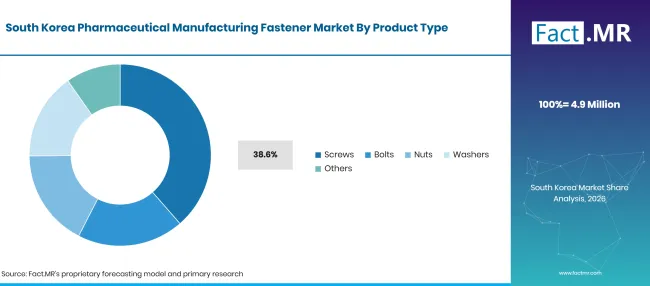
Factmr Pharmaceutical Manufacturing Fastener Market South Korea By Product Type | Source: Fact.MR
| Product Type | Share (2026) |
|---|---|
| Screws (Leading segment) | 38.6% |
| Other segments combined | 61.4% |
| Total | 100.0% |
Source: Fact.MR analysis. Updated Oct 26, 2026
Screws hold a strong position because they provide reliable fastening across pharmaceutical manufacturing equipment and packaging systems. Their threaded design supports secure assembly while still allowing components to be removed during maintenance or replacement. Other fastening products serve different load, access, and equipment-design requirements, giving manufacturers flexibility when specifying parts for individual machines.
What leads the Material segment?
Titanium accounts for 68.0% of 2026 value.
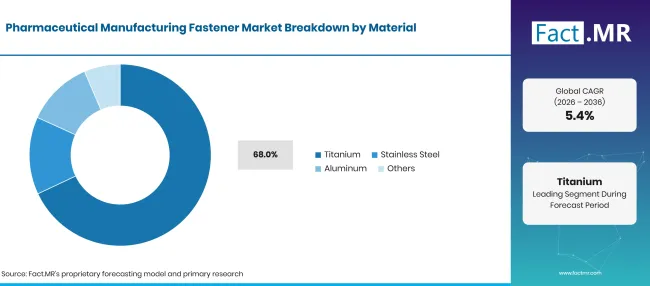
Pharmaceutical Manufacturing Fastener Market Breakdown Material | Source: Fact.MR
| Material | Share (2026) |
|---|---|
| Titanium (Leading segment) | 68.0% |
| Other segments combined | 32.0% |
| Total | 100.0% |
Source: Fact.MR analysis. Updated Oct 26, 2026
Titanium is projected to account for 68.0% of this market’s material segment in 2026. The metal combines a high strength-to-weight ratio with corrosion resistance for selected operating environments. Engineers still need to match the exact alloy and surface finish to the equipment design. Stainless steel remains a practical alternative for many cleanable machine assemblies.
How does Application shape demand?
Capsules accounts for 63.0% of 2026 value.
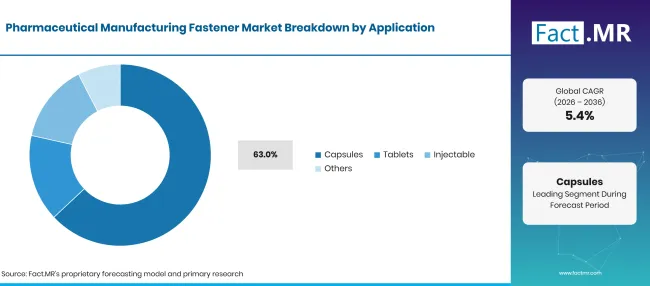
Pharmaceutical Manufacturing Fastener Market Breakdown Application | Source: Fact.MR
| Application | Share (2026) |
|---|---|
| Capsules (Leading segment) | 63.0% |
| Other segments combined | 37.0% |
| Total | 100.0% |
Source: Fact.MR analysis. Updated Oct 26, 2026
Capsule-related equipment creates regular requirements for precision fasteners across filling, handling, inspection, and packaging systems. Components must remain firmly positioned while allowing access for cleaning and maintenance between production runs. Other pharmaceutical applications use different fastener sizes and configurations according to machine layout, operating loads, and sanitation requirements.
Which End-User category accounts for most sales?
Pharmaceutical Companies accounts for 58.4% of 2026 value.
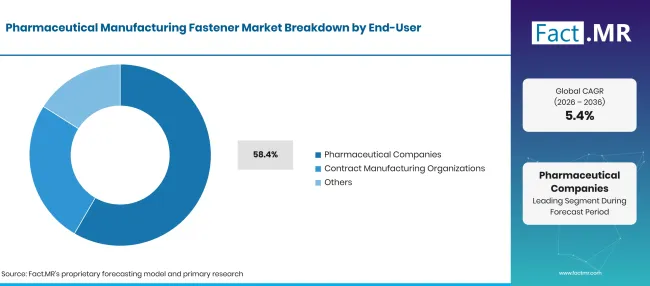
Pharmaceutical Manufacturing Fastener Market Breakdown End User | Source: Fact.MR
| End-User | Share (2026) |
|---|---|
| Pharmaceutical Companies (Leading segment) | 58.4% |
| Other segments combined | 41.6% |
| Total | 100.0% |
Source: Fact.MR analysis. Updated Oct 26, 2026
Pharmaceutical companies represent an important customer group because production facilities operate multiple processing and packaging systems that depend on secure mechanical connections. Equipment reliability, cleanability, material compatibility, and straightforward maintenance influence fastener selection across these facilities. Contract manufacturers, equipment builders, and other users may place different emphasis on replacement frequency, machine specifications, and operating conditions.
What is accelerating Pharmaceutical Manufacturing Fastener Market adoption, and what is holding it back?
Scheduled line servicing and cleaner mechanical assemblies support fastener purchases. Material qualification and approved-part substitution limits can slow supplier changes.
Drivers Impact Analysis
| DRIVER | (~) % IMPACT ON CAGR | GEOGRAPHIC RELEVANCE | IMPACT TIMELINE |
|---|---|---|---|
| Equipment replacement and upkeep | +1.0% | Global | Short term (<= 2 years) |
| Material and finish specifications | +0.8% | North America, Europe, Japan | Medium term (2–4 years) |
| Capsule equipment maintenance | +0.7% | Global | Short term (<= 2 years) |
| Local availability of approved spares | +0.5% | Global | Medium term (2–4 years) |
| Documented supplier consistency | +0.4% | Regulated manufacturing markets | Long term (>= 4 years) |
Source: Fact.MR analysis. Updated Oct 26, 2026
Opportunity Impact Analysis
| OPPORTUNITY | (~) % IMPACT ON CAGR | GEOGRAPHIC RELEVANCE | IMPACT TIMELINE |
|---|---|---|---|
| Standardized spare-part assortments | +0.8% | Global | Short term (<= 2 years) |
| Specialized surface finishes | +0.6% | Europe, North America | Medium term (2–4 years) |
| Equipment-maker supply agreements | +0.4% | Global | Medium term (2–4 years) |
Source: Fact.MR analysis. Updated Oct 26, 2026
Restraints Impact Analysis
| RESTRAINT | (~) % IMPACT ON CAGR | GEOGRAPHIC RELEVANCE | IMPACT TIMELINE |
|---|---|---|---|
| Material and qualification expense | -0.6% | Global | Short term (<= 2 years) |
| Restricted part substitutions | -0.5% | Regulated manufacturing markets | Medium term (2–4 years) |
| Corrosion and thread damage risk | -0.4% | Global | Long term (>= 4 years) |
Source: Fact.MR analysis. Updated Oct 26, 2026
Which countries are scaling the Pharmaceutical Manufacturing Fastener Market through 2036?
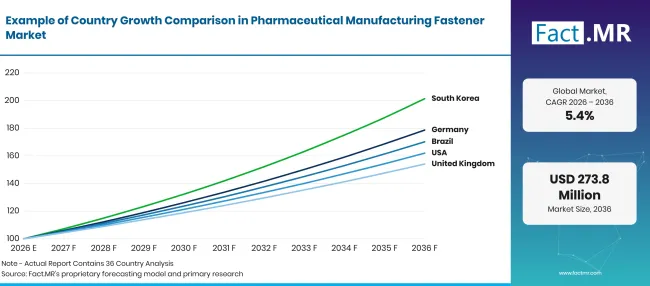
Pharmaceutical Manufacturing Fastener Market Growth Index | Source: Fact.MR
| Country | CAGR (2026 to 2036) |
|---|---|
| Germany | 6.0% |
| Brazil | 5.5% |
| United States | 4.9% |
| United Kingdom | 4.4% |
| Japan | 3.9% |
Source: Fact.MR analysis. Updated Oct 26, 2026
What supports Germany’s adoption?
6.0% CAGR, linked to pharmaceutical equipment engineering and repeatable spare-part specifications.
German pharmaceutical manufacturers operate in a large local medicines economy. Germany Trade & Invest reported EUR 67.9 billion in pharmaceutical industry revenue for 2025, indicating the scale of Germany’s medicines sector and its related manufacturing activities [5]. Equipment makers may benefit from orders for replacement screws that fit established processing machines.
How is Brazil developing demand?
5.5% CAGR, shaped by medicine production and plant-equipment maintenance.
Brazil’s regulated medicines sector provides a relevant setting for equipment servicing. In September 2026, Anvisa reported approximately R$ 182 billion in pharmaceutical sales during 2025 [2]. Manufacturers and equipment service teams may purchase replacement fasteners that match machine drawings, particularly for parts opened during routine repairs.
What is supporting United States adoption?
4.9% CAGR, tied to maintenance needs across registered drug-making facilities.
American pharmaceutical facilities rely on carefully recorded equipment maintenance. The U.S. Food and Drug Administration listed 8,895 domestic registered drug establishments as of September 30, 2025, in its 2026 inspection report [1]. Plant engineers may choose parts that match the approved equipment layout and material requirements.
How is the United Kingdom developing demand?
4.4% CAGR, with equipment servicing across pharmaceutical production sites.
British pharmaceutical facilities use fastening hardware across production machinery and service fixtures. The Office for National Statistics tracks the manufacture of basic pharmaceutical products and preparations through its official industry series [3]. This production base gives fastener suppliers a route into equipment maintenance and repeat replacement orders.
How does Japan perform?
3.9% CAGR, reflecting careful equipment specification and established production operations.
Japanese pharmaceutical production operates within a closely managed manufacturing environment. In its annual report released in 2025, Japan’s Ministry of Health, Labour and Welfare reported domestic pharmaceutical production of JPY 10.2485 trillion for 2024 [4]. Machine engineers may evaluate replacement fasteners against established equipment drawings.
Who leads the Pharmaceutical Manufacturing Fastener Market?
Suppliers compete through fastening ranges and support for equipment engineers. PennEngineering specializes in engineered fastening systems, while Bossard Group and TR Fastenings supply industrial fastening products. These capabilities are relevant when pharmaceutical equipment makers select threaded joints for machinery. Supplier assessment may focus on the part specification and the option to deliver the same component again.
qualified replacement stock represents a supply-chain advantage for pharmaceutical production sites. Engineers normally identify a fastener by material and thread specification. Manufacturers and distributors can compete by keeping those details consistent across orders and by responding promptly to equipment service needs.
Which companies are the key providers?
Key companies PennEngineering, Bossard Group, Stanley Black & Decker, Inc. (STANLEY Engineered Fastening), TR Fastenings and Hilti Corporation.
- PennEngineering
- Bossard Group
- Stanley Black & Decker, Inc. (STANLEY Engineered Fastening)
- TR Fastenings
- Hilti Corporation
Bibliography
[1] U.S. Food and Drug Administration. (2026). Annual report on inspections of establishments: FY 2025. https://www.fda.gov/media/192011/download?attachment=
[2] Agência Nacional de Vigilância Sanitária. (2026, September 28). CMED divulga 9° edição do Anuário Estatístico do Mercado Farmacêutico. https://www.gov.br/anvisa/pt-br/assuntos/noticias-anvisa/2026/cmed-divulga-9deg-edicao-do-anuario-estatistico-do-mercado-farmaceutico
[3] Office for National Statistics. (2026, October 15). UKProdTO: 21 - Manuf of Basic Pharmaceutical Products & Preparations TOTAL (£m). https://www.ons.gov.uk/businessindustryandtrade/manufacturingandproductionindustry/timeseries/jq7k
[4] Ministry of Health, Labour and Welfare. (2025, December 24).[Publication of the 2024 annual report on pharmaceutical industry production statistics]. https://www.mhlw.go.jp/stf/newpage_67099.html
[5] Germany Trade & Invest. (n.d.). The pharmaceutical industry in Germany. https://www.gtai.de/en/invest/industries/healthcare-market-germany/pharmaceutical-industry
This Report Answers
- Market value in 2025, 2026 and 2036 and the growth path between those years.
- How screws and titanium appear in the 2026 product and material mix.
- Why capsule equipment and pharmaceutical companies account for the specified shares.
- How engineering requirements shape purchasing decisions in five national markets.
- What supplier capabilities and maintenance practices influence fastener purchases.
What does the Pharmaceutical Manufacturing Fastener Market cover?
The market includes bolts, nuts, screws and washers used in machines and support assemblies inside pharmaceutical manufacturing operations. These parts hold equipment components together and allow selected joints to be opened during servicing. The market value refers to the fastener itself and excludes the value of the finished medicine.
What is included in the scope?
Fasteners installed in pharmaceutical manufacturing lines are counted when sold as individual hardware or as identifiable components of maintenance and equipment supply. Capsule handling, tablet production and injectable manufacturing are the application groupings. The material mix covers titanium, stainless steel, aluminum and other grades where their use is technically appropriate.
What is excluded from the scope?
Medicines, capsules used as dosage forms and primary drug packaging are outside the market boundary. The full value of processing machinery, installation labor and maintenance contracts is also excluded. General construction anchors and fasteners sold solely for unrelated building work are not part of this equipment-focused market.
How Was the Analysis Built?
The analysis draws on 120+ sources, 35+ company portfolios, 25+ countries, and more than 20 industry interviews.
- Primary Research: Primary research includes discussions with manufacturers, service providers, technology developers, distributors, end users, and subject-matter experts. These conversations examine purchasing priorities, product adoption, operational challenges, approval requirements, competitive positioning, and the factors that influence wider market acceptance.
- Desk Research: Desk research covers government statistics, regulatory publications, company filings, trade data, technical studies, industry associations, standards, public policy, and other authoritative sources. Every source used in the analysis is documented in the bibliography.
- Market Sizing and Forecasting: Market estimates combine historical performance, demand indicators, pricing and volume trends, segment shares, company participation, country-level growth, adoption patterns, investment activity, and barriers to market expansion.
- Data Validation and Update Cycle: Findings are validated by comparing primary interviews with public data, company activity, regulatory changes, trade patterns, and industry developments. Regular updates review new product launches, capacity changes, partnerships, approvals, and shifts in commercial adoption.
Segmentation
What is the report’s scope and coverage?
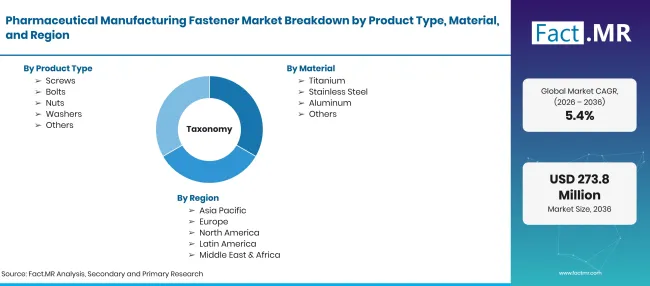
Pharmaceutical Manufacturing Fastener Market Taxonomy | Source: Fact.MR
| Attribute | Details |
|---|---|
| Quantitative Units | USD million in 2026 and 2036; CAGR from 2026 to 2036 |
| Market Definition | Mechanical fasteners used in pharmaceutical manufacturing equipment and plant assemblies. These include components that secure machine parts while allowing selected joints to be opened during servicing. Market value covers the fastener itself rather than the finished medicine or complete machinery. |
| Product Type | Screws; Bolts; Nuts; Washers; Others |
| Material | Titanium; Stainless Steel; Aluminum; Others |
| Application | Capsules; Tablets; Injectable; Others |
| End-User | Pharmaceutical Companies; Contract Manufacturing Organizations; Others |
| Regions Covered | North America; Latin America; Western Europe; Eastern Europe; East Asia; South Asia & Pacific; Middle East & Africa |
| Countries Covered | Germany; Brazil; United States; United Kingdom; Japan |
| Companies Profiled | PennEngineering; Bossard Group; Stanley Black & Decker, Inc. (STANLEY Engineered Fastening); TR Fastenings; Hilti Corporation |
| Forecast Period | 2026 to 2036 |
| Approach | Assessment of fastener use across pharmaceutical machinery, material and thread specifications, application requirements, maintenance practices, replacement activity, country growth conditions, and supplier participation. |
Source: Fact.MR analysis. Updated Oct 26, 2026
How is the market segmented?
-
By Product Type
- Screws
- Bolts
- Nuts
- Washers
- Others
-
By Material
- Titanium
- Stainless Steel
- Aluminum
- Others
-
By Application
- Capsules
- Tablets
- Injectable
- Others
-
By End-User
- Pharmaceutical Companies
- Contract Manufacturing Organizations
- Others
-
By Region
- North America
- Latin America
- Western Europe
- Eastern Europe
- East Asia
- South Asia & Pacific
- Middle East & Africa
Frequently Asked Questions
How big is the pharmaceutical manufacturing fastener market in 2026?
What is the CAGR between 2026 and 2036?
Which product type has the largest share?
Which material accounts for most of the market?
Who are the main companies in the pharmaceutical manufacturing fastener market?
Who worked on this report


Preview the report firsthand - request a free sample
Free SampleGet the brochure for pricing and purchase details
Download PDF