- Base Value(2026): 30.9 Bn
- Estimated Value(2026): 30.9 Bn
- Forecast Value (2036): 50.3 Bn
- CAGR (2026 - 2036): 5.0%
Pharmaceutical Plastic Packaging Market Forecast and Outlook 2026 to 2036
In 2025, the pharmaceutical plastic packaging market surpassed a valuation of USD 29.5 billion. Based on Fact.MR analysis, demand for pharmaceutical plastic packaging is estimated to grow to USD 30.9 billion in 2026 and USD 50.3 billion by 2036. Fact.MR projects a CAGR of 5.0% during the forecast period.
The market is expected to generate an absolute dollar opportunity of USD 20.8 billion between 2026 and 2036, a genuinely transformational expansion for an industry segment long characterized by incremental volume growth and commoditized resin pricing. Growth is driven structurally by two parallel forces: the rapid expansion of biologics and injectable therapies that demand complex, high-barrier, and contamination-free primary packaging, and tightening sustainability mandates across the EU and North America.
Dietmar Siemssen, CEO of Gerresheimer AG noted that, "The operative performance of our business in the first nine months is clearly below our expectations. Our goal is to grow faster than the overall market again in the medium and long term. The expansion of our product portfolio to include systems and solutions for biologics and the implementation of our growth projects will contribute considerably to this."
Country-level growth varies based on biologics investment, regulatory requirements, and healthcare infrastructure expansion. China leads with 7.0% CAGR, supported by pharmaceutical expansion under Made in China 2025 and rising biologics exports requiring certified primary packaging. India follows at 6.7%, driven by the Production Linked Incentive scheme boosting domestic drug manufacturing and demand for quality plastic packaging. The United States grows at 5.0%, supported by increasing novel drug approvals and investment in prefilled syringe and injectable manufacturing. Germany records 4.5% growth due to its strong EU-regulated manufacturing base, while the United Kingdom grows at 4.0%, supported by post-Brexit regulatory alignment and NHS supply chain investment.
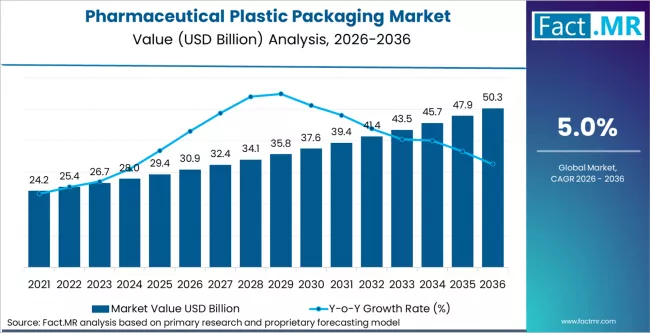
Pharmaceutical Plastic Packaging Market Market Value Analysis | Source: Fact.MR
| Metric | Value |
|---|---|
| Estimated Value in 2026 | USD 30.9 billion |
| Forecast Value in 2036 | USD 50.3 billion |
| Forecast CAGR (2026 to 2036) | 5.0% |
Source: Fact.MR analysis. Updated Mar 2, 2026
Market Definition
The pharmaceutical plastic packaging market covers the design and production of plastic-based primary and secondary packaging used to protect and deliver pharmaceutical products. It includes bottles, vials, blister packs, pouches, prefillable syringes, closures, and films made from polyethylene, polypropylene, PET, and PVC. These formats ensure contamination control, barrier protection, and regulatory compliance across oral, liquid, injectable, and home healthcare applications.
Market Inclusions
This report provides global and regional revenue forecasts from 2026 to 2036 by material, end use, and region. It includes primary packaging, contract manufacturing formats, high-barrier substrates, rigid and flexible solutions, smart packaging integration, mono-material developments, and sustainable resin transitions across pharma and biotech sectors.
Market Exclusions
The scope excludes glass packaging, aluminium foil blisters, paper cartons, and finished drug products unless highlighting packaging trends. Consumer plastic packaging for food or cosmetics is excluded unless pharmaceutical-grade. Standalone fill-finish and contract packaging services are also excluded.
Research Methodology
- Primary Research: Interviews were conducted with pharmaceutical procurement managers, CDMO specialists, regulatory leaders, and resin suppliers across North America, Europe, and Asia Pacific.
- Desk Research: Sources included pharma annual reports, PPWR legislative records, FDA container closure guidance, pharmacopoeia standards, sustainability disclosures, and verified press releases.
- Market Sizing and Forecasting: A hybrid approach combined global drug output estimates with packaging unit consumption and pricing benchmarks. Inputs included biologics growth, regulatory-driven material shifts, and premium packaging trends.
- Data Validation and Update Cycle: Findings were validated using earnings disclosures, trade data, regulatory filings, and public M&A records. Forecasts are updated annually or after major regulatory or technology changes.
Pharmaceutical Plastic Packaging Market Summary
- Market Definition
- Pharmaceutical plastic packaging includes polyethylene, polypropylene, PET, and PVC containers, blisters, syringes, and flexible formats used for compliant drug containment across global supply chains.
- Demand Drivers
- Growth in biologics and injectables is increasing demand for high-value primary packaging such as prefillable syringes and advanced vials.
- EU PPWR and FDA recyclability guidance are accelerating mono-material and sustainable packaging development, favoring established converters.
- Manufacturing incentives in China and India are expanding generic and biosimilar production, boosting demand for certified plastic packaging.
- Key Segments Analyzed
- By Material: Polyethylene holds around 38% share due to its dominance in oral solid dose bottles and cost-efficient barrier properties.
- By End Use: Pharmaceuticals account for roughly 42% of demand, driven by steady procurement from branded and generic drug makers.
- By Geography: Asia Pacific is the fastest-growing region, led by China at 7.0% CAGR and India at 6.7%, while Europe shows slower volume growth due to regulatory intensity.
- Analyst Opinion at FACT.MR
- Shambhu Nath Jha, Principal Consultant at Fact.MR, opines, 'Value in the pharmaceutical plastic packaging market is shifting decisively from commodity resin conversion to integrated smart and sustainable packaging systems. CXOs reviewing this report will find a market where regulatory compliance, biologics packaging complexity, and sustainability mandates are rewarding high-capability converters with premium margins while compressing returns for volume-only players.'
- Strategic Implications / Executive Takeaways
- Manufacturers should accelerate mono-material and recycled-content substrate development with validated extractable profiles, as EU PPWR and FDA guidance will make sustainable formats a baseline requirement.
- Asia Pacific converters should target China and India biologics and generics expansion through CDMO and state-backed pharma partnerships under government incentive schemes.
- Global players should expand smart packaging capabilities such as RFID, NFC tracking, and temperature indicators to capture premium biologics and specialty drug segments.
- Methodology
- Market size estimated using pharmaceutical production volumes, packaging consumption ratios, and material-specific pricing benchmarks validated through industry interviews.
- Shares verified through company reports, trade association data, and official product announcements.
- Regional forecasts based on biologics pipelines, manufacturing incentives, output growth, and sustainability regulation timelines.
Segmental Analysis
Pharmaceutical Plastic Packaging Market Analysis by Material
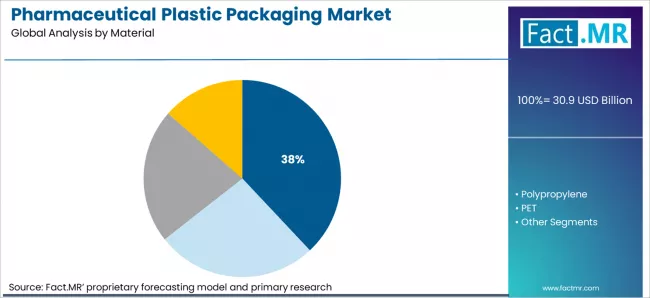
Pharmaceutical Plastic Packaging Market Analysis By Material | Source: Fact.MR
Polyethylene formats are estimated to hold about 38% share in 2026. Dominance stems from regulatory familiarity, moisture barrier performance, cost efficiency, and compatibility with high-speed oral solid dose filling lines.
- Amcor-Berry Global Combination and Healthcare Portfolio Expansion: In April 2025, Amcor completed its USD 8.4 billion acquisition of Berry Global, forming a USD 23 billion packaging entity targeting USD 650 million in synergies by FY2028. [4] The deal strengthens combined pharmaceutical bottle and flexible laminate capabilities.
- Alpek and TekniPlex PCR-PET Pharmaceutical Blister Film: In January 2024, Alpek and TekniPlex launched a PET blister film with 30% recycled monomers, compatible with Teknilid Plus lidding for recyclable pharmaceutical blister packs. [2]
- Polypropylene Premiumisation Trend in Healthcare Bottles: In October 2024, Berry Global launched ClariPPil clarified polypropylene bottles, offering improved visibility and 71% lower process carbon emissions versus certain PET formats. [5]
Pharmaceutical Plastic Packaging Market Analysis by End Use
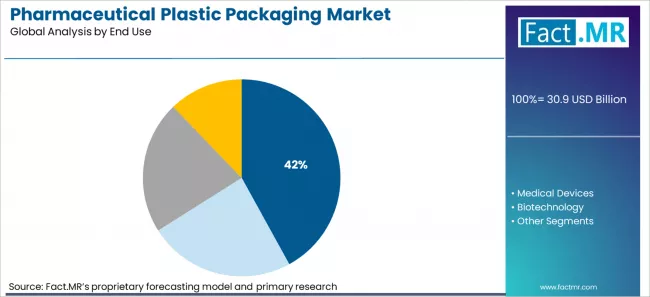
Pharmaceutical Plastic Packaging Market Analysis By End Use | Source: Fact.MR
The pharmaceuticals segment is estimated to hold about 42% share in 2026. Demand spans oral solid bottles to complex COP syringe systems, ensuring consistent procurement across branded and generic manufacturers.
- Gerresheimer Acquisition of Bormioli Pharma: In December 2024, Gerresheimer completed its EUR 800 million acquisition of Bormioli Pharma, expanding plastic bottle and closure capacity across five European sites. [6]
- West Pharmaceutical Services CZ Nested Vial Launch: In May 2024, West launched Daikyo Crystal Zenith Nested Vials in Tub for biologics and gene therapies, offering glass-free, extractable-tested containment. [1]
- Home Healthcare Segment Growth: Rising self-injection adoption is boosting demand for integrated plastic delivery systems. In February 2025, Systech introduced the UniSecure artAI cloud authentication platform targeting pharmaceutical and home healthcare packaging traceability. [7]
Drivers, Restraints, and Opportunities
Fact.MR identifies the market as stable in volume but shifting in value. Pharmaceutical output growth ensures steady baseline demand, while biologics expansion and sustainability rules are redirecting value toward high-barrier and traceable packaging formats.
The market is dividing between commodity bottle suppliers and integrated system providers offering COP vials, prefillable syringes, and smart blister systems. Sustainable and smart formats carry higher unit costs but are increasingly preferred in regulated and high-risk drug categories, supporting overall price growth despite resin volatility.
- Biologics and Injectable Growth as Primary Structural Driver: Rapid expansion in monoclonal antibodies, biosimilars, and gene therapies is increasing demand for complex primary packaging. In May 2024, West Pharmaceutical Services launched Daikyo Crystal Zenith Nested Vials in Tub for biologics fill-finish applications.
- EU Packaging and Packaging Waste Regulation (PPWR) as Compliance Accelerator: The EU PPWR, effective from 2024 with phased implementation through 2030, mandates recyclability and recycled content thresholds. In January 2024, Alpek Polyester and TekniPlex Healthcare introduced a pharmaceutical-grade PET blister film with 30% recycled monomers to support compliance.
- Asia Pacific Manufacturing Scale and PLI-Driven Volume Expansion: Government-backed pharma expansion in China and India is driving new certified packaging demand. India’s PLI scheme continues through 2025.
Regional Analysis
The pharmaceutical plastic packaging market is analysed across North America, Europe, Asia Pacific, Latin America, and Middle East and Africa, covering over 40+ countries. The full report also offers market attractiveness analysis based on regulatory environment, pharmaceutical production scale, biologics investment pipeline, and sustainable packaging transition readiness.
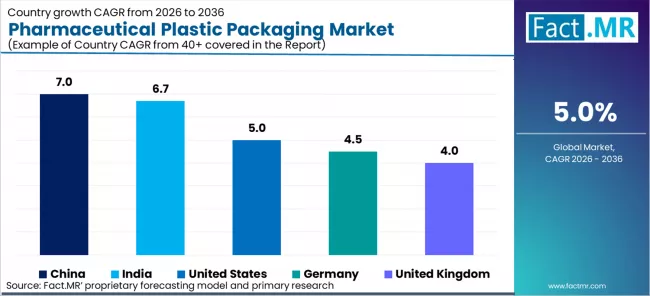
Pharmaceutical Plastic Packaging Market Cagr Analysis By Country | Source: Fact.MR
| Country | CAGR (2026-2036) |
|---|---|
| China | 7.0% |
| India | 6.7% |
| United States | 5.0% |
| Germany | 4.5% |
| United Kingdom | 4.0% |
Source: Fact.MR analysis. Updated Mar 2, 2026
Source: Fact.MR (FACT.MR) analysis, based on proprietary forecasting model and primary research
Asia Pacific Pharmaceutical Plastic Packaging Market Analysis
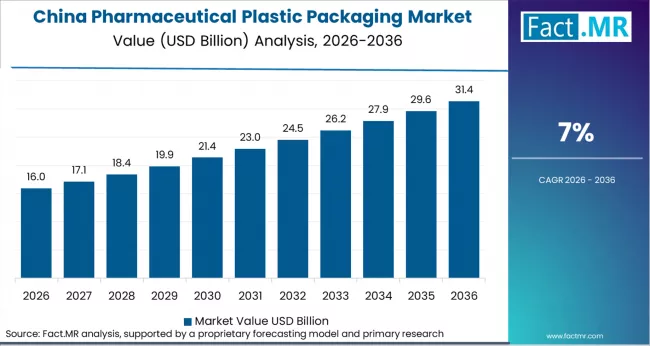
Pharmaceutical Plastic Packaging Market Country Value Analysis | Source: Fact.MR
Asia Pacific is the fastest-growing region, supported by government-backed pharma expansion, improving quality standards, and rising biologics production. The market includes global packaging multinationals serving large pharma clients and domestic converters focused on generics manufacturers across China, India, and Southeast Asia.
- China: Demand is projected to grow at 7.0% CAGR through 2036. Made in China 2025 and related pharma programmes are expanding biologics and innovative drug output, increasing demand for certified COP syringes, high-barrier blisters, and validated polyethylene bottles. NMPA alignment with ICH and USP standards is raising compliance requirements for domestic converters. Local capacity expansion by groups such as Gerresheimer and domestic OEMs is strengthening supply in major pharma clusters.
- India: Demand is projected to grow at 6.7% CAGR through 2036. The PLI scheme is expanding API and formulation manufacturing, creating sustained demand for GMP-certified packaging. Strengthened Drugs and Cosmetics Act rules from 2024 are raising supplier compliance standards. With exports exceeding USD 27 billion in FY2024, Indian manufacturers increasingly require USP, Ph. Eur., and FDA-compliant packaging.
FACT.MR covers China, Japan, South Korea, India, Australia and New Zealand, ASEAN, and Rest of Asia Pacific, focusing on manufacturing growth, regulatory upgrades, and biologics packaging demand.
Europe Pharmaceutical Plastic Packaging Market Analysis
Europe sets regulatory benchmarks through the EU PPWR and Falsified Medicines Directive, reshaping sustainability and traceability requirements. Established converters such as Gerresheimer and Bormioli Pharma maintain strong pharma client relationships, while compliance investment raises barriers for new entrants.
- Germany: Demand is projected to grow at 4.5% CAGR through 2036. Adoption of sustainable and serialised packaging is accelerating under PPWR and FMD mandates. Gerresheimer reported 8.0% organic growth in its Plastics and Devices division in FY2024, reflecting strong demand for drug delivery and containment systems. Multi-year reformulation projects are underway ahead of 2030 compliance deadlines.
- United Kingdom: Demand is projected to grow at 4.0% CAGR through 2036. MHRA guidance remains aligned with FDA and ICH standards, maintaining regulatory continuity. NHS procurement increasingly specifies sustainable packaging credentials. Major manufacturers such as AstraZeneca and GSK have 2030 sustainability commitments influencing supplier selection.
FACT.MR covers Germany, France, United Kingdom, Italy, Spain, Netherlands, Nordics, and Rest of Europe, highlighting PPWR compliance, serialisation adoption, and sustainable substrate qualification trends.
North America Pharmaceutical Plastic Packaging Market Analysis
North America remains the largest value market, supported by high biologics output, advanced packaging technologies, and strict container closure standards. Major suppliers include the combined Amcor Berry entity and AptarGroup.
- United States: Demand is projected to grow at 5.0% CAGR through 2036. The market combines large-volume polyethylene bottle demand with premium biologics packaging such as COP vials and prefillable syringes. In May 2024, Eli Lilly committed USD 5.3 billion to expand its Indiana facility, increasing demand for qualified primary packaging suppliers.
FACT.MR covers the United States, Canada, and Mexico, focusing on pharmaceutical output growth, biologics packaging complexity, CDMO procurement patterns, and sustainable material adoption.
Competitive Landscape for Market Players
The pharmaceutical plastic packaging market is moderately concentrated at the global system level but fragmented among regional commodity converters. Large players such as Amcor Berry, Gerresheimer, AptarGroup, and West Pharmaceutical Services hold strong positions due to pharmaceutical-grade certifications, long-standing customer relationships, proprietary materials, and integrated drug delivery capabilities. These companies focus on high-value segments including biologics packaging, injectable components, and sustainable formats where technical barriers are high.
Competitive advantage is increasingly tied to regulatory qualification rather than scale alone. For injectable and biologic drugs, packaging suppliers undergo multi-year validation processes, creating strong switching costs and protecting incumbent relationships. Gerresheimer’s 8.0 percent growth in its Plastics and Devices division in 2024 highlights the premium economics available in qualified system supply. Its acquisition of Bormioli Pharma further strengthens its integrated container and closure portfolio for biologics customers.
While generic drug packaging is often dual sourced and price sensitive, specialty and biologics packaging tends to rely on limited suppliers due to qualification complexity. Sustainability requirements are also becoming mandatory in procurement contracts, raising entry barriers and reinforcing the position of established, compliant players.
Recent Developments
- In April 2025, Amcor completed its all-stock acquisition of Berry Global for USD 8.4 billion, creating a combined packaging entity with approximately USD 23 billion in anticipated annual sales, approximately 70,000 employees, and operations across 140 countries with 400 production facilities, establishing the world's largest pharmaceutical and consumer packaging group.
- In December 2024, Gerresheimer completed its EUR 800 million acquisition of Blitz LuxCo Sarl, the holding company of Italy's Bormioli Pharma Group, which operates nine pharmaceutical primary packaging production sites in Europe specialising in glass and plastic bottles, closures, accessories, and dosing systems.
Key Players
- Berry Global
- Amcor plc
- Gerresheimer AG
- AptarGroup, Inc.
- West Pharmaceutical Services
- Kelpi
- PulpaTronics
- Bormioli Pharma
- Aluflexpack
- Parcel Health
Bibliography
- [1] West Pharmaceutical Services. (2024, May). West Pharmaceutical Services Launches Daikyo Crystal Zenith Nested Vials in Tub at ISCT 2024. PR Newswire.
- [2] TekniPlex Healthcare / Alpek Polyester. (2024, January). Alpek Polyester and TekniPlex Healthcare Launch Pharmaceutical-Grade PCR-PET Blister Film. Business Wire.
- [3] Berry Global. (2024, April). Berry Global Expands Healthcare Manufacturing Capacity in Three European Production Sites. Berry Global Corporate.
- [4] Amcor plc. (2025, April 30). Amcor Completes Combination with Berry Global. PR Newswire.
- [5] Berry Global. (2024, October). Berry Global Introduces ClariPPil Clarified Polypropylene Healthcare Bottles. Berry Global Corporate.
- [6] Gerresheimer AG. (2024, December 11). Gerresheimer Successfully Completes Acquisition of Blitz LuxCo Sarl, the Holding Company of the Bormioli Pharma Group. Gerresheimer Corporate.
- [7] Systech / Markem-Imaje. (2025, February). Systech Introduces UniSecure artAI AI-Powered Authentication System for Pharmaceutical Packaging. Globe Newswire.
- [8] Eli Lilly and Company. (2024, May). Eli Lilly Announces USD 5.3 Billion Manufacturing Expansion in Lebanon, Indiana. Eli Lilly Investor Relations.
This Report Addresses
- Market intelligence for strategic planning across product development, material innovation, sustainability transition, and competitive response to recent consolidation.
- Market size and forecast: valued at USD 30.9 billion in 2026, projected to reach USD 50.3 billion by 2036 at 5.0% CAGR, segmented by material, end use, and region.
- Growth opportunity mapping across biologics packaging, mono-material and recycled substrates for PPWR compliance, smart packaging integration, and Asia Pacific manufacturing expansion.
- Segment and regional forecasts with country-level CAGR for China 7.0%, India 6.7%, United States 5.0%, Germany 4.5%, and United Kingdom 4.0%, including material and end-use splits.
- Competitive strategy assessment covering Amcor Berry, Gerresheimer, AptarGroup, and West Pharmaceutical Services across qualification depth, sustainability capability, smart packaging, and pricing dynamics.
- Product and technology tracking including recycled substrates, RFID and NFC integration, COP and CZ vial systems, sustainable closures, and anti-counterfeiting solutions.
- Regulatory impact analysis covering EU PPWR, FDA container closure guidance, India packaging rule updates, and FDA synthetic dye phase-out requirements.
- Report delivery in Excel tables, PowerPoint executive summary, and detailed PDF with verified regulatory and manufacturer sources.
Segmentation
Scope of Report
| Items | Values |
|---|---|
| Quantitative Units | USD 30.9 billion (2026) to USD 50.3 billion (2036), at a CAGR of 5.0% |
| Market Definition | Pharmaceutical plastic packaging refers to polyethylene, polypropylene, PET, and PVC-based primary and secondary packaging formats including bottles, vials, blister packs, pouches, prefillable syringes, closures, and flexible films. |
| Material | Polyethylene, Polypropylene, PET, PVC |
| End Use | Pharmaceuticals, Medical Devices, Biotechnology, Home Healthcare |
| Application Coverage | Oral solid dose bottle packaging, injectable and biologic primary containment, blister pack and strip pack formats, prefillable syringe and cartridge systems, child-resistant and senior-friendly closures, smart packaging with RFID and NFC serialisation, sustainable mono-material and recycled-content formats for EU PPWR compliance |
| Regions Covered | Asia Pacific, Europe, North America, Latin America, Middle East and Africa |
| Countries Covered | China, Japan, South Korea, India, Australia and New Zealand, ASEAN, Rest of Asia Pacific, Germany, United Kingdom, France, Italy, Spain, Netherlands, Nordics, Rest of Europe, United States, Canada, Mexico, Brazil, Chile, Ecuador, Rest of Latin America, Kingdom of Saudi Arabia, United Arab Emirates, South Africa, Turkey, Rest of Middle East and Africa |
| Key Companies Profiled | Berry Global, Amcor plc, Gerresheimer AG, AptarGroup Inc., West Pharmaceutical Services, Kelpi, PulpaTronics, Bormioli Pharma, Aluflexpack, Parcel Health |
| Forecast Period | 2026 to 2036 |
| Approach | A hybrid top-down and bottom-up modelling approach was applied. Top-down inputs included global pharmaceutical output volumes by dosage form, region, and end use, with packaging consumption ratios and material-specific average selling price benchmarks. |
Source: Fact.MR analysis. Updated Mar 2, 2026
Pharmaceutical Plastic Packaging Market by Segment
-
By Material :
- Polyethylene
- Polypropylene
- PET
- PVC
-
By End Use :
- Pharmaceuticals
- Medical Devices
- Biotechnology
- Home Healthcare
-
By Region :
- North America
- United States
- Canada
- Mexico
- Europe
- Germany
- United Kingdom
- France
- Italy
- Spain
- Netherlands
- Nordics
- Rest of Europe
- Asia Pacific
- China
- Japan
- South Korea
- India
- Australia and New Zealand
- ASEAN
- Rest of Asia Pacific
- Latin America
- Brazil
- Chile
- Ecuador
- Rest of Latin America
- Middle East and Africa
- Kingdom of Saudi Arabia
- United Arab Emirates
- South Africa
- Turkey
- Rest of Middle East and Africa
- North America
Frequently Asked Questions
How large is the pharmaceutical plastic packaging market in 2025?
What will the market size be in 2026?
What is the projected market size by 2036?
What is the expected CAGR for the forecast period 2026 to 2036?
Which material segment is poised to lead the pharmaceutical plastic packaging market?
Which end-use segment holds the largest share?
Which country shows the fastest growth rate?
How fast is the pharmaceutical plastic packaging market expected to expand in the United States?
What growth rate is expected for Germany's pharmaceutical plastic packaging market?
How is the pharmaceutical plastic packaging market in the United Kingdom expected to grow?
Who worked on this report


Preview the report firsthand - request a free sample
Free SampleGet the brochure for pricing and purchase details
Download PDF