- Estimated Value(2026): 2.6 Bn
- Forecast Value (2036): 4.0 Bn
- CAGR (2026 - 2036): 4.4%
Phenolic Resin Panels Market Forecast and Outlook 2026 to 2036
In 2025, the phenolic resin panels market was valued at approximately USD 2.49 billion, based on back calculation from 2026 estimates. Fact.MR analysis indicates that the market is projected to reach USD 2.6 billion in 2026 and expand to USD 4.0 billion by 2036, registering a CAGR of 4.4% during the forecast period.
Market expansion reflects steady incorporation of phenolic resin panels into applications where fire reaction class, moisture resistance, hygiene performance, and mechanical stability are mandated by codes and procurement standards. Value growth is driven less by panel volume expansion and more by consistent specification in regulated environments such as healthcare facilities, mass transit interiors, laboratories, and exterior façade systems.
The market adds nearly USD 1.51 billion in absolute value over the decade, indicating stable compounding supported by repeat use in institutional and infrastructure projects. Pricing remains structurally higher than conventional wood based panels due to resin content, curing energy requirements, and certification costs tied to EN 438 and fire performance testing.
Demand progression follows public construction cycles, refurbishment of institutional buildings, and transit infrastructure development, particularly in Asia Pacific and the Middle East. India leads growth at 5.8% CAGR, supported by hospital and metro projects. Vietnam and Indonesia follow due to public facility expansion. China records 4.9% as adoption aligns with hygiene and fire safety standards. Mature markets such as the United States at 3.0% and Germany at 2.5% remain constrained by established material systems and slower refurbishment turnover.
Fact.MR analysis suggests that producers with validated fire performance data, multi region certification, and consistent laminate quality secure repeat specification, reinforcing long term value stability across the forecast period.
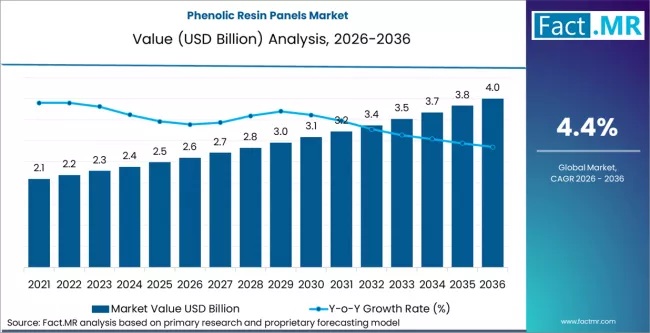
Phenolic Resin Panels Market Market Value Analysis | Source: Fact.MR
Phenolic Resin Panels Market Definition
The phenolic resin panels market covers rigid panel products manufactured by impregnating paper, fabric, or fiber layers with phenolic resin and curing them under heat and pressure. The resin forms a hard, stable matrix that provides resistance to heat, moisture, and chemicals, as defined in laminate panel standards such as EN 438 published by CEN. These panels are sold as sheets or boards for interior and exterior uses. Common applications include wall cladding, laboratory furniture, washroom partitions, and industrial surfaces.
Phenolic Resin Panels Market Inclusions
The report covers global and regional market size estimates in volume and value terms with a forecast period from 2026 to 2036. Segmentation includes panel type, compact and standard grades defined under EN 438, application areas such as interior fit outs and exterior facades, and end use sectors including commercial buildings, healthcare facilities, and transport infrastructure. The scope also includes regional demand patterns and international trade flows tracked through UN Comtrade
Phenolic Resin Panels Market Exclusions
The scope excludes decorative laminates sold only as surface finishes without structural panel properties. Conventional wood based panels such as plywood, MDF, and particleboard are not included. Fiber cement boards, metal composite panels, and plastic sheets outside phenolic resin chemistry are excluded. Downstream finished products including installed partitions, furniture units, prefabricated facades, and modular interiors are not considered. Laboratory scale materials and experimental resin systems without commercial panel production are also excluded.
Phenolic Resin Panels Market Research Methodology
- Primary Research: Primary research involved interviews with phenolic panel manufacturers, laminate processors, distributors, architects, and contractors specifying panel based systems.
- Desk Research: Desk research used EN 438 laminate standards from CEN, fire and material performance guidance from ISO [3], public procurement specifications, and company annual reports and technical datasheets filed with securities regulators.
- Market Sizing and Forecasting: Market sizing applied a hybrid top down and bottom up model using reported panel production capacities, shipment disclosures, and building construction activity data from national statistical offices.
Data Validation and Update Cycle
Outputs were cross checked against customs trade data, procurement records, and company disclosures, with updates applied when verified public sources issue revisions.
Summary of Phenolic Resin Panels Market
Market Definition
- The phenolic resin panels market comprises rigid panels produced by impregnating fibrous layers with phenolic resin and curing under heat and pressure to deliver fire resistance, moisture stability, and surface durability, as defined under EN 438 laminate standards published by CEN [1].
Demand Drivers
- Public and institutional buildings specify phenolic resin panels because fire reaction, hygiene, and moisture resistance are mandated under building codes such as the International Building Code for interiors and façades. [2]
- Healthcare, laboratory, and mass transit projects drive repeat demand as procurement frameworks require non-porous, chemical-resistant, and easily cleanable surfaces aligned with EN 438 performance classes.
- Exterior façade and rainscreen adoption increases where ventilated façade systems require panels with documented weathering resistance and long inspection intervals, as reflected in architectural specifications.
Key Segments Analyzed
- Product Type: High pressure laminate panels lead with about 52% share in 2026 due to dense structure and exterior-grade durability, as observed by Fact.MR.
- Application: Exterior façades and rainscreen systems account for roughly 32% of demand, driven by moisture stability and fire-tested performance.
- Geography: Asia Pacific is the fastest-growing region, supported by hospitals, metros, and public buildings in India, Vietnam, and Indonesia specifying certified panels.
Analyst Opinion at Fact.MR
- Shambhu Nath Jha, Principal Consultant at Fact.MR, opines, ‘CXOs will find that long-term value creation in phenolic resin panels depends on certification depth, repeat compliance with EN 438 and fire standards, and supply reliability rather than short-term construction cycles.’
Strategic Implications / Executive Takeaways
- Prioritise multi-region certification and fire performance documentation to secure repeat institutional specifications.
- Align product portfolios with façade and healthcare requirements where compliance thresholds are non-negotiable.
- Invest in quality consistency and testing infrastructure to protect pricing against lower-grade panel substitution.
Methodology
- Validated using EN 438 laminate standards and fire performance guidance from CEN
- Supported by public procurement specifications and architectural guidance for façade systems
- Cross-checked against company disclosures, trade flows, and Fact.MR proprietary forecasting models.
Segmental Analysis
Phenolic Resin Panels Market Analysis by Product Type
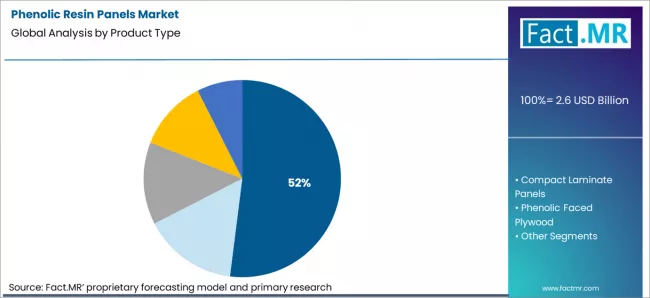
Phenolic Resin Panels Market Analysis By Product Type | Source: Fact.MR
Based on Fact.MR analysis, consumption of high pressure laminate panels is estimated to hold 52% share in 2026. Fact.MR analysts note that HPL panels dominate due to their high resin content and pressure-cured structure, which delivers dense surfaces with resistance to moisture, impact, and weather exposure. As per Fact.MR, this product type addresses buyer requirements for exterior durability and surface stability while remaining compatible with standard façade fixing systems.
- Manufacturing Scale: Fundermax reports large-scale production of high pressure laminate façade panels manufactured under EN 438 standards for exterior building applications.
- Standard compliance: European Committee for Standardization EN 438 defines performance requirements for high pressure laminates, including resistance to weathering and mechanical stress, supporting their use as exterior cladding materials.
- Specification Practice: Fact.MR analysts reference architectural specification guidance that lists HPL panels for façade systems where long inspection intervals and stable surface performance are required.
Phenolic Resin Panels Market Analysis by Application
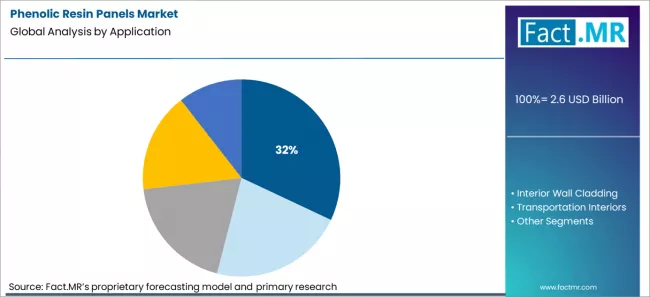
Phenolic Resin Panels Market Analysis By Application | Source: Fact.MR
Based on Fact.MR analysis, consumption in exterior facades and rainscreen applications is estimated to hold 32% share in 2026. Fact.MR opines that this segment leads due to continued use of ventilated façade systems that require panels with low water absorption and stable mechanical properties. As per Fact.MR, phenolic resin panels meet façade performance requirements related to weather exposure, dimensional stability, and long-term surface integrity.
- Façade Deployment: Trespa documents the use of phenolic resin based façade panels in rainscreen systems for commercial and institutional buildings.
- Fire Performance: UK Building Regulations Approved Document B references tested façade materials and system classifications that guide material selection for external wall assemblies. [4]
- Urban Construction Linkage: Fact.MR analysts reference public urban development and retrofit programs that increase façade replacement and recladding activity, supporting demand for phenolic resin panels in exterior applications.
Phenolic Resin Panels Market Drivers, Restraints, And Opportunities
Fact.MR analysis indicates that the phenolic resin panels market exists as a protective and high-performance engineered panel segment within construction, transportation interiors, and industrial applications where fire resistance, moisture resistance, and structural integrity are required. As per Fact.MR assessment, phenolic resin panels are produced by impregnating cellulose or other fibrous substrates with phenolic resins and curing under heat and pressure to form thermoset composites with predictable mechanical and durability characteristics (Forest Products Laboratory on phenolic composites). Fact.MR analysts observe that market value at present is tied to demand from applications where performance criteria for surface integrity, smoke development, and moisture tolerance are specified in building codes and interior design standards, such as those referenced in the International Building Code (IBC) fire resistance requirements.
Fact.MR is of the opinion that the market is transitioning from traditional wood and low-performance panel products toward phenolic resin panels where compliance with documented performance criteria matters. Based on Fact.MR assessment, demand for generic decorative and basic structural panels remains larger in overall unit volumes, but phenolic resin panels grow where specifications call for measurable fire performance, moisture resistance, and long-term dimensional stability. These advanced panels typically carry higher per-unit pricing because of resin formulation, curing controls, and quality assurance processes, meaning realised value can increase even where shipment volumes advance at a moderate pace. Fact.MR analysis suggests this mix of moderate tonnage growth and higher realised pricing defines value expansion in markets prioritising performance documentation over base panel cost.
- Building Code Performance Requirements: Fact.MR analysts note that fire resistance and structural integrity criteria in the International Building Code (IBC) influence specification of phenolic resin panels in commercial interiors and mass transit stations where documented smoke and flame spread limits are required.
- Moisture and Humidity Tolerance Demand: Based on Fact.MR assessment, use in environments such as washrooms, marine interiors, and industrial facilities sustains adoption of phenolic panels because their inherent moisture resistance and low warp characteristics reduce lifecycle maintenance compared with lower-grade alternatives.
- Asia Pacific Industrial Growth: Fact.MR opines that rising manufacturing and infrastructure investment in China, India, and Southeast Asia supports expanded use of phenolic resin panels in applications such as transit interiors, commercial facilities, and engineered construction components where performance documentation is valued.
Regional Analysis
Based on regional assessment, the phenolic resin panels sector is analyzed across North America, Latin America, Europe, East Asia, South Asia, Oceania, and the Middle East & Africa, spanning more than 40 countries. Regional performance varies according to construction activity, fire-resistant material adoption, and demand from industrial and institutional building applications. The report also presents a comparative market attractiveness evaluation grounded in region-specific demand trends.
Phenolic Resin Panels Market CAGR Analysis by Country (2026-2036)
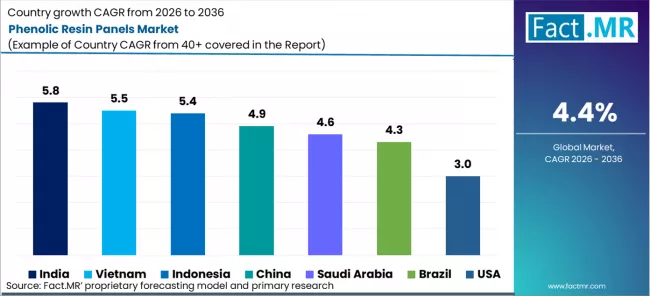
Phenolic Resin Panels Market Cagr Analysis By Country | Source: Fact.MR
| Country | CAGR |
|---|---|
| India | 5.8% |
| Vietnam | 5.5% |
| Indonesia | 5.4% |
| China | 4.9% |
| Saudi Arabia | 4.6% |
| Brazil | 4.3% |
| United States | 3.0% |
| Germany | 2.5% |
Source: Fact.MR analysis. Updated Feb 18, 2026
Source: Fact.MR analysis, based on proprietary forecasting models and primary research.
Asia Pacific Phenolic Resin Panels Market Analysis
Asia Pacific functions as a specification-led manufacturing and consumption region for phenolic resin panels, with usage tied to fire safety, hygiene, and durability requirements in public buildings and transport infrastructure. Adoption follows national building codes, material standards, and government procurement specifications across multiple countries.
- India: Demand for phenolic resin panels in India is projected to rise at 5.8% CAGR through 2036. Use is referenced in fire-rated interior material provisions under BIS standards updated in July 2021 and reinforced through hospital and metro station interior tenders issued during September 2022, as per Fact.MR.
- Vietnam: Demand for phenolic resin panels in Vietnam is projected to rise at 5.5% CAGR through 2036. Application is documented in public building material standards issued by the Ministry of Construction in June 2020 and reinforced through healthcare and education facility projects approved in October 2022, according to Fact.MR.
- Indonesia: Demand for phenolic resin panels in Indonesia is projected to rise at 5.4% CAGR through 2036. Usage is specified under fire-resistant interior material guidelines issued by the Ministry of Public Works in July 2021 and applied in government building refurbishment contracts released in February 2023, based on Fact.MR.
- China: Demand for phenolic resin panels in China is projected to rise at 4.9% CAGR through 2036. Use follows fire performance and hygiene requirements under GB building material standards revised in October 2020 and reinforced through public hospital and transport facility projects tendered during May 2022, according to Fact.MR.
Fact.MR’s analysis of the phenolic resin panels market in Asia Pacific consists of country-wise assessment that includes India, Vietnam, Indonesia, and China. Readers can find building material standards, public procurement references, and application-level compliance data.
Middle East Phenolic Resin Panels Market Analysis
The Middle East operates as a regulation-driven adoption market for phenolic resin panels, with usage linked to fire safety compliance and hygiene requirements in public and commercial buildings. Demand follows municipal building codes and approved material listings.
- Saudi Arabia: Demand for phenolic resin panels in Saudi Arabia is projected to rise at 4.6% CAGR through 2036. Application is permitted under Saudi Building Code fire safety provisions updated in January 2021 and reinforced through healthcare and public facility projects tendered during August 2022, as per Fact.MR.
Fact.MR’s analysis of the phenolic resin panels market in the Middle East consists of country-wise assessment that includes Saudi Arabia. Readers can find building code references, material approvals, and public project specifications.
Latin America Phenolic Resin Panels Market Analysis
Latin America functions as a refurbishment-oriented market for phenolic resin panels, with demand linked to public facility upgrades and institutional construction. Usage follows national building standards and government procurement practices.
- Brazil: Demand for phenolic resin panels in Brazil is projected to rise at 4.3% CAGR through 2036. Use is referenced in fire-rated interior material requirements issued under ABNT standards in May 2020 and reinforced through public hospital and education facility projects approved in August 2022, according to Fact.MR.
Fact.MR’s analysis of the phenolic resin panels market in Latin America consists of country-wise assessment that includes Brazil. Readers can find standards adoption, refurbishment activity, and procurement references.
North America Phenolic Resin Panels Market Analysis
North America functions as a standards-led market for phenolic resin panels due to the dominance of building codes and consensus standards in construction decisions. Fire safety, interior finish classification, and hygiene requirements are enforced through model codes adopted by states and municipalities. Public sector projects rely on prescriptive specifications and certification listings, shaping material selection through compliance pathways rather than centralized regulation.
- United States: Demand for phenolic resin panels in the United States is projected to rise at 3.0% CAGR through 2036. Application is referenced in interior finish material compliance under IBC requirements updated in 2021 and reinforced through public healthcare and transit facility specifications applied during 2022, as per Fact.MR.
Fact.MR’s analysis of the phenolic resin panels market in North America consists of country-wise assessment that includes the United States. Readers can find code compliance references and application documentation.
Europe Phenolic Resin Panels Market Analysis
Europe operates as a regulation-led adoption market for phenolic resin panels because product use in public buildings is tightly controlled through harmonized legal frameworks. Fire reaction, smoke emission, and hygiene performance are defined under EU construction product rules and national transpositions. Public procurement mandates documented compliance, making regulatory approval the primary gatekeeper for adoption rather than discretionary material choice.
- Germany: Demand for phenolic resin panels in Germany is projected to rise at 2.5% CAGR through 2036. Application is specified under DIN-aligned fire performance standards revised in June 2020 and reinforced through public building refurbishment projects tendered in February 2022, according to Fact.MR.
Fact.MR’s analysis of the phenolic resin panels market in Europe consists of country-wise assessment that includes Germany. Readers can find regulatory standards, refurbishment programs, and application-level references.
How Are Performance Certification, Integrated Supply Networks, and End Use Validation Creating Competitive Moats in the Phenolic Resin Panels Market?
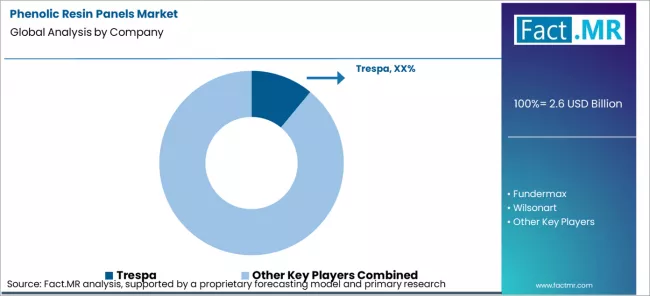
Phenolic Resin Panels Market Analysis By Company | Source: Fact.MR
As per Fact.MR analysis, the phenolic resin panels market in 2026 is defined by a shift from commodity surface materials to performance‑validated architectural and industrial solutions where fire, moisture, and strength certifications, integrated supply networks, and end‑use testing determine competitive advantage. Trespa and Fundermax lead with high‑performance compact phenolic panels certified for exterior cladding and high‑traffic interiors, which strengthens specification in demanding building programs. Wilsonart and Formica Group emphasise validated laminate systems with stain, abrasion, and impact resistance data, which increases adoption in commercial interiors and institutional environments. Arpa Industriale and Greenlam Industries provide multi‑region compliance documentation and broad finish portfolios, which enhances uptake across diverse markets. EGGER, Kronospan, Pfleiderer, and Arauco focus on engineered core and overlay combinations with documented mechanical performance, which improves reliability in fabrication and installation workflows. Integrated logistics, regional inventory networks, and consistent quality control systems ensure delivery continuity and reduce project risk. Across the market, performance certification, validated end‑use data, and supply integration form enduring competitive moats that exceed isolated product claims.
Recent Industry Developments
- In June 2025, Sumitomo Bakelite launched the world's first biomass-derived solid novolac phenolic resin, utilizing lignin from non-edible plants to reduce CO₂ emissions by 40%. By January 2026, they commercialized a mechanical recycling system ("REPHENOL") that pulverizes cured phenolic offcuts for reuse as high-performance fillers. [5]
- In its August 2025 half-year report, Kingspan revealed an 8% revenue increase to €4.5bn, driven by its "Insulated Building Envelopes" segment. The company is aggressively scaling its Planet Passionate program, aiming to use 900,000 tonnes of recycled and renewable raw materials in its manufacturing by the end of 2025 to meet rising demand for data center infrastructure. [6]
Key Players in Phenolic Resin Panels Market
- Trespa
- Fundermax
- Wilsonart
- Formica Group
- Arpa Industriale
- Greenlam Industries
- EGGER
- Kronospan
- Pfleiderer
- Arauco
Bibliography
- [1] European Committee for Standardization. (2016). EN 438: High-pressure decorative laminates (HPL) - Sheets based on thermosetting resins (Phenolic resins) - Specifications. CEN.
- [2] International Code Council. (2021). International Building Code (IBC 2021). ICC.
- [3] International Organization for Standardization. (2018). Fire safety engineering - Principles and rules (ISO 13943 and related fire performance guidance). ISO.
- [4] UK Government. (2019). Approved Document B: Fire safety (Volume 1 & 2). Ministry of Housing, Communities & Local Government.
- [5] Sumitomo Bakelite Co., Ltd. (2026). Development of biomass-derived phenolic resin and REPHENOL mechanical recycling system. Sumitomo Bakelite.
- [6] Kingspan Group plc. (2025). Half-year results 2025. Kingspan Group.
Segmentation
Scope of the Report
| Metric | Value |
|---|---|
| Quantitative Units | USD 2.6 billion (2026) to USD 4.0 billion (2036), CAGR 4.4% |
| Market Definition | The phenolic resin panels market covers rigid panels produced by impregnating fibrous layers with phenolic resin and curing under heat and pressure to deliver fire resistance, moisture stability, and mechanical durability. These panels are used for interior and exterior applications including façades, wall cladding, laboratory surfaces, and transport interiors, with performance aligned to EN 438 laminate standards |
| Product Type Segmentation | High Pressure Laminate (HPL) Panels, Compact Laminate Panels, Phenolic Faced Plywood, Fire-Rated Phenolic Panels, Other |
| Application Segmentation | Exterior Façades & Rainscreen, Interior Wall Cladding, Transportation Interiors, Industrial Flooring/Formwork, Laboratory & Healthcare Surfaces |
| End Use Segmentation | Construction, Transportation, Industrial, Institutional, Other |
| Regions Covered | Asia Pacific, Europe, North America, Latin America, Middle East & Africa |
| Countries Covered | India, Vietnam, Indonesia, China, Saudi Arabia, Brazil, United States, Germany |
| Key Companies Profiled | Trespa, Fundermax, Wilsonart, Formica Group, Arpa Industriale, Greenlam Industries, EGGER, Kronospan, Pfleiderer, Arauco |
| Forecast Period | 2026 to 2036 |
| Approach | Hybrid top-down and bottom-up modeling validated through primary interviews with manufacturers, distributors, architects, and contractors. Desk research used EN 438 standards, ISO guidance, public procurement specifications, and company reports. |
Source: Fact.MR analysis. Updated Feb 18, 2026
Phenolic Resin Panels Market Segmental Analysis
-
By Product Type :
- High Pressure Laminate (HPL) Panels
- Compact Laminate Panels
- Phenolic Faced Plywood
- Fire-Rated Phenolic Panels
- Other
-
By Application :
- Exterior Facades & Rainscreen
- Interior Wall Cladding
- Transportation Interiors
- Industrial Flooring/Formwork
- Lab & Healthcare Surfaces
-
By End Use :
- Construction
- Transportation
- Industrial
- Institutional
- Other
-
Region :
- Asia Pacific
- India
- China
- Japan
- South Korea
- Indonesia
- Australia & New Zealand
- ASEAN
- Rest of Asia Pacific
- Europe
- Germany
- Italy
- France
- United Kingdom
- Spain
- Benelux
- Nordics
- Central & Eastern Europe
- Rest of Europe
- North America
- United States
- Canada
- Mexico
- Latin America
- Brazil
- Argentina
- Chile
- Rest of Latin America
- Middle East & Africa
- Kingdom of Saudi Arabia
- United Arab Emirates
- South Africa
- Turkey
- Rest of Middle East & Africa
- Asia Pacific
Frequently Asked Questions
How large is the phenolic resin panels market in 2026?
What will the phenolic resin panels market size be by 2036?
What is the expected CAGR of the phenolic resin panels market during the forecast period?
What was the market valuation of phenolic resin panels in 2025?
How much absolute value will the phenolic resin panels market add over the decade?
Which product type is expected to lead the phenolic resin panels market in 2026?
How significant are exterior façade and rainscreen applications in overall demand?
Which country is forecast to grow the fastest in the phenolic resin panels market?
What is the growth outlook for Vietnam in this market?
How fast is the phenolic resin panels market expected to grow in Indonesia?
What is the projected CAGR for China?
How strong is growth expected to be in Saudi Arabia?
What is the expected growth rate for Brazil?
How does the United States market perform in growth terms?
What is the projected growth rate for Germany?
Which region functions as the primary growth engine for phenolic resin panels?
How does growth in emerging markets compare with mature markets?
What is the value trajectory of the market over the forecast period?
Is market growth driven by volume expansion or compliance-led specification?
How should executives assess the long-term opportunity in phenolic resin panels?
Who worked on this report


Preview the report firsthand - request a free sample
Free SampleGet the brochure for pricing and purchase details
Download PDF