- Market Value (2025): USD 402.5 Mn
- Estimated Value (2026): USD 426.6 Mn
- Forecast Value (2036): USD 764.0 Mn
- CAGR (2026-2036): 6.0%
What is the Photosensitive Glass Market forecast to be worth by 2036?
USD 426.6 million in 2026 to USD 764.0 million by 2036 at a 6.0% CAGR.
- Fact.MR estimates that the photosensitive glass market reached USD 402.5 million in 2025.
- Revenue is forecast to increase from USD 426.6 million in 2026 to USD 764.0 million in 2036.
- The market is forecast to grow at a 6.0% CAGR from 2026 to 2036, with demand linked to optical components and selected aerospace applications.
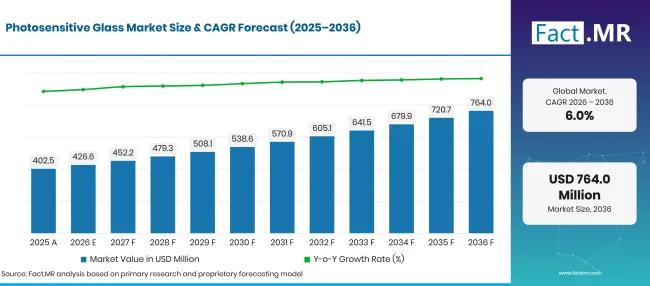
Photosensitive Glass Market Forecast Global | Source: Fact.MR
| Year | Basis | Market Value (USD million) |
|---|---|---|
| 2025 | Actual | 402.5 |
| 2026 | Estimate | 426.6 |
| 2036 | Forecast | 764.0 |
| CAGR 2026 to 2036 | Forecast period | 6.0% |
Source: Fact.MR analysis. Updated Oct 30, 2026
What are the defining numbers behind Photosensitive Glass Market growth?
USD 337.4 million absolute opportunity through 2036; Silver Halide and Optical Components have the highest stated segment shares.
- Demand Drivers in the Market
- Optical-component designers value glass that preserves optical performance after controlled processing. Tight tolerances raise the cost of failed parts, making consistent batches more useful than a low initial material price.
- Electronics manufacturers seek smaller features where electrical insulation and dimensional accuracy remain important. The Semiconductor Industry Association initially reported global semiconductor sales of USD 791.7 billion for 2025 in February 2026, up 25.6% from 2024 [1].
- Aerospace engineering teams prioritize qualification and repeatable part behavior. When a glass feature enters a carefully tested assembly, documented dimensions and stable processing become factors buyers assess.
- Equipment developers assess wafer thickness variation and surface quality when selecting suppliers. SCHOTT specifies that FOTURAN II offers more than 90% optical transmission across wavelengths from 350 nm to 2,700 nm for a 1 mm-thick specimen. Such technical specifications help engineering teams screen materials before testing.
- Key Segments Analyzed
- By Product Type: Silver Halide represents 48.6% of 2026 revenue under the defined product classification.
- By Application: Optical Components account for 42.5% of 2026 revenue in the application split.
- By End-User Industry: Aerospace captures 31.8% of 2026 revenue in the end-user split.
- Analyst Opinion at Fact.MR
- Shambhu Nath Jha, Principal Consultant at Fact.MR, states, “A central commercial question is how well suppliers transfer laboratory patterning performance into repeatable production. Device makers evaluate finished features after exposure and etching, not the glass sheet alone.”
- Strategic Implications
- Glass manufacturers should publish usable processing windows and wafer tolerances so device engineers can estimate yield during early trials.
- Microdevice developers should test feature geometry after each heat-treatment and etching stage before setting volume purchase plans.
- Specialty distributors should preserve batch traceability and protect polished surfaces during storage and shipping.
- Component makers should compare finished-part cost with alternative materials instead of comparing raw substrate prices alone.
The UK is forecast at 7.5% CAGR, Brazil at 7.1%, Germany at 6.2%, the USA at 5.4%, and Japan at 4.7% through 2036. Different purchasing conditions shape each outlook, from research-led device design to commercial wafer processing and qualification.
How does the Photosensitive Glass Market break down by segment?
Silver Halide leads Product Type at 48.6%; Optical Components lead Application at 42.5%; Aerospace leads End-User Industry at 31.8%.
Which Product Type dominates?
Silver Halide accounts for 48.6% of 2026 value.
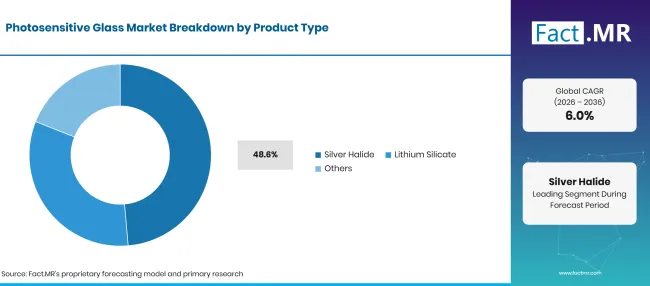
Photosensitive Glass Market Breakdown Product Type | Source: Fact.MR
| Product Type | Share (2026) |
|---|---|
| Silver Halide (Leading segment) | 48.6% |
| Other segments combined | 51.4% |
| Total | 100.0% |
Source: Fact.MR analysis. Updated Oct 30, 2026
Silver halide photosensitivity is associated with light-induced changes involving silver-containing chemistry. For commercial analysis, the category captures uses where a controlled response to exposure makes a patterned or optically useful part possible. Lithium silicate grades offer a different route based on glass-ceramic processing and selective structuring. These products should be compared by exposure dose, developed feature size and final part strength.
What leads the Application segment?
Optical Components represent 42.5% of 2026 sales.
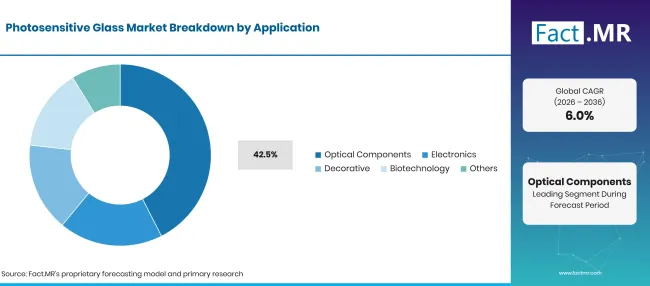
Photosensitive Glass Market Breakdown Application | Source: Fact.MR
| Application | Share (2026) |
|---|---|
| Optical Components (Leading segment) | 42.5% |
| Other segments combined | 57.5% |
| Total | 100.0% |
Source: Fact.MR analysis. Updated Oct 30, 2026
Optical components use glass when stable transmission and precisely shaped features matter to system performance. Buyers examine roughness and thickness variation because uneven substrates complicate later assembly. Electronics applications include substrates for miniature structures and wafer-based processing. Decorative uses depend more on appearance and pattern consistency, while biotechnology applications emphasize usable microchannels and controlled contact with samples. SCHOTT states that FOTURAN II can be structured without a photoresist by combining UV treatment with heat processing and wet etching.
How does End-User Industry shape demand?
Aerospace captures 31.8% of 2026 sales.
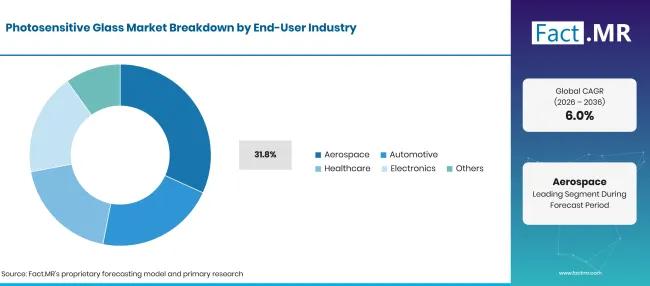
Photosensitive Glass Market Breakdown End User Industry | Source: Fact.MR
| End-User Industry | Share (2026) |
|---|---|
| Aerospace (Leading segment) | 31.8% |
| Other segments combined | 68.2% |
| Total | 100.0% |
Source: Fact.MR analysis. Updated Oct 30, 2026
Aerospace end users assess performance consistency and the evidence that a part can meet its intended service conditions. Photosensitive glass is relevant where a qualified glass component offers the required dimensional accuracy or optical response. Automotive users focus on stable unit cost and predictable production; healthcare device teams give closer attention to material contact and process cleanliness.
What is accelerating Photosensitive Glass Market adoption, and what is holding it back?
Demand is linked to optical-component design and wafer-level device fabrication. Microfluidic devices and specialist optical assemblies may provide additional applications. Processing costs, yield variation and qualification periods affect the pace of adoption.
Drivers Impact Analysis
| DRIVER | (~) % IMPACT ON CAGR | GEOGRAPHIC RELEVANCE | IMPACT TIMELINE |
|---|---|---|---|
| Use in patterned optical components | +0.9% | Europe, North America | Medium term |
| Wafer-level device fabrication | +0.8% | USA, Japan | Medium term |
| Miniature channel manufacturing | +0.6% | Global specialist users | Long term |
| Aerospace specification demand | +0.5% | USA, Europe | Long term |
| Reliable repeat-order supply | +0.4% | Global | Short term |
Source: Fact.MR analysis. Updated Oct 30, 2026
Opportunity Impact Analysis
| OPPORTUNITY | (~) % IMPACT ON CAGR | GEOGRAPHIC RELEVANCE | IMPACT TIMELINE |
|---|---|---|---|
| Microfluidic substrate design | +0.6% | USA, Japan, Europe | Medium term |
| Semiconductor packaging prototypes | +0.5% | Japan, USA | Medium term |
| Specialty optical assemblies | +0.4% | Germany, UK | Long term |
| Design-stage supplier support | +0.3% | Global | Short term |
Source: Fact.MR analysis. Updated Oct 30, 2026
Restraints Impact Analysis
| RESTRAINT | (~) % IMPACT ON CAGR | GEOGRAPHIC RELEVANCE | IMPACT TIMELINE |
|---|---|---|---|
| Multi-stage processing cost | −0.7% | Global | Short term |
| Yield variation in fine structures | −0.6% | Global | Medium term |
| Qualification and documentation | −0.5% | USA, Europe, Japan | Long term |
Source: Fact.MR analysis. Updated Oct 30, 2026
Which countries are scaling the Photosensitive Glass Market through 2036?
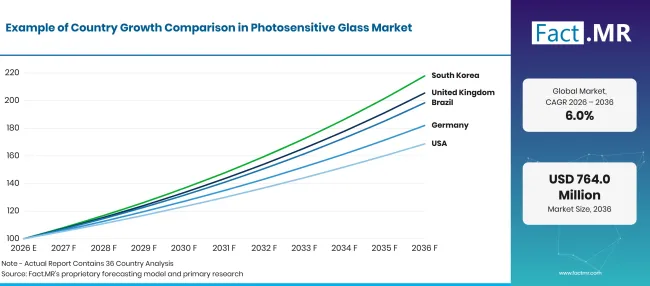
Photosensitive Glass Market Growth Index | Source: Fact.MR
| Country | CAGR (2026 to 2036) |
|---|---|
| UK | 7.5% |
| Brazil | 7.1% |
| Germany | 6.2% |
| USA | 5.4% |
| Japan | 4.7% |
Source: Fact.MR analysis. Updated Oct 30, 2026
How is the UK developing demand?
7.5% CAGR linked to optical-device design and specialist manufacturing.
The UK is forecast to record a 7.5% CAGR through 2036, supported by specialist optical design and links between research laboratories and device manufacturers. The UK Council for Science and Technology reported in March 2026 that the photonics industry generated £18.5 billion in turnover during 2024 [6].
How does Brazil compare?
7.1% CAGR associated with specialist industrial and optical applications.
Brazil is forecast to achieve a 7.1% CAGR between 2026 and 2036 as specialist optical and electronics projects create demand for patterned glass components. Local engineering teams often depend on imported specialty substrates, making shipment planning and technical support central to material selection. IBGE reported in February 2026 that Brazilian industrial production declined 1.2% in December 2025 compared with November [2].
What supports Germany’s market?
6.2% CAGR tied to precision industrial and optical engineering.
German demand is estimated to advance at a 6.2% CAGR through 2036, shaped by precision optics production and the availability of established specialty-glass expertise. SCHOTT describes FOTURAN II as a photo-structurable material that undergoes UV exposure and heat treatment before selective etching [5]. Device manufacturers can assess this processing route when testing repeatable microstructures. Destatis reported on February 6, 2026, that production in Germany’s producing sector decreased by 1.1% in 2025 on a calendar-adjusted basis [7].
What is supporting adoption in the USA?
5.4% CAGR linked to device research and specialized chip packaging.
The USA is forecast to post a 5.4% CAGR from 2026 to 2036 as chip-packaging research and microdevice design provide opportunities for structured insulating glass. Researchers need material properties that remain stable after exposure and etching, while component manufacturers focus on the number of usable parts produced from each wafer. The Semiconductor Industry Association reported USD 425 billion in sales by US-headquartered semiconductor companies during 2025 [3].
How is Japan scaling sales?
4.7% CAGR linked to materials processing expertise and device miniaturization.
Japan may register a 4.7% CAGR through 2036, reflecting established expertise in electronic materials and precision optical components. The country's device makers can assess photopatternable glass for miniature structures where stable dimensions and uniform surfaces are needed. Japan's Ministry of Economy, Trade and Industry published its annual adjustment to the 2025 production survey in March 2026 [4].
Who leads the Photosensitive Glass Market?
SCHOTT AG has a directly documented offering in photo-structurable glass through FOTURAN II. It publishes technical information for semiconductor-compatible wafer patterning and glass-ceramic processing.
Other named groups, including Corning Incorporated, HOYA Corporation, Nippon Electric Glass Co., Ltd., AGC Inc., OHARA Inc. and SUMITA OPTICAL GLASS, Inc., are established glass or optical-material businesses. Their wider optical-glass activity should not be read as proof that each sells a directly comparable photosensitive glass grade. The commercial distinction depends on the grade, its exposure response and the target application.
Which companies are the key providers?
Key companies include SCHOTT AG; Corning Incorporated; HOYA Corporation; Nippon Electric Glass Co., Ltd.; AGC Inc.; OHARA Inc.; SUMITA OPTICAL GLASS, Inc.
- SCHOTT AG
- Corning Incorporated
- HOYA Corporation
- Nippon Electric Glass Co., Ltd.
- AGC Inc.
- OHARA Inc.
- SUMITA OPTICAL GLASS, Inc.
Bibliography
- [1] Semiconductor Industry Association. (2026, February 6). Global annual semiconductor sales increase 25.6% to $791.7 billion in 2025
- [2] Instituto Brasileiro de Geografia e Estatística. (2026, February 3). Produção industrial recua 1,2% em dezembro
- [3] LaRocca, G. (2026, July 27). 2026 state of the industry report: Historic growth amid intensifying global competition. Semiconductor Industry Association.
- [4] Ministry of Economy, Trade and Industry. (2026, March 19). Current Survey of Production: Revised report (annual adjustment), 2025
- [6] Council for Science and Technology. (2026, March 9). CST advice on growth and global leadership in photonics
- [7] Statistisches Bundesamt (Destatis). (2026, February 6). Production in December 2025: −1.9% on the previous month.
This Report Answers
- The report examines where photosensitive glass provides functional value in optical components and miniature structures.
- Product analysis compares silver halide and lithium silicate material groups according to exposure response and use conditions.
- Country analysis considers product qualification and manufacturing conditions in the UK, Brazil, Germany, USA and Japan.
- Supplier analysis distinguishes a documented photo-structurable offering from wider optical-glass portfolios.
What does the Photosensitive Glass Market cover?
The market covers glass materials selected for their response to light exposure and subsequent processing. It includes formulations used to create features inside a substrate and forms purchased for specialized components. Sales are assessed according to the product classification and the final commercial application.
What is included in the scope?
Silver halide and lithium silicate categories are included with other suitable photosensitive grades.
Applications cover optical components and electronics alongside decorative and biotechnology uses. End users include aerospace and automotive businesses as well as healthcare and electronics manufacturers.
What is excluded from the scope?
Ordinary clear glass and standard optical glass lacking a photosensitive function fall outside the core definition.
Conventional architectural glazing and display cover glass are excluded unless a documented light-sensitive processing function makes them part of the defined product group.
How Was the Analysis Built?
The analysis draws on 120+ sources, 35+ company portfolios, 25+ countries, and more than 20 industry interviews.
- Primary Research: Primary research includes discussions with manufacturers, service providers, technology developers, distributors, end users, and subject-matter experts. These conversations examine purchasing priorities, product adoption, operational challenges, approval requirements, competitive marketing, and the factors that influence wider market acceptance.
- Desk Research: Desk research covers government statistics, regulatory publications, company filings, trade data, technical studies, industry associations, standards, public policy, and other authoritative sources. Every source used in the analysis is documented in the bibliography.
- Market Sizing and Forecasting: Market estimates combine historical performance, demand indicators, pricing and volume trends, segment shares, company participation, country-level growth, adoption patterns, investment activity, and barriers to market expansion.
- Data Validation and Update Cycle: Findings are validated by comparing primary interviews with public data, company activity, regulatory changes, trade patterns, and industry developments. Regular updates review new product launches, capacity changes, partnerships, approvals, and shifts in commercial adoption.
Segmentation
What is the report’s scope and coverage?
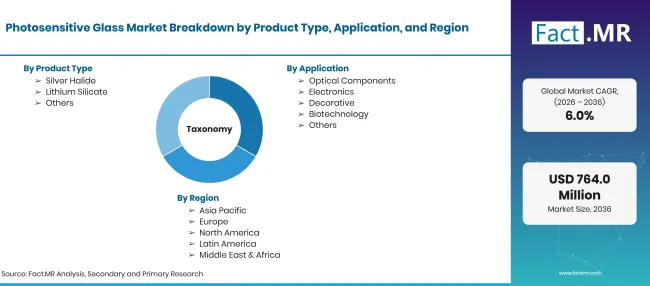
Photosensitive Glass Market Taxonomy | Source: Fact.MR
| Attribute | Details |
|---|---|
| Quantitative units | USD million |
| Definition | Exposure-responsive glass materials used for patterned components or controlled photo-structuring |
| Product Type | Silver Halide; Lithium Silicate; Others |
| Application | Optical Components; Electronics; Decorative; Biotechnology; Others |
| End-User Industry | Aerospace; Automotive; Healthcare; Electronics; Others |
| Regions covered | North America; Latin America; Western Europe; Eastern Europe; East Asia; South Asia and Pacific; Middle East and Africa |
| Countries covered | UK; Brazil; Germany; USA; Japan |
| Companies Profiled | SCHOTT AG; Corning Incorporated; HOYA Corporation; Nippon Electric Glass Co., Ltd.; AGC Inc.; OHARA Inc.; SUMITA OPTICAL GLASS, Inc. |
| Forecast period | 2026 to 2036 |
| Approach | Application-level demand assessment with supplier product review and manufacturing-process analysis |
Source: Fact.MR analysis. Updated Oct 30, 2026
How is the market segmented?
-
By Product Type
- Silver Halide
- Lithium Silicate
- Others
-
By Application
- Optical Components
- Electronics
- Decorative
- Biotechnology
- Others
-
By End-User Industry
- Aerospace
- Automotive
- Healthcare
- Electronics
- Others
-
By Region
- North America
- Latin America
- Western Europe
- Eastern Europe
- East Asia
- South Asia and Pacific
- Middle East and Africa
Frequently Asked Questions
How big is the photosensitive glass market in 2026?
What CAGR applies to the photosensitive glass market?
Which product type represents the leading share?
Which application leads the market?
Who are the main companies in the photosensitive glass market?
Who worked on this report


Preview the report firsthand - request a free sample
Free SampleGet the brochure for pricing and purchase details
Download PDF