- Market Value (2025): USD 2.09 Bn
- Estimated Value (2026): USD 2.21 Bn
- Forecast Value (2036): USD 3.86 Bn
- CAGR (2026-2036): 5.7%
What is the Composite Dressings Market forecast to be worth by 2036?
USD 2.2 billion in 2026 to USD 3.9 billion by 2036, at a 5.7% CAGR.
- As per Fact.MR analysis, the composite dressings market was valued at USD 2.09 billion in 2025.
- Demand is estimated to increase from USD 2.21 billion in 2026 to USD 3.86 billion by 2036.
- The forecast records a 5.7% CAGR from 2026 to 2036, reflecting the projected expansion of advanced wound care.
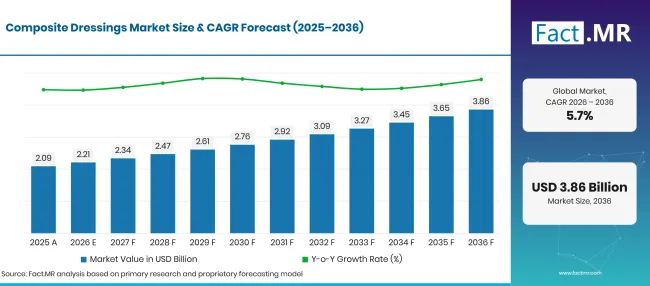
Composite Dressings Market Forecast Global | Source: Fact.MR
| Year | Basis | Market Value (USD billion) |
|---|---|---|
| 2025 | Actual | 2.09 |
| 2026 | Estimate | 2.21 |
| 2036 | Forecast | 3.86 |
| CAGR 2026 to 2036 | Forecast period | 5.7% |
Source: Fact.MR analysis. Updated Oct 30, 2026
What are the defining numbers behind Composite Dressings Market growth?
The absolute opportunity between 2026 and 2036 is USD 1.7 billion
- Demand Drivers in the Market
- Rising prevalence of chronic wounds is driving demand for composite dressings as healthcare providers seek effective solutions for managing diabetic foot ulcers and pressure ulcers. According to the U.S. Centers for Disease Control and Prevention (CDC), its National Diabetes Statistics Report updated in September 2026 estimates that 40.1 million people in the United States had diagnosed or undiagnosed diabetes in 2023, highlighting the substantial population at risk of diabetes-related complications [2]. [1] [2]
- Increasing surgical procedures and traumatic injuries is supporting demand for composite dressings for post-operative wound management and injury care. According to the UK Health Security Agency's 2026-accessible surveillance report covering 2024–2025, surveillance data for 146,411 operations and 1,250 surgical-site infections detected during inpatient stays or hospital readmissions were submitted by participating healthcare facilities in England. The number of procedures submitted to the surveillance programme increased by 7.9% year over year. This highlights the ongoing need for effective wound protection and post-operative care [3] [4]. [3][4]
- Growing preference for advanced wound care solutions is encouraging healthcare providers to adopt composite dressings for effective wound management. These dressings combine absorbent materials with protective layers to manage wound exudate and shield damaged tissue from external contaminants. Their multifunctional design supports convenient wound care across hospitals, clinics and home healthcare settings.
- Key Segments Analyzed
- By Product Type, Foam is the leading segment, accounting for 32.4% of the market in 2026.
- By Application, Chronic Wounds segment captures a 42.7% share in 2026, reflecting the stated importance of ongoing wound management.
- By End-User, Hospitals account for 47.2% of the market in 2026.
- By Distribution Channel, Online Stores will account for 42.8% share in 2026.
- Analyst Opinion at Fact.MR
- Shambhu Nath Jha, Principal Consultant at Fact.MR, states, “Composite dressings serve wound care needs that require a combination of absorption and protection. Manufacturers need to demonstrate product suitability across wound types and care settings, while healthcare providers must match dressing selection to clinical requirements and wound characteristics.”
- Strategic Implications
- Manufacturers should demonstrate how each dressing's absorbent layer and protective components suit its intended wound type.
- Hospitals and clinics need to evaluate dressing performance alongside wound characteristics, exudate levels and clinical protocols.
- Distributors can provide clear product information and usage guidance to support appropriate purchasing decisions.
- Online sellers must maintain accurate product descriptions and distinguish composite dressings from other advanced wound care products.
Germany is projected to record a 5.3% CAGR through 2036. Brazil is forecast to grow at 6.8%, followed by the USA at 4.0%. The UK is estimated to advance at 6.4%, while Japan is projected to register a 7.1% CAGR.
How does the Composite Dressings Market break down by segment?
Fact.MR identifies Foam as the leading Product Type at 32.4%, Chronic Wounds as the leading Application at 42.7%, Hospitals as the leading End-User at 47.2% and Online Stores as the leading Distribution Channel at 42.8% in 2026.
Which Product Type dominates?
Foam is set to hold a 32.4% share in 2026.
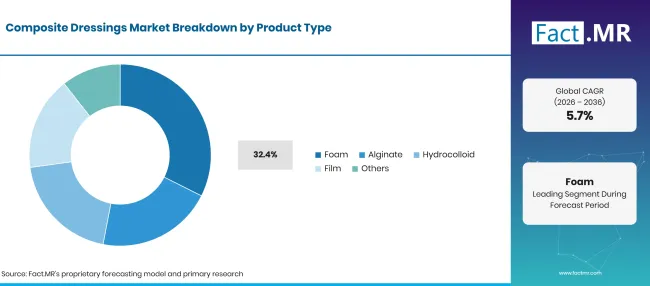
Composite Dressings Market Breakdown Product Type | Source: Fact.MR
| Product Type | Share (2026) |
|---|---|
| Foam (Leading segment) | 32.4% |
| Other segments combined | 67.6%* |
| Total | 100.0% |
Source: Fact.MR analysis. Updated Oct 30, 2026
Foam dressings are used in wound care where absorption and cushioning are important considerations. Their suitability depends on wound characteristics and exudate levels. Alginate, hydrocolloid and film-based products serve different wound management requirements, so product selection should follow clinical assessment rather than material type alone.
Which Application leads the market?
Chronic Wounds is set to represent 42.7% of the market in 2026.
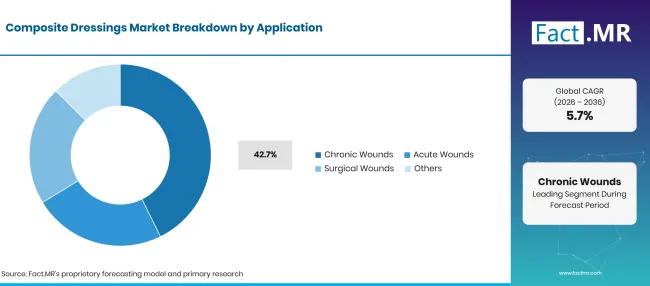
Composite Dressings Market Breakdown Application | Source: Fact.MR
| Application | Share (2026) |
|---|---|
| Chronic Wounds (Leading segment) | 42.7% |
| Other segments combined | 57.3%* |
| Total | 100.0% |
Source: Fact.MR analysis. Updated Oct 30, 2026
Chronic wounds may require ongoing management and repeated dressing changes, depending on the underlying condition and wound progression. Composite dressings can support wound protection and exudate management when clinically appropriate. Acute and surgical wounds have different care requirements, making dressing choice dependent on the wound's condition and treatment plan.
How does End-User demand shape the market?
Hospitals are likely to account for 47.2% of the market in 2026.
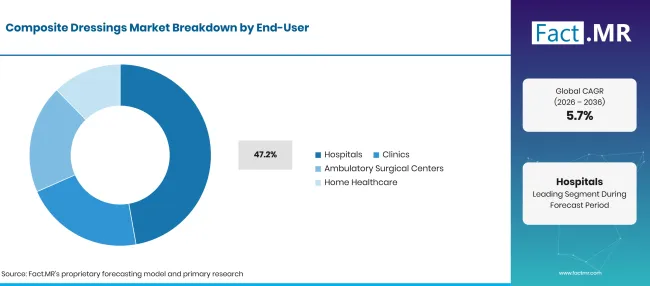
Composite Dressings Market Breakdown End User | Source: Fact.MR
| End-User | Share (2026) |
|---|---|
| Hospitals (Leading segment) | 47.2% |
| Other segments combined | 52.8%* |
| Total | 100.0% |
Source: Fact.MR analysis. Updated Oct 30, 2026
Hospitals use wound dressings across surgical care and the management of acute and chronic wounds. Decisions can depend on clinical protocols, product availability and the needs of different departments. Clinics, ambulatory surgical centers and home healthcare providers represent additional care settings with different purchasing and dressing-change requirements.
Which Distribution Channel leads?
Online Stores are projected to capture 42.8% of the market in 2026.
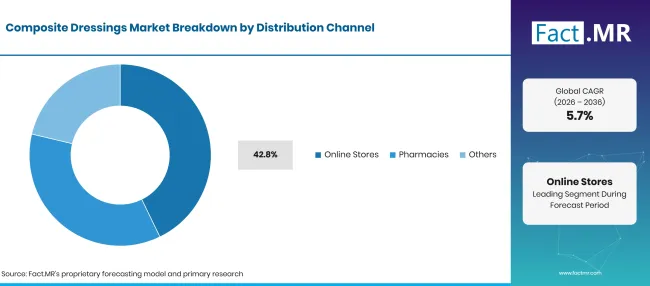
Composite Dressings Market Breakdown Distribution Channel | Source: Fact.MR
| Distribution Channel | Share (2026) |
|---|---|
| Online Stores (Leading segment) | 42.8% |
| Other segments combined | 57.2%* |
| Total | 100.0% |
Source: Fact.MR analysis. Updated Oct 30, 2026
Online stores can make product information and purchasing options more accessible to healthcare providers and home users. However, clinical suitability, product authenticity and appropriate usage instructions remain important considerations. Pharmacies and other offline suppliers continue to serve buyers who prefer in-person assistance or established healthcare procurement arrangements.
What is accelerating Composite Dressings Market adoption, and what is holding it back?
The need for effective wound management and convenient dressing changes may support demand, while product costs and the need to match dressing properties to individual wounds can constrain adoption.
Drivers Impact Analysis
| DRIVER | (~) % IMPACT ON CAGR | GEOGRAPHIC RELEVANCE | IMPACT TIMELINE |
|---|---|---|---|
| Rising prevalence of chronic wounds | +1.1% | Global | Medium term (2–4 years) |
| Increasing surgical procedures and traumatic injuries | +0.9% | Americas, Europe | Short term (≤ 2 years) |
| Growing adoption of advanced wound care products | +0.8% | Global | Medium term (2–4 years) |
| Expanding home healthcare services | +0.6% | North America, Europe | Long term (≥ 4 years) |
| Increasing awareness of infection prevention | +0.5% | Global | Short term (≤ 2 years) |
Source: Fact.MR analysis. Updated Oct 30, 2026
Opportunity Impact Analysis
| OPPORTUNITY | (~) % IMPACT ON CAGR | GEOGRAPHIC RELEVANCE | IMPACT TIMELINE |
|---|---|---|---|
| Development of multifunctional wound dressings | +0.8% | Global | Medium term (2–4 years) |
| Expansion of home-based wound care | +0.7% | North America, Asia | Medium term (2–4 years) |
| Rising demand for advanced diabetic wound management | +0.6% | Americas, Asia | Long term (≥ 4 years) |
| Improved dressing materials and fluid management | +0.5% | Europe, North America | Medium term (2–4 years) |
| Expansion of healthcare infrastructure in emerging markets | +0.4% | Asia, Latin America | Long term (≥ 4 years) |
Source: Fact.MR analysis. Updated Oct 30, 2026
Restraints Impact Analysis
| RESTRAINT | (~) % IMPACT ON CAGR | GEOGRAPHIC RELEVANCE | IMPACT TIMELINE |
|---|---|---|---|
| Higher cost compared with conventional dressings | -0.8% | Global | Short term (≤ 2 years) |
| Limited reimbursement for advanced wound care products | -0.6% | Americas, Europe | Medium term (2–4 years) |
| Price sensitivity in developing healthcare markets | -0.5% | Asia, Latin America, Africa | Short term (≤ 2 years) |
| Limited access to specialized wound care services | -0.4% | Emerging markets | Medium term (2–4 years) |
Source: Fact.MR analysis. Updated Oct 30, 2026
Which countries are scaling the Composite Dressings Market through 2036?
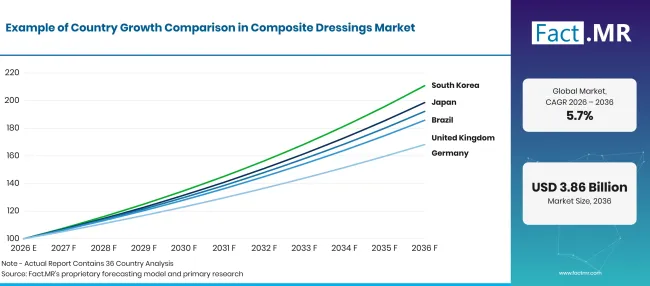
Composite Dressings Market Growth Index | Source: Fact.MR
| Country | CAGR (2026–2036) |
|---|---|
| Germany | 5.3% |
| Brazil | 6.8% |
| USA | 4.0% |
| UK | 6.4% |
| Japan | 7.1% |
Source: Fact.MR analysis. Updated Oct 30, 2026
What supports Germany's projected growth?
5.3% CAGR, supported by its well-established healthcare infrastructure.
Germany's market opportunity is associated with wound care demand across hospitals and other healthcare settings. Manufacturers may compete through product performance, clinical suitability and distribution relationships. Germany's Composite Dressings Market is supported by its well-established healthcare infrastructure and the growing need for effective wound management. Rising demand for advanced wound care products is linked to the treatment of chronic wounds and diabetic foot ulcers as well as post-operative wounds. The country's emphasis on quality healthcare and modern medical technologies also supports the adoption of multifunctional dressings that combine absorption with wound protection.
How is Brazil developing composite dressings adoption?
6.8% CAGR, driven by the rising prevalence of diabetes.
Brazil's Composite Dressings Market is driven by the rising prevalence of diabetes and the growing need for effective chronic wound management. According to Brazil's Ministry of Health, the prevalence of diabetes among adults increased by 135% between 2006 and 2024, rising from 5.5% to 12.9%, as reported in January 2026. This trend strengthens the need for wound care products used to manage diabetic foot ulcers and protect damaged tissue [5]
Brazil is expanding treatment options for chronic wounds and diabetic foot conditions. In April 2026, the Ministry of Health announced the incorporation of amniotic membrane transplantation into the Unified Health System (SUS) for selected conditions, with an estimated potential to benefit more than 860,000 patients annually. This initiative concerns a distinct biological treatment and provides broader advanced-wound-care context rather than direct evidence of composite dressing sales [6].[6]
What supports United States adoption?
4.0% CAGR, shaped by use of advanced medical technologies and need for effective chronic wound management.
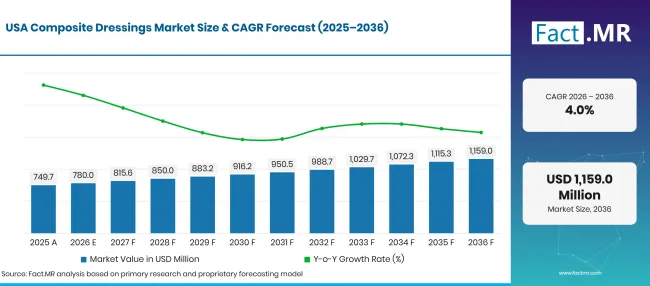
Composite Dressings Market Forecast Usa | Source: Fact.MR
The United States market encompasses wound care needs across outpatient facilities and home healthcare. Product selection depends on wound condition, clinician preferences and purchasing requirements. Another factor is the growing emphasis on evidence-based wound management. CMS guidance identifies the need to select appropriate dressings to control excessive moisture or maintain wound moisture balance, depending on the wound type.
How is the United Kingdom building adoption?
6.4% CAGR, driven by dressing requirements across hospital care.
The UK opportunity includes dressing requirements across hospital care and community-based wound management. The UK Composite Dressings Market is supported by the increasing need for chronic wound treatment and post-operative wound care. The UK government's April 2026 Diabetes Profile draws on updated diabetes surveillance and healthcare data in England. Diabetes-related complications contribute to continuing wound-management needs; the exact diagnosed-population estimate requires confirmation against the underlying statistical table. Diabetes-related complications increase the need for effective wound management, supporting demand for composite dressings. [7][7]
What supports Japan's projected growth?
7.1% CAGR, led by Japan's rapidly ageing population.
Japan composite dressings market is driven by the rapidly ageing population, which is increasing the need for long-term wound management and supportive healthcare services. According to Japan's Cabinet Office, the 65-and-older population reached 36.22 million in October 2025, accounting for 29.4% of the total population, as reported in the 2026 Ageing Society White Paper. This demographic trend supports demand for wound care products used to manage pressure injuries and other chronic wounds among older patients
Another factor is the rising burden of diabetes. Japan's Ministry of Health, Labour and Welfare reported in December 2025 that approximately 11 million people were estimated to have strongly suspected diabetes, based on the 2024 National Health and Nutrition Survey. Diabetes-related complications can increase the need for wound care products that manage exudate and protect damaged tissue, supporting demand for composite dressings [8] [9]
Who leads the Composite Dressings Market?
Fact.MR finds that Mölnlycke Health Care AB, Medline Industries, LP, Smith+Nephew plc, Solventum Corporation, DeRoyal Industries, Inc. and Cardinal Health are profiled across the wound care products value chain.
Mölnlycke Health Care AB and Smith+Nephew plc are relevant to advanced wound management and dressing solutions. Medline Industries, LP and Cardinal Health participate in medical-surgical supplies and wound care product distribution. Solventum Corporation offers advanced wound care products, while DeRoyal Industries, Inc. supplies wound care products and related medical solutions. Product offerings should be checked for specific composite dressing types and intended clinical applications before treating their portfolios as directly comparable.
Commercial competition depends on dressing performance and clinical suitability. Healthcare providers need products that offer effective exudate management and protective wound coverage. Procurement teams prioritize product quality, availability and cost efficiency. Distributors need reliable supply and product documentation to serve hospitals, clinics and home healthcare providers.
Which companies are the key providers?
Key companies include : Mölnlycke Health Care AB, Medline Industries, LP, Smith+Nephew plc, Solventum Corporation, DeRoyal Industries, Inc., and Cardinal Health.
- Mölnlycke Health Care AB
- Medline Industries, LP
- Smith+Nephew plc
- Solventum Corporation
- DeRoyal Industries, Inc.
- Cardinal Health
Bibliography
- [1] Centers for Disease Control and Prevention. (2026). September 15–16, 2026, ICD-10 Coordination and Maintenance Committee meeting: Topic packet. https://www.cdc.gov/nchs/data/icd/topic-packet-september-2026.pdf
- [2] Centers for Disease Control and Prevention. (2026, September 16). National diabetes statistics report. https://www.cdc.gov/diabetes/php/data-research/
- [3] UK Health Security Agency. (2025, December 19). HPR volume 19 issue 12: News (18 and 19 December 2025). https://www.gov.uk/government/publications/health-protection-report-volume-19-2025/hpr-volume-19-issue-12-news-18-december-2025
- [4] UK Health Security Agency. (2025, December). Surveillance of surgical site infections in NHS hospitals in England: April 2024 to March 2025. https://assets.publishing.service.gov.uk/media/69383a867a605b2d61cd8fa0/SSISS-annual-report-2024-to-2025.pdf
- [5] Agência Gov. (2026, January 28). Diabetes, hipertensão e obesidade: Saúde investe R$ 340 milhões para estimular prevenção. https://agenciagov.ebc.com.br/noticias/202601/diabetes-cresce-135-no-brasil-em-18-anos-hipertensao-e-obesidade-tambem-avancam-saude-lanca-viva-mais-brasil-com-r-340-mi-para-a-promocao-da-saude
- [6] Agência Gov. (2026, April 16). SUS adota transplante da membrana amniótica para tratar diabetes e alterações oculares. https://agenciagov.ebc.com.br/noticias/202604/ministerio-da-saude-incorpora-transplante-da-membrana-amniotica-para-tratamento-da-diabetes-e-alteracoes-oculares
- [7] NHS England. (2026, March 26). Quality and Outcomes Framework guidance for 2026/27. https://www.england.nhs.uk/wp-content/uploads/2026/03/PRN02356-quality-and-outcomes-framework-guidance-26-27.pdf
- [8] Cabinet Office, Government of Japan. (2026). Annual report on the ageing society, 2026: Current status and future outlook for population ageing. https://www8.cao.go.jp/kourei/whitepaper/w-2026/html/zenbun/s1_1_1.html
- [9] Ministry of Health, Labour and Welfare. (2025, December 2). 令和6年「国民健康・栄養調査」の結果 [Results of the 2024 National Health and Nutrition Survey]. https://www.mhlw.go.jp/stf/newpage_66279.html
This Report Answers
- The report describes how composite dressings are used across acute and chronic wound care applications.
- Segment analysis compares the specified product categories and their 2026 shares.
- Country analysis discusses Germany, Brazil, USA, UK and Japan alongside official healthcare statistics.
- The competitive overview profiles Mölnlycke Health Care AB, Medline Industries, LP, Smith+Nephew plc, Solventum Corporation, DeRoyal Industries, Inc. and Cardinal Health.
- Application analysis examines composite dressing use across hospitals, clinics and home healthcare settings.
What does the Composite Dressings Market cover?
The market covers composite wound dressings that combine materials or layers to provide functions such as absorption and wound protection. It considers products used in chronic wound care, acute wound management and surgical wound care across institutional and home healthcare settings.
What is included in the scope?
Included products are composite wound dressings sold for wound management. The segmentation covers the specified product types, applications, end-users and distribution channels. Market valuation should reflect sales of products meeting the defined composite dressing category.
What is excluded from the scope?
Standalone wound care devices and unrelated medical supplies are excluded unless explicitly included in the market definition. Single-material dressings that do not meet the chosen composite dressing classification should not automatically be counted. General wound care services and sales of unrelated medical equipment are outside the stated product boundary.
How Was the Analysis Built?
The analysis draws on 120+ sources, 35+ company portfolios, 25+ countries, and more than 20 industry interviews.
- Primary Research: Primary research includes discussions with manufacturers, service providers, technology developers, distributors, end users, and subject-matter experts. These conversations examine purchasing priorities, product adoption, operational challenges, approval requirements, competitive positioning, and the factors that influence wider market acceptance.
- Desk Research: Desk research covers government statistics, regulatory publications, company filings, trade data, technical studies, industry associations, standards, public policy, and other authoritative sources. Every source used in the analysis is documented in the bibliography.
- Market Sizing and Forecasting: Market estimates combine historical performance, demand indicators, pricing and volume trends, segment shares, company participation, country-level growth, adoption patterns, investment activity, and barriers to market expansion.
- Data Validation and Update Cycle: Findings are validated by comparing primary interviews with public data, company activity, regulatory changes, trade patterns, and industry developments. Regular updates review new product launches, capacity changes, partnerships, approvals, and shifts in commercial adoption.
Segmentation
What is the report's scope and coverage?
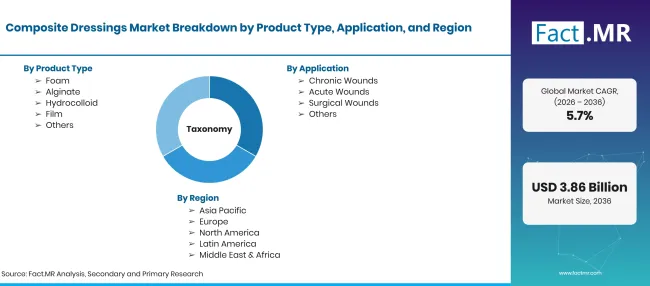
Composite Dressings Market Taxonomy | Source: Fact.MR
| Attribute | Details |
|---|---|
| Quantitative units | USD billion |
| Market definition | Composite dressings are advanced wound care products that combine multiple materials or functional layers to absorb wound exudate and protect the wound site. They provide a barrier against external contaminants while supporting moisture balance and wound healing across acute and chronic wound care applications. |
| Product Type | Foam; Alginate; Hydrocolloid; Film; Others |
| Application | Chronic Wounds; Acute Wounds; Surgical Wounds; Others |
| End-User | Hospitals; Clinics; Ambulatory Surgical Centers; Home Healthcare; Others |
| Distribution Channel | Online Stores; Pharmacies; other |
| Countries covered | Germany; Brazil; USA; UK; Japan |
| Companies profiled | Mölnlycke Health Care AB; Medline Industries, LP; Smith+Nephew plc; Solventum Corporation; DeRoyal Industries, Inc.; Cardinal Health |
| Forecast period | 2026 to 2036 |
| Approach | Market segmentation and forecast analysis, subject to validation of market estimates and country-level |
Source: Fact.MR analysis. Updated Oct 30, 2026
How is the market segmented?
-
By Product Type
- Foam
- Alginate
- Hydrocolloid
- Film
- Others
-
By Application
- Chronic Wounds
- Acute Wounds
- Surgical Wounds
- Others
-
By End-User
- Hospitals
- Clinics
- Ambulatory Surgical Centers
- Home Healthcare
- Others
-
By Distribution Channel
- Online Stores
- Pharmacies
- Other
-
By Region
- North America
- Latin America
- Western Europe
- Eastern Europe
- East Asia
- South Asia & Pacific
- Middle East & Africa
Frequently Asked Questions
How big is the Composite Dressings Market in 2026?
What is the CAGR from 2026 to 2036?
Which Product Type has the largest share?
Which Application leads the market?
Which End-User has the largest share?
Which countries are covered?
Which companies are profiled?
Who worked on this report


Preview the report firsthand - request a free sample
Free SampleGet the brochure for pricing and purchase details
Download PDF