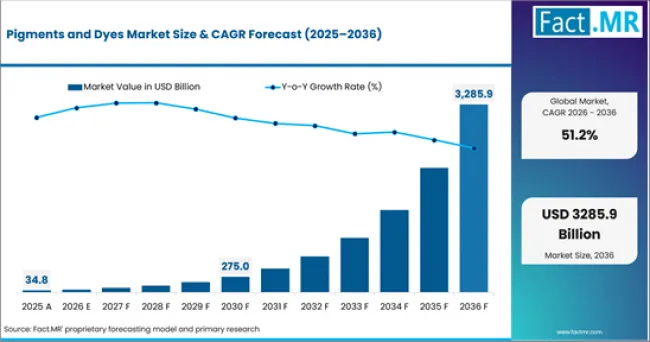
- Base Value(2025): 34.8 Bn
- Estimated Value(2026): 52.6 Bn
- Forecast Value (2036): 3285.9 Bn
- CAGR (2026 - 2036): 51.2%
Pigments and Dyes Market Analysis and Forecast by Fact.MR
- The Pigments and Dyes Market is anticipated to expand from USD 52.6 billion in 2026 to USD 3285.9 billion by 2036, at a CAGR of 51.2%.
- Fueled by increasing worldwide consumption of paints and coatings in construction and automotive refinishing, rising demand for textile dyeing in Asian Pacific manufacturing hubs, and the growing adoption of high-performance organic pigments and specialty dyes for advanced coating, printing, and cosmetic applications.
- Inorganic pigments holding a 34.8% share and paints and coatings representing a 41.6% share as companies invest in sustainable pigment production, bio-based dye development, and regulatory-compliant colorant formulations.
Pigments And Dyes Market Value Analysis | Source: Fact.MR
Summary of Pigments and Dyes Market
- Market Snapshot
- The market is expected to reach USD 52.6 billion in 2026 and is forecast to reach USD 3285.9 billion by 2036.
- The pigments and dyes market is projected to grow at a CAGR of 51.2% over the forecast period.
- The market is expected to generate an absolute dollar opportunity of USD 3233.3 billion during 2026-2036.
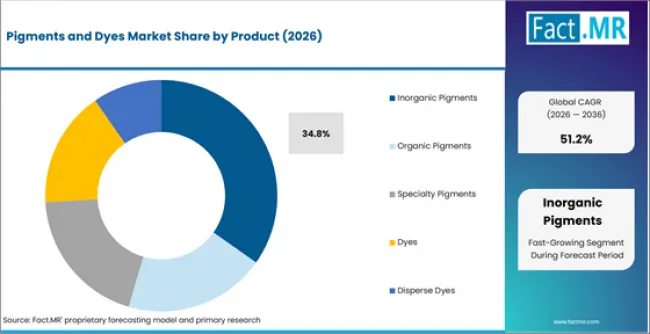
- Inorganic Pigments holds 34.8% share in the product segment in 2026.
- China (6.5%) and South Korea (5%) are the leading growth markets during the forecast period.
- Demand and Growth Drivers
- Architectural coatings, which utilize the highest volume of pigments and dyes in both exterior and interior paint formulations, are witnessing increased demand owing to the growth of construction activity around the world.
- The textile industry is growing in Bangladesh, India and Vietnam, which is contributing to the fabric dyeing and printing ink consumption, especially for reactive and disperse dye categories.
- Automotive OEM and refinish coatings require premium pigments with superior weathering, chemical resistance and color consistency performance.
- Demand for plastics coloring is growing as packaging, consumer goods and industrial product manufacturers specify custom color matching using masterbatch and liquid colorant systems.
- To formulate cosmetics and personal care products, certified colorants that satisfy FDA, EU and other regulatory safety standards for skin contact applications are needed.
- Product and Segment View
- Titanium dioxide dominance in white pigment applications and iron oxide dominance in construction coatings are supporting the growth of inorganic pigments leading with 34.8% product share in 2026.
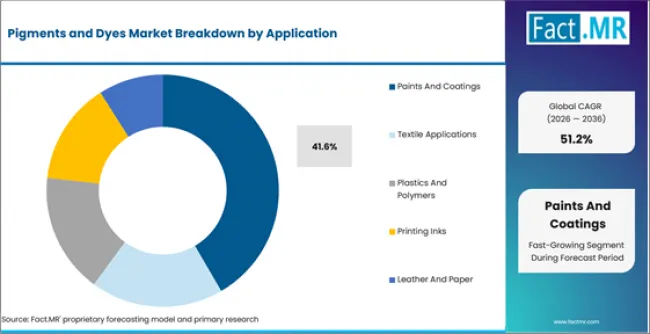
- The paints and coatings application segment represented 41.6% of the total consumption share and is the largest single end-use consumption channel for pigments and dyes.
- Key segmentation includes:
- These products enable:
- Color delivery and opacity in architectural, industrial and automotive coating systems
- Colouring of fabrics of natural and synthetic textile substrates. Dyeing and printing processes
- Color matching for custom products and batch consistency in plastic, print, and cosmetic manufacturing
- Geography and Competitive Outlook
- China leads at 6.5%, driven by the largest global manufacturing base for pigments and dyes, strong domestic consumption, and export production.
- South Korea at 5.0% and U.S. at 4.8% reflect advanced coating and specialty chemical demand.
- Germany at 4.2% is supported by automotive coatings, specialty chemical manufacturing, and EU regulatory compliance infrastructure.
- Major players include BASF SE, Atlanta AG, Asahi Songwon Colors, Atul Ltd., and Cathay Industries.
- Analyst Opinion
- Shambhu Nath Jha, Principal Consultant at Fact.MR, says 'The pigments and dyes market is a foundational chemical industry segment where titanium dioxide alone accounts for the largest single product value. BASF leads with 16% market share through its comprehensive pigment portfolio spanning inorganic, organic, and effect pigments for coatings, plastics, and printing applications. The growth dynamic is shaped by regional construction cycles in Asia Pacific, automotive production volumes in Europe and North America, and textile manufacturing expansion in South and Southeast Asia. Sustainability pressure is driving investment in bio-based dyes and reduced-VOC pigment dispersion technology.'
Key Growth Drivers, Constraints, and Opportunities
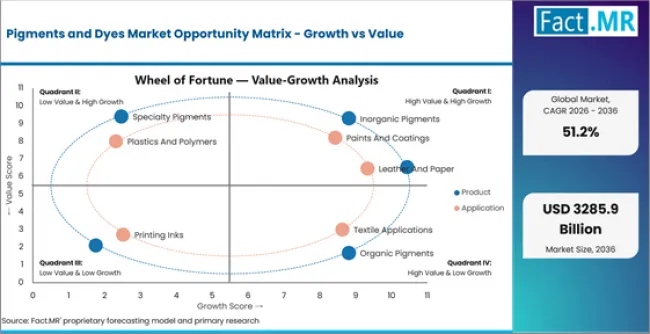
Pigments And Dyes Market Opportunity Matrix Growth Vs Value | Source: Fact.MR
Key Factors Driving Growth
- The main driver of architectural coatings pigment consumption is the rise in global construction output driven by residential and commercial building activity in the Asia Pacific region.
- Growth in textile manufacturing in Asia Pacific is sustaining demand for reactive, disperse and acid dyes in the production of cotton, polyester and blended fabrics.
- Premier organic pigments are needed for automotive OEM and refinishing coating programs with proven light-fastness, chemical resistance and color matching accuracy.
Key Market Constraints
- Uncertainty in the cost of raw materials, as titanium dioxide feedstock supply is concentrated and prices are volatile, affects the production of white pigment.
- Environmental regulations regarding heavy metal content, VOC emissions and wastewater discharge from dye manufacturing create compliance costs and restrict certain colorant chemistries .
- Mid-tier producers that lack differentiated specialty products also suffer from tight margins due to competition from low-cost pigment and dye producers in China and India.
Key Opportunity Areas
- Bio-based and naturally derived dyes for textile, cosmetic and food applications respond to increasing consumer and regulatory demand for sustainable colorant alternatives.
- Metallic, pearlescent and interference effect pigments form premium product tiers in automotive, cosmetic and packaging applications.
- The growth of digital printing in textiles and packaging requires dye and pigment formulations that are suitable for inkjet printing, with special requirements for particle size and dispersion.
Segment-wise Analysis of the Pigments and Dyes Market
- The market share of inorganic pigments will be 34.8% in 2026, driven by the dominance of titanium dioxide and iron oxide in volume.
- Paints & Coatings has the largest share of 41.6% in terms of application for the paints and coatings market, owing to the high consumption of construction and automotive coatings.
- The end use share is driven by global production in fabric dyeing and printing, which is 37.9%.
The market is segmented by product, application, form, end use, technology and region. Inorganic pigments are growing on tonnage volume, organic pigments are growing on specialty coating demand. 44.2% Share of Synthetic Dye Technology in Technology
Which Product Segment Dominates the Pigments and Dyes Market?
Pigments And Dyes Market Analysis By Product | Source: Fact.MR
In 2026, the value share of inorganic pigments in the product segment will be 34.8%. Titanium Dioxide is the largest single product by revenue and volume and is the main white pigment and opacifier used in architectural coatings, plastics, paper and industrial coating applications. Iron oxides are the second largest group of inorganic pigments used for construction and industrial coloration.
Organic pigments are used in applications where bright high-chroma colors are needed that cannot be achieved by inorganic products. Reactive dyes, disperse dyes and acid dyes are employed in the textile industry on natural and synthetic fibre substrates. Reactive dyes are the leader in cotton colouring and disperse dyes in polyester.
Which Application Segment Dominates the Pigments and Dyes Market?
Pigments And Dyes Market Analysis By Application | Source: Fact.MR
The Paints & Coatings segment is forecast to be valued at $41.6 billion in 2026. The largest volume of pigment goes to architectural coatings for residential and commercial construction, followed by automotive OEM coatings, industrial protective coatings and wood and furniture finishes.
The second largest application in textile industry with fabric dyeing, printing and finishing operations using reactive, disperse, acid and vat dyes on cotton, polyester, nylon and blended textile manufacturing operations worldwide.
Which Product Trend is Shaping the Next Phase of Growth in the Pigments and Dyes Market?
The primary product trend reshaping the textile coloring segment is digital textile printing using pigment and dye formulations compatible with inkjet. Digital printing has lower costs than traditional screen setup, allows short-run customisation and uses less water and chemicals than traditional wet dyeing processes.
This trend is supported by demand in the fashion industry for faster design-to-production cycles, and by sustainability pressure to reduce water consumption and wastewater generation of textile dyeing. The digital textile printing consumables market is growing and companies developing pigment and dye formulations optimized for industrial inkjet printheads with validated wash-fastness and color gamut performance are well positioned to capitalize on this growth.
Regional Outlook Across Key Markets
- China has 6.5% of the market, with the world’s largest pigment manufacturing base, strong domestic construction and textile demand and export production.
- South Korea at 5.0% and U.S. at 4.8% shows demand for advanced specialty pigment and coatings.
- 4.2% Germany: Automotive coatings, specialty chemical production, and adherence to EU regulations.
.webp "Top Country Growth Comparison Pigments And Dyes Market Cagr (2026 2036)")
Top Country Growth Comparison Pigments And Dyes Market Cagr (2026 2036) | Source: Fact.MR
CAGR Table
| Country | CAGR (%) |
|---|---|
| China | 6.5% |
| South Korea | 5% |
| U.S. | 4.8% |
| Germany | 4.2% |
| Japan | 4% |
| France | 3.8% |
| Italy | 3.6% |
| UK | 3.5% |
Source: Fact.MR analysis. Updated Jun 17, 2026
Source: Fact MR (FMR) analysis, based on proprietary forecasting model and primary research.
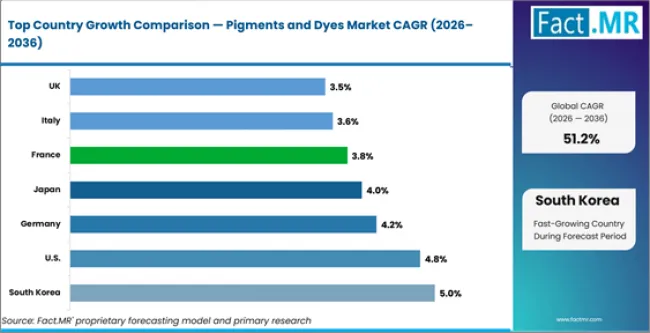
Pigments And Dyes Market Cagr Analysis By Country | Source: Fact.MR
Market Outlook for Pigments and Dyes in China
The China Pigments and Dyes Market is projected to grow at a CAGR of 6.5% through 2036. Global production capacity share in both pigments and dyes creates the largest single-country manufacturing and consumption base. Trade policy impacts on specialty chemical exports influence domestic and international market dynamics.
- Domestic manufacturing scale supports competitive pricing for commodity and specialty pigment products.
- Trade policy and export regulation influence pricing and availability of Chinese-origin pigments in international markets.
- Textile and construction sector demand generates the largest single-country consumption of both pigments and dyes.
Pigments and Dyes Growth Assessment in South Korea
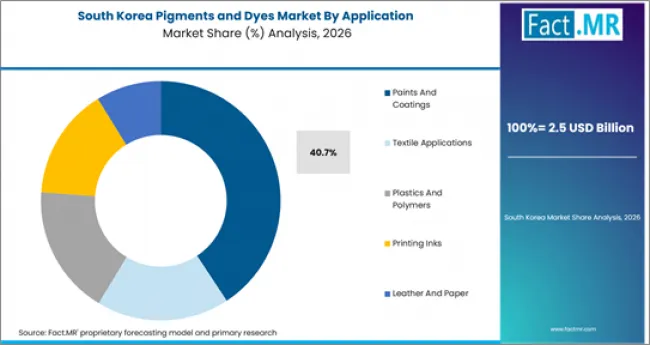
Pigments And Dyes Market South Korea Market Share Analysis By Application | Source: Fact.MR
The South Korea Pigments and Dyes Market is projected to grow at a CAGR of 5% through 2036. Advanced display, automotive, and electronics manufacturing create demand for high-performance specialty pigments. Quality standards and color specification requirements shape procurement toward validated international brands.
- Display and electronics manufacturing create demand for high-purity specialty pigments with precise color specifications.
- Automotive coatings demand requires premium organic pigments with superior weathering and chemical resistance.
- Government R&D support strengthens domestic specialty chemical development including advanced pigment formulations.
Market Outlook for Pigments and Dyes in U.S.
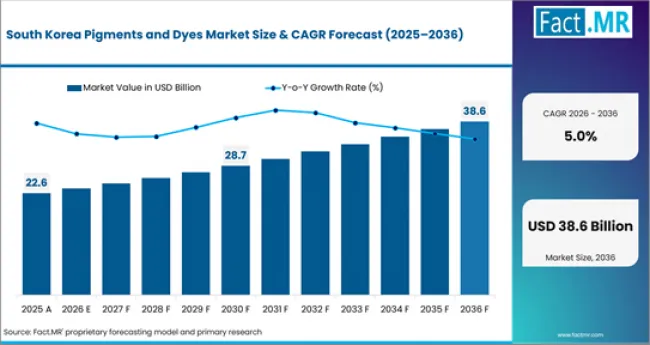
Pigments And Dyes Market Country Value Analysis | Source: Fact.MR
The U.S. Pigments and Dyes Market is projected to grow at a CAGR of 4.8% through 2036. Construction activity, automotive production, and sustainability mandates shape pigment and dye demand. EPA VOC regulations and consumer preference for reduced-chemical products influence formulation development.
- Construction output growth drives architectural coatings pigment consumption across residential and commercial sectors.
- EPA VOC regulations and sustainability mandates influence pigment dispersion technology and low-emission coating development.
- Brand differentiation through sustainable and bio-based colorant positioning supports premium pricing in consumer-facing applications.
Pigments and Dyes Demand Analysis in Germany
The Germany Pigments and Dyes Market is projected to grow at a CAGR of 4.2% through 2036. EU REACH regulations and automotive coatings demand define a specification-intensive market for pigments. DIN/EU quality standards and environmental compliance requirements shape procurement specifications.
- EU REACH compliance requirements shape pigment and dye market access and restrict certain heavy metal and azo dye chemistries.
- Automotive OEM coating programs require premium pigments with validated performance under German automotive industry specifications.
- DIN/EU quality standards and lifecycle environmental assessments influence pigment selection criteria.
India Pigments and Dyes Demand Trends
The India Pigments and Dyes Market is projected to grow at a CAGR of 3.9% through 2036. National Infrastructure Pipeline investment and textile manufacturing expansion are the primary demand drivers. Domestic dye and pigment manufacturing capability supports competitive pricing for both local consumption and export.
- National Infrastructure Pipeline construction investment drives architectural coatings pigment consumption.
- Textile manufacturing expansion supports domestic dye production and consumption across reactive and disperse categories.
- Domestic pigment and dye manufacturing supports export competitiveness and reduces import dependency for commodity grades.
Competitive Benchmarking and Company Positioning
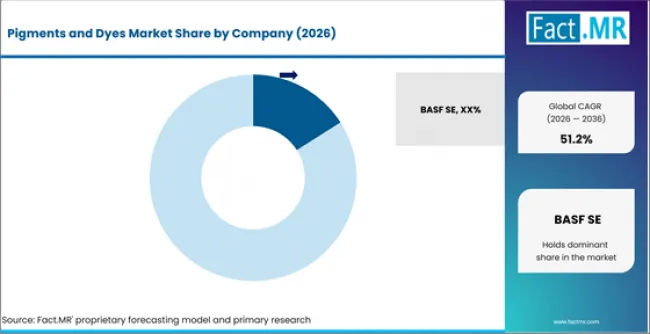
Pigments And Dyes Market Analysis By Company | Source: Fact.MR
Pigments and Dyes Market Analysis By Company
- BASF SE leads with approximately 16.0% market share through its comprehensive pigment portfolio spanning inorganic, organic, and effect pigments for coatings, plastics, printing, and agricultural applications globally.
- Atlanta AG, Asahi Songwon Colors, and Atul Ltd. compete through focused pigment and dye manufacturing operations serving specific regional markets and application segments.
- Cathay Industries and Lanxess (through iron oxide operations) serve the inorganic pigment segment through large-scale manufacturing and global distribution infrastructure.
The competitive landscape is moderately fragmented, with BASF holding the broadest portfolio across inorganic, organic, and effect pigment categories. Regional manufacturers in China, India, and Southeast Asia compete through cost advantages in commodity pigment and dye production.
Competition is shaped by product quality consistency, regulatory compliance documentation, and technical application support. Specialty pigment manufacturers differentiate through high-performance organic pigments for automotive and industrial coatings where color precision and durability justify premium pricing.
Key Companies in the Pigments and Dyes Market
BASF SE, Atlanta AG, Asahi Songwon Colors Ltd., Atul Ltd., Cathay Industries USA, Clariant AG, DIC Corp., DyStar Singapore Pte. Ltd., Ferro Corp., Sun Chemical Corporation are the leading companies.
Recent Industry Developments
- BASF SE - Pigment Portfolio and Sustainability Initiatives (2025)
- automotive coatings business following the divestiture of its global pigments business, focusing on advanced color design and sustainable coating technologies. Through its 2025–2026 Automotive Color Trends collection, Driving the Proxy, the company introduced innovative effect finishes and specialized coating systems that enhance visual appeal while supporting durability and sustainability requirements across global automotive markets.
- Asahi Songwon Colors - Pigment Manufacturing Capacity Development (2025)
- Colors optimized production across its manufacturing facilities in India, increasing capacity utilization for its Phthalocyanine Blue pigment lines while improving operational efficiency at its subsidiary, Asahi Tennants Colour, for Azo-based yellow and red pigments. These initiatives strengthened the company's ability to meet growing domestic and international demand from the coatings, plastics, and printing ink industries.
- Atul Ltd. - Dye and Pigment Product Range Expansion (2025)
- Colors business by leveraging its manufacturing and research capabilities in Gujarat to offer a broad portfolio of dyes and organic pigments. The company continued to strengthen its position in textile, coatings, packaging, and industrial applications by focusing on high-performance colorants and sustainable manufacturing practices while serving customers across global markets.
Leading Companies Shaping the Pigments and Dyes Market
- BASF SE
- Atlanta AG
- Asahi Songwon Colors Ltd.
- Atul Ltd.
- Cathay Industries USA
- Clariant AG
- DIC Corp.
- DyStar Singapore Pte. Ltd.
- Ferro Corp.
- Sun Chemical Corporation
Sources and Research References
BASF SE. (2025). Pigments and dyes product portfolio and sustainability documentation. https://www.basf.com
European Chemicals Agency. (2025). REACH registration requirements for pigments and dyes. https://echa.europa.eu
Fact.MR. (2026). Primary interviews with pigment manufacturers, dye producers, coatings companies, and textile processors. Unpublished raw data.
U.S. Environmental Protection Agency. (2025). VOC emission standards for coatings and pigment manufacturing. https://www.epa.gov
World Coatings Council. (2025). Global coatings production and pigment consumption statistics.
This bibliography is provided for reader reference and is not exhaustive. The full report contains the complete reference list and detailed citations.
Key Questions This Report Addresses
- What is the estimated size of the global Pigments and Dyes Market in 2026, and how is it projected to grow through 2036?
- What incremental revenue opportunity is the market expected to create between 2026 and 2036?
- Which product segment holds the largest share in 2026, and what volume factors support inorganic pigment leadership?
- How is the balance between inorganic and organic pigments expected to shift as specialty coatings demand grows?
- Which application segment is projected to generate the most incremental revenue through 2036?
- Which countries are projected to register the highest CAGR, and what manufacturing and construction factors accelerate growth?
- How do demand patterns in China compare with the U.S. and Germany in terms of application mix and regulatory requirements?
- What raw material costs and environmental regulations could constrain growth in specific pigment categories?
- Who are the leading companies, and how are they differentiating through portfolio breadth, sustainability, and application support?
- What recent manufacturing and sustainability developments in 2025 are shaping competitive positioning?
- Which digital printing or sustainable colorant trend is driving the next phase of growth?
- How is digital textile printing changing dye formulation requirements and consumption patterns?
- What role are bio-based dyes, REACH compliance, and effect pigments playing in reshaping market structure?
- What demand-side drivers sustain growth, and how do they vary between construction coatings and textile dyeing applications?
Pigments and Dyes Market Definition
The pigments and dyes market covers organic and inorganic colorants used across paints and coatings, textiles, plastics, printing inks, cosmetics, and food applications in powder, liquid, paste, and granular forms produced through synthetic and natural extraction processes.
Pigments and Dyes Market Inclusions
- Global and regional market size and forecasts for 2026 to 2036 across product, application, form, end use, technology, and region.
- Demand analysis based on construction output, automotive production, textile manufacturing volumes, and coatings consumption data.
- Competitive landscape including pigment portfolios, manufacturing capacity, and distribution strategies of leading companies.
Pigments and Dyes Market Exclusions
- Functional additives including UV stabilizers, antioxidants, and flow agents not classified as colorants.
- Raw mineral ores and chemical intermediates used in pigment manufacturing but not sold as finished colorant products.
- Specialty fluorescent and phosphorescent materials used exclusively in safety marking and signage applications.
Pigments and Dyes Market Research Methodology
- Methodology combines secondary research from chemical industry publications, coatings databases, and textile trade statistics with primary validation.
- Market sizing covers 30+ countries with inputs including construction output, automotive production, textile manufacturing, and coatings consumption.
- Primary validation includes 18+ interviews across pigment manufacturers, dye producers, coatings companies, and textile processors.
Segmentation
Scope of Analysis
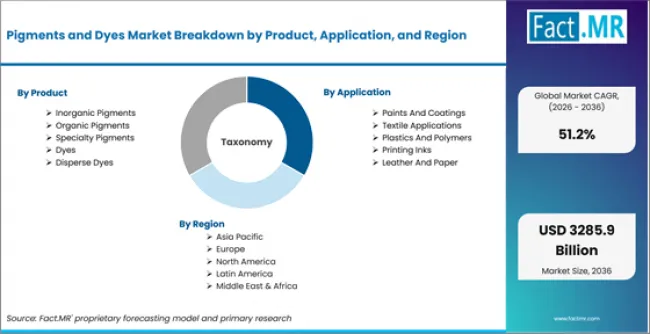
Pigments And Dyes Market Breakdown By Product, Application, And Region | Source: Fact.MR
| Parameter | Details |
|---|---|
| Quantitative Units | USD 52.6 billion to USD 3285.9 billion, at a CAGR of 51.2% |
| Market Definition | The pigments and dyes market covers organic and inorganic colorants used across paints and coatings, textiles, plastics, printing inks, cosmetics, and food applications in powder, liquid, paste, and granular forms produced through synthetic and natural extraction processes. |
| Regions Covered | North America, Latin America, Europe, East Asia, South Asia and Pacific, Middle East and Africa |
| Countries Covered | China, South Korea, U.S., Germany, Japan, France, Italy, UK, 30 plus countries |
| Key Companies | BASF SE, Atlanta AG, Asahi Songwon Colors Ltd., Atul Ltd., Cathay Industries USA, Clariant AG, DIC Corp., DyStar Singapore Pte. Ltd. |
| Forecast Period | 2026 to 2036 |
| Approach | Hybrid demand-side and top-down methodology built on construction output, automotive production, textile manufacturing, coatings consumption, and primary interviews |
Source: Fact.MR analysis. Updated Jun 17, 2026
Pigments and Dyes Market Segmentation
-
Pigments and Dyes Market Segmented by Product:
- Inorganic Pigments
- Titanium Dioxide Pigments
- Paint And Coating Applications
- White Colorant Systems
- Iron Oxide Pigments
- Construction Material Applications
- Industrial Coloring Products
- Titanium Dioxide Pigments
- Organic Pigments
- Azo Pigments
- Textile Printing Applications
- Colorant Chemical Products
- Pthalocyanine Pigments
- Plastics Coloring Applications
- Industrial Coating Products
- Azo Pigments
- Specialty Pigments
- Perlene Pigments
- High Performance Coatings Applications
- Automotive Finish Products
- Quinacridone Pigments
- Premium Color Applications
- Advanced Coating Systems
- Perlene Pigments
- Dyes
- Reactive Dyes
- Textile Fiber Applications
- Fabric Coloring Products
- Acid Dyes
- Wool And Nylon Applications
- Dyeing Chemical Systems
- Reactive Dyes
- Disperse Dyes
- Synthetic Fiber Dyes
- Polyester Applications
- Industrial Textile Products
- Vat Dyes
- High Fastness Applications
- Premium Fabric Coloring Systems
- Synthetic Fiber Dyes
- Inorganic Pigments
-
Pigments and Dyes Market Segmented by Application:
- Paints And Coatings
- Architectural Coatings
- Building Surface Applications
- Decorative Paint Systems
- Industrial Coatings
- Corrosion Protection Applications
- Protective Surface Products
- Architectural Coatings
- Textile Applications
- Apparel Dyeing Applications
- Fashion Industry Products
- Fabric Color Systems
- Home Textile Applications
- Interior Fabric Coloring
- Decorative Textile Products
- Apparel Dyeing Applications
- Plastics And Polymers
- Polymer Coloring Applications
- Plastic Manufacturing Products
- Color Masterbatch Systems
- Engineering Plastics Coloring
- Automotive Components Applications
- Industrial Polymer Systems
- Polymer Coloring Applications
- Printing Inks
- Packaging Ink Applications
- Label Printing Products
- Commercial Printing Systems
- Publication Ink Applications
- Publishing Industry Products
- Graphic Color Systems
- Packaging Ink Applications
- Leather And Paper
- Leather Dyeing Applications
- Paper Coloring Applications
- Paints And Coatings
-
Pigments and Dyes Market Segmented by Form:
- Powder Pigments And Dyes
- Dry Powder Pigments
- Industrial Mixing Applications
- Bulk Color Products
- Micronized Powder Systems
- High Dispersion Applications
- Advanced Color Systems
- Dry Powder Pigments
- Liquid Pigments And Dyes
- Solvent Based Liquid Systems
- Coating Applications
- Ready To Use Colorants
- Water Based Liquid Systems
- Eco Friendly Applications
- Low VOC Color Products
- Solvent Based Liquid Systems
- Granular Pigments
- Pelletized Pigment Systems
- Plastics Processing Applications
- Masterbatch Production Products
- Granulated Dye Systems
- Controlled Release Applications
- Industrial Processing Systems
- Pelletized Pigment Systems
- Paste Pigments
- Pigment Dispersion Pastes
- Printing Applications
- High Concentration Color Products
- Viscous Dye Pastes
- Textile Printing Applications
- Specialty Color Systems
- Pigment Dispersion Pastes
- Powder Pigments And Dyes
-
Pigments and Dyes Market Segmented by End Use:
- Textile Industry
- Apparel Manufacturers
- Mass Clothing Production
- Coloring Chemical Systems
- Home Textile Manufacturers
- Interior Fabric Applications
- Decorative Textile Products
- Apparel Manufacturers
- Paint And Coatings Industry
- Architectural Paint Manufacturers
- Building Coating Applications
- Surface Color Systems
- Industrial Coating Producers
- Protective Surface Applications
- Performance Coating Products
- Architectural Paint Manufacturers
- Plastics Industry
- Polymer Processing Companies
- Plastic Coloring Applications
- Masterbatch Systems
- Engineering Plastic Manufacturers
- Automotive And Industrial Applications
- High Performance Color Systems
- Polymer Processing Companies
- Printing Industry
- Commercial Printing Companies
- Packaging And Label Applications
- Ink Color Systems
- Publication Printing Houses
- Publishing Applications
- Graphic Color Products
- Commercial Printing Companies
- Leather And Paper Industry
- Leather Processing Companies
- Paper Manufacturing Companies
- Textile Industry
-
Pigments and Dyes Market Segmented by Technology:
- Synthetic Dye Technology
- Azo Synthesis Technology
- Mass Color Production Applications
- Industrial Dye Systems
- Anthraquinone Synthesis Systems
- High Fastness Applications
- Advanced Color Chemistry
- Azo Synthesis Technology
- Pigment Dispersion Technology
- Surface Treatment Systems
- High Stability Applications
- Coating And Ink Products
- Nano Pigment Technology
- High Transparency Applications
- Advanced Coating Systems
- Surface Treatment Systems
- Bio Based Colorant Technology
- Natural Dye Extraction Systems
- Eco Friendly Applications
- Sustainable Color Products
- Microbial Pigment Production
- Green Chemistry Applications
- Biotech Color Systems
- Natural Dye Extraction Systems
- Synthetic Dye Technology
-
Pigments and Dyes Market by Region:
- North America
- USA
- Canada
- Mexico
- Latin America
- Brazil
- Chile
- Rest of Latin America
- Western Europe
- Germany
- UK
- Italy
- Spain
- France
- Nordic
- BENELUX
- Rest of Western Europe
- Eastern Europe
- Russia
- Poland
- Hungary
- Balkan & Baltic
- Rest of Eastern Europe
- East Asia
- China
- Japan
- South Korea
- South Asia and Pacific
- India
- ASEAN
- Australia & New Zealand
- Rest of South Asia and Pacific
- Middle East & Africa
- Kingdom of Saudi Arabia
- Other GCC Countries
- Turkiye
- South Africa
- Other African Union
- Rest of Middle East & Africa
- North America
Frequently Asked Questions
How big is the pigments and dyes market in 2026?
What will be the size of the pigments and dyes market in 2036?
How much will the pigments and dyes market grow between 2026 and 2036?
What are the key products in the pigments and dyes market?
Which application segment is expected to contribute a significant share in the pigments and dyes market in 2026?
Who worked on this report


Preview the report firsthand - request a free sample
Free SampleGet the brochure for pricing and purchase details
Download PDF