- Market Value (2025): USD 371.8 Mn
- Estimated Value (2026): USD 393.3 Mn
- Forecast Value (2036): USD 689.9 Mn
- CAGR (2026-2036): 5.8%
What is the Pneumatic and Electric Pivot Units Market forecast to be worth by 2036?
USD 393.3 million in 2026 to USD 689.9 million by 2036 at a 5.8% CAGR.
- The pneumatic and electric pivot units market reached a value of USD 371.8 million in 2025, with compressed-air units carrying most of the installed base on car body and component lines.
- Revenue will expand from USD 393.3 million in 2026 to USD 689.9 million by 2036 as plants refit welding fixtures and add automated workholding stations.
- A 5.8% CAGR will hold through the forecast years, helped by steady fixture replacement in vehicle plants and wider use of programmable electric units in mixed-model cells.
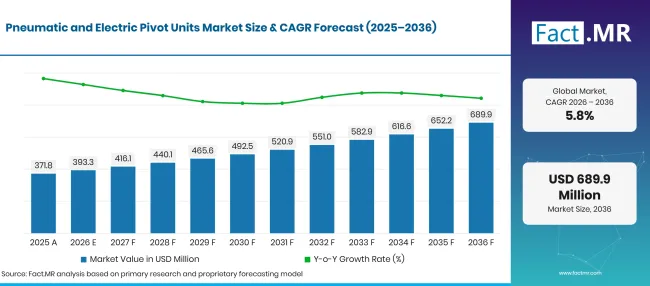
Pneumatic And Electric Pivot Units Market Forecast Global | Source: Fact.MR
| Year | Basis | Market Value (USD million) |
|---|---|---|
| 2025 | Actual | 371.8 |
| 2026 | Estimate | 393.3 |
| 2036 | Forecast | 689.9 |
| CAGR 2026 to 2036 | Forecast period | 5.8% |
Source: Fact.MR analysis. Updated Nov 4, 2026
What are the defining numbers behind Pneumatic and Electric Pivot Units Market growth?
The 2026 to 2036 period will add USD 296.6 million in new value, led by automotive fixture lines, robotic workholding and electronics assembly equipment.
- Demand Drivers in the Market
- Car plants depend on accurate fixture movement during body welding, assembly and part handling. Each new or refitted welding cell needs pivot units that repeat the same angle over millions of cycles without drift.
- Electronics output is lifting demand for compact pivot units inside assembly and test equipment. India’s electronics production rose from ₹11.32 lakh crore in FY2024-25 to ₹13.11 lakh crore in FY2025-26, a 15.8% increase [1].
- Component programmes are widening the equipment base beyond final assembly. India had approved 106 projects under its Electronics Component Manufacturing Scheme by 17 August 2026, with 38 plants already producing and 16 at advanced construction or machinery-installation stages [2].
- Machine builders are fitting automated positioning into machining, material handling and assembly equipment. Electric pivot units with programmable angles let one fixture serve several part types, which cuts changeover time on short production runs.
- Plant upgrades are making requirements more varied. Compact layouts, controlled acceleration and sensor feedback now appear in purchase specifications alongside load and torque.
- Key Segments Analyzed
- By Product Type: Pneumatic Pivot Units will hold 62.3% of 2026 value, since most welding and workholding fixtures already run on plant compressed air.
- By Application: Automotive will account for 38.2% in 2026, given the number of fixture moves in body welding and component assembly.
- By Distribution Channel: Direct Sales will capture 54.7% of 2026 revenue, as buyers settle torque, angle and mounting details directly with the manufacturer.
- Analyst Opinion at Fact.MR
- Shambhu Nath Jha, Principal Consultant at Fact.MR, states, “Pneumatic pivot units will keep their hold on automotive welding and workholding lines because plants trust their cycle life and already have the air supply in place. Electric units will win orders in cells that switch between part variants and need programmable stop positions. By 2036, suppliers that offer both drive types on common mounting patterns will be best placed as factories mix air and electric motion on the same line.”
- Strategic Implications
- Manufacturers should offer pneumatic and electric pivot units on shared mounting patterns, so integrators can swap the drive type without redesigning the fixture.
- Distributors should stock standard torque classes and spare seal kits near automotive clusters, where downtime on a welding line costs more than the part itself.
- Plant engineers should compare total air consumption against electric energy use before each fixture refit, since compressed-air cost is often the hidden line item.
- Investors should track electric pivot unit uptake in electronics and machinery plants, which will shape margins as programmable designs carry higher unit prices.
Germany leads the comparison at 6.6%, carried by a deep machinery order book and automotive suppliers that refit fixtures often. Brazil follows at 6.0%, where subsidised credit for Industry 4.0 equipment is pulling older plants toward automated workholding. The United States trails Brazil by 0.6 points at 5.4%, since its large factory base grows from replacement as much as from new lines. In the United Kingdom, the rate of 4.8% rests on machinery and electronics subsectors that keep adding automated cells. Japan closes the range at 4.3%, held back by a mature installed base even as production machinery output improves.
How does the Pneumatic and Electric Pivot Units Market break down by segment?
Pneumatic Pivot Units will lead Product Type at 62.3%; Automotive will head Application at 38.2%; Direct Sales will lead Distribution Channel at 54.7% in 2026.
Which Product Type leads?
Pneumatic Pivot Units take 62.3% of 2026 sales.
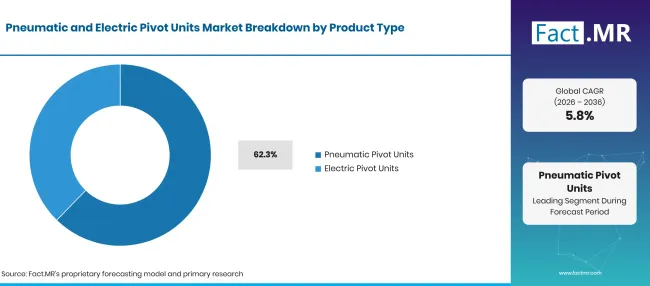
Pneumatic And Electric Pivot Units Market Breakdown Product Type | Source: Fact.MR
| Product Type | Share (2026) |
|---|---|
| Pneumatic Pivot Units (Leading segment) | 62.3% |
| Other segments combined | 37.7%* |
| Total | 100.0% |
Source: Fact.MR analysis. Updated Nov 4, 2026
Compressed air is already piped to nearly every welding and assembly station, so a pneumatic pivot unit drops into an existing circuit with little extra work. These units deliver high clamping torque in a small housing and tolerate weld spatter and heavy duty cycles. Plants refitting fixtures often keep the same air valves and sensors, which lowers the cost of each upgrade. Supply of the air itself depends on industrial air compressors and on pneumatic fittings that hold pressure across long fixture runs. Electric pivot units serve buyers who need programmable stop positions, constant torque at every angle or quieter operation. They suit fixtures that switch between part variants, testing stations and CNC loading cells. Their higher purchase price limits use on simple two-position moves, although energy savings and finer control will widen their reach over the forecast years.
What supports Automotive within Application?
Automotive represents 38.2% of 2026 revenue.
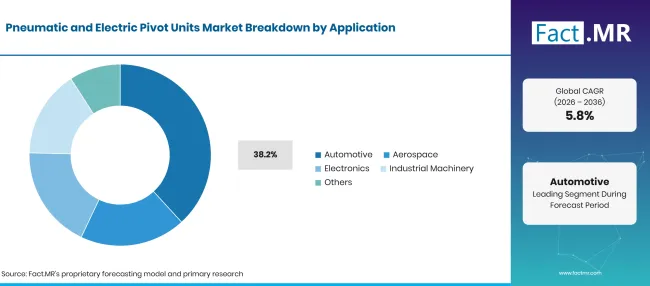
Pneumatic And Electric Pivot Units Market Breakdown Application | Source: Fact.MR
| Application | Share (2026) |
|---|---|
| Automotive (Leading segment) | 38.2% |
| Other segments combined | 61.8%* |
| Total | 100.0% |
Source: Fact.MR analysis. Updated Nov 4, 2026
Vehicle plants move fixtures between load, weld and inspect positions many times per body, and each move calls for a pivot unit that returns to the same angle. Body-in-white lines, battery tray assembly and component welding all use these units alongside industrial robotics that handle the parts. Output swings still affect orders, as US motor vehicle and parts production fell 3.0% in September 2026 [3]. Aerospace plants use pivot units in precision tooling and assembly jigs where loads are heavy and tolerances tight. Electronics makers need small, light units inside assembly and test equipment. Industrial machinery builders fit them into machining centres and material handling systems, where some fixtures also rely on a hydraulic cylinder for higher clamping force.
How does Distribution Channel shape demand?
Direct Sales command 54.7% of 2026 value.
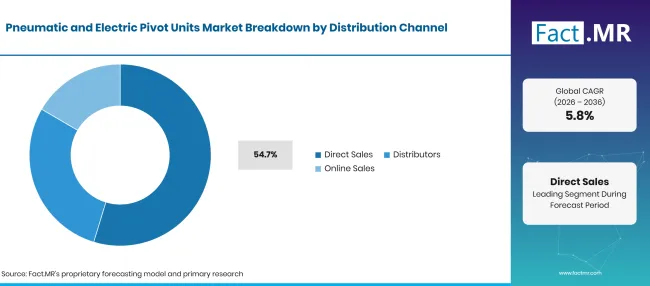
Pneumatic And Electric Pivot Units Market Breakdown Distribution Channel | Source: Fact.MR
| Distribution Channel | Share (2026) |
|---|---|
| Direct Sales (Leading segment) | 54.7% |
| Other segments combined | 45.3%* |
| Total | 100.0% |
Source: Fact.MR analysis. Updated Nov 4, 2026
Pivot units are rarely bought off a shelf for a new line. Engineers settle load capacity, rotation range, operating pressure and sensor type with the supplier before the fixture design is frozen. Direct contact also helps with application testing and with matching units to the line’s controls, which keeps large automotive and machinery accounts with the manufacturer. Distributors cover regional availability, spare parts and technical help for smaller plants and maintenance teams. Online channels make it easier to compare specifications and reorder standard sizes. Custom angles, heavy loads and integrated sensing still favour a direct relationship with the producer.
What is accelerating Pneumatic and Electric Pivot Units Market adoption, and what is holding it back?
Automation of welding and assembly in car plants is the main source of new orders, and robotic workholding is widening the use of both pneumatic and electric pivot units. Electronics and machinery plants add a second stream of demand for compact and programmable designs. Integration cost, compressed-air running costs and competition from general rotary actuators slow adoption, especially for small manufacturers refitting older lines.
Drivers Impact Analysis
| DRIVER | (~) % IMPACT ON CAGR | GEOGRAPHIC RELEVANCE | IMPACT TIMELINE |
|---|---|---|---|
| DRIVER | (~) % IMPACT ON CAGR | GEOGRAPHIC RELEVANCE | IMPACT TIMELINE |
| More automated welding and assembly lines in car plants | +2.0% | Global, East Asia, Europe, North America | Short term (<=2 years) |
| Growing use of robotic workholding and fixture positioning | +1.3% | Global | Medium term (2-4 years) |
| Tighter tolerances and repeatable part positioning on the shop floor | +0.9% | Germany, United States, Japan, Brazil | Medium term (2-4 years) |
| Shift to programmable electric actuation in specialised machinery | +0.5% | Europe, North America, East Asia | Long term (>=4 years) |
Source: Fact.MR analysis. Updated Nov 4, 2026
Opportunity Impact Analysis
| OPPORTUNITY | (~) % IMPACT ON CAGR | GEOGRAPHIC RELEVANCE | IMPACT TIMELINE |
|---|---|---|---|
| OPPORTUNITY | (~) % IMPACT ON CAGR | GEOGRAPHIC RELEVANCE | IMPACT TIMELINE |
| Compact pivot units that fit into smaller assembly equipment | +0.8% | Global | Short term (<=2 years) |
| Electric pivot units with programmable positioning | +0.6% | Europe, North America, East Asia | Medium term (2-4 years) |
| Purpose-built units for aerospace and precision manufacturing | +0.4% | North America, Europe, Japan | Medium term (2-4 years) |
| Pivot units built into robotic workholding and handling systems | +0.3% | Global | Long term (>=4 years) |
Source: Fact.MR analysis. Updated Nov 4, 2026
Restraints Impact Analysis
| RESTRAINT | (~) % IMPACT ON CAGR | GEOGRAPHIC RELEVANCE | IMPACT TIMELINE |
|---|---|---|---|
| RESTRAINT | (~) % IMPACT ON CAGR | GEOGRAPHIC RELEVANCE | IMPACT TIMELINE |
| Upfront equipment and integration cost for specialised positioning systems | -0.4% | Global | Short term (<=2 years) |
| Maintenance needs and reliance on compressed-air supply | -0.3% | Global | Short term (<=2 years) |
| Difficulty fitting pivot units into existing automation setups | -0.2% | Europe, North America, East Asia | Medium term (2-4 years) |
| Rival rotary actuators and custom positioning mechanisms | -0.1% | Global | Long term (>=4 years) |
Source: Fact.MR analysis. Updated Nov 4, 2026
Which countries are scaling the Pneumatic and Electric Pivot Units Market through 2036?
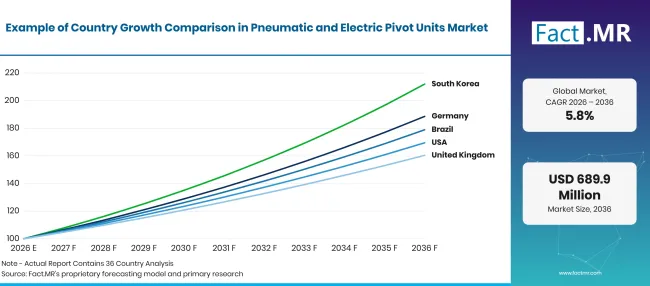
Pneumatic And Electric Pivot Units Market Growth Index | Source: Fact.MR
| Country | CAGR (2026 to 2036) |
|---|---|
| Germany | 6.6% |
| Brazil | 6.0% |
| United States | 5.4% |
| United Kingdom | 4.8% |
| Japan | 4.3% |
Source: Fact.MR analysis. Updated Nov 4, 2026
What supports pivot unit adoption in Germany?
6.6% CAGR, backed by a long machinery order book and frequent fixture refits at automotive suppliers.
German machinery makers ended 2025 with a sharp rise in orders. New orders for machinery and equipment grew 11.5% in December 2025 over November, and overall manufacturing orders were 9.5% higher in the fourth quarter than in the third [4]. The order book has stayed firm into 2026. The real stock of manufacturing orders rose 10.7% year on year in August 2026, and capital goods producers held 12.6 months of work in hand [5]. That backlog will keep fixture builders busy, even as motor vehicle orders softened in the same month.
How is Brazil developing demand?
6.0% CAGR, helped by state credit for Industry 4.0 equipment.
Brazilian industry grew 0.6% in 2025, its third straight year of expansion [6]. The government opened a BRL 12 billion credit line in August 2025 to renew the industrial park with Industry 4.0 machines, with BNDES supplying BRL 10 billion and Finep BRL 2 billion [7]. The same announcement put the average age of the country’s industrial machinery at 14 years. Car and machinery plants that replace old fixtures under this credit will add automated pivot units to welding and assembly cells.
What is supporting United States adoption?
5.4% CAGR, reflecting a broad factory base where replacement drives much of the demand.
New orders for US manufactured goods reached USD 663.5 billion in August 2026, up 0.1% from July [8]. Automotive, aerospace and industrial machinery plants remain the main users of pivot units. Their spending on automated assembly equipment and precision workholding creates orders on new lines and during equipment refits. Fixture refits on existing lines will supply a steady share of orders across the forecast years.
How is the United Kingdom scaling demand?
4.8% CAGR, as machinery and electronics producers add automated cells.
UK manufacturing output rose 1.0% in the three months to June 2026 compared with the three months to March. Machinery and equipment output grew 2.6% over the same period, while computer, electronic and optical products rose 3.0% [9]. These are the subsectors that buy compact pivot units for assembly and test stations. Automotive and aerospace plants add steady demand for heavier units in welding and tooling fixtures.
How does Japan perform?
4.3% CAGR, owing to a mature automation base with renewed output gains.
Japan’s industrial production index rose 1.9% in June 2026 from May and stood 4.9% higher than a year earlier [10]. Most plants already run automated fixtures, so growth will come from replacement, robot cell upgrades and a gradual move to electric units in electronics and precision machinery. Domestic suppliers of pneumatic components give buyers short lead times and local service, which keeps pneumatic designs in wide use.
Who leads the Pneumatic and Electric Pivot Units Market?
The field splits into two groups. Fixture specialists such as DESTACO, Zimmer Group and SCHUNK build pivot units for welding, workholding and handling, and they win on torque density, sealing against weld spatter and sensors that plug into line controls. DESTACO offers an electric pivot unit series with programmable stop positions next to its pneumatic range, a pairing that suits mixed-model car lines.
Broad automation suppliers such as SMC, Festo, Parker Hannifin and Emerson (AVENTICS) compete through catalogue depth in rotary actuators, valves and air preparation, which lets a plant source the whole motion package from one vendor. Festo announced in October 2026 that it is building digital twins of its handling systems with NVIDIA technologies to validate machines before physical setup [11]. Emerson, meanwhile, is selling AVENTICS smart flow sensors that track compressed-air use on packaging lines [12]. Over the forecast years, service reach, simulation-ready product data and the ability to offer air and electric units on common mounts will separate the winners.
Which companies are the key providers?
Key companies include SMC, Festo, Parker Hannifin, SCHUNK, DESTACO, Zimmer Group and Emerson (AVENTICS).
- SMC
- Festo
- Parker Hannifin
- SCHUNK
- DESTACO
- Zimmer Group
- Emerson (AVENTICS)
Bibliography
- [1] Press Information Bureau, Government of India. (2026, August 14). Manufacturing Momentum: Building a Self-Reliant India.
- [2] Press Information Bureau, Government of India. (2026, August 17). ECMS Accelerates Electronics Manufacturing: 38 Plants Operational, 16 in Advanced Construction Stages.
- [3] Board of Governors of the Federal Reserve System. (2026, October 16). Industrial Production and Capacity Utilization: G.17.
- [4] Federal Statistical Office (Destatis). (2026, February 5). New orders in manufacturing in December 2025: +7.8% on the previous month.
- [5] Federal Statistical Office (Destatis). (2026, October 19). Stock of orders in manufacturing in August 2026: +0.5% on the previous month.
- [6] Agência Gov, Government of Brazil. (2026, February 3). IBGE: indústria fecha 2025 com alta de 0,6% e tem terceiro ano seguido de crescimento.
- [7] Agência Gov, Government of Brazil. (2025, August 25). Governo lança linha de R$ 12 bi para renovar parque industrial brasileiro com tecnologias 4.0.
- [8] U.S. Census Bureau. (2026, October 2). Monthly Full Report on Manufacturers’ Shipments, Inventories, and Orders: August 2026.
- [9] Office for National Statistics. (2026, August 13). GDP monthly estimate, UK: June 2026.
- [10] Ministry of Economy, Trade and Industry. (2026, August 17). Indices of Industrial Production: Revised Report for June 2026.
- [11] Festo. (2026, October 21). Festo Develops Digital Twins for Physical AI Using NVIDIA Technologies.
- [12] Emerson. (2026, May 4). Colgate-Palmolive Pursues Net Zero Carbon Target with Emerson’s Smart Sensor Technology for Compressed Air Monitoring.
This Report Answers
- How is pivot unit revenue split across product type, application, end-user and distribution channel?
- Why do pneumatic designs keep the lead, and where do electric units with programmable stops win orders?
- Which fixture tasks in automotive, aerospace and electronics plants create the most unit demand?
- What separates growth in Germany, Brazil, the United States, the United Kingdom and Japan?
- How do fixture specialists and broad automation suppliers compete for the same welding and workholding lines?
- Which costs and technical hurdles slow adoption, and how will they change through 2036?
What does the Pneumatic and Electric Pivot Units Market cover?
This study tracks pivot units that rotate fixtures, workpieces and tooling between set angles in industrial production. Both compressed-air and electrically driven designs are counted, along with their integrated sensors and mounting interfaces when sold as one unit.
Values reflect manufacturer revenue at the point of first sale, in USD million. The analysis follows how actuation type, torque class and control options shape unit selection across automotive, aerospace, electronics and machinery plants from 2026 to 2036.
What is included in the scope?
Pneumatic pivot units used for welding, clamping, workholding and fixture positioning.
Electric pivot units with fixed or programmable stop positions, including their built-in drive electronics.
Units sold directly to plants, through distributors and through online channels, including replacement units for existing fixtures.
Pivot units delivered as part of robotic workholding stations, counted at the value of the unit alone, while arm drives covered by hydraulic robot arm studies are counted separately.
What is excluded from the scope?
Standard pneumatic cylinders, hydraulic actuators and general-purpose rotary actuators that are not built for fixture pivoting.
The full value of robots, welding equipment, assembly lines and finished machinery that contain pivot units.
Compressors, air preparation, control systems and standalone drive components such as industrial motor brakes.
Installation, maintenance and repair services billed separately from the unit.
How Was the Analysis Built?
The analysis draws on 120+ sources, 35+ company portfolios, 25+ countries, and more than 20 industry interviews.
- Primary Research: Primary research includes discussions with manufacturers, service providers, technology developers, distributors, end users, and subject-matter experts. These conversations examine purchasing priorities, product adoption, operational challenges, approval requirements, competitive positioning, and the factors that influence wider market acceptance.
- Desk Research: Desk research covers government statistics, regulatory publications, company filings, trade data, technical studies, industry associations, standards, public policy, and other authoritative sources. Every source used in the analysis is documented in the bibliography.
- Market Sizing and Forecasting: Market estimates combine historical performance, demand indicators, pricing and volume trends, segment shares, company participation, country-level growth, adoption patterns, investment activity, and barriers to market expansion.
- Data Validation and Update Cycle: Findings are validated by comparing primary interviews with public data, company activity, regulatory changes, trade patterns, and industry developments. Regular updates review new product launches, capacity changes, partnerships, approvals, and shifts in commercial adoption.
Segmentation
What is the report’s scope and coverage?
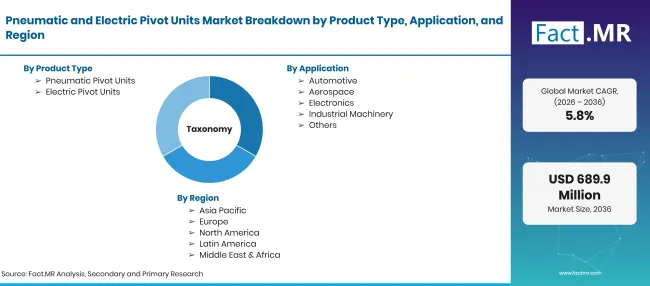
Pneumatic And Electric Pivot Units Market Taxonomy | Source: Fact.MR
| Attribute | Details |
|---|---|
| Quantitative Units | USD million |
| Market Definition | Pneumatic and electric pivot units that give controlled rotary movement to fixtures, workpieces and tooling in industrial production. |
| Product Type | Pneumatic Pivot Units; Electric Pivot Units |
| Application | Automotive; Aerospace; Electronics; Industrial Machinery; Others |
| End-User | Manufacturing; Automotive; Aerospace; Electronics; Others |
| Distribution Channel | Direct Sales; Distributors; Online Sales |
| Regions Covered | North America; Latin America; Western Europe; Eastern Europe; East Asia; South Asia & Pacific; Middle East & Africa |
| Countries Covered | Germany; Brazil; United States; United Kingdom; Japan |
| Companies Profiled | SMC; Festo; Parker Hannifin; SCHUNK; DESTACO; Zimmer Group; Emerson (AVENTICS) |
| Forecast Period | 2026 to 2036 |
| Approach | Unit demand by fixture application, multiplied by average selling prices for pneumatic and electric designs and checked against supplier portfolios and plant investment data. |
Source: Fact.MR analysis. Updated Nov 4, 2026
How is the market segmented?
-
By Product Type
- Pneumatic Pivot Units
- Electric Pivot Units
-
By Application
- Automotive
- Aerospace
- Electronics
- Industrial Machinery
- Others
-
By End-User
- Manufacturing
- Automotive
- Aerospace
- Electronics
- Others
-
By Distribution Channel
- Direct Sales
- Distributors
- Online Sales
-
By Region
- North America
- Latin America
- Western Europe
- Eastern Europe
- East Asia
- South Asia & Pacific
- Middle East & Africa
Frequently Asked Questions
How large is the pneumatic and electric pivot units market in 2026?
What growth rate will the pneumatic and electric pivot units market record?
Which product type leads?
Which application leads?
Which distribution channel leads?
Which country will grow quickest?
Who are the main companies?
What holds the market back?
Who worked on this report


Preview the report firsthand - request a free sample
Free SampleGet the brochure for pricing and purchase details
Download PDF