- Market Value (2025): USD 1.7 Bn
- Estimated Value (2026): USD 1.79 Bn
- Forecast Value (2036): USD 3.06 Bn
- CAGR (2026-2036): 5.5%
What is the Nematicides Market forecast to be worth by 2036?
USD 1.8 billion in 2026 to USD 3.1 billion by 2036 at a 5.5% CAGR.
- As per Fact.MR analysis, the nematicides market crossed a valuation of USD 1.7 billion in 2025.
- Demand is projected to increase from USD 1.79 billion in 2026 to USD 3.06 billion by 2036.
- The forecast represents a 5.5% CAGR from 2026 to 2036 as growers seek effective ways to manage nematode-related crop losses.
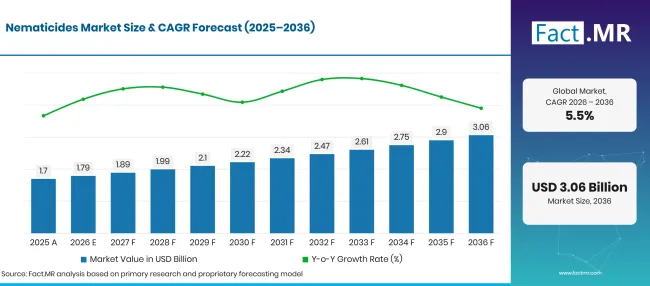
Nematicides Market Forecast Global | Source: Fact.MR
| Year | Basis | Market Value (USD billion) |
|---|---|---|
| 2025 | Actual | 1.7 |
| 2026 | Estimate | 1.79 |
| 2036 | Forecast | 3.06 |
| CAGR 2026 to 2036 | Forecast period | 5.5% |
Source: Fact.MR analysis. Updated Nov 4, 2026
What are the defining numbers behind Nematicides Market growth?
USD 1.3 billion absolute opportunity between 2026 and 2036
- Demand Drivers in the Market
- Rising crop losses from plant-parasitic nematodes are encouraging growers to strengthen crop-protection programmes. Root-knot, cyst and lesion nematodes can weaken root systems and restrict nutrient uptake, affecting plant growth and yield potential.
- Growing interest in biological crop-protection solutions is creating opportunities for bionematicides alongside conventional chemical treatments. Products based on beneficial microorganisms and biologically derived ingredients provide additional options for nematode suppression. Their adoption is gaining attention as growers explore integrated pest-management practices and seek alternatives to repeated chemical applications.
- Expansion of high-value horticulture and intensive crop production is supporting demand for targeted nematode management. Vegetables, fruit crops and protected cultivation systems can be particularly vulnerable to root damage that affects plant development and produce quality. Growers increasingly require crop-specific treatments to protect productivity and maintain commercial standards.
- Advances in active ingredients and seed-treatment technologies are broadening the range of nematode-control solutions available to farmers. Manufacturers are developing products for soil application, in-furrow treatment and seed protection to address nematode pressure during early crop development. These approaches can improve treatment placement and support more targeted crop protection.
- Key Segments Analyzed
- By Type: Bio-Nematicides will account for 32.4% of the market in 2026, reflecting demand for biological approaches to nematode management.
- By Application: Agriculture will hold 68.5% share in 2026, supported by the use of nematicides across commercial crop production.
- By Formulation: Liquid formulations represent 58.2% share in 2026, reflecting their suitability for several soil-treatment and application systems.
- By Crop Type: Cereals & Grains lead with 34.6% of the market in 2026, supported by the need to protect large field-crop areas from soil-borne pests.
- Analyst Opinion at Fact.MR
- Shambhu Nath Jha, Principal Consultant at Fact.MR, states, “Nematicide demand is moving toward more targeted crop-protection programmes. Suppliers need to demonstrate reliable control across relevant nematode species while giving growers practical guidance on application timing, crop suitability and resistance management.”
- Strategic Implications
- Manufacturers should communicate the target nematode species, approved crops and application instructions clearly on product labels.
- Biological product developers need to support performance claims with field trials across different soil types, climates and crop systems.
- Distributors must help growers identify nematode pressure before recommending a treatment, as root symptoms can resemble nutrient deficiencies or other soil-related problems.
- Farmers can compare treatment costs with crop value and expected protection while following local registration requirements and resistance-management guidance.
Germany is projected to register a 6.1% CAGR through 2036. Brazil is set to record 5.6%, followed by the USA at 5.0%. The UK is projected to advance at 4.5%, while Japan is forecast to grow at 4.0%.
How does the Nematicides Market break down by segment?
Fact.MR finds that Bio-Nematicides leads Type at 32.4%; Agriculture leads Application at 68.5%; Liquid leads Formulation at 58.2%; and Cereals & Grains leads Crop Type at 34.6%.
Which Type segment dominates?
Bio-Nematicides is set to hold 32.4% share in 2026.
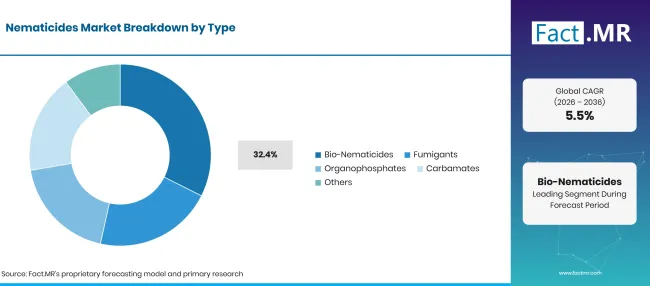
Nematicides Market Breakdown Type | Source: Fact.MR
| Type | Share (2026) |
|---|---|
| Bio-Nematicides (Leading segment) | 32.4% |
| Other segments combined | 67.6%* |
| Total | 100.0% |
Source: Fact.MR analysis. Updated Nov 4, 2026
Biological nematicides use microorganisms or biologically derived materials to suppress plant-parasitic nematodes. Their role in crop-protection programmes is expanding as growers assess options that can complement conventional chemical treatments. Product selection still depends on the target nematode, crop, soil conditions and evidence of field performance.
Which Application segment leads?
Agriculture is set to represent 68.5% share in 2026.
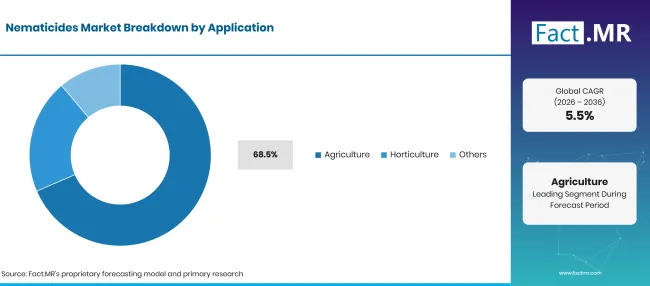
Nematicides Market Breakdown Application | Source: Fact.MR
| Application | Share (2026) |
|---|---|
| Agriculture (Leading segment) | 68.5% |
| Other segments combined | 31.5%* |
| Total | 100.0% |
Source: Fact.MR analysis. Updated Nov 4, 2026
Agriculture accounts for the largest application area because nematode management is directly linked to protecting crop productivity and root health. Horticulture also requires targeted control, particularly in high-value vegetable and fruit production where root damage can affect plant vigour and marketable yields. Other applications may include non-food crop and specialist growing systems, depending on the report's market boundary.
How does Formulation shape demand?
Liquid formulations are likely to account for 58.2% share in 2026.
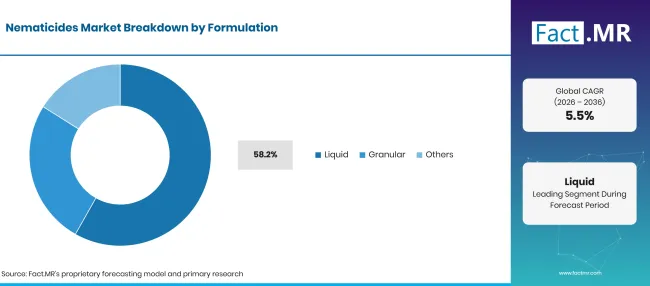
Nematicides Market Breakdown Formulation | Source: Fact.MR
| Formulation | Share (2026) |
|---|---|
| Liquid (Leading segment) | 58.2% |
| Other segments combined | 41.8%* |
| Total | 100.0% |
Source: Fact.MR analysis. Updated Nov 4, 2026
Liquid formulations can be applied through suitable soil-treatment equipment and irrigation systems, depending on the product label. Their use allows growers to deliver active ingredients to the crop root zone. Granular products remain relevant where application equipment, soil incorporation and crop-specific directions favour solid formulations. Formulation choice depends on the active ingredient, application timing and local agronomic conditions.
Which Crop Type dominates?
Cereals & Grains is set to hold 34.6% share in 2026.
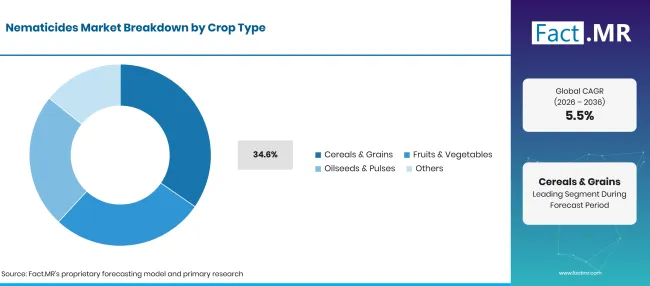
Nematicides Market Breakdown Crop Type 1 | Source: Fact.MR
| Crop Type | Share (2026) |
|---|---|
| Cereals & Grains (Leading segment) | 34.6% |
| Other segments combined | 65.4%* |
| Total | 100.0% |
Source: Fact.MR analysis. Updated Nov 4, 2026
Cereals and grains account for a large area of cultivated farmland, creating a broad requirement for soil-pest management. Nematode pressure varies by crop, soil and region, so growers need to identify the species present before selecting a treatment. Fruits and vegetables can also require intensive nematode management because root damage may affect crop quality and commercial value. Oilseeds and pulses represent another important use area, particularly where crop-specific nematodes threaten root development and yield.
What is accelerating Nematicides Market adoption, and what is holding it back?
Growing need to protect crop roots supports demand, while treatment costs, resistance concerns and registration requirements can limit adoption.
Drivers Impact Analysis
| DRIVER | (~) % IMPACT ON CAGR | GEOGRAPHIC RELEVANCE | IMPACT TIMELINE |
|---|---|---|---|
| Persistent crop losses from plant-parasitic nematodes | +1.0% | Global | Short term (≤ 2 years) |
| Growing adoption of biological nematicides | +0.9% | Europe, Americas, Asia | Medium term (2–4 years) |
| Increasing nematode-control requirements in high-value crops | +0.7% | Global | Medium term (2–4 years) |
| Expansion of seed-treatment and in-furrow technologies | +0.5% | Americas, Asia | Long term (≥ 4 years) |
| Wider adoption of integrated pest-management practices | +0.4% | Global | Long term (≥ 4 years) |
Source: Fact.MR analysis. Updated Nov 4, 2026
Opportunity Impact Analysis
| OPPORTUNITY | (~) % IMPACT ON CAGR | GEOGRAPHIC RELEVANCE | IMPACT TIMELINE |
|---|---|---|---|
| Development of advanced biological nematicide formulations | +0.8% | Global | Medium term (2–4 years) |
| Crop-specific solutions for root-knot and cyst nematodes | +0.6% | Americas, Europe, Asia | Medium term (2–4 years) |
| Expansion of biological seed-treatment technologies | +0.5% | Americas, Asia | Long term (≥ 4 years) |
| Development of non-fumigant nematicide products | +0.4% | North America, Europe | Medium term (2–4 years) |
Source: Fact.MR analysis. Updated Nov 4, 2026
Restraints Impact Analysis
| RESTRAINT | (~) % IMPACT ON CAGR | GEOGRAPHIC RELEVANCE | IMPACT TIMELINE |
|---|---|---|---|
| High treatment costs per cultivated hectare | -0.8% | Global | Short term (≤ 2 years) |
| Strict pesticide registration and residue requirements | -0.6% | Europe, North America, Asia | Medium term (2–4 years) |
| Variable product performance across soil conditions | -0.5% | Global | Medium term (2–4 years) |
| Resistance risks from repeated use of similar active ingredients | -0.4% | Global | Long term (≥ 4 years) |
Source: Fact.MR analysis. Updated Nov 4, 2026
Which countries are scaling the Nematicides Market through 2036?
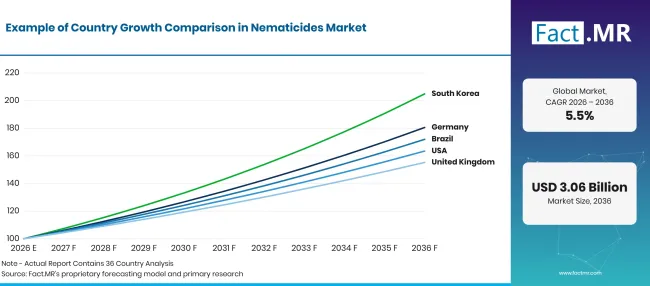
Nematicides Market Growth Index | Source: Fact.MR
| Country | CAGR (2026–2036) |
|---|---|
| Germany | 6.1% |
| Brazil | 5.6% |
| USA | 5.0% |
| UK | 4.5% |
| Japan | 4.0% |
Source: Fact.MR analysis. Updated Nov 4, 2026
What supports Germany adoption?
6.1% CAGR, supported by demand for crop protection and targeted soil-pest management.
Germany's agricultural sector includes cereals, oilseeds and horticultural crops that require crop-specific pest management. Nematicide adoption depends on the presence of economically significant nematode species and the availability of approved treatments. Germany's agricultural sector provides a substantial base for crop-protection solutions. According to Destatis, approximately 5.92 million hectares were under grain crops in 2026, while rapeseed and turnip rape covered around 1.13 million hectares. The scale of cereal and oilseed cultivation supports demand for crop-specific pest management. Nematicide adoption will depend on local nematode pressure and the availability of approved treatments [1].
How is Brazil developing nematicide adoption?
5.6% CAGR, led by large-scale crop production and the need to manage soil-borne pests.
Brazil's extensive soybean, maize, cotton and horticultural production creates demand for crop-protection solutions across different growing regions. Nematode management is relevant where root-knot, cyst and other plant-parasitic nematodes affect crop establishment and productivity. Suppliers can address this market through locally registered products, seed treatments and field support tailored to regional crop systems. Brazil's large-scale grain production supports demand for crop-protection solutions across major agricultural regions. CONAB estimated 2025/26 grain production at 361.7 million tonnes across 83.5 million hectares of planted area. Soybean production was projected at 180.4 million tonnes, while maize production was estimated at 144 million tonnes. [2]
What supports United States adoption?
5.0% CAGR, backed by commercial field-crop production and established crop-protection channels.
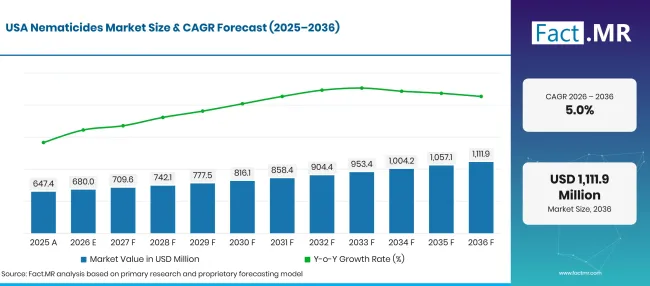
Nematicides Market Forecast Usa | Source: Fact.MR
The United States has a broad market for nematode management across soybean, corn, cotton, vegetables and specialty crops. Growers use chemical and biological products according to the target pest, crop label and local conditions. Product innovation in non-fumigant treatments and biological seed treatments is adding options to existing nematode-control programmes. The United States has a broad commercial crop-production base supporting demand for targeted crop-protection solutions. USDA estimated that farmers planted 95.3 million acres of corn and 85.4 million acres of soybeans in 2026. Cotton planted area was estimated at 9.85 million acres. [3]
How is the United Kingdom building adoption?
4.5% CAGR, shaped by crop protection requirements in arable and horticultural production.
The UK market is influenced by nematode risks in potatoes, vegetables and other susceptible crops. Growers need to consider soil health, crop rotation and approved pesticide options when planning nematode control. Suppliers must demonstrate product suitability under UK conditions and comply with local pesticide authorisation requirements. England's agricultural sector provides a relevant base for nematode-management solutions in arable and horticultural production. Defra reported 8.8 million hectares of utilised agricultural area in 2026, including approximately 2.36 million hectares of cereal crops and 118,000 hectares of horticultural crops. Oilseed rape covered a further 276,000 hectares [4].
What supports Japan adoption?
4.0% CAGR, driven by intensive crop production and demand for targeted pest management.
Japan's intensive agricultural systems include rice, vegetables and other high-value crops. Nematode management requirements differ by crop and growing environment, creating a need for accurate pest identification and suitable treatment selection. Product registration, application precision and compatibility with established crop practices will influence market development. Japan's intensive agricultural production creates demand for targeted crop-protection practices. According to the Ministry of Agriculture, Forestry and Fisheries, the area planted with table rice reached approximately 1.36 million hectares for the 2026 crop year [5].
Who leads the Nematicides Market?
Fact.MR profiles Syngenta AG, Corteva Agriscience, UPL Limited, Bayer AG and ADAMA Agricultural Solutions across the nematicide and crop-protection value chain. All five have identifiable nematicide products or technologies, although their portfolios differ between chemical products, biological treatments and distribution arrangements.
Syngenta AG develops nematode-control solutions through its TYMIRIUM technology. Its portfolio includes products such as VANIVA and VICTRATO, and the company announced US federal registration of TREFINTI nematicide/fungicide for ornamental applications in November 2025 [7]. Corteva Agriscience markets Reklemel-based nematicide solutions. Its Salibro product range includes a California registration announced in January 2025, following earlier product launches in other markets [8].[6][7][8]
UPL Limited is active in biological nematicides through NIMAXXA, a biological seed treatment for soybeans, and ATROFORCE, a bionematicide seed treatment for cotton. The company announced the US registration of ATROFORCE in January 2025 [9] [10]. Bayer AG offers chemical nematicide products such as Velum Prime and has expanded its biological crop-protection portfolio through an agreement to distribute Ecospray's garlic-derived nematicide as Velsinum in selected markets from 2026 [11] [12]. ADAMA Agricultural Solutions markets NIMITZ, a non-fumigant nematicide containing fluensulfone. Its product information identifies applications across several crop groups, including vegetables and root and tuber crops.
Which companies are the key providers?
Key companies list are below:
- Syngenta AG
- Corteva Agriscience
- UPL Limited
- Bayer AG
- ADAMA Agricultural Solutions
Bibliography
- [1] Statistisches Bundesamt (Destatis). (2026, September 2). Anbauflächen, Hektarerträge und Erntemengen ausgewählter Anbaukulturen im Zeitvergleich.
- [2] Companhia Nacional de Abastecimento. (2026, September 15). 12º Levantamento - Safra 2025/26.
- [3] U.S. Department of Agriculture, National Agricultural Statistics Service. (2026, June 30). Corn planted acreage down 3% from 2025, soybean acreage up 5% from last year.
- [4] Department for Environment, Food & Rural Affairs. (2026, September 24). Agricultural land use in England at 1 June 2026.
- [5] Ministry of Agriculture, Forestry and Fisheries. (2026, October 13). 令和8年産の水田における作付状況について [Planting status of paddy fields for the 2026 crop year].
- [6] Syngenta Group News Service. (2024, March). Accelerated innovation provides new game-changing tools for farmers. Syngenta.
- [7] Syngenta. (2025, November 12). Syngenta granted federal registration for Trefinti® nematicide/fungicide in ornamental market.
- [8] Corteva Agriscience. (2025, January 24). Salibro® CA Nematicide with Reklemel™ active registered for California.
- [9] UPL NA Inc. (2024, December 23). UPL Corp launches Nimaxxa™ bionematicide seed treatment to protect soybeans from nematodes in three ways. UPL.
- [10] UPL NA Inc. (2025, January 13). UPL Corp launches Atroforce™ bionematicide seed treatment in cotton. UPL.
- [11] Bayer. (2025, April 16). Next generation nematicide delivers long lasting and cost effective control.
- [12] Bayer. (2025, January 23). Bayer and Ecospray reach distribution agreement for new garlic-sourced biological crop protection product.
This Report Answers
- The report examines demand for nematicides across the specified crop types and agricultural applications.
- Type analysis compares biological nematicides, fumigants, organophosphates, carbamates and other product categories.
- Formulation analysis evaluates liquid and granular product demand.
- Country analysis discusses Germany, Brazil, the USA, the UK and Japan alongside their agricultural and crop-protection requirements.
- The competitive overview profiles Syngenta, Corteva, UPL, Bayer and ADAMA.
What does the Nematicides Market cover?
The market covers chemical and biological products used to manage plant-parasitic nematodes in agricultural and horticultural production. It includes products intended to protect crop roots and reduce damage caused by nematode infestations. The analysis considers product type, application area, formulation and crop category.
What is included in the scope?
Included products are nematicides sold for the control or suppression of plant-parasitic nematodes in crops.
The scope covers biological products, chemical nematicides and fumigant products where they are marketed for nematode control. It also includes liquid and granular formulations and products used across the specified crop categories.
What is excluded from the scope?
The analysis excludes nematicides used solely for non-agricultural purposes unless they fall within the defined crop-protection market.
It also excludes insecticides, fungicides and herbicides that do not carry a nematode-control purpose. General soil conditioners, fertilizers and crop-growth products without nematicidal activity are outside the defined market. Application equipment and standalone diagnostic services are also excluded.
How Was the Analysis Built?
The analysis draws on 120+ sources, 35+ company portfolios, 25+ countries, and more than 20 industry interviews.
- Primary Research: Primary research includes discussions with manufacturers, service providers, technology developers, distributors, end users, and subject-matter experts. These conversations examine purchasing priorities, product adoption, operational challenges, approval requirements, competitive positioning, and the factors that influence wider market acceptance.
- Desk Research: Desk research covers government statistics, regulatory publications, company filings, trade data, technical studies, industry associations, standards, public policy, and other authoritative sources. Every source used in the analysis is documented in the bibliography.
- Market Sizing and Forecasting: Market estimates combine historical performance, demand indicators, pricing and volume trends, segment shares, company participation, country-level growth, adoption patterns, investment activity, and barriers to market expansion.
- Data Validation and Update Cycle: Findings are validated by comparing primary interviews with public data, company activity, regulatory changes, trade patterns, and industry developments. Regular updates review new product launches, capacity changes, partnerships, approvals, and shifts in commercial adoption.
Segmentation
What is the report’s scope and coverage?
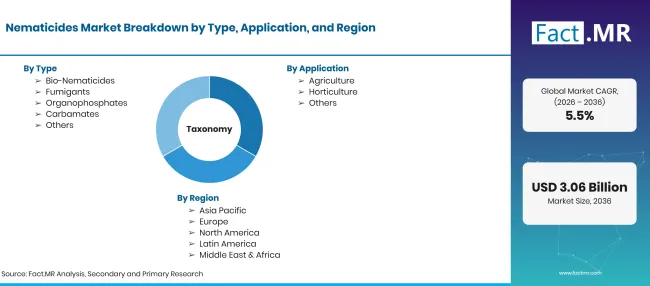
Nematicides Market Taxonomy | Source: Fact.MR
| Attribute | Details |
|---|---|
| Quantitative Units | USD billion in 2026 to USD billion by 2036, at CAGR |
| Market Definition | The nematicides market comprises chemical and biological crop-protection products designed to control plant-parasitic nematodes and reduce their impact on crop growth and agricultural productivity. |
| Type | Bio-Nematicides; Fumigants; Organophosphates; Carbamates; Others |
| Application | Agriculture; Horticulture; Others |
| Formulation | Liquid; Granular; Others |
| Crop Type | Cereals & Grains; Fruits & Vegetables; Oilseeds & Pulses; Others |
| Regions Covered | North America; Latin America; Western Europe; Eastern Europe; East Asia; South Asia & Pacific; Middle East & Africa |
| Countries Covered | Germany; Brazil; USA; UK; Japan |
| Companies Profiled | Syngenta AG; Corteva Agriscience; UPL Limited; Bayer AG; ADAMA Agricultural Solutions |
| Forecast Period | 2026 to 2036 |
| Approach | Market segmentation and scenario-based analysis supported by agricultural, regulatory and company-level information |
Source: Fact.MR analysis. Updated Nov 4, 2026
How is the market segmented?
-
By Type
- Bio-Nematicides
- Fumigants
- Organophosphates
- Carbamates
- Others
-
By Application
- Agriculture
- Horticulture
- Others
-
By Formulation
- Liquid
- Granular
- Others
-
By Crop Type
- Cereals & Grains
- Fruits & Vegetables
- Oilseeds & Pulses
- Others
-
By Region
- North America
- Latin America
- Western Europe
- Eastern Europe
- East Asia
- South Asia & Pacific
- Middle East & Africa
Frequently Asked Questions
How big is the nematicides market in 2026?
What is the CAGR from 2026 to 2036?
Which type segment has the largest share?
Which application segment leads?
Which formulation leads the market?
Which crop type has the largest share?
Which companies are covered?
Who worked on this report


Preview the report firsthand - request a free sample
Free SampleGet the brochure for pricing and purchase details
Download PDF