- Market Value (2025): USD 1.26 Bn
- Estimated Value (2026): USD 1.35 Bn
- Forecast Value (2036): USD 2.71 Bn
- CAGR (2026-2036): 7.2%
What is the Smart Repeater Market forecast to be worth by 2036?
USD 1.35 billion in 2026 to USD 2.71 billion by 2036 at a 7.2% CAGR.
- According to Fact.MR analysis, the smart repeater market stood USD 1.26 billion in 2025.
- Sales are projected to increase from USD 1.35 billion in 2026 to USD 2.71 billion by 2036.
- The market is forecast to grow at 7.2% annually from 2026 to 2036 as households and commercial premises look for practical ways to improve local network coverage.
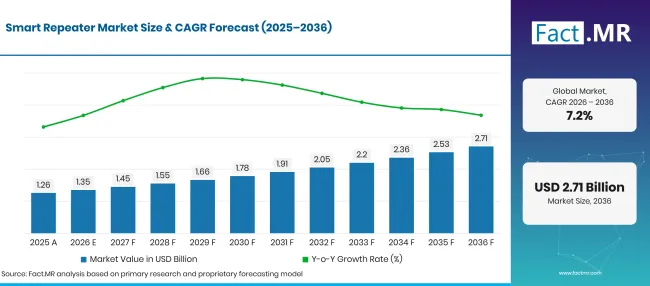
Smart Repeater Market Forecast Global | Source: Fact.MR
| Year | Basis | Market Value (USD billion) |
|---|---|---|
| 2025 | Actual | 1.26 |
| 2026 | Estimate | 1.35 |
| 2036 | Forecast | 2.71 |
| CAGR 2026 to 2036 | Forecast period | 7.2% |
Source: Fact.MR analysis. Updated Nov 4, 2026
What are the defining numbers behind Smart Repeater Market growth?
The market is forecast to generate USD 1.3 billion in value between 2026 and 2036.
- Demand Drivers in the Market
- Home network users often find that a working broadband line still leaves rooms with weak wireless coverage. A repeater can be installed with less disruption than rewiring a property or replacing its network equipment. The International Telecommunication Union estimated that 6 billion people worldwide used the internet in 2025 [1].
- Broadband service providers face questions about indoor coverage after installation. Repeater placement matters because a unit that receives a weak source signal cannot recover the original connection speed. In 2025, Eurostat recorded internet access in 94.0% of German households [2].
- Retailers often sell Wi-Fi repeaters to customers who already own a router but have difficulty getting a usable signal in part of their home. Online product pages can help buyers compare supported bands, setup methods and compatibility before making a purchase.
- New router standards can improve wireless performance while creating compatibility questions for older extenders. Buyers need to check which bands and features their current equipment supports before assuming an upgrade will improve coverage.
- Key Segments Analyzed
- By Product Type: Wi-Fi Repeaters account for 52.3% of 2026 market value, reflecting replacement and room-level coverage purchases.
- By Application: Residential use represents 47.6% of 2026 sales as household layouts influence coverage gaps.
- By Frequency Band: Dual Band units hold 51.8% of 2026 demand and balance familiar router compatibility with band selection.
- By Distribution Channel: Online sales account for 61.2% of 2026 value as consumers compare model specifications before ordering.
- Analyst Opinion at Fact.MR
- Shambhu Nath Jha, Principal Consultant at Fact.MR, states, “Ease of installation is central to the commercial appeal of smart repeaters. A Wi-Fi extender and a cellular signal booster solve different problems, so sellers need to explain that difference clearly.”
- Strategic Implications
- Wi-Fi equipment brands can publish clear router compatibility lists and placement guidance for each extender family.
- Mobile signal equipment installers need to assess usable donor signal and confirm national equipment rules before proposing an amplified system. Portable connectivity also includes mobile Wi-Fi devices.
- Retailers benefit from separating cellular repeaters from Wi-Fi extenders in online catalogues to reduce mistaken orders.
Germany is projected to advance at 8.3% CAGR through 2036, followed by Brazil at 7.6%. The USA carries 6.8%, the UK 6.1%, and Japan 5.4%.
How does the Smart Repeater Market break down by segment?
Wi-Fi repeaters account for 52.3% of product value, residential applications for 47.6%, dual-band units for 51.8%, and online distribution for 61.2%.
Which Product Type dominates?
Wi-Fi Repeaters account for 52.3% of 2026 market value.
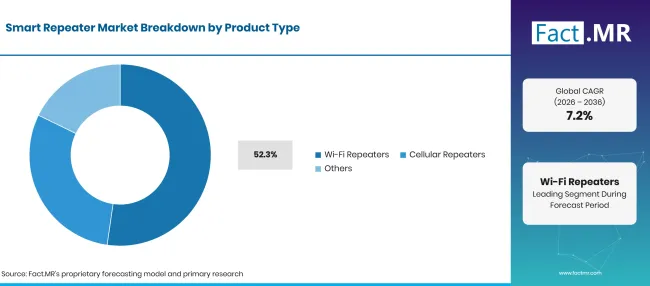
Smart Repeater Market Breakdown Product Type | Source: Fact.MR
| Product Type | Share (2026) |
|---|---|
| Wi-Fi Repeaters (Leading segment) | 52.3% |
| Other segments combined | 47.7% |
| Total | 100.0% |
Source: Fact.MR analysis. Updated Nov 4, 2026
Wi-Fi repeaters extend an existing wireless local area network and are sold mainly to users facing indoor signal gaps. Cellular repeaters serve a different task: relaying mobile-network signals where an approved installation has a usable source signal. Product selection depends on network type before speed or appearance. A consumer device cannot be treated as a substitute for a licensed-band cellular booster.
How does Application shape demand?
Residential applications lead with 47.6% of 2026 value.
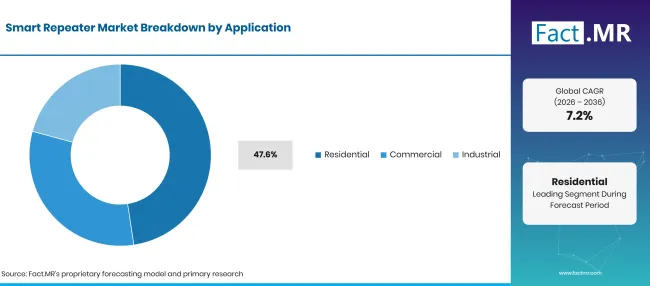
Smart Repeater Market Breakdown Application | Source: Fact.MR
| Application | Share (2026) |
|---|---|
| Residential (Leading segment) | 47.6% |
| Other segments combined | 52.4% |
| Total | 100.0% |
Source: Fact.MR analysis. Updated Nov 4, 2026
Residential buyers usually want usable coverage in a bedroom, upstairs room or home office. The decision starts with router placement and the quality of the original signal. Commercial applications cover smaller offices and customer-facing buildings where wireless availability affects day-to-day work. Industrial sites may need planned access points or specialized radio systems because metal structures and interference complicate simple extender deployment.
What leads the Frequency Band segment?
Dual Band products capture 51.8% of 2026 sales.
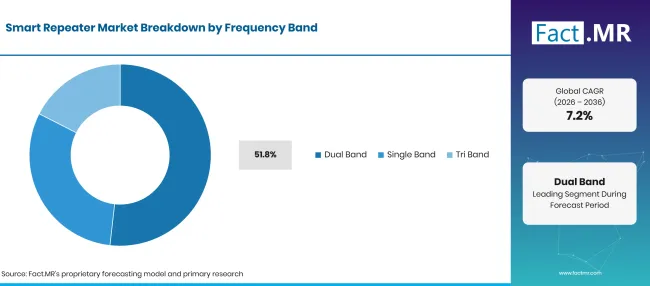
Smart Repeater Market Breakdown Frequency Band | Source: Fact.MR
| Frequency Band | Share (2026) |
|---|---|
| Dual Band (Leading segment) | 51.8% |
| Other segments combined | 48.2% |
| Total | 100.0% |
Source: Fact.MR analysis. Updated Nov 4, 2026
Dual Band repeaters offer a choice between common Wi-Fi bands, helping users balance coverage and performance around their existing router. Single Band models appeal when the network is simple and cost is a deciding factor. Tri Band products address more demanding layouts but need compatible equipment and careful placement to justify their price.
How is Distribution Channel developing?
Online channels hold 61.2% of 2026 market sales.
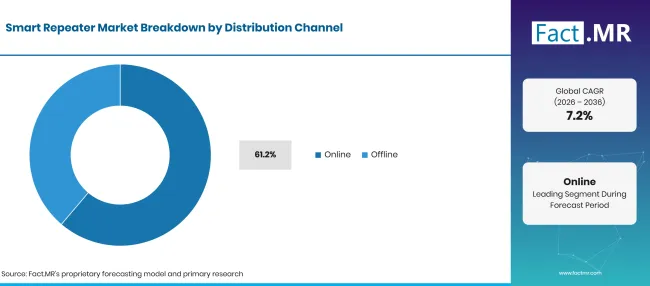
Smart Repeater Market Breakdown Distribution Channel | Source: Fact.MR
| Distribution Channel | Share (2026) |
|---|---|
| Online (Leading segment) | 61.2% |
| Other segments combined | 38.8% |
| Total | 100.0% |
Source: Fact.MR analysis. Updated Nov 4, 2026
Online shops allow consumers to compare range-extender models, check supported standards and read setup instructions before purchase. This approach suits accessories that can be installed without a technician. Offline distribution remains useful where a retailer can inspect the existing router or recommend a suitable cellular-signal assessment. Digital listings also need clear labeling: Wi-Fi range extension and cellular signal boosting are separate product families. Eurostat reported that 74% of individuals in the EU purchased goods or services online in 2025 [4].
What is accelerating Smart Repeater Market adoption, and what is holding it back?
Room-level Wi-Fi coverage gaps and easier online comparison support demand. Network compatibility errors and cellular-equipment rules constrain installations.
Drivers Impact Analysis
| DRIVER | (~) % IMPACT ON CAGR | GEOGRAPHIC RELEVANCE | IMPACT TIMELINE |
|---|---|---|---|
| Room-level Wi-Fi coverage needs | +1.1% | Global | Short term |
| Broader fixed broadband access | +0.9% | Europe; Latin America | Medium term |
| Easy online hardware comparison | +0.7% | North America; Europe | Short term |
| Commercial indoor connectivity | +0.5% | Global | Medium term |
| Replacement of unsupported devices | +0.4% | Mature markets | Long term |
Source: Fact.MR analysis. Updated Nov 4, 2026
Opportunity Impact Analysis
| OPPORTUNITY | (~) % IMPACT ON CAGR | GEOGRAPHIC RELEVANCE | IMPACT TIMELINE |
|---|---|---|---|
| Easy-setup dual-band devices | +0.7% | Global | Medium term |
| Building-level installation services | +0.5% | North America; Europe | Medium term |
| Broadband provider accessory bundles | +0.4% | Global | Long term |
| Cellular coverage assessments | +0.3% | Selected local markets | Long term |
Source: Fact.MR analysis. Updated Nov 4, 2026
Restraints Impact Analysis
| RESTRAINT | (~) % IMPACT ON CAGR | GEOGRAPHIC RELEVANCE | IMPACT TIMELINE |
|---|---|---|---|
| Weak source signal | -0.8% | Global | Short term |
| Router and band incompatibility | -0.6% | Global | Medium term |
| Cellular equipment compliance | -0.5% | Country-specific | Medium term |
| Competition from mesh Wi-Fi | -0.4% | Mature markets | Long term |
Source: Fact.MR analysis. Updated Nov 4, 2026
Which countries are scaling the Smart Repeater Market through 2036?
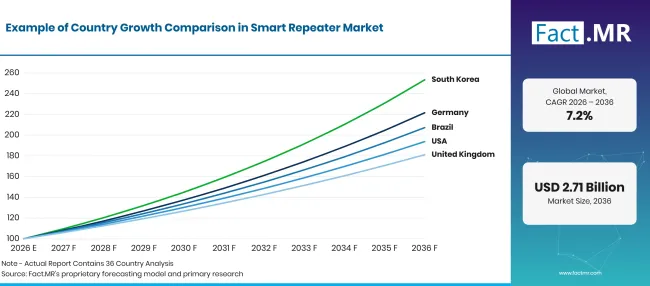
Smart Repeater Market Growth Index | Source: Fact.MR
| Country | CAGR (2026 to 2036) |
|---|---|
| Germany | 8.3% |
| Brazil | 7.6% |
| USA | 6.8% |
| UK | 6.1% |
| Japan | 5.4% |
Source: Fact.MR analysis. Updated Nov 4, 2026
Why is Germany seeing stronger demand for Wi-Fi repeaters in connected households?
8.3% CAGR, linked to high household internet access and careful equipment compatibility.
German household buyers generally assess a Wi-Fi extender after identifying weak reception behind walls or across floors. Germany's Federal Network Agency reported in June 2026 that fixed broadband connections offering at least 100 Mbps reached 23.6 million in 2025 [8]. Eurostat's 2026 digital infrastructure release reported high household internet access across Germany [6]. Commercial sites with complex layouts are expected to favor a basic wireless survey before purchasing extra devices.
How is wider household connectivity expanding Brazil’s Wi-Fi repeater market?
7.6% CAGR, related to expanding household connectivity and regional retail access.
Brazil's regional internet providers can introduce Wi-Fi coverage accessories when households arrange installation or report poor reception indoors. The Brazilian Institute of Geography and Statistics reported in July 2026 that 76 million households had internet access in 2025 [5]. Anatel reported in October 2026 that Brazil had 57.9 million fixed broadband subscriptions in the third quarter of 2026 [7]. Household connectivity and fixed-service counts describe the installed network environment for repeater sales. Product guidance needs to distinguish an indoor Wi-Fi problem from a weak external connection.
Why do U.S. households continue to add Wi-Fi coverage equipment alongside existing routers?
6.8% CAGR, with home-network accessories and specialist cellular coverage installations.
US consumers usually begin with an existing router and a specific room that receives an unreliable Wi-Fi signal. The US Census Bureau's 2024 American Community Survey, published in 2025, recorded about 122.6 million households with a broadband internet subscription [9].
How are broadband upgrades reshaping Wi-Fi repeater demand in the UK?
6.1% CAGR, associated with broadband upgrades and home wireless distribution.
UK households increasingly review indoor Wi-Fi performance after upgrading their fixed broadband line. Ofcom reported in May 2026 that full fibre was available to 82% of UK homes as of January 2026 [10]. Small offices may prefer a short site assessment before adding coverage equipment. Ofcom's November 2025 Connected Nations report counted 10.6 million premises taking full-fiber services [3].
What is driving selective Wi-Fi repeater replacement across Japan’s mature connected-home market?
5.4% CAGR, reflecting mature connected households and selective equipment replacement.
Japan's consumer electronics retailers position compact Wi-Fi extenders beside routers, making clear band descriptions useful at the point of sale. The Ministry of Economy, Trade and Industry reported in August 2025 that online sales of electrical appliances, audiovisual products, computers and peripherals reached JPY 2.7443 trillion in 2024 [11]. Commercial buildings with internal partitions create a separate reason to assess signal placement before purchase.
Who leads the Smart Repeater Market?
Fact.MR considers that competition divides into consumer Wi-Fi range extenders, enterprise radio systems and cellular coverage equipment.
Comba Telecom Systems Holdings Ltd., Nextivity Inc. (CEL-FI), Huawei, ZTE and Movandi Corporation operate principally in operator network equipment, where repeaters and indoor coverage systems need to be distinguished from consumer plug-in products. FRTek Co., Ltd. and Amphenol’s Andrew business address infrastructure and coverage equipment. Operator backhaul equipment is separately addressed under microwave network equipment.
Which companies are the key providers?
Key companies include Comba Telecom Systems Holdings Ltd.; Nextivity Inc. (CEL-FI); Movandi Corporation; Amphenol (Andrew); FRTek Co., Ltd.
- Comba Telecom Systems Holdings Ltd.
- Nextivity Inc. (CEL-FI)
- Movandi Corporation
- Amphenol (Andrew)
- FRTek Co., Ltd.
Bibliography
- [1] International Telecommunication Union. (2025, November 17). Global number of Internet users increases, but disparities deepen key digital divides.
- [2] D-Link. (2025, October 30). DAP-1325 – N300 Wi-Fi Range Extender: End of Support Notice.
- [3] Eurostat. (2026, February 3). Digital economy and society statistics – households and individuals.
- [4] Instituto Brasileiro de Geografia e Estatística. (2026, July 2). Internet chega a 95% de domicílios do país em 2025.
- [5] Eurostat. (2026, July). Secure, performant and sustainable digital infrastructures.
- [6] Agência Nacional de Telecomunicações. (2026, October 20). Anatel divulga Relatório de Monitoramento da Competição do 3º trimestre de 2026.
- [7] Statistics Bureau of Japan. (2026). Japan Statistical Yearbook 2026: Chapter 12 – Information and Communication.
- [8] U.S. Census Bureau. (2024). Presence of a Computer and Type of Internet Subscription in Household: 2024 ACS 1-Year Estimates, Table B28003.
- [9] Ofcom. (2026, May 13). Connected Nations update: Spring 2026.
- [10] Ministry of Economy, Trade and Industry. (2025, August 26). Results of FY2024 E-Commerce Market Survey Compiled.
- [11] Bundesnetzagentur. (2026, June 18). Bundesnetzagentur publishes 10th annual report on broadband speed tests.
This Report Answers
- The report compares Wi-Fi and cellular repeaters and identifies the different source-signal conditions that determine their use.
- Product analysis reviews the residential segment and separates it from commercial and industrial coverage requirements.
- Frequency-band analysis considers what dual-band units offer and when simple or multi-band models are appropriate.
- Distribution analysis explains why online equipment descriptions and offline installation advice shape purchases.
- Country analysis reviews Germany, Brazil, USA, UK and Japan with distinct network and retail considerations.
What does the Smart Repeater Market cover?
In Fact.MR analysis, the market covers devices sold to extend usable wireless coverage from an existing network. Wi-Fi repeaters work with local wireless routers, while cellular repeaters serve mobile-signal coverage under applicable radio rules. Related indoor communication services include voice over Wi-Fi services.
What is included in the scope?
Fact.MR analysis points to how included products are standalone Wi-Fi range extenders and eligible cellular repeaters sold through consumer or specialist channels.
What is excluded from the scope?
New broadband subscriptions and the underlying access lines are excluded. Ordinary routers, complete mesh kits, dedicated access points and operator base stations fall outside the standalone repeater boundary unless their sale is specifically for an included repeater device.
How Was the Analysis Built?
The analysis draws on 120+ sources, 35+ company portfolios, 25+ countries, and more than 20 industry interviews.
- Primary Research: Primary research includes discussions with manufacturers, service providers, technology developers, distributors, end users, and subject-matter experts. These conversations examine purchasing priorities, product adoption, operational challenges, approval requirements, competitive positioning, and the factors that influence wider market acceptance.
- Desk Research: Desk research covers government statistics, regulatory publications, company filings, trade data, technical studies, industry associations, standards, public policy, and other authoritative sources. Every source used in the analysis is documented in the bibliography.
- Market Sizing and Forecasting: Market estimates combine historical performance, demand indicators, pricing and volume trends, segment shares, company participation, country-level growth, adoption patterns, investment activity, and barriers to market expansion.
- Data Validation and Update Cycle: Findings are validated by comparing primary interviews with public data, company activity, regulatory changes, trade patterns, and industry developments. Regular updates review new product launches, capacity changes, partnerships, approvals, and shifts in commercial adoption.
Segmentation
What is the report’s scope and coverage?
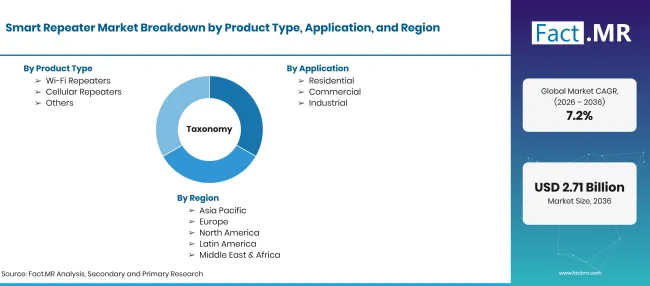
Smart Repeater Market Taxonomy | Source: Fact.MR
| Attribute | Details |
|---|---|
| Quantitative Units | USD billion |
| Market Definition | Standalone equipment that extends an existing Wi-Fi or cellular signal in a supported deployment |
| Product Type | Wi-Fi Repeaters; Cellular Repeaters; Others |
| Application | Residential; Commercial; Industrial |
| Frequency Band | Dual Band; Single Band; Tri Band |
| Distribution Channel | Online; Offline |
| Regions Covered | North America; Latin America; Western Europe; Eastern Europe; East Asia; South Asia & Pacific; Middle East & Africa |
| Countries Covered | Germany; Brazil; USA; UK; Japan |
| Companies Profiled | Comba Telecom Systems Holdings Ltd.; Nextivity Inc. (CEL-FI); Movandi Corporation; Amphenol (Andrew); FRTek Co., Ltd. |
| Forecast Period | 2026 to 2036 |
| Approach | Application mapping, product distinctions, public connectivity indicators and supplier portfolio analysis |
Source: Fact.MR analysis. Updated Nov 4, 2026
How is the market segmented?
-
By Product Type
- Wi-Fi Repeaters
- Cellular Repeaters
- Others
-
By Application
- Residential
- Commercial
- Industrial
-
By Frequency Band
- Dual Band
- Single Band
- Tri Band
-
By Distribution Channel
- Online
- Offline
-
By Region
- North America
- Latin America
- Western Europe
- Eastern Europe
- East Asia
- South Asia & Pacific
- Middle East & Africa
Frequently Asked Questions
How big is the Smart Repeater Market in 2026?
What is the Smart Repeater Market CAGR?
Which product type leads?
Which application leads?
Who are the main companies in the smart repeater market?
Who worked on this report


Preview the report firsthand - request a free sample
Free SampleGet the brochure for pricing and purchase details
Download PDF