- Market Value (2025): USD 3.8 Bn
- Estimated Value (2026): USD 4.02 Bn
- Forecast Value (2036): USD 7.06 Bn
- CAGR (2026-2036): 5.8%
What is the Polyacrylamide for Oilfield Market forecast to be worth by 2036?
USD 4.0 billion in 2026 to USD 7.1 billion by 2036, at the CAGR of 5.8%.
- As per Fact.MR analysis, the polyacrylamide for oilfield market was valued at USD 3.8 billion in 2025.
- Demand will grow from USD 4.02 billion in 2026 to USD 7.06 billion by 2036.
- The forecast records a 5.8% CAGR from 2026 to 2036 due to expansion of unconventional oil and gas production
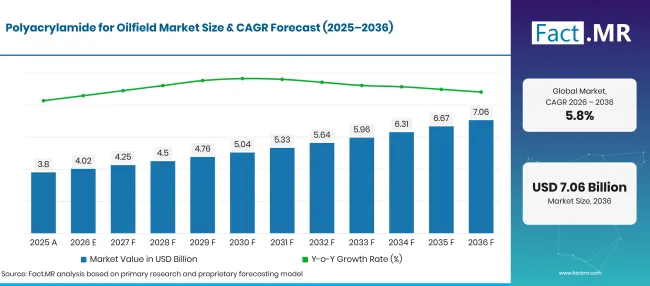
Polyacrylamide For Oilfield Market Forecast Global | Source: Fact.MR
| Year | Basis | Market Value (USD billion) |
|---|---|---|
| 2025 | Actual | 3.8 |
| 2026 | Estimate | 4.02 |
| 2036 | Forecast | 7.06 |
| CAGR 2026 to 2036 | Forecast period | 5.8% |
Source: Fact.MR analysis. Updated Nov 6, 2026
What are the defining numbers behind Polyacrylamide for Oilfield Market growth?
USD 3.1 billion in absolute opportunity between 2026 and 2036.
- Demand Drivers in the Market
- Enhanced oil recovery programmes increase the need for polymer flooding solutions. Polyacrylamide can increase injected-water viscosity and improve the mobility ratio during polymer flooding. SNF supplies polymer technologies for chemical enhanced oil recovery, including polymer flooding systems designed to improve sweep efficiency in suitable reservoirs [1].[1]
- Mature oilfields create demand for improved recovery methods. Operators can use polymer-based chemical flooding to improve sweep efficiency and recover residual oil after conventional water injection. CNPC has documented the commercial use of polymer flooding at Daqing Oilfield since 2002 [2].
- Expanding unconventional oil and gas activity supports demand for specialised polymers. Polyacrylamide-based products are used in selected drilling and fracturing-fluid formulations. Suppliers need to adapt polymer properties to salinity, temperature and reservoir conditions.
- Produced-water management creates additional application opportunities. Oilfield operations generate water streams that require treatment before reuse or discharge. Polyacrylamide grades can support flocculation and separation processes, subject to the characteristics of the water and the treatment system.
- Oilfield chemical suppliers are expanding application-specific portfolios. Nuoer Energy lists hydrolyzed polyacrylamide, PHPA and anionic, cationic, non-ionic and zwitterionic polyacrylamide among its oilfield chemical products [3].
- Key Segments Analyzed
- By Product Type: Anionic polyacrylamide will account for 45.8% of the market in 2026, reflecting its use in polymer flooding and selected oilfield fluid applications.
- By Application: Enhanced Oil Recovery leads with a 42.0% share in 2026, supported by polymer flooding and reservoir recovery programmes.
- By End-User: Onshore operations are projected to hold 61.8% share in 2026, reflecting the importance of land-based oilfield activity.
- Analyst Opinion at Fact.MR
- Shambhu Nath Jha, Principal Consultant at Fact.MR, states, “Polyacrylamide demand in oilfields depends on how effectively a polymer performs under specific reservoir conditions. Suppliers that can demonstrate suitable viscosity control and reliable performance in high-salinity or high-temperature environments can strengthen their position with operators pursuing improved oil recovery.”
- Strategic Implications
- Polymer manufacturers should provide technical data covering molecular weight, degree of hydrolysis, charge density and compatibility with reservoir brine.
- Oilfield chemical suppliers need to support product selection through laboratory testing and field trials rather than relying on generic performance claims.
- EOR service providers must work with operators to assess injection pressure, polymer concentration and reservoir response before scaling polymer flooding.
- Drilling and fracturing chemical suppliers can distinguish polyacrylamide grades used for fluid-loss control or friction reduction from those designed for polymer flooding.
- Oilfield operators need to assess chemical costs against incremental recovery, water handling requirements and field operating conditions.
Germany is projected to record a 6.7% CAGR through 2036. Brazil is set to post 6.1%, followed by the USA at 5.5%. The UK is estimated to advance at 4.9%, while Japan is forecast at 4.4%.
How does the Polyacrylamide for Oilfield Market break down by segment?
Fact.MR estimates that Anionic Polyacrylamide will lead Product Type with a 45.8% share in 2026. Enhanced Oil Recovery will dominate Application at 42.0%, while Onshore operations will account for 61.8% of End-User demand.
Which Product Type dominates?
Anionic Polyacrylamide is set to hold a 45.8% share in 2026.
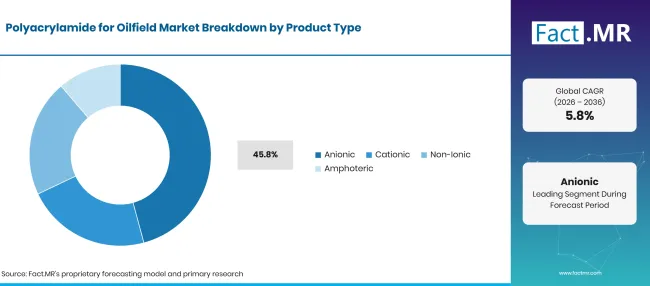
Polyacrylamide For Oilfield Market Breakdown Product Type | Source: Fact.MR
| Product Type | Share (2026) |
|---|---|
| Anionic (Leading segment) | 45.8% |
| Other segments combined | 54.2%* |
| Total | 100.0% |
Source: Fact.MR analysis. Updated Nov 6, 2026
Anionic polyacrylamide is widely used in polymer flooding because its molecular characteristics can help increase water viscosity and improve displacement efficiency. Product selection depends on molecular weight, degree of hydrolysis, reservoir temperature and brine salinity. Cationic grades are more commonly associated with separation and flocculation applications, while non-ionic and amphoteric grades serve specialised conditions. Their suitability for oilfield use depends on the intended operation and formulation requirements.
What leads the Application segment?
Enhanced Oil Recovery is set to represent 42.0% share in 2026.
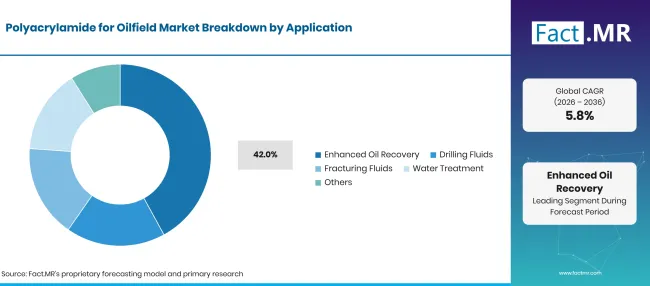
Polyacrylamide For Oilfield Market Breakdown Application | Source: Fact.MR
| Application | Share (2026) |
|---|---|
| Enhanced Oil Recovery (Leading segment) | 42.0% |
| Other segments combined | 58.0%* |
| Total | 100.0% |
Source: Fact.MR analysis. Updated Nov 6, 2026
Enhanced oil recovery applications use polyacrylamide to increase the viscosity of injected water and improve the distribution of fluids through the reservoir. Polymer flooding can help improve sweep efficiency and reduce the amount of water moving through high-permeability channels. Drilling fluids and fracturing fluids use specialised polymer formulations for different operating purposes. Water treatment applications can involve flocculation and separation of suspended material from produced water.
How does End-User shape demand?
Onshore operations are projected to account for 61.8% share in 2026.
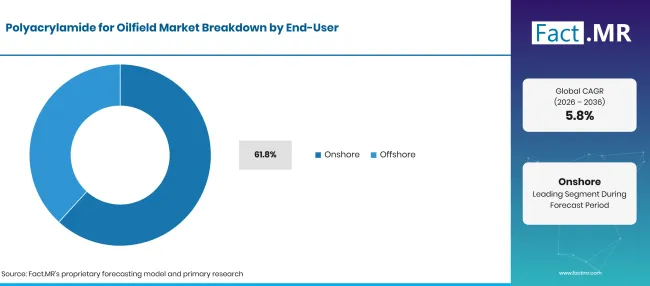
Polyacrylamide For Oilfield Market Breakdown End User | Source: Fact.MR
| End-User | Share (2026) |
|---|---|
| Onshore (Leading segment) | 61.8% |
| Other segments combined | 38.2%* |
| Total | 100.0% |
Source: Fact.MR analysis. Updated Nov 6, 2026
Onshore oilfields account for a substantial portion of the market's projected demand because polymer flooding and other chemical recovery methods can be deployed across land-based production assets. Operators can use polyacrylamide in mature fields where conventional recovery methods leave significant residual oil. Offshore applications require careful consideration of logistics, chemical handling, injection systems and operating costs. Product selection in both settings depends on reservoir characteristics and the economics of the recovery programme.
What is accelerating Polyacrylamide for Oilfield Market adoption, and what is holding it back?
Demand for improved oil recovery and specialised drilling fluids supports market expansion, while polymer cost, reservoir-specific performance requirements and produced-water management constraints can limit adoption.
Drivers Impact Analysis
| DRIVER | (~) % IMPACT ON CAGR | GEOGRAPHIC RELEVANCE | IMPACT TIMELINE |
|---|---|---|---|
| Expansion of polymer flooding for enhanced oil recovery | +1.1% | China, North America, Middle East | Medium term (2–4 years) |
| Mature oilfield recovery programmes | +0.9% | China, Americas | Long term (≥ 4 years) |
| Demand for specialised drilling and fracturing fluids | +0.7% | USA, Brazil | Short term (≤ 2 years) |
| Produced-water treatment requirements | +0.5% | Global | Medium term (2–4 years) |
| Reservoir-specific polymer formulation development | +0.4% | Global | Long term (≥ 4 years) |
Source: Fact.MR analysis. Updated Nov 6, 2026
Opportunity Impact Analysis
| OPPORTUNITY | (~) % IMPACT ON CAGR | GEOGRAPHIC RELEVANCE | IMPACT TIMELINE |
|---|---|---|---|
| High-temperature and high-salinity EOR polymers | +0.8% | Middle East, China | Medium term (2–4 years) |
| Expansion of polymer flooding in mature fields | +0.7% | China, North America | Long term (≥ 4 years) |
| Customized polymer grades for field conditions | +0.6% | Global | Medium term (2–4 years) |
| Integrated chemical supply and field services | +0.5% | Middle East, Asia | Short term (≤ 2 years) |
| Improved produced-water treatment formulations | +0.4% | Global | Medium term (2–4 years) |
Source: Fact.MR analysis. Updated Nov 6, 2026
Restraints Impact Analysis
| RESTRAINT | (~) % IMPACT ON CAGR | GEOGRAPHIC RELEVANCE | IMPACT TIMELINE |
|---|---|---|---|
| High polymer treatment and injection costs | -0.8% | Global | Short term (≤ 2 years) |
| Sensitivity to reservoir temperature and salinity | -0.7% | Middle East, Americas | Medium term (2–4 years) |
| Injectivity and formation damage concerns | -0.6% | Global | Medium term (2–4 years) |
| Oil price volatility and changes in capital spending | -0.5% | Global | Short term (≤ 2 years) |
| Handling, dissolution and mixing requirements | -0.4% | Global | Short term (≤ 2 years) |
Source: Fact.MR analysis. Updated Nov 6, 2026
Which countries are scaling the Polyacrylamide for Oilfield Market through 2036?
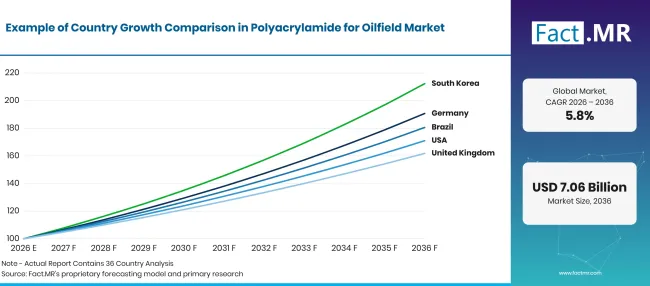
Polyacrylamide For Oilfield Market Growth Index | Source: Fact.MR
| Country | CAGR (2026–2036) |
|---|---|
| Germany | 6.7% |
| Brazil | 6.1% |
| USA | 5.5% |
| UK | 4.9% |
| Japan | 4.4% |
Source: Fact.MR analysis. Updated Nov 6, 2026
What supports Germany's market growth?
6.7% CAGR, supported by demand for specialised oilfield chemicals and industrial process expertise.
Germany has a relatively limited domestic crude oil production base compared with major producing countries. Its oil and gas services and chemicals industries nevertheless provide a market for specialised production chemicals and imported oilfield technologies. The International Energy Agency tracks Germany's crude oil production, imports and exports, highlighting the country's reliance on a wider oil supply chain [4]. Polyacrylamide demand is likely to be more closely linked to oilfield chemical availability and technology supply than to domestic extraction volumes alone.
How is Brazil developing polyacrylamide adoption?
6.1% CAGR, shaped by expanding offshore oil production and continued investment in field operations.
Brazil's oil sector provides a significant opportunity for oilfield chemical suppliers. The National Agency of Petroleum, Natural Gas and Biofuels reported average national oil production of approximately 3.8 million barrels per day in 2025, 12% higher than in 2024. Pre-salt production averaged around 3.0 million barrels per day [5]. These operating volumes create demand for chemicals used in production, water management and reservoir recovery. Suppliers need to tailor formulations to offshore logistics and field-specific operating conditions.
What supports United States adoption?
5.5% CAGR, driven by high crude oil production and demand for specialised drilling and recovery chemicals.
The United States remained the world's largest crude oil producer in 2025, recording average production of 13.6 million barrels per day, according to the U.S. Energy Information Administration [6]. The Permian Basin accounted for approximately 48% of national crude oil production. Continued activity in major producing basins supports demand for drilling, fracturing and production chemicals. Polyacrylamide suppliers can address this demand through friction-reduction and fluid-management formulations, alongside suitable polymer products for enhanced recovery.
How is the United Kingdom building market demand?
4.9% CAGR, backed by mature offshore fields and the need to improve recovery from existing assets.
The UK oil and gas sector continues to manage mature offshore production assets in the North Sea. The Department for Energy Security and Net Zero publishes historical crude oil and petroleum production data through 2025, providing a basis for tracking changes in domestic upstream activity [7]. Oilfield chemical suppliers can serve operators seeking to manage production fluids and improve recovery from existing fields. Demand depends on field economics, remaining reserves and operators' investment priorities.
What supports Japan's market development?
4.4% CAGR, led by specialist upstream operations and demand for imported oilfield technologies.
Japan has a smaller domestic upstream sector than the major oil-producing economies in this country comparison. The Ministry of Economy, Trade and Industry publishes annual and monthly petroleum statistics, including data relevant to domestic petroleum supply and production [8]. Suppliers need to demonstrate reliable product performance and provide technical support for specific field conditions.
Who leads the Polyacrylamide for Oilfield Market?
Fact.MR profiles SNF Group, BASF SE, PetroChina, Shandong Nuoer Biological Technology, Anhui Tianrun Chemicals, Beijing Hengju Chemical Group, SINOFLOC, ZL EOR Chemicals, Jiangsu Hengfeng Fine Chemical and Yixing Bluwat Chemicals across the oilfield polymer and chemical supply landscape.
SNF Group is a directly relevant participant in enhanced oil recovery. Its oil and gas portfolio includes polymer solutions for chemical EOR, supported by field assessments, polymer injection equipment and technical services. The company identifies polyacrylamide as a central part of its polymer flooding solutions.
BASF SE participates in the oilfield chemicals market through products for well construction, flow assurance, phase separation and enhanced oil recovery. Its published EOR portfolio includes surfactants [9]. PetroChina (Daqing Oilfield / CNPC) is relevant through its use and development of polymer flooding technologies. CNPC documents the commercial application of polymer flooding at Daqing Oilfield and its contribution to improved oil recovery. However, this establishes operator and technology expertise rather than independent evidence that PetroChina sells polyacrylamide commercially to third-party oilfield customers. Shandong Nuoer Biological Technology Co., Ltd. manufactures polyacrylamide products for oilfield drilling and enhanced oil recovery. Its portfolio includes anionic, cationic and non-ionic grades, alongside customised formulations for industrial applications [10].
Anhui Tianrun Chemicals Co., Ltd. manufactures water-soluble and functional polyacrylamide products for petroleum, mining and water-treatment applications. Its product portfolio includes anionic, cationic, non-ionic and amphoteric grades [11].
SINOFLOC directly supplies anionic polyacrylamide for enhanced oil recovery and polymer flooding. Its published portfolio includes grades intended for high-temperature and high-salinity oilfield conditions. Yixing Bluwat Chemicals Co., Ltd. supplies PHPA and polyacrylamide products for oil and gas drilling and enhanced oil recovery, according to its company profile.
Commercial competition depends on polymer performance under demanding field conditions. Manufacturers need to demonstrate reliable dissolution, viscosity retention and compatibility with reservoir water. Oilfield operators also consider injection requirements, chemical costs and the availability of field-level technical support when selecting suppliers.
Which companies are the key providers?
Key companies profiled include SNF Group; BASF SE; PetroChina (Daqing Oilfield / CNPC); Shandong Nuoer Biological Technology Co., Ltd.; Anhui Tianrun Chemicals Co., Ltd.; Beijing Hengju Chemical Group Co., Ltd.; SINOFLOC; ZL EOR Chemicals Ltd.; Jiangsu Hengfeng Fine Chemical Co., Ltd.; and Yixing Bluwat Chemicals Co., Ltd.
- SNF Group
- BASF SE
- PetroChina (Daqing Oilfield / CNPC)
- Shandong Nuoer Biological Technology Co., Ltd.
- Anhui Tianrun Chemicals Co., Ltd.
- Beijing Hengju Chemical Group Co., Ltd.
- SINOFLOC
- ZL EOR Chemicals Ltd.
- Jiangsu Hengfeng Fine Chemical Co., Ltd.
- Yixing Bluwat Chemicals Co., Ltd.
Bibliography
- [1] SNF Group. (n.d.). Enhanced oil recovery (EOR): Proven polymer performance.
- [2] China National Petroleum Corporation. (n.d.). Technology shapes the future: Chemical flood for enhanced oil recovery.
- [3] Nuoer Energy Solutions Trading Co., Ltd. (n.d.). Our business: Oilfield chemicals and chemical flooding solutions.
- [4] International Energy Agency. (n.d.). Germany: Oil production, imports and exports.
- [5] Agência Nacional do Petróleo, Gás Natural e Biocombustíveis. (2026, June 30). ANP divulga dados consolidados do setor regulado em 2025.
- [6] U.S. Energy Information Administration. (2026, July 9). The United States produced more crude oil than any other country in 2025.
- [7] Department for Energy Security and Net Zero. (2026, July 30). Crude oil and petroleum: Production, imports and exports. GOV.UK.
- [8] Ministry of Economy, Trade and Industry. (2026, June 30). Petroleum Statistics: Preliminary Report. Government of Japan.
- [9] BASF. (n.d.). Oilfield chemicals.
- [10] Shandong Nuoer Biological Technology Co., Ltd. (n.d.). Polyacrylamide.
- [11] Anhui Tianrun Chemicals Co., Ltd. (n.d.). Company overview.
This Report Answers
- The report examines polyacrylamide demand across enhanced oil recovery, drilling fluids, fracturing fluids and water treatment.
- Product analysis compares anionic, cationic, non-ionic and amphoteric polyacrylamide.
- End-user analysis evaluates onshore and offshore oilfield applications.
- Country analysis discusses Germany, Brazil, the USA, the UK and Japan.
- The competitive overview assesses the oilfield chemical manufacturers, polymer suppliers and EOR technology participants.
What does the Polyacrylamide for Oilfield Market cover?
The market covers polyacrylamide products used in oil and gas exploration, drilling, production and recovery operations. It includes polymer grades used to modify fluid viscosity, support drilling-fluid performance, reduce friction in selected fracturing applications and assist produced-water treatment. Enhanced oil recovery is a major application because polymer flooding can improve the mobility ratio between injected water and reservoir oil.
What is included in the scope?
The scope includes anionic, cationic, non-ionic and amphoteric polyacrylamide products sold for oilfield applications. It covers polymer flooding and other enhanced oil recovery operations, drilling and fracturing fluid formulations, and associated water-treatment applications. Both onshore and offshore oilfield operations are included.
What is excluded from the scope?
The analysis excludes polyacrylamide sold exclusively for municipal wastewater treatment, paper manufacturing, mining, agriculture and other non-oilfield applications. General-purpose water-treatment grades are excluded unless they are specifically supplied for oilfield use. Oilfield equipment, drilling services and standalone EOR engineering services are also excluded from the chemical product revenue boundary.
How Was the Analysis Built?
The analysis draws on 120+ sources, 35+ company portfolios, 25+ countries, and more than 20 industry interviews.
- Primary Research: Primary research includes discussions with manufacturers, service providers, technology developers, distributors, end users, and subject-matter experts. These conversations examine purchasing priorities, product adoption, operational challenges, approval requirements, competitive positioning, and the factors that influence wider market acceptance.
- Desk Research: Desk research covers government statistics, regulatory publications, company filings, trade data, technical studies, industry associations, standards, public policy, and other authoritative sources. Every source used in the analysis is documented in the bibliography.
- Market Sizing and Forecasting: Market estimates combine historical performance, demand indicators, pricing and volume trends, segment shares, company participation, country-level growth, adoption patterns, investment activity, and barriers to market expansion.
- Data Validation and Update Cycle: Findings are validated by comparing primary interviews with public data, company activity, regulatory changes, trade patterns, and industry developments. Regular updates review new product launches, capacity changes, partnerships, approvals, and shifts in commercial adoption.
Segmentation
What is the report's scope and coverage?
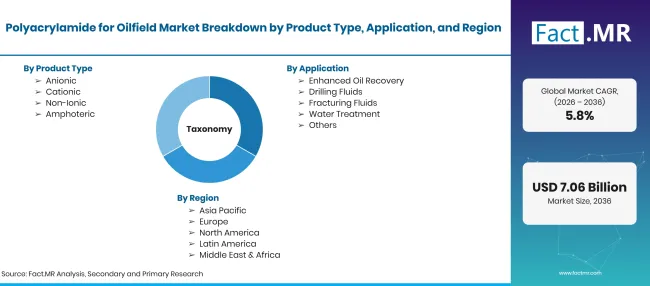
Polyacrylamide For Oilfield Market Taxonomy | Source: Fact.MR
| Attribute | Details |
|---|---|
| Quantitative Units | USD billion |
| Market Definition | The polyacrylamide for oilfield market comprises the production and supply of polyacrylamide-based polymers used in upstream oil and gas operations. These products are applied in enhanced oil recovery to improve fluid mobility control and increase oil displacement, as well as in drilling fluids and hydraulic fracturing fluids to support viscosity management, shale stabilization and friction reduction. |
| Product Type | Anionic; Cationic; Non-Ionic; Amphoteric |
| Application | Enhanced Oil Recovery; Drilling Fluids; Fracturing Fluids; Water Treatment; Others |
| End-User | Onshore; Offshore |
| Regions Covered | North America; Latin America; Western Europe; Eastern Europe; East Asia; South Asia & Pacific; Middle East & Africa |
| Countries Covered | Germany; Brazil; USA; UK; Japan |
| Companies Profiled | SNF Group; BASF SE; PetroChina (Daqing Oilfield / CNPC); Shandong Nuoer Biological Technology; Anhui Tianrun Chemicals; Beijing Hengju Chemical Group; SINOFLOC; ZL EOR Chemicals; Jiangsu Hengfeng Fine Chemical; Yixing Bluwat Chemicals |
| Forecast Period | 2026 to 2036 |
| Approach | Market segmentation and scenario-based analysis supported by oilfield production indicators and company product information |
Source: Fact.MR analysis. Updated Nov 6, 2026
How is the market segmented?
-
By Product Type
- Anionic
- Cationic
- Non-Ionic
- Amphoteric
-
By Application
- Enhanced Oil Recovery
- Drilling Fluids
- Fracturing Fluids
- Water Treatment
- Others
-
By End-User
- Onshore
- Offshore
-
By Region
- North America
- Latin America
- Western Europe
- Eastern Europe
- East Asia
- South Asia & Pacific
- Middle East & Africa
Frequently Asked Questions
How big is the Polyacrylamide for Oilfield Market in 2026?
What is the CAGR from 2026 to 2036?
Which product type has the largest share?
Which application leads the market?
Which end-user segment dominates?
Which companies are covered?
Who worked on this report


Preview the report firsthand - request a free sample
Free SampleGet the brochure for pricing and purchase details
Download PDF