- Market Value (2025): USD 4.39 Bn
- Estimated Value (2026): USD 4.59 Bn
- Forecast Value (2036): USD 7.15 Bn
- CAGR (2026-2036): 4.5%
What is the Elastomeric Rubber Sheeting Market forecast to be worth by 2036?
USD 4.6 billion in 2026 to USD 7.2 billion by 2036 at a 4.5% CAGR.
- Fact.MR estimates that the elastomeric rubber sheeting market was valued at USD 4.39 billion in 2025
- Demand is projected to increase from USD 4.59 billion in 2026 to USD 7.15 billion by 2036.
- The market is projected to expand at a 4.5% CAGR from 2026 to 2036, supported by demand for flexible rubber materials across industrial, automotive and construction applications.
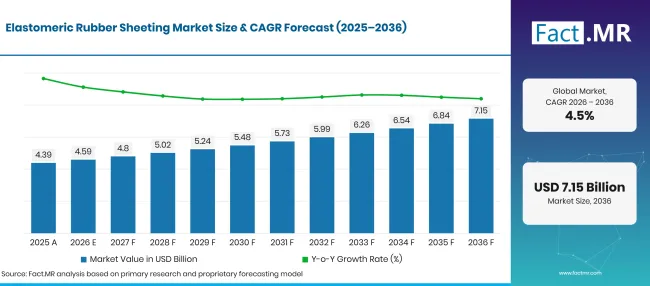
Elastomeric Rubber Sheeting Market Forecast Global | Source: Fact.MR
| Year | Basis | Market Value (USD billion) |
|---|---|---|
| 2025 | Actual | 4.39 |
| 2026 | Estimate | 4.59 |
| 2036 | Forecast | 7.15 |
| CAGR 2026 to 2036 | Forecast period | 4.5% |
Source: Fact.MR analysis. Updated Nov 3, 2026
What are the defining numbers behind Elastomeric Rubber Sheeting Market growth?
USD 2.6 billion absolute opportunity between 2026 and 2036.
- Demand Drivers in the Market
- Industrial buyers use rubber sheeting for sealing, equipment protection and process applications. Material selection depends on the operating environment, including exposure to chemicals, temperature changes, abrasion and weathering. Trelleborg identifies sealing and machine or process protection among the main uses of industrial rubber sheeting [1].
- Automotive and manufacturing applications require rubber components that can maintain flexibility and performance under mechanical stress. Continental lists elastomer sheetings for static and dynamic applications across industrial requirements [2].
- India's Department for Promotion of Industry and Internal Trade estimated non-tyre rubber goods exports at INR 16,332.81 crore in FY2025–26, compared with INR 15,051.15 crore in FY2024–25. These figures describe a broad rubber-products category that includes products beyond elastomeric rubber sheeting [3].[3]rubber sheets
- Key Segments Analyzed
- By Material Type, EPDM is projected to account for 32.4% of the market in 2026. Its resistance to ozone, UV exposure and weathering supports use in outdoor and industrial environments.
- By Application, Industrial applications are set to hold 28.3% of the market in 2026, reflecting demand for sealing, equipment protection and process-related uses.
- By End-User, Manufacturing leads with 33.7% share in 2026 as industrial facilities use rubber sheets in machinery, fabrication and maintenance.
- By Distribution Channel, Offline sales will represent 78.4% of the market in 2026, supported by specification-led purchases and the need to assess material grades and dimensions.
- Analyst Opinion at Fact.MR
- Shambhu Nath Jha, Principal Consultant at Fact.MR, states, “Rubber sheeting buyers are likely to focus on material performance and service life rather than price alone. Suppliers that can offer consistent specifications and application guidance may be better positioned to serve industrial and manufacturing customers.”
- Strategic Implications
- Manufacturers should communicate the grade, thickness, hardness and performance characteristics of each sheet clearly.
- Suppliers need to match EPDM, natural rubber, silicone and neoprene grades to the operating conditions of the application.
- Distributors can maintain access to commonly specified sheet sizes and provide technical support for custom-cut requirements.
- Industrial buyers must assess total service life and replacement frequency alongside initial material costs.
The USA is projected to record a 5.6% CAGR through 2036, followed by the UK at 5.2%, Brazil at 4.2%, Japan at 3.7%, and Germany at 3.2%, according to Fact.MR's country-level forecasts.
How does the Elastomeric Rubber Sheeting Market break down by segment?
According to Fact.MR, EPDM leads Material Type at 32.4%; Industrial leads Application at 28.3%; Manufacturing leads End-User at 33.7%; and Offline leads Distribution Channel at 78.4%.
Which Material Type dominates?
EPDM is projected to hold 32.4% of the market in 2026.
| Material Type | Share (2026) |
|---|---|
| EPDM (Leading segment) | 32.4% |
| Other segments combined | 67.6%* |
| Total | 100.0% |
Source: Fact.MR analysis. Updated Nov 3, 2026
EPDM sheeting is used in applications where resistance to ozone, UV exposure and outdoor weather conditions is important. Trelleborg identifies EPDM sheeting for general industry, construction, automotive and marine applications. Natural rubber is used where flexibility and mechanical properties are important, while silicone rubber is selected for applications requiring a wider temperature operating range. Neoprene serves applications that require a balance of weather resistance and general-purpose performance.
Which Application leads the market?
Industrial applications are set to represent 28.3% of the market in 2026.
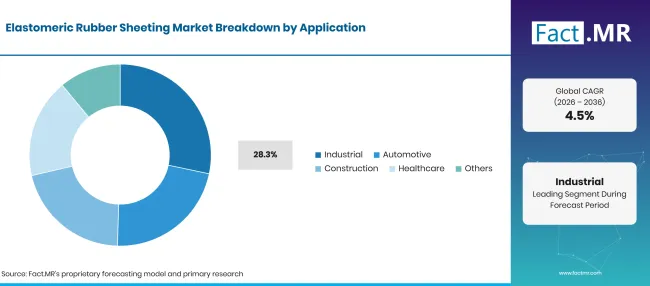
Elastomeric Rubber Sheeting Market Breakdown Application | Source: Fact.MR
| Application | Share (2026) |
|---|---|
| Industrial (Leading segment) | 28.3% |
| Other segments combined | 71.7%* |
| Total | 100.0% |
Source: Fact.MR analysis. Updated Nov 3, 2026
Industrial applications include sealing, gasket production, equipment protection and process-related uses. Rubber sheeting can help protect machinery and surfaces from wear or environmental exposure. Automotive applications use rubber sheets and fabricated components in sealing and related functions. Construction uses include waterproofing, insulation and protective applications, while healthcare demand depends on the suitability of the selected rubber grade for the intended environment.
Which End-User accounts for the largest share?
Manufacturing is expected to account for 33.7% of the market in 2026.
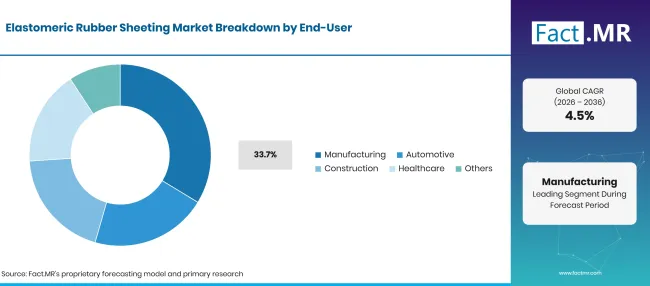
Elastomeric Rubber Sheeting Market Breakdown End User | Source: Fact.MR
| End-User | Share (2026) |
|---|---|
| Manufacturing (Leading segment) | 33.7% |
| Other segments combined | 66.3%* |
| Total | 100.0% |
Source: Fact.MR analysis. Updated Nov 3, 2026
Manufacturing facilities use rubber sheeting in equipment maintenance, fabrication, sealing and protective applications. The required material depends on the machinery, operating temperature and exposure to oils, chemicals or abrasion. Automotive and construction users select sheets for more specific component and site requirements. Healthcare buyers may require products that meet relevant material and regulatory specifications.
How does Distribution Channel shape demand?
Offline distribution is projected to account for 78.4% of the market in 2026.
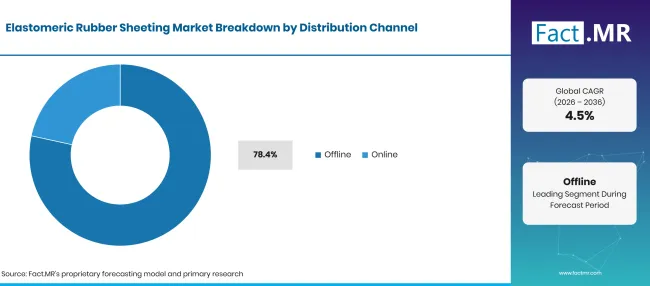
Elastomeric Rubber Sheeting Market Breakdown Distribution Channel | Source: Fact.MR
| Distribution Channel | Share (2026) |
|---|---|
| Offline (Leading segment) | 78.4% |
| Other segments combined | 21.6%* |
| Total | 100.0% |
Source: Fact.MR analysis. Updated Nov 3, 2026
Offline distribution remains important because buyers often need to review technical specifications, confirm dimensions and discuss application requirements before purchasing. Industrial distributors can also provide cut-to-size sheets. Online channels help buyers compare product ranges and place orders for standard specifications. Their use is likely to be more suitable where material requirements are clearly defined.
What is accelerating Elastomeric Rubber Sheeting Market adoption, and what is holding it back?
Industrial maintenance requirements and demand for application-specific rubber materials support adoption, while raw material price changes and specification requirements can constrain purchasing.
Drivers Impact Analysis
| DRIVER | (~) % IMPACT ON CAGR | GEOGRAPHIC RELEVANCE | IMPACT TIMELINE |
|---|---|---|---|
| Industrial equipment sealing and protection | +0.9% | Global | Medium term (2–4 years) |
| Demand for weather-resistant EPDM sheets | +0.8% | Europe, Americas | Medium term (2–4 years) |
| Automotive component applications | +0.7% | Global | Long term (≥ 4 years) |
| Manufacturing maintenance and fabrication | +0.6% | Global | Short term (≤ 2 years) |
| Custom sheet sizes and compound development | +0.4% | Global | Medium term (2–4 years) |
Source: Fact.MR analysis. Updated Nov 3, 2026
Opportunity Impact Analysis
| OPPORTUNITY | (~) % IMPACT ON CAGR | GEOGRAPHIC RELEVANCE | IMPACT TIMELINE |
|---|---|---|---|
| High-performance EPDM and silicone grades | +0.8% | Global | Medium term (2–4 years) |
| Custom-cut and fabricated rubber sheets | +0.7% | North America, Europe, Asia | Short term (≤ 2 years) |
| Industrial equipment modernization | +0.6% | Global | Long term (≥ 4 years) |
| Application-specific rubber compounds | +0.5% | Global | Medium term (2–4 years) |
Source: Fact.MR analysis. Updated Nov 3, 2026
Restraints Impact Analysis
| RESTRAINT | (~) % IMPACT ON CAGR | GEOGRAPHIC RELEVANCE | IMPACT TIMELINE |
|---|---|---|---|
| Volatility in natural and synthetic rubber prices | -0.8% | Global | Short term (≤ 2 years) |
| Competition from alternative sealing materials | -0.6% | Global | Medium term (2–4 years) |
| Grade and specification mismatch | -0.5% | Global | Short term (≤ 2 years) |
| Quality consistency across suppliers | -0.4% | Global | Medium term (2–4 years) |
Source: Fact.MR analysis. Updated Nov 3, 2026
Which countries are scaling the Elastomeric Rubber Sheeting Market through 2036?
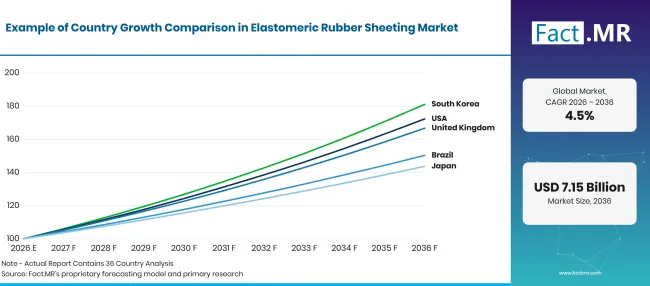
Elastomeric Rubber Sheeting Market Growth Index | Source: Fact.MR
| Country | CAGR (2026–2036) |
|---|---|
| Germany | 3.2% |
| Brazil | 4.2% |
| USA | 5.6% |
| UK | 5.2% |
| Japan | 3.7% |
Source: Fact.MR analysis. Updated Nov 3, 2026
What supports Germany adoption?
3.2% CAGR, supported by demand from industrial manufacturing and automotive supply chains.
Germany's industrial base creates demand for rubber materials used in sealing, machinery protection and fabrication. Suppliers serving this market need to provide consistent material specifications and technical documentation. EPDM and other elastomer grades can be selected according to weather exposure, temperature and chemical contact.
How is Brazil developing elastomeric rubber sheeting adoption?
4.2% CAGR, shaped by industrial activity and demand for rubber products across manufacturing and construction.
Brazil's rubber-products industry serves a range of industrial and commercial requirements. Buyers need sheets suited to local operating conditions and application-specific dimensions. Suppliers that maintain distribution reach and offer technical assistance can serve industrial customers.
What supports United States adoption?
5.6% CAGR, driven by industrial maintenance, equipment protection and established rubber-product distribution.
The United States has a developed market for industrial rubber products. Rubber-Cal lists sheet rubber across EPDM, neoprene, silicone and other material categories and offers products for industrial and commercial use [4]. Buyers can source standard sheets or request fabrication based on their equipment and application requirements.
How is the United Kingdom building adoption?
5.2% CAGR, backed by demand for industrial sealing, equipment protection and construction-related applications.
UK demand is linked to the use of elastomeric materials in manufacturing facilities and infrastructure-related applications. EPDM sheets are relevant where weathering and ozone resistance are important. Purchasing decisions depend on the required performance grade and compliance with applicable product specifications.
What supports Japan adoption?
3.7% CAGR, led by manufacturing requirements and demand for engineered rubber materials.
Japan's manufacturing base creates demand for materials used in equipment, automotive components and industrial processes. Rubber sheet suppliers need to meet requirements for dimensional consistency and material performance. Silicone and other specialty elastomers can serve applications where temperature resistance or specific operating characteristics are important.
Who leads the Elastomeric Rubber Sheeting Market?
Fact.MR identifies Trelleborg AB, Continental AG, American Biltrite Inc., Warco and Kiran Rubber Industries among the companies with directly verifiable rubber sheeting or elastomer sheeting portfolios. Nanjing Skypro Rubber & Plastic Co. Ltd. and Zenith Rubber also show direct product evidence.
Trelleborg offers industrial rubber sheeting in natural and synthetic elastomers, including EPDM, neoprene and other grades. Its product portfolio covers sealing and equipment protection [1]. Continental lists elastomer sheetings manufactured from a range of materials for static and dynamic applications. American Biltrite offers sheet rubber across major elastomers and fabric-reinforced options [5].
Warco identifies itself as a rubber sheet manufacturer with in-house compounding, mixing, calendering and sheet-processing capabilities [6]. Kiran Rubber Industries lists rubber sheets in natural rubber and neoprene among its product range [7]. Zenith Rubber manufactures industrial rubber sheeting in rolls, tiles and plates [8]. Nanjing Skypro Rubber & Plastic identifies EPDM, silicone and natural rubber sheeting among its products [9].
Hanna Rubber Company lists sheet rubber and gasket materials in its industrial product portfolio [10]. Rubber-Cal identifies itself as a distributor of industrial rubber products and offers sheet rubber in multiple elastomer types. These two companies are best treated as distribution and supply-channel participants rather than automatically classified as primary sheet manufacturers.
Which companies are the key providers?
The competitive landscape includes rubber sheeting manufacturers, specialist processors and industrial distributors. Companies listed for manufacturer-level assessment include Trelleborg, Continental, American Biltrite, WARCO, Kiran Rubber Industries, Zenith Rubber and Nanjing Skypro Rubber & Plastic. Hanna Rubber Company and Rubber-Cal are treated separately as supply and distribution participants.
- Trelleborg AB
- Continental AG
- American Biltrite Inc.
- Warco
- Kiran Rubber Industries
- Zenith Rubber
- Nanjing Skypro Rubber & Plastic Co. Ltd.
- Hanna Rubber Company
- Rubber-Cal Inc.
Bibliography
- [1] Trelleborg. (n.d.). Industrial rubber sheeting
- [2] Continental. (n.d.). Compounds & sheetings
- [3] Department for Promotion of Industry and Internal Trade. (2026). Annual report 2025–26: Specific industries and their development. Government of India.
- [4] Rubber-Cal. (n.d.). Sheet rubber
- [5] American Biltrite. (n.d.). Sheet rubber
- [6] West American Rubber Company. (n.d.). Rubber sheet
- [7] Kiran Rubber Industries. (n.d.). Rubber sheet
- [8] Zenith Industrial Rubber Products Private Limited. (n.d.). Industrial rubber sheets
- [9] Nanjing Skypro Rubber & Plastic Co., Ltd. (n.d.). About us.
- [10] Hanna Rubber Company. (n.d.). Sheet rubber supplier.
This Report Answers
- The report describes how elastomeric rubber sheeting is used across industrial, automotive, construction and healthcare applications.
- Material analysis compares EPDM, natural rubber, silicone rubber and neoprene.
- End-user analysis examines demand from manufacturing, automotive, construction and healthcare industries.
- Country analysis discusses Germany, Brazil, USA, UK and Japan alongside their respective market growth estimates.
- The competitive overview profiles manufacturers and suppliers with verifiable rubber sheeting portfolios.
What does the Elastomeric Rubber Sheeting Market cover?
The market covers flexible rubber sheets manufactured from natural and synthetic elastomers for industrial and commercial applications. These sheets are supplied in different thicknesses, widths, hardness levels and material grades. Their uses include sealing, gasket fabrication, insulation, equipment protection, flooring and other application-specific requirements. Market demand depends on the physical and chemical properties required by the end application.
What is included in the scope?
Included products comprise elastomeric rubber sheets made from EPDM, natural rubber, silicone rubber, neoprene and other relevant rubber compounds. The market covers sheets supplied in standard formats as well as customized sizes for industrial, automotive, construction and healthcare applications. Both offline and online distribution channels are included.
What is excluded from the scope?
The analysis excludes finished rubber products such as tyres, hoses, conveyor belts and molded components when sold as separate product categories. Rubber adhesives, sealants and coatings are excluded unless they form part of a sheet product covered by the defined market. Raw rubber, synthetic rubber feedstocks and unprocessed polymer compounds are also outside the market boundary. Sales of fabrication machinery and installation equipment are excluded.
How Was the Analysis Built?
The analysis draws on 120+ sources, 35+ company portfolios, 25+ countries, and more than 20 industry interviews.
- Primary Research: Primary research includes discussions with manufacturers, distributors, industrial buyers, automotive suppliers, construction material providers and subject-matter experts. These conversations examine purchasing priorities, product specifications, material selection, operational challenges and competitive positioning.
- Desk Research: Desk research covers government statistics, company product portfolios, corporate publications, trade data, technical studies, industry associations, standards and other authoritative sources. Every source used in the analysis is documented in the bibliography.
- Market Sizing and Forecasting: Market estimates combine historical performance, demand indicators, pricing and volume trends, segment shares, company participation, country-level growth, adoption patterns and barriers to market expansion.
- Data Validation and Update Cycle: Findings are validated by comparing primary interviews with public data, company activity, product launches, manufacturing developments and changes in industrial demand. Regular updates review new product offerings, capacity changes, partnerships and shifts in commercial adoption.
Segmentation
What is the report’s scope and coverage?
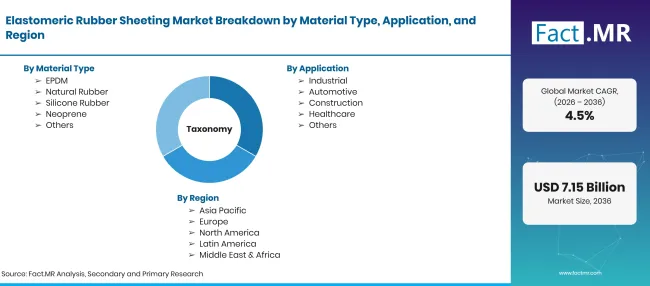
Elastomeric Rubber Sheeting Market Taxonomy | Source: Fact.MR
| Attribute | Details |
| Quantitative Units | USD billion |
| Market Definition | The elastomeric rubber sheeting market comprises flexible rubber sheets manufactured from natural and synthetic elastomers for use across industrial and commercial applications. These sheets provide sealing and surface protection while offering flexibility and resistance to environmental exposure, abrasion and mechanical stress. |
| Material Type | EPDM; Natural Rubber; Silicone Rubber; Neoprene; Others |
| Application | Industrial; Automotive; Construction; Healthcare; Others |
| End-User | Manufacturing; Automotive; Construction; Healthcare; Others |
| Distribution Channel | Offline; Online |
| Regions Covered | North America; Latin America; Western Europe; Eastern Europe; East Asia; South Asia & Pacific; Middle East & Africa |
| Countries Covered | Germany; Brazil; USA; UK; Japan |
| Companies Profiled | Trelleborg AB; Continental AG; American Biltrite Inc.; Warco; Kiran Rubber Industries; Zenith Rubber; Nanjing Skypro Rubber & Plastic Co. Ltd.; Hanna Rubber Company; Rubber-Cal Inc. |
| Forecast Period | 2026 to 2036 |
| Approach | Market segmentation and scenario-based analysis supported by company product portfolios and industrial demand indicators |
Source: Fact.MR analysis. Updated Nov 3, 2026
How is the market segmented?
-
By Material Type
- EPDM
- Natural Rubber
- Silicone Rubber
- Neoprene
- Others
-
By Application
- Industrial
- Automotive
- Construction
- Healthcare
- Others
-
By End-User
- Manufacturing
- Automotive
- Construction
- Healthcare
- Others
-
By Distribution Channel
- Offline
- Online
-
By Region
- North America
- Latin America
- Western Europe
- Eastern Europe
- East Asia
- South Asia & Pacific
- Middle East & Africa
Frequently Asked Questions
How big is the Elastomeric Rubber Sheeting Market in 2026?
What is the CAGR from 2026 to 2036?
Which material type has the largest share?
Which application leads the market?
Which end-user accounts for the largest share?
Which distribution channel leads?
Which companies are covered?
Who worked on this report


Preview the report firsthand - request a free sample
Free SampleGet the brochure for pricing and purchase details
Download PDF