- Market Value (2025): USD 3.8 Bn
- Estimated Value (2026): USD 4.01 Bn
- Forecast Value (2036): USD 6.79 Bn
- CAGR (2026-2036): 5.4%
What is the Scale Inhibitors Market forecast to be worth by 2036?
USD 4.0 billion in 2026 to USD 6.8 billion by 2036, at a CAGR of 5.4%.
- As per the Fact.MR analysis, the market was valued at USD 3.8 billion in 2025.
- Demand will grow from USD 4.01 billion in 2026 to USD 6.79 billion by 2036.
- The forecast represents a 5.4% CAGR between 2026 and 2036, supported by the need to manage mineral deposits across oil and gas operations, industrial water systems, and other process applications.
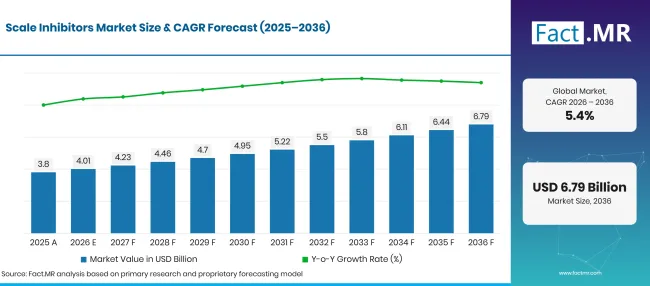
Scale Inhibitors Market Forecast Global | Source: Fact.MR
| Year | Basis | Market Value (USD billion) |
|---|---|---|
| 2025 | Actual | 3.8 |
| 2026 | Estimate | 4.01 |
| 2036 | Forecast | 6.79 |
| CAGR 2026 to 2036 | Forecast period | 5.4% |
Source: Fact.MR analysis. Updated Nov 6, 2026
What are the defining numbers behind Scale Inhibitors Market growth?
USD 2.8 billion in absolute opportunity between 2026 and 2036
- Demand Drivers in the Market
- Scale control in oil and gas production supports demand for chemical inhibitors. The U.S. Department of Energy reported approximately 22 million barrels of produced water per day in the Permian Basin as of 2025 in its April 2026 infographic [1]. In addition, the U.S. Energy Information Administration forecast that American crude oil production would average 13.8 million barrels per day in 2026 [2]. [1][2]
- Industrial water-treatment requirements support demand for scale inhibitors. Cooling towers, boilers, and other water systems can experience mineral deposits when dissolved salts exceed their solubility limits. Chemical treatment helps protect heat-transfer surfaces and maintain operating efficiency [3].[3]
- Growth in membrane treatment and water reuse supports the growth of the market. Reverse osmosis and desalination systems concentrate dissolved salts, increasing the risk of membrane scaling. Antiscalants are used to control deposits and support reliable membrane operation [4] [5].
- Demand for application-specific formulations supports market growth. Operators need products that work under different water chemistries and operating conditions. Phosphonates and polymeric inhibitors are selected according to the scale minerals present, brine composition, temperature, and treatment method [6].[6]
- Key Segments Analyzed
- By Active Ingredient Type: Phosphonates will account for 38.2% of the market in 2026, supported by their use in controlling carbonate and sulfate scale in industrial and oilfield water systems.
- By Application: Oil & Gas segment lead with a 34.7% share in 2026, reflecting the need to manage mineral deposits in production wells, pipelines, and produced-water systems.
- By Form: Liquid products will hold a 71.5% share in 2026, supported by their suitability for metered dosing and continuous chemical treatment.
- Analyst Opinion at Fact.MR
- Shambhu Nath Jha, Principal Consultant at Fact.MR, states, “Scale inhibitor suppliers are likely to compete on performance under demanding water conditions, compatibility with other treatment chemicals, and the ability to maintain protection at controlled dosage levels. Buyers should assess inhibitor performance through water analysis and application-specific testing rather than relying only on broad product claims.”
- Strategic Implications
- Manufacturers should provide application-specific performance data covering scale type, temperature range, brine composition, and recommended dosage.
- Oil and gas operators need to evaluate inhibitor selection against produced-water chemistry and the potential for scale formation during production and reinjection.
- Industrial water-treatment providers must demonstrate how chemical programs protect heat exchangers, boilers, cooling circuits, and membrane systems.
- Industrial operators can compare overall treatment costs by considering chemical dosage and the expenses involved in monitoring and maintenance rather than focusing only on the price per unit of chemical.
Germany is projected to record a 6.2% CAGR through 2036. Brazil is set to grow at 5.7%, followed by the USA at 5.1%. The UK is forecast to advance at 4.6%, while Japan is expected to record a 4.1% CAGR.
How does the Scale Inhibitors Market break down by segment?
Fact.MR identifies phosphonates as the leading active ingredient type with a 38.2% share, Oil & Gas as the leading application with a 34.7% share, and liquid products as the leading form with a 71.5% share in 2026.
Which Active Ingredient Type dominates?
Phosphonates are set to hold a 38.2% share of the market in 2026.
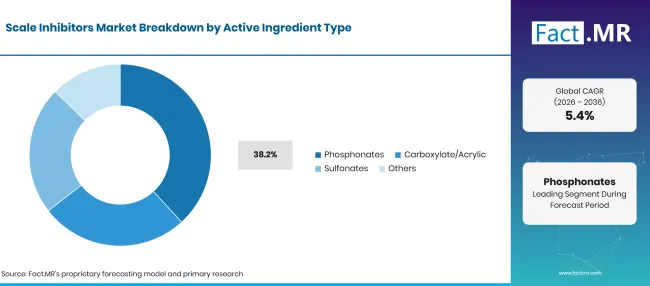
Scale Inhibitors Market Breakdown Active Ingredient Type | Source: Fact.MR
| Active Ingredient Type | Share (2026) |
|---|---|
| Phosphonates (Leading segment) | 38.2% |
| Other segments combined | 61.8%* |
| Total | 100.0% |
Source: Fact.MR analysis. Updated Nov 6, 2026
Phosphonates are widely used in scale-control programs because they can inhibit mineral crystal formation and growth at relatively low concentrations. Their performance depends on the water chemistry and operating conditions as well as the minerals responsible for scaling. Carboxylate and acrylic polymers offer dispersancy and compatibility with demanding process conditions. Sulfonated polymers and other chemistries address specialised treatment requirements.
What leads the Application segment?
Oil & Gas is set to represent a 34.7% share in 2026.
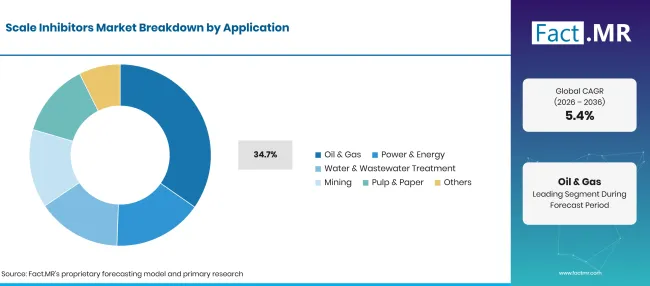
Scale Inhibitors Market Breakdown Application | Source: Fact.MR
| Application | Share (2026) |
|---|---|
| Oil & Gas (Leading segment) | 34.7% |
| Other segments combined | 65.3%* |
| Total | 100.0% |
Source: Fact.MR analysis. Updated Nov 6, 2026
Oil and gas production can create conditions in which dissolved minerals precipitate as water composition, pressure, and temperature change. Deposits can form in production tubing, wellbores, pipelines, and processing equipment. Scale inhibitors are applied through continuous injection, squeeze treatments, or other field-specific methods to limit deposition and reduce production interruptions. Power and energy facilities, water and wastewater treatment plants, mining operations, and pulp and paper mills also require scale management to protect process equipment and maintain operating efficiency.
How does Form shape demand?
Liquid products are likely to account for a 71.5% share in 2026.
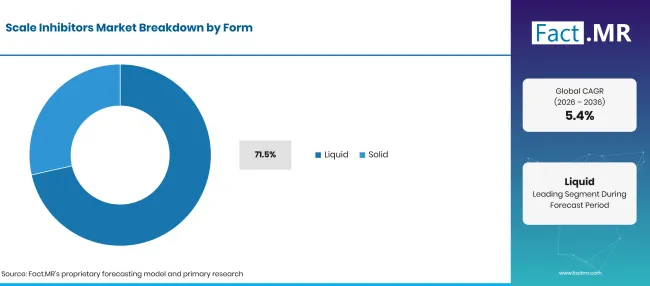
Scale Inhibitors Market Breakdown Form | Source: Fact.MR
| Form | Share (2026) |
|---|---|
| Liquid (Leading segment) | 71.5% |
| Solid | 28.5%* |
| Total | 100.0% |
Source: Fact.MR analysis. Updated Nov 6, 2026
Liquid scale inhibitors are suitable for dosing pumps and continuous chemical injection systems used in oilfield production and industrial water treatment. Their dosage can be adjusted according to water quality and operating requirements. Solid products are preferred where controlled release or treatment-system design requires a non-liquid format. Selection depends on solubility and storage conditions as well as the available dosing infrastructure and compatibility with the treatment process.
What is accelerating Scale Inhibitors Market growth, and what is holding it back?
Increasing oilfield production requirements and industrial water-treatment needs support demand, while chemical costs and application-specific performance constraints can limit wider uptake.
Drivers Impact Analysis
| DRIVER | (~) % IMPACT ON CAGR | GEOGRAPHIC RELEVANCE | IMPACT TIMELINE |
|---|---|---|---|
| Scale prevention in oil and gas production | +1.1% | Americas, Middle East | Medium term (2–4 years) |
| Industrial cooling and boiler-water treatment | +0.8% | Global | Short term (≤ 2 years) |
| Expansion of membrane water treatment | +0.6% | Europe, Asia, Americas | Medium term (2–4 years) |
| Demand for produced-water treatment | +0.5% | Americas, Middle East | Medium term (2–4 years) |
| Application-specific chemical formulations | +0.4% | Global | Long term (≥ 4 years) |
Source: Fact.MR analysis. Updated Nov 6, 2026
Opportunity Impact Analysis
| OPPORTUNITY | (~) % IMPACT ON CAGR | GEOGRAPHIC RELEVANCE | IMPACT TIMELINE |
|---|---|---|---|
| High-temperature and high-salinity formulations | +0.7% | Americas, Middle East | Medium term (2–4 years) |
| Phosphorus-free and lower-impact chemistries | +0.6% | Europe, Asia | Long term (≥ 4 years) |
| Scale control for water reuse and desalination | +0.5% | Middle East, Asia | Long term (≥ 4 years) |
| Digital monitoring and optimized chemical dosing | +0.4% | Global | Medium term (2–4 years) |
Source: Fact.MR analysis. Updated Nov 6, 2026
Restraints Impact Analysis
| RESTRAINT | (~) % IMPACT ON CAGR | GEOGRAPHIC RELEVANCE | IMPACT TIMELINE |
|---|---|---|---|
| Chemical treatment and operating costs | -0.8% | Global | Short term (≤ 2 years) |
| Variable water chemistry and field conditions | -0.6% | Global | Medium term (2–4 years) |
| Compatibility with other treatment chemicals | -0.5% | Global | Short term (≤ 2 years) |
| Environmental and discharge requirements | -0.4% | Europe, North America | Long term (≥ 4 years) |
Source: Fact.MR analysis. Updated Nov 6, 2026
Which countries are scaling the Scale Inhibitors Market through 2036?
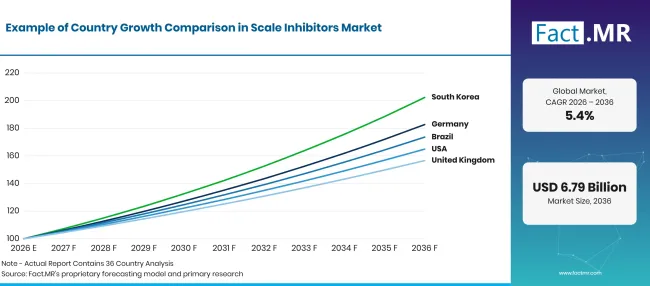
Scale Inhibitors Market Growth Index | Source: Fact.MR
| Country | CAGR (2026–2036) |
|---|---|
| Germany | 6.2% |
| Brazil | 5.7% |
| USA | 5.1% |
| UK | 4.6% |
| Japan | 4.1% |
Source: Fact.MR analysis. Updated Nov 6, 2026
What supports Germany's market growth?
6.2% CAGR, supported by industrial water-treatment requirements and demand for reliable process operations.
Germany's industrial base includes chemical processing, power generation, manufacturing, and water-intensive production facilities. These operations require water conditioning to limit mineral deposits in cooling circuits, boilers, and process equipment. Scale inhibitor suppliers can address demand through formulations suited to different water qualities and operating conditions. Industrial users are also likely to evaluate treatment programs based on equipment protection, water efficiency, and operating costs.
How is Brazil developing scale inhibitor demand?
5.7% CAGR, shaped by oil and gas production and the need to manage mineral deposits in industrial water systems.
Brazil's offshore oil and gas operations create demand for production chemicals that help maintain flow assurance and protect equipment from inorganic deposits. Scale inhibitors are relevant to produced-water handling and reinjection, where brine composition and operating conditions influence mineral precipitation. Industrial water treatment and mining applications provide additional opportunities for suppliers offering formulations suited to local process requirements.
What supports United States market growth?
5.1% CAGR, driven by oilfield chemical consumption and extensive industrial water-treatment activity.
The United States has a broad base of upstream oil and gas operations alongside power generation, manufacturing, and water-intensive industries. Scale inhibitors are used to control mineral deposition in production systems and industrial water circuits. Suppliers can differentiate through performance in high-temperature and high-salinity environments, reliable chemical delivery, and monitoring support for treatment programs.
What is driving the United Kingdom market?
4.6% CAGR, led by offshore oil and gas operations and industrial water-treatment needs.
The UK's offshore production sector requires chemical programs that help manage scale formation in wells and production equipment. Scale control is particularly important where produced-water chemistry and changing operating conditions increase the risk of mineral deposits. Industrial facilities also use treatment chemicals to protect cooling and process-water systems. Suppliers with field-testing capabilities and application support can address these requirements.
What supports Japan's market growth?
4.1% CAGR, backed by industrial process-water management and demand for reliable equipment performance.
Japan's manufacturing and energy industries rely on water-treatment programs to maintain efficient operation of boilers, cooling systems, and process equipment. Mineral deposits can reduce heat-transfer efficiency and increase maintenance requirements, making scale prevention an important part of industrial water management. Suppliers can address demand through formulations that support precise dosing, system compatibility, and consistent performance under defined operating conditions.
Who leads the Scale Inhibitors Market?
Fact.MR profiles BASF SE, Clariant AG, Kemira Oyj, Ecolab Inc., Dow Inc., Baker Hughes Company, Veolia Water Technologies, and Nouryon across the scale-inhibition and industrial water-treatment value chain.
Clariant and Baker Hughes offer scale-control products for oilfield operations, while Nouryon supplies scale-control chemistries for both oilfield and industrial water-treatment applications. Kemira's KemGuard portfolio addresses antiscalants and dispersants in industrial water, wastewater, cooling, and desalination. Dow offers antiscalants for oilfield and industrial water-treatment uses. Veolia provides scale-control chemicals for cooling systems and membrane treatment. BASF has antiscalant products for mining and water-treatment applications. Ecolab's Nalco Champion business has documented oilfield scale-management solutions.
Commercial competition depends on the target application and the active chemistry. Oilfield operators need products that perform reliably against carbonate and sulfate scale under challenging brine conditions. Industrial water-treatment users prioritise protection against deposits and compatibility with treatment systems. Suppliers need to support product selection through water analysis and application-specific performance data.
Which companies are the key providers?
Key companies profiled include BASF SE; Clariant AG; Kemira Oyj; Ecolab Inc.; Dow Inc.; Baker Hughes Company; Veolia Water Technologies; and Nouryon.
- BASF SE
- Clariant AG
- Kemira Oyj
- Ecolab Inc.
- Dow Inc.
- Baker Hughes Company
- Veolia Water Technologies
- Nouryon
Bibliography
- [1] U.S. Department of Energy. (2026, April 16). Produced water: From waste to resource.
- [2] U.S. Energy Information Administration. (2026, September 10). United States on track for record crude oil production in 2026.
- [3] Veolia Water Technologies. (n.d.). Chapter 25: Deposit and scale control—Cooling system.
- [4] Veolia Water Technologies. (n.d.). Water treatment product directory.
- [5] Dow Inc. (n.d.). Antiscalants—Scale inhibitors.
- [6] Kemira Oyj. (n.d.). Antiscalants and dispersants.
This Report Answers
- The report examines the use of scale inhibitors across oil and gas, power and energy, water and wastewater treatment, mining, and pulp and paper applications.
- Segment analysis compares phosphonates, carboxylate/acrylic chemistries, sulfonates, and other active ingredient types.
- Form analysis distinguishes liquid and solid scale inhibitor products.
- Country analysis discusses Germany, Brazil, the USA, the UK, and Japan.
- The competitive overview profiles eight companies with identified scale-control or related treatment activities.
What does the Scale Inhibitors Market cover?
The market covers chemical products formulated to prevent or reduce the formation of inorganic mineral deposits in water-based industrial and oilfield systems. These products work by interfering with crystal nucleation and growth, modifying crystal formation, or dispersing scale-forming particles. The market includes phosphonate-based inhibitors and polymeric chemistries such as acrylic, carboxylate, and sulfonated formulations.
What is included in the scope?
Included products are chemical formulations sold for scale prevention or control in oil and gas production, industrial cooling and boiler systems, membrane water treatment, mining operations, and other specified industrial applications. Both liquid and solid products are included, along with the active ingredient categories identified in the segmentation.
What is excluded from the scope?
The analysis excludes standalone descalers and cleaning agents sold solely for the removal of deposits already formed, unless they are also marketed for scale inhibition. It excludes water-treatment equipment, dosing pumps, monitoring instruments, and service contracts sold independently of scale inhibitor products. General corrosion inhibitors, biocides, coagulants, and flocculants are also excluded unless they have a defined scale-inhibition function within a marketed formulation.
How Was the Analysis Built?
The analysis draws on 120+ sources, 35+ company portfolios, 25+ countries, and more than 20 industry interviews.
- Primary Research: Primary research includes discussions with manufacturers, service providers, technology developers, distributors, end users, and subject-matter experts. These conversations examine purchasing priorities, product adoption, operational challenges, approval requirements, competitive positioning, and the factors that influence wider market acceptance.
- Desk Research: Desk research covers government statistics, regulatory publications, company filings, trade data, technical studies, industry associations, standards, public policy, and other authoritative sources. Every source used in the analysis is documented in the bibliography.
- Market Sizing and Forecasting: Market estimates combine historical performance, demand indicators, pricing and volume trends, segment shares, company participation, country-level growth, adoption patterns, investment activity, and barriers to market expansion.
- Data Validation and Update Cycle: Findings are validated by comparing primary interviews with public data, company activity, regulatory changes, trade patterns, and industry developments. Regular updates review new product launches, capacity changes, partnerships, approvals, and shifts in commercial adoption.
Segmentation
What is the report's scope and coverage?
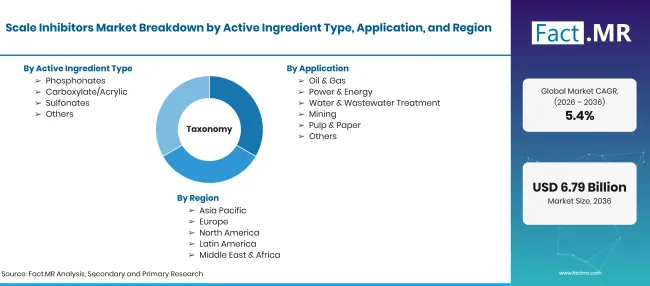
Scale Inhibitors Market Taxonomy | Source: Fact.MR
| Attribute | Details |
|---|---|
| Quantitative Units | USD billion |
| Market Definition | The scale inhibitors market comprises chemical formulations designed to prevent or control the formation and deposition of mineral scales in industrial and oilfield operations. |
| Active Ingredient Type | Phosphonates; Carboxylate/Acrylic; Sulfonates; Others |
| Application | Oil & Gas; Power & Energy; Water & Wastewater Treatment; Mining; Pulp & Paper; Others |
| Form | Liquid; Solid |
| Regions Covered | North America; Latin America; Western Europe; Eastern Europe; East Asia; South Asia & Pacific; Middle East & Africa |
| Countries Covered | Germany; Brazil; USA; UK; Japan |
| Companies Profiled | BASF SE; Clariant AG; Kemira Oyj; Ecolab Inc.; Dow Inc.; Baker Hughes Company; Veolia Water Technologies; Nouryon |
| Forecast Period | 2026 to 2036 |
| Approach | Market segmentation and scenario-based analysis supported by industrial water-treatment, oilfield, product-portfolio, and company information |
Source: Fact.MR analysis. Updated Nov 6, 2026
How is the market segmented?
-
By Active Ingredient Type
- Phosphonates
- Carboxylate/Acrylic
- Sulfonates
- Others
-
By Application
- Oil & Gas
- Power & Energy
- Water & Wastewater Treatment
- Mining
- Pulp & Paper
- Others
-
By Form
- Liquid
- Solid
-
By Region
- North America
- Latin America
- Western Europe
- Eastern Europe
- East Asia
- South Asia & Pacific
- Middle East & Africa
Frequently Asked Questions
How big is the Scale Inhibitors Market in 2026?
What is the CAGR from 2026 to 2036?
Which active ingredient type has the largest share?
Which application leads the market?
Which form accounts for the largest market share?
Which companies are covered?
Who worked on this report


Preview the report firsthand - request a free sample
Free SampleGet the brochure for pricing and purchase details
Download PDF