Porokeratosis Treatment Market Size, Share, Growth and Forecast (2026 - 2036)
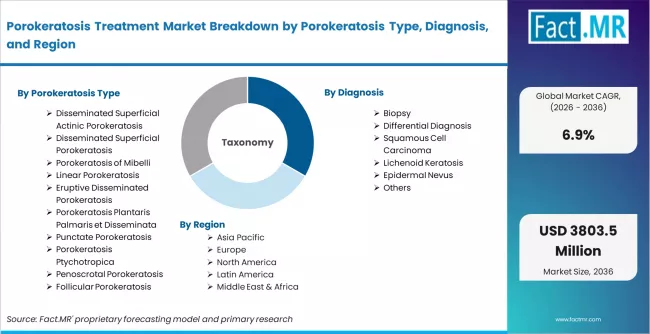
Porokeratosis Treatment Market is segmented by Porokeratosis Type (Disseminated Superficial Actinic Porokeratosis, Disseminated Superficial Porokeratosis, Porokeratosis of Mibelli, Linear Porokeratosis, Eruptive Disseminated Porokeratosis, Porokeratosis Plantaris Palmaris et Disseminata, Punctate Porokeratosis, Porokeratosis Ptychotropica, Penoscrotal Porokeratosis, Follicular Porokeratosis), Diagnosis (Biopsy, Differential Diagnosis, Squamous Cell Carcinoma, Lichenoid Keratosis, Epidermal Nevus, Others), Treatment (Topical Therapies, Topical 5 Fluorouracil, Topical Imiquimod, Topical Retinoids, Topical Vitamin D Analogs, Combination Therapy, Systemic Therapy, Oral Retinoids, Physical Interventions, Cryotherapy, Electrodesiccation and Curettage, Surgical Excision, Dermabrasion, Laser Therapy, Carbon Dioxide Lasers, Q Switched Ruby Laser, Nd YAG Laser, Pulsed Dye Laser Therapy), and Region, with forecasts covering the period from 2026 to 2036.
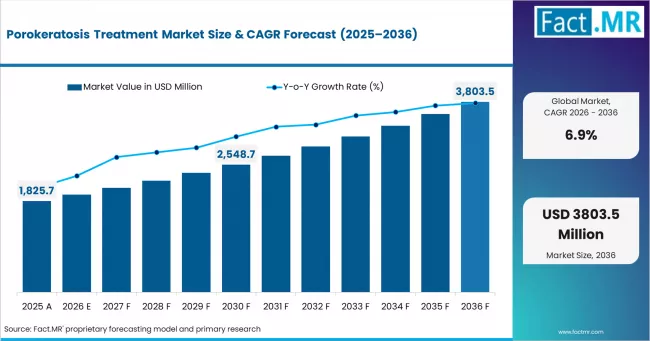
According to Fact.MR estimates, the global porokeratosis treatment market market was valued at USD 1,825.7 million in 2025. The market is projected to reach USD 1,951.7 million in 2026 and is expected to grow to USD 3,803.5 million by 2036, expanding at a CAGR of 6.9%. Disseminated Superficial Actinic Porokeratosis is anticipated to account for 21.4% of the product segment in 2026, while Biopsy is expected to remain the leading application with around 33.7% share.
Porokeratosis Treatment Market Analysis and Forecast by Fact.MR
The porokeratosis treatment market, valued at USD 1,825.7 million in 2025, is expanding at a 6.9% CAGR to reach USD 3,803.507 million by 2036. Porokeratosis treatment encompasses topical therapies (5-fluorouracil, imiquimod, retinoids, vitamin D analogs), systemic therapies (oral retinoids), and physical interventions (cryotherapy, laser therapy, electrodesiccation, surgical excision) used to manage this group of keratinization disorders. Growth reflects rising diagnostic awareness, expanding dermatological treatment access, and adoption of laser-based treatment modalities. The USD 1,851.834 million incremental opportunity between 2026 and 2036 is concentrated in laser-based interventions across Asia, North America, and Europe.
Summary of Porokeratosis Treatment Market
- Market Snapshot
- Market value in 2025: USD 1,825.7 million
- Projected value in 2026: USD 1,951.673 million; forecast to reach USD 3,803.507 million by 2036
- CAGR from 2026 to 2036: 6.9%
- Incremental opportunity (2026 to 2036): USD 1,851.834 million
- Topical therapies lead treatment demand with 36.9% share in 2025
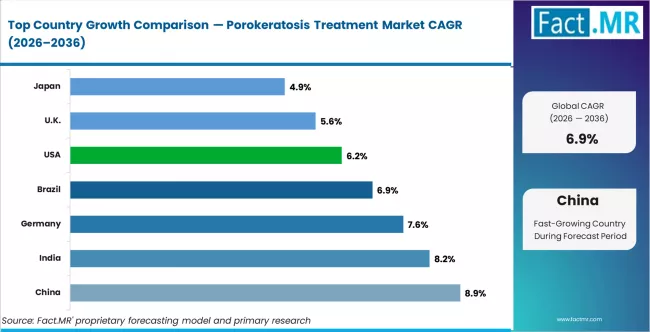
- China and India lead country-level growth, followed by Germany and Brazil
- Demand and Growth Drivers
- Dermatological diagnostic awareness for porokeratosis has improved through dermatoscopy adoption and teledermatology expansion, increasing the diagnosed patient population.
- Laser therapy adoption, including CO2 lasers, Q-switched ruby lasers, and pulsed dye lasers, is expanding the treatment toolkit beyond conventional topical therapies.
- The association between porokeratosis and malignant transformation risk (squamous cell carcinoma) creates clinical urgency for treatment and monitoring.
- Combination therapy protocols using topical 5-FU or imiquimod alongside cryotherapy or laser treatment are demonstrating improved clearance rates.
- Product and Segment View
- Topical therapies hold 36.9% of treatment demand, driven by first-line prescribing of 5-fluorouracil, imiquimod, and retinoids.
- Biopsy accounts for 33.7% of diagnosis demand, reflecting histopathological confirmation requirements.
- Hospitals hold 41.2% of end-user demand, anchored by dermatology department outpatient services.
- Key segmentation includes:
- Porokeratosis Type: DSAP, DSP, Porokeratosis of Mibelli, Linear Porokeratosis, Others
- Diagnosis: Biopsy, Differential Diagnosis, Squamous Cell Carcinoma, Others
- Treatment: Topical Therapies, Systemic Therapy, Physical Interventions (Cryotherapy, Laser, Surgical Excision)
- End User: Hospitals, Clinics, Pharmacies, Diagnostic Centers, Research Institutes
- Geography and Competitive Outlook
- North America is the largest revenue region, with the USA contributing USD 714.508 million in 2025.
- East Asia is the fastest-growing region, with China recording the highest country CAGR.
- Europe maintains strong growth, with Germany leading through dermatological science leadership.
- F. Hoffmann-La Roche Ltd leads the competitive field with a 14.8% market share, followed by Allergan, Lumenis, and Alma Lasers.
- Analyst Opinion
- The porokeratosis treatment market is a specialized dermatological niche where growth depends on diagnostic awareness and treatment access rather than disease prevalence changes. The condition is under-diagnosed in many markets, meaning the treatment market has significant latent demand that converts as dermatoscopy adoption and dermatologist training improve. Fact.MR expects laser-based treatment modalities to capture an increasing share of treatment revenue as clinical evidence accumulates. The malignant transformation risk associated with porokeratosis provides a clinical rationale for aggressive treatment that supports reimbursement coverage.
Key Growth Drivers, Constraints, and Opportunities
Key Factors Driving Growth
- Diagnostic improvement: Dermatoscopy and teledermatology expansion are improving porokeratosis recognition, increasing referral rates and confirmed diagnoses.
- Laser treatment adoption: CO2, Q-switched ruby, and Nd:YAG laser treatments provide improved lesion clearance rates compared to topical therapy alone.
- Malignant transformation surveillance: The association with SCC creates clinical urgency for treatment and long-term monitoring.
Key Market Constraints
- Low disease awareness: Porokeratosis remains unfamiliar to many general practitioners, resulting in misdiagnosis and delayed treatment.
- Limited clinical trial evidence: The condition rarity limits large RCT feasibility, with guidance based on case series and expert consensus.
- Treatment recurrence: Lesions frequently recur, particularly in disseminated subtypes, creating patient frustration.
Key Opportunity Areas
- Combination therapy protocols: Structured protocols combining topical 5-FU with laser treatment demonstrate improved clearance and reduced recurrence.
- Photodynamic therapy expansion: PDT using aminolevulinic acid is emerging for disseminated porokeratosis treatment.
- Genetic therapy research: Mevalonate pathway gene mutations underlying porokeratosis are opening research avenues for targeted molecular therapies.
Segment-wise Analysis of the Porokeratosis Treatment Market
- Topical therapies lead treatment demand at 36.9%, driven by first-line prescribing.
- Biopsy holds 33.7% of diagnosis demand, reflecting histopathological confirmation requirements.
- Hospitals account for 41.2% of end-user demand.
Which treatment modality dominates the Porokeratosis Treatment Market?
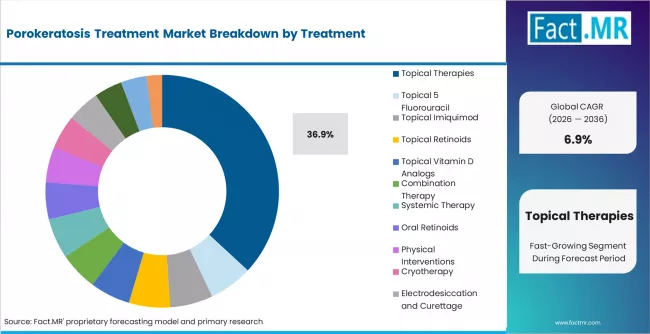
Topical therapies hold a 36.9% share of treatment demand in 2025. Topical 5-fluorouracil is the most prescribed agent, applied directly to lesions to disrupt abnormal keratinocyte proliferation. Topical imiquimod, retinoids, and vitamin D analogs are prescribed based on subtype, location, and patient tolerance. Topical therapy is preferred as first-line for localized porokeratosis.
Physical interventions hold the second-largest share. Cryotherapy using liquid nitrogen is the most common physical procedure, while laser treatments are gaining share for treatment-resistant and cosmetically sensitive lesions. Systemic therapy with oral retinoids is reserved for widespread or refractory cases.
Which porokeratosis type generates the most treatment demand?
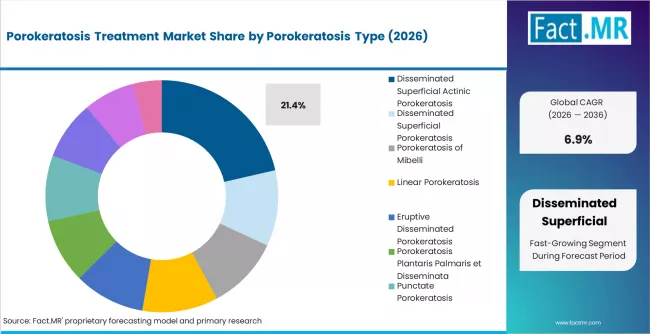
Disseminated superficial actinic porokeratosis (DSAP) accounts for 21.4% of treatment demand in 2025. DSAP is the most common form, presenting as multiple superficial lesions on sun-exposed surfaces. The association with chronic UV exposure and cosmetic impact drive treatment seeking.
Other subtypes including porokeratosis of Mibelli, linear porokeratosis, and eruptive disseminated porokeratosis generate treatment demand based on their specific clinical presentations. Porokeratosis of Mibelli typically requires more aggressive treatment.
Which end user dominates the Porokeratosis Treatment Market?
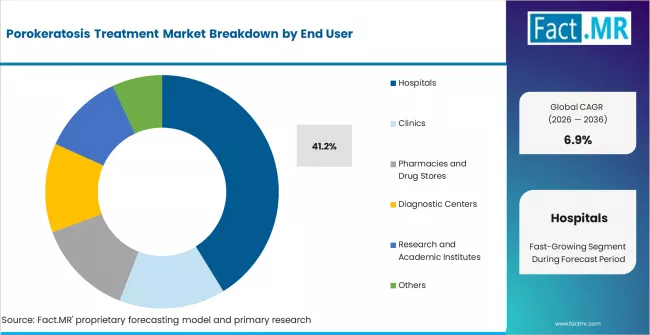
Hospitals account for 41.2% of end-user demand. Hospital dermatology departments provide diagnostic infrastructure, procedural capability, and specialist expertise required for definitive management.
Clinics represent the second-largest segment, managing localized porokeratosis through topical therapy prescribing and minor procedures. Pharmacies serve as the dispensing channel.
Which Product Trend is Shaping the Next Phase of Growth in the Porokeratosis Treatment Market?
Laser-based treatment modalities are shaping the next growth phase. CO2 laser ablation provides precise lesion destruction with controlled depth penetration, while Q-switched ruby and Nd:YAG lasers offer selective photothermolysis approaches. Clinical case series are demonstrating superior clearance rates and reduced recurrence with laser-based approaches, driving clinical adoption.
The convergence of laser treatment with topical therapy in combination protocols is creating a treatment intensification strategy. Dermatologists are prescribing topical 5-FU or imiquimod as pre-treatment or maintenance therapy alongside laser sessions. Fact.MR projects that combination laser-topical protocols will become the standard of care for moderate-to-severe porokeratosis by 2030.
Regional Outlook Across Key Markets
.webp)
- North America is the largest revenue region, with the USA contributing USD 714.508 million in 2025.
- East Asia is the fastest-growing region, with China recording the highest country CAGR.
- Europe maintains strong growth, shaped by comprehensive health insurance coverage.
- South Asia is an emerging corridor, with India recording strong CAGR.
CAGR Table
| Country | CAGR (%) |
|---|---|
| China | 8.9% |
| India | 8.2% |
| Germany | 7.6% |
| Brazil | 6.9% |
| USA | 6.2% |
| U.K. | 5.6% |
| Japan | 4.9% |
Source: Fact.MR analysis, based on proprietary forecasting model and primary research.
China: Dermatological awareness and diagnostic expansion
China records the highest CAGR driven by improving dermatological diagnostic capabilities, expanding dermatology capacity in public hospitals, and growing skin disorder awareness. Dermatoscopy adoption is improving porokeratosis recognition. Laser treatment availability is expanding as clinics invest in CO2 and Nd:YAG platforms.
- Growth anchor: Diagnostic capability improvement and laser accessibility convert under-diagnosed cases into treatment demand.
USA: Specialized dermatology and treatment sophistication
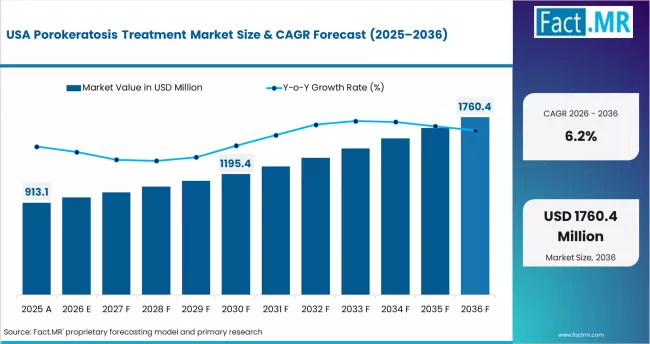
The USA contributes USD 714.508 million in 2025. Growth reflects the maturity of the US dermatology infrastructure, where porokeratosis is diagnosed through routine dermatoscopic screening and managed through evidence-based algorithms. Access to the full treatment spectrum is well-established, and insurance coverage supports treatment access.
- Growth anchor: Diagnostic maturity and full treatment modality access support comprehensive management.
India: Dermatology access expansion
India records strong growth driven by expanding dermatology practice capacity, growing patient awareness, and increasing availability of laser equipment in urban clinics. The tropical climate and high UV exposure contribute to DSAP prevalence.
- Growth anchor: Dermatology workforce expansion and laser equipment availability increase both diagnostic and treatment capacity.
Germany: Dermatological science and insurance coverage
Germany leads European growth supported by comprehensive statutory health insurance coverage for dermatological treatment and strong dermatopathology services. German dermatology academic centers contribute to clinical evidence generation.
- Growth anchor: Insurance coverage and academic dermatology contribute to high treatment rates.
Competitive Benchmarking and Company Positioning
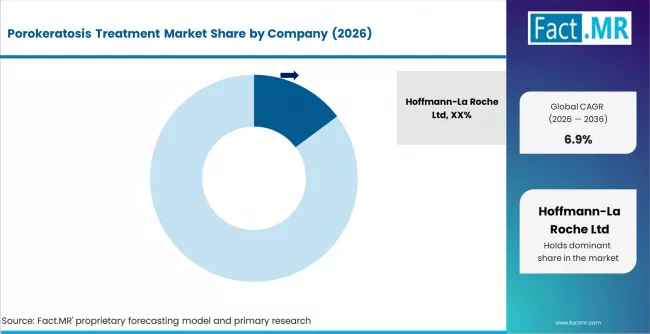
Porokeratosis Treatment Market Analysis By Company
- F. Hoffmann-La Roche Ltd leads with 14.8% market share, through its dermatological pharmaceutical portfolio.
- Allergan and Lumenis compete in the treatment tier, with Allergan in injectable and topical products and Lumenis in laser platforms.
- Alma Lasers and Cutera maintain positions through aesthetic and dermatological laser device platforms.
The competitive field is fragmented across pharmaceutical companies, medical device companies, and diagnostic companies. No single company dominates across all treatment modalities.
In the pharmaceutical segment, generic competition is significant for 5-FU, imiquimod, and oral retinoids. Brand differentiation depends on formulation optimization and clinical evidence.
In the device segment, laser companies compete on treatment efficacy, versatility, and total cost of ownership for dermatology practices.
Key Companies in the Porokeratosis Treatment Market
F. Hoffmann-La Roche Ltd, Angiodynamics Inc., Alma Lasers, Allergan, Lumenis, Cutera, Pfizer, Danaher Corporation, and Hologic Inc. are the principal companies operating in the global porokeratosis treatment market.
Recent Industry Developments
- Lumenis: CO2 laser porokeratosis protocol publication (2025)
- Lumenis published clinical evidence in 2025 supporting a standardized fractional CO2 laser treatment protocol for DSAP, demonstrating high clearance rates at 12-month follow-up.
- Alma Lasers: dermatological laser platform expansion (2025)
- Alma Lasers expanded its platform capabilities in 2025, adding keratotic disorder treatment protocols with clinical training programs.
- Roche: topical combination therapy clinical data (2025)
- Roche-affiliated researchers published data in 2025 evaluating combination topical 5-FU and imiquimod therapy for disseminated porokeratosis.
- Cutera: Nd:YAG laser porokeratosis application study (2026)
- Cutera initiated clinical evaluation of its Nd:YAG laser for linear porokeratosis treatment in early 2026.
Leading Companies Shaping the Porokeratosis Treatment Market
-
Global Players
- F. Hoffmann-La Roche Ltd
- Allergan
- Lumenis
- Pfizer
- Danaher Corporation
- Hologic Inc.
-
Regional Players
- Alma Lasers
- Cutera
- Biolase Inc.
- Coherent Inc.
-
Emerging / Start-up Players
- PhotoMedex Inc.
- Angiodynamics Inc.
- Beiersdorf AG
Sources and Research References
- F. Hoffmann-La Roche Ltd Annual Report 2024
- Journal of the American Academy of Dermatology, Porokeratosis Treatment
- British Journal of Dermatology, Laser Treatment Publications
- Lumenis Clinical Evidence Publications
- WHO ICD-11 Classification for Porokeratosis
- National dermatology society clinical practice guidelines
All numerical data in this report is derived from Fact.MR proprietary research. Source references are provided for contextual and directional validation only.
Key Questions This Report Addresses
- What is the projected size of the porokeratosis treatment market by 2036?
- Which treatment holds the largest share?
- What CAGR is expected from 2026 to 2036?
- Which country is growing fastest?
- Who is the leading company?
- What is the incremental opportunity between 2026 and 2036?
- How is laser therapy affecting treatment?
- What role does diagnostic improvement play?
Porokeratosis Treatment Market Definition
The porokeratosis treatment market covers pharmacological and procedural interventions for porokeratosis, a group of keratinization disorders characterized by annular plaques with raised borders (cornoid lamella).
Porokeratosis Treatment Market Inclusions
- Topical therapies: 5-fluorouracil, imiquimod, retinoids, vitamin D analogs
- Systemic therapies: oral retinoids for widespread porokeratosis
- Physical interventions: cryotherapy, CO2 lasers, Nd:YAG lasers, pulsed dye lasers, surgical excision
- Diagnostic services: biopsy with histopathological analysis
Porokeratosis Treatment Market Exclusions
- General skincare products without porokeratosis treatment indication
- Sunscreen and photoprotection products
- Treatment of SCC arising in porokeratosis lesions (oncology)
- Dermatological diagnostic equipment as capital goods
Porokeratosis Treatment Market Research Methodology
- Bottom-up revenue modeling using dermatology visit data, treatment volumes, and prescription patterns across 15+ countries
- Primary interviews with dermatologists and dermatopathologists
- Cross-referencing dermatological disease registries and epidemiological studies
- Validation through dermatology society guidelines and clinical practice surveys
- Forecasting calibrated against dermatology workforce growth and diagnostic technology adoption
- Company-level revenue triangulation using annual reports and market share estimates
Scope of Analysis

| Parameter | Details |
|---|---|
| Market size (2025) | USD 1,825.7 million |
| Forecast period | 2026 to 2036 |
| CAGR | 6.9% |
| Base year | 2025 |
| Units | USD Million |
| Segments covered | Porokeratosis Type (DSAP, DSP, Mibelli, Linear, Others); Diagnosis (Biopsy, Differential Diagnosis, Others); Treatment (Topical, Systemic, Physical Interventions); End User (Hospitals, Clinics, Pharmacies, Diagnostic Centers, Research Institutes) |
| Regions covered | North America, Latin America, Europe, East Asia, South Asia and Pacific, Middle East and Africa |
| Countries profiled | USA, China, India, Germany, U.K., Brazil, Japan |
| Companies profiled | F. Hoffmann-La Roche, Allergan, Lumenis, Alma Lasers, Cutera, Pfizer |
| Forecasting approach | Bottom-up revenue modeling validated through primary research, dermatological registry analysis, and company-level financial triangulation |
Market Segmentation Analysis
-
Porokeratosis Treatment Market Market Segmented by Porokeratosis Type:
- Disseminated Superficial Actinic Porokeratosis
- Classic Variant
- Pigmented Variant
- Disseminated Superficial Porokeratosis
- Generalized Form
- Localized Form
- Porokeratosis of Mibelli
- Classic Plaque Type
- Giant Variant
- Linear Porokeratosis
- Localized Linear Form
- Systematized Linear Form
- Eruptive Disseminated Porokeratosis
- Acute Onset
- Chronic Recurrent
- Porokeratosis Plantaris Palmaris et Disseminata
- Palm Dominant
- Sole Dominant
- Punctate Porokeratosis
- Localized Punctate
- Diffuse Punctate
- Porokeratosis Ptychotropica
- Gluteal Fold Type
- Perianal Type
- Penoscrotal Porokeratosis
- Penile Involvement
- Scrotal Involvement
- Follicular Porokeratosis
- Hair Follicle Associated
- Non Follicular Variant
- Disseminated Superficial Actinic Porokeratosis
-
Porokeratosis Treatment Market Market Segmented by Diagnosis:
- Biopsy
- Punch Biopsy
- Excisional Biopsy
- Shave Biopsy
- Differential Diagnosis
- Clinical Examination
- Histopathological Correlation
- Squamous Cell Carcinoma
- Early Detection Screening
- Advanced Lesion Assessment
- Lichenoid Keratosis
- Dermatoscopic Evaluation
- Histological Confirmation
- Epidermal Nevus
- Clinical Differentiation
- Genetic Assessment
- Others
- Imaging Techniques
- Molecular Diagnostics
- Biopsy
-
Porokeratosis Treatment Market Market Segmented by Treatment:
- Topical Therapies
- Cream Based Formulations
- Gel Based Formulations
- Ointment Based Formulations
- Topical 5 Fluorouracil
- Low Concentration Therapy
- High Concentration Therapy
- Topical Imiquimod
- Immune Response Modulation
- Targeted Lesion Therapy
- Topical Retinoids
- Tretinoin Based
- Adapalene Based
- Topical Vitamin D Analogs
- Calcipotriol Based
- Combination Formulations
- Combination Therapy
- Topical and Oral Combination
- Topical and Physical Combination
- Systemic Therapy
- Oral Medications
- Immunosuppressive Agents
- Oral Retinoids
- Isotretinoin Based
- Acitretin Based
- Physical Interventions
- Minimally Invasive Procedures
- Advanced Surgical Procedures
- Cryotherapy
- Liquid Nitrogen Based
- Targeted Lesion Freezing
- Electrodesiccation and Curettage
- Superficial Lesion Removal
- Deep Lesion Removal
- Surgical Excision
- Local Excision
- Wide Excision
- Dermabrasion
- Superficial Dermabrasion
- Deep Dermabrasion
- Laser Therapy
- Ablative Laser Therapy
- Non Ablative Laser Therapy
- Carbon Dioxide Lasers
- Fractional CO2 Laser
- Continuous Wave CO2 Laser
- Q Switched Ruby Laser
- Pigmented Lesion Treatment
- Targeted Laser Therapy
- Nd YAG Laser
- Long Pulse Nd YAG
- Short Pulse Nd YAG
- Pulsed Dye Laser Therapy
- Vascular Targeted Therapy
- Low Fluence Therapy
- Topical Therapies
-
Porokeratosis Treatment Market Market Segmented by End User:
- Hospitals
- Public Hospitals
- Private Hospitals
- Clinics
- Dermatology Clinics
- Specialty Skin Clinics
- Pharmacies and Drug Stores
- Retail Pharmacies
- Online Pharmacies
- Diagnostic Centers
- Independent Diagnostic Labs
- Hospital Based Labs
- Research and Academic Institutes
- Clinical Research Organizations
- University Research Centers
- Others
- Ambulatory Care Centers
- Homecare Settings
- Hospitals
-
Porokeratosis Treatment Market Market by Region:
- North America
- USA
- Canada
- Mexico
- Latin America
- Brazil
- Chile
- Rest of Latin America
- Western Europe
- Germany
- UK
- Italy
- Spain
- France
- Nordic
- BENELUX
- Rest of Western Europe
- Eastern Europe
- Russia
- Poland
- Hungary
- Balkan & Baltic
- Rest of Eastern Europe
- East Asia
- China
- Japan
- South Korea
- South Asia and Pacific
- India
- ASEAN
- Australia & New Zealand
- Rest of South Asia and Pacific
- Middle East & Africa
- Kingdom of Saudi Arabia
- Other GCC Countries
- Turkiye
- South Africa
- Other African Union
- Rest of Middle East & Africa
- North America
- Frequently Asked Questions -
What is the current size of the porokeratosis treatment market?
The global porokeratosis treatment market is valued at USD 1,825.7 million in 2025.
What growth rate is expected?
The market is projected to grow at a CAGR of 6.9% from 2026 to 2036.
What will the market be worth by 2036?
The market is forecast to reach USD 3,803.507 million by 2036.
Which treatment leads?
Topical therapies lead with 36.9% of treatment demand in 2025.
Which country is growing fastest?
China records the highest country-level CAGR.
Who is the market leader?
F. Hoffmann-La Roche Ltd leads with a 14.8% market share in 2025.
What is the USA market value?
The USA contributes USD 714.508 million in 2025.
Table of Content
- Executive Summary
- Global Market Outlook
- Demand to side Trends
- Analysis and Recommendations
- Market Overview
- Market Coverage / Taxonomy
- Market Definition / Scope / Limitations
- Research Methodology
- Chapter Orientation
- Analytical Lens and Working Hypotheses
- Market Structure, Signals, and Trend Drivers
- Benchmarking and Cross-market Comparability
- Market Sizing, Forecasting, and Opportunity Mapping
- Research Design and Evidence Framework
- Desk Research Programme (Secondary Evidence)
- Company Annual and Sustainability Reports
- Peer-reviewed Journals and Academic Literature
- Corporate Websites, Product Literature, and Technical Notes
- Earnings Decks and Investor Briefings
- Statutory Filings and Regulatory Disclosures
- Press Releases and Reputable Media Coverage
- Specialist Newsletters and Curated Briefings
- Sector Databases and Reference Repositories
- Fact.MR Internal Proprietary Databases and Historical Market Datasets
- Subscription Datasets and Paid Sources
- Social Channels, Communities, and Digital Listening Inputs
- Additional Desk Sources
- Expert Input and Fieldwork (Primary Evidence)
- Primary Modes
- Qualitative Interviews and Expert Elicitation
- Quantitative Surveys and Structured Data Capture
- Blended Approach
- Why Primary Evidence is Used
- Field Techniques
- Interviews
- Surveys
- Focus Groups
- Observational and In-context Research
- Social and Community Interactions
- Stakeholder Universe Engaged
- C-suite Leaders
- Board Members
- Presidents and Vice Presidents
- R&D and Innovation Heads
- Technical Specialists
- Domain Subject-matter Experts
- Scientists
- Physicians and Other Healthcare Professionals
- Governance, Ethics, and Data Stewardship
- Research Ethics
- Data Integrity and Handling
- Primary Modes
- Tooling, Models, and Reference Databases
- Desk Research Programme (Secondary Evidence)
- Data Engineering and Model Build
- Data Acquisition and Ingestion
- Cleaning, Normalisation, and Verification
- Synthesis, Triangulation, and Analysis
- Quality Assurance and Audit Trail
- Market Background
- Market Dynamics
- Drivers
- Restraints
- Opportunity
- Trends
- Scenario Forecast
- Demand in Optimistic Scenario
- Demand in Likely Scenario
- Demand in Conservative Scenario
- Opportunity Map Analysis
- Product Life Cycle Analysis
- Supply Chain Analysis
- Investment Feasibility Matrix
- Value Chain Analysis
- PESTLE and Porter’s Analysis
- Regulatory Landscape
- Regional Parent Market Outlook
- Production and Consumption Statistics
- Import and Export Statistics
- Classic Variant
- Pigmented Variant
- Market Dynamics
- Disseminated Superficial Porokeratosis
- Generalized Form
- Localized Form
- Porokeratosis of Mibelli
- Classic Plaque Type
- Giant Variant
- Linear Porokeratosis
- Localized Linear Form
- Systematized Linear Form
- Eruptive Disseminated Porokeratosis
- Acute Onset
- Chronic Recurrent
- Porokeratosis Plantaris Palmaris et Disseminata
- Palm Dominant
- Sole Dominant
- Punctate Porokeratosis
- Localized Punctate
- Diffuse Punctate
- Porokeratosis Ptychotropica
- Gluteal Fold Type
- Perianal Type
- Penoscrotal Porokeratosis
- Penile Involvement
- Scrotal Involvement
- Follicular Porokeratosis
- Hair Follicle Associated
- Non Follicular Variant
- Y to o to Y Growth Trend Analysis By Porokeratosis Type , 2021 to 2025
- Absolute $ Opportunity Analysis By Porokeratosis Type , 2026 to 2036
- Global Market Analysis 2021 to 2025 and Forecast 2026 to 2036, By Diagnosis
- Introduction / Key Findings
- Historical Market Size Value (USD Million) Analysis By Diagnosis, 2021 to 2025
- Current and Future Market Size Value (USD Million) Analysis and Forecast By Diagnosis, 2026 to 2036
- Biopsy
- Punch Biopsy
- Excisional Biopsy
- Shave Biopsy
- Differential Diagnosis
- Clinical Examination
- Histopathological Correlation
- Squamous Cell Carcinoma
- Early Detection Screening
- Advanced Lesion Assessment
- Lichenoid Keratosis
- Dermatoscopic Evaluation
- Histological Confirmation
- Epidermal Nevus
- Clinical Differentiation
- Genetic Assessment
- Others
- Imaging Techniques
- Molecular Diagnostics
- Biopsy
- Y to o to Y Growth Trend Analysis By Diagnosis, 2021 to 2025
- Absolute $ Opportunity Analysis By Diagnosis, 2026 to 2036
- Global Market Analysis 2021 to 2025 and Forecast 2026 to 2036, By Treatment
- Introduction / Key Findings
- Historical Market Size Value (USD Million) Analysis By Treatment, 2021 to 2025
- Current and Future Market Size Value (USD Million) Analysis and Forecast By Treatment, 2026 to 2036
- Topical Therapies
- Cream Based Formulations
- Gel Based Formulations
- Ointment Based Formulations
- Topical 5 Fluorouracil
- Low Concentration Therapy
- High Concentration Therapy
- Topical Imiquimod
- Immune Response Modulation
- Targeted Lesion Therapy
- Topical Retinoids
- Tretinoin Based
- Adapalene Based
- Topical Vitamin D Analogs
- Calcipotriol Based
- Combination Formulations
- Combination Therapy
- Topical and Oral Combination
- Topical and Physical Combination
- Systemic Therapy
- Oral Medications
- Immunosuppressive Agents
- Oral Retinoids
- Isotretinoin Based
- Acitretin Based
- Physical Interventions
- Minimally Invasive Procedures
- Advanced Surgical Procedures
- Cryotherapy
- Liquid Nitrogen Based
- Targeted Lesion Freezing
- Electrodesiccation and Curettage
- Superficial Lesion Removal
- Deep Lesion Removal
- Topical Therapies
- Y to o to Y Growth Trend Analysis By Treatment, 2021 to 2025
- Absolute $ Opportunity Analysis By Treatment, 2026 to 2036
- Global Market Analysis 2021 to 2025 and Forecast 2026 to 2036, By End User
- Introduction / Key Findings
- Historical Market Size Value (USD Million) Analysis By End User, 2021 to 2025
- Current and Future Market Size Value (USD Million) Analysis and Forecast By End User, 2026 to 2036
- Hospitals
- Public Hospitals
- Private Hospitals
- Clinics
- Dermatology Clinics
- Specialty Skin Clinics
- Pharmacies and Drug Stores
- Retail Pharmacies
- Online Pharmacies
- Diagnostic Centers
- Independent Diagnostic Labs
- Hospital Based Labs
- Research and Academic Institutes
- Clinical Research Organizations
- University Research Centers
- Others
- Ambulatory Care Centers
- Homecare Settings
- Hospitals
- Y to o to Y Growth Trend Analysis By End User, 2021 to 2025
- Absolute $ Opportunity Analysis By End User, 2026 to 2036
- Global Market Analysis 2021 to 2025 and Forecast 2026 to 2036, By Region
- Introduction
- Historical Market Size Value (USD Million) Analysis By Region, 2021 to 2025
- Current Market Size Value (USD Million) Analysis and Forecast By Region, 2026 to 2036
- North America
- Latin America
- Western Europe
- Eastern Europe
- East Asia
- South Asia and Pacific
- Middle East & Africa
- Market Attractiveness Analysis By Region
- North America Market Analysis 2021 to 2025 and Forecast 2026 to 2036, By Country
- Historical Market Size Value (USD Million) Trend Analysis By Market Taxonomy, 2021 to 2025
- Market Size Value (USD Million) Forecast By Market Taxonomy, 2026 to 2036
- By Country
- USA
- Canada
- Mexico
- By Porokeratosis Type
- By Diagnosis
- By Treatment
- By End User
- By Country
- Market Attractiveness Analysis
- By Country
- By Porokeratosis Type
- By Diagnosis
- By Treatment
- By End User
- Key Takeaways
- Latin America Market Analysis 2021 to 2025 and Forecast 2026 to 2036, By Country
- Historical Market Size Value (USD Million) Trend Analysis By Market Taxonomy, 2021 to 2025
- Market Size Value (USD Million) Forecast By Market Taxonomy, 2026 to 2036
- By Country
- Brazil
- Chile
- Rest of Latin America
- By Porokeratosis Type
- By Diagnosis
- By Treatment
- By End User
- By Country
- Market Attractiveness Analysis
- By Country
- By Porokeratosis Type
- By Diagnosis
- By Treatment
- By End User
- Key Takeaways
- Western Europe Market Analysis 2021 to 2025 and Forecast 2026 to 2036, By Country
- Historical Market Size Value (USD Million) Trend Analysis By Market Taxonomy, 2021 to 2025
- Market Size Value (USD Million) Forecast By Market Taxonomy, 2026 to 2036
- By Country
- Germany
- UK
- Italy
- Spain
- France
- Nordic
- BENELUX
- Rest of Western Europe
- By Porokeratosis Type
- By Diagnosis
- By Treatment
- By End User
- By Country
- Market Attractiveness Analysis
- By Country
- By Porokeratosis Type
- By Diagnosis
- By Treatment
- By End User
- Key Takeaways
- Eastern Europe Market Analysis 2021 to 2025 and Forecast 2026 to 2036, By Country
- Historical Market Size Value (USD Million) Trend Analysis By Market Taxonomy, 2021 to 2025
- Market Size Value (USD Million) Forecast By Market Taxonomy, 2026 to 2036
- By Country
- Russia
- Poland
- Hungary
- Balkan & Baltic
- Rest of Eastern Europe
- By Porokeratosis Type
- By Diagnosis
- By Treatment
- By End User
- By Country
- Market Attractiveness Analysis
- By Country
- By Porokeratosis Type
- By Diagnosis
- By Treatment
- By End User
- Key Takeaways
- East Asia Market Analysis 2021 to 2025 and Forecast 2026 to 2036, By Country
- Historical Market Size Value (USD Million) Trend Analysis By Market Taxonomy, 2021 to 2025
- Market Size Value (USD Million) Forecast By Market Taxonomy, 2026 to 2036
- By Country
- China
- Japan
- South Korea
- By Porokeratosis Type
- By Diagnosis
- By Treatment
- By End User
- By Country
- Market Attractiveness Analysis
- By Country
- By Porokeratosis Type
- By Diagnosis
- By Treatment
- By End User
- Key Takeaways
- South Asia and Pacific Market Analysis 2021 to 2025 and Forecast 2026 to 2036, By Country
- Historical Market Size Value (USD Million) Trend Analysis By Market Taxonomy, 2021 to 2025
- Market Size Value (USD Million) Forecast By Market Taxonomy, 2026 to 2036
- By Country
- India
- ASEAN
- Australia & New Zealand
- Rest of South Asia and Pacific
- By Porokeratosis Type
- By Diagnosis
- By Treatment
- By End User
- By Country
- Market Attractiveness Analysis
- By Country
- By Porokeratosis Type
- By Diagnosis
- By Treatment
- By End User
- Key Takeaways
- Middle East & Africa Market Analysis 2021 to 2025 and Forecast 2026 to 2036, By Country
- Historical Market Size Value (USD Million) Trend Analysis By Market Taxonomy, 2021 to 2025
- Market Size Value (USD Million) Forecast By Market Taxonomy, 2026 to 2036
- By Country
- Kingdom of Saudi Arabia
- Other GCC Countries
- Turkiye
- South Africa
- Other African Union
- Rest of Middle East & Africa
- By Porokeratosis Type
- By Diagnosis
- By Treatment
- By End User
- By Country
- Market Attractiveness Analysis
- By Country
- By Porokeratosis Type
- By Diagnosis
- By Treatment
- By End User
- Key Takeaways
- Key Countries Market Analysis
- USA
- Pricing Analysis
- Market Share Analysis, 2025
- By Porokeratosis Type
- By Diagnosis
- By Treatment
- By End User
- Canada
- Pricing Analysis
- Market Share Analysis, 2025
- By Porokeratosis Type
- By Diagnosis
- By Treatment
- By End User
- Mexico
- Pricing Analysis
- Market Share Analysis, 2025
- By Porokeratosis Type
- By Diagnosis
- By Treatment
- By End User
- Brazil
- Pricing Analysis
- Market Share Analysis, 2025
- By Porokeratosis Type
- By Diagnosis
- By Treatment
- By End User
- Chile
- Pricing Analysis
- Market Share Analysis, 2025
- By Porokeratosis Type
- By Diagnosis
- By Treatment
- By End User
- Germany
- Pricing Analysis
- Market Share Analysis, 2025
- By Porokeratosis Type
- By Diagnosis
- By Treatment
- By End User
- UK
- Pricing Analysis
- Market Share Analysis, 2025
- By Porokeratosis Type
- By Diagnosis
- By Treatment
- By End User
- Italy
- Pricing Analysis
- Market Share Analysis, 2025
- By Porokeratosis Type
- By Diagnosis
- By Treatment
- By End User
- Spain
- Pricing Analysis
- Market Share Analysis, 2025
- By Porokeratosis Type
- By Diagnosis
- By Treatment
- By End User
- France
- Pricing Analysis
- Market Share Analysis, 2025
- By Porokeratosis Type
- By Diagnosis
- By Treatment
- By End User
- India
- Pricing Analysis
- Market Share Analysis, 2025
- By Porokeratosis Type
- By Diagnosis
- By Treatment
- By End User
- ASEAN
- Pricing Analysis
- Market Share Analysis, 2025
- By Porokeratosis Type
- By Diagnosis
- By Treatment
- By End User
- Australia & New Zealand
- Pricing Analysis
- Market Share Analysis, 2025
- By Porokeratosis Type
- By Diagnosis
- By Treatment
- By End User
- China
- Pricing Analysis
- Market Share Analysis, 2025
- By Porokeratosis Type
- By Diagnosis
- By Treatment
- By End User
- Japan
- Pricing Analysis
- Market Share Analysis, 2025
- By Porokeratosis Type
- By Diagnosis
- By Treatment
- By End User
- South Korea
- Pricing Analysis
- Market Share Analysis, 2025
- By Porokeratosis Type
- By Diagnosis
- By Treatment
- By End User
- Russia
- Pricing Analysis
- Market Share Analysis, 2025
- By Porokeratosis Type
- By Diagnosis
- By Treatment
- By End User
- Poland
- Pricing Analysis
- Market Share Analysis, 2025
- By Porokeratosis Type
- By Diagnosis
- By Treatment
- By End User
- Hungary
- Pricing Analysis
- Market Share Analysis, 2025
- By Porokeratosis Type
- By Diagnosis
- By Treatment
- By End User
- Kingdom of Saudi Arabia
- Pricing Analysis
- Market Share Analysis, 2025
- By Porokeratosis Type
- By Diagnosis
- By Treatment
- By End User
- Turkiye
- Pricing Analysis
- Market Share Analysis, 2025
- By Porokeratosis Type
- By Diagnosis
- By Treatment
- By End User
- South Africa
- Pricing Analysis
- Market Share Analysis, 2025
- By Porokeratosis Type
- By Diagnosis
- By Treatment
- By End User
- USA
- Market Structure Analysis
- Competition Dashboard
- Competition Benchmarking
- Market Share Analysis of Top Players
- By Regional
- By Porokeratosis Type
- By Diagnosis
- By Treatment
- By End User
- Competition Analysis
- Competition Deep Dive
- Hoffmann-La Roche Ltd
- Overview
- Product Portfolio
- Profitability by Market Segments (Product/Age /Sales Channel/Region)
- Sales Footprint
- Strategy Overview
- Marketing Strategy
- Product Strategy
- Channel Strategy
- Angiodynamics Inc.
- Alma Lasers
- Allergan
- Beiersdorf Ag
- Bioness Inc
- Biogen
- Biolase Inc.
- Coherent Inc.
- Coty Inc.
- Cutera
- Danaher Corporation
- Hologic Inc.
- Pfizer
- IPG Photonics Corporation (U.S.)
- IRIDEX Corp.
- Lumenis
- PhotoMedex Inc.
- Valeant Pharmaceuticals
- Hoffmann-La Roche Ltd
- Competition Deep Dive
- Assumptions & Acronyms Used
List Of Table
- Table 1: Global Market Value (USD Million) Forecast by Region, 2021 to 2036
- Table 2: Global Market Value (USD Million) Forecast by Porokeratosis Type , 2021 to 2036
- Table 3: Global Market Value (USD Million) Forecast by Diagnosis, 2021 to 2036
- Table 4: Global Market Value (USD Million) Forecast by Treatment, 2021 to 2036
- Table 5: Global Market Value (USD Million) Forecast by End User, 2021 to 2036
- Table 6: North America Market Value (USD Million) Forecast by Country, 2021 to 2036
- Table 7: North America Market Value (USD Million) Forecast by Porokeratosis Type , 2021 to 2036
- Table 8: North America Market Value (USD Million) Forecast by Diagnosis, 2021 to 2036
- Table 9: North America Market Value (USD Million) Forecast by Treatment, 2021 to 2036
- Table 10: North America Market Value (USD Million) Forecast by End User, 2021 to 2036
- Table 11: Latin America Market Value (USD Million) Forecast by Country, 2021 to 2036
- Table 12: Latin America Market Value (USD Million) Forecast by Porokeratosis Type , 2021 to 2036
- Table 13: Latin America Market Value (USD Million) Forecast by Diagnosis, 2021 to 2036
- Table 14: Latin America Market Value (USD Million) Forecast by Treatment, 2021 to 2036
- Table 15: Latin America Market Value (USD Million) Forecast by End User, 2021 to 2036
- Table 16: Western Europe Market Value (USD Million) Forecast by Country, 2021 to 2036
- Table 17: Western Europe Market Value (USD Million) Forecast by Porokeratosis Type , 2021 to 2036
- Table 18: Western Europe Market Value (USD Million) Forecast by Diagnosis, 2021 to 2036
- Table 19: Western Europe Market Value (USD Million) Forecast by Treatment, 2021 to 2036
- Table 20: Western Europe Market Value (USD Million) Forecast by End User, 2021 to 2036
- Table 21: Eastern Europe Market Value (USD Million) Forecast by Country, 2021 to 2036
- Table 22: Eastern Europe Market Value (USD Million) Forecast by Porokeratosis Type , 2021 to 2036
- Table 23: Eastern Europe Market Value (USD Million) Forecast by Diagnosis, 2021 to 2036
- Table 24: Eastern Europe Market Value (USD Million) Forecast by Treatment, 2021 to 2036
- Table 25: Eastern Europe Market Value (USD Million) Forecast by End User, 2021 to 2036
- Table 26: East Asia Market Value (USD Million) Forecast by Country, 2021 to 2036
- Table 27: East Asia Market Value (USD Million) Forecast by Porokeratosis Type , 2021 to 2036
- Table 28: East Asia Market Value (USD Million) Forecast by Diagnosis, 2021 to 2036
- Table 29: East Asia Market Value (USD Million) Forecast by Treatment, 2021 to 2036
- Table 30: East Asia Market Value (USD Million) Forecast by End User, 2021 to 2036
- Table 31: South Asia and Pacific Market Value (USD Million) Forecast by Country, 2021 to 2036
- Table 32: South Asia and Pacific Market Value (USD Million) Forecast by Porokeratosis Type , 2021 to 2036
- Table 33: South Asia and Pacific Market Value (USD Million) Forecast by Diagnosis, 2021 to 2036
- Table 34: South Asia and Pacific Market Value (USD Million) Forecast by Treatment, 2021 to 2036
- Table 35: South Asia and Pacific Market Value (USD Million) Forecast by End User, 2021 to 2036
- Table 36: Middle East & Africa Market Value (USD Million) Forecast by Country, 2021 to 2036
- Table 37: Middle East & Africa Market Value (USD Million) Forecast by Porokeratosis Type , 2021 to 2036
- Table 38: Middle East & Africa Market Value (USD Million) Forecast by Diagnosis, 2021 to 2036
- Table 39: Middle East & Africa Market Value (USD Million) Forecast by Treatment, 2021 to 2036
- Table 40: Middle East & Africa Market Value (USD Million) Forecast by End User, 2021 to 2036
List Of Figures
- Figure 1: Global Market Pricing Analysis
- Figure 2: Global Market Value (USD Million) Forecast 2021-2036
- Figure 3: Global Market Value Share and BPS Analysis by Porokeratosis Type, 2026 and 2036
- Figure 4: Global Market Y-o-Y Growth Comparison by Porokeratosis Type,2026 to 2036
- Figure 5: Global Market Attractiveness Analysis by Porokeratosis Type
- Figure 6: Global Market Value Share and BPS Analysis by Diagnosis, 2026 and 2036
- Figure 7: Global Market Y-o-Y Growth Comparison by Diagnosis,2026 to 2036
- Figure 8: Global Market Attractiveness Analysis by Diagnosis
- Figure 9: Global Market Value Share and BPS Analysis by Treatment, 2026 and 2036
- Figure 10: Global Market Y-o-Y Growth Comparison by Treatment,2026 to 2036
- Figure 11: Global Market Attractiveness Analysis by Treatment
- Figure 12: Global Market Value Share and BPS Analysis by End User, 2026 and 2036
- Figure 13: Global Market Y-o-Y Growth Comparison by End User,2026 to 2036
- Figure 14: Global Market Attractiveness Analysis by End User
- Figure 15: Global Market Value (USD Million) Share and BPS Analysis by Region, 2026 and 2036
- Figure 16: Global Market Y-o-Y Growth Comparison by Region,2026 to 2036
- Figure 17: Global Market Attractiveness Analysis by Region
- Figure 18: North America Market Incremental Dollar Opportunity,2026 to 2036
- Figure 19: Latin America Market Incremental Dollar Opportunity,2026 to 2036
- Figure 20: Western Europe Market Incremental Dollar Opportunity,2026 to 2036
- Figure 21: Eastern Europe Market Incremental Dollar Opportunity,2026 to 2036
- Figure 22: East Asia Market Incremental Dollar Opportunity,2026 to 2036
- Figure 23: South Asia and Pacific Market Incremental Dollar Opportunity,2026 to 2036
- Figure 24: Middle East & Africa Market Incremental Dollar Opportunity,2026 to 2036
- Figure 25: North America Market Value Share and BPS Analysis by Country, 2026 and 2036
- Figure 26: North America Market Value Share and BPS Analysis by Porokeratosis Type, 2026 and 2036
- Figure 27: North America Market Y-o-Y Growth Comparison by Porokeratosis Type,2026 to 2036
- Figure 28: North America Market Attractiveness Analysis by Porokeratosis Type
- Figure 29: North America Market Value Share and BPS Analysis by Diagnosis, 2026 and 2036
- Figure 30: North America Market Y-o-Y Growth Comparison by Diagnosis,2026 to 2036
- Figure 31: North America Market Attractiveness Analysis by Diagnosis
- Figure 32: North America Market Value Share and BPS Analysis by Treatment, 2026 and 2036
- Figure 33: North America Market Y-o-Y Growth Comparison by Treatment,2026 to 2036
- Figure 34: North America Market Attractiveness Analysis by Treatment
- Figure 35: North America Market Value Share and BPS Analysis by End User, 2026 and 2036
- Figure 36: North America Market Y-o-Y Growth Comparison by End User,2026 to 2036
- Figure 37: North America Market Attractiveness Analysis by End User
- Figure 38: Latin America Market Value Share and BPS Analysis by Country, 2026 and 2036
- Figure 39: Latin America Market Value Share and BPS Analysis by Porokeratosis Type, 2026 and 2036
- Figure 40: Latin America Market Y-o-Y Growth Comparison by Porokeratosis Type,2026 to 2036
- Figure 41: Latin America Market Attractiveness Analysis by Porokeratosis Type
- Figure 42: Latin America Market Value Share and BPS Analysis by Diagnosis, 2026 and 2036
- Figure 43: Latin America Market Y-o-Y Growth Comparison by Diagnosis,2026 to 2036
- Figure 44: Latin America Market Attractiveness Analysis by Diagnosis
- Figure 45: Latin America Market Value Share and BPS Analysis by Treatment, 2026 and 2036
- Figure 46: Latin America Market Y-o-Y Growth Comparison by Treatment,2026 to 2036
- Figure 47: Latin America Market Attractiveness Analysis by Treatment
- Figure 48: Latin America Market Value Share and BPS Analysis by End User, 2026 and 2036
- Figure 49: Latin America Market Y-o-Y Growth Comparison by End User,2026 to 2036
- Figure 50: Latin America Market Attractiveness Analysis by End User
- Figure 51: Western Europe Market Value Share and BPS Analysis by Country, 2026 and 2036
- Figure 52: Western Europe Market Value Share and BPS Analysis by Porokeratosis Type, 2026 and 2036
- Figure 53: Western Europe Market Y-o-Y Growth Comparison by Porokeratosis Type,2026 to 2036
- Figure 54: Western Europe Market Attractiveness Analysis by Porokeratosis Type
- Figure 55: Western Europe Market Value Share and BPS Analysis by Diagnosis, 2026 and 2036
- Figure 56: Western Europe Market Y-o-Y Growth Comparison by Diagnosis,2026 to 2036
- Figure 57: Western Europe Market Attractiveness Analysis by Diagnosis
- Figure 58: Western Europe Market Value Share and BPS Analysis by Treatment, 2026 and 2036
- Figure 59: Western Europe Market Y-o-Y Growth Comparison by Treatment,2026 to 2036
- Figure 60: Western Europe Market Attractiveness Analysis by Treatment
- Figure 61: Western Europe Market Value Share and BPS Analysis by End User, 2026 and 2036
- Figure 62: Western Europe Market Y-o-Y Growth Comparison by End User,2026 to 2036
- Figure 63: Western Europe Market Attractiveness Analysis by End User
- Figure 64: Eastern Europe Market Value Share and BPS Analysis by Country, 2026 and 2036
- Figure 65: Eastern Europe Market Value Share and BPS Analysis by Porokeratosis Type, 2026 and 2036
- Figure 66: Eastern Europe Market Y-o-Y Growth Comparison by Porokeratosis Type,2026 to 2036
- Figure 67: Eastern Europe Market Attractiveness Analysis by Porokeratosis Type
- Figure 68: Eastern Europe Market Value Share and BPS Analysis by Diagnosis, 2026 and 2036
- Figure 69: Eastern Europe Market Y-o-Y Growth Comparison by Diagnosis,2026 to 2036
- Figure 70: Eastern Europe Market Attractiveness Analysis by Diagnosis
- Figure 71: Eastern Europe Market Value Share and BPS Analysis by Treatment, 2026 and 2036
- Figure 72: Eastern Europe Market Y-o-Y Growth Comparison by Treatment,2026 to 2036
- Figure 73: Eastern Europe Market Attractiveness Analysis by Treatment
- Figure 74: Eastern Europe Market Value Share and BPS Analysis by End User, 2026 and 2036
- Figure 75: Eastern Europe Market Y-o-Y Growth Comparison by End User,2026 to 2036
- Figure 76: Eastern Europe Market Attractiveness Analysis by End User
- Figure 77: East Asia Market Value Share and BPS Analysis by Country, 2026 and 2036
- Figure 78: East Asia Market Value Share and BPS Analysis by Porokeratosis Type, 2026 and 2036
- Figure 79: East Asia Market Y-o-Y Growth Comparison by Porokeratosis Type,2026 to 2036
- Figure 80: East Asia Market Attractiveness Analysis by Porokeratosis Type
- Figure 81: East Asia Market Value Share and BPS Analysis by Diagnosis, 2026 and 2036
- Figure 82: East Asia Market Y-o-Y Growth Comparison by Diagnosis,2026 to 2036
- Figure 83: East Asia Market Attractiveness Analysis by Diagnosis
- Figure 84: East Asia Market Value Share and BPS Analysis by Treatment, 2026 and 2036
- Figure 85: East Asia Market Y-o-Y Growth Comparison by Treatment,2026 to 2036
- Figure 86: East Asia Market Attractiveness Analysis by Treatment
- Figure 87: East Asia Market Value Share and BPS Analysis by End User, 2026 and 2036
- Figure 88: East Asia Market Y-o-Y Growth Comparison by End User,2026 to 2036
- Figure 89: East Asia Market Attractiveness Analysis by End User
- Figure 90: South Asia and Pacific Market Value Share and BPS Analysis by Country, 2026 and 2036
- Figure 91: South Asia and Pacific Market Value Share and BPS Analysis by Porokeratosis Type, 2026 and 2036
- Figure 92: South Asia and Pacific Market Y-o-Y Growth Comparison by Porokeratosis Type,2026 to 2036
- Figure 93: South Asia and Pacific Market Attractiveness Analysis by Porokeratosis Type
- Figure 94: South Asia and Pacific Market Value Share and BPS Analysis by Diagnosis, 2026 and 2036
- Figure 95: South Asia and Pacific Market Y-o-Y Growth Comparison by Diagnosis,2026 to 2036
- Figure 96: South Asia and Pacific Market Attractiveness Analysis by Diagnosis
- Figure 97: South Asia and Pacific Market Value Share and BPS Analysis by Treatment, 2026 and 2036
- Figure 98: South Asia and Pacific Market Y-o-Y Growth Comparison by Treatment,2026 to 2036
- Figure 99: South Asia and Pacific Market Attractiveness Analysis by Treatment
- Figure 100: South Asia and Pacific Market Value Share and BPS Analysis by End User, 2026 and 2036
- Figure 101: South Asia and Pacific Market Y-o-Y Growth Comparison by End User,2026 to 2036
- Figure 102: South Asia and Pacific Market Attractiveness Analysis by End User
- Figure 103: Middle East & Africa Market Value Share and BPS Analysis by Country, 2026 and 2036
- Figure 104: Middle East & Africa Market Value Share and BPS Analysis by Porokeratosis Type, 2026 and 2036
- Figure 105: Middle East & Africa Market Y-o-Y Growth Comparison by Porokeratosis Type,2026 to 2036
- Figure 106: Middle East & Africa Market Attractiveness Analysis by Porokeratosis Type
- Figure 107: Middle East & Africa Market Value Share and BPS Analysis by Diagnosis, 2026 and 2036
- Figure 108: Middle East & Africa Market Y-o-Y Growth Comparison by Diagnosis,2026 to 2036
- Figure 109: Middle East & Africa Market Attractiveness Analysis by Diagnosis
- Figure 110: Middle East & Africa Market Value Share and BPS Analysis by Treatment, 2026 and 2036
- Figure 111: Middle East & Africa Market Y-o-Y Growth Comparison by Treatment,2026 to 2036
- Figure 112: Middle East & Africa Market Attractiveness Analysis by Treatment
- Figure 113: Middle East & Africa Market Value Share and BPS Analysis by End User, 2026 and 2036
- Figure 114: Middle East & Africa Market Y-o-Y Growth Comparison by End User,2026 to 2036
- Figure 115: Middle East & Africa Market Attractiveness Analysis by End User
- Figure 116: Global Market - Tier Structure Analysis
- Figure 117: Global Market - Company Share Analysis