- Base Value(2025): 0.9 Bn
- Estimated Value(2026): 1.0 Bn
- Forecast Value (2036): 2.8 Bn
- CAGR (2026 - 2036): 9.9%
Pressure Guidewires Market Forecast and Outlook By Fact.MR
- In 2025, the pressure guidewires market was valued at USD 0.9 billion.
- Based on Fact.MR analysis, demand for pressure guidewires is estimated to grow to USD 1.0 billion in 2026 and USD 2.8 billion by 2036.
- FACT.MR projects a CAGR of 9.9% during the forecast period.
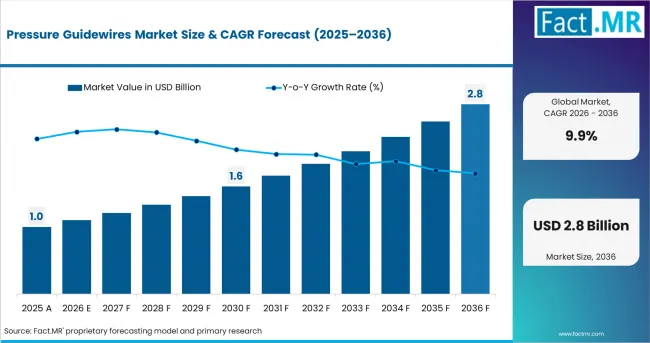
Pressure Guidewires Market Market Value Analysis | Source: Fact.MR
| Metric | Value |
|---|---|
| Estimated Value in 2026 | USD 1.0 billion |
| Forecast Value in 2036 | USD 2.8 billion |
| Forecast CAGR (2026 to 2036) | 9.9% |
Summary of Pressure Guidewires Market
- Market Definition
- The market covers pressure-sensing coronary and peripheral guidewire devices used in FFR and iFR-guided interventional procedures, delivered by medical device manufacturers to hospitals, ambulatory surgical centres, and catheterization laboratories globally.
- Demand Drivers
- ACC/AHA 2023 guideline update endorsing FFR-guided PCI decision-making is expanding routine pressure guidewire use across US cardiac catheterization laboratories, driving protocol-mandated procurement upgrades at major cardiac centres.
- India's Ayushman Bharat Pradhan Mantri Jan Arogya Yojana expansion in 2024, covering cardiovascular interventions at empanelled hospitals, is accelerating catheterization laboratory equipment procurement and pressure guidewire adoption in private and government cardiac care facilities.
- Germany's statutory health insurer (GKV) reimbursement framework for FFR-guided coronary intervention is sustaining high procedural volumes at DRG-funded cardiac centres, supporting consistent pressure guidewire demand across tertiary and secondary hospitals.
- Key Segments Analyzed
- By Technology: Pressure Wire Technologies holds approximately 60% share in 2026, driven by established clinical adoption, compatibility with existing cath lab console infrastructure, and lower per-procedure switching cost compared to optical fiber systems.
- By Product: Flexible Tip holds approximately 65% share in 2026, preferred for superior navigation in complex and tortuous coronary anatomies with reduced risk of vessel trauma during catheterization procedures.
- By End User: Hospitals account for approximately 75% share in 2026, anchored by higher interventional cardiology procedure volumes, advanced cath lab infrastructure, and specialist physician availability for FFR-guided assessments.
- By Application: Coronary Artery Disease holds approximately 80% share in 2026, reflecting the central role of FFR measurement in clinical decision-making for coronary lesion significance assessment prior to stent placement.
- By Coating Type: Hydrophilic Coating holds approximately 60% share in 2026, enhancing trackability and reducing procedural friction during minimally invasive coronary and peripheral navigation.
- Analyst Opinion at FACT.MR
- Shambhu Nath Jha, Principal Consultant at Fact.MR, opines, 'CXOs will find that reimbursement coverage depth and clinical guideline alignment are the primary market access levers. Suppliers that secure preferred vendor positioning within hospital cath lab supply agreements before optical fiber platform adoption accelerates will hold a durable revenue advantage through 2036.'
- Strategic Implications
- Secure multi-year catheterization laboratory supply agreements at large cardiac centres in Germany and Japan by aligning device specifications with FFR reimbursement pathway requirements and bundling clinical education support with volume commitments.
- Invest in optical fiber guidewire platform development and regulatory clearance to defend market positioning as hospital procurement committees evaluate next-generation physiological assessment technology for capital equipment replacement cycles.
- Establish distributor partnerships and regulatory submission programmes in India and Brazil to capture Ayushman Bharat and SUS-funded cardiac intervention procurement before competing suppliers consolidate preferred vendor positions in rapidly expanding markets.
- Methodology
- Market sizing uses manufacturer revenue disclosures, interventional cardiology procedure volume data, and hospital procurement benchmarks validated with 2024–2025 reimbursement and clinical guideline data.
- Analysis includes CMS reimbursement records, ACC/AHA guideline updates, EU MDR approval databases, MHLW device clearance records, and company filings from Abbott Laboratories, Boston Scientific, Philips, Terumo, and Opsens Inc.
- Forecasts account for FFR procedure volume growth trajectories, reimbursement expansion timelines in India and Brazil, optical fiber technology adoption rates, and competitive pricing dynamics across pressure wire and optical fiber segments.
The market is set to generate an absolute opportunity of USD 1.8 billion between 2026 and 2036. Growth is structurally driven by rising coronary intervention procedure volumes and expanding FFR adoption guidelines, but is moderated by high per-unit device cost, reimbursement variability across emerging markets, and the continued reliance on angiography-only assessment in cost-constrained hospital settings.
Hospital procurement of pressure guidewires is increasingly governed by multi-year catheterization laboratory supply agreements bundled with capital equipment placements. Large cardiac centres and multi-specialty hospital chains in the United States, Germany, and Japan are formalising preferred supplier panels for interventional cardiology consumables. Abbott Laboratories and Boston Scientific Corporation are aligned to these procurement shifts, offering procedure support and clinical education programmes to secure volume commitments.
India leads with a projected CAGR of 10.5% through 2036, driven by rapid expansion of private cardiac care capacity and government-funded catheterization laboratory installation under the Ayushman Bharat programme. China follows at 9.8%, supported by national cardiovascular disease management guidelines mandating FFR-guided intervention assessment and domestic medical device industry expansion. Germany registers 9.6%, driven by statutory health insurer reimbursement of FFR procedures and dense cardiac intervention centre infrastructure. Japan grows at 8.8%, sustained by high procedural volume at tertiary cardiac care hospitals and MHLW reimbursement frameworks supporting physiological lesion assessment. Brazil registers 9.2%, supported by SUS-funded interventional cardiology expansion and growing private hospital network investment. The United States grows at 8.5%, sustained by CMS reimbursement coverage and ACC/AHA guideline-endorsed FFR use, with growth moderated by high procedure pricing scrutiny and device cost benchmarking.
Segmental Analysis
Pressure Guidewires Market Analysis by Technology
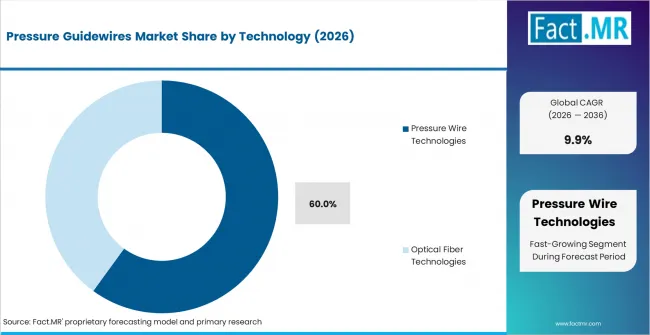
Pressure Guidewires Market Analysis By Technology | Source: Fact.MR
Based on FACT.MR's pressure guidewires market report, Pressure Wire Technologies is estimated to hold approximately 60% share in 2026. Pressure wire dominates due to its established compatibility with existing catheterization laboratory console infrastructure and decades of clinical validation in FFR-guided coronary intervention, lowering the procedural and procurement switching cost for hospitals.
- Abbott COMET Platform Launch: Abbott Laboratories launched the COMET II pressure guidewire system in Q2 2024, featuring an updated pressure sensor design with improved signal fidelity for complex lesion assessment. The platform is compatible with Abbott's existing RadiAnalyzer console installed in over 4,000 cardiac catheterization laboratories globally, enabling adoption without capital equipment replacement. [4]
- Opsens Optical Fiber Expansion: Opsens Inc. received FDA 510(k) clearance for its OptoWire III optical fiber pressure guidewire in January 2025, expanding U.S. market access for fiber-based FFR assessment. The device offers drift-free pressure measurement and single-use sterility compliance, targeting hospitals transitioning from reusable pressure wire systems under infection control protocol reviews. [5]
- Cath Lab Console Installed Base: Philips Healthcare reported that its COROVENTIS CoroFlow platform, used for FFR and iFR analysis, maintained an installed base of over 3,500 systems in European and North American cardiac centres as of Q3 2024, providing a structural usage anchor for compatible pressure guidewire procurement across the installed device ecosystem. [6]
Pressure Guidewires Market Analysis by Product
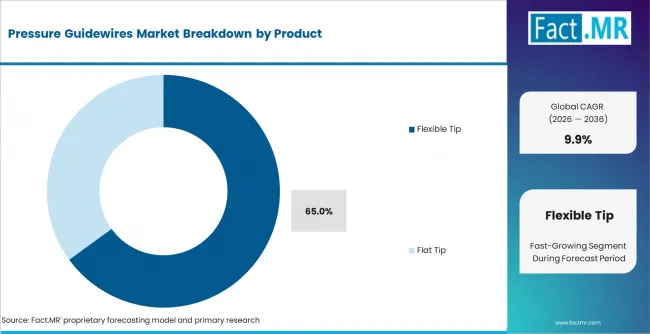
Pressure Guidewires Market Analysis By Product | Source: Fact.MR
Based on FACT.MR's pressure guidewires market report, Flexible Tip is estimated to hold approximately 65% share in 2026. Flexible tip designs dominate because complex coronary anatomies including tortuous vessels and heavily calcified lesions require superior tip conformability to navigate safely. Flexible tip guidewires reduce procedural risk and enable access to lesions that flat tip designs cannot reliably cross.
- Boston Scientific Guidewire Launch: Boston Scientific Corporation launched an updated flexible tip pressure guidewire in its COMET product line in Q3 2024, incorporating a hydrophilic polymer tip coating for enhanced trackability in complex left anterior descending artery lesions. Clinical validation data was presented at TCT 2024, demonstrating superior crossability versus the prior generation flat tip design. [7]
- Terumo Tip Technology Development: Terumo Corporation introduced a next-generation tapered flexible tip pressure guidewire for the Japanese market in Q1 2025, designed to meet MHLW device approval standards and optimised for the high calcification burden observed in Japanese coronary artery disease patient populations. [8]
- Complex PCI Procedure Growth: The Society for Cardiovascular Angiography and Interventions reported a 14% year-on-year increase in complex PCI procedure volumes at US academic cardiac centres in 2024, driven by an ageing patient population with higher calcification and tortuosity burden, directly supporting demand for flexible tip guidewires over flat tip alternatives. [9]
Pressure Guidewires Market Analysis by End User
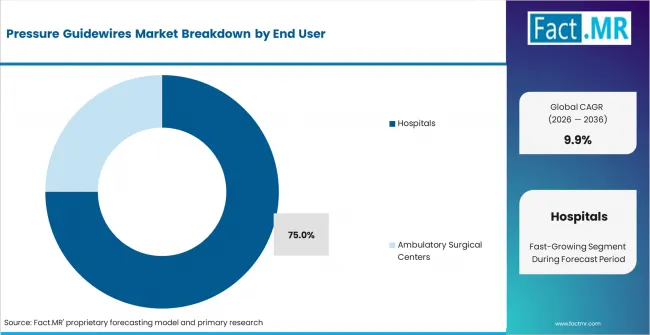
Pressure Guidewires Market Analysis By End User | Source: Fact.MR
Based on FACT.MR's pressure guidewires market report, Hospitals are estimated to hold approximately 75% share in 2026. Hospitals dominate because tertiary and secondary cardiac care facilities operate high-volume catheterization laboratories with specialist interventional cardiology teams, generating the procedural throughput and procurement scale that drives pressure guidewire consumption at consistent annual volumes.
- Medtronic Hospital Partnership: Medtronic plc announced an expanded interventional cardiology device supply agreement with HCA Healthcare covering 180 hospitals in the United States in Q1 2025, including pressure guidewires and haemodynamic assessment consoles under a multi-year preferred supplier arrangement. [10]
- ASC Procedure Migration: The Ambulatory Surgery Center Association reported a 22% increase in cardiac catheterization procedures performed at US ambulatory surgical centres in 2024, driven by CMS reimbursement parity adjustments and lower facility cost structures, expanding the addressable market for pressure guidewires beyond hospital settings. [11]
- India Private Hospital Expansion: Fortis Healthcare and Apollo Hospitals each announced new catheterization laboratory installations in Tier-2 Indian cities in 2024, with Fortis commissioning three new cath labs in Punjab and Rajasthan and Apollo expanding cardiac intervention capacity in Andhra Pradesh, directly growing the institutional procurement base for pressure guidewires. [12]
Pressure Guidewires Market Analysis by Application
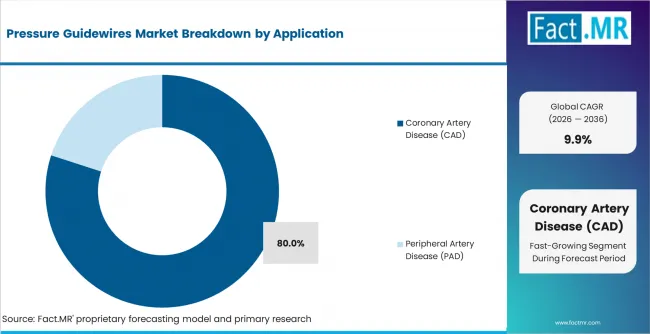
Pressure Guidewires Market Analysis By Application | Source: Fact.MR
Based on FACT.MR's pressure guidewires market report, Coronary Artery Disease is estimated to hold approximately 80% share in 2026. CAD dominates because FFR-guided PCI is a guideline-endorsed standard of care for intermediate coronary lesion assessment, generating high and recurring device use across cardiac catheterization procedures at hospitals globally.
- FAME 3 Trial Impact: Publication of five-year FAME 3 trial follow-up data in The Lancet in early 2024 confirmed that FFR-guided complete revascularisation achieved outcomes comparable to coronary artery bypass grafting in selected patients, reinforcing the clinical positioning of pressure guidewires in complex multi-vessel CAD assessment and supporting guideline endorsement of FFR use in this indication.
- PAD Application Growth: Merit Medical Systems reported a 17% increase in peripheral pressure guidewire sales in 2024, driven by expanding use of resting full-cycle ratio (RFR) and FFR assessment in peripheral artery disease interventions, particularly in infrapopliteal and renal artery lesion evaluation at vascular centres in the United States and Germany.
- Interventional Volume Data: The American Heart Association Heart Disease and Stroke Statistics 2025 update reported that approximately 500,000 percutaneous coronary intervention procedures were performed in the United States in 2024, with FFR or iFR guidance used in an estimated 25% of cases and growing, providing a procedural volume anchor for sustained pressure guidewire demand.
Pressure Guidewires Market Analysis by Coating Type
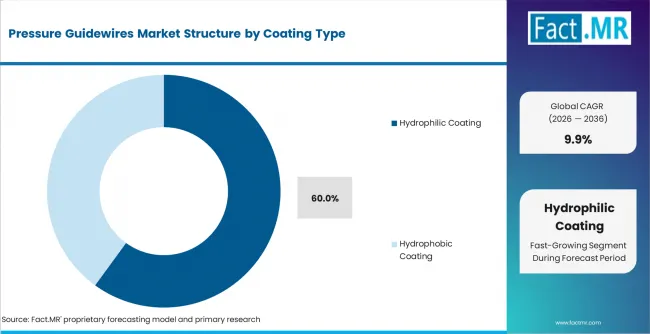
Pressure Guidewires Market Analysis By Coating Type | Source: Fact.MR
Based on FACT.MR's pressure guidewires market report, Hydrophilic Coating is estimated to hold approximately 60% share in 2026. Hydrophilic coating dominates because it significantly reduces friction during coronary navigation, enabling smoother advancement through calcified or tortuous vessels and improving procedural efficiency in complex interventions where tactile feedback and tip control are critical.
- Abbott Coating Innovation: Abbott Laboratories introduced an updated hydrophilic polymer coating formulation on its COMET II guidewire in Q2 2024, validated against ISO 10993 biocompatibility standards and demonstrating a 30% reduction in crossing force in bench testing versus the prior generation, supporting adoption in complex calcified lesion FFR assessment.
- Drug-coated Wire Development: Asahi Intecc Co., Ltd. disclosed development of a drug-eluting coating layer for pressure guidewire applications at the EuroPCR 2025 conference in May 2025, targeting vessels with high procedural spasm risk. Regulatory submission was indicated for the EU MDR pathway in H2 2025, representing a next-generation coating development beyond hydrophilic and hydrophobic categories.
- Hydrophobic Coating Adoption: Boston Scientific reported growing use of hydrophobic-coated tip guidewire variants in peripheral artery disease procedures in 2024, where greater tactile feedback during lesion crossing is preferred by vascular interventionalists over the slippery feel of fully hydrophilic wire shafts in below-knee applications.
Drivers, Restraints, and Opportunities
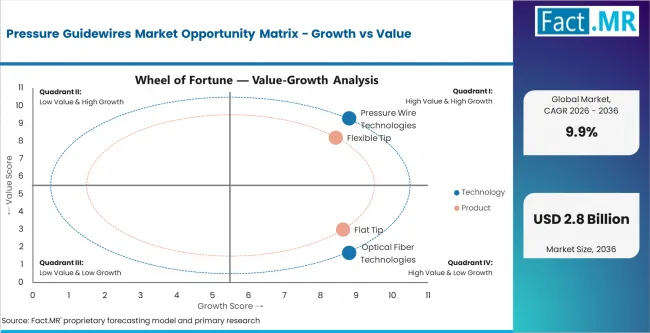
Pressure Guidewires Market Opportunity Matrix Growth Vs Value | Source: Fact.MR
FACT.MR analysts observe that the pressure guidewires market has evolved through two phases. The first phase established FFR as superior to angiography alone. Clinical trials such as DEFER and FAME built strong evidence. The second phase involved guideline adoption by major cardiology bodies. This converted evidence into routine clinical practice.
The market is entering a technology transition phase. Optical fiber-based systems are gaining traction. Traditional piezoelectric pressure wires face increasing competition. Optical systems offer better signal stability and sterility advantages.
- ACC/AHA Guideline Endorsement: American College of Cardiology and American Heart Association updated guidelines in 2023. FFR and iFR are recommended for intermediate lesions. Hospitals are integrating pressure guidewires into standard cath lab protocols [1].
- India Cardiac Care Expansion: Ministry of Health and Family Welfare reported strong growth in cath lab installations. Expansion is driven by the Ayushman Bharat programme. Demand is rising across high-growth states [2].
- EU MDR Compliance Transition: The EU MDR 2017/745 is increasing compliance requirements. Smaller manufacturers face higher costs. Large players such as Abbott Laboratories and Boston Scientific Corporation are strengthening market position through certified portfolios [3].
Regional Analysis
The pressure guidewires market is assessed across North America, Europe, Asia Pacific, Latin America, and Middle East and Africa, covering 40+ countries with demand profiles shaped by cardiovascular disease burden, catheterization laboratory density, FFR reimbursement frameworks, and clinical guideline adoption maturity. The full report offers market attractiveness analysis by region and country.
.webp "Top Country Growth Comparison Pressure Guidewires Market Cagr (2026 2036)")
Top Country Growth Comparison Pressure Guidewires Market Cagr (2026 2036) | Source: Fact.MR
| Country | CAGR (2026 to 2036) |
|---|---|
| India | 10.5% |
| China | 9.8% |
| Brazil | 9.2% |
| Germany | 9.6% |
| Japan | 8.8% |
| United States | 8.5% |
Source: Fact.MR (FACT.MR) analysis, based on proprietary forecasting model and primary research
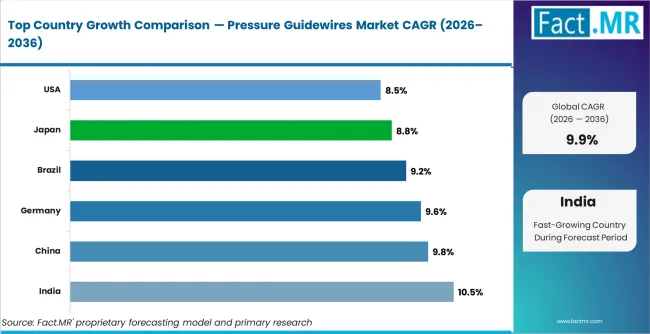
Pressure Guidewires Market Cagr Analysis By Country | Source: Fact.MR
Asia Pacific Pressure Guidewires Market Analysis
Asia Pacific leads global growth in pressure guidewires. Expansion is driven by rising cardiovascular disease burden and rapid cath lab installations. National healthcare programmes are pushing physiological assessment into standard practice. Both multinational and domestic suppliers are scaling presence across the region.
- India: India shows the fastest growth at 10.5% CAGR through 2036. Public healthcare expansion is increasing access to cardiac procedures. Ayushman Bharat is enabling reimbursement-backed adoption. New cath labs are being installed across Tier-2 and Tier-3 cities. Abbott Laboratories is expanding distribution to capture this demand.
- China: China continues strong expansion at 9.8% CAGR through 2036. National policy is mandating FFR-based assessment in major hospitals. National Health Commission of China has integrated physiological metrics into care protocols. Domestic players such as MicroPort Scientific Corporation and Lepu Medical Technology are increasing competition. Global firms retain strength in advanced systems and integration.
- Japan: Japan reflects steady growth at 8.8% CAGR through 2036. Reimbursement frameworks continue to support high procedure volumes. Ministry of Health, Labour and Welfare maintains coverage for FFR-guided interventions. Clinical guidelines are expanding usage across patient categories. Terumo Corporation and Asahi Intecc Co., Ltd. hold strong domestic positions.
FACT.MR's analysis of pressure guidewires market in Asia Pacific covers China, India, Japan, South Korea, ASEAN, and Australia and New Zealand. Readers can find catheterization laboratory density benchmarks, FFR reimbursement framework data, national cardiovascular programme procurement trends.
Europe Pressure Guidewires Market Analysis
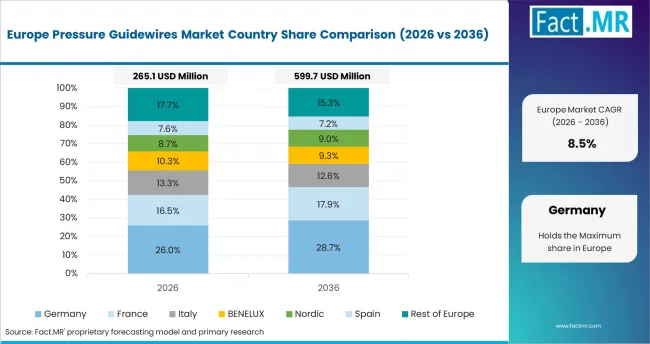
Pressure Guidewires Market Europe Country Market Share Analysis, 2026 & 2036 | Source: Fact.MR
Europe remains a mature and clinically advanced market. High adoption of FFR is supported by reimbursement systems. Regulatory tightening is reshaping supplier competition. Companies such as Abbott Laboratories, Boston Scientific Corporation, and Philips Healthcare dominate through established networks.
- Germany: Germany shows strong growth at 9.6% CAGR through 2036. Reimbursement under DRG systems supports consistent usage. German Cardiac Society has reinforced physiological assessment as standard practice. Hospitals are increasing procurement through long-term agreements. Expanded reimbursement for additional metrics is boosting usage per procedure.
FACT.MR's analysis of pressure guidewires market in Europe covers Germany, France, the United Kingdom, Italy, Spain, Netherlands, and Rest of Europe. Readers can find DRG reimbursement benchmarks, EU MDR compliance impact data, FFR adoption rate trends.
North America Pressure Guidewires Market Analysis
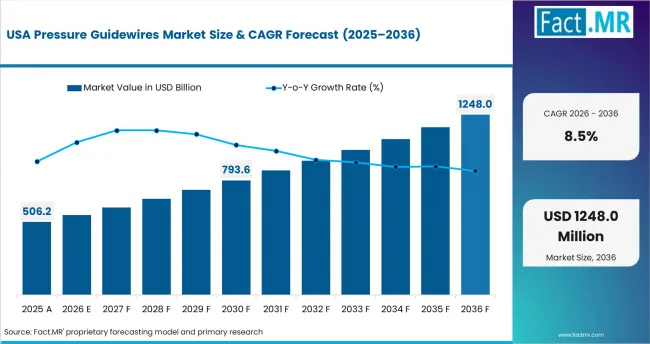
Pressure Guidewires Market Country Value Analysis | Source: Fact.MR
North America remains the largest revenue market. Growth is supported by strong clinical guidelines and reimbursement coverage. Adoption is closely linked to evidence-based care protocols.
- United States: The United States records steady growth at 8.5% CAGR through 2036. Centers for Medicare & Medicaid Services continues reimbursement support for FFR procedures. Clinical registries show increasing adoption rates across cath labs. Compliance programmes are reinforcing use in certified centres.
FACT.MR's analysis of pressure guidewires market in North America covers the United States, Canada, and Mexico. Readers can find CMS reimbursement data, NCDR procedural volume benchmarks, ACC/AHA guideline adoption rates, and competitive device pricing trends across hospital and ambulatory surgical centre procurement channels.
Latin America Pressure Guidewires Market Analysis
Latin America is emerging as a growth region. Expansion is driven by improving cardiac care infrastructure. Public and private sector investments are increasing adoption.
- Brazil: Brazil leads regional growth at 9.2% CAGR through 2036. Regulatory approvals are expanding device availability. Agência Nacional de Vigilância Sanitária has cleared multiple products for use. Clinical guidelines are promoting physiological assessment. Leading hospitals are expanding cath lab capacity, increasing device demand.
FACT.MR's analysis of pressure guidewires market in Latin America covers Brazil, Argentina, Colombia, and Rest of Latin America. Readers can find SUS procurement benchmarks, ANVISA device registration timelines, SBHCI guideline adoption data, and private hospital expansion trends.
Competitive Aligners for Market Players
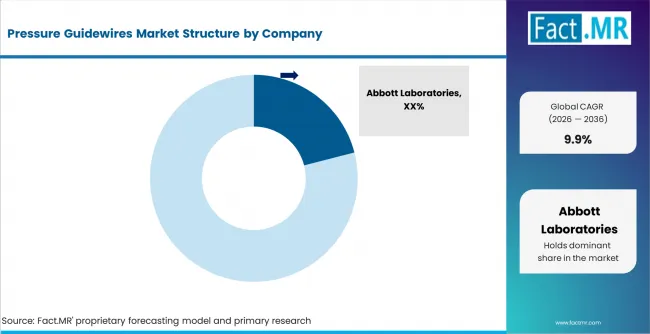
Pressure Guidewires Market Analysis By Company | Source: Fact.MR
Competition in the pressure guidewires market is increasingly shaped by clinical credibility, technology differentiation, and integration with cath lab ecosystems. Hospitals are not just buying devices. They are choosing platforms that fit into their procedural workflows and deliver consistent clinical outcomes.
Clinical validation remains the strongest competitive lever. Companies such as Abbott Laboratories and Boston Scientific Corporation benefit from long-standing trial data and guideline alignment. Products backed by strong evidence and inclusion in cardiology protocols are more likely to be selected in hospital tenders.
Technology is becoming a clear point of separation. Traditional pressure wire systems are now competing with optical fiber-based solutions. Suppliers that can demonstrate better signal stability, ease of use, and reduced procedural variability are gaining traction, especially in advanced cardiac centres.
Integration with existing cath lab infrastructure is another key factor. Devices that work seamlessly with imaging systems and consoles reduce training time and operational friction. This gives an advantage to players with established installed bases and partnerships with hospitals. Pricing and reimbursement alignment also influence decisions. In cost-sensitive markets, hospitals weigh device cost against reimbursement coverage and procedure volume. Vendors offering bundled pricing, training, and service support are better positioned to secure long-term contracts. Thus, education and physician engagement matter. Companies investing in training programs and clinical support are building stronger relationships with cardiologists. Over time, this trust translates into repeat usage and preferred supplier status across hospital networks.
Key Players
- Abbott Laboratories
- Philips Healthcare
- Boston Scientific Corporation
- Medtronic plc
- Terumo Corporation
- Opsens Inc.
- Asahi Intecc Co., Ltd.
- Merit Medical Systems, Inc.
Bibliography
- [1] American College of Cardiology / American Heart Association. (2023). 2023 ACC/AHA Guideline for the Diagnosis and Management of Coronary Artery Disease: FFR and iFR Recommendations for Intermediate Lesion Assessment. Journal of the American College of Cardiology, November 2023. acc.org/guidelines
- [2] Ministry of Health and Family Welfare, Government of India. (2025). Ayushman Bharat PM-JAY Annual Progress Report 2024–25: Catheterization Laboratory Empanelment Data and Cardiovascular Intervention Coverage. National Health Authority, March 2025. pmjay.gov.in/resources
- [3] European Commission. (2024). EU MDR 2017/745 Implementation Status: Class IIb Cardiovascular Device Certification Progress Report. European Commission Health and Food Safety Directorate, 2024. ec.europa.eu/health/medical-devices
- [4] Abbott Laboratories. (2024). Abbott Launches COMET II Pressure Guidewire System with Updated Sensor Design for Complex Coronary Lesion FFR Assessment. Abbott Newsroom, Q2 2024. abbott.com/newsroom
- [5] Opsens Inc. (2025). Opsens Receives FDA 510(k) Clearance for OptoWire III Optical Fiber Pressure Guidewire for US Market. Opsens Investor News, January 2025. opsens.com/news
- [6] Philips Healthcare. (2024). COROVENTIS CoroFlow Installed Base and Platform Usage Update: European and North American Cardiac Centre Deployment Q3 2024. Philips Investor Relations, October 2024. philips.com/investor-relations
- [7] Boston Scientific Corporation. (2024). TCT 2024 Clinical Data Presentation: COMET Flexible Tip Pressure Guidewire Crossability in Complex Coronary Anatomy. Boston Scientific Medical Affairs, October 2024. bostonscientific.com/en-US/medical-specialties/interventional-cardiology
- [8] Terumo Corporation. (2025). Terumo Introduces Next-Generation Tapered Flexible Tip Pressure Guidewire for Japanese Market Under MHLW Approval. Terumo Press Release, Q1 2025. terumo.com/press-releases
- [9] Society for Cardiovascular Angiography and Interventions. (2024). SCAI Annual Report 2024: Complex PCI Procedure Volume Growth at US Academic Cardiac Centres. SCAI, December 2024. scai.org/research
- [10] Medtronic plc. (2025). Medtronic Announces Expanded Interventional Cardiology Supply Agreement with HCA Healthcare Covering 180 US Hospitals. Medtronic Newsroom, Q1 2025. medtronic.com/newsroom
- [11] Ambulatory Surgery Center Association. (2024). ASCA Annual Report 2024: Cardiac Catheterization Procedure Migration to US Ambulatory Surgical Centres Under CMS Reimbursement Parity. ASCA, December 2024. ascassociation.org/research
- [12] Fortis Healthcare / Apollo Hospitals. (2024). Catheterization Laboratory Expansion Announcements: New Cath Lab Commissioning in Tier-2 Indian Cities. Fortis Healthcare Press Release and Apollo Hospitals Annual Report, 2024. fortishealthcare.com/media; apollohospitals.com/investor-relations
This Report Addresses
- Strategic intelligence on pressure guidewire demand across FFR and iFR-guided coronary and peripheral artery disease interventions for hospitals, ambulatory surgical centres, and catheterization laboratories globally.
- Market forecast from USD 1.0 billion in 2026 to USD 2.8 billion by 2036, at a CAGR of 9.9%.
- Growth opportunity mapping across India Ayushman Bharat cardiac care expansion, China National Health Commission FFR mandate, Germany GKV reimbursement broadening, and U.S. ACC/AHA guideline-driven protocol adoption.
- Segment analysis by technology (pressure wire, optical fiber), product (flat tip, flexible tip), end user, application (CAD, PAD), and coating type (hydrophilic, hydrophobic, drug-coated).
- Regional outlook covering Asia Pacific catheterization laboratory expansion, North America CMS reimbursement trends, Europe EU MDR compliance impact, and Latin America SUS-funded cardiac intervention procurement growth.
- Competitive landscape of Abbott Laboratories, Boston Scientific, Philips Healthcare, Medtronic, Terumo, Opsens, Asahi Intecc, and Merit Medical covering console integration positioning, guideline alignment strategies, and hospital supply agreement models.
- Regulatory impact analysis covering CMS CPT reimbursement codes, ACC/AHA 2023 guideline updates, EU MDR 2017/745 Class IIb enforcement, MHLW device clearance frameworks, ANVISA registration timelines, and China NHC quality indicator mandates.
- Report delivered in PDF, Excel datasets, and presentation formats, supported by primary interviews, manufacturer revenue disclosures, reimbursement data, and procedural volume benchmarks.
Scope of the Report
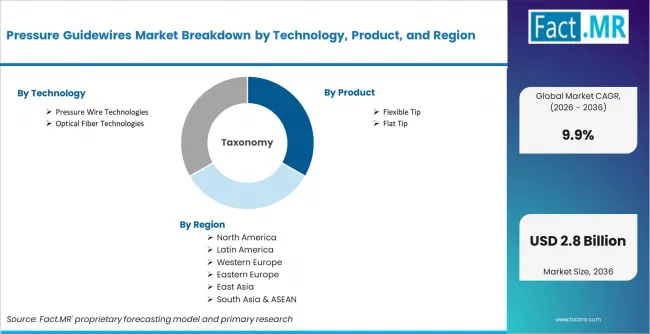
Pressure Guidewires Market Breakdown By Technology, Product, And Region | Source: Fact.MR
| Attribute | Details |
|---|---|
| Quantitative Units | USD 1.0 billion (2026) to USD 2.8 billion (2036), at a CAGR of 9.9% |
| Market Definition | Market includes pressure-sensing coronary and peripheral guidewire devices used in FFR and iFR-guided interventional procedures across hospitals, ambulatory surgical centres, and catheterization laboratories globally. |
| Technology Segmentation | Pressure Wire Technologies, Optical Fiber Technologies |
| Product Segmentation | Flat Tip, Flexible Tip |
| End User Segmentation | Hospitals, Ambulatory Surgical Centers, Independent Catheterization Labs |
| Application Segmentation | Coronary Artery Disease (CAD), Peripheral Artery Disease (PAD) |
| Coating Type Segmentation | Hydrophilic Coating, Hydrophobic Coating, Drug-coated / Specialty Coatings |
| Regions Covered | North America, Europe, Asia Pacific, Latin America, Middle East and Africa |
| Countries Covered | USA, Canada, Mexico, Germany, UK, France, Italy, Spain, Netherlands, Nordic, BENELUX, China, Japan, South Korea, India, ASEAN, Australia and New Zealand, Brazil, Argentina, Colombia, UAE, Saudi Arabia, Turkey, South Africa, Rest of MEA |
| Key Companies Profiled | Abbott Laboratories, Philips Healthcare, Boston Scientific Corporation, Medtronic plc, Terumo Corporation, Opsens Inc., Asahi Intecc Co., Ltd., Merit Medical Systems, Inc. |
| Forecast Period | 2026 to 2036 |
| Approach | Hybrid top-down and bottom-up model using manufacturer revenue disclosures, interventional cardiology procedure volumes, hospital procurement benchmarks, reimbursement framework data, and primary interviews with cardiac catheterization laboratory procurement directors. |
Pressure Guidewires Market By Segment
-
By Technology
- Pressure Wire Technologies
- Optical Fiber Technologies
-
By Product
- Flat Tip
- Flexible Tip
-
By End User
- Hospitals
- Ambulatory Surgical Centers
- Independent Catheterization Labs
-
By Application
- Coronary Artery Disease (CAD)
- Peripheral Artery Disease (PAD)
-
By Coating Type
- Hydrophilic Coating
- Hydrophobic Coating
- Drug-coated / Specialty Coatings
-
By Region
- North America
- United States
- Canada
- Mexico
- Latin America
- Brazil
- Argentina
- Colombia
- Rest of Latin America
- Western Europe
- Germany
- United Kingdom
- France
- Italy
- Spain
- Netherlands
- Nordic Countries
- BENELUX
- Rest of Western Europe
- East Asia
- China
- Japan
- South Korea
- South Asia and Pacific
- India
- ASEAN
- Australia and New Zealand
- Rest of South Asia and Pacific
- Middle East and Africa
- Saudi Arabia
- UAE
- Turkey
- South Africa
- Rest of Middle East and Africa
- North America