- Base Value(2025): 1.5 Bn
- Estimated Value(2026): 1.7 Bn
- Forecast Value (2036): 5.2 Bn
- CAGR (2026 - 2036): 12.1%
RaaS Platforms for Small and Mid-Size Manufacturers Market Forecast and Outlook By Fact.MR
In 2025, the RaaS platforms for small and mid-size manufacturers market was valued at USD 1.5 billion. Based on Fact MR analysis, demand for robotics-as-a-service platforms for small and mid-size manufacturers is estimated to grow to USD 1.7 billion in 2026 and USD 5.2 billion by 2036. FMR projects a CAGR of 12.1% during the forecast period.
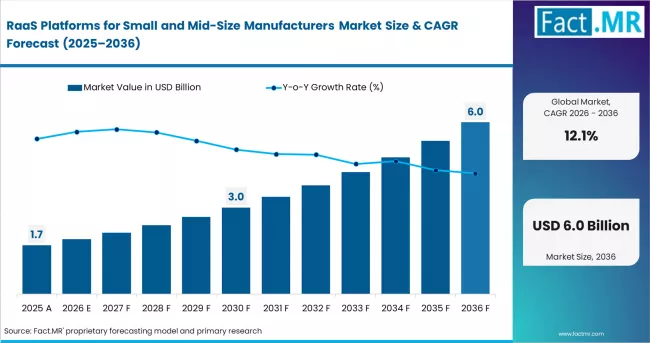
Raas Platforms For Small And Mid Size Manufacturers Market Market Value Analysis | Source: Fact.MR
RaaS Platforms for Small and Mid-Size Manufacturers Market
| Metric | Details |
|---|---|
| Industry Size (2026E) | USD 1.7 billion |
| Industry Value (2036F) | USD 5.2 billion |
| CAGR (2026 to 2036) | 12.1% |
Source: Fact.MR analysis. Updated Apr 17, 2026
Summary of RaaS Platforms for Small and Mid-Size Manufacturers Market
- Market Definition
- The market comprises robotics as a service platforms delivering industrial robots, software, maintenance, and analytics through subscription or usage based models, enabling small and mid size manufacturers to adopt automation for material handling, inspection, assembly, and packaging without high upfront capital investment requirements.
- Demand Drivers
- Increasing demand for flexible automation solutions supporting small batch and variable production workflows.
- Rising preference for subscription based robotics reducing upfront capital expenditure constraints.
- Growing labor cost pressure supporting adoption of automated material handling and assembly systems.
- Expansion of cloud connected robotic platforms supporting scalable automation deployment models.
- Increasing adoption of collaborative robots supporting safe human machine interaction across manufacturing environments.
- Demand for predictable operational expenditure structures supporting financial planning stability in small manufacturing firms.
- Key Segments Analyzed
- Robot Type: Collaborative robots lead with 34% share supported by adaptable deployment across shared workspaces.
- Deployment Model: Subscription based model dominates with 52% share driven by reduced upfront investment requirements.
- Application: Material handling, assembly, inspection, and packaging support diversified robotic service utilization.
- Technology Role: Cloud connected robotics platforms support scalable automation across modular production environments.
- Geography: Asia Pacific demonstrates strong SME automation demand, while North America supports steady adoption across contract manufacturing environments.
- Analyst Opinion at Fact MR
- Shambhu Nath Jha, Principal Consultant, Fact MR, opines, 'In this updated edition of the RaaS Platforms for Small and Mid-Size Manufacturers Market report, adoption trends indicate increasing transition toward operational expenditure based automation procurement models. Market participants observe growing demand for scalable robotics deployment frameworks enabling flexible production capacity expansion aligned with evolving manufacturing throughput requirements through 2036.'
- Strategic Implications/Executive Takeaways
- Develop subscription pricing models supporting predictable automation cost structures.
- Strengthen cloud integration capability supporting remote monitoring and robotic performance analytics.
- Expand collaborative robot deployment capability supporting shared workspace automation environments.
- Improve system integration frameworks supporting compatibility with existing manufacturing infrastructure.
- Focus on modular robotic architectures supporting scalability across variable production demand conditions.
- Monitor workforce training requirements supporting adoption of programmable robotic automation systems.
- Methodology
- Primary interviews conducted with robotics platform providers, automation integrators, and SME manufacturing operators.
- Benchmarked against industrial automation adoption indicators influencing robotics subscription demand patterns.
- Evaluated utilization across material handling, inspection, packaging, and assembly automation workflows.
- Hybrid modeling applied combining top down manufacturing automation demand assessment with bottom up robotics deployment analysis.
- Validation conducted using supplier platform deployment data, SME automation indicators, and robotics integration activity trends.
- Peer review applied using Fact MR analytical frameworks linking service based robotics adoption with flexible manufacturing demand indicators.
A CAGR of 12.1% indicates transformational expansion with variability linked to adoption readiness among small and mid-size manufacturers and subscription pricing sensitivity. Growth is supported by reduced upfront automation costs and scalability benefits, while volatility persists due to integration complexity, workforce adaptation requirements, and capital allocation priorities across production environments.
China leads with a projected CAGR of 13.4%, supported by increasing adoption of subscription-based automation solutions across small-scale manufacturing facilities. India follows with a CAGR of 13.1%, driven by growing deployment of flexible robotic systems across mid-size production environments. The United Kingdom records a CAGR of 12.9%, reflecting steady integration of scalable automation platforms across precision manufacturing applications. Germany shows a CAGR of 12.6%, supported by consistent implementation of modular robotic service models across industrial production systems. The United States records the slowest growth at 12.1%, reflecting a relatively mature automation ecosystem where demand is largely tied to replacement cycles within existing robotics deployment frameworks.
Segmental Analysis
RaaS Platforms for Small and Mid-Size Manufacturers Market Analysis by Deployment Model
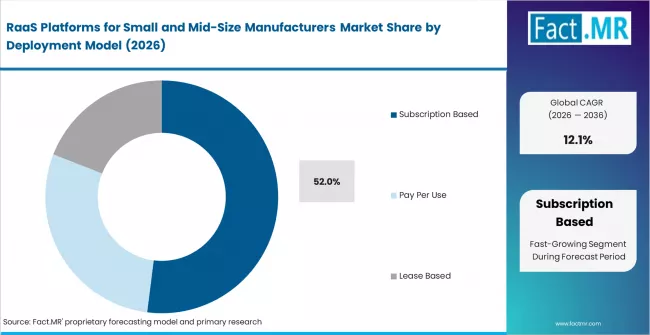
Raas Platforms For Small And Mid Size Manufacturers Market Analysis By Deployment Model | Source: Fact.MR
- Market Overview: Based on Fact MR assessment, subscription based deployment is projected to account for 52% share of the RaaS platforms for small and mid size manufacturers market in 2026. Robotics as a service models enable access to automation infrastructure through periodic payment structures supporting reduced upfront capital allocation requirements. Service agreements include robot hardware, software updates, maintenance support, and system integration services enabling predictable operational expenditure across manufacturing environments. Deployment frameworks support scalability of automation capacity aligned with production volume variability across small and medium scale industrial facilities requiring flexible automation adoption pathways.
- Demand Drivers:
- Capital Allocation Efficiency: Subscription structure supports conversion of automation investment into operational expenditure enabling financial planning flexibility across manufacturing operations.
- Scalability Parameters: RaaS platforms enable adjustment of robotic deployment capacity aligned with production demand variability across manufacturing workflows.
- Maintenance Integration Needs: Service contracts incorporate system monitoring and technical support supporting continuity of robotic system performance across production environments.
RaaS Platforms for Small and Mid-Size Manufacturers Market Analysis by Robot Type
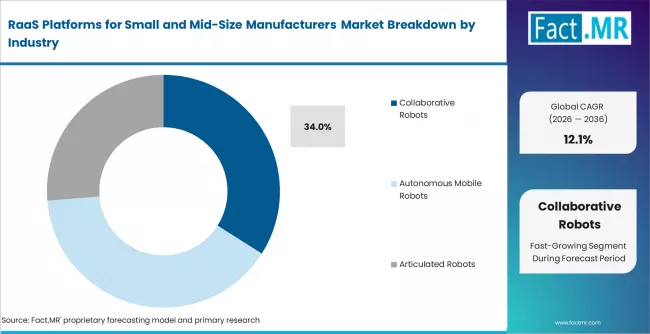
Raas Platforms For Small And Mid Size Manufacturers Market Analysis By Robot Type | Source: Fact.MR
- Market Overview: Collaborative robots are estimated to hold 34% share of the RaaS platforms for small and mid size manufacturers market in 2026, supported by capability to operate within shared human robot workspaces requiring controlled force limitation and sensor assisted motion control. Cobots are deployed across assembly, material handling, inspection, and packaging tasks requiring adaptable automation solutions compatible with existing production layouts. Compact equipment footprint supports integration across manufacturing cells requiring minimal structural modification enabling progressive automation adoption across small scale industrial operations.
- Demand Drivers:
- Human Robot Interaction Requirements: Collaborative robots support safe operation within shared workspaces requiring controlled force and motion limitation characteristics.
- Flexible Automation Parameters: Cobots enable deployment across varied production tasks requiring adaptable programming across multiple manufacturing processes.
- Integration Compatibility Needs: Collaborative robotic systems support installation across existing production environments requiring limited infrastructure modification.
Key Dynamics
RaaS Platforms for Small and Mid-Size Manufacturers Market Drivers, Restraints, and Opportunities
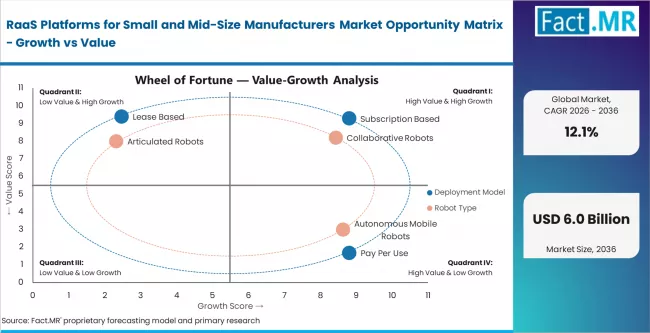
Raas Platforms For Small And Mid Size Manufacturers Market Opportunity Matrix Growth Vs Value | Source: Fact.MR
FMR analysts observe that historical patterns position Robotics-as-a-Service platforms as a transitional automation model emerging from high upfront capital barriers associated with industrial robot adoption. The current market size reflects early-stage scaling where subscription-based robotics deployment enables smaller manufacturers to access automation capability without balance sheet exposure to large capital expenditure cycles. Structural reality indicates a growth-phase market shaped by labor cost pressure, production variability, and increasing demand for flexible automation architectures capable of supporting shorter production runs across contract manufacturing environments.
The present structural shift reflects declining preference for fixed automation systems that require long depreciation cycles, while modular robotic subscriptions provide scalable capacity aligned with fluctuating production volumes. Subscription pricing increases lifecycle cost per unit of robotic utilization, yet reduced integration complexity and faster deployment timelines offset higher recurring expenditure through improved equipment utilization rates. Demand expansion is concentrated among discrete manufacturing segments where workforce shortages and margin pressure reinforce adoption of operational expenditure-based automation procurement models.
- OPEX Automation Model: RaaS platforms convert large upfront robot acquisition costs into predictable subscription expenses, improving capital efficiency for small and mid-size manufacturers.
- Safety Standard Integration: ISO 10218 and ISO/TS 15066 collaborative robot safety frameworks enable wider deployment of robots in mixed human-machine production environments.
- North America Adoption: United States and Canada show higher uptake due to labor shortages and contract manufacturing structures requiring flexible automation scaling.
Regional Analysis
The RaaS Platforms for Small and Mid-Size Manufacturers Market is assessed across North America, Europe, and Asia Pacific, segmented by country-level demand in collaborative robotics deployment, subscription-based automation solutions, flexible manufacturing systems, and production line digitization platforms. Regional demand reflects SME automation adoption, labor optimization strategies, and expansion of robotics-as-a-service business models. The full report offers market attractiveness analysis.
.webp "Top Country Growth Comparison Raas Platforms For Small And Mid Size Manufacturers Market Cagr (2026 2036)")
Top Country Growth Comparison Raas Platforms For Small And Mid Size Manufacturers Market Cagr (2026 2036) | Source: Fact.MR
CAGR Table
| Country | CAGR (2026–2036) |
|---|---|
| China | 13.4% |
| India | 13.1% |
| United Kingdom | 12.9% |
| Germany | 12.6% |
| United States | 12.1% |
Source: Fact.MR analysis. Updated Apr 17, 2026
Source: Fact MR analysis, based on proprietary forecasting model and primary research
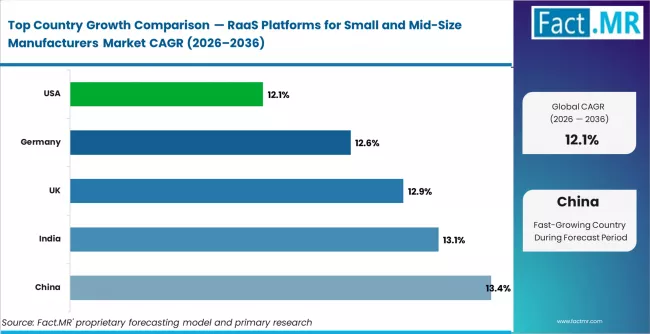
Raas Platforms For Small And Mid Size Manufacturers Market Cagr Analysis By Country | Source: Fact.MR
Asia Pacific
Asia Pacific functions as the SME automation adoption hub, supported by government-backed smart manufacturing initiatives and strong demand for flexible robotic deployment models. ABB Ltd. strengthens collaborative robot leasing solutions. Fanuc Corporation expands subscription-based automation platforms. Universal Robots A/S supports scalable robotic integration capability.
- China: China is projected to record 13.4% CAGR in RaaS platforms for small and mid-size manufacturers through 2036. Intelligent Manufacturing pilot programme expansion (MIIT, March 2024) supports robotics subscription adoption. ABB Ltd. expanded RobotStudio cloud-enabled deployment capability (June 2023).
- India: Uptake of RaaS platforms for small and mid-size manufacturers in India is forecast to grow at 13.1% CAGR through 2036. Production Linked Incentive manufacturing digitization initiatives (Ministry of Commerce, January 2024) encourage robotics integration. Fanuc India expanded SME-focused robotic leasing programs (September 2023).
Europe
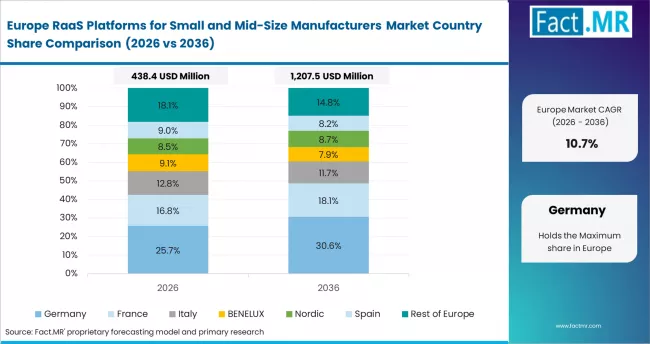
Raas Platforms For Small And Mid Size Manufacturers Market Europe Country Market Share Analysis, 2026 & 2036 | Source: Fact.MR
Europe operates as the flexible robotics integration center, supported by Industry 4.0 adoption frameworks and structured SME digitalization funding mechanisms. KUKA AG strengthens robotics subscription offerings. Universal Robots A/S expands collaborative automation ecosystems. Siemens AG supports digital manufacturing platform integration capability.
- United Kingdom: Deployment of RaaS platforms for small and mid-size manufacturers in United Kingdom is expected to expand at 12.9% CAGR through 2036. Made Smarter adoption programme expansion (Department for Business and Trade, February 2024) supports robotics integration in SMEs. Universal Robots A/S expanded partner-based automation leasing programs (May 2023).
- Germany: Germany is anticipated to observe 12.6% CAGR in RaaS platforms for small and mid-size manufacturers through 2036. Plattform Industrie 4.0 interoperability initiative update (BMWK, October 2023) strengthens robotic platform adoption pathways. KUKA AG expanded subscription-based robotic deployment models (April 2023).
North America
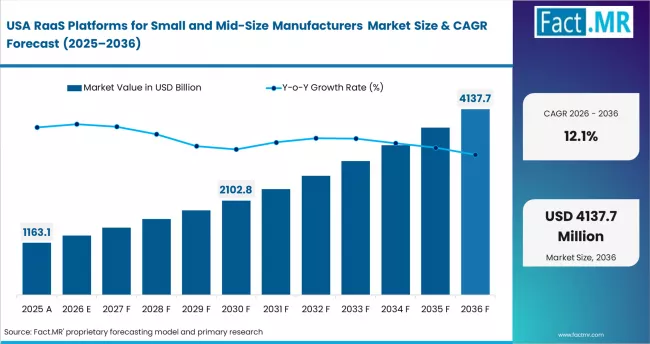
Raas Platforms For Small And Mid Size Manufacturers Market Country Value Analysis | Source: Fact.MR
North America represents the commercial robotics subscription ecosystem, supported by venture-backed automation providers and strong SME digital transformation demand. Rockwell Automation Inc. strengthens robotics lifecycle service capabilities. Teradyne Inc. supports collaborative robot deployment platforms. Ready Robotics Corp. expands robotic automation subscription infrastructure.
- United States: The United States is forecast to expand at 12.1% CAGR in RaaS platforms for small and mid-size manufacturers through 2036. Manufacturing USA digital transformation funding update (NIST, March 2024) supports robotics-as-a-service deployment models. Teradyne Inc. expanded Universal Robots service-based automation programs (August 2023).
Fact MR's analysis of RaaS platforms for small and mid-size manufacturers market in global regions consists of country-wise assessment that includes China, India, United Kingdom, Germany, and United States. Readers can find SME automation adoption trends, robotics subscription model developments, digital manufacturing transformation signals, and competitive positioning across key markets.
Competitive Landscape
Competitive Structure and Buyer Dynamics in the RaaS Platforms for Small and Mid-Size Manufacturers Market
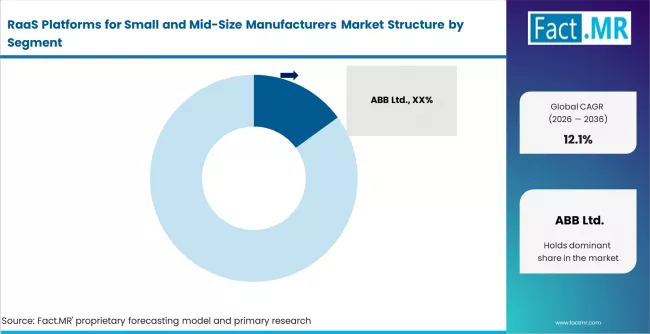
Raas Platforms For Small And Mid Size Manufacturers Market Analysis By Company | Source: Fact.MR
The competitive structure of the RaaS Platforms for Small and Mid-Size Manufacturers Market is moderately fragmented, with industrial robotics providers and software platform developers competing across subscription based automation deployment models. Companies such as ABB Ltd., KUKA AG, Universal Robots A/S, Locus Robotics Corporation, Fetch Robotics Inc., and inVia Robotics Inc. maintain strong positions through established robotics platforms integrated with flexible service based pricing structures. Additional participants including Rapid Robotics Inc., Relay Robotics Inc., Hirebotics Inc., and Formant Inc. contribute through cloud based robot management software and fleet optimization tools designed for scalable automation adoption. Competition is primarily influenced by deployment flexibility, integration capability, ease of programming, and cost efficiency aligned with smaller production environments.
Several companies maintain structural advantages through established robotics engineering capabilities and recurring service based business models that reduce upfront investment requirements. Firms such as ABB Ltd., KUKA AG, and Universal Robots A/S benefit from extensive industrial robotics portfolios supporting modular automation deployment. Locus Robotics Corporation and inVia Robotics Inc. maintain advantages through warehouse automation expertise and fleet orchestration software capabilities. Small and mid-size manufacturers typically evaluate multiple RaaS providers to reduce dependence on a single automation partner and maintain operational flexibility. Procurement decisions assess subscription cost structure, system reliability, and scalability potential, moderating supplier pricing leverage across robotics as a service deployments.
Key Players of the RaaS Platforms for Small and Mid-Size Manufacturers Market
- ABB Ltd.
- KUKA AG
- Locus Robotics Corporation
- Relay Robotics Inc.
- Rapid Robotics Inc.
- Formant Inc.
- inVia Robotics Inc.
- Hirebotics Inc.
- Universal Robots A/S
- Fetch Robotics Inc.
Bibliographies
- [1] National Institute of Standards and Technology. (2024, August). Strategic plan for the Manufacturing USA program. U.S. Department of Commerce.
- [2] National Institute of Standards and Technology. (2024, March). NIST to launch competition for AI-focused Manufacturing USA institute. U.S. Department of Commerce.
- [3] Ministry of Industry and Information Technology. (2026, March). AI + manufacturing special action plan. Government of China.
- [4] Ministry of Commerce and Industry. (2024, January). Production linked incentive scheme: Manufacturing digitization initiatives. Government of India.
- [5] Department for Business and Trade. (2024, February). Made Smarter adoption programme expansion. UK Government.
- [6] Federal Ministry for Economic Affairs and Climate Action. (2023, October). Plattform Industrie 4.0 interoperability initiative update. Government of Germany.
This Report Addresses
- Market size forecasts for 2026 to 2036 based on subscription-based industrial automation adoption across small and mid-size manufacturing environments.
- Opportunity mapping across collaborative robots, autonomous mobile robots, articulated robots, SCARA robots, and Cartesian robotic deployment models.
- Segment and regional forecasts covering material handling, assembly, packaging, inspection, and palletizing automation applications.
- Competition assessment based on platform scalability, fleet orchestration software capability, and robotic integration performance across SME production systems.
- Regulatory review covering ISO 10218 and ISO TS 15066 collaborative robot safety compliance frameworks influencing deployment feasibility.
- Report delivery in PDF, Excel, PPT, and dashboard formats for robotics providers, manufacturing technology consultants, and SME automation decision-makers.
- Technology risk assessment covering integration complexity, workforce adaptation requirements, subscription cost sensitivity, and interoperability constraints across digital manufacturing ecosystems.
RaaS Platforms for Small and Mid-Size Manufacturers Market Definition
The RaaS Platforms for Small and Mid-Size Manufacturers Market includes cloud connected robotics platforms that provide industrial robots, software, maintenance, and analytics through subscription or pay per use models, enabling smaller manufacturers to automate production, material handling, inspection, and packaging without high upfront capital investment.
RaaS Platforms for Small and Mid-Size Manufacturers Market Inclusions
The report includes global and regional market size estimates, forecast analysis, and segmentation by robot type, deployment model, application area, software capability, end use industry, pricing structure, and integration with manufacturing automation systems supporting small and mid size enterprises.
RaaS Platforms for Small and Mid-Size Manufacturers Market Exclusions
The scope excludes conventional capital purchase industrial robots, robotic hardware without service based delivery models, general manufacturing software not integrated with robotic automation, and large enterprise custom automation systems not structured as subscription platforms.
RaaS Platforms for Small and Mid-Size Manufacturers Market Research Methodology
- Primary Research: Interviews were conducted with robotics platform providers, system integrators, manufacturing technology consultants, small factory operators, and industrial automation specialists.
- Desk Research: Public sources included robotics industry publications, company platform documentation, cloud automation research, and technical literature on subscription based industrial robotics models.
- Market-Sizing and Forecasting: A hybrid model combining top-down manufacturing automation demand evaluation and bottom-up analysis of subscription robotics deployment across small and mid size production environments was applied.
- Data Validation and Update Cycle: Outputs were validated through cross comparison of supplier data, expert consultation, and periodic monitoring of robotics adoption trends in small and mid size manufacturing sectors.
Segmentation
Report Scope
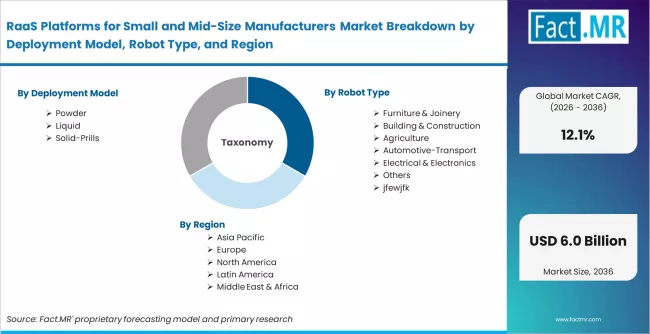
Raas Platforms For Small And Mid Size Manufacturers Market Breakdown By Deployment Model, Robot Type, And Region | Source: Fact.MR
| Metric | Value |
|---|---|
| Quantitative Units | USD 1.7 billion (2026) to USD 5.2 billion (2036), at a CAGR of 12.1% |
| Market Definition | The robotics-as-a-service platforms for small and mid-size manufacturers market includes subscription-based and usage-based robotic automation solutions enabling flexible deployment of industrial robots without significant upfront capital investment, supporting scalable automation adoption across manufacturing operations. |
| Robot Type Segmentation | Collaborative robots, Autonomous mobile robots, Articulated robots, SCARA robots, Cartesian robots |
| Application Segmentation | Material handling, Assembly, Packaging, Inspection, Palletizing |
| Deployment Model Segmentation | Subscription based, Pay per use, Lease based |
| Regions Covered | North America, Latin America, Europe, East Asia, South Asia, Oceania, Middle East and Africa |
| Countries Covered | United States, Canada, Mexico, Germany, France, United Kingdom, Italy, Spain, Netherlands, Sweden, China, Japan, South Korea, India, Singapore, Australia, United Arab Emirates, Saudi Arabia, and 40+ countries |
| Key Companies Profiled | ABB Ltd., KUKA AG, Locus Robotics Corporation, Relay Robotics Inc., Rapid Robotics Inc., Formant Inc., inVia Robotics Inc., Hirebotics Inc., Universal Robots A/S, Fetch Robotics Inc. |
| Forecast Period | 2026 to 2036 |
| Approach | Hybrid top-down and bottom-up market estimation based on robotics adoption trends among small and mid-size enterprises, subscription-based automation demand benchmarking, capital expenditure substitution patterns, manufacturing productivity optimization requirements, and validation through primary interviews with robotics platform providers, system integrators, and manufacturing companies. |
Source: Fact.MR analysis. Updated Apr 17, 2026
RaaS Platforms for Small and Mid Size Manufacturers Market Key Segments
-
Robot Type:
- Collaborative Robots
- Autonomous Mobile Robots
- Articulated Robots
- SCARA Robots
- Cartesian Robots
-
Application:
- Material Handling
- Assembly
- Packaging
- Inspection
- Palletizing
-
Deployment Model:
- Subscription Based
- Pay Per Use
- Lease Based
-
Region:
-
North America
- USA
- Canada
- Mexico
- Europe
- Germany
- UK
- France
- Italy
- Spain
- Nordic Countries
- BENELUX
- Rest of Europe
- Asia Pacific
- China
- Japan
- South Korea
- India
- Australia
- Rest of Asia Pacific
- Latin America
- Brazil
- Argentina
- Rest of Latin America
- Middle East and Africa
- Kingdom of Saudi Arabia
- United Arab Emirates
- South Africa
- Rest of Middle East and Africa
- Other Regions
- Oceania
- Central Asia
- Other Markets
-
Frequently Asked Questions
How large is the demand for RaaS Platforms for Small and Mid-Size Manufacturers in the global market in 2026?
What will be the market size of RaaS Platforms for Small and Mid-Size Manufacturers in the global market by 2036?
What is the expected demand growth for RaaS Platforms for Small and Mid-Size Manufacturers in the global market between 2026 and 2036?
Which company is identified as a leading provider in the RaaS Platforms for Small and Mid-Size Manufacturers market?
Which deployment model is projected to dominate RaaS platform adoption by 2026?
Why are subscription based RaaS platforms widely adopted by small and mid-size manufacturers?
What is driving demand for RaaS platforms in China?
What is the growth outlook for the RaaS Platforms for Small and Mid-Size Manufacturers market in China?
Why is India an important market for robotics as a service adoption?
What is the growth outlook for the RaaS Platforms for Small and Mid-Size Manufacturers market in India?
How is demand for RaaS platforms evolving in the United Kingdom manufacturing sector?
Demand is supported by modernization of factory automation systems and increasing adoption of flexible robotics deployment models.
What is the growth outlook for the RaaS Platforms for Small and Mid-Size Manufacturers market in Germany?
How is the United States positioned in the RaaS Platforms for Small and Mid-Size Manufacturers market?
What is the growth outlook for the RaaS Platforms for Small and Mid-Size Manufacturers market in the United States?
What are RaaS platforms and what are they mainly used for in manufacturing environments?
What does the RaaS Platforms for Small and Mid-Size Manufacturers market include in this report?
What applications are included in the scope of the RaaS Platforms for Small and Mid-Size Manufacturers market?
What is excluded from the scope of the RaaS Platforms for Small and Mid-Size Manufacturers market report?
What does market forecast mean in the RaaS Platforms for Small and Mid-Size Manufacturers market report?
How is the RaaS Platforms for Small and Mid-Size Manufacturers market forecast developed in this report?
What does primary validation indicate in the RaaS Platforms for Small and Mid-Size Manufacturers market analysis?
Who worked on this report


Preview the report firsthand - request a free sample
Free SampleGet the brochure for pricing and purchase details
Download PDF