Powertrain Domain Control Unit Platforms Market Size, Share, Growth and Forecast (2026 - 2036)

The Powertrain Domain Control Unit Platforms Market is segmented by Platform Type (Single Domain Control Unit, Multi-domain Control Unit, Zonal Control Architecture, Centralized Vehicle Computer, Integrated Powertrain Controller), Powertrain Type (ICE Platforms, Hybrid Platforms, Battery Electric Platforms, Fuel Cell Platforms), Component (Microcontrollers, System on Chip Processors, Power Management ICs, Communication Interfaces, Software Platforms), Vehicle Type (Passenger Vehicles, Commercial Vehicles, Electric Vehicles) and Region. Forecast for 2026 to 2036.

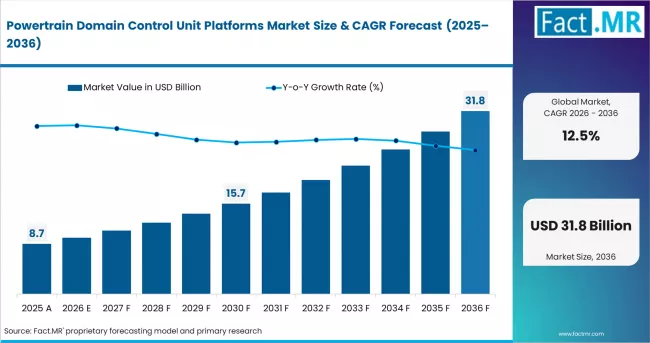
Fact MR estimates the powertrain domain control unit platforms market at USD 6.8 billion in 2025. Market value is projected to increase to USD 8.7 billion in 2026 and USD 28.4 billion by 2036, advancing at a CAGR of 12.5%. Passenger vehicles are anticipated to lead with 69.2%, whereas battery electric platforms are expected to hold 41.6%.

Powertrain Domain Control Unit Platforms Market Size, Share and Forecast Powertrain Domain Control Unit Platforms Market Size, Share and Forecast by Fact.MR

In 2025, the powertrain domain control unit platforms market was valued at USD 6.8 billion. Fact MR analysis indicates demand for powertrain domain control unit platforms is expected to reach USD 8.7 billion in 2026 and USD 28.4 billion by 2036. FMR estimates the market will expand at a CAGR of 12.5% across the forecast period.
Powertrain Domain Control Unit Platforms Market Value Analysis

Summary of Powertrain Domain Control Unit Platforms Market

The powertrain domain control unit platforms market refers to centralized electronic computing architectures that manage propulsion functions including engine control, electric motor performance, transmission coordination, battery management, and thermal regulation. These platforms consolidate multiple electronic control units into unified processing systems enabling software-defined control of internal combustion, hybrid, and electric powertrain configurations.

  • Demand Drivers
    • Increasing transition toward centralized electronic architectures replacing distributed control units across vehicle propulsion systems.
    • Rising integration of software-defined vehicle platforms requiring coordinated control of motor, inverter, battery, and transmission subsystems.
    • Expansion of electric and hybrid vehicle production increasing demand for high-performance automotive computing platforms.
    • Growing requirement for real-time data processing supporting torque optimization, energy efficiency management, and thermal control integration.
    • Increasing semiconductor capability enabling consolidation of multiple powertrain control functions within single domain computing platforms.
  • Key Segments Analyzed
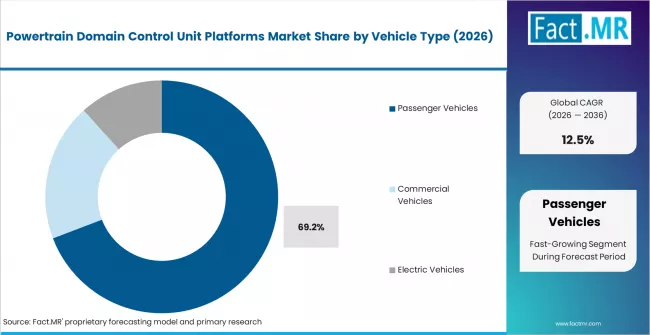
    • Vehicle Type: Passenger vehicles lead with 69.2% share supported by high adoption of centralized electronic control architectures.
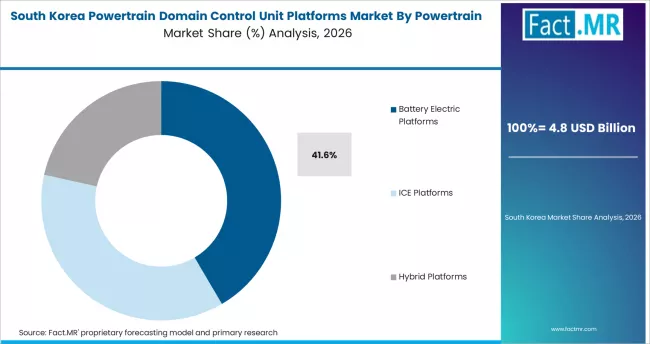
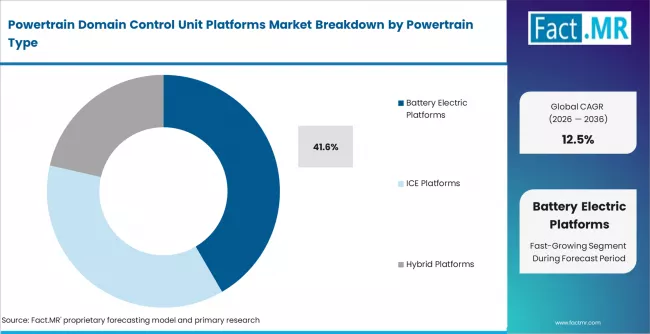
    • Powertrain Type: Battery electric platforms account for 41.6% share due to complexity of electric propulsion control requirements.
    • Component: Microcontrollers and system-on-chip processors show strong adoption supporting high-speed data processing capability.
    • Platform Type: Multi-domain control units and centralized vehicle computers demonstrate increasing deployment across software-defined vehicle architectures.
    • Geography: China and South Korea show strong growth supported by expansion of vehicle electronic architecture innovation.
  • Analyst Opinion at Fact MR
    • Shambhu Nath Jha, Principal Consultant at Fact MR, states, "Domain-based control architectures are transforming vehicle electronic design as centralized computing platforms replace distributed control units across propulsion systems. Suppliers capable of delivering high-reliability processors and software integration capability will maintain strong positioning as vehicle electrification and software-defined architecture adoption expand."
  • Strategic Implications
    • Strengthen development of high-performance automotive processors supporting real-time propulsion system coordination.
    • Improve integration between software platforms and powertrain control hardware supporting unified vehicle electronic architecture.
    • Expand capability for scalable domain controller platforms compatible with electric, hybrid, and internal combustion vehicle configurations.
    • Support collaboration between semiconductor suppliers and vehicle manufacturers enabling optimized system-level performance integration.
  • Methodology
  • Based on primary interviews with automotive OEM engineers, semiconductor suppliers, and vehicle software platform developers.
  • Supported by review of automotive E/E architecture research, semiconductor platform documentation, and vehicle control system studies.
  • Market estimation uses hybrid modeling combining supplier revenue benchmarking with evaluation of vehicle production and electrification trends.
  • Data validation conducted using technical literature and expert consultation inputs.

Powertrain Domain Control Unit Platforms Market

Metric Details
Industry Size (2026E) USD 8.7 billion
Industry Value (2036F) USD 28.4 billion
CAGR (2026 to 2036) 12.5%

A CAGR of 12.5%, with value increasing from USD 8.7 billion to USD 28.4 billion, indicates a strong upward growth curve reflecting consolidation of electronic control functions into centralized domain architectures. Expansion is supported by vehicle software integration requirements, while moderated by semiconductor dependency, functional safety validation costs, and platform migration complexity across legacy ECU ecosystems.

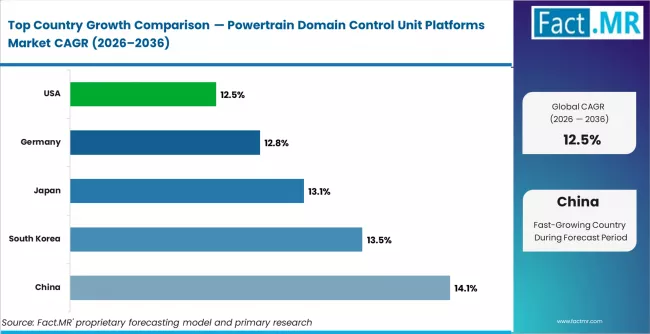
China records the fastest growth at 14.1%, supported by increasing integration of centralized electronic control architectures in electric and hybrid vehicle powertrain systems. South Korea follows at 13.5%, driven by expansion of semiconductor-based vehicle control processing platforms. Japan shows 13.1% growth, linked to development of high-reliability automotive electronic control units for next-generation mobility platforms. Germany at 12.8% and the USA at 12.5% represent mature markets where demand is largely replacement-driven due to established adoption of domain-based vehicle electronic architectures. A structural constraint across mature markets is functional safety validation complexity, which extends development cycles for high-performance powertrain control units.

Segmental Analysis

Powertrain Domain Control Unit Platforms Market Analysis by Vehicle Type
Powertrain Domain Control Unit Platforms Market Analysis By Vehicle Type

  • Market Overview: Passenger vehicles are projected to hold 69.2% share of the powertrain domain control unit platforms market in 2026. Demand concentration reflects increasing consolidation of electronic control functions within centralized domain controller architectures managing engine control, transmission systems, thermal management, and power distribution across modern vehicle platforms. Passenger vehicle manufacturers deploy domain control units to support integration of software-defined vehicle architectures enabling coordinated powertrain performance optimization.
  • Demand Drivers:
    • Centralized Electronic Architecture: Domain control units consolidate multiple electronic control functions into unified processing platforms supporting coordinated management of powertrain subsystems.
    • Software Integration Requirements: Passenger vehicle platforms increasingly utilize software-based control frameworks enabling real-time optimization of propulsion system performance parameters.
    • Vehicle Electrification Compatibility: Domain controller architectures support integration of electric propulsion control modules and hybrid system management functions within centralized processing environments.

Powertrain Domain Control Unit Platforms Market Analysis by Powertrain Type
Powertrain Domain Control Unit Platforms Market Analysis By Powertrain Type

  • Market Overview: Battery electric platforms are estimated to account for 41.6% share in 2026, supported by requirement for centralized control systems capable of managing electric motor operation, inverter control, thermal regulation, and battery management communication within electric vehicle architectures. Domain control unit platforms enable coordinated data exchange across multiple electronic subsystems supporting optimized electric propulsion system performance.
  • Demand Drivers:
    • Electric Propulsion Control Requirements: Battery electric vehicle architectures require centralized control units capable of coordinating motor torque delivery, inverter switching behavior, and regenerative braking functions.
    • Thermal Management Integration: Domain controllers manage communication between battery cooling systems, power electronics thermal regulation modules, and vehicle operating parameters.
    • High-Speed Data Processing Needs: Electric powertrain platforms require real-time data processing capability supporting communication across sensors, power electronics modules, and vehicle control software systems.

Key Dynamics

Powertrain Domain Control Unit Platforms Market Drivers, Restraints, and Opportunities
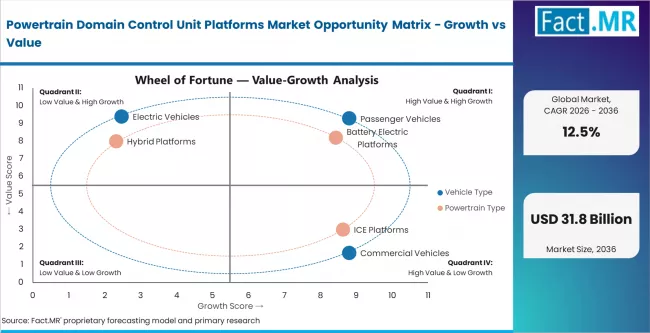
Powertrain Domain Control Unit Platforms Market Opportunity Matrix Growth Vs Value

Fact MR analysis indicates the market reflects a structurally transitioning automotive electronics architecture segment shifting from distributed electronic control units toward centralized domain-based vehicle computing platforms. Market size exists because modern powertrains, including internal combustion, hybrid, and electric systems, require coordinated control of torque delivery, thermal management, energy efficiency, and emissions performance across multiple subsystems. Historical architectures relied on separate ECUs for engine, transmission, battery, and motor control, while domain control units consolidate these functions into high-performance computing platforms that reduce wiring complexity and enable software-defined calibration updates. Structural growth is tied to electrification trends and increasing algorithm complexity required to optimize efficiency and performance across integrated propulsion systems.

Current dynamics show declining reliance on fragmented ECU networks as OEMs transition toward centralized powertrain domain controllers capable of managing inverter control, battery energy flow, regenerative braking coordination, and predictive efficiency optimization. Domain controller platforms command higher per-unit pricing due to high-performance processors, cybersecurity integration, and real-time operating software validation requirements, while reducing total hardware complexity across vehicle electrical architecture. Market expansion reflects the transition toward zonal vehicle computing structures where fewer but more powerful control units replace dozens of standalone controllers.

  • Software-Defined Architecture: Migration toward software-defined vehicles requires centralized domain controllers capable of coordinating propulsion algorithms and enabling over-the-air updates for performance optimization and emissions calibration.
  • Electrification Control Complexity: China, Europe, and the United States EV platform growth increases demand for integrated control of battery, inverter, motor, and thermal subsystems within unified computing hardware.
  • Functional Safety Compliance: ISO 26262 safety frameworks require redundant processing architectures and fault-tolerant control logic, increasing system cost while improving reliability in safety-critical powertrain operation.

Regional Analysis

The powertrain domain control unit platforms market is assessed across Asia Pacific, Europe, and North America, segmented by country-level demand for centralized electronic control architectures used in engine management, electric drivetrain optimization, battery control integration, and vehicle performance coordination. Geographic variation reflects vehicle electrification adoption, domain-based electronic architecture deployment, and integration of software-defined vehicle platforms. The full report offers market attractiveness analysis.

Top Country Growth Comparison Powertrain Domain Control Unit Platforms Market Cagr (2026 2036)

CAGR Table

Country CAGR (2026–2036)
China 14.1%
South Korea 13.5%
Japan 13.1%
Germany 12.8%
USA 12.5%

Source: Fact MR analysis, based on proprietary forecasting model and primary research
Powertrain Domain Control Unit Platforms Market Cagr Analysis By Country

Asia Pacific

Powertrain Domain Control Unit Platforms Market South Korea Market Share Analysis By Powertrain Type

Asia Pacific functions as the vehicle electronic architecture innovation hub supported by expansion of software-defined vehicle platforms and integration of centralized powertrain control technologies. Hyundai Mobis strengthens domain controller engineering capability. Denso Corporation expands powertrain control software portfolio depth. Huawei Intelligent Automotive Solution supports vehicle electronic architecture innovation.

  • China: China is projected to record 14.1% CAGR in powertrain domain control unit platforms through 2036. New Energy Vehicle Development Plan update (Ministry of Industry and Information Technology, January 2023) supports centralized electronic control architecture adoption. Huawei expanded domain control platform capability (June 2023).
  • South Korea: South Korea is expected to observe 13.5% CAGR in powertrain domain control unit platforms through 2036. Future Mobility Strategy update (Ministry of Trade, Industry and Energy, February 2023) supports software-defined vehicle development. Hyundai Mobis expanded integrated control module investment (May 2023).
  • Japan: Japan is anticipated to expand at 13.1% CAGR in powertrain domain control unit platforms through 2036. Green Growth Strategy update (Ministry of Economy, Trade and Industry, March 2023) supports next generation vehicle electronic architecture innovation. Denso Corporation expanded powertrain control software development capability (April 2023).

Europe
Powertrain Domain Control Unit Platforms Market Europe Country Market Share Analysis, 2026 & 2036

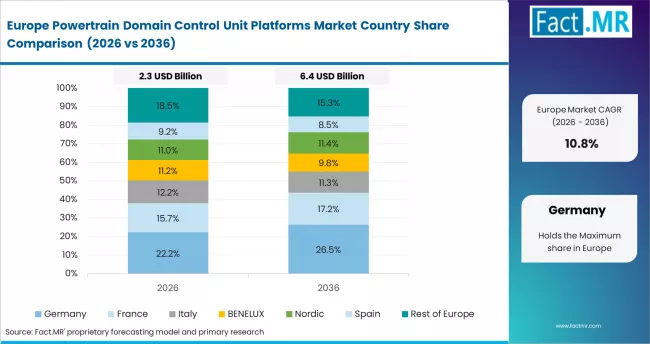
Europe operates as the vehicle electronic systems engineering laboratory supported by strong automotive R&D capability and integration of domain-based control architectures. Bosch GmbH strengthens centralized powertrain controller engineering capability. Continental AG expands vehicle software platform portfolio depth. ZF Friedrichshafen AG supports electronic control architecture innovation.

  • Germany: Germany is forecast to grow at 12.8% CAGR in powertrain domain control unit platforms through 2036. EU vehicle safety regulation update (European Commission, January 2023) supports adoption of integrated vehicle control systems. Bosch GmbH expanded domain controller development capability (July 2023).

North America
Powertrain Domain Control Unit Platforms Market Country Value Analysis

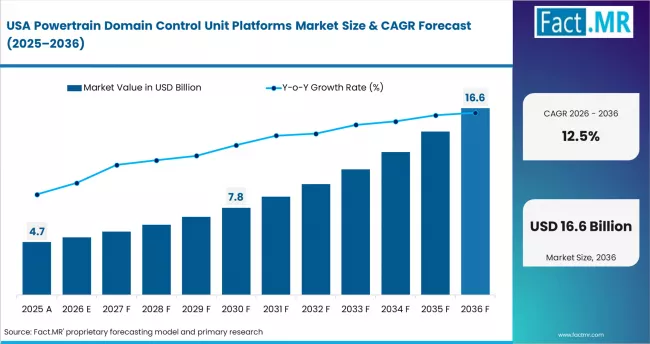
North America functions as the software-defined vehicle commercialization center supported by increasing demand for integrated vehicle control architectures and centralized electronic systems. Aptiv PLC strengthens domain controller platform capability. BorgWarner Inc. expands powertrain electronics portfolio depth. Visteon Corporation supports integrated vehicle software architecture innovation.

  • USA: The USA is projected to register 12.5% CAGR in powertrain domain control unit platforms through 2036. U.S. vehicle safety standards update (National Highway Traffic Safety Administration, March 2023) supports adoption of centralized electronic control systems. Aptiv PLC expanded domain controller production capability (August 2023).

Fact MR's analysis of powertrain domain control unit platforms market in global regions consists of country-wise assessment that includes China, South Korea, Japan, Germany, and USA. Readers can find vehicle electronic architecture trends, powertrain control developments, regulatory positioning frameworks, and competitive software integration insights.

Competitive Landscape

What is the Competitive Structure of the Powertrain Domain Control Unit Platforms Market?
Powertrain Domain Control Unit Platforms Market Analysis By Company

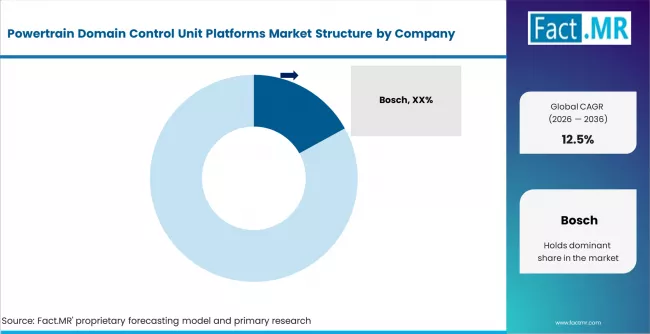
The Powertrain Domain Control Unit Platforms Market demonstrates a moderately concentrated competitive structure, supported by automotive electronics suppliers and semiconductor companies with expertise in vehicle control architecture and high-performance computing platforms. Leading companies including Bosch, Continental, Denso, ZF Friedrichshafen, Aptiv, NXP Semiconductors, Infineon Technologies, Qualcomm, Magna International, and Hyundai Mobis collectively account for nearly 65–75% of global market share, particularly in centralized control units managing propulsion, battery management, thermal systems, and drivetrain electronics in electrified vehicles. Competitive positioning is primarily determined by processing capability, functional safety compliance, software integration flexibility, and compatibility with zonal vehicle architectures. High research investment in automotive-grade semiconductor platforms and safety-certified software frameworks creates strong entry barriers, reinforcing the role of established Tier 1 suppliers and chip manufacturers.

Structural advantages are observed among companies possessing integrated hardware and software ecosystems aligned with evolving vehicle electrical architecture requirements. Bosch and Continental benefit from strong engineering capabilities covering electronic control units, sensors, and middleware software platforms supporting scalable powertrain domain control integration. Buyers typically manage supplier dependency through dual sourcing strategies and technical validation of controller performance across multiple approved vendors. Procurement decisions often consider processing reliability, compliance with automotive functional safety standards, and compatibility with vehicle communication networks. Pricing power remains relatively balanced, though suppliers retain moderate leverage where platform-specific software frameworks and validation requirements create switching constraints for automotive manufacturers implementing centralized powertrain control systems.

Key Players of the Powertrain Domain Control Unit Platforms Market

  • Bosch
  • Continental
  • Denso
  • ZF Friedrichshafen
  • Aptiv
  • NXP Semiconductors
  • Infineon Technologies
  • Qualcomm
  • Magna International
  • Hyundai Mobis

Bibliographies

  • [1] Ministry of Industry and Information Technology (MIIT), China. (2023). New Energy Vehicle (NEV) Policy - Emission Standards (2023 Update).
  • [2] Ministry of Trade, Industry and Energy (MOTIE), South Korea. (2023). Future Mobility Strategy (Road Transport Research Factsheet).
  • [3] Ministry of Economy, Trade and Industry (METI), Japan. (2023, July). Green Growth Strategy Through Achieving Carbon Neutrality in 2050 (GX Promotion Update).
  • [4] Scania Group (EU Commission Reg). (2023, March). EU's New Safety Regulation for Trucks and Buses (GSR 2019/2144 Update).
  • [5] National Highway Traffic Safety Administration (NHTSA). (2023, June). NPRM for FMVSS No. 127 Automatic Emergency Braking Systems (Powertrain Integrity).
  • [6] International Council on Clean Transportation (ICCT). (2023, December). Accelerating New Energy Vehicle Uptake in Chinese Cities (2023 Policy Update).
  • [7] State Council of China. (2025, September). China Establishes Full Industrial Chain for Key Intelligent Connected Vehicle Technologies.
  • [8] China Daily. (2025, October). China Stepping Up Strategic Push into Smart Mobility.

This Report Addresses

  • Market size estimation and revenue forecast for 2026 to 2036 supported by vehicle production benchmarks and domain controller integration adoption data.
  • Growth opportunity evaluation across single domain units, multi domain controllers, zonal architectures, centralized vehicle computers, and integrated powertrain control platforms.
  • Segment level demand assessment covering ICE, hybrid, battery electric, and fuel cell powertrain control environments.
  • Regional adoption analysis identifying demand trends across Asia Pacific, Europe, and North America software defined vehicle ecosystems.
  • Competitive benchmarking covering automotive electronics suppliers specializing in high performance processors, domain controller platforms, and vehicle software integration architectures.
  • Technology evaluation assessing real time processing capability, functional safety compliance, communication interface integration, and centralized control architecture performance.
  • Supply chain assessment identifying dependency on semiconductor fabrication, system on chip processors, power management ICs, and automotive grade software validation cycles.
  • Deliverables including PDF report, Excel dataset, presentation slides, and forecast models supporting vehicle electronics strategy and software defined powertrain platform development.

Powertrain Domain Control Unit Platforms Market Definition

The powertrain domain control unit platforms market refers to centralized electronic computing systems that manage and coordinate propulsion-related vehicle functions such as engine control, transmission control, battery management, and motor performance. These platforms integrate multiple electronic control units into a unified architecture to improve efficiency, performance optimization, and software-based vehicle functionality.

Powertrain Domain Control Unit Platforms Market Inclusions

The report covers global and regional market size evaluation and forecast outlook across the defined study period. It includes segmentation by platform architecture such as domain-based ECU consolidation, high-performance microcontroller platforms, and integrated software frameworks. Applications include internal combustion vehicles, hybrid vehicles, and electric vehicles. Analysis includes supply chain structure, semiconductor integration, and software-defined vehicle architecture trends.

Powertrain Domain Control Unit Platforms Market Exclusions

The scope excludes standalone engine control units, transmission components, and mechanical drivetrain hardware not integrated within domain-based computing platforms. Individual sensors, actuators, and infotainment control systems are not included. The analysis focuses strictly on centralized powertrain domain computing platforms that coordinate propulsion system electronics and embedded software functions.

Powertrain Domain Control Unit Platforms Market Research Methodology

  • Primary Research
    • Interviews were conducted with automotive OEM engineers, semiconductor suppliers, vehicle software platform developers, and Tier 1 electronic system integrators involved in domain controller architecture design.
  • Desk Research
    • Technical journals, automotive E/E architecture publications, semiconductor platform documentation, and company technical literature were reviewed to identify adoption trends in centralized vehicle computing platforms.
  • Market-Sizing and Forecasting
    • A hybrid model combining bottom-up supplier revenue assessment and top-down evaluation of vehicle production volumes and domain controller penetration was applied to estimate market size and growth outlook.
  • Data Validation and Update Cycle
    • Outputs were validated through triangulation of technical publications, supplier capability data, and expert consultation. Periodic updates reflect developments in software-defined vehicle architectures, high-performance automotive processors, and consolidation of distributed ECUs into centralized domain platforms.

Report Scope
Powertrain Domain Control Unit Platforms Market Breakdown By Vehicle Type, Powertrain Type, And Region

Metric Value
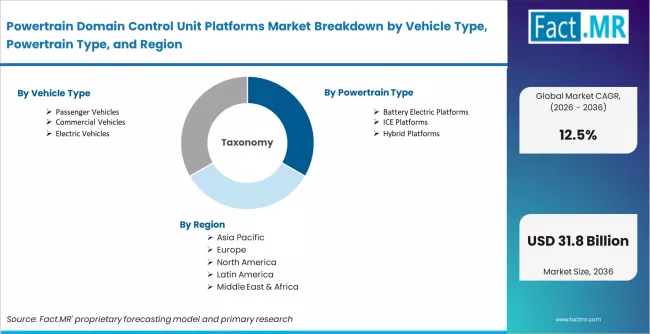
Quantitative Units USD 8.7 billion (2026) to USD 28.4 billion (2036), at a CAGR of 12.5%
Market Definition The powertrain domain control unit platforms market includes centralized electronic control architectures designed to manage propulsion system functions across internal combustion, hybrid, electric, and fuel cell vehicle platforms. These systems integrate computing hardware and software to coordinate energy management, drivetrain control, communication protocols, and real-time processing across vehicle powertrain subsystems.
Platform Type Segmentation Single domain control unit, Multi-domain control unit, Zonal control architecture, Centralized vehicle computer, Integrated powertrain controller
Powertrain Type Segmentation ICE platforms, Hybrid platforms, Battery electric platforms, Fuel cell platforms
Component Segmentation Microcontrollers, System on chip processors, Power management ICs, Communication interfaces, Software platforms
Vehicle Type Segmentation Passenger vehicles, Commercial vehicles, Electric vehicles
Regions Covered North America, Latin America, Europe, East Asia, South Asia, Oceania, Middle East and Africa
Countries Covered United States, Canada, Mexico, Brazil, Argentina, Germany, France, United Kingdom, Italy, Spain, China, India, Japan, South Korea, Indonesia, Australia, and 40+ countries
Key Companies Profiled Bosch, Continental, Denso, ZF Friedrichshafen, Aptiv, NXP Semiconductors, Infineon Technologies, Qualcomm, Magna International, Hyundai Mobis
Forecast Period 2026 to 2036
Approach Hybrid top-down and bottom-up market estimation validated through primary interviews with automotive semiconductor manufacturers, vehicle OEM engineering teams, electronic control module developers, and vehicle architecture specialists, supported by vehicle production benchmarking, semiconductor integration assessment, and evaluation of adoption trends across centralized vehicle computing and powertrain control architectures

Powertrain Domain Control Unit Platforms Market Key Segments

  • Platform Type:

    • Single Domain Control Unit
    • Multi Domain Control Unit
    • Zonal Control Architecture
    • Centralized Vehicle Computer
    • Integrated Powertrain Controller
  • Powertrain Type:

    • ICE Platforms
    • Hybrid Platforms
    • Battery Electric Platforms
    • Fuel Cell Platforms
  • Component:

    • Microcontrollers
    • System on Chip Processors
    • Power Management ICs
    • Communication Interfaces
    • Software Platforms
  • Vehicle Type:

    • Passenger Vehicles
    • Commercial Vehicles
    • Electric Vehicles
  • Region:

    • North America
      • USA
      • Canada
      • Mexico
    • Europe
      • Germany
      • UK
      • France
      • Italy
      • Spain
      • Nordic Countries
      • BENELUX
      • Rest of Europe
    • Asia Pacific
      • China
      • Japan
      • South Korea
      • India
      • Australia
      • Rest of Asia Pacific
    • Latin America
      • Brazil
      • Argentina
      • Rest of Latin America
    • Middle East and Africa
      • Kingdom of Saudi Arabia
      • United Arab Emirates
      • South Africa
      • Rest of Middle East and Africa
    • Other Regions
      • Oceania
      • Central Asia
      • Other Markets

Table of Content

  1. Executive Summary
    • Global Market Outlook
    • Demand to side Trends
    • Supply to side Trends
    • Technology Roadmap Analysis
    • Analysis and Recommendations
  2. Market Overview
    • Market Coverage / Taxonomy
    • Market Definition / Scope / Limitations
  3. Research Methodology
    • Chapter Orientation
    • Analytical Lens and Working Hypotheses
      • Market Structure, Signals, and Trend Drivers
      • Benchmarking and Cross-market Comparability
      • Market Sizing, Forecasting, and Opportunity Mapping
    • Research Design and Evidence Framework
      • Desk Research Programme (Secondary Evidence)
        • Company Annual and Sustainability Reports
        • Peer-reviewed Journals and Academic Literature
        • Corporate Websites, Product Literature, and Technical Notes
        • Earnings Decks and Investor Briefings
        • Statutory Filings and Regulatory Disclosures
        • Technical White Papers and Standards Notes
        • Trade Journals, Industry Magazines, and Analyst Briefs
        • Conference Proceedings, Webinars, and Seminar Materials
        • Government Statistics Portals and Public Data Releases
        • Press Releases and Reputable Media Coverage
        • Specialist Newsletters and Curated Briefings
        • Sector Databases and Reference Repositories
        • Fact.MR Internal Proprietary Databases and Historical Market Datasets
        • Subscription Datasets and Paid Sources
        • Social Channels, Communities, and Digital Listening Inputs
        • Additional Desk Sources
      • Expert Input and Fieldwork (Primary Evidence)
        • Primary Modes
          • Qualitative Interviews and Expert Elicitation
          • Quantitative Surveys and Structured Data Capture
          • Blended Approach
        • Why Primary Evidence is Used
        • Field Techniques
          • Interviews
          • Surveys
          • Focus Groups
          • Observational and In-context Research
          • Social and Community Interactions
        • Stakeholder Universe Engaged
          • C-suite Leaders
          • Board Members
          • Presidents and Vice Presidents
          • R&D and Innovation Heads
          • Technical Specialists
          • Domain Subject-matter Experts
          • Scientists
          • Physicians and Other Healthcare Professionals
        • Governance, Ethics, and Data Stewardship
          • Research Ethics
          • Data Integrity and Handling
      • Tooling, Models, and Reference Databases
    • Data Engineering and Model Build
      • Data Acquisition and Ingestion
      • Cleaning, Normalisation, and Verification
      • Synthesis, Triangulation, and Analysis
    • Quality Assurance and Audit Trail
  4. Market Background
    • Market Dynamics
      • Drivers
      • Restraints
      • Opportunity
      • Trends
    • Scenario Forecast
      • Demand in Optimistic Scenario
      • Demand in Likely Scenario
      • Demand in Conservative Scenario
    • Opportunity Map Analysis
    • Product Life Cycle Analysis
    • Supply Chain Analysis
    • Investment Feasibility Matrix
    • Value Chain Analysis
    • PESTLE and Porter’s Analysis
    • Regulatory Landscape
    • Regional Parent Market Outlook
    • Production and Consumption Statistics
    • Import and Export Statistics
  5. Global Market Analysis 2021 to 2025 and Forecast, 2026 to 2036
    • Historical Market Size Value (USD Million) Analysis, 2021 to 2025
    • Current and Future Market Size Value (USD Million) Projections, 2026 to 2036
      • Y to o to Y Growth Trend Analysis
      • Absolute $ Opportunity Analysis
  6. Global Market Pricing Analysis 2021 to 2025 and Forecast 2026 to 2036
  7. Global Market Analysis 2021 to 2025 and Forecast 2026 to 2036, By Vehicle Type
    • Introduction / Key Findings
    • Historical Market Size Value (USD Million) Analysis By Vehicle Type , 2021 to 2025
    • Current and Future Market Size Value (USD Million) Analysis and Forecast By Vehicle Type , 2026 to 2036
      • Passenger Vehicles
      • Commercial Vehicles
      • Electric Vehicles
    • Y to o to Y Growth Trend Analysis By Vehicle Type , 2021 to 2025
    • Absolute $ Opportunity Analysis By Vehicle Type , 2026 to 2036
  8. Global Market Analysis 2021 to 2025 and Forecast 2026 to 2036, By Powertrain Type
    • Introduction / Key Findings
    • Historical Market Size Value (USD Million) Analysis By Powertrain Type, 2021 to 2025
    • Current and Future Market Size Value (USD Million) Analysis and Forecast By Powertrain Type, 2026 to 2036
      • Battery Electric Platforms
      • ICE Platforms
      • Hybrid Platforms
    • Y to o to Y Growth Trend Analysis By Powertrain Type, 2021 to 2025
    • Absolute $ Opportunity Analysis By Powertrain Type, 2026 to 2036
  9. Global Market Analysis 2021 to 2025 and Forecast 2026 to 2036, By Region
    • Introduction
    • Historical Market Size Value (USD Million) Analysis By Region, 2021 to 2025
    • Current Market Size Value (USD Million) Analysis and Forecast By Region, 2026 to 2036
      • North America
      • Latin America
      • Western Europe
      • Eastern Europe
      • East Asia
      • South Asia and Pacific
      • Middle East & Africa
    • Market Attractiveness Analysis By Region
  10. North America Market Analysis 2021 to 2025 and Forecast 2026 to 2036, By Country
    • Historical Market Size Value (USD Million) Trend Analysis By Market Taxonomy, 2021 to 2025
    • Market Size Value (USD Million) Forecast By Market Taxonomy, 2026 to 2036
      • By Country
        • USA
        • Canada
        • Mexico
      • By Vehicle Type
      • By Powertrain Type
    • Market Attractiveness Analysis
      • By Country
      • By Vehicle Type
      • By Powertrain Type
    • Key Takeaways
  11. Latin America Market Analysis 2021 to 2025 and Forecast 2026 to 2036, By Country
    • Historical Market Size Value (USD Million) Trend Analysis By Market Taxonomy, 2021 to 2025
    • Market Size Value (USD Million) Forecast By Market Taxonomy, 2026 to 2036
      • By Country
        • Brazil
        • Chile
        • Rest of Latin America
      • By Vehicle Type
      • By Powertrain Type
    • Market Attractiveness Analysis
      • By Country
      • By Vehicle Type
      • By Powertrain Type
    • Key Takeaways
  12. Western Europe Market Analysis 2021 to 2025 and Forecast 2026 to 2036, By Country
    • Historical Market Size Value (USD Million) Trend Analysis By Market Taxonomy, 2021 to 2025
    • Market Size Value (USD Million) Forecast By Market Taxonomy, 2026 to 2036
      • By Country
        • Germany
        • UK
        • Italy
        • Spain
        • France
        • Nordic
        • BENELUX
        • Rest of Western Europe
      • By Vehicle Type
      • By Powertrain Type
    • Market Attractiveness Analysis
      • By Country
      • By Vehicle Type
      • By Powertrain Type
    • Key Takeaways
  13. Eastern Europe Market Analysis 2021 to 2025 and Forecast 2026 to 2036, By Country
    • Historical Market Size Value (USD Million) Trend Analysis By Market Taxonomy, 2021 to 2025
    • Market Size Value (USD Million) Forecast By Market Taxonomy, 2026 to 2036
      • By Country
        • Russia
        • Poland
        • Hungary
        • Balkan & Baltic
        • Rest of Eastern Europe
      • By Vehicle Type
      • By Powertrain Type
    • Market Attractiveness Analysis
      • By Country
      • By Vehicle Type
      • By Powertrain Type
    • Key Takeaways
  14. East Asia Market Analysis 2021 to 2025 and Forecast 2026 to 2036, By Country
    • Historical Market Size Value (USD Million) Trend Analysis By Market Taxonomy, 2021 to 2025
    • Market Size Value (USD Million) Forecast By Market Taxonomy, 2026 to 2036
      • By Country
        • China
        • Japan
        • South Korea
      • By Vehicle Type
      • By Powertrain Type
    • Market Attractiveness Analysis
      • By Country
      • By Vehicle Type
      • By Powertrain Type
    • Key Takeaways
  15. South Asia and Pacific Market Analysis 2021 to 2025 and Forecast 2026 to 2036, By Country
    • Historical Market Size Value (USD Million) Trend Analysis By Market Taxonomy, 2021 to 2025
    • Market Size Value (USD Million) Forecast By Market Taxonomy, 2026 to 2036
      • By Country
        • India
        • ASEAN
        • Australia & New Zealand
        • Rest of South Asia and Pacific
      • By Vehicle Type
      • By Powertrain Type
    • Market Attractiveness Analysis
      • By Country
      • By Vehicle Type
      • By Powertrain Type
    • Key Takeaways
  16. Middle East & Africa Market Analysis 2021 to 2025 and Forecast 2026 to 2036, By Country
    • Historical Market Size Value (USD Million) Trend Analysis By Market Taxonomy, 2021 to 2025
    • Market Size Value (USD Million) Forecast By Market Taxonomy, 2026 to 2036
      • By Country
        • Kingdom of Saudi Arabia
        • Other GCC Countries
        • Turkiye
        • South Africa
        • Other African Union
        • Rest of Middle East & Africa
      • By Vehicle Type
      • By Powertrain Type
    • Market Attractiveness Analysis
      • By Country
      • By Vehicle Type
      • By Powertrain Type
    • Key Takeaways
  17. Key Countries Market Analysis
    • USA
      • Pricing Analysis
      • Market Share Analysis, 2025
        • By Vehicle Type
        • By Powertrain Type
    • Canada
      • Pricing Analysis
      • Market Share Analysis, 2025
        • By Vehicle Type
        • By Powertrain Type
    • Mexico
      • Pricing Analysis
      • Market Share Analysis, 2025
        • By Vehicle Type
        • By Powertrain Type
    • Brazil
      • Pricing Analysis
      • Market Share Analysis, 2025
        • By Vehicle Type
        • By Powertrain Type
    • Chile
      • Pricing Analysis
      • Market Share Analysis, 2025
        • By Vehicle Type
        • By Powertrain Type
    • Germany
      • Pricing Analysis
      • Market Share Analysis, 2025
        • By Vehicle Type
        • By Powertrain Type
    • UK
      • Pricing Analysis
      • Market Share Analysis, 2025
        • By Vehicle Type
        • By Powertrain Type
    • Italy
      • Pricing Analysis
      • Market Share Analysis, 2025
        • By Vehicle Type
        • By Powertrain Type
    • Spain
      • Pricing Analysis
      • Market Share Analysis, 2025
        • By Vehicle Type
        • By Powertrain Type
    • France
      • Pricing Analysis
      • Market Share Analysis, 2025
        • By Vehicle Type
        • By Powertrain Type
    • India
      • Pricing Analysis
      • Market Share Analysis, 2025
        • By Vehicle Type
        • By Powertrain Type
    • ASEAN
      • Pricing Analysis
      • Market Share Analysis, 2025
        • By Vehicle Type
        • By Powertrain Type
    • Australia & New Zealand
      • Pricing Analysis
      • Market Share Analysis, 2025
        • By Vehicle Type
        • By Powertrain Type
    • China
      • Pricing Analysis
      • Market Share Analysis, 2025
        • By Vehicle Type
        • By Powertrain Type
    • Japan
      • Pricing Analysis
      • Market Share Analysis, 2025
        • By Vehicle Type
        • By Powertrain Type
    • South Korea
      • Pricing Analysis
      • Market Share Analysis, 2025
        • By Vehicle Type
        • By Powertrain Type
    • Russia
      • Pricing Analysis
      • Market Share Analysis, 2025
        • By Vehicle Type
        • By Powertrain Type
    • Poland
      • Pricing Analysis
      • Market Share Analysis, 2025
        • By Vehicle Type
        • By Powertrain Type
    • Hungary
      • Pricing Analysis
      • Market Share Analysis, 2025
        • By Vehicle Type
        • By Powertrain Type
    • Kingdom of Saudi Arabia
      • Pricing Analysis
      • Market Share Analysis, 2025
        • By Vehicle Type
        • By Powertrain Type
    • Turkiye
      • Pricing Analysis
      • Market Share Analysis, 2025
        • By Vehicle Type
        • By Powertrain Type
    • South Africa
      • Pricing Analysis
      • Market Share Analysis, 2025
        • By Vehicle Type
        • By Powertrain Type
  18. Market Structure Analysis
    • Competition Dashboard
    • Competition Benchmarking
    • Market Share Analysis of Top Players
      • By Regional
      • By Vehicle Type
      • By Powertrain Type
  19. Competition Analysis
    • Competition Deep Dive
      • Bosch
        • Overview
        • Product Portfolio
        • Profitability by Market Segments (Product/Age /Sales Channel/Region)
        • Sales Footprint
        • Strategy Overview
          • Marketing Strategy
          • Product Strategy
          • Channel Strategy
      • Continental
      • Denso
      • ZF Friedrichshafen
      • Aptiv
      • NXP Semiconductors
      • Infineon Technologies
  20. Assumptions & Acronyms Used

List Of Table

  • Table 1: Global Market Value (USD Million) Forecast by Region, 2021 to 2036
  • Table 2: Global Market Value (USD Million) Forecast by Vehicle Type, 2021 to 2036
  • Table 3: Global Market Value (USD Million) Forecast by Powertrain Type, 2021 to 2036
  • Table 4: North America Market Value (USD Million) Forecast by Country, 2021 to 2036
  • Table 5: North America Market Value (USD Million) Forecast by Vehicle Type, 2021 to 2036
  • Table 6: North America Market Value (USD Million) Forecast by Powertrain Type, 2021 to 2036
  • Table 7: Latin America Market Value (USD Million) Forecast by Country, 2021 to 2036
  • Table 8: Latin America Market Value (USD Million) Forecast by Vehicle Type, 2021 to 2036
  • Table 9: Latin America Market Value (USD Million) Forecast by Powertrain Type, 2021 to 2036
  • Table 10: Western Europe Market Value (USD Million) Forecast by Country, 2021 to 2036
  • Table 11: Western Europe Market Value (USD Million) Forecast by Vehicle Type, 2021 to 2036
  • Table 12: Western Europe Market Value (USD Million) Forecast by Powertrain Type, 2021 to 2036
  • Table 13: Eastern Europe Market Value (USD Million) Forecast by Country, 2021 to 2036
  • Table 14: Eastern Europe Market Value (USD Million) Forecast by Vehicle Type, 2021 to 2036
  • Table 15: Eastern Europe Market Value (USD Million) Forecast by Powertrain Type, 2021 to 2036
  • Table 16: East Asia Market Value (USD Million) Forecast by Country, 2021 to 2036
  • Table 17: East Asia Market Value (USD Million) Forecast by Vehicle Type, 2021 to 2036
  • Table 18: East Asia Market Value (USD Million) Forecast by Powertrain Type, 2021 to 2036
  • Table 19: South Asia and Pacific Market Value (USD Million) Forecast by Country, 2021 to 2036
  • Table 20: South Asia and Pacific Market Value (USD Million) Forecast by Vehicle Type, 2021 to 2036
  • Table 21: South Asia and Pacific Market Value (USD Million) Forecast by Powertrain Type, 2021 to 2036
  • Table 22: Middle East & Africa Market Value (USD Million) Forecast by Country, 2021 to 2036
  • Table 23: Middle East & Africa Market Value (USD Million) Forecast by Vehicle Type, 2021 to 2036
  • Table 24: Middle East & Africa Market Value (USD Million) Forecast by Powertrain Type, 2021 to 2036

List Of Figures

  • Figure 1: Global Market Pricing Analysis
  • Figure 2: Global Market Value (USD Million) Forecast 2021 to 2036
  • Figure 3: Global Market Value Share and BPS Analysis by Vehicle Type, 2026 and 2036
  • Figure 4: Global Market Y-o-Y Growth Comparison by Vehicle Type,2026 to 2036
  • Figure 5: Global Market Attractiveness Analysis by Vehicle Type
  • Figure 6: Global Market Value Share and BPS Analysis by Powertrain Type, 2026 and 2036
  • Figure 7: Global Market Y-o-Y Growth Comparison by Powertrain Type,2026 to 2036
  • Figure 8: Global Market Attractiveness Analysis by Powertrain Type
  • Figure 9: Global Market Value (USD Million) Share and BPS Analysis by Region, 2026 and 2036
  • Figure 10: Global Market Y-o-Y Growth Comparison by Region,2026 to 2036
  • Figure 11: Global Market Attractiveness Analysis by Region
  • Figure 12: North America Market Incremental Dollar Opportunity,2026 to 2036
  • Figure 13: Latin America Market Incremental Dollar Opportunity,2026 to 2036
  • Figure 14: Western Europe Market Incremental Dollar Opportunity,2026 to 2036
  • Figure 15: Eastern Europe Market Incremental Dollar Opportunity,2026 to 2036
  • Figure 16: East Asia Market Incremental Dollar Opportunity,2026 to 2036
  • Figure 17: South Asia and Pacific Market Incremental Dollar Opportunity,2026 to 2036
  • Figure 18: Middle East & Africa Market Incremental Dollar Opportunity,2026 to 2036
  • Figure 19: North America Market Value Share and BPS Analysis by Country, 2026 and 2036
  • Figure 20: North America Market Value Share and BPS Analysis by Vehicle Type, 2026 and 2036
  • Figure 21: North America Market Y-o-Y Growth Comparison by Vehicle Type,2026 to 2036
  • Figure 22: North America Market Attractiveness Analysis by Vehicle Type
  • Figure 23: North America Market Value Share and BPS Analysis by Powertrain Type, 2026 and 2036
  • Figure 24: North America Market Y-o-Y Growth Comparison by Powertrain Type,2026 to 2036
  • Figure 25: North America Market Attractiveness Analysis by Powertrain Type
  • Figure 26: Latin America Market Value Share and BPS Analysis by Country, 2026 and 2036
  • Figure 27: Latin America Market Value Share and BPS Analysis by Vehicle Type, 2026 and 2036
  • Figure 28: Latin America Market Y-o-Y Growth Comparison by Vehicle Type,2026 to 2036
  • Figure 29: Latin America Market Attractiveness Analysis by Vehicle Type
  • Figure 30: Latin America Market Value Share and BPS Analysis by Powertrain Type, 2026 and 2036
  • Figure 31: Latin America Market Y-o-Y Growth Comparison by Powertrain Type,2026 to 2036
  • Figure 32: Latin America Market Attractiveness Analysis by Powertrain Type
  • Figure 33: Western Europe Market Value Share and BPS Analysis by Country, 2026 and 2036
  • Figure 34: Western Europe Market Value Share and BPS Analysis by Vehicle Type, 2026 and 2036
  • Figure 35: Western Europe Market Y-o-Y Growth Comparison by Vehicle Type,2026 to 2036
  • Figure 36: Western Europe Market Attractiveness Analysis by Vehicle Type
  • Figure 37: Western Europe Market Value Share and BPS Analysis by Powertrain Type, 2026 and 2036
  • Figure 38: Western Europe Market Y-o-Y Growth Comparison by Powertrain Type,2026 to 2036
  • Figure 39: Western Europe Market Attractiveness Analysis by Powertrain Type
  • Figure 40: Eastern Europe Market Value Share and BPS Analysis by Country, 2026 and 2036
  • Figure 41: Eastern Europe Market Value Share and BPS Analysis by Vehicle Type, 2026 and 2036
  • Figure 42: Eastern Europe Market Y-o-Y Growth Comparison by Vehicle Type,2026 to 2036
  • Figure 43: Eastern Europe Market Attractiveness Analysis by Vehicle Type
  • Figure 44: Eastern Europe Market Value Share and BPS Analysis by Powertrain Type, 2026 and 2036
  • Figure 45: Eastern Europe Market Y-o-Y Growth Comparison by Powertrain Type,2026 to 2036
  • Figure 46: Eastern Europe Market Attractiveness Analysis by Powertrain Type
  • Figure 47: East Asia Market Value Share and BPS Analysis by Country, 2026 and 2036
  • Figure 48: East Asia Market Value Share and BPS Analysis by Vehicle Type, 2026 and 2036
  • Figure 49: East Asia Market Y-o-Y Growth Comparison by Vehicle Type,2026 to 2036
  • Figure 50: East Asia Market Attractiveness Analysis by Vehicle Type
  • Figure 51: East Asia Market Value Share and BPS Analysis by Powertrain Type, 2026 and 2036
  • Figure 52: East Asia Market Y-o-Y Growth Comparison by Powertrain Type,2026 to 2036
  • Figure 53: East Asia Market Attractiveness Analysis by Powertrain Type
  • Figure 54: South Asia and Pacific Market Value Share and BPS Analysis by Country, 2026 and 2036
  • Figure 55: South Asia and Pacific Market Value Share and BPS Analysis by Vehicle Type, 2026 and 2036
  • Figure 56: South Asia and Pacific Market Y-o-Y Growth Comparison by Vehicle Type,2026 to 2036
  • Figure 57: South Asia and Pacific Market Attractiveness Analysis by Vehicle Type
  • Figure 58: South Asia and Pacific Market Value Share and BPS Analysis by Powertrain Type, 2026 and 2036
  • Figure 59: South Asia and Pacific Market Y-o-Y Growth Comparison by Powertrain Type,2026 to 2036
  • Figure 60: South Asia and Pacific Market Attractiveness Analysis by Powertrain Type
  • Figure 61: Middle East & Africa Market Value Share and BPS Analysis by Country, 2026 and 2036
  • Figure 62: Middle East & Africa Market Value Share and BPS Analysis by Vehicle Type, 2026 and 2036
  • Figure 63: Middle East & Africa Market Y-o-Y Growth Comparison by Vehicle Type,2026 to 2036
  • Figure 64: Middle East & Africa Market Attractiveness Analysis by Vehicle Type
  • Figure 65: Middle East & Africa Market Value Share and BPS Analysis by Powertrain Type, 2026 and 2036
  • Figure 66: Middle East & Africa Market Y-o-Y Growth Comparison by Powertrain Type,2026 to 2036
  • Figure 67: Middle East & Africa Market Attractiveness Analysis by Powertrain Type
  • Figure 68: Global Market - Tier Structure Analysis
  • Figure 69: Global Market - Company Share Analysis

- Frequently Asked Questions -

How large is the demand for Powertrain Domain Control Unit Platforms in the global market in 2026?

Demand for powertrain domain control unit platforms in the global market is estimated to be valued at USD 8.7 billion in 2026.

What will be the market size of Powertrain Domain Control Unit Platforms in the global market by 2036?

Market size for powertrain domain control unit platforms is projected to reach USD 28.4 billion by 2036.

What is the expected demand growth for Powertrain Domain Control Unit Platforms in the global market between 2026 and 2036?

Demand for powertrain domain control unit platforms in the global market is expected to grow at a CAGR of 12.5% between 2026 and 2036.

Which Vehicle Type is poised to lead global demand by 2026?

Passenger vehicles are expected to dominate the market, accounting for approximately 69.2% share in 2026 due to integration of centralized electronic control architectures managing propulsion and drivetrain functions.

What is Driving Powertrain Domain Control Unit Platform Demand in China?

Demand is influenced by expansion of electric and hybrid vehicle production requiring centralized control architectures for powertrain optimization.

What is the China Growth Outlook in this Report?

China is projected to expand at a CAGR of 14.1% between 2026 and 2036 reflecting increasing integration of domain based electronic control platforms.

What is Driving Powertrain Domain Control Unit Platform Demand in South Korea?

Demand is supported by development of advanced vehicle electronic architectures consolidating multiple control functions within centralized processing units.

What is the South Korea Growth Outlook in this Report?

South Korea is projected to grow at a CAGR of 13.5% between 2026 and 2036 reflecting continued adoption of domain based automotive computing platforms.

What is Driving Powertrain Domain Control Unit Platform Demand in Japan?

Demand is associated with integration of electronic control modules supporting electrified powertrain management and vehicle efficiency optimization.

What is the Japan Growth Outlook in this Report?

Japan is projected to expand at a CAGR of 13.1% between 2026 and 2036 supported by increasing deployment of centralized powertrain computing architectures.

What is Driving Powertrain Domain Control Unit Platform Demand in Germany?

Demand is linked to development of vehicle electronic architectures supporting centralized control of propulsion, torque distribution, and energy management functions.

What is the Germany Growth Outlook in this Report?

Germany is projected to grow at a CAGR of 12.8% between 2026 and 2036 reflecting increasing integration of domain control technologies.

What is Driving Powertrain Domain Control Unit Platform Demand in the United States?

Demand is influenced by adoption of software defined vehicle architectures requiring centralized electronic control of drivetrain subsystems.

What is the United States Growth Outlook in this Report?

The United States is projected to expand at a CAGR of 12.5% between 2026 and 2036 reflecting continued use of domain based vehicle computing platforms.

Which Companies are Identified as Leading Participants in the Powertrain Domain Control Unit Platforms Market?

Bosch is identified as a leading manufacturer due to its portfolio of automotive electronic control and domain computing technologies.

What are Powertrain Domain Control Unit Platforms and What are They Mainly Used For?

Powertrain domain control unit platforms are centralized electronic computing systems used to manage propulsion control, torque distribution, transmission behavior, and energy optimization functions.

What does Powertrain Domain Control Unit Platforms Market Mean in this Report?

Powertrain domain control unit platforms market refers to global production, distribution, and integration of centralized automotive electronic control architectures used in drivetrain and propulsion management.

What is Included in the Scope of this Powertrain Domain Control Unit Platforms Market Report?

Scope includes vehicle type segmentation, domain controller applications, and demand across passenger vehicle electronic architecture platforms.

What is Excluded from the Scope of this Report?

Standalone electronic control units designed for single function operation are excluded unless integrated within domain based control architectures.

What does Market Forecast Mean on this Page?

Market forecast represents a modeled projection developed using defined assumptions to support automotive electronics demand estimation.

How is the Powertrain Domain Control Unit Platforms Market Forecast Developed in this Report?

Forecast modeling is based on vehicle electrification trends, centralized computing architecture adoption rates, and validation through manufacturer level supply assessment.

What does Data Validation Approach Mean in this Report?

Primary industry inputs, company disclosures, and publicly available automotive electronics statistics are used to verify market sizing assumptions.

Powertrain Domain Control Unit Platforms Market