- Base Value(2025): 1.7 Bn
- Estimated Value(2026): 1.9 Bn
- Forecast Value (2036): 5.1 Bn
- CAGR (2026 - 2036): 10.0%
Zonal Wiring Harness Platforms for Software-Defined Vehicles Market Forecast and Outlook By Fact.MR
- In 2025, the zonal wiring harness platforms for software-defined vehicles market was valued at USD 1.7 billion.
- Based on Fact.MR analysis, demand for zonal wiring harness platforms is estimated to grow to USD 1.9 billion in 2026 and USD 5.1 billion by 2036.
- FACT.MR projects a CAGR of 10.0% during the forecast period.
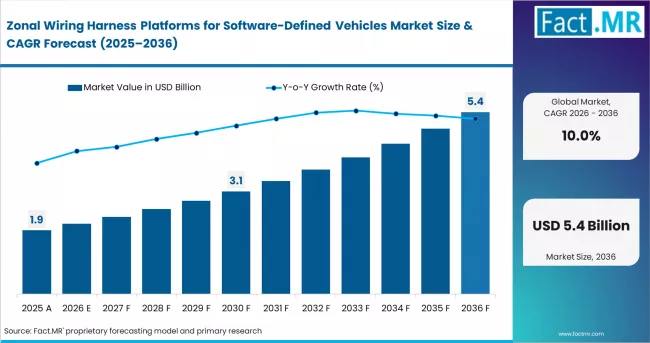
Zonal Wiring Harness Platforms For Software Defined Vehicles Market Market Value Analysis | Source: Fact.MR
| Metric | Value |
|---|---|
| Estimated Value in 2026 | USD 1.9 billion |
| Forecast Value in 2036 | USD 5.1 billion |
| Forecast CAGR (2026 to 2036) | 10.0% |
Source: Fact.MR analysis. Updated May 14, 2026
Summary of Zonal Wiring Harness Platforms for Software-Defined Vehicles Market
- Market Definition
- The market covers zonal wiring harness platforms integrating zone controllers, power distribution, and high-speed data networks into consolidated SDV electrical architectures for passenger and commercial vehicle OEM programmes globally.
- Demand Drivers
- Volkswagen Group's E3 2.0 SDV platform programme is driving zonal harness nominations across multiple model lines, converting architecture transition into volume procurement from 2026.
- GM's ULTIFI software platform rollout is mandating zonal harness integration across North American vehicle programmes, increasing per-vehicle harness content value for approved Tier-1 suppliers.
- China NEV OEMs including BYD and NIO are adopting zonal electrical architectures as a standard design requirement, accelerating procurement of zonal harness platforms from 2024.
- Key Segments Analyzed
- By Architecture Type: 4–6 Zone Architecture leads at 45% in 2026. Preferred by mainstream passenger car OEM SDV platforms for balance of cost and complexity.
- By Vehicle Type: Passenger Vehicles dominate at 62% in 2026. High SDV programme density and rising EV content drive zonal harness adoption.
- By Integration Type: Fully Zonal Integrated Harness Platforms lead at 40% in 2026. Adopted by dedicated SDV platforms at BEV-first OEMs.
- Analyst Opinion at FACT.MR
- Shambhu Nath Jha, Principal Consultant at Fact.MR, opines, CXOs will find that zonal harness platform nominations are increasingly concentrating among suppliers with proven zone controller integration and OEM specific software defined vehicle architecture expertise. Suppliers that continue to rely on legacy domain based harness capabilities risk being structurally excluded from next generation platform awards.
- Strategic Implications
- Invest in zone controller integration capability and SDV-compatible harness platforms to secure nominations in OEM EV and SDV programme cycles beginning 2026–2027.
- Develop validated 4–6 zone harness sub-systems targeting mainstream passenger car SDV platforms at Volkswagen, GM, and Hyundai Motor Group.
- Build co-development relationships with China NEV OEMs to capture the fastest-growing regional SDV harness procurement opportunity through joint platform engineering.
- Methodology
- Market sizing based on OEM SDV platform production volumes, zonal harness content per vehicle, and Tier-1 programme data. Validated with 2024–2025 inputs.
- Uses Aptiv SVA disclosures, SAE zonal architecture standards, OEM SDV announcements, and EV production forecasts for demand validation.
- Forecasts integrate zone platform nomination timelines, architecture migration rates, and commercial vehicle SDV adoption curves.
The market is set to generate USD 3.2 billion in absolute opportunity between 2026 and 2036. Growth is transformational. SDV platform commitments from Volkswagen, Toyota, and GM are converting zonal harness from a concept to a volume procurement category. High per-platform development costs and long OEM validation cycles remain structural constraints on faster adoption.
Zonal harness design is replacing function-specific wiring domains across new OEM platforms. Legacy domain ECU architectures are losing platform awards. Zone controllers are consolidating wiring routes and reducing total harness weight by 30–40% per vehicle. Suppliers without validated zone-platform capability are losing nomination cycles to Aptiv and Yazaki.
China leads with 11.0% CAGR through 2036, driven by NEV OEM SDV platform mandates and state-backed intelligent vehicle investment. India follows at 10.5%, supported by EV production scale-up and emerging SDV-oriented OEM platform development. The United States records 10.0%, anchored by GM ULTIFI and Ford IVI SDV platform rollouts. Germany grows at 9.4%, driven by Volkswagen Group SDV commitment and Tier-1 zonal harness localisation. South Korea records 9.2%, underpinned by Hyundai Motor Group E-GMP and ccNC SDV platform programmes. Japan records 8.6%, driven by Toyota Arene OS-linked harness architecture migration. Mature European and Japanese markets face longer OEM qualification cycles as structural pace constraints.
Segmental Analysis
Zonal Wiring Harness Platforms Market Analysis by Architecture Type
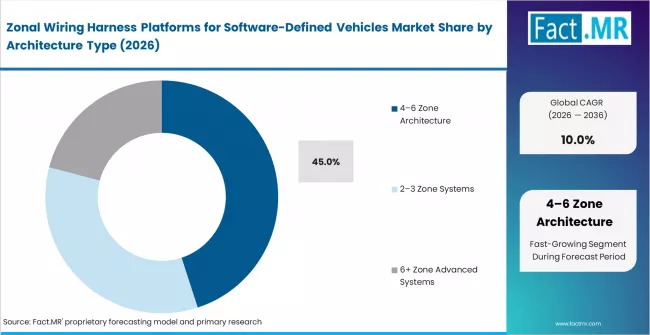
Zonal Wiring Harness Platforms For Software Defined Vehicles Market Analysis By Architecture Type | Source: Fact.MR
Based on FACT.MR, 4 to 6 zone architecture holds about 45 percent share in 2026. It offers a balance between cost and system complexity. This configuration is widely used in passenger EV platforms.
- Aptiv SVA Investment: Aptiv expanded SDV harness production in Morocco in 2024. The facility supports European zonal platform programmes. [1]
- TE Connectivity Technology: TE Connectivity introduced zonal connector systems in 2025. These support high speed data and 48V architectures. [5]
- Zone Platform Adoption Trend: SAE International released zonal architecture standards in 2024. OEMs are aligning internal designs with these frameworks. [6]
Zonal Wiring Harness Platforms Market Analysis by Vehicle Type
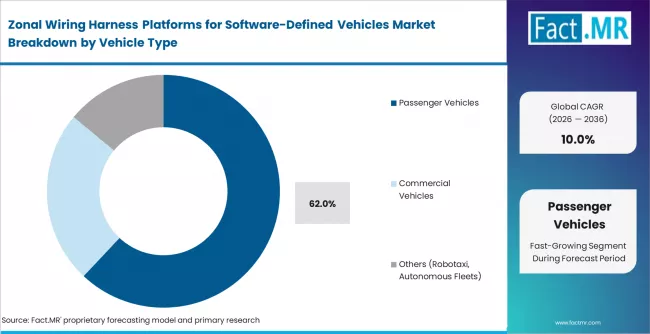
Zonal Wiring Harness Platforms For Software Defined Vehicles Market Analysis By Vehicle Type | Source: Fact.MR
Passenger vehicles account for about 62 percent share in 2026. This segment leads due to strong SDV adoption in EV platforms. Commercial vehicle adoption is growing but remains smaller.
- Yazaki SDV Investment: Yazaki Corporation set up an SDV engineering centre in Germany in 2024. It focuses on zonal platform co development. [7]
- Sumitomo Electric Development: Sumitomo Electric Industries launched zonal harness systems for commercial EVs in 2025. These integrate power and data networks. [4]
- Commercial SDV Trend: Commercial EV adoption increased 35 percent in 2024. Fleet operators are adopting OTA enabled architectures. This is driving zonal harness demand from 2025. [8]
Drivers, Restraints, and Opportunities
Fact.MR analysis indicates the market is early stage but scaling quickly. SDV commitments from major OEMs are moving zonal harness from pilot to production. EV first platforms are removing legacy wiring constraints. Cost and weight reduction targets are accelerating adoption across new models.
Legacy distributed harness designs are losing relevance. OEMs are specifying zonal architecture in new platform awards. Fully zonal systems deliver 20 to 35 percent higher per vehicle value than domain architectures. Hybrid zonal domain systems are supporting transition on existing platforms.
- SDV OEM Platform Mandates: Volkswagen Group introduced its E3 2.0 zonal architecture for new BEV platforms from 2025. Aptiv and Leoni AG secured platform nominations in 2024. This establishes zonal harness as the default for SDV launches. [2]
- China NEV SDV Policy: China updated its ICV roadmap in 2024. BYD and SAIC Motor adopted zonal architectures in new models. This is increasing procurement volumes for Tier 1 suppliers. [3]
- Weight and Harness Length Reduction: Zonal designs reduce wire length by 30 to 40 percent per vehicle. Sumitomo Electric Industries reported about 35 percent reduction in 2024 pilot programmes. This supports cost and efficiency gains. [4]
Regional Analysis
The zonal wiring harness platforms for software-defined vehicles market is assessed across Asia Pacific, North America, Europe, Latin America, and Middle East and Africa, covering 40+ countries with distinct demand profiles shaped by SDV programme density, EV production volumes, OEM architecture mandates, and Tier-1 supplier investment. The full report offers market attractiveness analysis by region and country.
.webp "Top Country Growth Comparison Zonal Wiring Harness Platforms For Software Defined Vehicles Market Cagr (2026 2036)")
Top Country Growth Comparison Zonal Wiring Harness Platforms For Software Defined Vehicles Market Cagr (2026 2036) | Source: Fact.MR
| Country | CAGR (2026 to 2036) |
|---|---|
| China | 11.0% |
| India | 10.5% |
| United States | 10.0% |
| Germany | 9.4% |
| South Korea | 9.2% |
| Japan | 8.6% |
Source: Fact.MR analysis. Updated May 14, 2026
Source: Fact.MR (FACT.MR) analysis, based on proprietary forecasting model and primary research
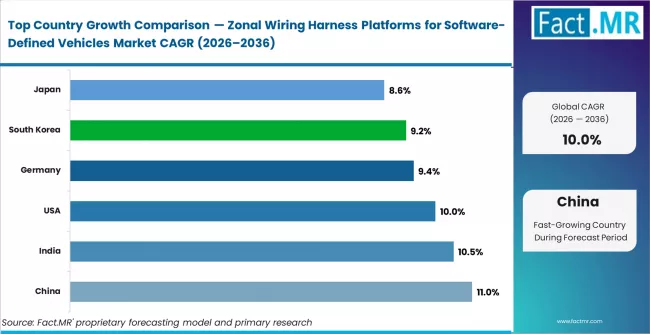
Zonal Wiring Harness Platforms For Software Defined Vehicles Market Cagr Analysis By Country | Source: Fact.MR
Asia Pacific Zonal Wiring Harness Platforms Market Analysis
Asia Pacific is the fastest-growing and highest-volume regional market for zonal harness platforms. China NEV OEM programme density drives the largest absolute growth. India is emerging as a new SDV platform manufacturing hub. Japan and South Korea anchor technology development through OEM and Tier-1 investment.
- China: NEV OEM SDV adoption drives the highest country CAGR at 11.0% through 2036. China’s MIIT Intelligent Connected Vehicle Roadmap 2.0, issued in 2024, formalised zonal architecture as a recommended design standard for NEV platforms. BYD integrated zonal harness into its Ocean and Dynasty series platforms from Q3 2024. SAIC Motor adopted zonal electrical architecture for its IM Motors SDV platform in 2024. Procurement is structured through long-term Tier-1 agreements. State investment in intelligent vehicle infrastructure sustains programme velocity.
- India: EV platform growth and SDV programme emergence drive 10.5% CAGR through 2036. Tata Motors launched its Avinya EV platform in 2024–2025 with zone-based architecture. The PLI Automotive scheme supported harness capacity expansion in 2024. Samvardhana Motherson International invested in SDV-capable assembly infrastructure in Pune. Rising OEM activity and export commitments are positioning India as a regional manufacturing centre.
- South Korea: Hyundai Motor Group SDV architecture leadership anchors 9.2% CAGR through 2036. Hyundai Motor Group deployed ccNC centralised computing across IONIQ 6 and Genesis GV60 from 2024. Aptiv secured zonal harness supply nominations in 2024. Government EV incentives extended through 2025 are sustaining platform momentum and procurement volumes.
FACT.MR covers China, India, Japan, South Korea, ASEAN, and Australia and New Zealand. Includes NEV SDV mandate data, OEM platform nomination timelines, and Tier-1 investment trends.
North America Zonal Wiring Harness Platforms Market Analysis
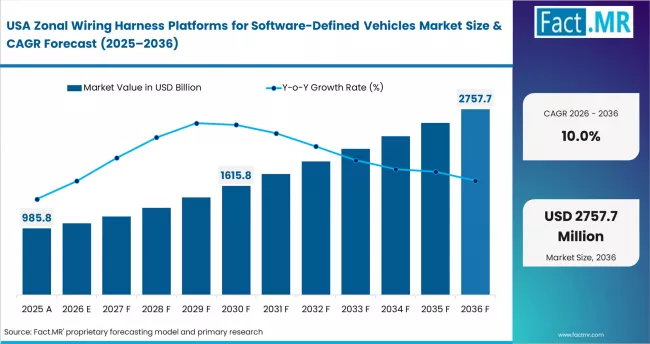
Zonal Wiring Harness Platforms For Software Defined Vehicles Market Country Value Analysis | Source: Fact.MR
North America is an OEM-programme-led and SDV platform-driven market. GM and Ford SDV rollouts are the primary procurement catalysts. IRA-aligned domestic EV production incentives are reshaping Tier-1 supply positioning. Aptiv and TE Connectivity lead regional zonal harness supply.
- United States: GM and Ford SDV programme scale-up drives 10.0% CAGR through 2036. General Motors extended its ULTIFI software platform to Silverado EV and Equinox EV in 2024. Aptiv secured zonal harness nominations in Q2 2024. Ford is advancing IVI software-driven architectures for Explorer EV and next-generation F-150. IRA domestic manufacturing requirements are supporting Tier-1 investment.
FACT.MR covers the United States, Canada, and Mexico. Includes GM and Ford SDV programme data, IRA incentive impact, and Tier-1 zonal harness supply investment trends.
Europe Zonal Wiring Harness Platforms Market Analysis
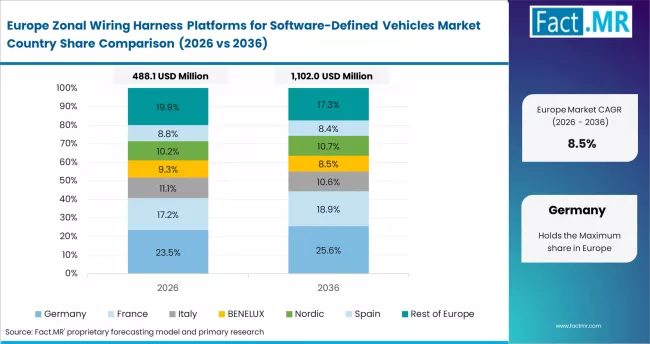
Zonal Wiring Harness Platforms For Software Defined Vehicles Market Europe Country Market Share Analysis, 2026 & 2036 | Source: Fact.MR
Europe is the global SDV regulatory laboratory and the most mature zonal harness platform market by OEM programme density. VW Group E3 2.0 and BMW Neue Klasse architectures anchor Tier-1 procurement. Leoni AG and Aptiv lead European zonal harness supply through long-term platform agreements.
- Germany: Volkswagen Group and BMW SDV programme density drives 9.4% CAGR through 2036. Volkswagen Group launched its E3 2.0 zonal electrical architecture programme in 2024. Leoni AG secured a multi-year harness supply nomination in Q2 2024. BMW is advancing Neue Klasse with full zonal integration, with Aptiv as a key Tier-1 partner.
FACT.MR covers Germany, France, UK, Italy, Spain, and Rest of Europe. Includes VW E3 2.0 programme data, EU automotive SDV regulatory context, and Tier-1 zonal platform investment timelines.
Competitive Aligners for Market Players
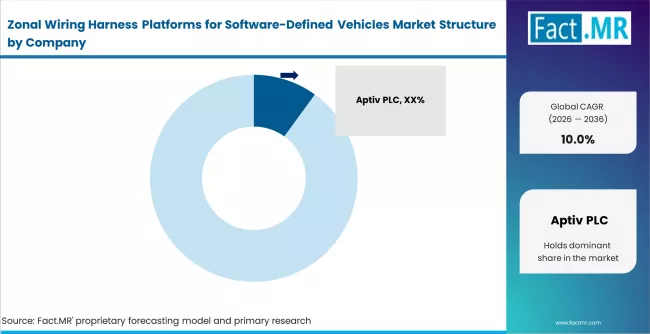
Zonal Wiring Harness Platforms For Software Defined Vehicles Market Analysis By Company | Source: Fact.MR
Competitive aligners in the zonal wiring harness platforms market are increasingly defined by architectural capability rather than scale alone. Leading suppliers such as Aptiv, Leoni AG, Yazaki Corporation, Sumitomo Electric Industries, and TE Connectivity are repositioning around software-defined vehicle integration instead of traditional harness manufacturing.
One of the most critical aligners is zone controller integration capability. OEMs are no longer sourcing wiring as isolated components. They expect suppliers to deliver harness systems aligned with centralized computing architectures. This includes integration with Ethernet backbones, power distribution units, and software-controlled nodes. Suppliers that can validate these systems at the platform level are securing early design nominations.
Another key factor is early-stage co-development with OEM engineering teams. Zonal architecture decisions are made at the initial vehicle design phase. Suppliers involved at this stage gain a structural advantage through long-term platform contracts. This also creates high switching costs once production begins, limiting competitive displacement.
Scalability across global platforms is also becoming important. OEMs want harmonized harness designs that can be deployed across multiple vehicle models and regions. Suppliers with modular, repeatable architectures are better positioned to support these requirements while maintaining cost efficiency. Technology readiness in high-speed data transmission and power optimization is another differentiator. As vehicles rely more on software and connectivity, harness systems must support higher bandwidth and reduced wiring complexity. Suppliers investing in lightweight materials and optimized routing are gaining cost and performance advantages. Thus, competitive advantage is shifting toward suppliers that combine deep engineering expertise, early OEM alignment, and scalable zonal architecture solutions.
Key Players
- Aptiv PLC
- Leoni AG
- Yazaki Corporation
- Sumitomo Electric Industries, Ltd.
- Furukawa Electric Co., Ltd.
- TE Connectivity Ltd.
Bibliography
- [1] Aptiv PLC. (Q4 2024). Q4 2024 Earnings Call Transcript: Smart Vehicle Architecture SVA Programme Four New SDV Platform Nominations from Global OEMs with Production Intent from 2026 and Tangier Facility Expansion for European SDV Supply. Q4 2024. aptiv.com/investor-relations
- [2] Leoni AG. (Q2 2024). Press Release: Multi-Year Zonal Wiring Harness Supply Agreement for Volkswagen Group E3 2.0 SDV Electrical Architecture Front and Rear Zone Sub-Systems for German and Slovak OEM Production Facilities. Q2 2024. leoni.com/news
- [3] Ministry of Industry and Information Technology, China. (2024). Intelligent Connected Vehicle Technology Roadmap 2.0 Update: Zonal Electrical Architecture as Recommended Design Standard for NEV Platforms from 2026 Production Year. 2024. miit.gov.cn
- [4] Sumitomo Electric Industries, Ltd. (2024–2025). Annual Report 2024 and Q1 2025 Launch: Zonal Harness Platform for Commercial EV Applications Toyota SDV Pilot Wire Reduction Data and Isuzu/Hino CAN-FD Ethernet Zone Platform Targeting Japan Market. sumitomo-electric.com/ir
- [5] TE Connectivity Ltd. (Q1 2025). Product Launch: DEUTSCH Zonal Connector Platform for 48V and 100BASE-T1 Ethernet SDV Architectures ISO 17987 LIN and Automotive Ethernet Validated for 4–6 Zone Passenger Car Harness Integration. January 2025. te.com/news
- [6] SAE International. (2024). Zonal Architecture Framework Update 2024: Zone Controller Interface Standards for SDV Harness Integration Referenced by Ford and Toyota Platform Architecture Reviews. 2024. sae.org/standards
- [7] Yazaki Corporation. (2024). Press Release: SDV Wiring Harness Engineering Centre Established in Wiesbaden, Germany for Zonal Platform Co-Development with European OEM Partners Targeting VW Group and BMW Group Programme Nominations from 2025. 2024. yazaki.com/news
- [8] International Energy Agency. (2024). Global EV Outlook 2024: Commercial Electric Vehicle Registrations Growth of 35% and OTA-Updatable SDV Architecture Adoption by Fleet Operators in Europe and China Driving Zonal Harness Procurement in LCV and Bus Platforms. iea.org/reports/global-ev-outlook-2024
This Report Addresses
- Strategic intelligence on zonal wiring harness platform demand across architecture types, vehicle categories, and integration stages for SDV OEM programmes across passenger car, commercial EV, and autonomous fleet applications globally.
- Market forecast from USD 1.9 billion in 2026 to USD 5.1 billion by 2036 at a CAGR of 10.0%.
- Growth opportunity mapping across China NEV SDV mandate-driven harness procurement, U.S. GM and Ford platform rollouts, Germany VW E3 2.0 programme supply, South Korea Hyundai ccNC architecture, and India emerging SDV platform development.
- Segment analysis by architecture type (4–6 zone, 2–3 zone, 6+ zone), vehicle type (passenger, commercial, others), and integration type (fully zonal, hybrid, legacy transition) across global and regional markets.
- Regional outlook covering Asia Pacific NEV OEM SDV programme density, North America IRA-supported EV platform production, and Europe VW and BMW SDV architecture mandate-driven Tier-1 procurement.
- Competitive analysis of Aptiv, Leoni AG, Yazaki, Sumitomo Electric, Furukawa Electric, and TE Connectivity. Focus on SDV platform co-development depth, zone controller integration capability, and OEM nomination positioning.
- Regulatory impact analysis covering China MIIT ICV Roadmap 2.0, EU automotive SDV regulatory framework, U.S. IRA domestic manufacturing incentives, and SAE zonal architecture standards adoption.
- Report delivered in PDF, Excel, and presentation formats. Supported by primary interviews, OEM platform nomination data, Tier-1 earnings disclosures, and SAE and ISO zonal architecture standards documentation.
Zonal Wiring Harness Platforms for Software-Defined Vehicles Market Definition
The market covers pre-engineered zonal wiring harness platforms designed for software-defined vehicles, integrating zone controllers, high-speed data buses, and power distribution into consolidated front, rear, and side zones. These platforms replace distributed ECU domain architectures.
Zonal Wiring Harness Platforms for Software-Defined Vehicles Market Inclusions
Covers global and regional forecasts from 2026 to 2036. Includes architecture type, vehicle type, and integration type segments. Covers fully zonal, hybrid, and legacy-transition platforms. Includes OEM-embedded and Tier-1 modular zonal harness sub-system supply channels.
Zonal Wiring Harness Platforms for Software-Defined Vehicles Market Exclusions
Excludes standalone ECU domain harnesses not part of zonal platform architecture. Omits body and interior cabin wiring outside zone controller scope. Excludes EV battery pack wiring. Focus remains on front-end and zone-based harness sub-systems within SDV platform programmes.
Zonal Wiring Harness Platforms for Software-Defined Vehicles MarketResearch Methodology
- Primary Research:Interviews with SDV platform engineers, Tier-1 harness suppliers, and OEM electrical architecture teams. Covers passenger car and commercial vehicle programmes across China, Germany, the United States, Japan, and South Korea.
- Desk Research:Uses Aptiv, Yazaki, Sumitomo Electric, and TE Connectivity annual filings. Includes OEM SDV programme disclosures, SAE zonal architecture standards, and EV production data from 2024–2025.
- Market-Sizing and Forecasting:Hybrid model based on OEM SDV platform volume forecasts, zone harness content per vehicle, and Tier-1 supplier programme data. Covers all key regions and vehicle segments.
- Data Validation and Update Cycle:Validated using OEM platform nomination data, Tier-1 earnings disclosures, and zonal architecture adoption timelines. Cross-checked with SAE and ISO standards activity. Updated regularly.
Segmentation
Scope of Report
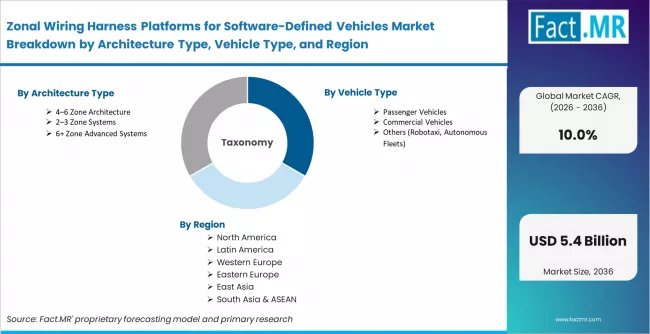
Zonal Wiring Harness Platforms For Software Defined Vehicles Market Breakdown By Architecture Type, Vehicle Type, And Region | Source: Fact.MR
| Attribute | Details |
|---|---|
| Quantitative Units | USD 1.9 billion (2026) to USD 5.1 billion (2036), at a CAGR of 10.0% |
| Market Definition | Pre-engineered zonal wiring harness platforms integrating zone controllers, power distribution, and high-speed data networks for software-defined vehicle OEM programmes in passenger and commercial vehicles globally. |
| Architecture Type Segmentation | 4–6 Zone Architecture, 2–3 Zone Systems, 6+ Zone Advanced Systems |
| Vehicle Type Segmentation | Passenger Vehicles, Commercial Vehicles, Others (Robotaxi, Autonomous Fleets) |
| Integration Type Segmentation | Fully Zonal Integrated Harness Platforms, Hybrid (Domain + Zonal), Legacy Distributed Systems |
| Application Coverage | Passenger car SDV platform zonal harness integration, commercial EV zone-based wiring, robotaxi and autonomous fleet electrical architecture, and hybrid OEM platform transition supply. |
| Regions Covered | North America, Europe, Asia Pacific, Latin America, Middle East and Africa |
| Countries Covered | USA, Canada, Mexico, Germany, UK, France, Italy, Spain, Nordic, BENELUX, China, Japan, South Korea, India, ASEAN, Australia and New Zealand, Brazil, Argentina, Saudi Arabia, GCC, Turkey, South Africa, Rest of MEA |
| Key Companies Profiled | Aptiv, Leoni AG, Yazaki Corporation, Sumitomo Electric Industries, Furukawa Electric, TE Connectivity |
| Forecast Period | 2026 to 2036 |
| Approach | Hybrid top-down and bottom-up model using OEM SDV platform production volume forecasts, zonal harness content per vehicle, Tier-1 platform nomination data, zone controller pricing, and primary interviews with OEM electrical architecture teams and Tier-1 SDV programme managers. |
Source: Fact.MR analysis. Updated May 14, 2026
Zonal Wiring Harness Platforms for Software-Defined Vehicles Market by Segments
-
By Architecture Type:
- 4–6 Zone Architecture
- 2–3 Zone Systems
- 6+ Zone Advanced Systems
-
By Vehicle Type:
- Passenger Vehicles
- Commercial Vehicles
- Others (Robotaxi, Autonomous Fleets)
-
By Integration Type:
- Fully Zonal Integrated Harness Platforms
- Hybrid (Domain + Zonal)
- Legacy Distributed Systems
-
By Region:
- North America
- United States
- Canada
- Mexico
- Latin America
- Brazil
- Mexico
- Argentina
- Chile
- Rest of Latin America
- Western Europe
- Germany
- United Kingdom
- France
- Italy
- Spain
- Nordic Countries
- BENELUX
- Rest of Western Europe
- Eastern Europe
- Russia
- Poland
- Hungary
- Balkan and Baltic
- Rest of Eastern Europe
- East Asia
- China
- Japan
- South Korea
- South Asia and Pacific
- India
- ASEAN
- Australia and New Zealand
- Rest of South Asia and Pacific
- Middle East and Africa
- Kingdom of Saudi Arabia
- Other GCC Countries
- Turkey
- South Africa
- Rest of Middle East and Africa
- North America
Frequently Asked Questions
How large is the global zonal wiring harness platforms for software-defined vehicles market in 2025?
What will the market size be in 2026?
What is the projected market size by 2036?
What is the expected CAGR from 2026 to 2036?
Which architecture type segment is poised to lead the market?
Which vehicle type segment holds the largest share?
Which integration type leads the market?
Which country shows the fastest growth?
What is driving demand for zonal wiring harness platforms?
What are the major restraints?
Who worked on this report


Preview the report firsthand - request a free sample
Free SampleGet the brochure for pricing and purchase details
Download PDF