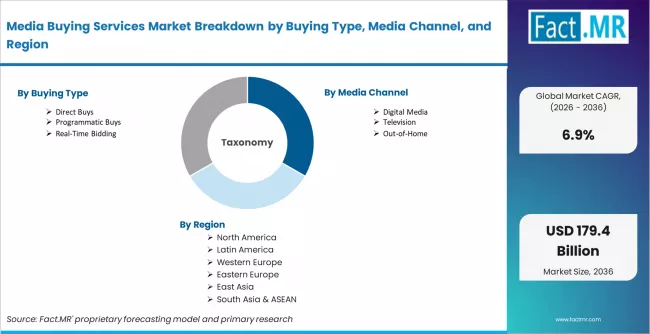
Media Buying Services Market Size, Share, Growth and Forecast (2026 - 2036)

The Media Buying Services Market is segmented by Buying Type (Direct Buys, Programmatic Buys, Real-Time Bidding, Private Marketplace Deals, and Preferred Deals), Media Channel (Digital Media, Television, Out-of-Home, Radio, Print, and Connected TV), Service Model (Full-Service Media Buying, Managed Programmatic Services, Self-Serve Platform Support, Campaign Planning and Optimization, and Performance Reporting), Customer Type (Large Enterprises, Mid-sized Enterprises, Small Businesses, Advertising Agencies, and D2C Brands), and End-use Industry (Retail and E-Commerce, BFSI, Consumer Goods, Media and Entertainment, Healthcare, and Automotive). Forecast for 2026 to 2036.

Fact.MR analysis indicates that the media buying services market is moving through a measurement and channel-fragmentation cycle. Advertisers need support across digital, television, outdoor, audio, and connected TV because buying decisions now span several platforms. Media buying partners are gaining relevance where brands need audience planning, cost control, inventory access, and campaign performance discipline.

Media Buying Services Market Forecast and Outlook By FACT MR

  • The media buying services market was valued at USD 80.5 billion in 2025. According to Fact.MR, demand is projected to reach USD 86.1 billion in 2026 and expand to USD 167.8 billion by 2036, reflecting a CAGR of 6.9% during the forecast period.
  • The market is expected to generate an absolute opportunity of USD 81.7 billion between 2026 and 2036, supported by continued expansion in advertising ecosystems.
  • Growth is being driven by rising digital media spending, increasing use of programmatic buying, and stronger demand for campaign accountability and measurable outcomes.
  • Data from Interactive Advertising Bureau shows significant growth in U.S. internet advertising revenues in 2024, highlighting the scale of digital ad buying managed by agencies and media specialists.
  • As brands allocate more budgets to digital channels, media buying services are becoming more data-driven, performance-focused, and integrated across platforms. [1]
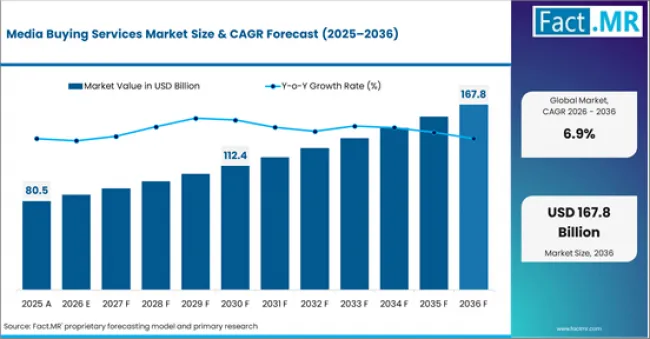
Media Buying Services Market Market Value Analysis 2

Summary of Media Buying Services Market

  • Market Definition
    • The market includes services that help advertisers plan, buy, optimize, and report paid media placements across online and offline channels.
  • Demand Drivers
    • Brand marketing heads need buying support as audiences fragment across channels.
    • Programmatic teams use specialists to manage bidding, targeting, and reporting.
    • Retail advertisers rely on media buyers to connect campaign spend with sales outcomes.
  • Key Segments Analyzed
    • By Buying Type: Direct buys are estimated to lead with 44.0% share in 2026, supported by premium inventory access and advertiser control.
    • By Media Channel: Digital media is expected to account for 57.0% share in 2026 because advertisers prioritize measurable and flexible campaign formats.
    • By Service Model: Full-service media buying is projected to hold 48.0% share in 2026 due to planning, buying, and reporting needs.
    • By Customer Type: Large enterprises are expected to hold 51.0% share in 2026 because large budgets need structured planning and governance.
    • By End-use Industry: Retail and e-commerce are projected to account for 29.0% share in 2026 because paid media supports traffic, conversion, and product visibility.
  • Analyst Opinion at Fact.MR
    • Shambhu Nath Jha, Senior Analyst at Fact.MR, notes, “Media buying is no longer a rate-card negotiation function. Advertisers need partners that understand inventory quality, platform rules, audience data, and campaign outcomes. Agencies that combine buying discipline with measurement clarity will gain more than firms competing only on cheaper media access.”
  • Strategic Implications
    • Media buying firms should strengthen programmatic, connected TV, and retail media capabilities.
    • Advertisers need better governance over audience data, spend pacing, and campaign reporting.
    • Regional growth should focus on markets where digital commerce and mobile advertising are expanding.
  • Methodology
    • Sizing Base: Market sizing uses media buying service fees, managed spend, client mix, channel split, and campaign volume.
    • Evidence Inputs: Analysis includes IAB revenue data, OpenRTB standards, agency holding company reports, and privacy regulation references.
    • Forecast Design: Forecasts account for digital media growth, programmatic adoption, retail media expansion, privacy rules, and advertiser demand for measurable outcomes.
Metric Value
Estimated Value in 2026 USD 86.1 billion
Forecast Value in 2036 USD 167.8 billion
Forecast CAGR (2026 to 2036) 6.9%

Media buying is becoming more technical because advertisers need better control over reach, frequency, brand safety, and measurable outcomes. IAB Tech Lab’s OpenRTB standard supports programmatic buying by defining how bid requests and responses work across digital advertising systems [3]. Buyers are also paying closer attention to privacy, consent, and data governance as media buying becomes more data-driven.

India is projected to grow at 8.9% CAGR through 2036. China follows at 8.2% CAGR, supported by digital commerce and platform-led advertising. Brazil grows at 7.6% CAGR, driven by retail media and mobile-first campaigns. The United States records 6.8% CAGR, linked to mature digital and connected TV buying. Germany grows at 6.1% CAGR, supported by privacy-conscious programmatic adoption. The United Kingdom advances at 5.9% CAGR, driven by agency-led campaign planning.

Segmental Analysis

Media Buying Services Market Analysis by Buying Type
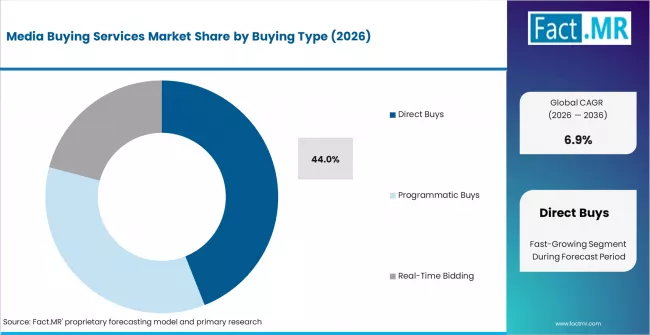
Media Buying Services Market Analysis By Buying Type

Direct buys are estimated to hold 44.0% share in 2026, as advertisers still prefer direct access to premium placements, fixed terms, and trusted media partners for important campaigns. Direct buys are common in television, outdoor, premium digital placements, and sponsorship-led campaigns. Programmatic buys are expanding because advertisers want automated activation and faster optimization. Real-time bidding serves performance campaigns where price and audience reach matter. Private marketplace deals help brands access premium digital inventory with more control than open exchanges. Direct buys lead because many advertisers still value certainty, placement quality, and relationship-based inventory access.

  • Premium Control: Direct buys help advertisers secure preferred placements with clearer terms.
  • Automated Activation: Programmatic buying supports faster campaign setup and optimization.
  • Inventory Quality: Private marketplaces help brands balance automation with placement control.

Media Buying Services Market Analysis by Media Channel
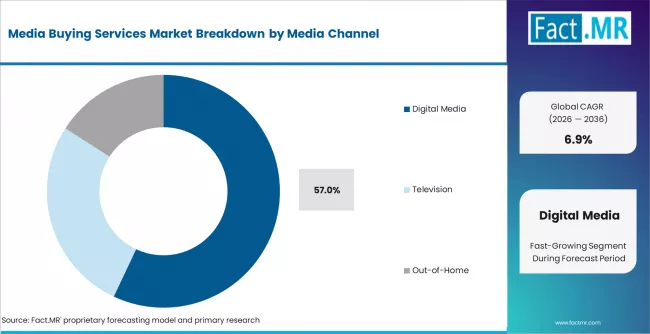
Media Buying Services Market Analysis By Media Channel

Digital media is expected to account for 57.0% share in 2026. This channel leads because advertisers can target audiences, change campaigns quickly, and measure outcomes more directly than traditional formats. IAB’s 2024 internet advertising revenue report shows the size and growth of digital ad activity in the United States. Television remains important for broad reach and brand campaigns. Out-of-home supports physical visibility and local activation. Radio and print remain selective channels where audience context is valuable. Connected TV is gaining attention because it combines video storytelling with data-driven buying. Digital media leads because it offers flexibility and clearer reporting.

  • Measurable Reach: Digital media helps advertisers track campaign response and audience delivery.
  • Broad Awareness: Television remains valuable for large brand campaigns.
  • Local Visibility: Out-of-home supports geographic targeting and store traffic.

Media Buying Services Market Analysis by Service Model
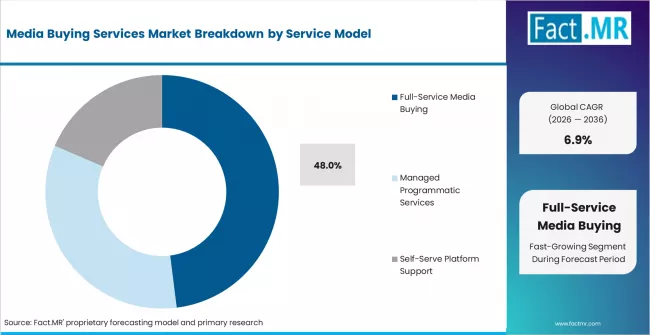
Media Buying Services Market Analysis By Service Model

Full-service media buying is projected to hold 48.0% share in 2026, because advertisers often need planning, buying, optimization, and reporting under one partner. Full-service agencies help clients decide channel mix, negotiate inventory, monitor spend, and interpret performance. Managed programmatic services are growing because bid strategy and platform management require technical skill. Self-serve platform support fits brands that want more internal control. Campaign planning and optimization are important where advertisers use several channels. Performance reporting is now a core client expectation. Full-service buying leads because fragmented media environments make coordination difficult for internal teams.

  • Integrated Execution: Full-service buying links planning, inventory access, and reporting.
  • Programmatic Skill: Managed programmatic services help brands handle platform complexity.
  • Reporting Discipline: Performance reporting helps advertisers compare channel outcomes.

Media Buying Services Market Analysis by Customer Type
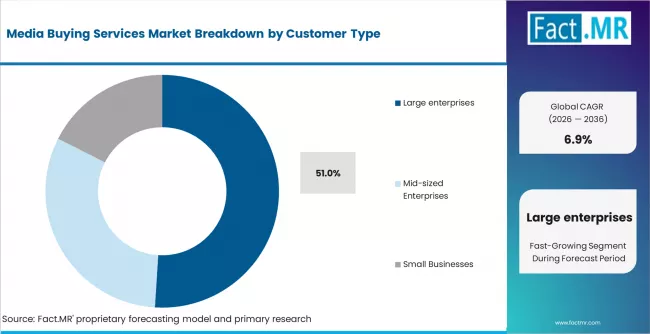
Media Buying Services Market Analysis By Customer Type

Large enterprises lead demand due to their larger advertising budgets, multi-channel media strategies, and stricter governance around brand safety, audience targeting, and campaign measurement. Their media buying processes often involve deeper contract review, compliance checks, and performance tracking across platforms. Large enterprises are expected to hold 51.0% share over the assessment period. Mid-sized firms rely on agencies for added expertise, while small businesses focus on simpler campaigns and local execution. Agencies and D2C brands also contribute to demand, but large enterprises remain dominant because their media decisions carry higher financial exposure and brand reputation risk.

  • Budget Governance: Large enterprises need stronger planning controls across media channels.
  • Local Campaigns: Small businesses use buying support for practical reach and response.
  • Acquisition Focus: D2C brands rely on paid media for product discovery and sales.

Media Buying Services Market Analysis by End-use Industry
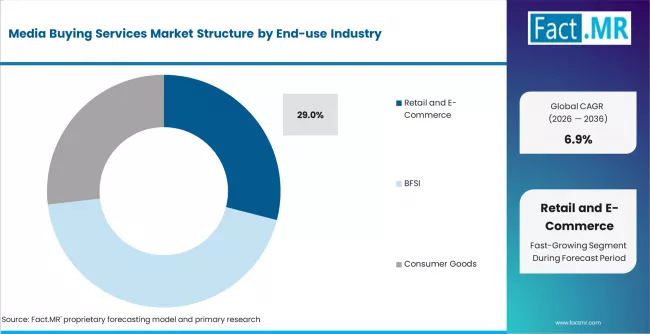
Media Buying Services Market Analysis By End Use Industry

Retail and e-commerce are projected to account for 29.0% share in 2026, as paid media directly supports traffic, product visibility, and seasonal promotion. Retailers are shifting budgets toward channels that can connect media exposure with conversion signals. BFSI advertisers use media buying to build trust and acquire customers in regulated categories. Consumer goods firms need broad awareness and retail-linked campaigns. Media and entertainment buyers use paid placements for releases and subscriptions. Healthcare advertisers require compliant messaging and careful channel selection. Automotive companies use media buying for launches and dealer demand. Retail leads because paid media is closely tied to revenue outcomes.

  • Sales Link: Retail campaigns connect media exposure with traffic and conversion goals.
  • Trust Building: BFSI advertisers use planned media to support credibility.
  • Launch Support: Automotive brands need media buying for model visibility and dealer leads.

Media Buying Services Market Drivers, Restraints, and Opportunities
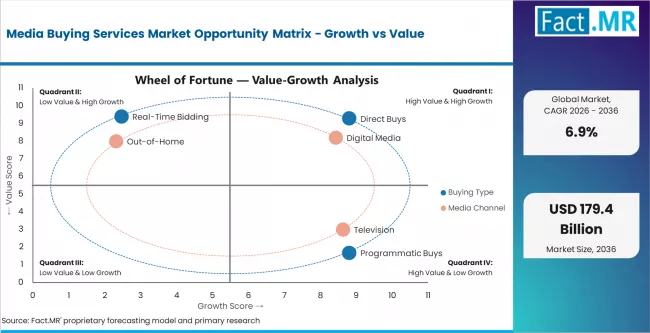
Media Buying Services Market Opportunity Matrix Growth Vs Value

Fact.MR analysts observe that media buying services demand is supported by fragmented audiences, digital ad growth, and greater pressure on campaign accountability. IAB reported strong U.S. internet ad revenues in 2024, confirming the scale of digital media investment. OpenRTB standards from IAB Tech Lab support automated buying workflows used across programmatic advertising. Agency holding companies such as Omnicom, Publicis, WPP, IPG, and Dentsu continue to report large media and advertising service operations, showing that enterprise clients still rely on specialist partners. [4]

Privacy and measurement disruption remain the main restraints. Media buyers must manage consent requirements, platform policy changes, data loss, and attribution gaps. GDPR sets strict rules for personal data processing in the European Union, which affects audience targeting and measurement [5]. Campaign performance can weaken when advertisers depend on poor-quality inventory or unclear reporting. Buyers also face margin pressure when fees are compared only against media rates. Agencies need stronger measurement methods and transparent buying practices to protect trust.

Opportunities in the Media Buying Services Market

  • Retail Media Planning: Agencies can help brands manage growing spend across retailer-owned media networks.
  • Connected TV Buying: Media buyers can support advertisers seeking video reach with better targeting.
  • Measurement Governance: Service providers can gain by improving reporting, brand safety, and spend transparency.

Regional Analysis

Top Country Growth Comparison Media Buying Services Market Cagr (2026 2036)

The media buying services market is assessed across North America, Europe, Asia Pacific, Latin America, and Middle East and Africa, covering 30+ countries with demand profiles shaped by digital ad spending, retail media growth, privacy rules, agency networks, and platform adoption.

Country CAGR (2026 to 2036)
India 8.9%
China 8.2%
Brazil 7.6%
United States 6.8%
Germany 6.1%
United Kingdom 5.9%

Source: Fact.MR analysis, based on proprietary forecasting model and primary research
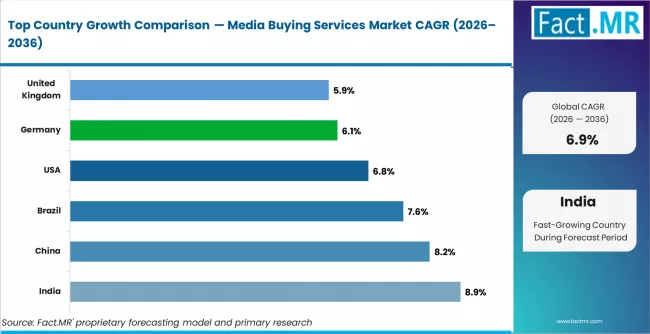
Media Buying Services Market Cagr Analysis By Country

Asia Pacific Media Buying Services Market Analysis

Asia Pacific records faster growth because mobile advertising, e-commerce, and digital entertainment are expanding advertiser demand. India benefits from fast digital commerce growth and high social media use. China supports demand through platform-led advertising and retail media ecosystems. Regional buyers need media buying partners that understand local platforms, languages, and performance measurement. Growth depends on platform access, brand safety, and campaign optimization skills.

  • India: Media buying services demand in India is projected to grow at 8.9% CAGR from 2026 to 2036. Retail brands, D2C companies, and app-based businesses are increasing digital ad spending. Agencies are gaining work where advertisers need help across search, social, video, and marketplace ads. Smaller brands often need buying partners to manage budget pacing and performance reporting. Providers with strong regional media knowledge can win repeat campaigns.
  • China: China’s demand is tied to platform ecosystems, e-commerce campaigns, and brand activity across digital video and social commerce. Advertisers need media buyers that understand local channels and campaign rules. The market is projected to expand at 8.2% CAGR by 2036. Large brands use agencies to manage audience planning and campaign execution across several platforms. Local platform expertise remains central to supplier selection.

North America Media Buying Services Market Analysis
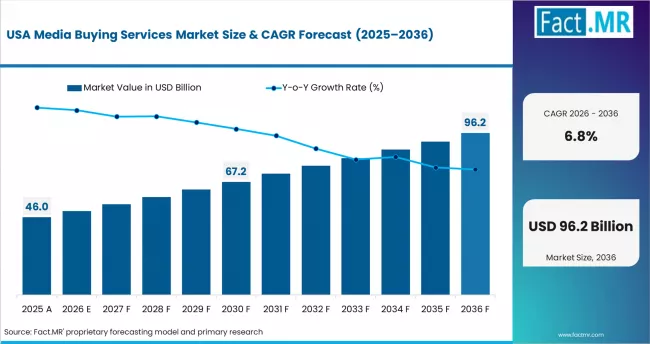
Media Buying Services Market Country Value Analysis

North America remains a high-value region because advertisers spend heavily across digital, connected TV, television, retail media, and outdoor channels. The United States leads regional demand through large agency networks and mature programmatic buying. IAB revenue data confirms the depth of U.S. digital advertising activity. Buyers expect performance transparency, brand safety, and cross-channel reporting.

  • United States: The U.S. media buying services market is forecast to grow at 6.8% CAGR through 2036. Large enterprises, retailers, and digital-first brands rely on agencies for complex campaign execution. Connected TV and retail media are creating new planning needs. Privacy changes are pushing advertisers to review data use and measurement quality. Media buyers with strong analytics and transparent inventory practices are better placed.

Europe Media Buying Services Market Analysis
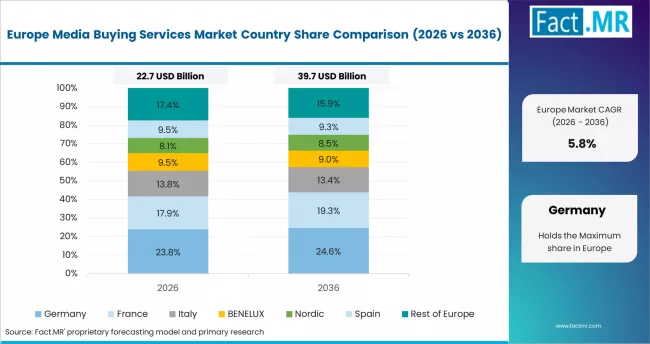
Media Buying Services Market Europe Country Market Share Analysis, 2026 & 2036

Europe grows through programmatic buying, retail media, and careful privacy-led campaign planning. Germany and the United Kingdom are key markets because advertisers use agencies to manage complex channel mixes and compliance expectations. GDPR influences audience targeting and campaign measurement, especially when personal data is used. Agencies need privacy-aware planning and stronger reporting to protect advertiser trust.

  • Germany: Germany’s demand is supported by privacy-conscious digital buying and strong brand advertiser activity. Retail, automotive, and consumer goods companies use media buyers to manage cross-channel campaigns. The market is projected to record 6.1% CAGR over the assessment period. Buyers value media quality and data governance. Agencies with transparent inventory access and careful reporting can protect long-term client relationships.
  • United Kingdom: UK media buying demand is driven by agency-led planning, digital video, retail media, and connected TV. Advertisers need support as campaign measurement becomes more complex. Media buying services are projected to grow at 5.9% CAGR from 2026 to 2036. Large agencies hold strong positions because they offer planning, buying, and optimization across channels. Specialist firms can gain where clients need programmatic or performance depth.

Latin America Media Buying Services Market Analysis

Latin America grows through mobile advertising, retail media, and e-commerce campaigns. Brazil remains the key country because advertisers use paid media for brand visibility and online sales. Cost control is important, so buyers expect efficient campaign planning and measurable outcomes. Agencies with platform expertise and local audience knowledge are better positioned.

  • Brazil: Brazil’s demand is tied to retail campaigns, mobile advertising, and digital commerce. Brands need media buying partners to manage paid social, video, search, and marketplace ads. The market is projected to expand at 7.6% CAGR over the foreseen period. Local consumer behavior and regional media pricing influence campaign design. Agencies that combine platform knowledge with clear performance reporting can gain repeat work.

Competitive Aligners for Market Players
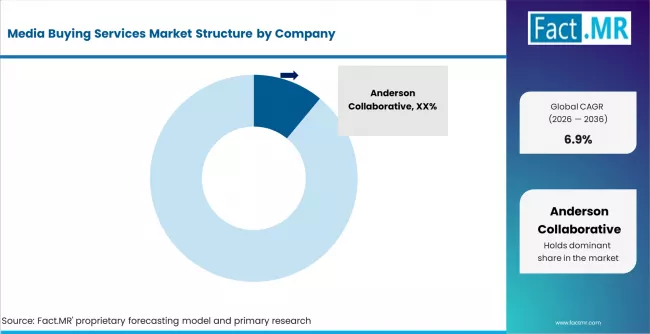
Media Buying Services Market Analysis By Company

The media buying services market is moderately concentrated among global agency networks, while independent and specialist agencies compete in programmatic, performance, and regional buying. Large networks gain through global client relationships, proprietary planning tools, data partnerships, and cross-channel execution. Independent agencies compete through speed, channel focus, and sector-specific service.

Competitive advantage depends on inventory access, measurement quality, data governance, and buying transparency. Advertisers are more cautious about waste, low-quality impressions, and unclear attribution. Agencies that can explain where money is spent and what performance is delivered can protect fee value. Programmatic buying also rewards firms with strong platform skills and brand safety controls.

The market is divided between broad media networks and specialist performance agencies. Broad networks compete on scale and integrated planning. Specialists compete on platform depth and optimization speed. Firms that combine media access with transparent reporting are positioned to win larger and longer client assignments.

Key Players in Media Buying Services Market

  • Anderson Collaborative
  • ARSENL
  • ATTN Agency
  • Booyah Advertising
  • Colormatics
  • Dentsu
  • EXL Media
  • GKV
  • Interpublic Group
  • Katz Media Group
  • Mancuso Media
  • Metric Theory
  • Moburst
  • MuteSix
  • Omnicom Group Inc.
  • Publicis Groupe

Bibliography

  • [1]. Interactive Advertising Bureau. IAB Internet Advertising Revenue Report: Full Year 2024. IAB.
  • [2]. Omnicom Group Inc. 2024 Annual Report. Omnicom Group.
  • [3]. IAB Tech Lab. OpenRTB. IAB Tech Lab.
  • [4]. Publicis Groupe. 2024 Universal Registration Document. Publicis Groupe.
  • [5]. European Union. General Data Protection Regulation. EUR-Lex.

This Report Addresses

  • Strategic intelligence on media buying services demand across direct media buys, programmatic buying, private marketplace deals, connected TV buying, campaign planning, and performance reporting.
  • Market forecast from USD 86.1 billion in 2026 to USD 167.8 billion by 2036 at a CAGR of 6.9%.
  • Segment analysis by buying type, media channel, service model, customer type, and end-use industry, covering direct buys, digital media, full-service media buying, large enterprises, and retail and e-commerce demand.
  • Growth opportunity mapping across India, China, Brazil, the United States, Germany, and the United Kingdom. India is projected to record the fastest growth at 8.9% CAGR through 2036, followed by China at 8.2% CAGR.
  • Regional outlook covering Asia Pacific mobile advertising growth, North America connected TV and retail media adoption, Europe privacy-aware campaign planning, and Latin America digital commerce campaigns.
  • Competitive analysis of Anderson Collaborative, ARSENL, ATTN Agency, Booyah Advertising, Colormatics, Dentsu, EXL Media, GKV, Interpublic Group, Katz Media Group, Mancuso Media, Metric Theory, Moburst, MuteSix, Omnicom Group, and Publicis Groupe.
  • Report delivered with market sizing, segment forecasts, regional outlook, and competitive assessment. Supported by media buyer interviews, managed spend modeling, IAB advertising revenue data, OpenRTB standards, agency disclosures, and privacy regulation references.

Media Buying Services Market Definition

The market covers professional services used to plan, negotiate, purchase, optimize, and report advertising placements across media channels. It includes direct media buys, programmatic buying, private marketplace deals, connected TV buying, paid social coordination, and cross-channel campaign execution. Scope is limited to paid media buying services delivered for advertisers, agencies, brands, and institutions.

Media Buying Services MarketInclusions

The market includes buying strategy, media planning support, inventory negotiation, campaign setup, audience targeting, budget pacing, bid optimization, reporting, and supplier coordination. It covers buying across digital media, television, out-of-home, radio, print, and connected TV. Managed programmatic services and performance reporting are included when they support paid media placement.

Media Buying Services Market Exclusions

The market excludes creative production, public relations, unpaid social media management, owned media content strategy, search engine optimization, and marketing software subscriptions sold without buying support. It does not include pure ad inventory revenue retained by media owners. Consultancy work is outside scope unless tied to paid media buying execution or campaign optimization.

Media Buying Services Market Research Methodology

  • Primary Research: Interviews with media agency planners, programmatic trading leads, brand marketing heads, retail media managers, and campaign analytics specialists.
  • Desk Research: Review includes IAB advertising revenue data, programmatic standards, agency holding company reports, digital advertising guidance, and privacy regulation material. [2]
  • Market-Sizing and Forecasting: The model uses media buying fee pools, managed spend, channel mix, programmatic penetration, and client type demand.
  • Data Validation and Update Cycle: Forecasts are validated using agency disclosures, advertiser interviews, campaign buying patterns, and digital ad spending signals.

Scope of Report

Media Buying Services Market Breakdown By Buying Type, Media Channel, And Region

Attribute Details
Quantitative Units USD 80.5 billion (2025), USD 86.1 billion (2026), and USD 167.8 billion (2036), at a CAGR of 6.9% from 2026 to 2036
Market Definition Services used to plan, negotiate, purchase, optimize, and report paid advertising placements across media channels.
Buying Type Segmentation Direct Buys, Programmatic Buys, Real-Time Bidding, Private Marketplace Deals, Preferred Deals
Media Channel Segmentation Digital Media, Television, Out-of-Home, Radio, Print, Connected TV
Service Model Segmentation Full-Service Media Buying, Managed Programmatic Services, Self-Serve Platform Support, Campaign Planning and Optimization, Performance Reporting
Customer Type Segmentation Large Enterprises, Mid-sized Enterprises, Small Businesses, Advertising Agencies, D2C Brands
End-use Industry Segmentation Retail and E-Commerce, BFSI, Consumer Goods, Media and Entertainment, Healthcare, Automotive
Regions Covered North America, Europe, Asia Pacific, Latin America, Middle East and Africa
Countries Covered United States, Canada, Germany, UK, France, China, India, Japan, South Korea, Brazil, Mexico, GCC countries, South Africa, and 30+ countries
Key Companies Profiled Anderson Collaborative, ARSENL, ATTN Agency, Booyah Advertising, Colormatics, Dentsu, EXL Media, GKV, Interpublic Group, Katz Media Group, Mancuso Media, Metric Theory, Moburst, MuteSix, Omnicom Group
Forecast Period 2026 to 2036
Approach Hybrid top-down and bottom-up model using service fee pools, managed media spend, channel mix, client type demand, and media buyer interviews.

Media Buying Services Market by Segments

  • By Buying Type:

    • Direct Buys
    • Programmatic Buys
    • Real-Time Bidding
    • Private Marketplace Deals
    • Preferred Deals
  • By Media Channel:

    • Digital Media
    • Television
    • Out-of-Home
    • Radio
    • Print
    • Connected TV
  • By Service Model:

    • Full-Service Media Buying
    • Managed Programmatic Services
    • Self-Serve Platform Support
    • Campaign Planning and Optimization
    • Performance Reporting
  • By Customer Type:

    • Large Enterprises
    • Mid-sized Enterprises
    • Small Businesses
    • Advertising Agencies
    • D2C Brands
  • By End-use Industry:

    • Retail and E-Commerce
    • BFSI
    • Consumer Goods
    • Media and Entertainment
    • Healthcare
    • Automotive
  • By Region:

    • North America
      • United States
      • Canada
      • Mexico
    • Latin America
      • Brazil
      • Argentina
      • Chile
      • Rest of Latin America
    • Western Europe
      • Germany
      • France
      • United Kingdom
      • Italy
      • Spain
      • Nordic Countries
      • BENELUX
      • Rest of Western Europe
    • Eastern Europe
      • Russia
      • Poland
      • Hungary
      • Balkan and Baltic
      • Rest of Eastern Europe
    • East Asia
      • China
      • Japan
      • South Korea
    • South Asia and Pacific
      • India
      • ASEAN
      • Australia and New Zealand
      • Rest of South Asia and Pacific
    • Middle East and Africa
      • Kingdom of Saudi Arabia
      • Other GCC Countries
      • Turkey
      • South Africa
      • Rest of Middle East and Africa

- Frequently Asked Questions -

How large is the media buying services market in 2026?

The market is estimated to reach USD 86.1 billion in 2026.

What will the media buying services market be valued at by 2036?

The market is forecast to reach USD 167.8 billion by 2036.

What CAGR is projected from 2026 to 2036?

The market is projected to grow at a 6.9% CAGR during the forecast period.

Which buying type leads the market?

Direct buys lead with an estimated 44.0% share in 2026.

Which media channel leads demand?

Digital media leads with an estimated 57.0% share in 2026.

Which service model holds the largest share?

Full-service media buying leads with an estimated 48.0% share in 2026.

Which customer type leads the market?

Large enterprises lead with an estimated 51.0% share in 2026.

Which end-use industry holds the highest share?

Retail and e-commerce lead with an estimated 29.0% share in 2026.

Which country grows fastest through 2036?

India leads with a projected 8.9% CAGR through 2036.

Why do direct buys lead demand?

Direct buys lead because advertisers value premium placements and clearer buying terms.

Why does digital media hold the highest share?

Digital media leads because advertisers can target, optimize, and measure campaigns faster.

Why is full-service media buying preferred?

Full-service buying helps advertisers manage planning, placement, optimization, and reporting together.

Why do large enterprises dominate demand?

Large enterprises manage bigger budgets and need stronger campaign governance.

What is the main restraint for the market?

Privacy changes and measurement disruption can reduce campaign clarity.

Why is programmatic buying growing?

Programmatic buying supports faster activation and automated campaign optimization.

Why is India growing faster than mature markets?

India is growing faster because digital commerce and mobile advertising are expanding.

Why is Germany growing more steadily?

Germany grows steadily because privacy rules and media quality expectations influence buying decisions.

What shapes supplier success in this market?

Supplier success depends on inventory access, data governance, measurement quality, and transparency.

How does GDPR affect media buying?

GDPR affects media buying by shaping how personal data can be used for targeting and measurement.

Why is retail media important?

Retail media helps brands connect advertising spend with product visibility and sales outcomes.

What opportunity exists for agencies?

Agencies can gain through connected TV, retail media planning, and transparent reporting.

What does the report measure across segments?

The report measures demand by buying type, media channel, service model, customer type, end-use industry, and region.

Table of Content

  1. Executive Summary
    • Global Market Outlook
    • Demand to side Trends
    • Supply to side Trends
    • Technology Roadmap Analysis
    • Analysis and Recommendations
  2. Market Overview
    • Market Coverage / Taxonomy
    • Market Definition / Scope / Limitations
  3. Research Methodology
    • Chapter Orientation
    • Analytical Lens and Working Hypotheses
      • Market Structure, Signals, and Trend Drivers
      • Benchmarking and Cross-market Comparability
      • Market Sizing, Forecasting, and Opportunity Mapping
    • Research Design and Evidence Framework
      • Desk Research Programme (Secondary Evidence)
        • Company Annual and Sustainability Reports
        • Peer-reviewed Journals and Academic Literature
        • Corporate Websites, Product Literature, and Technical Notes
        • Earnings Decks and Investor Briefings
        • Statutory Filings and Regulatory Disclosures
        • Technical White Papers and Standards Notes
        • Trade Journals, Industry Magazines, and Analyst Briefs
        • Conference Proceedings, Webinars, and Seminar Materials
        • Government Statistics Portals and Public Data Releases
        • Press Releases and Reputable Media Coverage
        • Specialist Newsletters and Curated Briefings
        • Sector Databases and Reference Repositories
        • Fact.MR Internal Proprietary Databases and Historical Market Datasets
        • Subscription Datasets and Paid Sources
        • Social Channels, Communities, and Digital Listening Inputs
        • Additional Desk Sources
      • Expert Input and Fieldwork (Primary Evidence)
        • Primary Modes
          • Qualitative Interviews and Expert Elicitation
          • Quantitative Surveys and Structured Data Capture
          • Blended Approach
        • Why Primary Evidence is Used
        • Field Techniques
          • Interviews
          • Surveys
          • Focus Groups
          • Observational and In-context Research
          • Social and Community Interactions
        • Stakeholder Universe Engaged
          • C-suite Leaders
          • Board Members
          • Presidents and Vice Presidents
          • R&D and Innovation Heads
          • Technical Specialists
          • Domain Subject-matter Experts
          • Scientists
          • Physicians and Other Healthcare Professionals
        • Governance, Ethics, and Data Stewardship
          • Research Ethics
          • Data Integrity and Handling
      • Tooling, Models, and Reference Databases
    • Data Engineering and Model Build
      • Data Acquisition and Ingestion
      • Cleaning, Normalisation, and Verification
      • Synthesis, Triangulation, and Analysis
    • Quality Assurance and Audit Trail
  4. Market Background
    • Market Dynamics
      • Drivers
      • Restraints
      • Opportunity
      • Trends
    • Scenario Forecast
      • Demand in Optimistic Scenario
      • Demand in Likely Scenario
      • Demand in Conservative Scenario
    • Opportunity Map Analysis
    • Product Life Cycle Analysis
    • Supply Chain Analysis
    • Investment Feasibility Matrix
    • Value Chain Analysis
    • PESTLE and Porter’s Analysis
    • Regulatory Landscape
    • Regional Parent Market Outlook
    • Production and Consumption Statistics
    • Import and Export Statistics
  5. Global Market Analysis 2021 to 2025 and Forecast, 2026 to 2036
    • Historical Market Size Value (USD Million) Analysis, 2021 to 2025
    • Current and Future Market Size Value (USD Million) Projections, 2026 to 2036
      • Y to o to Y Growth Trend Analysis
      • Absolute $ Opportunity Analysis
  6. Global Market Pricing Analysis 2021 to 2025 and Forecast 2026 to 2036
  7. Global Market Analysis 2021 to 2025 and Forecast 2026 to 2036, By Service Type
    • Introduction / Key Findings
    • Historical Market Size Value (USD Million) Analysis By Service Type , 2021 to 2025
    • Current and Future Market Size Value (USD Million) Analysis and Forecast By Service Type , 2026 to 2036
      • Media Relations
      • Digital and Social Media Management
      • Crisis and Reputation Management
    • Y to o to Y Growth Trend Analysis By Service Type , 2021 to 2025
    • Absolute $ Opportunity Analysis By Service Type , 2026 to 2036
  8. Global Market Analysis 2021 to 2025 and Forecast 2026 to 2036, By Deployment
    • Introduction / Key Findings
    • Historical Market Size Value (USD Million) Analysis By Deployment, 2021 to 2025
    • Current and Future Market Size Value (USD Million) Analysis and Forecast By Deployment, 2026 to 2036
      • Hybrid Models
      • In-house Solutions
      • Agency Outsourced Services
    • Y to o to Y Growth Trend Analysis By Deployment, 2021 to 2025
    • Absolute $ Opportunity Analysis By Deployment, 2026 to 2036
  9. Global Market Analysis 2021 to 2025 and Forecast 2026 to 2036, By End User
    • Introduction / Key Findings
    • Historical Market Size Value (USD Million) Analysis By End User, 2021 to 2025
    • Current and Future Market Size Value (USD Million) Analysis and Forecast By End User, 2026 to 2036
      • Corporate Enterprises
      • Small and Medium Enterprises
      • Public Sector and Government
    • Y to o to Y Growth Trend Analysis By End User, 2021 to 2025
    • Absolute $ Opportunity Analysis By End User, 2026 to 2036
  10. Global Market Analysis 2021 to 2025 and Forecast 2026 to 2036, By Communication Channel
    • Introduction / Key Findings
    • Historical Market Size Value (USD Million) Analysis By Communication Channel, 2021 to 2025
    • Current and Future Market Size Value (USD Million) Analysis and Forecast By Communication Channel, 2026 to 2036
      • Earned Media
      • Social Media
      • Executive Communications
    • Y to o to Y Growth Trend Analysis By Communication Channel, 2021 to 2025
    • Absolute $ Opportunity Analysis By Communication Channel, 2026 to 2036
  11. Global Market Analysis 2021 to 2025 and Forecast 2026 to 2036, By Organization Size
    • Introduction / Key Findings
    • Historical Market Size Value (USD Million) Analysis By Organization Size, 2021 to 2025
    • Current and Future Market Size Value (USD Million) Analysis and Forecast By Organization Size, 2026 to 2036
      • Large Enterprises
      • Mid-sized Enterprises
      • Small Enterprises
    • Y to o to Y Growth Trend Analysis By Organization Size, 2021 to 2025
    • Absolute $ Opportunity Analysis By Organization Size, 2026 to 2036
  12. Global Market Analysis 2021 to 2025 and Forecast 2026 to 2036, By Region
    • Introduction
    • Historical Market Size Value (USD Million) Analysis By Region, 2021 to 2025
    • Current Market Size Value (USD Million) Analysis and Forecast By Region, 2026 to 2036
      • North America
      • Latin America
      • Western Europe
      • Eastern Europe
      • East Asia
      • South Asia and Pacific
      • Middle East & Africa
    • Market Attractiveness Analysis By Region
  13. North America Market Analysis 2021 to 2025 and Forecast 2026 to 2036, By Country
    • Historical Market Size Value (USD Million) Trend Analysis By Market Taxonomy, 2021 to 2025
    • Market Size Value (USD Million) Forecast By Market Taxonomy, 2026 to 2036
      • By Country
        • USA
        • Canada
        • Mexico
      • By Service Type
      • By Deployment
      • By End User
      • By Communication Channel
      • By Organization Size
    • Market Attractiveness Analysis
      • By Country
      • By Service Type
      • By Deployment
      • By End User
      • By Communication Channel
      • By Organization Size
    • Key Takeaways
  14. Latin America Market Analysis 2021 to 2025 and Forecast 2026 to 2036, By Country
    • Historical Market Size Value (USD Million) Trend Analysis By Market Taxonomy, 2021 to 2025
    • Market Size Value (USD Million) Forecast By Market Taxonomy, 2026 to 2036
      • By Country
        • Brazil
        • Chile
        • Rest of Latin America
      • By Service Type
      • By Deployment
      • By End User
      • By Communication Channel
      • By Organization Size
    • Market Attractiveness Analysis
      • By Country
      • By Service Type
      • By Deployment
      • By End User
      • By Communication Channel
      • By Organization Size
    • Key Takeaways
  15. Western Europe Market Analysis 2021 to 2025 and Forecast 2026 to 2036, By Country
    • Historical Market Size Value (USD Million) Trend Analysis By Market Taxonomy, 2021 to 2025
    • Market Size Value (USD Million) Forecast By Market Taxonomy, 2026 to 2036
      • By Country
        • Germany
        • UK
        • Italy
        • Spain
        • France
        • Nordic
        • BENELUX
        • Rest of Western Europe
      • By Service Type
      • By Deployment
      • By End User
      • By Communication Channel
      • By Organization Size
    • Market Attractiveness Analysis
      • By Country
      • By Service Type
      • By Deployment
      • By End User
      • By Communication Channel
      • By Organization Size
    • Key Takeaways
  16. Eastern Europe Market Analysis 2021 to 2025 and Forecast 2026 to 2036, By Country
    • Historical Market Size Value (USD Million) Trend Analysis By Market Taxonomy, 2021 to 2025
    • Market Size Value (USD Million) Forecast By Market Taxonomy, 2026 to 2036
      • By Country
        • Russia
        • Poland
        • Hungary
        • Balkan & Baltic
        • Rest of Eastern Europe
      • By Service Type
      • By Deployment
      • By End User
      • By Communication Channel
      • By Organization Size
    • Market Attractiveness Analysis
      • By Country
      • By Service Type
      • By Deployment
      • By End User
      • By Communication Channel
      • By Organization Size
    • Key Takeaways
  17. East Asia Market Analysis 2021 to 2025 and Forecast 2026 to 2036, By Country
    • Historical Market Size Value (USD Million) Trend Analysis By Market Taxonomy, 2021 to 2025
    • Market Size Value (USD Million) Forecast By Market Taxonomy, 2026 to 2036
      • By Country
        • China
        • Japan
        • South Korea
      • By Service Type
      • By Deployment
      • By End User
      • By Communication Channel
      • By Organization Size
    • Market Attractiveness Analysis
      • By Country
      • By Service Type
      • By Deployment
      • By End User
      • By Communication Channel
      • By Organization Size
    • Key Takeaways
  18. South Asia and Pacific Market Analysis 2021 to 2025 and Forecast 2026 to 2036, By Country
    • Historical Market Size Value (USD Million) Trend Analysis By Market Taxonomy, 2021 to 2025
    • Market Size Value (USD Million) Forecast By Market Taxonomy, 2026 to 2036
      • By Country
        • India
        • ASEAN
        • Australia & New Zealand
        • Rest of South Asia and Pacific
      • By Service Type
      • By Deployment
      • By End User
      • By Communication Channel
      • By Organization Size
    • Market Attractiveness Analysis
      • By Country
      • By Service Type
      • By Deployment
      • By End User
      • By Communication Channel
      • By Organization Size
    • Key Takeaways
  19. Middle East & Africa Market Analysis 2021 to 2025 and Forecast 2026 to 2036, By Country
    • Historical Market Size Value (USD Million) Trend Analysis By Market Taxonomy, 2021 to 2025
    • Market Size Value (USD Million) Forecast By Market Taxonomy, 2026 to 2036
      • By Country
        • Kingdom of Saudi Arabia
        • Other GCC Countries
        • Turkiye
        • South Africa
        • Other African Union
        • Rest of Middle East & Africa
      • By Service Type
      • By Deployment
      • By End User
      • By Communication Channel
      • By Organization Size
    • Market Attractiveness Analysis
      • By Country
      • By Service Type
      • By Deployment
      • By End User
      • By Communication Channel
      • By Organization Size
    • Key Takeaways
  20. Key Countries Market Analysis
    • USA
      • Pricing Analysis
      • Market Share Analysis, 2025
        • By Service Type
        • By Deployment
        • By End User
        • By Communication Channel
        • By Organization Size
    • Canada
      • Pricing Analysis
      • Market Share Analysis, 2025
        • By Service Type
        • By Deployment
        • By End User
        • By Communication Channel
        • By Organization Size
    • Mexico
      • Pricing Analysis
      • Market Share Analysis, 2025
        • By Service Type
        • By Deployment
        • By End User
        • By Communication Channel
        • By Organization Size
    • Brazil
      • Pricing Analysis
      • Market Share Analysis, 2025
        • By Service Type
        • By Deployment
        • By End User
        • By Communication Channel
        • By Organization Size
    • Chile
      • Pricing Analysis
      • Market Share Analysis, 2025
        • By Service Type
        • By Deployment
        • By End User
        • By Communication Channel
        • By Organization Size
    • Germany
      • Pricing Analysis
      • Market Share Analysis, 2025
        • By Service Type
        • By Deployment
        • By End User
        • By Communication Channel
        • By Organization Size
    • UK
      • Pricing Analysis
      • Market Share Analysis, 2025
        • By Service Type
        • By Deployment
        • By End User
        • By Communication Channel
        • By Organization Size
    • Italy
      • Pricing Analysis
      • Market Share Analysis, 2025
        • By Service Type
        • By Deployment
        • By End User
        • By Communication Channel
        • By Organization Size
    • Spain
      • Pricing Analysis
      • Market Share Analysis, 2025
        • By Service Type
        • By Deployment
        • By End User
        • By Communication Channel
        • By Organization Size
    • France
      • Pricing Analysis
      • Market Share Analysis, 2025
        • By Service Type
        • By Deployment
        • By End User
        • By Communication Channel
        • By Organization Size
    • India
      • Pricing Analysis
      • Market Share Analysis, 2025
        • By Service Type
        • By Deployment
        • By End User
        • By Communication Channel
        • By Organization Size
    • ASEAN
      • Pricing Analysis
      • Market Share Analysis, 2025
        • By Service Type
        • By Deployment
        • By End User
        • By Communication Channel
        • By Organization Size
    • Australia & New Zealand
      • Pricing Analysis
      • Market Share Analysis, 2025
        • By Service Type
        • By Deployment
        • By End User
        • By Communication Channel
        • By Organization Size
    • China
      • Pricing Analysis
      • Market Share Analysis, 2025
        • By Service Type
        • By Deployment
        • By End User
        • By Communication Channel
        • By Organization Size
    • Japan
      • Pricing Analysis
      • Market Share Analysis, 2025
        • By Service Type
        • By Deployment
        • By End User
        • By Communication Channel
        • By Organization Size
    • South Korea
      • Pricing Analysis
      • Market Share Analysis, 2025
        • By Service Type
        • By Deployment
        • By End User
        • By Communication Channel
        • By Organization Size
    • Russia
      • Pricing Analysis
      • Market Share Analysis, 2025
        • By Service Type
        • By Deployment
        • By End User
        • By Communication Channel
        • By Organization Size
    • Poland
      • Pricing Analysis
      • Market Share Analysis, 2025
        • By Service Type
        • By Deployment
        • By End User
        • By Communication Channel
        • By Organization Size
    • Hungary
      • Pricing Analysis
      • Market Share Analysis, 2025
        • By Service Type
        • By Deployment
        • By End User
        • By Communication Channel
        • By Organization Size
    • Kingdom of Saudi Arabia
      • Pricing Analysis
      • Market Share Analysis, 2025
        • By Service Type
        • By Deployment
        • By End User
        • By Communication Channel
        • By Organization Size
    • Turkiye
      • Pricing Analysis
      • Market Share Analysis, 2025
        • By Service Type
        • By Deployment
        • By End User
        • By Communication Channel
        • By Organization Size
    • South Africa
      • Pricing Analysis
      • Market Share Analysis, 2025
        • By Service Type
        • By Deployment
        • By End User
        • By Communication Channel
        • By Organization Size
  21. Market Structure Analysis
    • Competition Dashboard
    • Competition Benchmarking
    • Market Share Analysis of Top Players
      • By Regional
      • By Service Type
      • By Deployment
      • By End User
      • By Communication Channel
      • By Organization Size
  22. Competition Analysis
    • Competition Deep Dive
      • APCO Worldwide
        • Overview
        • Product Portfolio
        • Profitability by Market Segments (Product/Age /Sales Channel/Region)
        • Sales Footprint
        • Strategy Overview
          • Marketing Strategy
          • Product Strategy
          • Channel Strategy
      • BlueFocus
      • Brunswick Group
      • Daniel J. Edelman Holdings Inc.
      • FINN Partners
      • FischerAppelt
      • FTI Consulting
  23. Assumptions & Acronyms Used

List Of Table

  • Table 1: Global Market Value (USD Million) Forecast by Region, 2021 to 2036
  • Table 2: Global Market Value (USD Million) Forecast by Service Type , 2021 to 2036
  • Table 3: Global Market Value (USD Million) Forecast by Deployment, 2021 to 2036
  • Table 4: Global Market Value (USD Million) Forecast by End User, 2021 to 2036
  • Table 5: Global Market Value (USD Million) Forecast by Communication Channel, 2021 to 2036
  • Table 6: Global Market Value (USD Million) Forecast by Organization Size, 2021 to 2036
  • Table 7: North America Market Value (USD Million) Forecast by Country, 2021 to 2036
  • Table 8: North America Market Value (USD Million) Forecast by Service Type , 2021 to 2036
  • Table 9: North America Market Value (USD Million) Forecast by Deployment, 2021 to 2036
  • Table 10: North America Market Value (USD Million) Forecast by End User, 2021 to 2036
  • Table 11: North America Market Value (USD Million) Forecast by Communication Channel, 2021 to 2036
  • Table 12: North America Market Value (USD Million) Forecast by Organization Size, 2021 to 2036
  • Table 13: Latin America Market Value (USD Million) Forecast by Country, 2021 to 2036
  • Table 14: Latin America Market Value (USD Million) Forecast by Service Type , 2021 to 2036
  • Table 15: Latin America Market Value (USD Million) Forecast by Deployment, 2021 to 2036
  • Table 16: Latin America Market Value (USD Million) Forecast by End User, 2021 to 2036
  • Table 17: Latin America Market Value (USD Million) Forecast by Communication Channel, 2021 to 2036
  • Table 18: Latin America Market Value (USD Million) Forecast by Organization Size, 2021 to 2036
  • Table 19: Western Europe Market Value (USD Million) Forecast by Country, 2021 to 2036
  • Table 20: Western Europe Market Value (USD Million) Forecast by Service Type , 2021 to 2036
  • Table 21: Western Europe Market Value (USD Million) Forecast by Deployment, 2021 to 2036
  • Table 22: Western Europe Market Value (USD Million) Forecast by End User, 2021 to 2036
  • Table 23: Western Europe Market Value (USD Million) Forecast by Communication Channel, 2021 to 2036
  • Table 24: Western Europe Market Value (USD Million) Forecast by Organization Size, 2021 to 2036
  • Table 25: Eastern Europe Market Value (USD Million) Forecast by Country, 2021 to 2036
  • Table 26: Eastern Europe Market Value (USD Million) Forecast by Service Type , 2021 to 2036
  • Table 27: Eastern Europe Market Value (USD Million) Forecast by Deployment, 2021 to 2036
  • Table 28: Eastern Europe Market Value (USD Million) Forecast by End User, 2021 to 2036
  • Table 29: Eastern Europe Market Value (USD Million) Forecast by Communication Channel, 2021 to 2036
  • Table 30: Eastern Europe Market Value (USD Million) Forecast by Organization Size, 2021 to 2036
  • Table 31: East Asia Market Value (USD Million) Forecast by Country, 2021 to 2036
  • Table 32: East Asia Market Value (USD Million) Forecast by Service Type , 2021 to 2036
  • Table 33: East Asia Market Value (USD Million) Forecast by Deployment, 2021 to 2036
  • Table 34: East Asia Market Value (USD Million) Forecast by End User, 2021 to 2036
  • Table 35: East Asia Market Value (USD Million) Forecast by Communication Channel, 2021 to 2036
  • Table 36: East Asia Market Value (USD Million) Forecast by Organization Size, 2021 to 2036
  • Table 37: South Asia and Pacific Market Value (USD Million) Forecast by Country, 2021 to 2036
  • Table 38: South Asia and Pacific Market Value (USD Million) Forecast by Service Type , 2021 to 2036
  • Table 39: South Asia and Pacific Market Value (USD Million) Forecast by Deployment, 2021 to 2036
  • Table 40: South Asia and Pacific Market Value (USD Million) Forecast by End User, 2021 to 2036
  • Table 41: South Asia and Pacific Market Value (USD Million) Forecast by Communication Channel, 2021 to 2036
  • Table 42: South Asia and Pacific Market Value (USD Million) Forecast by Organization Size, 2021 to 2036
  • Table 43: Middle East & Africa Market Value (USD Million) Forecast by Country, 2021 to 2036
  • Table 44: Middle East & Africa Market Value (USD Million) Forecast by Service Type , 2021 to 2036
  • Table 45: Middle East & Africa Market Value (USD Million) Forecast by Deployment, 2021 to 2036
  • Table 46: Middle East & Africa Market Value (USD Million) Forecast by End User, 2021 to 2036
  • Table 47: Middle East & Africa Market Value (USD Million) Forecast by Communication Channel, 2021 to 2036
  • Table 48: Middle East & Africa Market Value (USD Million) Forecast by Organization Size, 2021 to 2036

List Of Figures

  • Figure 1: Global Market Pricing Analysis
  • Figure 2: Global Market Value (USD Million) Forecast 2021-2036
  • Figure 3: Global Market Value Share and BPS Analysis by Service Type , 2026 and 2036
  • Figure 4: Global Market Y-o-Y Growth Comparison by Service Type ,2026 to 2036
  • Figure 5: Global Market Attractiveness Analysis by Service Type
  • Figure 6: Global Market Value Share and BPS Analysis by Deployment, 2026 and 2036
  • Figure 7: Global Market Y-o-Y Growth Comparison by Deployment,2026 to 2036
  • Figure 8: Global Market Attractiveness Analysis by Deployment
  • Figure 9: Global Market Value Share and BPS Analysis by End User, 2026 and 2036
  • Figure 10: Global Market Y-o-Y Growth Comparison by End User,2026 to 2036
  • Figure 11: Global Market Attractiveness Analysis by End User
  • Figure 12: Global Market Value Share and BPS Analysis by Communication Channel, 2026 and 2036
  • Figure 13: Global Market Y-o-Y Growth Comparison by Communication Channel,2026 to 2036
  • Figure 14: Global Market Attractiveness Analysis by Communication Channel
  • Figure 15: Global Market Value Share and BPS Analysis by Organization Size, 2026 and 2036
  • Figure 16: Global Market Y-o-Y Growth Comparison by Organization Size,2026 to 2036
  • Figure 17: Global Market Attractiveness Analysis by Organization Size
  • Figure 18: Global Market Value (USD Million) Share and BPS Analysis by Region, 2026 and 2036
  • Figure 19: Global Market Y-o-Y Growth Comparison by Region,2026 to 2036
  • Figure 20: Global Market Attractiveness Analysis by Region
  • Figure 21: North America Market Incremental Dollar Opportunity,2026 to 2036
  • Figure 22: Latin America Market Incremental Dollar Opportunity,2026 to 2036
  • Figure 23: Western Europe Market Incremental Dollar Opportunity,2026 to 2036
  • Figure 24: Eastern Europe Market Incremental Dollar Opportunity,2026 to 2036
  • Figure 25: East Asia Market Incremental Dollar Opportunity,2026 to 2036
  • Figure 26: South Asia and Pacific Market Incremental Dollar Opportunity,2026 to 2036
  • Figure 27: Middle East & Africa Market Incremental Dollar Opportunity,2026 to 2036
  • Figure 28: North America Market Value Share and BPS Analysis by Country, 2026 and 2036
  • Figure 29: North America Market Value Share and BPS Analysis by Service Type , 2026 and 2036
  • Figure 30: North America Market Y-o-Y Growth Comparison by Service Type ,2026 to 2036
  • Figure 31: North America Market Attractiveness Analysis by Service Type
  • Figure 32: North America Market Value Share and BPS Analysis by Deployment, 2026 and 2036
  • Figure 33: North America Market Y-o-Y Growth Comparison by Deployment,2026 to 2036
  • Figure 34: North America Market Attractiveness Analysis by Deployment
  • Figure 35: North America Market Value Share and BPS Analysis by End User, 2026 and 2036
  • Figure 36: North America Market Y-o-Y Growth Comparison by End User,2026 to 2036
  • Figure 37: North America Market Attractiveness Analysis by End User
  • Figure 38: North America Market Value Share and BPS Analysis by Communication Channel, 2026 and 2036
  • Figure 39: North America Market Y-o-Y Growth Comparison by Communication Channel,2026 to 2036
  • Figure 40: North America Market Attractiveness Analysis by Communication Channel
  • Figure 41: North America Market Value Share and BPS Analysis by Organization Size, 2026 and 2036
  • Figure 42: North America Market Y-o-Y Growth Comparison by Organization Size,2026 to 2036
  • Figure 43: North America Market Attractiveness Analysis by Organization Size
  • Figure 44: Latin America Market Value Share and BPS Analysis by Country, 2026 and 2036
  • Figure 45: Latin America Market Value Share and BPS Analysis by Service Type , 2026 and 2036
  • Figure 46: Latin America Market Y-o-Y Growth Comparison by Service Type ,2026 to 2036
  • Figure 47: Latin America Market Attractiveness Analysis by Service Type
  • Figure 48: Latin America Market Value Share and BPS Analysis by Deployment, 2026 and 2036
  • Figure 49: Latin America Market Y-o-Y Growth Comparison by Deployment,2026 to 2036
  • Figure 50: Latin America Market Attractiveness Analysis by Deployment
  • Figure 51: Latin America Market Value Share and BPS Analysis by End User, 2026 and 2036
  • Figure 52: Latin America Market Y-o-Y Growth Comparison by End User,2026 to 2036
  • Figure 53: Latin America Market Attractiveness Analysis by End User
  • Figure 54: Latin America Market Value Share and BPS Analysis by Communication Channel, 2026 and 2036
  • Figure 55: Latin America Market Y-o-Y Growth Comparison by Communication Channel,2026 to 2036
  • Figure 56: Latin America Market Attractiveness Analysis by Communication Channel
  • Figure 57: Latin America Market Value Share and BPS Analysis by Organization Size, 2026 and 2036
  • Figure 58: Latin America Market Y-o-Y Growth Comparison by Organization Size,2026 to 2036
  • Figure 59: Latin America Market Attractiveness Analysis by Organization Size
  • Figure 60: Western Europe Market Value Share and BPS Analysis by Country, 2026 and 2036
  • Figure 61: Western Europe Market Value Share and BPS Analysis by Service Type , 2026 and 2036
  • Figure 62: Western Europe Market Y-o-Y Growth Comparison by Service Type ,2026 to 2036
  • Figure 63: Western Europe Market Attractiveness Analysis by Service Type
  • Figure 64: Western Europe Market Value Share and BPS Analysis by Deployment, 2026 and 2036
  • Figure 65: Western Europe Market Y-o-Y Growth Comparison by Deployment,2026 to 2036
  • Figure 66: Western Europe Market Attractiveness Analysis by Deployment
  • Figure 67: Western Europe Market Value Share and BPS Analysis by End User, 2026 and 2036
  • Figure 68: Western Europe Market Y-o-Y Growth Comparison by End User,2026 to 2036
  • Figure 69: Western Europe Market Attractiveness Analysis by End User
  • Figure 70: Western Europe Market Value Share and BPS Analysis by Communication Channel, 2026 and 2036
  • Figure 71: Western Europe Market Y-o-Y Growth Comparison by Communication Channel,2026 to 2036
  • Figure 72: Western Europe Market Attractiveness Analysis by Communication Channel
  • Figure 73: Western Europe Market Value Share and BPS Analysis by Organization Size, 2026 and 2036
  • Figure 74: Western Europe Market Y-o-Y Growth Comparison by Organization Size,2026 to 2036
  • Figure 75: Western Europe Market Attractiveness Analysis by Organization Size
  • Figure 76: Eastern Europe Market Value Share and BPS Analysis by Country, 2026 and 2036
  • Figure 77: Eastern Europe Market Value Share and BPS Analysis by Service Type , 2026 and 2036
  • Figure 78: Eastern Europe Market Y-o-Y Growth Comparison by Service Type ,2026 to 2036
  • Figure 79: Eastern Europe Market Attractiveness Analysis by Service Type
  • Figure 80: Eastern Europe Market Value Share and BPS Analysis by Deployment, 2026 and 2036
  • Figure 81: Eastern Europe Market Y-o-Y Growth Comparison by Deployment,2026 to 2036
  • Figure 82: Eastern Europe Market Attractiveness Analysis by Deployment
  • Figure 83: Eastern Europe Market Value Share and BPS Analysis by End User, 2026 and 2036
  • Figure 84: Eastern Europe Market Y-o-Y Growth Comparison by End User,2026 to 2036
  • Figure 85: Eastern Europe Market Attractiveness Analysis by End User
  • Figure 86: Eastern Europe Market Value Share and BPS Analysis by Communication Channel, 2026 and 2036
  • Figure 87: Eastern Europe Market Y-o-Y Growth Comparison by Communication Channel,2026 to 2036
  • Figure 88: Eastern Europe Market Attractiveness Analysis by Communication Channel
  • Figure 89: Eastern Europe Market Value Share and BPS Analysis by Organization Size, 2026 and 2036
  • Figure 90: Eastern Europe Market Y-o-Y Growth Comparison by Organization Size,2026 to 2036
  • Figure 91: Eastern Europe Market Attractiveness Analysis by Organization Size
  • Figure 92: East Asia Market Value Share and BPS Analysis by Country, 2026 and 2036
  • Figure 93: East Asia Market Value Share and BPS Analysis by Service Type , 2026 and 2036
  • Figure 94: East Asia Market Y-o-Y Growth Comparison by Service Type ,2026 to 2036
  • Figure 95: East Asia Market Attractiveness Analysis by Service Type
  • Figure 96: East Asia Market Value Share and BPS Analysis by Deployment, 2026 and 2036
  • Figure 97: East Asia Market Y-o-Y Growth Comparison by Deployment,2026 to 2036
  • Figure 98: East Asia Market Attractiveness Analysis by Deployment
  • Figure 99: East Asia Market Value Share and BPS Analysis by End User, 2026 and 2036
  • Figure 100: East Asia Market Y-o-Y Growth Comparison by End User,2026 to 2036
  • Figure 101: East Asia Market Attractiveness Analysis by End User
  • Figure 102: East Asia Market Value Share and BPS Analysis by Communication Channel, 2026 and 2036
  • Figure 103: East Asia Market Y-o-Y Growth Comparison by Communication Channel,2026 to 2036
  • Figure 104: East Asia Market Attractiveness Analysis by Communication Channel
  • Figure 105: East Asia Market Value Share and BPS Analysis by Organization Size, 2026 and 2036
  • Figure 106: East Asia Market Y-o-Y Growth Comparison by Organization Size,2026 to 2036
  • Figure 107: East Asia Market Attractiveness Analysis by Organization Size
  • Figure 108: South Asia and Pacific Market Value Share and BPS Analysis by Country, 2026 and 2036
  • Figure 109: South Asia and Pacific Market Value Share and BPS Analysis by Service Type , 2026 and 2036
  • Figure 110: South Asia and Pacific Market Y-o-Y Growth Comparison by Service Type ,2026 to 2036
  • Figure 111: South Asia and Pacific Market Attractiveness Analysis by Service Type
  • Figure 112: South Asia and Pacific Market Value Share and BPS Analysis by Deployment, 2026 and 2036
  • Figure 113: South Asia and Pacific Market Y-o-Y Growth Comparison by Deployment,2026 to 2036
  • Figure 114: South Asia and Pacific Market Attractiveness Analysis by Deployment
  • Figure 115: South Asia and Pacific Market Value Share and BPS Analysis by End User, 2026 and 2036
  • Figure 116: South Asia and Pacific Market Y-o-Y Growth Comparison by End User,2026 to 2036
  • Figure 117: South Asia and Pacific Market Attractiveness Analysis by End User
  • Figure 118: South Asia and Pacific Market Value Share and BPS Analysis by Communication Channel, 2026 and 2036
  • Figure 119: South Asia and Pacific Market Y-o-Y Growth Comparison by Communication Channel,2026 to 2036
  • Figure 120: South Asia and Pacific Market Attractiveness Analysis by Communication Channel
  • Figure 121: South Asia and Pacific Market Value Share and BPS Analysis by Organization Size, 2026 and 2036
  • Figure 122: South Asia and Pacific Market Y-o-Y Growth Comparison by Organization Size,2026 to 2036
  • Figure 123: South Asia and Pacific Market Attractiveness Analysis by Organization Size
  • Figure 124: Middle East & Africa Market Value Share and BPS Analysis by Country, 2026 and 2036
  • Figure 125: Middle East & Africa Market Value Share and BPS Analysis by Service Type , 2026 and 2036
  • Figure 126: Middle East & Africa Market Y-o-Y Growth Comparison by Service Type ,2026 to 2036
  • Figure 127: Middle East & Africa Market Attractiveness Analysis by Service Type
  • Figure 128: Middle East & Africa Market Value Share and BPS Analysis by Deployment, 2026 and 2036
  • Figure 129: Middle East & Africa Market Y-o-Y Growth Comparison by Deployment,2026 to 2036
  • Figure 130: Middle East & Africa Market Attractiveness Analysis by Deployment
  • Figure 131: Middle East & Africa Market Value Share and BPS Analysis by End User, 2026 and 2036
  • Figure 132: Middle East & Africa Market Y-o-Y Growth Comparison by End User,2026 to 2036
  • Figure 133: Middle East & Africa Market Attractiveness Analysis by End User
  • Figure 134: Middle East & Africa Market Value Share and BPS Analysis by Communication Channel, 2026 and 2036
  • Figure 135: Middle East & Africa Market Y-o-Y Growth Comparison by Communication Channel,2026 to 2036
  • Figure 136: Middle East & Africa Market Attractiveness Analysis by Communication Channel
  • Figure 137: Middle East & Africa Market Value Share and BPS Analysis by Organization Size, 2026 and 2036
  • Figure 138: Middle East & Africa Market Y-o-Y Growth Comparison by Organization Size,2026 to 2036
  • Figure 139: Middle East & Africa Market Attractiveness Analysis by Organization Size
  • Figure 140: Global Market - Tier Structure Analysis
  • Figure 141: Global Market - Company Share Analysis

Media Buying Services Market