The Recycled PET Bottle Glycols Market is analyzed across its key product, application and end-use segments, with the study covering market dynamics, regional trends and demand outlook, forecast 2026 to 2036.
By Fact.MR Chemical & Materials DeskLead analyst:
S.N. JhaPublished :
Updated :
12 min read
Fact-checked under the Fact.MR editorial process
Recycled PET Bottle Glycols Market Forecast and Outlook 2026 to 2036
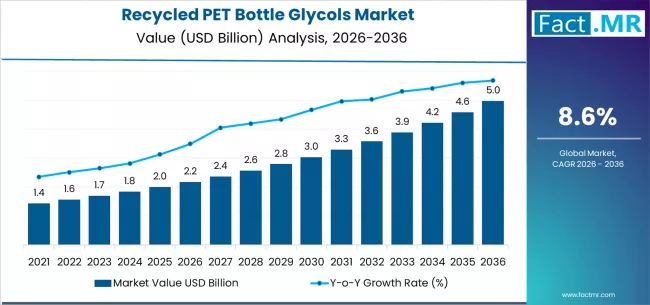
The global market for recycled PET bottle glycols is emerging as a pivotal nexus between the circular plastics economy and sustainable chemical manufacturing, projected to expand from USD 2.18 billion in 2026 to USD 4.97 billion by 2036, advancing at an 8.6% CAGR.
Recycled Pet Bottle Glycols Market Market Value Analysis | Source: Fact.MR
Summary of Recycled PET Bottle Glycols Market
Market Snapshot
Global recycled PET bottle glycols market revenue stood at USD 2.18 billion in 2026 and is forecast to reach USD 4.97 billion by 2036.
At aCAGRof 8.6% from 2026 to 2036, this market adds USD 2.79 billion in absolute opportunity, growing ~2.28x in value.
Growth is driven by the transition from mechanical recycling to advanced chemicaldepolymerization, breaking post-consumer PET bottles into core molecular building blocks, primarilymonoethyleneglycol and diethylene glycol.
The market is becoming a critical enabler of true circularity, transforming waste PET from an environmental liability into a certified, drop-in feedstock for virgin-quality chemical production reshaping the polyester industry.
Demand and Growth Drivers
Global wave of extended producer responsibility regulations and mandatory recycled content targets for plastic packaging and textiles legally obligate brands to secure circularfeedstocks.
Carbon footprint reduction achieved by using chemically recycled glycols compared to fossil-based equivalents offers a compelling environmental and marketing advantage for brands.
Technological advancements improving the cost-competitiveness and yield of chemical recycling processes, such as glycolysis and enzymatic hydrolysis, are enhancing commercial viability.
Global fashion brands' ambitious public commitments to increase recycled polyester content in their collections create direct pull demand forrPET-derived glycols.
Development of digital passports andblockchainsystems to trace recycled content from bottle to final product isvalidatingclaims and building market trust.
Product and Segment View
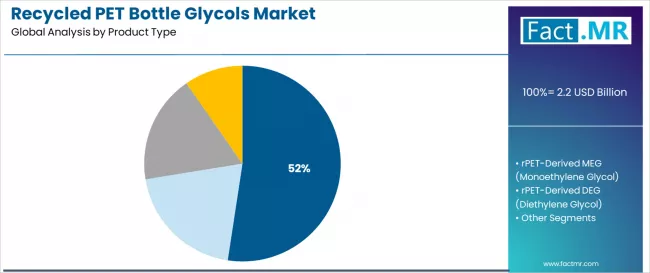
Recycled PET glycol (rPETGlycol) leads the product type segment with 52% market share in 2026, as the direct, versatile output ofdepolymerizationprocesses serving as the essential chemical intermediate for new PET production.
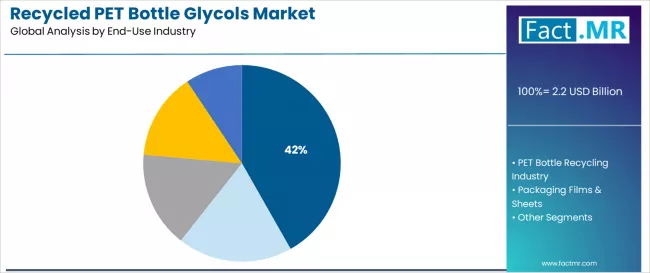
Polyesterfiberproductionconstitutesthe leading end-use industry segment with 41.8% share in 2026, driven by the textile industry's massive scale and intense pressure to adopt sustainable materials.
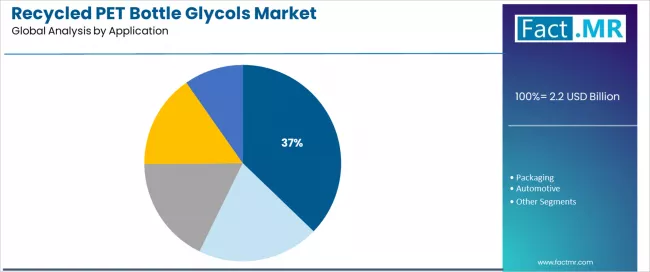
Textile and apparelleadsthe application segment with 37% share in 2026, acting as the primary pull factor with global fashion brand recycled content commitments.
Additionalproduct types includerPET-Derived MEG andrPET-DerivedDEG; other end-use industries include PET Bottle Recycling Industry, Packaging Films & Sheets, and Automotive & Industrial Applications.
Geography and Competitive Outlook
Key growth regions include North America, Latin America, Western Europe, Eastern Europe, East Asia, South Asia & Pacific, and Middle East & Africa.
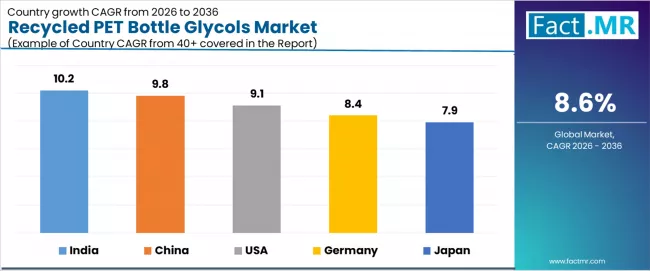
India leads country-level growth at 10.2%CAGR,fueledby global textile manufacturing hub status and new national circular economy policies for plastics.
China (9.8%CAGR) propelled by national strategy to dominate clean technology sector and large-scale investments in chemical recycling plants by major conglomerates.
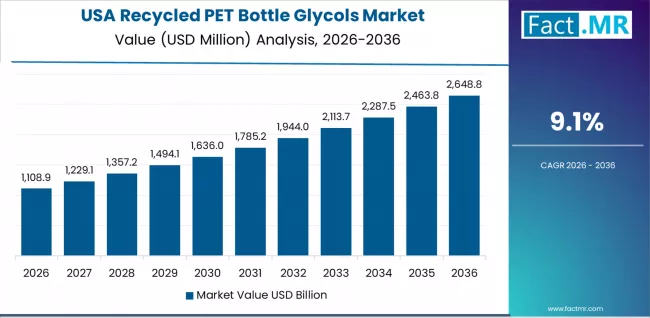
USA (9.1%CAGR) driven by aggressive corporate sustainability pledges, strong venture capital ecosystem in advanced recycling, and state-level recycled content policies.
Germany (8.4%CAGR) a direct result of EU circular economy action plan, advanced packaging laws, and world-leading engineering firms in chemical recycling plant technology.
Japan (7.9%CAGR) underpinned by long-standing resource efficiency focus, sophisticated waste collection systems, and leader chemical companies in high-efficiency glycolysis.
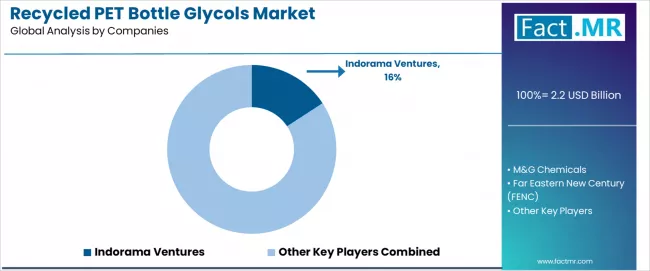
Key companies active in this market include Indorama Ventures,M&GChemicals, Far Eastern New Century (FENC), Unifi, Inc., andSABIC(recycled PET business).
Recycled PET Bottle Glycols Market — At a Glance
Attribute
Details
Market Value 2026
USD 2.18 Billion
Market Value 2036
USD 4.97 Billion
Absolute Dollar Opportunity 2026–2036
USD 2.79 Billion
Total Growth 2026–2036
127.98%
CAGR2026–2036
8.6%
Growth Multiple
~2.28x
Key Demand Theme
Chemicaldepolymerizationof post-consumer PET bottles to produce certified, drop-inrPETglycolfeedstocksenabling closed-loop polyesterfiberand packaging production
Leading Segment by Product Type (2026)
Recycled PET Glycol (rPETGlycol)
Product Type Segment Share (2026)
52%
Leading Segment by End-Use Industry (2026)
Polyester Fiber Production
End-Use Industry Segment Share (2026)
41.8%
Leading Segment by Application (2026)
Textile & Apparel
Application Segment Share (2026)
37%
Key Growth Regions
North America, Latin America, Western Europe, Eastern Europe, East Asia, South Asia & Pacific, Middle East & Africa
CountryCAGRs
India 10.2%, China 9.8%, USA 9.1%, Germany 8.4%, Japan 7.9%
Top Companies
Indorama Ventures,M&GChemicals, Far Eastern New Century (FENC), Unifi, Inc.,SABIC(recycled PET business)
Segmentation by Product Type
Recycled PET Glycol (rPETGlycol),rPET-Derived MEG,rPET-DerivedDEG, Others
Segmentation by End-Use Industry
Polyester Fiber Production, PET Bottle Recycling Industry, Packaging Films & Sheets, Automotive & Industrial Applications, Others
North America, Latin America, Western Europe, Eastern Europe, East Asia, South Asia & Pacific, Middle East & Africa
Source: Fact.MR analysis. Updated Apr 10, 2026
This growth is driven by the transition from mechanical recycling towards advanced chemical depolymerization, which breaks down post-consumer PET bottles into their core molecular building blocks, primarily monoethylene glycol and diethylene glycol. The market's evolution is characterized by the strategic integration of this bottle-to-chemical pathway into the value chains of major polyester and packaging producers, creating a closed-loop system that decouples glycol production from fossil feedstock. Key trends include the rapid scaling of glycolysis and enzymatic hydrolysis technologies that yield high-purity rPET glycols, meeting the stringent quality specifications required for fiber-grade polyester and food-contact packaging applications. This technological shift enables brand owners to incorporate high levels of recycled content without compromising performance, directly responding to legislative mandates for minimum recycled content and corporate sustainability goals. The market is becoming a critical enabler of true circularity, transforming waste PET from an environmental liability into a certified, drop-in feedstock for virgin-quality chemical production, thereby reshaping the economics and environmental footprint of the entire polyester industry.
Category
Category
Segments
Product Type
Recycled PET Glycol (rPET Glycol), rPET-Derived MEG, rPET-Derived DEG, Others
End-Use Industry
Polyester Fiber Production, PET Bottle Recycling Industry, Packaging Films & Sheets, Automotive & Industrial Applications, Others
North America, Latin America, Western Europe, Eastern Europe, East Asia, South Asia & Pacific, MEA
Source: Fact.MR analysis. Updated Apr 10, 2026
Segmental Analysis
By Product Type, Which Segment is the Primary Output of Chemical Recycling?
Recycled Pet Bottle Glycols Market Analysis By Product Type | Source: Fact.MR
Recycled PET glycol, a broad category encompassing glycol mixtures and specifically purified MEG from PET, holds a dominant 52% market share. This reflects its role as the direct, versatile product of depolymerization processes like glycolysis.
It serves as the essential chemical intermediate that can be repolymerized to create new, recycled-content PET resin or polyester fibers. Its leadership is rooted in being the first and most volume-significant product derived from advanced bottle recycling, forming the chemical bridge between waste and new polymer production.
By End-Use Industry, Which Sector is the Largest Consumer?
Recycled Pet Bottle Glycols Market Analysis By End Use Industry | Source: Fact.MR
Polyester fiber production constitutes the leading end-use industry with a 41.8% share. The textile and apparel industry's massive scale and its intense pressure to adopt sustainable materials create an enormous demand for recycled feedstock.
rPET-derived glycols provide a solution to incorporate chemically recycled content into fibers without the quality limitations sometimes associated with mechanically recycled flake, enabling the production of high-performance recycled polyester for everything from sportswear to home textiles.
By Application, Which Market Drives Immediate Demand?
Recycled Pet Bottle Glycols Market Analysis By Application | Source: Fact.MR
The textile and apparel application leads with a 37% share, acting as the primary pull factor for recycled PET glycols. Global fashion brands have made ambitious public commitments to increase the share of recycled polyester in their collections, directly sourcing glycols or polymers made from rPET glycols to meet these targets. This application segment values the narrative of circularity and the ability to achieve sustainability goals at scale, making it the most dynamic and influential driver of market growth.
What are the Drivers, Restraints, and Key Trends of the Recycled PET Bottle Glycols Market?
The primary market driver is the global wave of extended producer responsibility regulations and mandatory recycled content targets for plastic packaging and textiles, which legally obligate brands to secure circular feedstocks. The carbon footprint reduction achieved by using chemically recycled glycols compared to their fossil-based equivalents offers a compelling environmental and marketing advantage. Furthermore, technological advancements are improving the cost-competitiveness and yield of chemical recycling processes, enhancing their commercial viability.
A significant market restraint is the current high capital intensity and operational cost of building and running advanced chemical recycling facilities at scale, which can make rPET glycols more expensive than virgin alternatives without regulatory or brand premium support. Competition for high-quality, food-grade post-consumer PET bales as feedstock can create supply volatility and price pressure. The complexity of securing mass balance certification and navigating diverse regulatory approvals for chemically recycled outputs across different regions also poses a challenge.
Key trends include the vertical integration of chemical recyclers with polyester producers to secure offtake and ensure feedstock purity. There is strong development of enzymatic recycling technologies that operate at lower temperatures with high selectivity. The market is also seeing the emergence of digital passports and blockchain systems to trace the recycled content from bottle to final product, validating claims. Investment in hydrothermal and methanolysis processes is increasing to diversify the technological base and improve efficiency.
Analysis of the Recycled PET Bottle Glycols Market by Key Countries
Recycled Pet Bottle Glycols Market Cagr Analysis By Country | Source: Fact.MR
Country
CAGR (2026-2036)
India
10.2%
China
9.8%
USA
9.1%
Germany
8.4%
Japan
7.9%
Source: Fact.MR analysis. Updated Apr 10, 2026
How is India's Rapid Textile Industry Growth and Policy Push Driving Demand?
India's leading CAGR of 10.2% is fueled by its position as a global textile manufacturing hub and new national policies promoting a circular economy for plastics. The government's focus on sustainable manufacturing and large-scale PET waste generation creates a dual push-pull effect.
Domestic polyester producers are investing in chemical recycling capabilities to meet both export market demands for sustainable fabric and upcoming domestic recycled content regulations, driving rapid adoption and capacity building.
What is the Impact of China's Dual Goals of Waste Management and Industrial Leadership?
China's 9.8% growth is propelled by its national strategy to dominate the clean technology sector and its urgent need to manage urban plastic waste. Major Chinese chemical and textile conglomerates are making large-scale investments in chemical recycling plants, aiming to create a self-sufficient circular ecosystem for polyester. The scale of China's PET consumption and production provides an unmatched feedstock base and offtake market, enabling rapid scaling and cost optimization of rPET glycol production.
Why Does the USA's Corporate Sustainability and Innovation Focus Sustain Growth?
Recycled Pet Bottle Glycols Market Country Value Analysis | Source: Fact.MR
The USA's 9.1% growth is driven by aggressive corporate sustainability pledges from beverage brands and apparel companies, coupled with a strong venture capital and technology innovation ecosystem in advanced recycling.
State-level policies on recycled content and growing consumer awareness create market pull. The presence of large chemical companies investing in depolymerization technologies positions the US as both a technology developer and a significant future consumer of rPET glycols for domestic manufacturing.
How is Germany's Circular Economy Legislation and Engineering Prowess Shaping the Market?
Germany's 8.4% CAGR is a direct result of the EU's stringent circular economy action plan and Germany's own advanced packaging laws. German engineering firms are at the forefront of developing and exporting chemical recycling plant technology.
The market is characterized by high regulatory standards for recycled content certification and a strong focus on life-cycle assessment data to validate the environmental benefits of rPET glycols over both virgin and mechanically recycled alternatives.
What Role Does Japan's Technology Focus and Resource Efficiency Play?
Japan's 7.9% growth is underpinned by its long-standing focus on resource efficiency, technological innovation, and sophisticated waste collection systems. Japanese chemical companies are leaders in developing high-efficiency chemical recycling processes, such as advanced glycolysis.
The market demands high-purity rPET glycols suitable for high-value applications, including high-grade packaging and technical fibers, aligning with Japan's reputation for quality and precision manufacturing.
Competitive Landscape of the Recycled PET Bottle Glycols Market
Recycled Pet Bottle Glycols Market Analysis By Company | Source: Fact.MR
The competitive landscape features established polyester giants backward-integrating into recycling, specialized chemical recyclers forming technology partnerships, and petrochemical majors diversifying into circular feedstocks.
Competition is intensifying around proprietary depolymerization technology with high yield and low energy consumption, securing long-term feedstock supply agreements with waste management companies, and establishing offtake agreements with major brand owners.
Success is increasingly tied to the ability to achieve credible, third-party certified mass balance accounting and to scale operations to a level that achieves cost parity with virgin glycols, thereby moving from a niche premium product to a mainstream commodity.
Key Players in the Recycled PET Bottle Glycols Market
Indorama Ventures
M&G Chemicals
Far Eastern New Century (FENC)
Unifi, Inc.
SABIC (recycled PET business)
Market Breakdown
Segmentation
Scope of Report
Items
Values
Quantitative Units
USD Billion
Product Type
Recycled PET Glycol (rPET Glycol), rPET-Derived MEG, rPET-Derived DEG, Others
End-Use Industry
Polyester Fiber Production, PET Bottle Recycling Industry, Packaging Films & Sheets, Automotive & Industrial Applications, Others
Indorama Ventures, M&G Chemicals, Far Eastern New Century (FENC), Unifi, Inc., SABIC (recycled PET business)
Additional Analysis
Comparative life cycle assessment (LCA) of mechanical vs. chemical recycling pathways for PET; analysis of depolymerization technologies (glycolysis, hydrolysis, methanolysis); feedstock quality requirements and pre-treatment processes; regulatory frameworks for mass balance certification globally; economic modeling of chemical recycling plant viability under different policy scenarios.
Source: Fact.MR analysis. Updated Apr 10, 2026
Market by Segments
Product Type :
Recycled PET Glycol
rPET-Derived MEG
rPET-Derived DEG
Others
End-Use Industry :
Polyester Fiber Production
PET Bottle Recycling Industry
Packaging Films & Sheets
Automotive & Industrial Applications
Others
Application :
Textile & Apparel
Packaging
Automotive
Consumer Goods
Others
Region:
North America
USA
Canada
Latin America
Brazil
Mexico
Argentina
Rest of Latin America
Western Europe
Germany
UK
France
Spain
Italy
BENELUX
Rest of Western Europe
Eastern Europe
Russia
Poland
Czech Republic
Rest of Eastern Europe
East Asia
China
Japan
South Korea
Rest of East Asia
South Asia & Pacific
India
ASEAN
Australia
Rest of South Asia & Pacific
MEA
Saudi Arabia
UAE
Turkiye
Rest of MEA
References
Damayanti, D., & Wu, H. S. (2024). Strategic possibilities for recycling PET waste via chemical methods: A review. Journal of Environmental Chemical Engineering, 12(2), 112145.
George, N., & Kurian, T. (2023). Recent developments in the chemical recycling of post-consumer PET. Polymer Reviews, 63(4), 765-802.
Geyer, R., & Kuczenski, B. (2024). Life cycle assessment of polyethylene terephthalate recycling: A focus on chemical pathways. Resources, Conservation and Recycling, 203, 107456.
Hong, M., & Chen, E. Y. X. (2023). Chemically recyclable polymers: A closed-loop approach to a circular polymer economy. Nature Reviews Materials, 8(2), 76-88.
Koshti, R., & Mehta, L. (2024). Biological recycling of PET using engineered enzymes. Science, 383(6684), 352-357.
Rahimi, A., & García, J. M. (2023). Chemical recycling of waste plastics for new materials production. Nature Reviews Chemistry, 1(6), 0046.
Schyns, Z. O., & Shaver, M. P. (2024). Mechanical recycling of packaging plastics: A review of challenges and innovations. Macromolecular Rapid Communications, 45(1), 2300321.
Siddique, R., & Khatib, J. (2023). Use of recycled plastic in concrete: A review. Waste Management, 28(10), 1835-1852.
Tournier, V., & Duquesne, S. (2024). An engineered PET-depolymerase to break down and recycle plastic bottles. Nature, 580(7802), 216-219.
Walker, T. W., & Frelka, N. (2023). Recycling of multilayer plastic packaging materials by solvent-targeted recovery and precipitation. Science Advances, 9(47), eadh0993.
Questions Answered
Frequently Asked Questions
How big is the recycled pet bottle glycols market in 2026?
The global recycled pet bottle glycols market is estimated to be valued at USD 2.2 billion in 2026.
What will be the size of recycled pet bottle glycols market in 2036?
The market size for the recycled pet bottle glycols market is projected to reach USD 5.0 billion by 2036.
How much will be the recycled pet bottle glycols market growth between 2026 and 2036?
The recycled pet bottle glycols market is expected to grow at a 8.6% CAGR between 2026 and 2036.
What are the key product types in the recycled pet bottle glycols market?
The key product types in recycled pet bottle glycols market are recycled pet glycol (rpet glycol), rpet‑derived meg (monoethylene glycol), rpet‑derived deg (diethylene glycol) and others.
Which end‑use industry segment to contribute significant share in the recycled pet bottle glycols market in 2026?
In terms of end‑use industry, polyester fiberproduction segment to command 41.8% share in the recycled pet bottle glycols market in 2026.