- Forecast Value (2035): 3285.0 Mn
- CAGR (2035): 9.2%
Pet Fur Remover Market Outlook 2025 to 2035
The global pet fur remover market is forecast to reach USD 3,285.0 million by 2035, up from USD 1,362.4 million in 2025. During the forecast period, the industry is projected to register at a CAGR of 9.2%. People are buying more versatile, comfortable devices that can be used on furniture, clothes, and inside cars.
On the other hand, brands want designs and materials that are better for the environment. Niche businesses and specialized companies have grown stronger thanks to online shopping and marketing directly to customers.
Quick Stats on Pet Fur Remover Market
- Pet Fur Remover Market Size (2025): USD 1,362.4 million
- Projected Pet Fur Remover Market Size (2035): USD 3,285.0 million
- Forecast CAGR of Pet Fur Remover Market (2025 to 2035): 9.2%
- Leading Material Segment of Pet Fur Remover Market: Rubber
- Leading Power Type Segment of Pet Fur Remover Market: Manual
- Key Growth Regions of Pet Fur Remover Market: United States, China, Germany
- Prominent Players in the Pet Fur Remover Market: Delomo, EverCare, Bissell, Chom Chom, Lily Brush
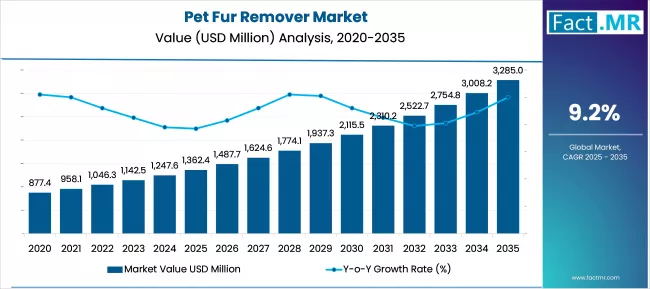
Pet Fur Remover Market Market Value Analysis | Source: Fact.MR
| Metric | Value |
|---|---|
| Industry Size (2025E) | USD 1362.4 million |
| Industry Size (2035F) | USD 3,285.0 million |
| CAGR (2025-2035) | 9.2% |
Source: Fact.MR analysis. Updated Sep 15, 2025
The pet fur remover market is expected to expand significantly from USD 1,362.4 million in 2025 to USD 3,285.0 million by 2035, progressing at a CAGR of 9.2%. By 2030, the market is projected to reach around USD 2,117.8 million, representing a strong mid-decade milestone.
The CAGR from 2025 to 2030 is calculated at 9.2%, while the growth rate from 2030 to 2035 remains steady at 9.2%, showing consistency across both halves of the forecast period. This balanced progression highlights that the market trajectory is not front-loaded but supported by a steady demand curve.
Pet ownership trends, particularly in urban households, play a central role in sustaining this expansion. Increased awareness of home hygiene, coupled with the prevalence of allergies linked to fur, is encouraging households to invest in efficient cleaning tools.
The rising adoption of reusable rollers, vacuum-based fur removers, and eco-friendly lint solutions has created a competitive environment where product differentiation relies on design ease, material durability, and cleaning effectiveness.
With consumers seeking long-lasting solutions, manufacturers are focusing on ergonomic designs and multi-surface compatibility. By 2030, when the industry size reaches USD 2,117.8 million, the demand will largely be influenced by middle-income households in North America, Europe, and Asia Pacific.
The CAGR of 9.2% between 2025 and 2030 demonstrates the accelerating momentum in the first half of the forecast, while the same CAGR between 2030 and 2035 reinforces the stability of demand into the longer horizon. By 2035, the market size at USD 3,285.0 million reflects both the growing population of pet owners and the normalization of fur-removal tools as everyday household essentials.
Analyzing Key Dynamics of the Global Pet Fur Remover Market
The pet fur remover industry is evolving as consumer expectations shift toward greater convenience, functionality, and affordability. With a growing base of pet owners across both developed and emerging regions, the category has gained recognition as an essential household necessity rather than a discretionary purchase.
Beyond pet care, the sector also intersects with broader home cleaning solutions, making its relevance even stronger in the global market. Yet, growth in this space is not free from challenges.
Factors such as raw material fluctuations, consumer price sensitivity, and counterfeit product circulation have created barriers that require strategic responses from brands. Below, key drivers and obstacles shaping this industry are explored in detail.
Rising Pet Adoption Across Demographics
The surge in pet ownership across age groups, including younger millennials and older consumers, has driven consistent demand for fur-removing solutions. As pets are increasingly treated as family members, maintaining cleanliness within shared living spaces has become a priority.
This demographic expansion has created opportunities for diverse products, ranging from manual brushes to advanced motorized devices. Manufacturers have responded with tailored solutions for households with multiple pets, reinforcing the long-term role of fur removers in daily routines.
Cultural acceptance of pets in urban and suburban areas has also contributed to a broadening customer base. Households with limited space or shared accommodations are seeking compact yet efficient cleaning products to ensure hygienic living.
This shift in ownership behavior ensures that pet fur removers are no longer confined to niche buyers but represent mainstream utility purchases, contributing to sustained revenue generation in both online and offline retail channels.
Innovation in Cleaning Technologies
The sector has benefited from product design improvements that enhance usability and efficiency. From self-cleaning rollers to dual-action brushes and vacuum-compatible attachments, new technologies have expanded the appeal of fur removers.
These innovations reduce the effort required by consumers while delivering better results across surfaces like upholstery, carpets, and bedding. Such variety has strengthened brand positioning while enabling premium pricing opportunities.
Integration of multi-surface functionality has allowed a single product to address multiple pain points within a household. With the inclusion of washable components and environmentally conscious designs, consumer preference has tilted toward higher-quality offerings. These upgrades not only encourage repeat purchases but also foster brand loyalty, creating an environment where innovation remains a primary competitive lever.
Expansion of E-commerce Distribution
The increasing dominance of e-commerce platforms has played a vital role in expanding access to pet fur removers. Online retailers provide greater visibility for both established and emerging brands, offering consumers a wide range of price points and product styles. Digital channels also provide the advantage of customer reviews and comparison shopping, making them highly influential in shaping purchase decisions.
Global shipping capabilities have further enabled small and medium-scale brands to penetrate international markets. Subscription-based pet supply services and promotional bundling strategies have amplified exposure for fur-removal tools. The convenience of doorstep delivery, coupled with strong discount campaigns, has significantly bolstered the reach of this product category across diverse geographies.
Intense Price Competition
The entry of numerous low-cost manufacturers has resulted in heavy price competition within the sector. With several brands targeting similar demographics, the pressure to maintain competitive retail prices often erodes margins. Consumers frequently compare options online, leading to price-driven decisions rather than loyalty to a particular brand. This limits the ability of premium players to justify higher costs without clear product differentiation.
Discount-led competition has also undermined innovation-driven companies, as many buyers lean toward affordable alternatives that meet basic functionality. Such dynamics force established brands to continuously recalibrate their pricing and promotional strategies, creating challenges in sustaining profitability while meeting consumer expectations.
Fluctuating Raw Material Costs
The reliance on plastics, fabrics, and adhesives in production has exposed the sector to fluctuations in raw material pricing. Volatility in oil-derived polymers and textile components has led to unstable manufacturing expenses, which can be difficult to pass on to consumers in competitive retail environments. Manufacturers are left balancing input costs with pricing strategies that maintain market share.
This challenge is particularly pronounced for smaller players with limited supply chain leverage. Inconsistent access to raw materials also creates production delays, directly impacting fulfillment cycles and distributor relationships. As global supply chains remain unpredictable, the ability to manage procurement efficiently has become a critical success factor in this market.
Prevalence of Counterfeit Products
Unauthorized copies and counterfeit fur removers have grown significantly across both online and offline retail channels. These products, often priced at a fraction of branded solutions, erode consumer trust and disrupt legitimate market growth. Counterfeits typically compromise on durability and performance, leading to dissatisfaction that indirectly impacts brand reputation for authentic players.
E-commerce platforms have become particularly vulnerable to counterfeit circulation due to lax enforcement mechanisms in certain regions. Established companies are compelled to invest in authentication measures, packaging safeguards, and legal enforcement to curb imitation products. The persistence of this issue adds complexity to brand management and heightens the cost of protecting intellectual property.
Regional Trends of the Pet Fur Remover Market
North America remains the leading region for pet fur removers, supported by high pet ownership rates and strong consumer attachment to pets as family members. The United States leads global sales, driven by the availability of modern and eco-friendly fur removal tools across online and offline channels. Canada follows with rising awareness of home hygiene and growing access to premium-quality products, reinforcing the region’s leadership.
In Europe, demand is centered on durable, chemical-free, and environmentally conscious solutions, with the United Kingdom, Germany, and France at the forefront. The expansion of e-commerce and specialty pet retailers has broadened access to innovative products and strengthened regional growth prospects.
Asia Pacific has emerged as the fastest-growing market, with rising pet adoption in urban centers and increasing disposable incomes fueling sales. China, Japan, and Australia represent the largest demand centers, with consumers showing preference for multifunctional and technologically advanced fur removal devices.
Online shopping platforms enable small and mid-sized brands to compete effectively with established players, driving product visibility and category penetration.
In Latin America, Brazil and Mexico dominate sales as the expanding middle class embraces pet hygiene products. Growth is supported by the rise of specialty pet outlets and digital platforms, with consumer preference concentrated on mid-range products that balance affordability and quality.
Country-Wise Outlook
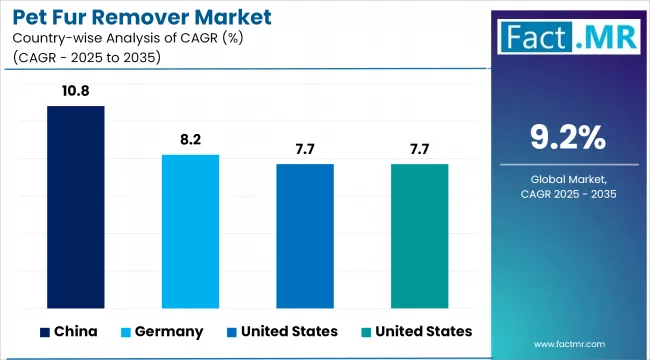
Pet Fur Remover Market Cagr Analysis By Country | Source: Fact.MR
| Countries | CAGR (2025-2035) |
|---|---|
| United States | 7.7% |
| China | 10.8% |
| Germany | 8.2% |
Source: Fact.MR analysis. Updated Sep 15, 2025
Urban Pet Owners Drive Demand for Smart Grooming Solutions in the United States
Urban and suburban households with pets are driving demand for grooming tools that remove fur while reducing allergens. Strong retail coverage across specialty stores, big-box chains, and online platforms supports both low-cost rollers and premium vacuum-integrated devices. Safety claims and trusted branding play a decisive role in purchase behavior, with established companies leveraging cause-driven campaigns to strengthen consumer loyalty.
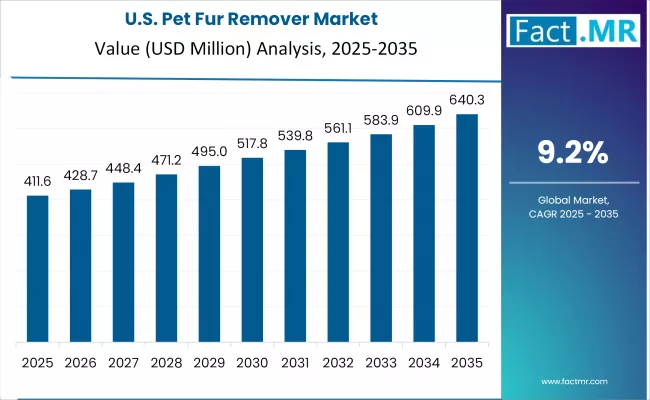
Pet Fur Remover Market Country Value Analysis | Source: Fact.MR
Subscription-based consumables and connected grooming ecosystems present untapped opportunities, as buyers increasingly prefer multifunctional products that combine durability with features such as dander control. Retail promotions and bundled offerings encourage trial, while smaller brands accelerate growth through influencer-driven campaigns.
Although regulatory standards remain moderate, transparency on safety and materials is expected, particularly by younger demographics who favor reusable and recyclable designs. Cordless and lightweight electric solutions stand out, with warranties and after-sales service emerging as key differentiators in purchase decisions.
- Subscription and connected ecosystems create recurring revenue opportunities
- Younger buyers show strong preference for recyclable and reusable designs
- Warranty and after-sales service remain key competitive differentiators
Rising Urban Pet Ownership Accelerates E-Commerce Grooming Sales in China
Rapid urbanization and rising pet adoption provide a strong base for demand in grooming and cleaning devices. E-commerce platforms and live-streaming demos have become vital channels, enabling quick product launches, real-time feedback, and fast adoption cycles.
While price sensitivity exists, a premium segment for high-performance and imported devices is clearly visible, with local innovators replicating features at lower cost. Influencers play a significant role in shaping preferences, while cross-border access to trusted brands adds to product diversity.
Most distribution is concentrated in major markets, but social commerce platforms are gaining traction as discovery and sales channels. Regulatory attention on product labeling and safety is intensifying, requiring brands to maintain compliance while competing aggressively.
Success in this environment depends on rapid product rollout, targeted messaging, and efficient logistics. Partnerships with pet-service chains and grooming salons further enhance adoption by creating experiential exposure to new products.
- E-commerce and live-streaming demos speed up consumer adoption
- Cross-border access strengthens premium and imported product demand
- Regulatory scrutiny on labeling and safety is rising across markets
Affordable, Durable, and Eco-Friendly Grooming Penetrates Smaller Cities in Germany
As pet ownership rises across both metropolitan and tier-2 cities, demand for affordable fur removal tools is expanding quickly. Buyers emphasize strength, ease of use, and multipurpose functionality when choosing products.
E-commerce platforms have enabled brands to reach semi-urban and rural households, though neighborhood pet stores and small retail outlets remain important distribution points. Price competitiveness and durability continue to influence purchase priorities in these segments.
Regulatory frameworks for smaller cleaning tools remain under development, but consumers increasingly scrutinize safety and material disclosures online. Domestic manufacturers leverage localized production advantages to compete effectively on pricing.
Growing awareness of environmental concerns creates opportunities for eco-friendly product lines, particularly those designed with reusable and recyclable components. Brands that successfully balance affordability with sustainability and durability are positioned to capture growth outside major metropolitan centers.
- Domestic players benefit from localized production and cost advantage
- Price and durability remain primary buying factors in smaller cities
- Eco-friendly product lines offer new growth opportunities outside metros
Competitive Analysis
The pet fur remover market has a mix of global appliance makers, specialty pet brands, and a lot of companies that sell directly to consumers. Big brands of household and vacuum cleaners compete with companies that only make pet-care products. Many niche brands only make certain types of tools, like rollers, brushes, and powered hand vacuums.
These companies are different in terms of where sell their products, what they focus on in research and development, and how much price their products. Brand trust and after-sales networks help well-known vacuum and appliance makers sell more expensive attachments and options that come with their products.
Key Players in the Market
- Delomo
- EverCare
- Bissell
- Chom Chom
- Lily Brush
- Brellavi
- Analin Mini
- Gonzo Corp
- OXO
- Fur Magic
- DELOMO
- FURemover
- Furrfighters
- Alpha Paw
- HankPets
- Other Players
Recent Developments
- In March 2025, The American Pet Products Association released its 2025 State of the Industry and Dog & Cat reports highlighting ownership trends and purchasing behaviour that underpin demand for pet care and cleaning products. This is a major industry reference for 2024 to 2025 market direction.
- In April 2025, A major vacuum and pet-care brand announced new stick vacuum models explicitly positioned against seasonal shedding with features tailored to pet hair capture, a commercially significant launch for the fur removal device category in 2025.
Segmentation
Analyzing the Reusable Pet Fur Market by Key Segments
The pet fur remover market is defined not only by rising consumer demand but also by clear distinctions across materials, product types, power options, and sales channels.
Each factor shapes purchasing decisions, growth patterns, and competitive positioning within the industry. Material innovations are enhancing product durability and sustainability, while product variety reflects the balance between affordability and convenience.
Power choices highlight the trade-off between cost and multifunctionality, and distribution channels continue to evolve as e-commerce accelerates adoption. Together, these dimensions illustrate how the market is diversifying and where companies can capture long-term value.
Reusable Rubber and Silicone Tools Lead Demand with Lasting Durability
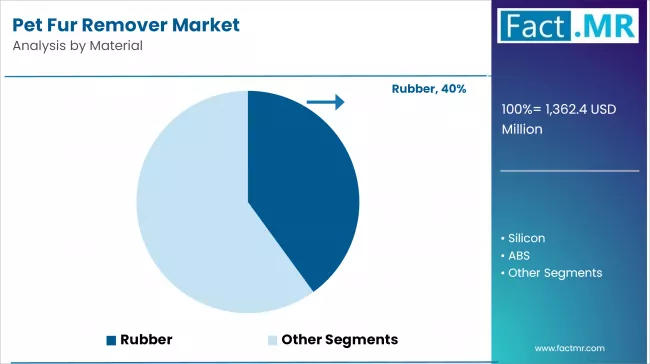
Pet Fur Remover Market Analysis By Material | Source: Fact.MR
The materials used affect stiffness, durability, and performance across surfaces. Rubber and silicone options are flexible, reusable, and gentle on furniture, while ABS supports structural strength for powered devices. Product designers often combine soft elastomers for contact points with harder plastics for mounts and cores.
Reusable rubber and silicone tools remain the most attractive subsegment due to their cleaning efficiency, long lifespan, and cost-effectiveness. These materials also support sustainability by reducing waste through repeated use. ABS continues to play a critical role in battery-powered devices and mechanical components.
- Rubber and silicone tools dominate demand as they balance reusability, durability, and surface compatibility.
- ABS materials are critical for powered and structural components, supporting device reliability.
- Sustainability and waste reduction are key drivers favoring reusable rubber and silicone solutions
Manual Rollers Dominate by Volume While Vacuums Win on Convenience
The market offers diverse product types, including manual rollers, grooming gloves, vacuum-integrated tools, fur zappers, and specialty sponges or stones. Rollers and brushes create friction to capture hair, while gloves groom directly. Vacuum-based devices are designed for deep cleaning and embedded fur removal.
Manual rollers and brushes remain the largest segment by unit volume, supported by affordability and impulse-driven purchases. However, vacuum-enabled solutions are the fastest-growing by value, as consumers increasingly pay for efficiency and convenience in fur removal.
- Manual rollers and brushes capture the largest unit sales, appealing to cost-sensitive buyers
- Vacuum-integrated devices are the fastest-growing category, driven by consumer preference for convenience
- Niche tools such as grooming gloves and fur zappers address specialized cleaning needs
Manual Tools Lead in Volume While Battery Options Capture Value Through Convenience
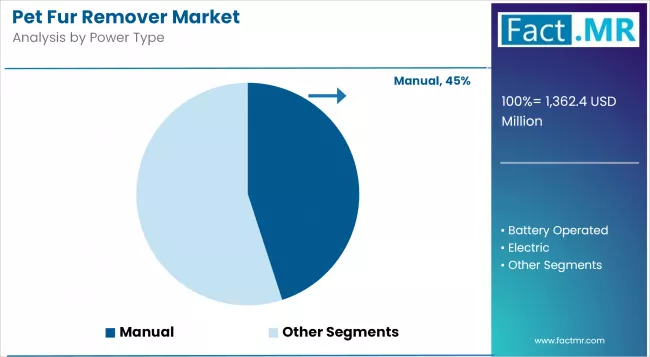
Pet Fur Remover Market Analysis By Power Type | Source: Fact.MR
Power options are divided into manual, battery-operated, and mains-electric devices. Manual tools dominate entry-level demand due to low cost and ease of use. Battery and mains-powered devices appeal to consumers seeking multifunctionality, offering suction and agitation for deeper cleaning.
By volume, manual tools remain the clear leader, reflecting their affordability and accessibility. Battery-operated devices, however, generate greater value as they are portable, cordless, and suited for modern lifestyles, positioning them as the premium growth category.
- Manual devices dominate by unit sales due to their affordability and simplicity
- Battery-operated solutions generate higher revenue by combining portability and advanced features
- Mains-powered devices maintain niche demand where continuous power and heavy-duty cleaning are required
Offline Retail Drives Volume While Online Channels Accelerate Through Convenience and Subscriptions
Offline retail remains essential, particularly through supermarkets, hypermarkets, and specialty pet stores that encourage impulse purchases and gift buying. These outlets create strong brand visibility, especially for mass-market products.
E-commerce is rapidly reshaping the channel landscape, offering consumers broader assortments, transparent reviews, and competitive price comparisons. Direct-to-consumer and third-party platforms also enable subscription models for consumables and refills, accelerating long-term engagement.
- Offline stores dominate by unit sales, especially for impulse-driven and replacement purchases
- Online channels are the fastest growing, supported by convenience, reviews, and subscription models
- Specialty stores and supermarkets enhance brand awareness, while direct brand stores capture higher margins
Segmentation of Pet Fur Remover Market
-
By Material :
- Rubber
- Silicon
- ABS
-
By Product Type :
- Brush
- Roller
- Glove
- Comb
- Vacuum Enabled Devices
- Fur Zapper
- Stone
- Sponge
-
By Application Type :
- Pets
- Dogs
- Cats
- Others
- Bed Sheets
- Carpet
- Couches
- Car Seat
- Clothes
-
By Power Type :
- Manual
- Battery operated
- Electric
-
By Sales Channel :
- Offline
- Pet Specialty Stores
- Supermarkets and Hypermarkets
- Convenience Stores
- Others
- Online
- Direct Sales
- Third Party E-Commerce Sales
-
By Region :
- North America
- Latin America
- Western Europe
- Eastern Europe
- East Asia
- South Asia & Pacific
- Middle East & Africa
Who worked on this report


Preview the report firsthand - request a free sample
Free SampleGet the brochure for pricing and purchase details
Download PDF