- Market Value (2025): USD 280 Mn
- Estimated Value (2026): USD USD 310 Mn
- Forecast Value (2036): USD 849 Mn
- CAGR (2026-2036): 10.6%
What is the Recycled PET Chain Extender Additives Market forecast to be worth by 2036?
USD 310 million in 2026 to USD 849 million by 2036, at 10.6% CAGR.
- The recycled PET chain extender additives market reached USD 280.3 million in 2025.
- Demand is projected to increase from USD 310 million in 2026 to USD 849 million by 2036.
- The market is expected to expand at 10.6% CAGR from 2026 to 2036.
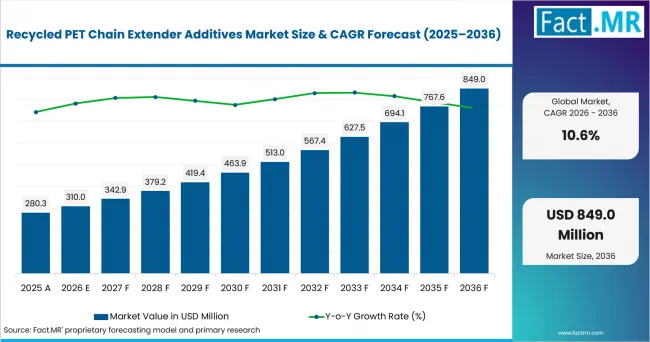
Recycled Pet Chain Extender Additives Market Value Analysis | Source: Fact.MR
What are the defining numbers behind Recycled PET Chain Extender Additives Market growth?
- USD 539 million in absolute opportunity is expected between 2026 and 2036.
- The Epoxy-functional (styrene-acrylic) category accounts for 47.0% of Chemistry in the recycled PET chain extender additives market in 2026, equivalent to USD 145.7 million.
- The Bottle-to-bottle rPET category accounts for 38.0% of Application in the recycled PET chain extender additives market in 2026.
- The Pellet/masterbatch category accounts for 63.0% of Form in the recycled PET chain extender additives market in 2026.
- Demand Drivers in the Market
- EU recycled-content requirements for PET bottles are increasing the volume of rPET processed for bottle applications. Chain extenders are used where recycled resin needs molecular-weight or melt-strength recovery for the intended conversion process.
- Brand-owner recycled-content commitments are increasing bottle-to-bottle rPET use, supporting demand for chain extenders that help maintain strength, clarity and processing stability as recycled-resin ratios rise.
- Repeated heat, moisture exposure and remelting can reduce recycled PET molecular weight, intrinsic viscosity and melt strength. Chain extenders are used when processors need to restore conversion performance for the intended application.
- Expansion of mechanical-recycling infrastructure in Asia-Pacific, particularly in South Korea and Japan, where advanced sorting and washing lines producing higher-quality rPET flake create a growing addressable volume for chain-extender additives at the pelletization stage.
- Technical advancements in epoxy-functional and anhydride-based chain-extender chemistry enabling lower dosage rates, faster reaction kinetics, and compatibility with a broader range of rPET feedstock sources including colored and mixed-stream bottle flake.
- Key Segments Analyzed
- By Chemistry: The Epoxy-functional (styrene-acrylic) category is projected to account for 47.0% of the recycled PET chain extender additives market in 2026. Epoxy-functional grades react with PET end groups and are available in practical additive and masterbatch forms.
- By Application: The Bottle-to-bottle rPET category is projected to account for 38.0% of the recycled PET chain extender additives market in 2026. Bottle-to-bottle recycling requires controlled melt strength, viscosity and clarity through repeated processing.
- By Form: The Pellet/masterbatch category is projected to account for 63.0% of the recycled PET chain extender additives market in 2026. Pellet and masterbatch formats simplify dosing, handling and dispersion at the recycling or compounding line.
- Analyst Opinion at Fact.MR
- Fact.MR opines, "A chain extender is selected against a resin problem, not against recycled content in the abstract. Processors need to know the starting intrinsic viscosity, contamination profile and end-use requirement before setting chemistry and dosage. Masterbatch formats reduce handling friction, while food-contact applications add a separate documentation and process-control burden." - Shambhu Nath Jha, Principal Consultant at Fact.MR.
- Strategic Implications
- Additive companies with application-specific food-contact documentation can compete more effectively in bottle-to-bottle use, where resin consistency and process control are closely scrutinized.
- The increasing diversity of rPET feedstock - from clear mono-stream bottle flake to mixed-color and tray-including streams - is creating demand for chain-extender formulations with broader contaminant tolerance.
- Pellet-format chain extenders will continue gaining share over powder forms as rPET operations automate additive-dosing, favoring suppliers delivering consistent pellet geometry and dust-free handling.
- Deposit-return scheme expansion in EU and select US states will increase volume and quality of collected PET bottles, expanding total demand for chain extenders at the pelletization stage.
- Chemical recycling emergence creates competitive pressure where chain-extender-enhanced mechanical rPET must demonstrate cost and carbon-footprint advantages against chemically recycled PET.
How does theRecycled PET Chain Extender Additives Market break down by segment?
Why does the Epoxy-functional (styrene-acrylic) category lead Chemistry?
In 2026, the Epoxy-functional (styrene-acrylic) category is projected to account for 47.0% of Chemistry within the recycled PET chain extender additives market.
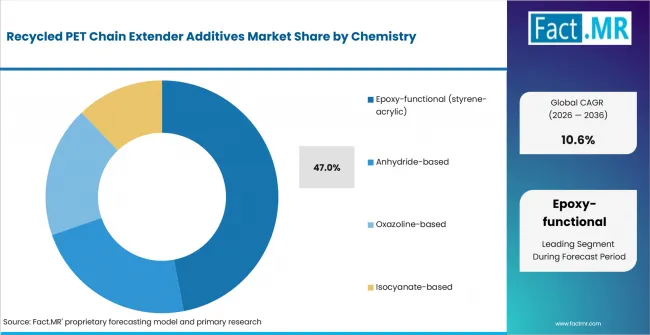
Recycled Pet Chain Extender Additives Market Analysis By Chemistry | Source: Fact.MR
Multifunctional epoxy groups can react with carboxyl and hydroxyl end groups created as PET degrades during use and reprocessing. The reaction can rebuild molecular weight and improve melt strength during extrusion.
Application performance depends on dosage, residence time, moisture control and the condition of the recycled feedstock. Anhydride, oxazoline and isocyanate chemistries serve narrower processing windows where a different reaction profile is required.
Why does the Bottle-to-bottle rPET category lead Application?
Within Application, the Bottle-to-bottle rPET category is projected to hold a 38.0% share in the recycled PET chain extender additives market in 2026.
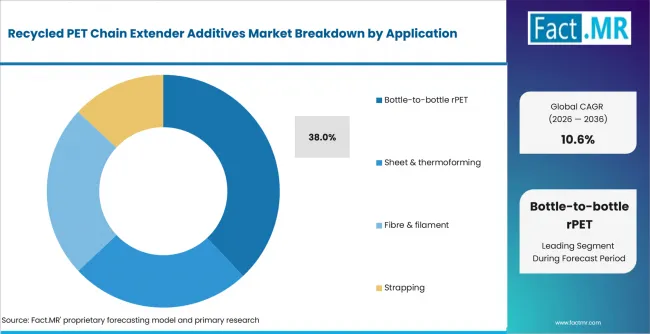
Recycled Pet Chain Extender Additives Market Analysis By Application | Source: Fact.MR
Bottle-to-bottle processing places tight demands on viscosity, clarity and mechanical consistency after collection, washing and remelting. Chain extension can help processors manage degradation when recycled resin returns to demanding preform and bottle applications.
The additive cannot compensate for poor sorting or decontamination, so qualification remains tied to the complete recycling process. Sheet, fiber and strapping applications may accept a wider property range, which changes both dosage and value expectations.
Why does the Pellet/masterbatch category lead Form?
The Pellet/masterbatch category is expected to represent 63.0% of Form within the recycled PET chain extender additives market in 2026.
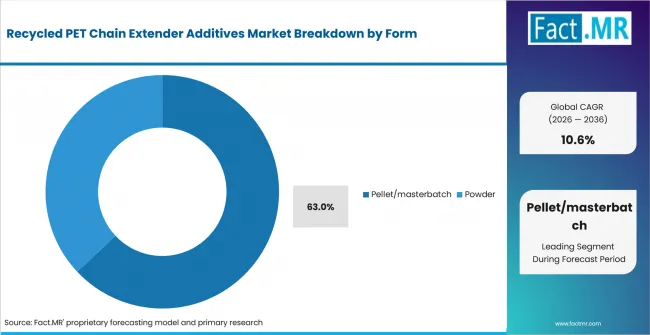
Recycled Pet Chain Extender Additives Market Analysis By Form | Source: Fact.MR
Pellet and masterbatch formats place the reactive chemistry in a carrier that supports controlled feeding and dispersion. This can simplify plant handling when additive doses are low and production lines run continuously.
Powder grades offer direct formulation flexibility and may suit experienced compounders, but they require reliable gravimetric feeding and dust control. The preferred form therefore reflects the recycler's equipment and quality-control capability.
What is accelerating Recycled PET Chain Extender Additives Market adoption, and what is holding it back?
Adoption is being driven by recycled-content rules and brand commitments, while virgin-PET price competition, approval uncertainty and chemical-recycling alternatives can limit demand.
Drivers Impact Analysis
| Driver | (~) % Impact on CAGR | Geographic Relevance | Impact Timeline |
|---|---|---|---|
| EU recycled-content requirements for PET bottles | +1.2% | EU/EEA | Near term |
| Brand-owner recycled-content commitments | +0.9% | Global (brand-driven) | Near term |
| Expansion of mechanical-recycling capacity in Asia-Pacific | +0.8% | South Korea, Japan, SE Asia | Mid term |
| Next-gen chain-extender chemistry improving dosage efficiency | +0.6% | Global | Mid term |
Opportunity Impact Analysis
| Opportunity | (~) % Impact on CAGR | Geographic Relevance | Impact Timeline |
|---|---|---|---|
| Deposit-return scheme expansion improving rPET feedstock quality | +1.0% | EU, select US states | Mid term |
| Chain-extender formulations for mixed-stream and colored rPET | +0.8% | Global | Long term |
| Closed-loop brand-to-bottle take-back programs | +0.7% | Western Europe, Japan | Long term |
Restraints Impact Analysis
| Restraint | (~) % Impact on CAGR | Geographic Relevance | Impact Timeline |
|---|---|---|---|
| Price competition from virgin PET when crude-oil prices are low | -0.6% | Global | Near term |
| Regulatory uncertainty in Asian food-contact approvals | -0.4% | South and SE Asia | Mid term |
| Chemical-recycling capacity offering rPET alternative without chain extenders | -0.5% | EU, North America | Long term |
Which countries are scaling the Recycled PET Chain Extender Additives Market through 2036?
- South Korea: South Korea's mechanical-recycling infrastructure and packaging-waste regulation support demand for rPET chain extender additives. The Korean Ministry of Environment's recycled-content targets for PET bottles and the country's collection infrastructure support rPET use. Domestic converters serving the bottled-water and beverage sectors use chain extenders in bottle-to-bottle rPET production.
- United States: The United States market is shaped by brand-owner commitments rather than federal mandates, with beverage companies driving rPET procurement at a scale that supports chain-extender use outside the EU. The fragmented nature of US recycling infrastructure means that rPET quality varies significantly by region, creating demand for chain-extender formulations capable of processing a wider range of feedstock quality. State-level recycled-content mandates in California, Washington, and New Jersey are beginning to convert brand-owner voluntary targets into regulatory requirements.
- Germany: Germany combines established packaging collection with PET recycling and conversion capacity. Recyclers use chain extension to manage viscosity and melt-strength variation as recovered resin moves into bottle, sheet and fiber applications.
- Netherlands: Mechanical recyclers, PET collection systems and the country's logistics role support rPET flake and pellet activity. Chain extenders are evaluated when processors need to recover molecular weight or melt strength for higher-specification applications. Dutch circular-economy targets also support market activity.
- Italy: Italy's rPET chain extender market is supported by PET bottle-grade recycling through COREPLA, its national packaging-waste consortium, and recycling targets embedded in Italian packaging regulation. Italian converters serving the mineral-water and beverage sectors have invested in rPET processing lines incorporating chain-extender dosing.
- Japan: Japan's PET bottle collection system, bottle-to-bottle recycling infrastructure operated by JCPRA and voluntary industry targets support the rPET chain extender market. Japanese converters operate to quality standards requiring consistent intrinsic-viscosity restoration, creating applications for chain extenders. Chain extenders are also evaluated in sheet and thermoforming, where rPET food trays replace virgin PET.
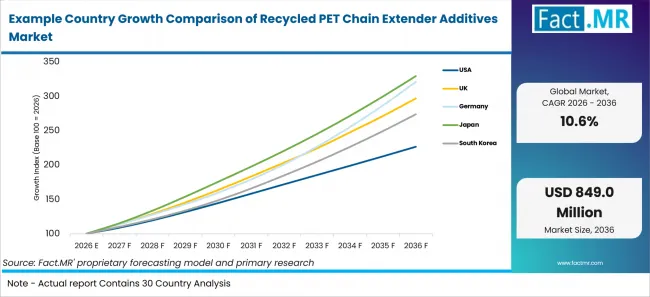
Example Country Growth Comparison Of Recycled Pet Chain Extender Additives Market | Source: Fact.MR
| Country | 2026 Share | CAGR (2026-2036) |
|---|---|---|
| South Korea | 23.0% | 13.1% |
| United States | 20.0% | 11.0% |
| Germany | 16.0% | 10.2% |
| Netherlands | 15.0% | 10.9% |
| Italy | 13.0% | 10.4% |
| Japan | 13.0% | 10.3% |
What is driving South Korea's growth through 2036?
The market in South Korea is projected to expand at a 13.1% CAGR from 2026 to 2036.
South Korea's PET collection and recycling investment supports bottle-to-bottle and higher-value conversion routes. Chain extenders are used when processors need to manage viscosity and melt-strength variation across recovered feedstock lots.
What is driving growth in the United States through 2036?
From 2026 to 2036, demand in the United States is forecast to grow at an 11.0% CAGR.
The United States combines a beverage and thermoforming base with uneven collection quality and state-level recycled-content requirements. That mix creates demand for reactive additives that help processors stabilize recycled PET for bottle, sheet and fiber applications.
What is driving Germany's growth through 2036?
Germany is expected to record a 10.2% CAGR between 2026 and 2036.
Germany's deposit-return and sorting infrastructure supplies relatively consistent PET bottle streams to recyclers. Chain extension remains relevant when repeated heat history or contamination causes viscosity loss before bottle, sheet or fiber conversion.
What is driving growth in the Netherlands through 2036?
Demand in the Netherlands is forecast to rise at a 10.9% CAGR from 2026 to 2036.
The Netherlands links deposit-return collection with a broader circular-packaging agenda and cross-border resin trade. Recyclers and converters use chain extenders to widen the usable range of recovered PET while maintaining process stability.
What is driving Italy's growth through 2036?
A 10.4% CAGR is projected for Italy from 2026 to 2036.
Italy's packaging-conversion base and consortium collection system support recycled PET use in bottles, sheet and other formats. Additive selection depends on the feedstock condition, processing route and the mechanical properties required after remelting.
What is driving Japan's growth through 2036?
Between 2026 and 2036, Japan is projected to post a 10.3% CAGR.
Japan has an organized PET bottle collection and recycling system with an emphasis on material quality. Processors evaluate chain extenders for application-specific viscosity recovery, especially when recycled resin is returned to bottle or thermoforming production.
Who leads the Recycled PET Chain Extender Additives Market?
The supplier set spans reactive-additive producers, masterbatch specialists and companies with broader polymer-processing portfolios. BASF, Clariant, Avient and Sukano provide chain-extension or application-support offerings for recycled polymers. Dow and SABIC participate through adjacent polymer-additive or resin-processing capabilities rather than dedicated rPET chain-extender portfolios.
Avient and Sukano compete through additive and masterbatch systems designed for practical dosing in recycling and conversion lines. Their role is particularly relevant where processors want a pre-dispersed format and application support rather than direct handling of reactive powder chemistry.
Competitive differentiation rests on reaction efficiency at the intended dose, color impact, hydrolytic stability and documentation for the target application. Suppliers also have to support the processor in balancing melt strength against gel formation, filtration pressure and downstream bottle or sheet performance.
Which companies operate across chain extension and adjacent recycled-PET additives?
Key companies profiled include BASF; Clariant; Dow; SABIC; Avient; and Sukano.
- BASF
- Clariant
- Dow
- SABIC
- Avient
- Sukano
Bibliography
- European Union. Directive (EU) 2019/904 on the reduction of the impact of certain plastic products on the environment.
- European Union. Regulation (EU) 2025/40 on packaging and packaging waste.
- U.S. Food and Drug Administration. Recycled Plastics in Food Packaging: Chemistry Considerations.
- European Food Safety Authority. Scientific opinions on post-consumer PET recycling processes for food-contact use.
- National Association for PET Container Resources. PET recycling reports and collection data.
- Plastics Recyclers Europe. PET market and recycling publications.
- BASF. Joncryl ADR chain-extender technical documentation for PET processing.
- Clariant. Additive and masterbatch solutions for recycled PET.
- Dow. Polymer compatibilizer and recycling-support documentation.
- Avient. Additive masterbatch systems for recycled-polymer processing.
- Sukano. PET and rPET masterbatch solutions.
- Ellen MacArthur Foundation. Global Commitment progress reporting on recycled content.
- SABIC. Recycled-polymer and resin-processing product documentation.
This Report Answers
- The report assesses chain-extender demand by reactive chemistry, recycled-PET application and delivery form.
- It explains how intrinsic-viscosity recovery differs across bottle, sheet, fiber and strapping processes.
- Country analysis links growth to recycled-content targets, domestic PET collection and conversion capacity.
- The supplier review compares direct additive chemistry with pellet and masterbatch routes used by recyclers.
- The scope excludes general PET stabilizers and compatibilizers when chain extension is not the defining function.
What does the Recycled PET Chain Extender Additives Market cover?
Chain extender additives specifically formulated for restoring the intrinsic viscosity and melt strength of mechanically recycled post-consumer PET (rPET) across all chemistry types and delivery formats.
Additives supplied as standalone chain extenders, chain-extender masterbatches, and chain-extender-containing compounded rPET products where the chain extender is the active functional component.
What is included in the scope?
Epoxy-functional styrene-acrylic, anhydride-based, oxazoline-based, and isocyanate-based chain extender chemistries; pellet, masterbatch, and powder delivery forms; dosage-rate calculation and application-development technical services.
Chain extenders used in bottle-to-bottle rPET, sheet and thermoforming, fiber and filament, and strapping applications; food-contact and non-food-contact grades.
What is excluded from the scope?
Solid-state polycondensation (SSP) equipment and technology, which is an alternative rPET IV-restoration route that competes with chemical chain extenders.
General-purpose PET additives - nucleating agents, antioxidants, UV stabilizers, colorants, acetaldehyde scavengers - that are not chain-extending by mechanism of action; virgin-PET-only chain extenders where rPET is not the target substrate.
How Was the Analysis Built?
The market boundary includes additives whose primary role is reactive chain rebuilding during recycled-PET melt processing.
- Primary Research: Discussions focus on recyclers, compounders, masterbatch suppliers and converters that monitor intrinsic viscosity, melt pressure and finished-product performance.
- Secondary Research: Packaging legislation, food-contact guidance, PET recycling publications and official company technical material support the application analysis.
- Market Sizing and Forecasting: Demand is estimated from recycled-PET throughput, application mix, additive form and realized dosage economics across the covered countries.
- Validation and Updates: Chemistry shares, market values and supplier participation are reviewed separately, and general stabilizers without a chain-extension role are excluded.
What is the report's scope and coverage?
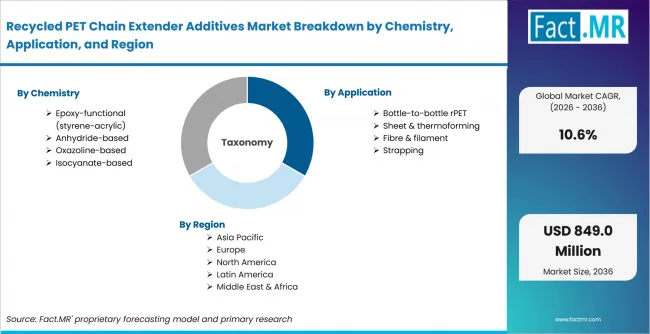
Recycled Pet Chain Extender Additives Market Breakdown By Chemistry, Application, And Region | Source: Fact.MR
| Attribute | Details |
|---|---|
| Quantitative Units | USD 310 million in 2026 to USD 849 million by 2036 at 10.6% CAGR |
| Market Definition | Multifunctional reactive additives used during PET reprocessing to rebuild molecular weight, intrinsic viscosity and melt strength in recycled resin. |
| Segments Covered | Chemistry; Application; Form |
| Regions Covered | North America; Latin America; Europe; East Asia; South Asia and Oceania; Middle East and Africa |
| Countries Covered | South Korea; United States; Germany; Netherlands; Italy; Japan |
| Key Companies Profiled | BASF; Clariant; Dow; SABIC; Avient; Sukano |
| Forecast Period | 2026 to 2036 |
| Base Year | 2025 |
| Market Value, 2026 | USD 310 million |
| Market Value, 2036 | USD 849 million |
| CAGR, 2026-2036 | 10.6% |
| Absolute Opportunity | USD 539 million |
| Approach | Demand is estimated from recycled-PET throughput, application mix, additive form and realized dosage economics across the covered countries. |
How is the market segmented?
-
By Chemistry
- Epoxy-functional (styrene-acrylic)
- Anhydride-based
- Oxazoline-based
- Isocyanate-based
-
By Application
- Bottle-to-bottle rPET
- Sheet & thermoforming
- Fiber & filament
- Strapping
-
By Form
- Pellet/masterbatch
- Powder
-
By Region
- North America
- Latin America
- Europe
- East Asia
- South Asia and Oceania
- Middle East and Africa