Mechanical Recycling Systems for Food-Grade Plastic Market
The Mechanical Recycling Systems for Food-Grade Plastic Market is analyzed across its key product, application and end-use segments, with regional trends and demand outlook, forecast 2026 to 2036.
By Fact.MR Chemical & Materials DeskLead analyst:
S.N. JhaPublished :
Updated :
11 min read
Fact-checked under the Fact.MR editorial process
Mechanical Recycling Systems for Food-Grade Plastic Market Forecast and Outlook 2026 to 2036
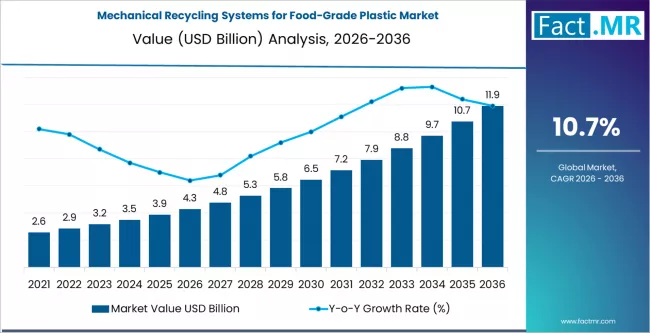
The mechanical recycling systems for food-grade plastic market is likely to be valued at USD 4.3 billion in 2026 and is expected to grow to USD 11.9 billion by 2036, expanding at a CAGR of 10.7%.
Decision-makers must immediately recognize the market’s growing economic exposure, driven by increasing regulatory pressures and consumer demand for sustainable packaging.
Mechanical Recycling Systems For Food Grade Plastic Market Market Value Analysis | Source: Fact.MR
Summary of Mechanical Recycling Systems for Food-Grade Plastic Market
Market Snapshot
Global mechanical recycling systems for food-grade plastic market revenue stood atUSD 4.32 billion in 2026and is forecast to reachUSD 11.94 billion by 2036.
At a10.7%CAGRfrom 2026 to 2036, this market is set to expand~2.8x in value, addingUSD 7.62 billion in absolute opportunity.
This marketrepresentsacritical recycling infrastructure segment, focused on converting post-consumer plastic waste into food-contact compliant recycled polymers.
Mechanical recycling systems are evolving intoadvanced polymer purification and decontamination platforms, enabling production of food-grade recycled plastics suitable for circular packaging applications.
Demand and Growth Drivers
Increasing regulatory mandatesregardingrecycled content in food packagingare the primary growth driver.
Bottle-to-bottle & food trays account for 45.0% of end-use share in 2026,emergingas the dominant segment due to large-scale collection and standardized feedstock streams.
Washing + extrusion lines hold 47.0% of system type share in 2026, positioning them as the leading segment due to integrated cleaning andpelletizationcapabilities.
Key system categories include:
Washing + extrusion lines
Turn-key recycling systems
High-capacity recycling lines
Precision decontamination systems
Core functionalities include:
Polymer purification and melt filtration
Odor and contaminant removal
Food-grade pellet production
Traceable recycling process validation
Geography and Competitive Outlook
Growth is supported acrossEurope, Asia Pacific, and North America, driven by circular economy regulations and food-grade packaging demand.
Market expansion is closely tied to:
Recycling infrastructure development
Sustainability regulations
Food-contact compliance standards
Key companies active in this market include:
EREMA
SOREMA
HERBOLDMeckesheim
Coperion
Polystar
ACERETECH
NGR
Mitsubishi Heavy Industries
Mechanical Recycling Systems for Food-Grade Plastic Market — At a Glance
Attribute
Details
Market Value 2026
USD 4.32 billion
Market Value 2036
USD 11.94 billion
Absolute Dollar Opportunity 2026–2036
USD 7.62 billion
Total Growth 2026–2036
176.4%
CAGR2026–2036
10.7%
Growth Multiple
~2.8x
Key Demand Theme
Increasing adoption of food-grade compliant recycling systems for circular packaging
Leading Segment by End Use (2026)
Bottle-to-Bottle & Food Trays
Segment Share (2026)
45.0%
Leading Segment by System Type (2026)
Washing + Extrusion Lines
Segment Share (2026)
47.0%
Key Growth Regions
Europe, Asia Pacific, North America
Top Companies
EREMA,SOREMA, HERBOLD,Coperion,Polystar,ACERETECH,NGR, Mitsubishi Heavy Industries
North America, Latin America, Western Europe, Eastern Europe, East Asia, South Asia & Pacific, Middle East & Africa
Source: Fact.MR analysis. Updated May 8, 2026
The prioritization of investments in recycling systems should focus on scalability and compliance, as the transition to recycled food-grade plastic requires both technological upgrades and strategic partnerships. Timing will be critical, with early movers in the recycling technology space likely to secure long-term contracts with key industry players. Companies that act swiftly to integrate these systems stand to benefit from regulatory incentives and market share, while delayed adoption could result in higher costs and reduced competitive positioning. Managing this shift requires balancing long-term capital commitments with the flexibility to adapt to evolving market conditions.
Category
Category
Segments
End-Use
Bottle-to-bottle and food trays; Food packaging recycling; Large recycling parks; High-purity recycling; Emerging food-grade PCR; Regional recyclers
PET, HDPE; PET and PE; Mixed food-grade plastics; PET; Others
Core Technology
Hot-wash, SSP, melt filtration; Decontamination and pelletising; Scale washing and extrusion; Ultra-clean processing; Others
Region
North America; Europe; Asia Pacific; Latin America; Middle East & Africa
Source: Fact.MR analysis. Updated May 8, 2026
Segmental Analysis
What Is the Impact of Polymer Focus on the Mechanical Recycling Systems for Food-Grade Plastic Market?
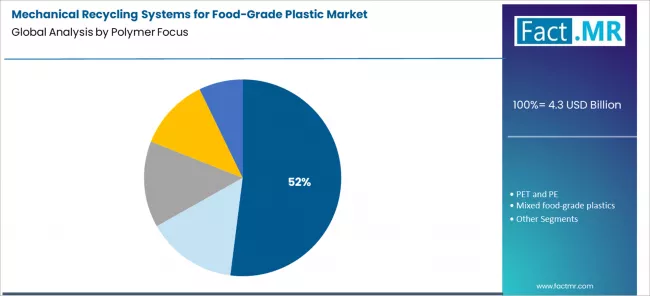
Mechanical Recycling Systems For Food Grade Plastic Market Analysis By Polymer Focus | Source: Fact.MR
In the mechanical recycling systems for food-grade plastic market, polymer focus plays a key role in shaping the technology and efficiency of recycling processes. PET and HDPE lead the market with a 52% share, due to their widespread use in food packaging and their recyclability. These polymers are highly suitable for mechanical recycling as they can be efficiently processed to create new food-grade materials. As the demand for sustainable packaging solutions grows, the focus on PET and HDPE will remain strong, driving the development of more efficient recycling systems that can process these widely used materials.
How Does Core Technology Influence the Mechanical Recycling Systems for Food-Grade Plastic Market?
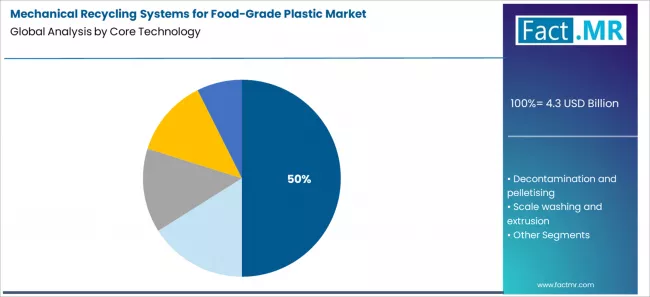
Mechanical Recycling Systems For Food Grade Plastic Market Analysis By Core Technology | Source: Fact.MR
Core technology is central to enhancing the efficiency and quality of recycling in the food-grade plastic market. Hot-wash, SSP, and melt filtration lead this segment with a 50% share. These technologies are critical for cleaning, purifying, and reprocessing food-grade plastics, ensuring they meet the stringent safety and quality standards required for reuse in food packaging. Hot-washing removes contaminants, while SSP (solid-state polymerization) and melt filtration further improve the material's properties. As consumer demand for recycled content in food-grade plastics increases, the adoption of these advanced technologies will continue to support the growth and sustainability of the market.
What are the Principal Drivers, Constraints, and Evolving Dynamics of the Mechanical Recycling Systems for FoodGrade Plastic Market?
Growth in mechanical recycling systems for foodgrade plastics has been shaped by requirements to recover and reuse polyethylene terephthalate and highdensity polyethylene in food packaging. Food and beverage producers seek recycled resins that meet regulatory standards for food contact. Investments in wash, sort, and pelletizing technologies have been influenced by mandates for recycled content in packaging and producer responsibility policies. Access to consistent, clean feedstock streams affects system throughput and output quality.
Constraints include contamination in collected plastics that complicates processing and increases sorting costs. Some recycling operations struggle to achieve food grade purity without advanced cleaning stages. Capacity limitations in existing systems have affected the volume of food grade recycled output. Efforts to scale mechanical recycling infrastructure and refine decontamination processes are in progress. Collaboration between brand owners, recyclers, and equipment suppliers is being used to align feedstock specifications and processing practices aimed at producing food grade recycled resins.
Analysis of the Mechanical Recycling Systems for Food-Grade Plastic Market by Key Country
Country
CAGR (2026–2036)
Germany
10%
USA
10.4%
China
12.8%
Japan
9%
India
14%
Brazil
11%
Source: Fact.MR analysis. Updated May 8, 2026
The report covers an in-depth analysis of 40+ countries; top-performing countries are highlighted below.
What is the Growth Outlook for Mechanical Recycling Systems for Food-Grade Plastic in Germany?
Germany’s mechanical recycling systems for food-grade plastic market is expected to grow at a CAGR of 10% from 2026 to 2036. As a leader in environmental sustainability, Germany is focusing on improving recycling technologies, including those for food-grade plastics. The country’s strict regulations on plastic waste management and the push towards a circular economy are key factors driving the adoption of mechanical recycling systems. As demand for sustainable packaging solutions increases across the food and beverage industries, Germany’s market for recycling systems is poised for steady growth.
How is the Mechanical Recycling Systems for Food-Grade Plastic Market Performing in the USA?
The USA’s mechanical recycling systems for food-grade plastic market is projected to grow at a CAGR of 10.4% from 2026 to 2036. The country’s growing focus on sustainable packaging solutions, particularly in the food and beverage sector, is driving the demand for advanced recycling technologies. With increasing consumer demand for eco-friendly products and regulatory pressures on waste management, the adoption of mechanical recycling systems for food-grade plastics is expected to rise. As the USA’s manufacturing sector continues to prioritize sustainability, the market for food-grade plastic recycling systems will continue to expand.
What is the Market Outlook for Mechanical Recycling Systems for Food-Grade Plastic in China?
China is expected to see significant growth in the mechanical recycling systems for food-grade plastic market, with a projected CAGR of 12.8% from 2026 to 2036. As one of the world’s largest producers and consumers of plastics, China’s focus on waste reduction and sustainable manufacturing is driving the adoption of recycling technologies. The food-grade plastic sector is increasingly turning to mechanical recycling systems to meet both environmental goals and regulatory standards. Government policies promoting recycling and waste reduction, along with growing consumer demand for eco-friendly products, will continue to fuel market growth in China.
What is the Growth Potential for Mechanical Recycling Systems for Food-Grade Plastic in Japan?
Japan’s mechanical recycling systems for food-grade plastic market is forecast to grow at a CAGR of 9% from 2026 to 2036. Japan’s recycling infrastructure and commitment to sustainability provide a solid foundation for the adoption of mechanical recycling systems. As the demand for sustainable packaging solutions in the food industry grows, Japan is focusing on improving recycling technologies, particularly for food-grade plastics. Despite a more modest growth rate compared to other regions, Japan’s continued investment in recycling innovation and eco-friendly packaging will support steady market expansion.
What is the Demand for Mechanical Recycling Systems for Food-Grade Plastic in India?
India’s mechanical recycling systems for food-grade plastic market is set to grow at a robust CAGR of 14% from 2026 to 2036. The country’s rapidly expanding food and beverage industry, coupled with growing awareness of sustainability and waste reduction, is driving the demand for food-grade plastic recycling systems. With government initiatives promoting recycling and a growing focus on circular economy practices, the market for mechanical recycling systems in India is expected to experience strong growth. As the infrastructure for recycling improves, India will continue to be a key market for food-grade plastic recycling technologies.
What is the Market Expansion Outlook for Mechanical Recycling Systems for Food-Grade Plastic in Brazil?
Brazil’s mechanical recycling systems for food-grade plastic market is projected to grow at a CAGR of 11% from 2026 to 2036. Brazil’s food and beverage sector, which is increasingly focused on sustainability, is driving the demand for more efficient recycling systems for food-grade plastics. The country’s efforts to improve waste management and enhance recycling infrastructure will support market growth. As regulatory frameworks around plastic waste management tighten and consumer preferences shift towards sustainable packaging, the demand for mechanical recycling systems in Brazil is expected to rise, contributing to the market’s continued expansion.
How is Competition Structured in the Mechanical Recycling Systems for Food Grade Plastic Market?
Competition in this market is driven by system efficiency, compliance with food grade standards, and throughput capability. Erema and Herbold Meckesheim compete with established extrusion and separation technologies that support consistent melt quality and contaminant removal. Polystar and NGR focus on turnkey lines that integrate shredding, washing, and pelletizing for recycled resin output suitable for food contact. Sorema differentiates through modular systems that adjust to varying waste streams and material types.
Coperion and Mitsubishi Heavy Industries emphasize engineering integration and reliability for high volume operations. ACERETECH positions offerings with compact systems suited to space constrained facilities. Competitive factors include energy efficiency, ease of maintenance, and documented compliance with regulatory food safety frameworks. Buyers assess providers based on validated performance, service support, and the ability to deliver stable pellet quality for downstream converters.
Key Players in the Mechanical Recycling Systems for FoodGrade Plastic Market?
Erema
Herbold Meckesheim
Polystar
NGR
Sorema
Coperion
ACERETECH
Mitsubishi Heavy Industries
Market Breakdown
Segmentation
Scope of the Report
Items
Values
Quantitative Units (2026)
USD Billion
End-use
Bottle-to-bottle and food trays, Food packaging recycling, Large recycling parks, High-purity recycling, Emerging food-grade PCR
Dollar revenue by end-use, system type, polymer focus, and core technology; regional demand trends, competitive landscape, technological advancements in mechanical recycling systems, and innovations in food-grade plastic recycling
Source: Fact.MR analysis. Updated May 8, 2026
Mechanical Recycling Systems for Food-Grade Plastic Market Key Segments
End-use :
Bottle-to-bottle and food trays
Food packaging recycling
Large recycling parks
High-purity recycling
Emerging food-grade PCR
Regional recyclers
System Type :
Washing + extrusion lines
Turn-key recycling plants
High-capacity lines
Precision recycling lines
Others
Polymer Focus :
PET, HDPE
PET and PE
Mixed food-grade plastics
PET
Others
Core Technology :
Hot-wash, SSP, melt filtration
Decontamination and pelletising
Scale washing and extrusion
Ultra-clean processing
Others
Region :
North America
USA
Canada
Mexico
Europe
Germany
UK
France
Italy
Spain
Nordic Countries
BENELUX
Rest of Europe
Asia Pacific
China
Japan
South Korea
India
Australia
Rest of Asia Pacific
Latin America
Brazil
Argentina
Rest of Latin America
Middle East and Africa
Kingdom of Saudi Arabia
United Arab Emirates
South Africa
Rest of Middle East and Africa
Other Regions
Oceania
Central Asia
Other Markets
Bibliographies
European Food Safety Authority. (2023).Guidance on the safety assessment of mechanical recycling processes for food contact plastics. EFSA Journal.
European Commission. (2024).Commission Regulation on recycled plastic materials and articles intended to come into contact with food (recast). European Union Publications.
United States Food and Drug Administration. (2023).Guidance for industry: Use of recycled plastics in food packaging-Chemistry considerations. FDA.
Organisation for Economic Co-operation and Development. (2023).Food-grade plastics recycling systems: Technology performance and policy drivers. OECD Publishing.
International Organization for Standardization. (2023).ISO 22000: Food safety management systems-Requirements for any organization in the food chain. ISO.
Questions Answered
Frequently Asked Questions
How big is the mechanical recycling systems for food-grade plastic market in 2026?
The global mechanical recycling systems for food-grade plastic market is estimated to be valued at USD 4.3 billion in 2026.
What will be the size of mechanical recycling systems for food-grade plastic market in 2036?
The market size for the mechanical recycling systems for food-grade plastic market is projected to reach USD 11.9 billion by 2036.
How much will be the mechanical recycling systems for food-grade plastic market growth between 2026 and 2036?
The mechanical recycling systems for food-grade plastic market is expected to grow at a 10.7% CAGR between 2026 and 2036.
What are the key product types in the mechanical recycling systems for food-grade plastic market?
The key product types in mechanical recycling systems for food-grade plastic market are bottle-to-bottle and food trays, food packaging recycling, large recycling parks, high-purity recycling, emerging food-grade pcr and regional recyclers.
Which system type segment to contribute significant share in the mechanical recycling systems for food-grade plastic market in 2026?
In terms of system type, washing + extrusion lines segment to command 43.0% share in the mechanical recycling systems for food-grade plastic market in 2026.