Recycled Silicones Market (2026 - 2036)
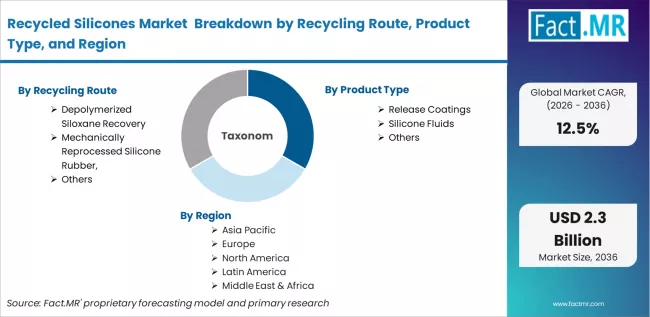
Recycled silicones market is segmented by Recycling Route (Depolymerized Siloxane Recovery, Mechanically Reprocessed Silicone Rubber, Mass-balanced Circular Silicones, Others), Product Type (Release Coatings, Silicone Fluids, Elastomers, Resins, Others), End Use Industry (Labels and Release Liners, Automotive, Construction, Electronics, Healthcare, Others), and Region. Forecast for 2026 to 2036.
Core Findings
Recycled Silicones Market Forecast and Outlook By Fact.MR
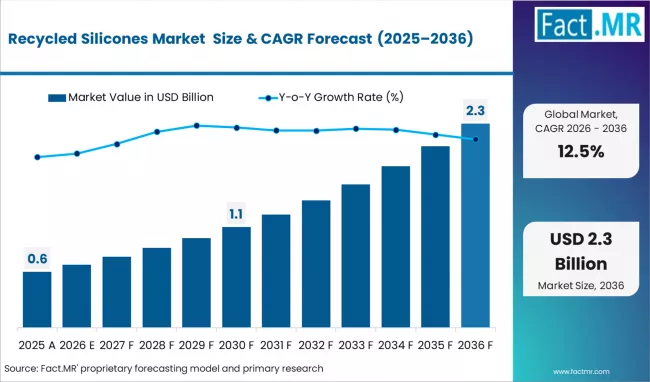
The recycled silicones market was valued at USD 0.6 billion in 2025 and is expected to reach USD 0.7 billion in 2026, growing to USD 2.3 billion by 2036 at a CAGR of 12.5%. Depolymerized Siloxane Recovery leads recycling route with a 38.1% share in 2026, Release Coatings leads product type at 32.4%, and Labels and Release Liners anchors end use industry demand at 29.7%. The interesting technical dimension of this market is that silicones are among the most difficult polymer families to recycle because their cured three-dimensional structure resists the approaches that work well for thermoplastics. The fact that depolymerization is starting to work at meaningful yields represents a genuine materials science advance, not just a rebranding exercise, and that underlying difficulty is what keeps new entrants out and gives established producers a durable lead.
![]()
Key Drivers
- Circular Chemistry Push: Silicone producers are advancing from waste minimization toward true feedstock recovery and commercial recycled product launches.
- Carbon Pressure: Buyers in labels, electronics, and industrial applications are seeking lower-footprint silicone solutions without compromising functional performance.
- Technology Progress: Depolymerization, chemical recovery, and mechanical pathways are beginning to convert waste silicone streams back into usable raw material.
Key Segments Analyzed in the Report
- Recycling Route: Depolymerized Siloxane Recovery, Mechanically Reprocessed Silicone Rubber, Mass-Balanced Circular Silicones, And Others
- Product Type: Release Coatings, Silicone Fluids, Elastomers, Resins, And Others
- End Use Industry: Labels And Release Liners, Automotive, Construction, Electronics, Healthcare, And Others
- Region: North America, Latin America, Europe, Asia Pacific, And Middle East & Africa
Analyst Opinion
Shambhu Nath Jha, Principal Consultant, Fact.MR says recycled silicones will grow where circularity is tied to very specific waste streams and performance-critical end uses. This market is about reclaiming value in applications where silicone remains hard to substitute. The producers who will define this category are the ones treating waste silicone not as a disposal problem but as a feedstock asset whose molecular value has simply been temporarily stored in the wrong form.
Recycled Silicones Market Definition
The recycled silicones market covers silicone materials manufactured using recovered silicone feedstocks, recycled silicone waste streams, or verified circular attribution systems that reduce virgin fossil input in silicone products while retaining functional performance.
Recycled Silicones Market Inclusions
- Revenue from recycled silicone materials sold as release coatings, fluids, elastomers, resins, and related specialty silicone products.
- Commercial sales based on chemical recycling, depolymerization, mechanical recycling, or certified circular feedstock attribution within silicone production.
- Demand across North America, Latin America, Europe, Asia Pacific, and the Middle East & Africa.
Recycled Silicones Market Exclusions
- Virgin silicone sales without a recycled or circular feedstock claim.
- General polymer recycling revenue not specific to silicone chemistry.
- Waste collection and disposal services that do not result in recycled silicone product sales.
Recycled Silicones Market Research Methodology
This study evaluates the recycled silicones market across recycling route, product type, end use industry, and region, using 2025 as the base year and 2026 to 2036 as the forecast period. Market value is expressed in USD billion. Evidence inputs include first-party circular silicone announcements, pilot plant developments, commercial product launches, and corporate R&D disclosures from Dow, Elkem, WACKER, and other specialty silicone producers. Triangulation aligns recoverable silicone waste streams, feasible recycling yields, premium pricing for lower-carbon grades, and end-use qualification rates to derive segment and regional estimates.
Key Drivers, Restraints, and Trends in Recycled Silicones Market
Drivers
Recycled silicones are gaining commercial attention because silicone performance is too valuable to lose in landfill or incineration-heavy end-of-life routes. Producers are working to recover siloxane value from manufacturing scrap, used liners, and cured silicone waste so they can reduce carbon intensity and strengthen resource efficiency without substantially altering end-use chemistry.
Restraints
Technical complexity remains high. Cured silicone waste is difficult to process, contamination is common, and recycled outputs must still satisfy demanding specifications in release, electronics, and healthcare-adjacent applications. As a result, not every waste stream can be economically upgraded into a high-value recycled silicone product.
Trends
The market is shifting from broad circular rhetoric toward application-focused commercial launches. Labels and release liners have emerged as a proving ground because coating performance can be benchmarked carefully and waste streams can be defined more precisely. Over time, chemical recycling routes that recover core silicone building blocks are likely to matter more than simple downcycling.
Segmental Analysis
Recycled Silicones Market Analysis by Recycling Route
![]()
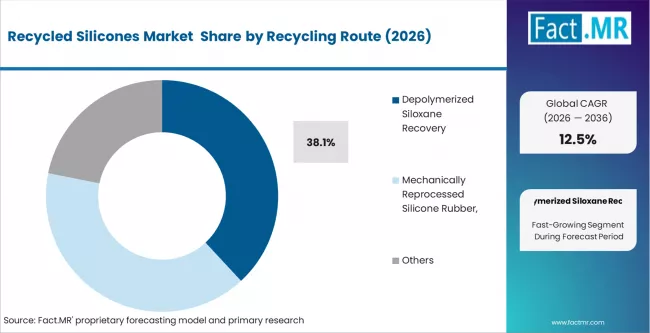
The Depolymerized Siloxane Recovery segment is expected to lead the recycling route category with a 38.1% share in 2026. This route leads because it creates the clearest pathway back into higher-value silicone chemistry. Depolymerization aims to recover usable molecular building blocks that can support premium circular products, treating waste silicone as a feedstock asset rather than a disposal problem.
Recycled Silicones Market Analysis by Product Type
![]()
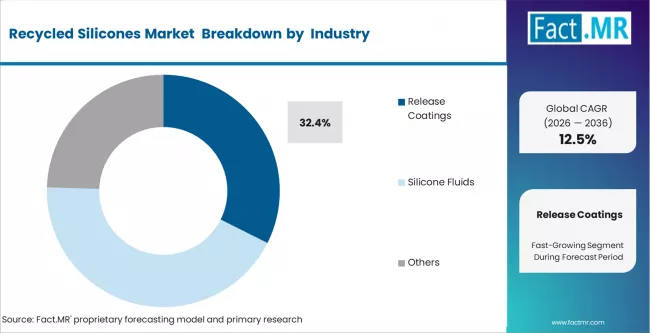
The Release Coatings segment is expected to lead the product type category with a 32.4% share in 2026. Release coatings lead because the label and liner value chain is already accustomed to qualification testing, coating optimization, and sustainability-led specification work. That makes it one of the first end markets where recycled silicones can scale without sacrificing a tightly controlled performance envelope.
Competitive Aligners for Market Players
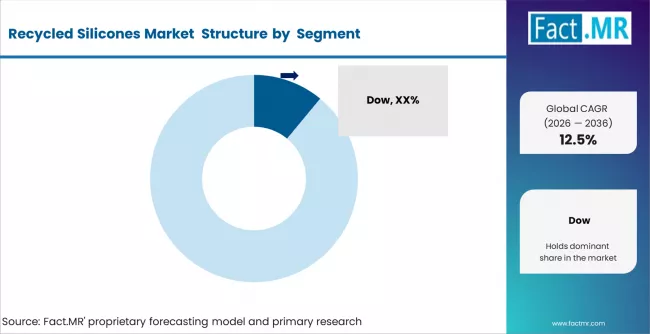
The competitive logic in recycled silicones is fundamentally different from most materials markets because the barriers are upstream, not downstream. It is not enough to have a good product if you cannot secure a consistent, contamination-controlled waste silicone stream to feed your recovery process. That makes access to waste streams, whether from your own manufacturing, from waste aggregators, or from long-term collection partnerships, the primary competitive variable in this market. Companies that solve the feedstock problem first will be hardest to displace.
Process credibility is the second axis of competition. Buyers in release liners, electronics, and healthcare-adjacent markets will not switch to a recycled grade on the basis of sustainability claims alone. They need test data showing that the recycled silicone performs identically or near-identically to the virgin grade across their line conditions. Elkem's approach of launching a specific recycled silicone range for the label industry, with documented performance benchmarks, represents the kind of application-specific proof that earns qualification in conservative buying environments.
For new entrants considering this space, the correct question is not which recycling technology to pursue but which waste stream to anchor on and which end-use qualification chain to target first. The companies trying to build broad platform recycled silicone businesses before they have proven a single narrow application will struggle against established producers with proprietary waste access, existing customer qualification, and the capital patience to absorb long development timelines. Narrow focus, proven performance, then expansion is the correct sequencing.
Key Players in Recycled Silicones Market
- Dow
- Elkem
- WACKER
- Momentive
- Shin-Etsu Chemical
- KCC Silicone
- Bluestar Silicones
- ACC Silicones
- Evonik
- Siltech
Strategic Outlook by Fact.MR on Recycled Silicones Market
Fact.MR expects recycled silicones to advance first through narrow premium niches and then widen as feedstock recovery improves and qualification confidence builds. The most durable growth will come from producers that combine circular chemistry with a credible lower-carbon value proposition and stable output quality. The technology development story is largely told. The commercial execution story is just beginning, and execution will be the deciding variable over the next decade.
Scope of the Report
![]()
| Metric | Value |
|---|---|
| Market Value | USD 0.6 billion in 2025 to USD 2.3 billion by 2036 |
| CAGR | 12.5% from 2026 to 2036 |
| Base Year | 2025 |
| Forecast Period | 2026 to 2036 |
| Recycling Route Segmentation | Depolymerized Siloxane Recovery, Mechanically Reprocessed Silicone Rubber, Mass-balanced Circular Silicones, Others |
| Product Type Segmentation | Release Coatings, Silicone Fluids, Elastomers, Resins, Others |
| End Use Industry Segmentation | Labels and Release Liners, Automotive, Construction, Electronics, Healthcare, Others |
| Regional Coverage | North America, Latin America, Europe, Asia Pacific, and Middle East & Africa |
Bibliography
- Dow. 2024. Dow Silicones Circularity Commitment.
- Elkem. 2025. Elkem scientists and partners publish silicone recycling breakthrough in Science journal.
- Elkem. 2025. Elkem launches pioneering range of recycled silicones for the label industry.
- Elkem. 2025. Elkem unlocks new mechanical recycling pathway for silicone rubber.
- WACKER. 2024. WACKER Annual Report 2024.
- WACKER. 2025. CDP Climate Change Questionnaire 2025.
Table of Content
- Executive Summary
- Global Market Outlook
- Demand to side Trends
- Supply to side Trends
- Technology Roadmap Analysis
- Analysis and Recommendations
- Market Overview
- Market Coverage / Taxonomy
- Market Definition / Scope / Limitations
- Research Methodology
- Chapter Orientation
- Analytical Lens and Working Hypotheses
- Market Structure, Signals, and Trend Drivers
- Desk Research Programme (Secondary Evidence)
- Company Annual and Sustainability Reports
- Peer-reviewed Journals and Academic Literature
- Corporate Websites, Product Literature, and Technical Notes
- Earnings Decks and Investor Briefings
- Statutory Filings and Regulatory Disclosures
- Technical White Papers and Standards Notes
- Trade Journals, Industry Magazines, and Analyst Briefs
- Conference Proceedings, Webinars, and Seminar Materials
- Government Statistics Portals and Public Data Releases
- Press Releases and Reputable Media Coverage
- Specialist Newsletters and Curated Briefings
- Sector Databases and Reference Repositories
- Fact.MR Internal Proprietary Databases and Historical Market Datasets
- Subscription Datasets and Paid Sources
- Social Channels, Communities, and Digital Listening Inputs
- Additional Desk Sources
- Expert Input and Fieldwork (Primary Evidence)
- Primary Modes
- Qualitative Interviews and Expert Elicitation
- Quantitative Surveys and Structured Data Capture
- Blended Approach
- Why Primary Evidence is Used
- Field Techniques
- Interviews
- Surveys
- Focus Groups
- Observational and In-context Research
- Social and Community Interactions
- Stakeholder Universe Engaged
- C-suite Leaders
- Board Members
- Presidents and Vice Presidents
- R&D and Innovation Heads
- Technical Specialists
- Domain Subject-matter Experts
- Scientists
- Physicians and Other Healthcare Professionals
- Governance, Ethics, and Data Stewardship
- Research Ethics
- Data Integrity and Handling
- Primary Modes
- Tooling, Models, and Reference Databases
- Data Engineering and Model Build
- Data Acquisition and Ingestion
- Cleaning, Normalisation, and Verification
- Synthesis, Triangulation, and Analysis
- Quality Assurance and Audit Trail
- Market Background
- Market Dynamics
- Drivers
- Restraints
- Opportunity
- Trends
- Scenario Forecast
- Demand in Optimistic Scenario
- Demand in Likely Scenario
- Demand in Conservative Scenario
- Opportunity Map Analysis
- Product Life Cycle Analysis
- Supply Chain Analysis
- Investment Feasibility Matrix
- Value Chain Analysis
- PESTLE and Porter’s Analysis
- Regulatory Landscape
- Regional Parent Market Outlook
- Production and Consumption Statistics
- Import and Export Statistics
- Market Dynamics
- Global Market Analysis 2021 to 2025 and Forecast, 2026 to 2036
- Historical Market Size Value (USD Million) Analysis, 2021 to 2025
- Current and Future Market Size Value (USD Million) Projections, 2026 to 2036
- Y to o to Y Growth Trend Analysis
- Absolute $ Opportunity Analysis
- Global Market Pricing Analysis 2021 to 2025 and Forecast 2026 to 2036
- Global Market Analysis 2021 to 2025 and Forecast 2026 to 2036, By Recycling Route
- Introduction / Key Findings
- Historical Market Size Value (USD Million) Analysis By Recycling Route, 2021 to 2025
- Current and Future Market Size Value (USD Million) Analysis and Forecast By Recycling Route, 2026 to 2036
- Depolymerized Siloxane Recovery
- Mechanically Reprocessed Silicone Rubber,
- Others
- Depolymerized Siloxane Recovery
- Y to o to Y Growth Trend Analysis By Recycling Route, 2021 to 2025
- Absolute $ Opportunity Analysis By Recycling Route, 2026 to 2036
- Global Market Analysis 2021 to 2025 and Forecast 2026 to 2036, By Product Type
- Introduction / Key Findings
- Historical Market Size Value (USD Million) Analysis By Product Type, 2021 to 2025
- Current and Future Market Size Value (USD Million) Analysis and Forecast By Product Type, 2026 to 2036
- Release Coatings
- Silicone Fluids
- Others
- Release Coatings
- Y to o to Y Growth Trend Analysis By Product Type, 2021 to 2025
- Absolute $ Opportunity Analysis By Product Type, 2026 to 2036
- Global Market Analysis 2021 to 2025 and Forecast 2026 to 2036, By Region
- Introduction
- Historical Market Size Value (USD Million) Analysis By Region, 2021 to 2025
- Current Market Size Value (USD Million) Analysis and Forecast By Region, 2026 to 2036
- North America
- Latin America
- Western Europe
- Eastern Europe
- East Asia
- South Asia and Pacific
- Middle East & Africa
- Market Attractiveness Analysis By Region
- North America Market Analysis 2021 to 2025 and Forecast 2026 to 2036, By Country
- Historical Market Size Value (USD Million) Trend Analysis By Market Taxonomy, 2021 to 2025
- Market Size Value (USD Million) Forecast By Market Taxonomy, 2026 to 2036
- By Country
- USA
- Canada
- Mexico
- By Recycling Route
- By Product Type
- By Country
- Market Attractiveness Analysis
- By Country
- By Recycling Route
- By Product Type
- Key Takeaways
- Latin America Market Analysis 2021 to 2025 and Forecast 2026 to 2036, By Country
- Historical Market Size Value (USD Million) Trend Analysis By Market Taxonomy, 2021 to 2025
- Market Size Value (USD Million) Forecast By Market Taxonomy, 2026 to 2036
- By Country
- Brazil
- Chile
- Rest of Latin America
- By Recycling Route
- By Product Type
- By Country
- Market Attractiveness Analysis
- By Country
- By Recycling Route
- By Product Type
- Key Takeaways
- Western Europe Market Analysis 2021 to 2025 and Forecast 2026 to 2036, By Country
- Historical Market Size Value (USD Million) Trend Analysis By Market Taxonomy, 2021 to 2025
- Market Size Value (USD Million) Forecast By Market Taxonomy, 2026 to 2036
- By Country
- Germany
- UK
- Italy
- Spain
- France
- Nordic
- BENELUX
- Rest of Western Europe
- By Recycling Route
- By Product Type
- By Country
- Market Attractiveness Analysis
- By Country
- By Recycling Route
- By Product Type
- Key Takeaways
- Eastern Europe Market Analysis 2021 to 2025 and Forecast 2026 to 2036, By Country
- Historical Market Size Value (USD Million) Trend Analysis By Market Taxonomy, 2021 to 2025
- Market Size Value (USD Million) Forecast By Market Taxonomy, 2026 to 2036
- By Country
- Russia
- Poland
- Hungary
- Balkan & Baltic
- Rest of Eastern Europe
- By Recycling Route
- By Product Type
- By Country
- Market Attractiveness Analysis
- By Country
- By Recycling Route
- By Product Type
- Key Takeaways
- East Asia Market Analysis 2021 to 2025 and Forecast 2026 to 2036, By Country
- Historical Market Size Value (USD Million) Trend Analysis By Market Taxonomy, 2021 to 2025
- Market Size Value (USD Million) Forecast By Market Taxonomy, 2026 to 2036
- By Country
- China
- Japan
- South Korea
- By Recycling Route
- By Product Type
- By Country
- Market Attractiveness Analysis
- By Country
- By Recycling Route
- By Product Type
- Key Takeaways
- South Asia and Pacific Market Analysis 2021 to 2025 and Forecast 2026 to 2036, By Country
- Historical Market Size Value (USD Million) Trend Analysis By Market Taxonomy, 2021 to 2025
- Market Size Value (USD Million) Forecast By Market Taxonomy, 2026 to 2036
- By Country
- India
- ASEAN
- Australia & New Zealand
- Rest of South Asia and Pacific
- By Recycling Route
- By Product Type
- By Country
- Market Attractiveness Analysis
- By Country
- By Recycling Route
- By Product Type
- Key Takeaways
- Middle East & Africa Market Analysis 2021 to 2025 and Forecast 2026 to 2036, By Country
- Historical Market Size Value (USD Million) Trend Analysis By Market Taxonomy, 2021 to 2025
- Market Size Value (USD Million) Forecast By Market Taxonomy, 2026 to 2036
- By Country
- Kingdom of Saudi Arabia
- Other GCC Countries
- Turkiye
- South Africa
- Other African Union
- Rest of Middle East & Africa
- By Recycling Route
- By Product Type
- By Country
- Market Attractiveness Analysis
- By Country
- By Recycling Route
- By Product Type
- Key Takeaways
- Key Countries Market Analysis
- USA
- Pricing Analysis
- Market Share Analysis, 2025
- By Recycling Route
- By Product Type
- Canada
- Pricing Analysis
- Market Share Analysis, 2025
- By Recycling Route
- By Product Type
- Mexico
- Pricing Analysis
- Market Share Analysis, 2025
- By Recycling Route
- By Product Type
- Brazil
- Pricing Analysis
- Market Share Analysis, 2025
- By Recycling Route
- By Product Type
- Chile
- Pricing Analysis
- Market Share Analysis, 2025
- By Recycling Route
- By Product Type
- Germany
- Pricing Analysis
- Market Share Analysis, 2025
- By Recycling Route
- By Product Type
- UK
- Pricing Analysis
- Market Share Analysis, 2025
- By Recycling Route
- By Product Type
- Italy
- Pricing Analysis
- Market Share Analysis, 2025
- By Recycling Route
- By Product Type
- Spain
- Pricing Analysis
- Market Share Analysis, 2025
- By Recycling Route
- By Product Type
- France
- Pricing Analysis
- Market Share Analysis, 2025
- By Recycling Route
- By Product Type
- India
- Pricing Analysis
- Market Share Analysis, 2025
- By Recycling Route
- By Product Type
- ASEAN
- Pricing Analysis
- Market Share Analysis, 2025
- By Recycling Route
- By Product Type
- Australia & New Zealand
- Pricing Analysis
- Market Share Analysis, 2025
- By Recycling Route
- By Product Type
- China
- Pricing Analysis
- Market Share Analysis, 2025
- By Recycling Route
- By Product Type
- Japan
- Pricing Analysis
- Market Share Analysis, 2025
- By Recycling Route
- By Product Type
- South Korea
- Pricing Analysis
- Market Share Analysis, 2025
- By Recycling Route
- By Product Type
- Russia
- Pricing Analysis
- Market Share Analysis, 2025
- By Recycling Route
- By Product Type
- Poland
- Pricing Analysis
- Market Share Analysis, 2025
- By Recycling Route
- By Product Type
- Hungary
- Pricing Analysis
- Market Share Analysis, 2025
- By Recycling Route
- By Product Type
- Kingdom of Saudi Arabia
- Pricing Analysis
- Market Share Analysis, 2025
- By Recycling Route
- By Product Type
- Turkiye
- Pricing Analysis
- Market Share Analysis, 2025
- By Recycling Route
- By Product Type
- South Africa
- Pricing Analysis
- Market Share Analysis, 2025
- By Recycling Route
- By Product Type
- USA
- Market Structure Analysis
- Competition Dashboard
- Competition Benchmarking
- Market Share Analysis of Top Players
- By Regional
- By Recycling Route
- By Product Type
- Competition Analysis
- Competition Deep Dive
- Dow
- Overview
- Product Portfolio
- Profitability by Market Segments (Product/Age /Sales Channel/Region)
- Sales Footprint
- Strategy Overview
- Marketing Strategy
- Product Strategy
- Channel Strategy
- Elkem
- WACKER
- Momentive
- Shin-Etsu Chemical
- KCC Silicone
- Dow
- Competition Deep Dive
- Assumptions & Acronyms Used
List Of Table
- Table 1: Global Market Value (USD Million) Forecast by Region, 2021 to 2036
- Table 2: Global Market Value (USD Million) Forecast by Recycling Route, 2021 to 2036
- Table 3: Global Market Value (USD Million) Forecast by Product Type, 2021 to 2036
- Table 4: North America Market Value (USD Million) Forecast by Country, 2021 to 2036
- Table 5: North America Market Value (USD Million) Forecast by Recycling Route, 2021 to 2036
- Table 6: North America Market Value (USD Million) Forecast by Product Type, 2021 to 2036
- Table 7: Latin America Market Value (USD Million) Forecast by Country, 2021 to 2036
- Table 8: Latin America Market Value (USD Million) Forecast by Recycling Route, 2021 to 2036
- Table 9: Latin America Market Value (USD Million) Forecast by Product Type, 2021 to 2036
- Table 10: Western Europe Market Value (USD Million) Forecast by Country, 2021 to 2036
- Table 11: Western Europe Market Value (USD Million) Forecast by Recycling Route, 2021 to 2036
- Table 12: Western Europe Market Value (USD Million) Forecast by Product Type, 2021 to 2036
- Table 13: Eastern Europe Market Value (USD Million) Forecast by Country, 2021 to 2036
- Table 14: Eastern Europe Market Value (USD Million) Forecast by Recycling Route, 2021 to 2036
- Table 15: Eastern Europe Market Value (USD Million) Forecast by Product Type, 2021 to 2036
- Table 16: East Asia Market Value (USD Million) Forecast by Country, 2021 to 2036
- Table 17: East Asia Market Value (USD Million) Forecast by Recycling Route, 2021 to 2036
- Table 18: East Asia Market Value (USD Million) Forecast by Product Type, 2021 to 2036
- Table 19: South Asia and Pacific Market Value (USD Million) Forecast by Country, 2021 to 2036
- Table 20: South Asia and Pacific Market Value (USD Million) Forecast by Recycling Route, 2021 to 2036
- Table 21: South Asia and Pacific Market Value (USD Million) Forecast by Product Type, 2021 to 2036
- Table 22: Middle East & Africa Market Value (USD Million) Forecast by Country, 2021 to 2036
- Table 23: Middle East & Africa Market Value (USD Million) Forecast by Recycling Route, 2021 to 2036
- Table 24: Middle East & Africa Market Value (USD Million) Forecast by Product Type, 2021 to 2036
List Of Figures
- Figure 1: Global Market Pricing Analysis
- Figure 2: Global Market Value (USD Million) Forecast 2021 to 2036
- Figure 3: Global Market Value Share and BPS Analysis by Recycling Route, 2026 and 2036
- Figure 4: Global Market Y-o-Y Growth Comparison by Recycling Route, 2026 to 2036
- Figure 5: Global Market Attractiveness Analysis by Recycling Route
- Figure 6: Global Market Value Share and BPS Analysis by Product Type, 2026 and 2036
- Figure 7: Global Market Y-o-Y Growth Comparison by Product Type, 2026 to 2036
- Figure 8: Global Market Attractiveness Analysis by Product Type
- Figure 9: Global Market Value (USD Million) Share and BPS Analysis by Region, 2026 and 2036
- Figure 10: Global Market Y-o-Y Growth Comparison by Region, 2026 to 2036
- Figure 11: Global Market Attractiveness Analysis by Region
- Figure 12: North America Market Incremental Dollar Opportunity, 2026 to 2036
- Figure 13: Latin America Market Incremental Dollar Opportunity, 2026 to 2036
- Figure 14: Western Europe Market Incremental Dollar Opportunity, 2026 to 2036
- Figure 15: Eastern Europe Market Incremental Dollar Opportunity, 2026 to 2036
- Figure 16: East Asia Market Incremental Dollar Opportunity, 2026 to 2036
- Figure 17: South Asia and Pacific Market Incremental Dollar Opportunity, 2026 to 2036
- Figure 18: Middle East & Africa Market Incremental Dollar Opportunity, 2026 to 2036
- Figure 19: North America Market Value Share and BPS Analysis by Country, 2026 and 2036
- Figure 20: North America Market Value Share and BPS Analysis by Recycling Route, 2026 and 2036
- Figure 21: North America Market Y-o-Y Growth Comparison by Recycling Route, 2026 to 2036
- Figure 22: North America Market Attractiveness Analysis by Recycling Route
- Figure 23: North America Market Value Share and BPS Analysis by Product Type, 2026 and 2036
- Figure 24: North America Market Y-o-Y Growth Comparison by Product Type, 2026 to 2036
- Figure 25: North America Market Attractiveness Analysis by Product Type
- Figure 26: Latin America Market Value Share and BPS Analysis by Country, 2026 and 2036
- Figure 27: Latin America Market Value Share and BPS Analysis by Recycling Route, 2026 and 2036
- Figure 28: Latin America Market Y-o-Y Growth Comparison by Recycling Route, 2026 to 2036
- Figure 29: Latin America Market Attractiveness Analysis by Recycling Route
- Figure 30: Latin America Market Value Share and BPS Analysis by Product Type, 2026 and 2036
- Figure 31: Latin America Market Y-o-Y Growth Comparison by Product Type, 2026 to 2036
- Figure 32: Latin America Market Attractiveness Analysis by Product Type
- Figure 33: Western Europe Market Value Share and BPS Analysis by Country, 2026 and 2036
- Figure 34: Western Europe Market Value Share and BPS Analysis by Recycling Route, 2026 and 2036
- Figure 35: Western Europe Market Y-o-Y Growth Comparison by Recycling Route, 2026 to 2036
- Figure 36: Western Europe Market Attractiveness Analysis by Recycling Route
- Figure 37: Western Europe Market Value Share and BPS Analysis by Product Type, 2026 and 2036
- Figure 38: Western Europe Market Y-o-Y Growth Comparison by Product Type, 2026 to 2036
- Figure 39: Western Europe Market Attractiveness Analysis by Product Type
- Figure 40: Eastern Europe Market Value Share and BPS Analysis by Country, 2026 and 2036
- Figure 41: Eastern Europe Market Value Share and BPS Analysis by Recycling Route, 2026 and 2036
- Figure 42: Eastern Europe Market Y-o-Y Growth Comparison by Recycling Route, 2026 to 2036
- Figure 43: Eastern Europe Market Attractiveness Analysis by Recycling Route
- Figure 44: Eastern Europe Market Value Share and BPS Analysis by Product Type, 2026 and 2036
- Figure 45: Eastern Europe Market Y-o-Y Growth Comparison by Product Type, 2026 to 2036
- Figure 46: Eastern Europe Market Attractiveness Analysis by Product Type
- Figure 47: East Asia Market Value Share and BPS Analysis by Country, 2026 and 2036
- Figure 48: East Asia Market Value Share and BPS Analysis by Recycling Route, 2026 and 2036
- Figure 49: East Asia Market Y-o-Y Growth Comparison by Recycling Route, 2026 to 2036
- Figure 50: East Asia Market Attractiveness Analysis by Recycling Route
- Figure 51: East Asia Market Value Share and BPS Analysis by Product Type, 2026 and 2036
- Figure 52: East Asia Market Y-o-Y Growth Comparison by Product Type, 2026 to 2036
- Figure 53: East Asia Market Attractiveness Analysis by Product Type
- Figure 54: South Asia and Pacific Market Value Share and BPS Analysis by Country, 2026 and 2036
- Figure 55: South Asia and Pacific Market Value Share and BPS Analysis by Recycling Route, 2026 and 2036
- Figure 56: South Asia and Pacific Market Y-o-Y Growth Comparison by Recycling Route, 2026 to 2036
- Figure 57: South Asia and Pacific Market Attractiveness Analysis by Recycling Route
- Figure 58: South Asia and Pacific Market Value Share and BPS Analysis by Product Type, 2026 and 2036
- Figure 59: South Asia and Pacific Market Y-o-Y Growth Comparison by Product Type, 2026 to 2036
- Figure 60: South Asia and Pacific Market Attractiveness Analysis by Product Type
- Figure 61: Middle East & Africa Market Value Share and BPS Analysis by Country, 2026 and 2036
- Figure 62: Middle East & Africa Market Value Share and BPS Analysis by Recycling Route, 2026 and 2036
- Figure 63: Middle East & Africa Market Y-o-Y Growth Comparison by Recycling Route, 2026 to 2036
- Figure 64: Middle East & Africa Market Attractiveness Analysis by Recycling Route
- Figure 65: Middle East & Africa Market Value Share and BPS Analysis by Product Type, 2026 and 2036
- Figure 66: Middle East & Africa Market Y-o-Y Growth Comparison by Product Type, 2026 to 2036
- Figure 67: Middle East & Africa Market Attractiveness Analysis by Product Type
- Figure 68: Global Market - Tier Structure Analysis
- Figure 69: Global Market - Company Share Analysis
- FAQs -
What is the projected size of the Recycled Silicones Market by 2036?
The recycled silicones market is projected to reach USD 2.3 billion by 2036.
What is the CAGR of the Recycled Silicones Market from 2026 to 2036?
The recycled silicones market is projected to expand at a CAGR of 12.5% from 2026 to 2036.
Which recycling route segment leads the Recycled Silicones Market?
The Depolymerized Siloxane Recovery segment leads the recycled silicones market with a 38.1% share in 2026.
Which product type segment dominates the Recycled Silicones Market?
The Release Coatings segment holds the leading position in the recycled silicones market with a 32.4% share in 2026.
Which end use industry segment leads the Recycled Silicones Market?
The Labels and Release Liners segment is expected to account for the largest share of the recycled silicones market at 29.7% in 2026.
Who are the key companies in the Recycled Silicones Market?
Key companies active in the recycled silicones market include Dow, Elkem, WACKER, Momentive, Shin-Etsu Chemical, KCC Silicone, and other specialized participants.
What is driving demand in the Recycled Silicones Market?
Demand in the recycled silicones market is being driven by circular chemistry investment, lower-carbon silicone demand, and growing commercialization of silicone recycling technologies.