- Market Value (2025): USD 214 Mn
- Estimated Value (2026): USD 240 Mn
- Forecast Value (2036): USD 759 Mn
- CAGR (2026-2036): 12.2%
What is the Recycled Polymer Odor-Scavenging Additives Market forecast to be worth by 2036?
USD 240 million in 2026 to USD 759 million by 2036, at 12.2% CAGR.
- The recycled polymer odor-scavenging additives market reached USD 213.9 million in 2025.
- Demand is projected to increase from USD 240 million in 2026 to USD 759 million by 2036.
- The market is expected to expand at 12.2% CAGR from 2026 to 2036.
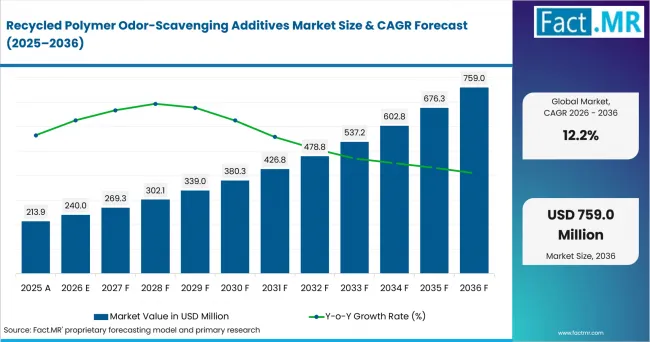
Recycled Polymer Odor Scavenging Additives Market Value Analysis | Source: Fact.MR
What are the defining numbers behind Recycled Polymer Odor-Scavenging Additives Market growth?
- Market Defination
- USD 519 million in absolute opportunity is expected between 2026 and 2036.
- The Physical adsorbers (zeolite/silica) category accounts for 44.0% of Technology in the recycled polymer odor-scavenging additives market in 2026, equivalent to USD 105.6 million.
- The Recycled PP category accounts for 37.0% of Polymer in the recycled polymer odor-scavenging additives market in 2026.
- The Rigid packaging category accounts for 33.0% of Application in the recycled polymer odor-scavenging additives market in 2026.
- The Masterbatch category accounts for 68.0% of Form in the recycled polymer odor-scavenging additives market in 2026.
- Demand Drivers in the Market
- EU packaging recycled-content rules are expanding the volume of post-consumer recyclate entering food and non-food packaging. Odor-scavenging additives are used where residual volatiles would otherwise limit material qualification.
- Automotive interior specifications that use VDA 270 odor testing are increasing attention to odor performance in recycled polypropylene and polyethylene. Physical adsorbers and chemical neutralizers are among the formulation options compounders evaluate for cabin-sensory targets.
- Brand owners in household, personal-care and consumer-goods packaging are setting odor and sensory tolerances for recycled content, creating explicit demand for zeolite, silica and chemical-neutralising additive systems.
- Mechanical recyclers are processing increasingly complex and mixed post-consumer streams, whose varied prior contents generate odor profiles that simple washing cannot fully remove, raising odor-scavenger dosage demand.
- Advances in high-loading masterbatch delivery allow odor-scavenging additives to be introduced at compounding with stable dispersion, making them practical in rigid and flexible packaging films and automotive parts.
- Key Segments Analyzed
- By Technology: The Physical adsorbers (zeolite/silica) category is projected to account for 44.0% of the recycled polymer odor-scavenging additives market in 2026. Physical adsorbers trap odor-forming volatiles without relying on fragrance or changing the base polymer chemistry.
- By Polymer: The Recycled PP category is projected to account for 37.0% of the recycled polymer odor-scavenging additives market in 2026. Recycled polypropylene enters packaging and automotive uses where odor is part of material qualification.
- By Application: The Rigid packaging category is projected to account for 33.0% of the recycled polymer odor-scavenging additives market in 2026. Rigid packaging creates direct sensory expectations for bottles, closures and thermoformed containers.
- By Form: The Masterbatch category is projected to account for 68.0% of the recycled polymer odor-scavenging additives market in 2026. Masterbatch supports controlled dosing and even dispersion during compounding.
- Analyst Opinion at Fact.MR
- Fact.MR opines, "Odor is one of the quickest ways for a recycled compound to be rejected, even when its mechanical data are acceptable. Physical adsorbers, chemical neutralizers and masking systems solve different problems, so the processor has to identify the odor source before setting the formulation. Masterbatch delivery is favored where dosing consistency and dispersion matter more than the lowest material cost." - Shambhu Nath Jha, Principal Consultant at Fact.MR.
- Strategic Implications
- Additive suppliers that combine physical zeolite adsorption with chemical neutralization in a single masterbatch can serve both packaging and automotive compounders seeking comprehensive odor abatement in one addition step.
- Automotive VDA 270 odor testing is increasing demand for documented odor performance in recycled interior compounds. Suppliers can respond with test data for adsorber or neutralizer formulations in recycled polypropylene.
- Food-contact clearances for odor-scavenging masterbatches are becoming a differentiator as recyclate moves into high-value food packaging, positioning suppliers with compliant silica and zeolite systems.
- The move toward higher recycled-content in flexible films and rigid packaging creates growing demand for low-dosage, high-efficiency odor-scavenging masterbatches that minimize cost per recycled metric ton.
- Recyclers that integrate odor control during compounding can raise the commercial value of recycled pellets, encouraging technical collaboration with additive suppliers.
How does the Recycled Polymer Odor-Scavenging Additives Market break down by segment?
Why does the Physical adsorbers (zeolite/silica) category lead Technology?
In 2026, the Physical adsorbers (zeolite/silica) category is projected to account for 44.0% of Technology within the recycled polymer odor-scavenging additives market.
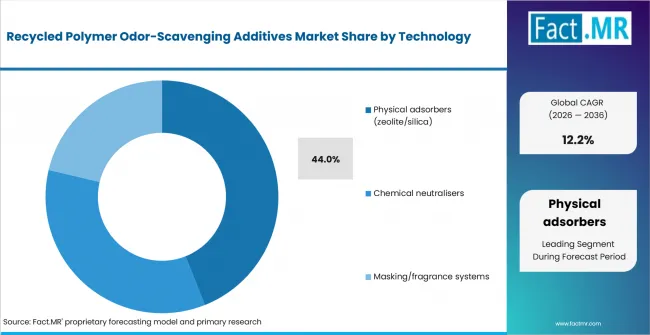
Recycled Polymer Odor Scavenging Additives Market Analysis By Technology | Source: Fact.MR
Zeolite and silica adsorbers capture odor-forming molecules within porous structures and can work across several recycled-polymer streams. They do not depend on adding a fragrance, which helps when the customer requires a neutral sensory profile.
Performance depends on pore structure, dosage and dispersion in the polymer melt. Chemical neutralizers are preferred when the volatile species is known and can be targeted through a specific reaction.
Why does the Recycled PP category lead Polymer?
Within Polymer, the Recycled PP category is projected to hold a 37.0% share in the recycled polymer odor-scavenging additives market in 2026.
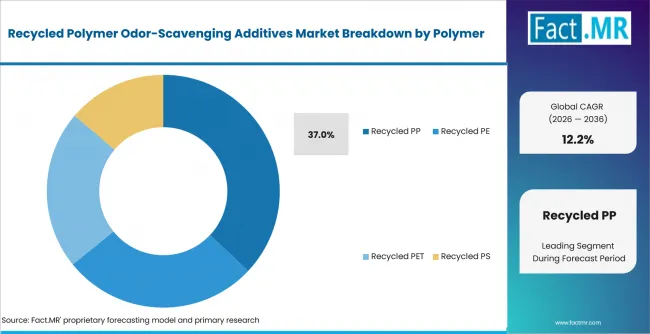
Recycled Polymer Odor Scavenging Additives Market Analysis By Polymer | Source: Fact.MR
Recycled polypropylene can retain residues from prior use, collection and repeated thermal processing. These volatiles become important when the resin enters packaging, household goods or vehicle interiors.
The variability of post-consumer feedstock makes incoming inspection and batch control important. Recycled polyethylene has similar challenges, while recycled PET and polystyrene present different odor profiles and processing temperatures.
Why does the Rigid packaging category lead Application?
The Rigid packaging category is expected to represent 33.0% of Application within the recycled polymer odor-scavenging additives market in 2026.
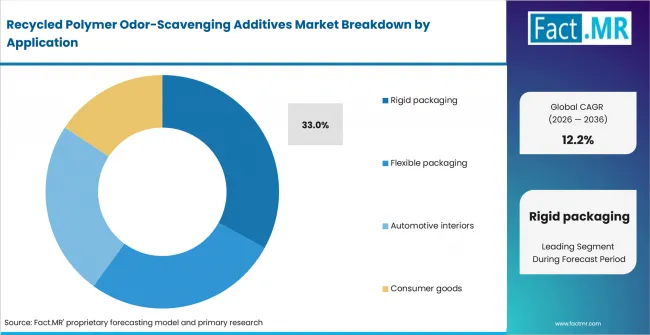
Recycled Polymer Odor Scavenging Additives Market Analysis By Application | Source: Fact.MR
Bottles, closures and thermoformed containers place the recycled polymer close to the consumer and the packaged product. Odor is therefore noticed quickly and can become a release criterion during resin qualification.
Flexible packaging also requires sensory control, but thin-film processing limits additive loading and dispersion choices. Rigid applications provide more room to balance odor performance with mechanical properties.
Why does the Masterbatch category lead Form?
For 2026, the Masterbatch category is projected at 68.0% of Form within the recycled polymer odor-scavenging additives market.
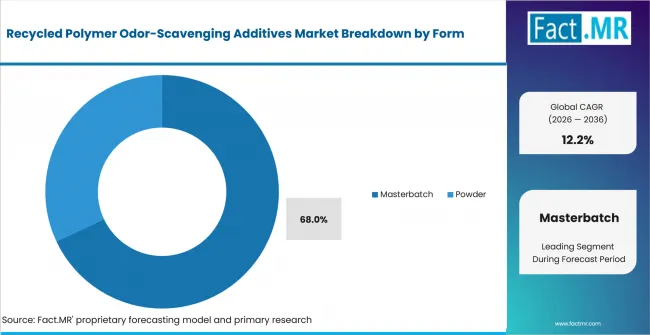
Recycled Polymer Odor Scavenging Additives Market Analysis By Form | Source: Fact.MR
A masterbatch pre-disperses the active material in a compatible carrier, helping the compounder maintain a consistent addition rate. The format also reduces direct handling of fine adsorbent powders.
Powders can lower carrier content and allow flexible formulation, but they require reliable feeding and dust management. Masterbatch use is therefore favored where production consistency and operator handling carry greater weight.
What is accelerating Recycled Polymer Odor-Scavenging Additives Market adoption, and what is holding it back?
Adoption is being driven by recycled-content requirements and sensory qualification for packaging and vehicle interiors, while cost, dosage, transparency trade-offs and uneven odor-testing standards can limit wider use.
Drivers Impact Analysis
| Driver | (~) % Impact on CAGR | Geographic Relevance | Impact Timeline |
|---|---|---|---|
| EU recycled-content mandates raising post-consumer recyclate volumes in packaging | +1.2% | Europe | Near term |
| Automotive VDA 270 odor testing for recycled interior compounds | +1.0% | Europe, Asia-Pacific | Mid term |
| Brand-owner sensory tolerances for recycled-content packaging | +0.8% | Global | Mid term |
| Increasingly mixed post-consumer streams requiring higher odor-scavenger dosage | +0.6% | Global | Long term |
Source: Fact.MR analysis. Updated Aug 20, 2026
Opportunity Impact Analysis
| Opportunity | (~) % Impact on CAGR | Geographic Relevance | Impact Timeline |
|---|---|---|---|
| Combined zeolite-adsorption and chemical-neutralization masterbatches | +0.8% | Global | Mid term |
| Food-contact compliant odor-scavenging systems for high-value recycled packaging | +0.7% | Europe, North America | Mid term |
| Odor-scavenging integration at the mechanical-recycling compounding stage | +0.6% | Europe, Asia-Pacific | Long term |
Source: Fact.MR analysis. Updated Aug 20, 2026
Restraints Impact Analysis
| Restraint | (~) % Impact on CAGR | Geographic Relevance | Impact Timeline |
|---|---|---|---|
| Cost and dosage constraints limiting odor-scavenger use in low-margin flexible packaging | -0.5% | Asia-Pacific, Latin America | Near term |
| Migration and clarity trade-offs of certain adsorbers in transparent food films | -0.4% | Global | Mid term |
| Lack of standardized odor measurement slowing specification in emerging regions | -0.3% | Asia-Pacific, Middle East and Africa | Long term |
Source: Fact.MR analysis. Updated Aug 20, 2026
Which countries are scaling the Recycled Polymer Odor-Scavenging Additives Market through 2036?
- Germany: Germany combines an established mechanical recycling industry with an automotive supply base, supporting odor-scavenging additive use in recycled packaging and interior compounds.
- United States: The United States is scaling post-consumer recycled-content adoption across packaging and automotive, with brand-owner sensory requirements and rising recyclate volumes supporting odor-scavenging demand.
- South Korea: Recyclers supply packaging and automotive converters with tight sensory requirements. Odor-scavenging additives help qualify recovered resin for enclosed interiors and consumer-facing applications where residual volatiles can block use.
- Italy: Italy hosts a substantial food and beverage packaging sector and a growing mechanical recycling base, with recycled-content requirements lifting demand for odor-control technologies in rigid packaging.
- France: Circular-economy policies are increasing attention to recycled-content packaging, where odor-scavenging additives can support sensory qualification.
- Japan: Japan's precision packaging and automotive manufacturers set tight odor and sensory specifications for recycled materials, sustaining refined demand for adsorber and neutralizer systems.
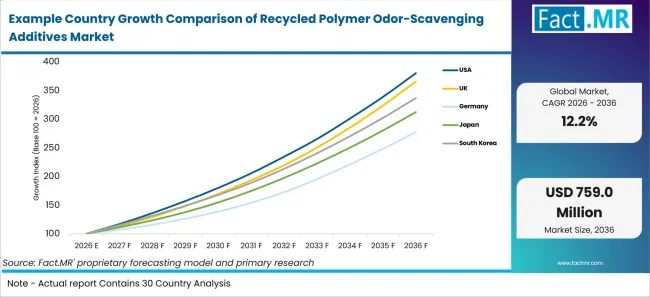
Example Country Growth Comparison Of Recycled Polymer Odor Scavenging Additives Market | Source: Fact.MR
| Country | CAGR (2026-2036) |
|---|---|
| Germany | 12.7% |
| United States | 12.8% |
| South Korea | 14.5% |
| Italy | 11.8% |
| France | 12.5% |
| Japan | 11.9% |
Source: Fact.MR analysis. Updated Aug 20, 2026
What is driving Germany's growth through 2036?
The market in Germany is projected to expand at a 12.7% CAGR from 2026 to 2036.
Germany has an established mechanical recycling industry and automotive supply base. Recycled-content packaging legislation and automotive interior odor testing support use of odor-scavenging masterbatches for rigid packaging and recycled interior compounds.
What is driving growth in the United States through 2036?
From 2026 to 2036, demand in the United States is forecast to grow at a 12.8% CAGR.
The United States is expanding post-consumer recycled-content use across packaging, automotive and consumer goods. Growing brand-owner sensory requirements and rising recyclate volumes are prompting compounders to add zeolite and chemical-neutralising odor-scavenging systems as recycled content increases.
What is driving South Korea's growth through 2036?
South Korea is expected to record a 14.5% CAGR between 2026 and 2036.
South Korea combines an export-oriented mechanical recycling industry with packaging and automobile manufacturers serving markets that demand verified recycled content. Its recyclers convert recovered streams into odor-controlled pellets and parts for packaging and automotive applications.
What is driving Italy's growth through 2036?
Demand in Italy is forecast to rise at an 11.8% CAGR from 2026 to 2036.
Italy hosts a substantial food and beverage packaging sector and a growing mechanical recycling base. Recycled-content requirements across flexible and rigid food packaging are lifting demand for odor-scavenging additives that keep recycled resin sensory-compliant.
What is driving France's growth through 2036?
A 12.5% CAGR is projected for France from 2026 to 2036.
France's circular-economy policies are increasing attention to recycled-content packaging. Odor-scavenging additives can support sensory qualification where residual volatiles would otherwise limit use.
What is driving Japan's growth through 2036?
Between 2026 and 2036, Japan is projected to post an 11.9% CAGR.
Japan's precision packaging and automotive manufacturers impose tight odor and sensory specifications on recycled materials. Japanese compounders favor high-performance adsorber and neutralizer systems that deliver consistent odor control in tolerance-critical applications.
Who leads the Recycled Polymer Odor-Scavenging Additives Market?
The competitive field spans dedicated odor-control masterbatches and broader recycled-polymer additive platforms. Ampacet supplies dedicated odor-scavenging masterbatches, while BASF, Clariant and Avient serve compounders through wider recycling-additive portfolios.
Milliken & Company and Baerlocher provide broader polymer-additive or recycled-resin platforms used by compounders and converters. These offerings are adjacent to dedicated odor-control masterbatches, and supplier fit varies by polymer, processing temperature and qualification target.
Evaluation is usually application-specific. Buyers compare odor reduction after processing and aging, color impact, food-contact documentation where relevant and consistency across variable recyclate lots. Trial support is therefore central to commercial conversion.
Which companies operate across odor control and recycled-polymer additives?
Key companies profiled include BASF; Clariant; Avient; Ampacet; Milliken & Company; and Baerlocher.
- BASF
- Clariant
- Avient
- Ampacet
- Milliken & Company
- Baerlocher
Bibliography
- European Union. Directive (EU) 2019/904 on selected single-use plastic products.
- European Union. Regulation (EU) 2025/40 on packaging and packaging waste.
- German Association of the Automotive Industry. VDA 270 determination of odor characteristics of vehicle interior materials.
- International Organization for Standardization. ISO 12219 series on vehicle interior air.
- U.S. Food and Drug Administration. Guidance on the use of recycled plastics in food packaging.
- BASF. Functional additive documentation for recycled polymers.
- Clariant. Masterbatch and additive documentation for recycled polymers.
- Avient. Additive solutions for recycled-polymer compounds.
- Ampacet. Odor Scavenger masterbatch documentation.
- Ampacet. OdorClear additive documentation for recycled resins.
- Milliken & Company. Polymer-additive documentation for recycled content.
- Baerlocher. Functional additive documentation for recycled polymer processing.
This Report Answers
- The report segments odor-scavenging additives by mechanism, recycled polymer, application and delivery form.
- It distinguishes physical adsorption from chemical neutralization and fragrance-based masking.
- Country analysis considers recycled-content use in packaging, automotive interiors and consumer products.
- The competitive review focuses on masterbatch delivery, polymer compatibility and sensory-testing support.
- The scope excludes deodorization equipment and additives used only for color, stabilization or processing.
What does the Recycled Polymer Odor-Scavenging Additives Market cover?
Odor-scavenging additives used to remove or neutralize odor-forming volatiles in recycled polymers, including physical zeolite and silica adsorbers, chemical neutralizers and masking or fragrance systems.
Applications across recycled PP, PE, PET and PS in rigid and flexible packaging, automotive interiors and consumer goods, available in masterbatch and powder forms.
What is included in the scope?
Physical adsorbers, chemical neutralizers and masking systems available as masterbatch and powder for compounding recycled polymers at the pelletization stage.
Odor-scavenging additives used in recycled-content rigid packaging, flexible films, automotive interior compounds and consumer-goods resins across the tracked applications.
What is excluded from the scope?
Virgin-polymer-only odor control, deodorising washing or gas-stripping processes in recycling lines, and non-odor functional additives such as nucleating agents.
Finished recycled packaging and automotive parts, odor-testing equipment and analytical services sold separately from additive supply.
How Was the Analysis Built?
The assessment includes additives formulated to reduce or neutralize residual odor in recycled thermoplastics during or after melt processing.
- Primary Research: Interviews involve recyclers, compounders, converters and quality teams that conduct sensory or instrumental odor evaluation.
- Secondary Research: Packaging rules, automotive interior test methods, recycling guidance and official supplier documentation inform the analysis.
- Market Sizing and Forecasting: Demand is modeled from recyclate volume, polymer mix, application sensitivity, additive form and typical treatment rates.
- Validation and Updates: Odor-control products are separated from antioxidants, color correctors and general process aids, and country figures are reconciled to the stated segment structure.
Segmentation
What is the report's scope and coverage?
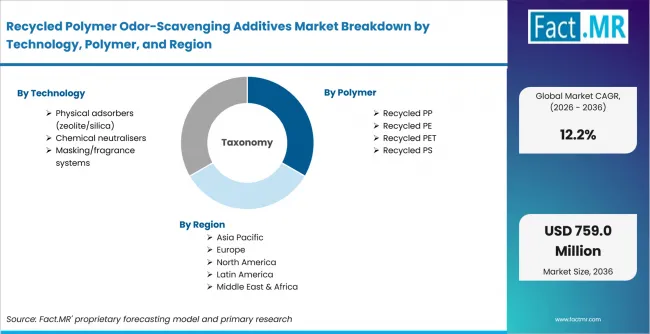
Recycled Polymer Odor Scavenging Additives Market Breakdown By Technology, Polymer, And Region | Source: Fact.MR
| Attribute | Details |
|---|---|
| Quantitative Units | USD Million |
| Market Definition | Odor-absorbing or odor-neutralizing additives used to reduce residual volatile compounds and malodors in recycled plastics. |
| Segments Covered | Technology; Polymer; Application; Form |
| Regions Covered | North America; Latin America; Europe; East Asia; South Asia and Oceania; Middle East and Africa |
| Countries Covered | Germany; United States; South Korea; Italy; France; Japan |
| Key Companies Profiled | BASF; Clariant; Avient; Ampacet; Milliken & Company; Baerlocher |
| Forecast Period | 2026 to 2036 |
| Base Year | 2025 |
| Market Value, 2026 | USD 240 million |
| Market Value, 2036 | USD 759 million |
| CAGR, 2026-2036 | 12.2% |
| Absolute Opportunity | USD 519 million |
| Approach | Demand is modeled from recyclate volume, polymer mix, application sensitivity, additive form and typical treatment rates. |
Source: Fact.MR analysis. Updated Aug 20, 2026
How is the market segmented?
-
By Technology:
- Physical adsorbers (zeolite/silica)
- Chemical neutralizers
- Masking/fragrance systems
-
By Polymer:
- Recycled PP
- Recycled PE
- Recycled PET
- Recycled PS
-
By Application:
- Rigid packaging
- Flexible packaging
- Automotive interiors
- Consumer goods
-
By Form:
- Masterbatch
- Powder
-
By Region:
- North America
- Latin America
- Europe
- East Asia
- South Asia and Oceania
- Middle East and Africa
Frequently Asked Questions
What is the Recycled Polymer Odor-Scavenging Additives Market value in 2026?
At what CAGR is the market projected to grow?
What is the projected market value by 2036?
Which Technology category has the leading share?
Which Polymer category has the leading share?
Which Application category has the leading share?
Which Form category has the leading share?
What CAGR is projected for South Korea?
What is the primary demand driver?
What is the main restraint?
Which companies are active across odor control and recycled-polymer additives?
Who worked on this report


Preview the report firsthand - request a free sample
Free SampleGet the brochure for pricing and purchase details
Download PDF