- Market Value (2025): USD 726.4 Mn
- Estimated Value (2026): USD 800.0 Mn
- Forecast Value (2036): USD 2100.0 Mn
- CAGR (2026-2036): 10.1%
What is the Recycling Compatibilizer Additives Market forecast?
USD 800.0 million in 2026 to USD 2,100.0 million by 2036, at 10.1% CAGR.
- The market crossed USD 726.4 million in 2025 as label production lines worked through early approval steps for plastic recycling additives and compatibilizers. Reviews trace a line from sorting and washing through to the melt feed, then from the compound to label release and finished-package requirements.
- Demand rises by USD 1,300.0 million (incremental opportunity between 2026 and 2036) as Mixed polyolefins and Maleic anhydride graft find clearer use cases.
- The 10.1% CAGR reflects a market still under technical review, largely because label release and wash water load keep shifting the goalposts. Formulations have to stay credible after washing and final conversion, not just in the first trial batch.
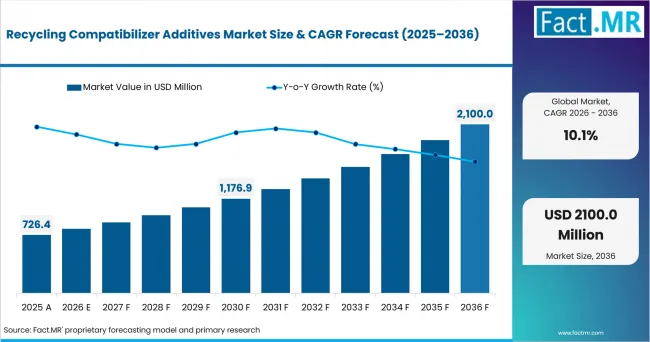
Recycling Compatibilizer Additives Market Market Value Analysis | Source: Fact.MR
What are the defining numbers behind Recycling Compatibilizer Additives Market growth?
The absolute opportunity comes to USD 1,300.0 million by 2036. Mixed polyolefins lead the Polymer Stream view at 39% share in 2026, worth USD 312.0 million.
- Demand Drivers in the Market
- Wash facilities prefer materials that do not interfere with sorting systems during normal operation. The quality of the sorted feed determines the mix of polymers and contaminants entering the process, so compatibilizer selection has to begin with a clear understanding of that material. Poorly controlled feedstock can make dosage trials look inconsistent even when the real issue lies with the incoming material.
- Buyers are more willing to adopt maleic anhydride graft when it can be linked to lower costs, less waste, or fewer rejected batches. They want to see clear improvements in the final compound, including better material structure, more stable processing, and reliable finished properties. Testing the additive on its own is not enough because the production team still has to work out the right dosage and operating conditions.
- Packaging manufacturers need evidence from actual packaging waste streams before approving a material. Weak bonding between layers often becomes visible during handling, processing, or delamination. Recycling also brings added concerns such as label removal and wash-water performance. The most useful trials follow the material from the mixed waste stream through compounding and final production.
- Demand for impact improvement is strongest where flake quality varies from batch to batch. Poor mixing between polymer phases can weaken the material.
- Testing works best when each stage contributes to the same record. The incoming material shows its composition and contamination levels. Processing trials show how the blend behaves under shear. Final production checks confirm whether the material keeps its properties and runs consistently. Adoption becomes easier when all three stages are evaluated together
- Key Segments Analyzed
- By Polymer Stream: Mixed polyolefins are expected to hold a 39% share in 2026. Demand is driven by the difficulty of combining recycled polymers that do not naturally blend well. Sorting quality and feedstock consistency have a major effect on the final material.
- By Chemistry: Maleic anhydride graft is projected to account for 34% of the market in 2026. Buyers compare it with epoxy-functional additives, block copolymers, reactive compatibilizers, and chain extenders. The final choice depends on the moisture level and the actual processing conditions.
- By Application: Packaging is expected to hold a 33% share in 2026. Approval depends on more than the final product. It also involves flake quality, label removal, wash performance, melt processing, and finished material properties.
- By Function: Impact improvement is projected to lead with a 36% share in 2026. It shows whether the additive is helping the mixed material hold together under stress. Other important functions include melt strength, blend compatibility, delamination resistance, and odor reduction.
- By End User: Recyclers are expected to hold a 29% share in 2026. They are closest to the incoming material and can identify changes in sorting quality, contamination, and moisture. That information later supports compounding, production, product approval, and resin selection.
- Analyst Opinion at Fact.MR
- Shambhu Nath Jha, Senior Analyst at Fact.MR, states this market as a practical processing challenge. Mixed recycled plastics often contain materials that do not blend easily. An additive creates value when it improves how those materials hold together and keeps processing stable during customer trials. Chemistry alone is not enough, results can change when the material mix or processing conditions change. The strongest products are those whose effect can be clearly separated from other factors in the process.
- Strategic Implications
- Companies need to prove out mixed polyolefins under actual customer conditions, not idealized ones.
- Product teams should run candidate and approved grades side by side before touching a recipe.
- Test records should be in order before the product line is extended. Those records need to identify stream, residence conditions, and production results.
- Regional teams should keep an eye on China, whose 13.7% CAGR is the fastest country rate in this view. Application support close to the customer lets teams investigate morphology or line fit on the exact material used in the trial.
Packaging policy is pushing recyclability considerations ahead of shelf placement decisions, which puts additives under evaluation alongside flake quality and label release from the start. But a compatibilizer can't fix every upstream weakness. Poor sorting and moisture that nobody controlled can still narrow the compounding window regardless of the formulation. Companies need to be upfront about what feed quality a formulation can tolerate and what production result it can actually deliver.
Country rates run Germany 11.7%, Brazil 10.6%, and United States 9.6%. The ranking through 2036 comes down to demand pull and how much evidence-building work has already been done. Local access to the feed and the production record helps separate a genuine chemistry fit from problems that are really about dose, moisture, shear, or residence time
How does the Recycling Compatibilizer Additives Market break down by segment?
Mixed polyolefins lead Polymer Stream at 39%, and Maleic anhydride graft leads Chemistry at 34%.
Where is Polymer Stream demand strongest?
Mixed polyolefins hold 39% share in 2026, and their lead puts phase separation squarely at the center of how buyers choose.
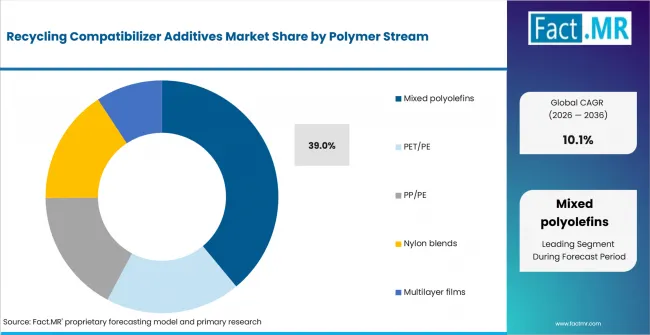
Recycling Compatibilizer Additives Market Analysis By Polymer Stream | Source: Fact.MR
Composition, contamination, and moisture rarely match the original trial batch exactly, and under shear those inputs shape domain breakup and interfacial stabilization. That is why morphology and melt handling are judged together rather than separately. PET/PE, PP/PE, Nylon blends, and Multilayer films still matter for their own mixed-stream problems, each needing its own chemistry fit and process window. Qualification has to show how dose responds to sorting quality, and whether tensile and impact retention make it through conversion without tipping into over-treatment. Production trials close the loop.
What supports Chemistry adoption?
Maleic anhydride graft holds 34% share in 2026, with buyers weighing it against Epoxy functional, Block copolymer, Reactive compatibilizer, and Chain extender alternatives.
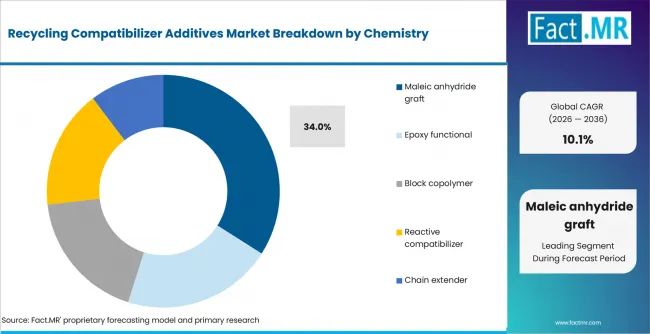
Recycling Compatibilizer Additives Market Analysis By Chemistry | Source: Fact.MR
Both reactive and non-reactive routes need evidence drawn from the intended stream. Where a reaction is involved, moisture, temperature history, residence time, and mixing sequence all become part of qualification. Even a non-reactive route still needs enough shear to distribute the additive and generate interfacial influence. The chemistry name by itself settles nothing. Testing has to map dose against domain size, adhesion, melt response, and mechanical retention, then confirm the selected window still works once recycled-feed variation is factored in. Conversion is what confirms repeatability.
Which Application dominates?
Packaging holds 33% share in 2026, and this application is where recycling and conversion end up on one approval path.
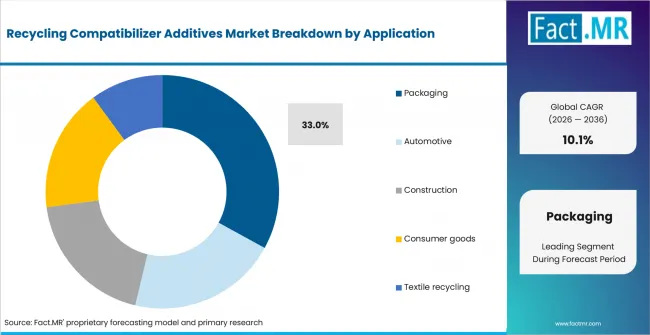
Recycling Compatibilizer Additives Market Analysis By Application | Source: Fact.MR
Sorting sets the blend entering the wash. Label release and wash water load shape the cleaned stream from there. Compounding decides whether phases stay coarse or turn into a controlled morphology. Production checks then judge melt stability, surface condition, tensile response, impact retention, and delamination, all in one pass. Automotive, Construction, Consumer goods, and Textile recycling remain part of the taxonomy, each shifting qualification toward a different final use. Packaging grades advance when a single formulation can connect upstream flake quality to downstream package performance under ordinary plant conditions, not just favorable ones.
What leads the Function segment?
Impact improvement holds 36% share in 2026.
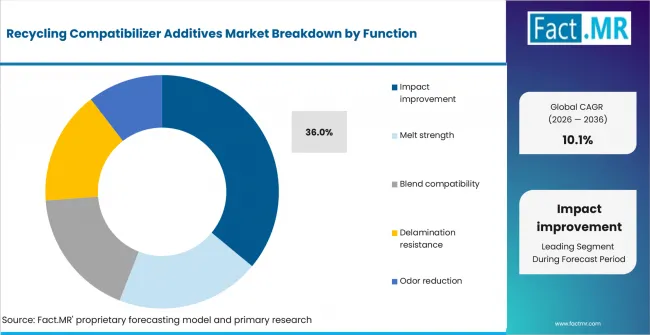
Recycling Compatibilizer Additives Market Analysis By Function | Source: Fact.MR
A weak interface tends to show itself during rapid loading or handling, but impact numbers only mean something read alongside tensile behavior and processability. Fixing one property while tightening melt control isn't actually solving the production problem. Melt strength, Blend compatibility, Delamination resistance, and Odor reduction fill out the rest of the Function taxonomy, and dose optimization matters across all of them. Too little treatment leaves large domains and poor adhesion. Too much risks the opposite problem, since buyers are trying to protect an existing balance of processing and finished properties, not chase one number in the lab.
How does End User shape demand?
Recyclers hold 29% share in 2026.
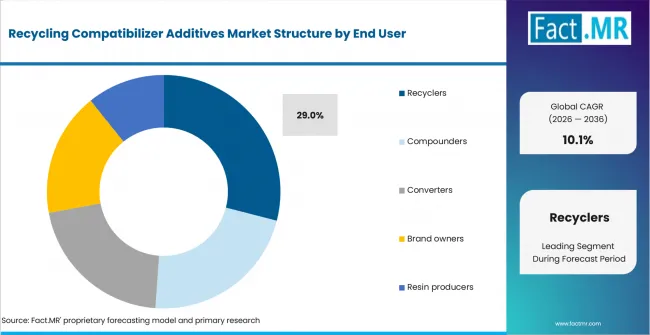
Recycling Compatibilizer Additives Market Analysis By End User | Source: Fact.MR
This stage records sorting quality, wash history, contamination, moisture, and incoming polymer streams. Compounding then uses that record to select chemistry and set a mixing window. Production checks whether the material runs clean, without unacceptable shifts in pressure, melt behavior, appearance, tensile response, impact behavior, or delamination. Application review ties the results to final use, while resin selection remains part of the process. Recyclers lead because they sit closest to feed variability, and linking those records to final qualification lets later lots be measured against a known morphology and property window instead of starting from scratch.
What is accelerating Recycling Compatibilizer Additives Market adoption, and what is holding it back?
Flake quality is the main thing accelerating adoption, while qualification cost and process fit are what hold it back. Better characterization gives chemistry and dose selection a stable starting point, and it also flags when sorting, contamination, or moisture has drifted outside what was approved in trial. Approval moves faster when the same material passes cleanly through washing, compounding, and conversion. Unexplained failures traced to feed quality, chemistry fit, mixing, residence time, or over-treatment are what slow everything back down.
Drivers Impact Analysis
| DRIVER | (~) % IMPACT ON CAGR | GEOGRAPHIC RELEVANCE | IMPACT TIMELINE |
|---|---|---|---|
| Flake quality control in Mixed polyolefins | +0.8% | China and export markets | Medium term (2-4 years) |
| Label release testing | +0.6% | Europe and North America | Short term (<= 2 years) |
| Mixed polyolefins approval programs | +0.5% | Asia Pacific | Medium term (2-4 years) |
| Local support near label production sites | +0.4% | Global | Long term (>= 4 years) |
Source: Fact.MR analysis. Updated Jul 15, 2026
- Flake quality control in Mixed polyolefins gives teams something measurable to start from. Documented blend composition and contamination levels let morphology and property changes get traced back to the compatibilizer, rather than to a feed that quietly shifted underneath it. That makes dose optimization and repeat results much easier to defend.
- Label release testing ties the additive directly to the package's recycling route. It shows whether the material actually reaching washing and sorting matches what compounding assumed, which lets interfacial improvement get judged against real downstream approval checks.
- Mixed polyolefins approval programs build a common route from feed inspection through to the converted article. Evidence can be tied to lower rework or fewer rejected runs, and a shared method keeps the stream and acceptance criteria consistent across whichever chemistry is being trialed.
- Local support near label production sites pays off when scale-up shifts a result. Teams can inspect feed, dose, shear, residence behavior, and finished material while the production evidence is still fresh, cutting diagnosis time without loosening the approval bar.
Opportunity Impact Analysis
| OPPORTUNITY | (~) % IMPACT ON CAGR | GEOGRAPHIC RELEVANCE | IMPACT TIMELINE |
|---|---|---|---|
| Grades tuned for Mixed polyolefins | +0.5% | Global | Medium term (2-4 years) |
| Application labs for Maleic anhydride graft | +0.4% | Asia Pacific and Europe | Short term (<= 2 years) |
| Rule-ready documentation | +0.4% | Europe and United Kingdom | Medium term (2-4 years) |
| Local trials with wash facilities | +0.3% | India and Brazil | Long term (>= 4 years) |
Source: Fact.MR analysis. Updated Jul 15, 2026
- Grades tuned for Mixed polyolefins narrow the formulation brief down to the phase boundary itself. The value shows up when customers repeat the original mixing and property checks on their own stream and get comparable morphology and conversion behavior back.
- Application labs for Maleic anhydride graft can separate chemistry fit from equipment effects before any plant time gets used. That work should define the feed, dose, mixing sequence, and residence window first, then run the customer's own tensile, impact, and process checks against it.
- Rule-ready documentation ties recycled feed, additive lot, recipe, process conditions, and finished result together in one record. When contamination or moisture shifts, that record shows whether the material is still inside the qualified boundary or has drifted out.
- Local trials with wash facilities tie label release and wash water load directly to the compounding feed. Moving washed material straight into a plant trial lets buyers check laboratory assumptions against actual line morphology and processability.
Restraints Impact Analysis
- Qualification cost eats into mixed feed, compounding capacity, production time, and laboratory review all at once. Trials have to separate ordinary stream variability from the additive's actual effect, and buyers balk when projected savings don't justify that workload.
- Fit limits in Maleic anhydride graft slow switching whenever the chemistry doesn't match the stream or process window on offer. Moisture and residence conditions all complicate the review. Testing has to confirm real adhesion rather than assume one chemistry works across every polymer combination.
- Documentation burden climbs because approval attaches to the compound and its application path, not just the additive. Customers need an unbroken record from sorting and washing through dose, extrusion, conversion, and property testing. Gaps in that record make morphology and repeatability hard to verify.
- Scale-up risk bites hardest in High-volume plants, where shear and residence conditions diverge from whatever the lab used. Domain breakup, additive distribution, and line stability can all drift outside the tested window. The cost of an approved recipe keeps customers cautious until production evidence actually repeats.
| RESTRAINT | (~) % IMPACT ON CAGR | GEOGRAPHIC RELEVANCE | IMPACT TIMELINE |
|---|---|---|---|
| Qualification cost | -0.4% | Global production | Medium term (2-4 years) |
| Fit limits in Maleic anhydride graft | -0.3% | Global | Short term (<= 2 years) |
| Documentation burden | -0.3% | Europe and North America | Medium term (2-4 years) |
| Scale-up risk | -0.2% | High-volume plants | Long term (>= 4 years) |
Source: Fact.MR analysis. Updated Jul 15, 2026
Which countries are scaling Recycling Compatibilizer Additives Market fastest?
Germany 11.7%, Brazil 10.6%, and United States 9.6%
.webp "Top Country Growth Comparison Recycling Compatibilizer Additives Market Cagr (2026 2036)")
Top Country Growth Comparison Recycling Compatibilizer Additives Market Cagr (2026 2036) | Source: Fact.MR
The country ranking spans North America, Europe, Asia Pacific, Central and South America, and the Middle East and Africa. Country performance tracks local manufacturing activity, customer testing, and how quickly a mixed-stream formulation can move from sample work into repeat supply. What matters as infrastructure here is the chain linking sorting, compounding, production, and technical support around the same feedstock evidence.
| COUNTRY | CAGR |
|---|---|
| China | 13.7% |
| India | 12.7% |
| Germany | 11.7% |
| Brazil | 10.6% |
| United States | 9.6% |
Source: Fact.MR analysis. Updated Jul 15, 2026
What is driving Germany's growth through 2036?
Germany is anticipated to advance at an 11.7% CAGR, with domestic manufacturing activity.
Customer testing around plastic recycling additives and compatibilizers behind the demand. Field feedback ahead of scale orders matters here because documentation and qualification carry real weight in the evidence chain. A candidate has to connect mixed-stream identity with chemistry, dose, moisture, compounding settings, morphology, and converted performance, all as one story. Nearby technical work helps investigate weak impact or unstable melt without pinning every deviation on the additive by default. Approval ultimately depends on interfacial improvement surviving actual shear, residence, and conversion while packaging and recycling checks stay intact, with production evidence closing out the case.
How is demand growing in Brazil?
Brazil is expected to record a 10.6% CAGR, underpinned by local manufacturing activity
Customer testing of plastic recycling additives and compatibilizers. Local wash-facility trials connect wash evidence to the compounding feed directly. Keeping flake identity and process records intact helps separate poor sorting or residual moisture from a genuine chemistry fit issue. Plant trials need to show that dose controls morphology without upsetting melt behavior, tensile response, impact retention, or the production window. Repeat supply depends on consistent behavior that doesn't need special handling routine production can't sustain, and one shared material record is needed to make that case.
What supports the United States outlook?
The United States is estimated to record a 9.6% CAGR, with domestic manufacturing activity and customer testing around plastic recycling additives and compatibilizers supporting the outlook.
Europe and North America carry particular relevance for label release testing and documentation burden. Local contact links feed data, melt control, and final approval whenever contamination, moisture, or polymer ratios shift. That proximity is what lets teams figure out whether the fix is better sorting, a different dose, revised shear, or a different chemistry altogether. Production carries the process risk, so scale orders demand property retention and line stability in the intended stream, with documented morphology rounding out the approval case.
Who leads the Recycling Compatibilizer Additives Market?
Dow, BASF, Arkema, Avient, Clariant, and BYK are among the leading players in this market. Competition here centers on proof under customer conditions and supply support, and the evidence trail follows the mixed feed through compounding.
Companies compete on application records and qualification support. Buyers have to separate additive performance from sorting quality and moisture. Companies earn position by nailing down a workable dose window and reproducing the production result reliably.
Which companies are the key providers?
- Dow
- BASF
- Arkema
- Avient
- Clariant
- BYK
How is the market segmented?
-
By Polymer Stream
- Mixed polyolefins
- PET/PE
- PP/PE
- Nylon blends
- Multilayer films
-
By Chemistry
- Maleic anhydride graft
- Epoxy functional
- Block copolymer
- Reactive compatibilizer
- Chain extender
-
By Application
- Packaging
- Automotive
- Construction
- Consumer goods
- Textile recycling
-
By Function
- Impact improvement
- Melt strength
- Blend compatibility
- Delamination resistance
- Odor reduction
-
By End User
- Recyclers
- Compounders
- Converters
- Brand owners
- Resin producers
-
By Region
- North America
- United States
- Canada
- Europe
- Germany
- United Kingdom
- France
- Italy
- Spain
- Asia Pacific
- Japan
- South Korea
- Australia
- Central & South America
- Brazil
- Argentina
- Mexico
- Chile
- Middle East & Africa
- UAE
- Saudi Arabia
- South Africa
- North America
Bibliography
- European Parliament, & Council of the European Union. (2025). Regulation (EU) 2025/40 of the European Parliament and of the Council of 19 December 2024 on packaging and packaging waste. Official Journal of the European Union.
- Association of Plastics Recyclers. (2026, March 30). Critical guidance protocol for PE film and flexible packaging (FPE-CG-01).
- Avient Corporation. (2025, March 26). Colorants and additives for recycled resins: Electrical and electronic applications.
- Association of Plastics Recyclers. (2025, July 7). APR benchmark testing for polyethylene films and flexible packaging (FPE-B-01).
This Report Addresses
- This report provides strategic intelligence on the recycling compatibilizer additives market across polymer stream and chemistry choices. It follows incompatible phases from variable recycled feed through melt mixing, interfacial modification, and final qualification.
- Segment analysis covers mixed polyolefins and maleic anhydride graft as the 2026 share leaders, while retaining every polymer stream, chemistry, application, function, and end user option in the defined taxonomy.
- Regional analysis evaluates China and India, with Germany, Brazil, and the United States completing the growth-country set, while the full regional and country taxonomy stays in the segmentation structure.
- Competitive analysis profiles Dow and BASF, followed by Arkema, Avient, Clariant, and BYK, keeping the assessment focused on customer evidence, process fit, and repeat support during mixed-stream qualification.
- Use-case assessment covers mixed polyolefins and adjacent applications within plastic recycling additives and compatibilizers, examining how sorting quality, contamination, moisture, dose, shear, residence time, morphology, and property retention shape approval.
What does the Recycling Compatibilizer Additives Market cover?
Coverage includes Mixed polyolefins, Maleic anhydride graft, and the applications where customers buy this compatibilizing function specifically. The complete taxonomy stays in scope. Inclusion comes down to whether a product is sold to improve compatibility or processability in a mixed or contaminated recycled plastic stream.
The value here is in changing how incompatible phases behave together during and after melt processing. Buyers want to know whether interfacial adhesion and domain morphology improve enough to protect tensile and impact behavior, melt handling, and final conversion. Sorting quality, labels, washing, contamination, and moisture all matter because they define the stream the formulation actually has to work with.
This purchased function is what separates the market from general chemical supply. A parent resin or commodity additive doesn't fall inside the boundary just because it happens to be present in a recycling plant. It has to be sold and qualified for the named compatibilizer role, in the listed polymer streams and applications.
What is included in the scope?
The scope includes additives used to improve compatibility.
mechanical properties, and processability of mixed or contaminated recycled plastic streams, spanning Mixed polyolefins, the listed chemistry options, the listed applications, the functional set, and the named end users buying that same function.
Included revenue covers approved grades, use support, and repeat deliveries once qualification is done. The buyer path can run through sorting and wash review, feed characterization, dose selection, compounding, morphology checks, tensile and impact testing, conversion trials, and whatever application evidence is required to keep supply approved.
What is excluded from the scope?
Parent products that don't deliver the defined compatibilizing function are excluded.
Equipment-only products sit outside the boundary too, even where sorting equipment, washers, dryers, compounding lines, or conversion lines have a real influence on whether the additive succeeds.
Commodity materials are excluded unless they're sold for a named application within the recycling compatibilizer additives market. General recycling activity, unqualified resin supply, and unrelated process aids don't get counted just because they happen alongside mixed recycled plastics.
How was the analysis built?
The analysis combines public reference review, country signals, segment shares, company mapping, and forecast checks.
Technical interpretation follows the chain from sorting and washing through compounding, phase morphology, property retention, and final production approval, keeping the stated market boundary separate from the broader recycling and polymer-additives industries.
- Primary Research
- Primary research draws on discussions across formulation, purchasing, distribution, and application functions working around plastic recycling additives and compatibilizers. The discussion framework covers stream variability, contamination, moisture, chemistry choice, dose, mixing, residence behavior, interfacial adhesion, mechanical retention, and qualification risk.
- Desk Research
- Desk research draws on public agencies, standards bodies, technical reports, and official industry statistics, providing packaging and recycling context, country manufacturing signals, chemical criteria, and the public checks used to frame customer testing.
- Market-Sizing and Forecasting
- Forecast work links value movement, share structure, named companies, and country-level adoption signals. Operational analysis preserves every market value, CAGR, segment share, country rate, company, scope boundary, segment entry, and forecast year, while examining how mixed-stream qualification affects commercial timing.
- Data Validation and Update Cycle
- Validation checks company coverage, public policy direction, country manufacturing activity, and the process risk customers carry. Updates track whether trial results stay credible as feed quality, contamination, moisture, dose, shear, residence time, and production conditions change.
Segmentation
What is the report's scope and coverage?
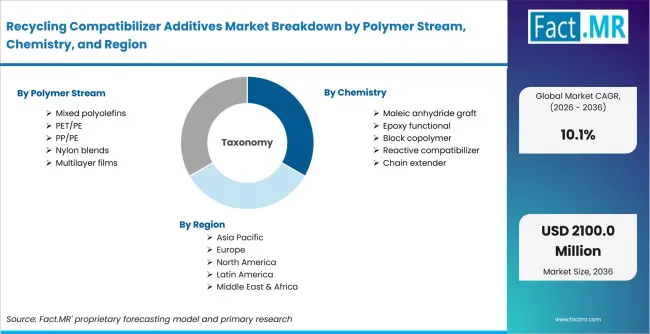
Recycling Compatibilizer Additives Market Breakdown By Polymer Stream, Chemistry, And Region | Source: Fact.MR
The market covers additives sold to improve compatibility, mechanical properties, and processability of mixed or contaminated recycled plastic streams. Coverage stops at that purchased function and the applications where it creates value. It doesn't stretch to every resin, commodity material, or piece of equipment involved in recycling. What counts is what's sold specifically to help manage incompatible phases and qualify the resulting compound.
| Attribute | Details |
|---|---|
| Quantitative Units | USD Million in 2026 to USD Million by 2036 at CAGR |
| Market Definition | Additives used to improve compatibility, mechanical properties, and processability of mixed or contaminated recycled plastic streams. |
| Polymer Stream | Mixed polyolefins, PET/PE, PP/PE, Nylon blends, Multilayer films |
| Chemistry | Maleic anhydride graft, Epoxy functional, Block copolymer, Reactive compatibilizer, Chain extender |
| Application | Packaging, Automotive, Construction, Consumer goods, Textile recycling |
| Function | Impact improvement, Melt strength, Blend compatibility, Delamination resistance, Odor reduction |
| End User | Recyclers, Compounding operations, Downstream manufacturing, Product companies, Resin producers |
| Regions Covered | North America, Europe, Asia Pacific, Central and South America, Middle East and Africa |
| Countries Covered | Germany, Brazil, United States |
| Key Companies Profiled | Dow, BASF, Arkema, Avient, Clariant, BYK |
| Forecast Period | 2026 to 2036 |
| Approach | Hybrid top-down and bottom-up approach using Plastic Recycling Additives / Compatibilizers, segment shares, country growth, company mapping, and technical validation |
Source: Fact.MR analysis. Updated Jul 15, 2026
Frequently Asked Questions
Which Polymer Stream leads the Recycling Compatibilizer Additives Market?
Which Chemistry leads the Recycling Compatibilizer Additives Market?
Which Application leads the Recycling Compatibilizer Additives Market?
Which Function leads the Recycling Compatibilizer Additives Market?
Which End User leads the Recycling Compatibilizer Additives Market?
What is the primary driver in the Recycling Compatibilizer Additives Market?
What is the main restraint in the Recycling Compatibilizer Additives Market?
Why is Mixed polyolefins important?
Why do buyers continue testing recycling compatibilizer additives?
Who worked on this report


Preview the report firsthand - request a free sample
Free SampleGet the brochure for pricing and purchase details
Download PDF