- Base Value(2025): 13.0 Bn
- Estimated Value(2026): 14.2 Bn
- Forecast Value (2036): 34.2 Bn
- CAGR (2026 - 2036): 9.2%
Plastic Chemical Recycling Catalysts Market Forecast and Outlook By Fact.MR
In 2025, the global plastic chemical recycling catalysts market was valued at USD 13.0 billion. Based on Fact.MR analysis, demand for plastic chemical recycling catalysts is estimated to grow to USD 14.2 billion in 2026 and USD 34.2 billion by 2036. FACT.MR projects a CAGR of 9.2% during the forecast period.
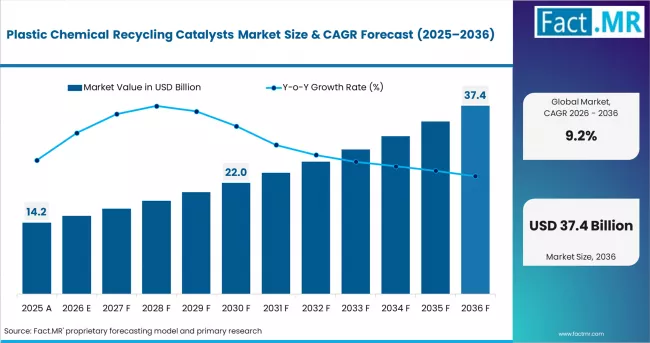
Plastic Chemical Recycling Catalysts Market Market Value Analysis | Source: Fact.MR
| Metric | Value |
|---|---|
| Estimated Value in 2026 | USD 14.2 billion |
| Forecast Value in 2036 | USD 34.2 billion |
| Forecast CAGR (2026 to 2036) | 9.2% |
Source: Fact.MR analysis. Updated Apr 17, 2026
Summary of the Plastic Chemical Recycling Catalysts Market
- Market Definition
- The market covers zeolite-based, metal-based, and enzyme-based catalysts used in pyrolysis, depolymerization, and gasification of post-consumer plastic waste streams to produce fuels, monomers, and chemical feedstocks sold to industrial recyclers globally.
- Demand Drivers
- EU Extended Producer Responsibility legislation mandates certified recycled plastic content, directly driving catalyst procurement at chemical recycling plants scaling to meet compliance deadlines.
- China's national plastic waste processing targets and state-backed recycling infrastructure investment are accelerating zeolite and metal catalyst adoption at pyrolysis facilities.
- U.S. petrochemical firms are co-investing in chemical recycling hubs, creating sustained catalyst demand as feedstock volumes and plant throughput expand through 2036.
- Key Segments Analyzed
- By Catalyst Type: Zeolite-based catalysts lead with 43% share in 2026, valued for selectivity and regeneration capability in polyolefin pyrolysis applications.
- By Process Type: Pyrolysis leads with 50% share driven by commercial scale-up maturity and compatibility with mixed polyolefin waste feedstocks.
- By Application: Polyolefins (PE, PP) lead with 58% share, reflecting the dominant volume of post-consumer polyolefin plastic waste globally.
- By Geography: China leads 12.3% CAGR through scale-up of government-mandated recycling infrastructure.
- Analyst Opinion at FACT.MR
- Shambhu Nath Jha, Principal Consultant at Fact.MR, opines, 'CXOs will find this report decisive for identifying which catalyst systems hold commercial-scale performance credentials versus those still bottlenecked by contaminated feedstock sensitivity at current EPR compliance timelines.'
- Strategic Implications
- Invest in zeolite catalyst regeneration technology. This reduces operating cost and supports high-volume EPR-compliant recycling plant contracts.
- Develop metal catalyst systems tolerant to mixed and contaminated post-consumer feedstock. Supports scalable pyrolysis deployment in emerging markets.
- Establish certified catalyst supply agreements with EU and UK chemical recyclers before 2027 EPR compliance deadlines create supply constraints.
- Methodology
- Based on catalyst shipment volumes and pricing by type and process. Validated using 2024-2025 plant commissioning and producer revenue data.
- Uses EU EPR, EPA, and IEA plastic waste regulatory sources. Supports regional demand and compliance analysis.
- Forecasts include pyrolysis capacity growth, EPR compliance timelines, and e-commerce plastic waste stream expansion data.
The market is expected to generate USD 21.2 billion in absolute opportunity. This reflects transformational rather than incremental growth. Demand is accelerated by Extended Producer Responsibility mandates and plastics circularity targets. Growth is moderated by high catalyst replacement costs, contamination sensitivity of zeolite systems, and feedstock consistency challenges in mixed post-consumer plastic waste streams.
China leads at 12.3% CAGR through rapid scale-up of pyrolysis catalyst infrastructure and government-mandated plastic waste processing targets. India follows at 11.7% through EPR regulation introduction and domestic catalyst manufacturing investment. The United States records 10.8% through petrochemical industry co-investment in chemical recycling hub development. Germany records 10.0% through EU Packaging Regulation compliance driving certified recycled content procurement. Japan records 8.5% through established circular economy policy and corporate recycling commitments. Mature markets generate compliance-driven replacement demand rather than volume growth, constrained by feedstock segregation infrastructure gaps.
Segmental Analysis
Plastic Chemical Recycling Catalysts Market Analysis by Catalyst Type
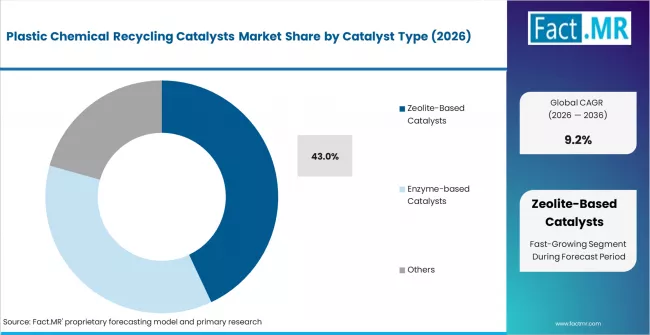
Plastic Chemical Recycling Catalysts Market Analysis By Catalyst Type | Source: Fact.MR
Based on FACT.MR's plastic chemical recycling catalysts market report, consumption of zeolite-based catalysts is estimated to hold 43% share in 2026. Zeolite systems dominate due to their thermal stability, acid-site tunability, and proven regeneration cycles in commercial pyrolysis reactors processing polyolefin-rich mixed plastic waste.
- BASF Catalyst Investment: BASF SE expanded its zeolite catalyst production for chemical recycling applications in Ludwigshafen in 2024, targeting pyrolysis plant operators scaling under EU PPWR compliance obligations. The investment included dedicated R&D for contamination-tolerant formulations. [5]
- W.R. Grace Technology Development: W.R. Grace launched its UNIPOL-CR catalyst series in 2025, specifically designed for mixed plastic pyrolysis with enhanced tolerance to halogenated contaminants. The product targets North American and European recycling facilities. [6]
- Regeneration Cycle Trend: Zeolite catalyst regeneration capability is becoming a procurement criterion at commercial recycling plants. Operators in Germany and the Netherlands reported catalyst regeneration cycle specifications in 2024 contract tenders, reducing total cost of ownership versus single-use metal catalyst systems. [7]
Plastic Chemical Recycling Catalysts Market Analysis by Process Type
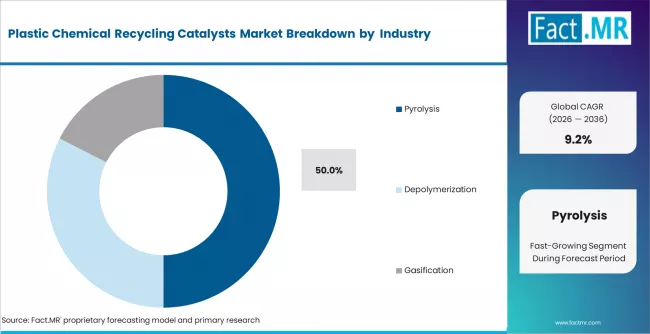
Plastic Chemical Recycling Catalysts Market Analysis By Process Type | Source: Fact.MR
Based on FACT.MR's plastic chemical recycling catalysts market report, pyrolysis is estimated to hold 50% share in 2026. Pyrolysis leads due to its feedstock flexibility across polyolefin waste types, established commercial-scale reactor designs, and compatibility with existing catalyst supply chains from the petroleum refining sector.
- Plastic Energy Plant Expansion: Plastic Energy commissioned its second commercial pyrolysis facility in Valencia, Spain, in Q1 2024, incorporating zeolite-enhanced catalytic upgrading to improve fuel-grade output quality. Catalyst procurement volumes were disclosed as a key operational cost driver. [8]
- Agilyx Process Technology: Agilyx ASA announced a polystyrene depolymerization technology upgrade in 2025, incorporating metal-oxide catalyst systems to improve monomer purity yields from post-consumer PS waste streams. The upgrade targets North American PS recycling mandates. [9]
- Gasification Adoption Trend: Gasification-based chemical recycling is gaining traction for low-grade mixed plastic waste unsuitable for pyrolysis. INEOS and NextChem reported gasification catalyst procurement activity in 2024 for projects handling contaminated industrial plastic streams in Europe. [10]
Drivers, Restraints, and Opportunities
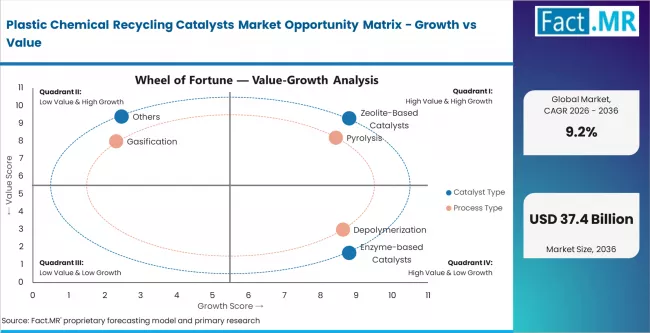
Plastic Chemical Recycling Catalysts Market Opportunity Matrix Growth Vs Value | Source: Fact.MR
FACT.MR analysis shows the plastic chemical recycling catalysts market has historically been constrained by limited commercial-scale chemical recycling plant deployment. Pre-2022, pyrolysis and depolymerization were largely pilot-stage, suppressing catalyst procurement volumes. Since 2023, EPR legislation across the EU, UK, and Asia has shifted chemical recycling from demonstration to industrial obligation, creating measurable catalyst demand at scale for the first time.
The core tension in this market is between regulatory urgency and technical readiness. EPR compliance timelines are compressing faster than catalyst performance validation cycles for contaminated mixed-plastic feedstocks. Pyrolysis catalyst demand is growing, but zeolite and metal systems face deactivation from chlorinated and sulphur-contaminated post-consumer streams. Producers investing in poison-tolerant catalyst formulations are gaining contract advantage over standard-grade suppliers.
- EPR Legislation Driving Scale: The EU Packaging and Packaging Waste Regulation (PPWR), effective from 2025, mandates escalating recycled content in plastic packaging. Chemical recycling catalysts are directly enabled by this requirement. European chemical recyclers commissioned over 15 new pyrolysis catalyst procurement contracts in 2024-2025 to meet compliance-grade capacity targets. [2]
- China National Recycling Infrastructure Push: China's 14th Five-Year Plan for Circular Economy, updated in 2024, includes specific pyrolysis and depolymerization plant targets with state co-funding. Catalyst manufacturers supplying SINOPEC and CNOOC-affiliated recycling subsidiaries reported contract expansions in Q3 2024. This creates a structurally different demand model from compliance-led Western markets. [3]
- Contamination Barrier Limiting Enzyme Adoption: Enzyme-based catalysts for PET depolymerization show high selectivity but remain cost-prohibitive at industrial scale due to sensitivity to mixed-stream contamination. CARBIOS's enzymatic recycling facility, commissioned in 2024 in France, demonstrated viable throughput only with sorted, near-pure PET feedstock, limiting broad applicability without upstream waste segregation investment. [4]
Regional Analysis
The plastic chemical recycling catalysts market is assessed across Asia Pacific, Europe, North America, Latin America, and Middle East and Africa, covering 40+ countries with distinct demand profiles shaped by EPR legislation maturity, plastic waste processing infrastructure, and chemical recycling plant commissioning rates. The full report offers market attractiveness analysis by region and country.
.webp "Top Country Growth Comparison Plastic Chemical Recycling Catalysts Market Cagr (2026 2036)")
Top Country Growth Comparison Plastic Chemical Recycling Catalysts Market Cagr (2026 2036) | Source: Fact.MR
| Country | CAGR (2026 to 2036) |
|---|---|
| China | 12.3% |
| India | 11.7% |
| United States | 10.8% |
| Germany | 10.0% |
| Japan | 8.5% |
Source: Fact.MR analysis. Updated Apr 17, 2026
Source: Fact.MR (FACT.MR) analysis, based on proprietary forecasting model and primary research
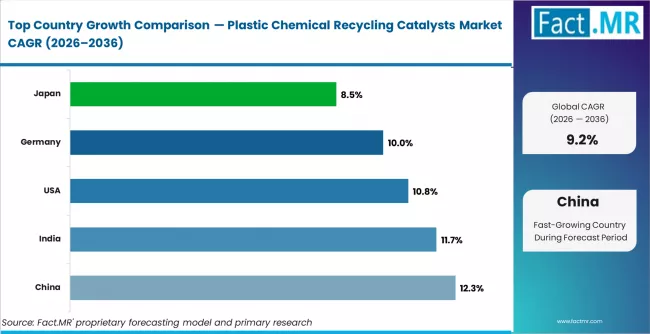
Plastic Chemical Recycling Catalysts Market Cagr Analysis By Country | Source: Fact.MR
Asia Pacific Plastic Chemical Recycling Catalysts Market Analysis
Asia Pacific is the fastest-growing region, led by China's state-driven pyrolysis infrastructure and India's emerging EPR framework. SINOPEC and CNOOC-affiliated recyclers anchor Chinese demand. Indian catalyst demand is early-stage but accelerating through domestic EPR compliance.
- China: Demand for plastic chemical recycling catalysts in China is projected to rise at 12.3% CAGR through 2036. China's National Plastic Pollution Control Plan (2021-2025 renewal, updated 2024) mandates plastic waste processing volumes by province, directly driving pyrolysis catalyst procurement at state-backed and private facilities. SINOPEC's chemical recycling division awarded catalyst supply contracts to three domestic zeolite manufacturers in Q2 2024.It targets100,000-tonne annual plastic waste throughput across its Shandong and Zhejiang processing hubs.
- India: Demand in India is projected to rise at 11.7% CAGR through 2036. India's Plastic Waste Management Rules Amendment (2024) extended EPR obligations to all plastic packaging producers. This creates the first commercially viable domestic demand for chemical recycling catalyst procurement. Reliance Industries and Nayara Energy disclosed investments in pyrolysis-to-fuel catalyst testing in Q3 2024, with pilot plant commissioning targeted for 2026.
FACT.MR covers China, Japan, South Korea, India, ASEAN, and ANZ. It includes EPR policy data, pyrolysis capacity trends, and regional catalyst demand forecasts.
North America Plastic Chemical Recycling Catalysts Market Analysis
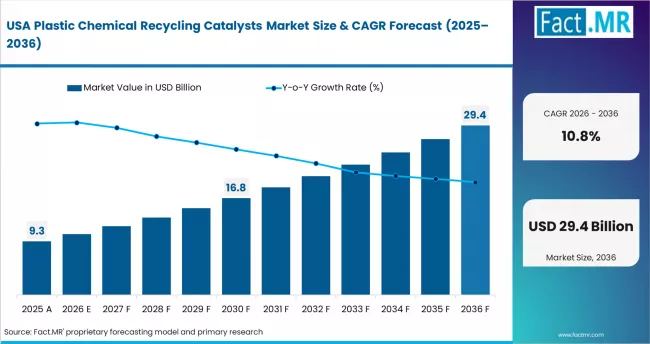
Plastic Chemical Recycling Catalysts Market Country Value Analysis | Source: Fact.MR
North America is driven by petrochemical industry co-investment in chemical recycling. ExxonMobil, LyondellBasell, and Eastman Chemical anchor catalyst procurement. Regulatory drivers include EPA framework updates and state-level recycled content mandates.
- United States: Demand in the United States is projected to rise at 10.8% CAGR through 2036. The EPA's National Recycling Strategy formalised chemical recycling as a qualifying pathway for post-consumer plastic content accounting. It has removed a key regulatory ambiguity that had delayed commercial-scale plant investment. ExxonMobil's 40,000-tonne Baytown expansion, operational from mid-2024 sustained demand through the forecast period.
FACT.MR covers the U.S., Canada, and Mexico. It includes EPA policy data, petrochemical plant commissioning records, and retail sustainability mandate analysis.
Europe Plastic Chemical Recycling Catalysts Market Analysis
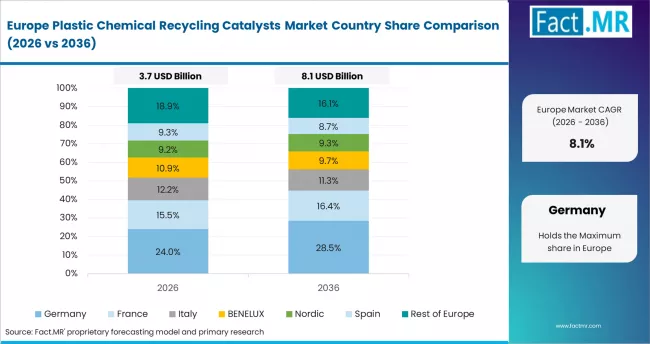
Plastic Chemical Recycling Catalysts Market Europe Country Market Share Analysis, 2026 & 2036 | Source: Fact.MR
Europe is the global regulatory laboratory for plastic chemical recycling. EU PPWR compliance deadlines anchor catalyst demand across Germany, France, and the Netherlands. BASF, Clariant, and W.R. Grace dominate certified catalyst supply.
- Germany: Demand is projected to grow at 10.0% CAGR through 2036. Growth is driven by PPWR implementation from January 2025. Chemical recycling output must meet recycled content certification requirements. BASF expanded zeolite catalyst capacity in 2024. Covestro is procuring depolymerization catalysts for PU recycling pilots. Certified catalyst documentation is now mandatory for procurement.FACT.MR covers Germany, France, UK, Italy, Spain, and Rest of Europe. It includes EU PPWR compliance data, plant commissioning records, and certified catalyst procurement analysis.
Competitive Aligners for Market Players
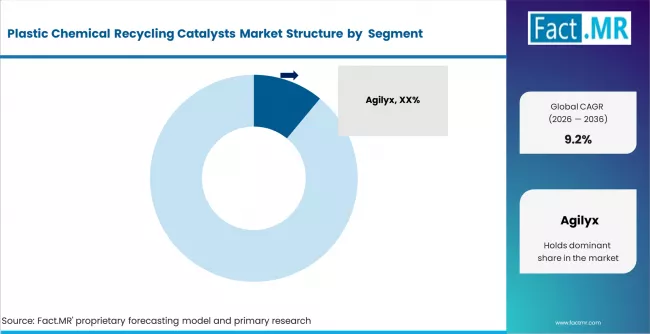
Plastic Chemical Recycling Catalysts Market Analysis By Company | Source: Fact.MR
The plastic chemical recycling catalysts market is moderately concentrated at the performance tier, where competition is driven by technical capability rather than volume. Catalyst selectivity, tolerance to contaminated feedstocks, and validated regeneration cycle performance are the primary differentiators.
Suppliers are required to demonstrate consistent results at commercial scale, particularly when processing mixed and post-consumer plastic waste. This requirement is especially critical in EU markets, where compliance with Extended Producer Responsibility (EPR) regulations places additional emphasis on traceability and performance documentation. In high-value segments, established players benefit from strong structural advantages. Companies such as BASF, W.R. Grace, and Clariant leverage their legacy in petroleum refining catalysts, particularly fluid catalytic cracking (FCC) systems. Their existing manufacturing infrastructure, technical service capabilities, and well-established quality assurance frameworks provide both cost efficiency and customer confidence. This legacy advantage creates a barrier for newer entrants, who often lack comparable scale, operational experience, and certification history.
Buyer behaviour is increasingly shifting toward long-term procurement strategies. Chemical recycling operators, including ExxonMobil, LyondellBasell, and CARBIOS-affiliated processors, are entering multi-year catalyst supply agreements. These agreements help mitigate risks associated with feedstock variability and ensure compliance with EPR reporting requirements. Once a catalyst is validated within a plant’s operating system, switching becomes complex and costly. As a result, suppliers with proven commercial-scale performance and strong documentation capabilities are more likely to secure and retain contracts, reinforcing their position in the market.
Key Players
- Agilyx
- BASF SE
- MaireTecnimont S.p.A.
- INEOS AG
- Recycling Technologies
- Veolia Environnement SA
- JEPLAN, INC.
- Eastman Chemical Company
- SABIC
Bibliography
- [1] European Commission. (2025). Packaging and Packaging Waste Regulation (PPWR) Implementation Guidance: Chemical Recycling Qualifying Pathways for Recycled Content Certification. January 2025. ec. europa.eu
- [2] National Development and Reform Commission, China. (2024). 14th Five-Year Circular Economy Plan Update: Pyrolysis and Depolymerization Plant Targets with State Co-Funding for Chemical Recycling Infrastructure. 2024. ndrc.gov.cn
- [3] CARBIOS. (2024). Enzymatic Recycling Plant Commissioning Report: Industrial-Scale PET Depolymerization Performance at Longlaville, France. Q1 2024. carbios.com
- [4] BASF SE. (2024). Investment Announcement: Zeolite Catalyst Production Expansion for Chemical Recycling Applications at Ludwigshafen Facility Targeting EU PPWR Compliance Customers. Q3 2024. basf.com
- [5] W.R. Grace & Co. (2025). Product Launch: UNIPOL-CR Catalyst Series for Mixed Plastic Pyrolysis with Enhanced Halogenated Contaminant Tolerance. January 2025. grace.com
- [6] Dechema e.V. (2024). Chemical Recycling in Germany: Catalyst Procurement Specifications and Regeneration Cycle Requirements in Commercial Pyrolysis Plant Tenders. October 2024. dechema.de
- [7] Plastic Energy Ltd. (2024). Valencia Plant Commissioning Report: Second Commercial TACOIL Pyrolysis Facility with Catalytic Upgrading Integration. Q1 2024. plasticenergy.com
- [8] Agilyx ASA. (2025). Technology Upgrade Announcement: Metal-Oxide Catalyst Integration for Polystyrene Depolymerization Monomer Purity Enhancement. 2025. agilyx.com
- [9] NextChem S.p.A. (2024). Gasification Catalyst Supply Partnership for Mixed Industrial Plastic Waste Streams: Mediterranean EPR Compliance Market Targeting. 2024. maire.com/nextchem
This Report Addresses
- Strategic insights on plastic chemical recycling catalyst demand across EU EPR-compliant European pyrolysis procurement, U.S. petrochemical co-investment in chemical recycling, China state-backed plastic waste processing infrastructure, India emerging EPR catalyst market, and Japan established circular economy catalyst demand.
- Market forecast from USD 14.2 billion in 2026 to USD 34.2 billion by 2036 at a CAGR of 9.2%.
- Growth opportunity mapping across China pyrolysis infrastructure scale-up, EU PPWR compliance-driven certified catalyst procurement, U.S. polyolefin recycling hub co-investment, Germany depolymerization and gasification catalyst adoption, and India EPR implementation catalyst market development.
- Segment-wise analysis by catalyst type (zeolite-based, metal-based, enzyme-based, others), process type (pyrolysis, depolymerization, gasification, others), and application (polyolefins, PET, polystyrene, others).
- Regional outlook covering Asia Pacific EPR and state-funded pyrolysis catalyst growth, North America petrochemical co-investment and state recycled content mandate demand, and Europe EU PPWR regulatory-driven certified catalyst adoption.
- Competitive landscape analysis of NextChem, Agilyx, ExxonMobil, INEOS, Recycling Technologies, Trinseo, JEPLAN, Borealis, Ioniqa, Sepco, and BlueAlp covering catalyst performance credentials, EPR documentation depth, and process-specific positioning strategies.
- Technology tracking including zeolite contamination tolerance advances, enzymatic PET depolymerization scale-up, metal catalyst poison resistance development, and gasification catalyst systems for mixed plastic waste.
- Report delivery in PDF, Excel datasets, and presentation formats supported by primary interviews, producer plant commissioning disclosures, EU PPWR compliance data, EPA chemical recycling framework, IEA plastic waste statistics, and EPR policy databases.
Plastic Chemical Recycling Catalysts Market Definition
The plastic chemical recycling catalysts market covers zeolite-based, metal-based, and enzyme-based catalytic materials used in pyrolysis, depolymerization, and gasification processes to convert post-consumer plastic waste into fuels, monomers, and chemical feedstocks for reuse in industrial production.
Plastic Chemical Recycling Catalysts Market Inclusions
Includes global and regional forecasts from 2026 to 2036 segmented by catalyst type, process type, and application. Covers zeolite, metal, and enzyme catalysts used in pyrolysis, depolymerization, and gasification of polyolefins, PET, and polystyrene waste streams.
Plastic Chemical Recycling Catalysts Market Exclusions
Excludes mechanical plastic recycling processes without catalytic conversion, physical sorting and washing equipment, and finished recycled polymer resin sales. Omits thermal cracking without catalyst participation and bio-based plastic composting infrastructure.
Plastic Chemical Recycling Catalysts Research Methodology
- Primary Research:Interviews with catalyst manufacturers and chemical recycling plant operators. Inputs from petrochemical firms, EPR compliance teams, and pyrolysis technology developers across North America, Europe, China, and India.
- Desk Research: Uses EU Packaging Regulation and EPR policy databases. Includes IEA plastic waste reports, EPA chemical recycling frameworks, and producer disclosures from 2024-2025.
- Market-Sizing and Forecasting: Based on catalyst shipment volumes and pricing by type and process. Includes pyrolysis plant capacity data and application-level demand benchmarks. Uses hybrid top-down and bottom-up model.
- Data Validation and Update Cycle: Validated using producer revenues and plant commissioning data. Cross-checked with regulatory deployment records. Updated regularly.
Segmentation
Scope of Report
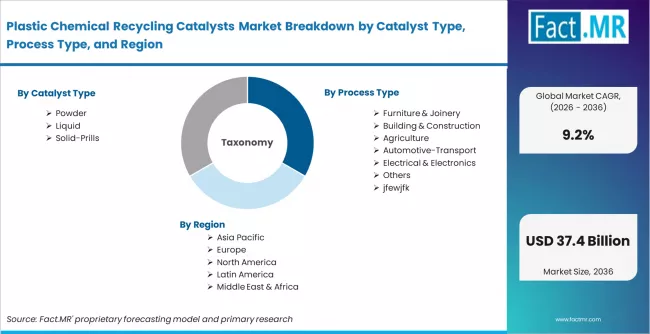
Plastic Chemical Recycling Catalysts Market Breakdown By Catalyst Type, Process Type, And Region | Source: Fact.MR
| Attribute | Details |
|---|---|
| Quantitative Units | USD 14.2 billion (2026) to USD 34.2 billion (2036), at a CAGR of 9.2% |
| Market Definition | Market covers zeolite-based, metal-based, and enzyme-based catalysts used in pyrolysis, depolymerization, and gasification of post-consumer plastic waste for fuel and monomer production. |
| Catalyst Type Segmentation | Zeolite-based Catalysts, Metal-based Catalysts, Enzyme-based Catalysts, Others |
| Process Type Segmentation | Pyrolysis, Depolymerization, Gasification, Others |
| Application Coverage | Polyolefins (PE, PP) recycling, PET depolymerization, Polystyrene (PS) recycling, and mixed plastic waste applications. |
| Regions Covered | North America, Europe, Asia Pacific, Latin America, Middle East and Africa |
| Countries Covered | USA, Canada, Mexico, Germany, UK, France, Italy, Spain, Nordic, BENELUX, China, Japan, South Korea, India, ASEAN, Australia and New Zealand, Brazil, Argentina, Chile, Saudi Arabia, GCC, Turkey, South Africa, Rest of MEA |
| Key Companies Profiled | Agilyx; BASF SE; Maire Tecnimont S.p.A.; INEOS AG; Recycling Technologies; Veolia Environnement SA; JEPLAN, Inc.; Eastman Chemical Company; SABIC |
| Forecast Period | 2026 to 2036 |
| Approach | Hybrid top-down and bottom-up model using catalyst shipment volumes by type and process, average selling prices by grade, EPR compliance timelines, chemical recycling plant capacity data, and primary interviews with catalyst manufacturers and recycling plant operators. |
Source: Fact.MR analysis. Updated Apr 17, 2026
Plastic Chemical Recycling Catalysts Market by Segments
-
By Catalyst Type:
- Zeolite-based Catalysts
- Metal-based Catalysts
- Enzyme-based Catalysts
- Others
-
By Process Type:
- Pyrolysis
- Depolymerization
- Gasification
- Others
-
By Application:
- Polyolefins (PE, PP)
- PET
- Polystyrene (PS)
- Others
-
By Region:
- North America
- United States
- Canada
- Mexico
-
Latin America
- Brazil
- Mexico
- Argentina
- Chile
- Rest of Latin America
- Western Europe
- Germany
- United Kingdom
- France
- Italy
- Spain
- Nordic Countries
- BENELUX
- Rest of Western Europe
- Eastern Europe
- Russia
- Poland
- Hungary
- Balkan and Baltic
- Rest of Eastern Europe
- East Asia
- China
- Japan
- South Korea
- South Asia and Pacific
- India
- ASEAN
- Australia and New Zealand
- Rest of South Asia and Pacific
- Middle East and Africa
- Kingdom of Saudi Arabia
- Other GCC Countries
- Turkey
- South Africa
- North America
Frequently Asked Questions
How large is the plastic chemical recycling catalysts market in 2025?
What will the market size be in 2026?
What is the projected market size by 2036?
What is the expected CAGR of the plastic chemical recycling catalysts market?
What is the absolute dollar opportunity in this market?
Which catalyst type segment leads the market?
Which process type holds the largest share?
Which application segment holds the largest share?
Which region grows fastest?
Which country shows the fastest growth?
What drives catalyst selection in this market?
Why are zeolite catalysts widely used?
Who are the leading players?
What gives incumbents an advantage?
Why is feedstock variability important?
Who worked on this report


Preview the report firsthand - request a free sample
Free SampleGet the brochure for pricing and purchase details
Download PDF