The Refillable Cleanser Pumps Market is analyzed across its key product, application and end-use segments, with the study covering market dynamics, regional trends and demand outlook, forecast 2026 to 2036.
By Fact.MR Consumer Goods DeskFact-checked under the Fact.MR editorial processUpdated
10 min read
Refillable Cleanser Pumps Market Forecast and Outlook 2026 to 2036
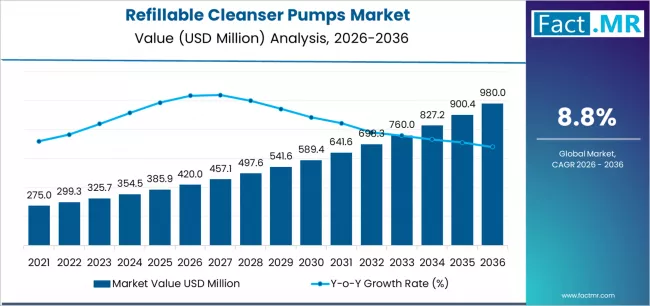
The global refillable cleanser pumps market is projected to reach USD 399.00 million in 2026, growing substantially to USD 931.00 million by 2036, following an 8.8% CAGR. Expansion of this market signifies a profound transformation in the packaging of fast-moving consumer goods, where the package itself transitions from a single-use vessel to a durable, reusable asset.
Refillable Cleanser Pumps Market Market Value Analysis | Source: Fact.MR
Summary of Refillable Cleanser Pumps Market
Market Snapshot
Global refillable cleanser pumps market revenue stood at USD 399.00 million in 2026 and is forecast to reach USD 931.00 million by 2036.
Ata8.8% CAGR from 2026 to 2036, this market is set to expand2.3x in value, adding USD 532.00 million in absolute opportunity.
The market reflects a transition toward durable, reusable packaging systems, replacing single-use plastic formats in personal care and household products.
Refillable pump systems are evolving into integrated circular packaging solutions, combining long-life primary containers with low-waste refill formats.
Demand and Growth Drivers
Increasing regulatory pressure on plastic waste reduction and circular economy adoption is a primary growth driver.
Rising consumer demand for sustainable and reusable packaging formats is accelerating market adoption.
Expansion of refill-based retail models (in-store refill stations, subscription refills) is supporting structural growth.
Brands are investing in durable, high-performance pump mechanisms to ensure long-term usability and customer retention.
However, growth is constrained by:
Higher upfront system costs
Need for dual packaging SKUs (pump + refill)
Product and Segment View
Skincare accounts for 44.1% of end-use share in 2026,emergingas the dominant segment driven by premium product positioning and sustainability branding.
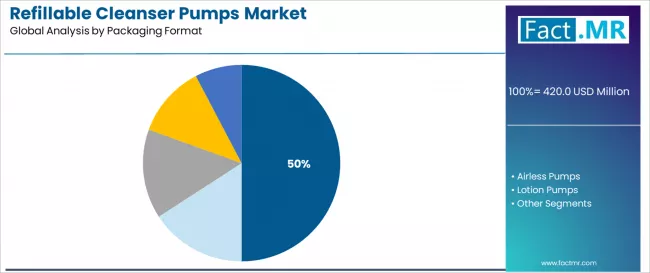
Refillable pump bottles hold 52.5% of packaging format share in 2026, positioning them as the leading format due to ease of use and consumer familiarity.
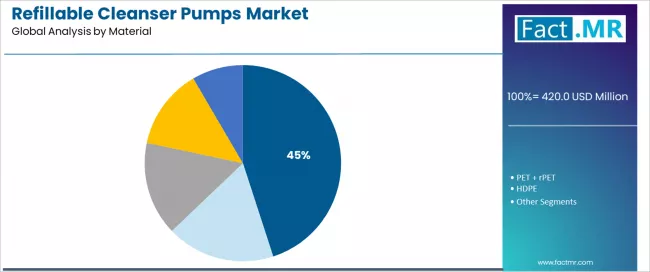
PP + PCR resin accounts for 47.3% of material share in 2026, reflecting its balance of durability, chemical resistance, and recycled content integration.
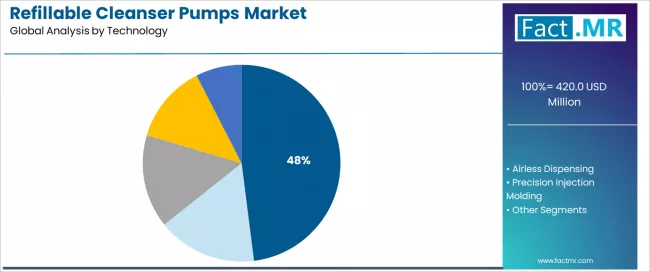
Reusable pump mechanisms hold 50.4% of technology share in 2026, highlighting their importance in ensuring long-term performance and consistent dispensing.
Key formats and technologies include:
Refillable pump bottles
Airless pumps
Lotion pumps
Reusable trigger systems
Geography and Competitive Outlook
Growth is supported across North America, Europe, and Asia Pacific, aligned with sustainability mandates and FMCG packaging innovation.
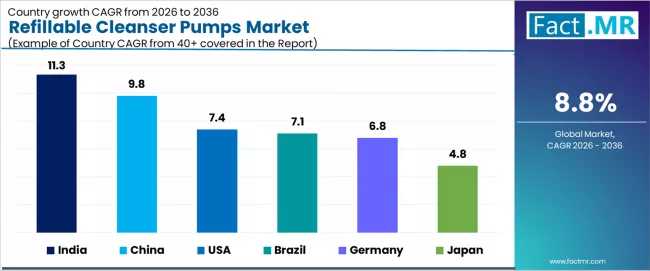
India (11.9% CAGR), China (9.3%), United States (7.0%), Germany (7.1%), Brazil (6.7%), and Japan (5.0%) are key growth markets.
Market expansion is closely tied to:
Circular economy regulations (EPR policies)
Retail infrastructure for refilling systems
Advancements in recyclable and PCR materials
Key companies active in this market include AptarGroup Inc.,Albéa,YonwooPKG, HCP Packaging, Natura, and Takemoto.
Refillable Cleanser Pumps Market — At a Glance
Attribute
Details
Market Value 2026
USD 399.00 million
Market Value 2036
USD 931.00 million
Absolute Dollar Opportunity 2026–2036
USD 532.00 million
Total Growth 2026–2036
133.3%
CAGR 2026–2036
8.8%
Growth Multiple
2.3x
Key Demand Theme
Shift toward reusable, circular packaging systems replacing single-use plastic containers
Leading Segment by End Use (2026)
Skincare
Segment Share (2026)
44.1%
Leading Segment by Packaging Format (2026)
Refillable Pump Bottles
Segment Share (2026)
52.5%
Leading Segment by Material (2026)
PP + PCR Resin
Segment Share (2026)
47.3%
Leading Segment by Technology (2026)
Reusable Pump Mechanism
Segment Share (2026)
50.4%
Key Growth Regions
North America, Europe, Asia Pacific
Country CAGRs
India 11.9%, China 9.3%, USA 7.0%, Germany 7.1%, Brazil 6.7%, Japan 5.0%
Reusable Pump Mechanism, Airless Dispensing, Injection Molding, Trigger Systems
Segmentation by Region
North America, Latin America, Western Europe, Eastern Europe, East Asia, South Asia & Pacific, MEA
The market is fueled by the powerful convergence of the global circular economy mandate and heightened consumer demand for sustainable consumption models that reduce plastic waste at its source. This evolution is marked by a strategic focus on system design over single-component innovation. Brands are investing in creating elegant, functional primary packaging, the durable pump bottle, designed for hundreds of uses, complemented by streamlined, low-waste refill formats. The trend extends beyond material substitution to encompass entire business model shifts, including in-store refill stations, subscription-based refill pouches, and advanced take-back programs. Success in this market hinges on engineering pumps that deliver superior, consistent user experience over their lifespan while ensuring compatibility with high-speed filling lines for both initial units and their subsequent refills.
Category
Category
Segments
End-use
Skincare, Haircare, Personal Wash, Household Cleaners, Others
North America, Latin America, Western Europe, Eastern Europe, East Asia, South Asia & Pacific, MEA
Segmental Analysis
By End-use, Which Segment is the Pioneer in Premium Reusability?
Refillable Cleanser Pumps Market Analysis By End Use | Source: Fact.MR
The skincare segment commands a leading 44.1% share. The sector’s high-value products, brand-led sustainability marketing, and consumers who are willing to invest in durable, aesthetically pleasing packaging drive this dominance.
Luxury and clinical skincare brands are leveraging refillable pump systems to enhance perceived value, foster brand loyalty through repeat purchases of refills, and visibly demonstrate a commitment to reducing packaging waste.
By Packaging Format, Which Design Embodies the Core Reusable Concept?
Refillable Cleanser Pumps Market Analysis By Packaging Format | Source: Fact.MR
Refillable pump bottles constitute the dominant format with a 52.5% share. This classic design offers the ideal balance of consumer familiarity, functional reliability, and design flexibility. Consumers, facilitating the transition from a disposable to a reusable mindset, easily understand its straightforward mechanism and its structure is readily adaptable to incorporate high levels of post-consumer recycled content.
By Material, Which Composition Balances Durability with Circular Sourcing?
Refillable Cleanser Pumps Market Analysis By Material | Source: Fact.MR
PP + PCR Resin is the predominant material choice, holding a 47.3% share. Polypropylene offers excellent chemical resistance for a wide range of formulations and durability for long-term use.
The integration of PCR resin directly into the pump body and bottle is critical for reducing the carbon footprint and virgin plastic use of the durable primary package, aligning with brand sustainability targets.
By Technology, Which Innovation Ensures Long-Term Performance and Consumer Trust?
Refillable Cleanser Pumps Market Analysis By Technology | Source: Fact.MR
The reusable pump mechanism itself is the foundational technology, with a 50.4% share. Its development focuses on engineering for longevity such as resistance to corrosion from various formulations, consistent dosing accuracy over hundreds of actuations, and a tactile feel that retains its quality. This technical reliability is paramount to prevent consumer frustration and ensure the refill model succeeds, making advanced mechanical engineering a key market driver.
What are the Drivers, Restraints, and Key Trends of the Refillable Cleanser Pumps Market?
Factor
Impact Analysis
Circular Economy Regulations & EPR
Government mandates for recycled content and EPR schemes are making refill-reuse systems financially and operationally advantageous compared to single-use plastic disposal.
Higher Initial System Cost
The significant upfront investment for brands in durable pumps and the need for dual SKUs for bottles and refills can deter widespread adoption, especially for mass-market, price-sensitive categories.
Integration with Retail Refill Infrastructure
Collaborating with retailers to establish in-store refill stations or standardized take-back programs presents a massive opportunity to build consumer convenience and lock in brand engagement.
Material Innovation for PCR Content
The trend toward developing new polymers and compatibilizers that allow for higher percentages of PCR content in durable pump components without compromising performance or aesthetics.
Analysis of the Refillable Cleanser Pumps Market by Key Countries
Refillable Cleanser Pumps Market Cagr Analysis By Country | Source: Fact.MR
Country
CAGR (2026-2036)
India
11.9%
China
9.3%
USA
7.0%
Germany
7.1%
Brazil
6.7%
Japan
5.0%
How is India's Price-Conscious Market Adapting to the Refill Model?
India’s leading 11.9% CAGR is shaped by a unique, value-driven adaptation of the refill concept. While premium skincare adopts global standards, high-volume categories like personal wash see growth in ultra-affordable, durable pump bottles paired with low-cost refill pouches.
This model reduces plastic use while aligning with longstanding consumer familiarity with sachet-and-refill economies, driving rapid adoption through cost savings rather than purely premium sustainability messaging.
What Strategic Role does China's Manufacturing Ecosystem Play?
China’s 9.3% CAGR is underpinned by its role as the world’s primary source for both packaging components and the finished goods they contain. Domestic brands are adopting refillables for differentiation.
Global players are partnering with Chinese manufacturers to develop cost-optimized, high-quality reusable systems at scale. The market is a hotbed for engineering pumps that meet both Western durability standards and Eastern aesthetic sensibilities.
Does the USA's Market Reflect a Tension Between Convenience and Sustainability?
The USA’s 7.0% CAGR highlights a market navigating the conflict between sustainable intent and convenience culture. Growth is strongest in prestige beauty, where the model enhances brand equity.
For mass market, adoption hinges on simplifying the refill process through subscription boxes or in-store systems to minimize consumer effort. Regulatory pressure at the state level is gradually tilting the balance by making single-use plastic more costly.
How does Germany's Regulatory Landscape Dictate Design Priorities?
Germany’s 7.1% CAGR is guided by the world’s most stringent packaging regulations, which favor reusable systems. Market growth is less about marketing and more about compliance, driving demand for pumps designed for extreme longevity and easy disassembly for recycling. The focus is on monomaterial constructions and maximizing PCR content to meet verifiable circular economy metrics.
Is Brazil's Growth Linked to Its Natural Heritage and Innovation?
Brazil’s 6.7% CAGR is closely tied to the strength of its domestic beauty giants, particularly in naturals and botanicals. These companies are leveraging refillable pumps as an extension of their natural ethos, reducing environmental impact. The market showcases innovative use of bio-based resins and focuses on refill systems accessible to a growing middle class, often through direct sales and loyalty programs.
What Defines Japan's Pursuit of Perfection in Reusable Packaging?
Japan’s 5.0% CAGR is defined by an uncompromising pursuit of quality, hygiene, and miniaturization. Refillable pumps must operate flawlessly, dispense precise doses, and maintain a pristine appearance through countless uses.
The market drives innovation in micro-pumps for travel-sized formats and airless technology that completely protects sensitive formulas, making reusability synonymous with superior performance.
Competitive Landscape of the Refillable Cleanser Pumps Market
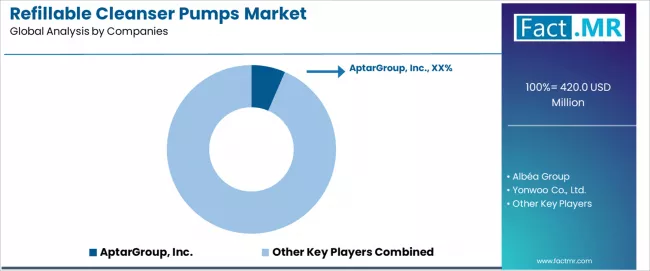
Refillable Cleanser Pumps Market Analysis By Company | Source: Fact.MR
The competitive landscape is characterized by a strategic pivot from supplying disposable components to becoming partners in circular system design. Leaders are those who can co-engineer not just the pump, but the entire refill ecosystem with brand owners.
Competition centers on developing ultra-durable mechanisms with guaranteed actuation counts, pioneering the use of high-PCR and bio-based materials that meet aesthetic standards, and creating smart, connected pumps that enable refill logistics. The ability to provide a seamless, cost-effective supply chain for both the durable primary package and its matching refill container is a critical differentiator.
Key Players in the Refillable Cleanser Pumps Market
AptarGroup Inc.
Albea
YonwooPKG
HCP Packaging
Natura
Takemoto
References
Ellen MacArthur Foundation. (2025). Universal reusable packaging: A vision for the circular economy. EMAResearch.
Klein, F., & Attari, S. Z. (2024). The behavioral economics of circular consumption: Overcoming barriers to reuse. Journal of Consumer Policy.
Montalbo, T., & Greyson, J. (2025). Chemical compatibility of post-consumer resins in cosmetic packaging. Journal of Applied Polymer Science.
Personal Care Products Council. (2024). Guidelines for the design and labeling of refillable personal care packaging. PCPC Technical Report.
Urbinati, A., Chiaroni, D., & Chiesa, V. (2025). Business models for the circular economy: The case of refill systems in the beauty industry. Journal of Cleaner Production.
Scope of Report
Items
Values
Quantitative Units
USD Million
End-use
Skincare, Haircare, Personal Wash, Household Cleaners, Others