- Base Value(2025): 9170 Mn
- Forecast Value (2035): 17871 Mn
- CAGR (2035): 7.6%
Solid Cleanser Market Outlook 2025 to 2035
The global solid cleanser market is expected to reach USD 17,871 million by 2035, up from USD 9,170 million in 2025. During the forecast period 2025 to 2035, the industry is projected to expand at a CAGR of 6.9%.
Solid cleanser market world is experiencing healthy growth, as a result of increased consumerism in sustainable, waterless and travel friendly personal care products. The most important factors are the increasing popularity of plastic-free packaging, the popularity of natural and organic formulations, and affordable concentrated forms. The market limitations are low awareness of the products in Third World countries and difficulties in formulating active ingredients.
Premiumization, expansion of e-commerce and multifunctional solid formats will be the opportunity. Trends are clean-label statements, vegan/cruelty-free statements, and dermatologically tested actives. To win over consumers who are environmentally conscious as well as comply with increasing regulatory requirements for waste disposal, brands are working on R&D and environmentally friendly packaging.
Quick Stats for Solid Cleanser Market
- Industry Value (2025): USD 9,170 Million
- Projected Value (2035): USD 17,871 Million
- Forecast CAGR (2025 to 2035): 6.9%
- Leading Segment (2025): Body Cleansers & Soaps (41.1% Market Share)
- Fastest Growing Country (2025-2035): India (7.8% CAGR)
- Top Key Players: Ethique, Lush, Unilever Plc, Procter & Gamble (P&G), L’Oréal SA
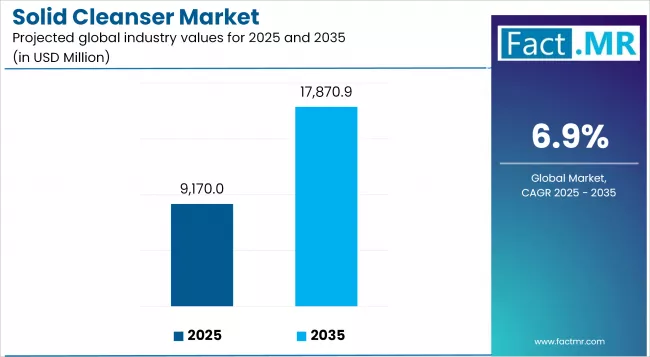
Solid Cleanser Market Industry Value Analysis | Source: Fact.MR
What are the drivers of the Solid Cleanser market?
The solid cleanser market is mainly influenced by the increased move towards sustainable and eco-friendly personal care solutions by the consumers. The increasing worries regarding plastic waste and water shortage have only increased the demand on waterless forms, since solid cleansers usually need little or no plastic wrappings and have a reduced environmental impact.
A growing interest in natural, organic and clean label products is also a significant growth driver, as people find safer and less chemical products to take care of their skin and hair. The ease of solid cleansers, which is lightweight, travel-friendly, and can be flown on an airplane, is very attractive to millennials and Gen Z. Niche solid-cleanser brands have become so available through e-commerce that their exposure has become global.
In addition, expensive nature and better concentration of active ingredients in solid form attract price-conscious consumers. Advancements in multifunctional formulations, dermatological testing bars, and high-end positioning are also making consumers attracted, which is boosting steady growth by double digits on both emerging and developed market levels.
What are the regional trends of the Solid Cleanser market?
Solid cleanser market exhibits varied regional dynamics influenced by consumer preferences, regulation and retailing channel. Innovation and use of clean-label, cruelty-free solid cleansers, good e-commerce penetration and high-end brand presence is highly prevalent in North America.
In Europe, especially Germany, U.K., and France, the focus is on sustainability, certified organic formulations, and high regulatory adherence, which contributes to the success of the adoption of eco-friendly packaging.
China and Japan are at the forefront of East Asia, which is swiftly expanding its influence due to the innovations of K-beauty and J-beauty, the demands of Gen Z, and the intensive introduction of new products. South Asia & Pacific: This is evidenced by a rapidly increasing adoption rate as urban customers embrace waterless solutions because of affordability and portability.
The Latin America is exhibiting increased interest, which has been fuelled by the younger population and the popularity of natural ingredients.
Middle East and Africa are still underdeveloped but have unexploited potential in terms of tourism oriented premium retailing and halal certified formulations. Online shopping, influencer marketing, and refillable substances are convergent forces that are enhancing the movement of solid cleansers towards sustainability in the world.
What are the challenges and restraining factors of the Solid Cleanser market?
There are a number of challenges and limiting factors on the solid cleanser market though its growth momentum is good. The main issue is the problem of consumer consciousness and reaction, since many consumers are used to liquid cleansers and find solid forms of the product less convenient or even outdated.
Another obstacle is the complexity of formulation, which necessitates a lot of research and development to incorporate active ingredients, stability of the product and an indulgent sensorial experience in a waterless product. Growth is also hindered by distribution and shelf placement constraints with the traditional retail preferring higher turnover liquid products. Also, the premium solid cleansers may take a long time to adopt because of price sensitivity in the developing markets.
There are regulatory compliance expenses and time-to-market strain on the brand due to regulatory compliance surrounding organic certification, ingredient transparency and sustainability claims.
Lastly, there is a threat of rivalry with the old liquid and the newer refillable offerings, which entails heavy investment in education, marketing, and differentiated positioning of the brand to turn the consumer to solid offers.
Country-Wise Insights
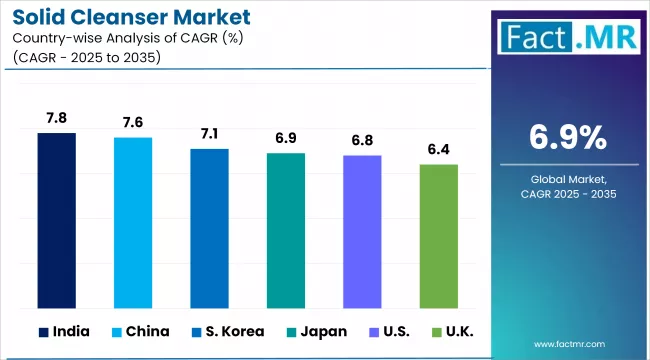
Solid Cleanser Market Cagr Analysis By Country | Source: Fact.MR
India is Driving Solid Cleanser Market Growth through Natural & Herbal Innovation
The cleanser segment in India is a robust market which is growing at a high rate, as the Indian culture has a high level of attachment to herbal, Ayurvedic and natural personal care products. There is a tendency among consumers to move to more environmentally friendly and water-efficient forms, which is in line with the sustainability efforts promoted by the government and increased awareness of plastic waste minimization.
Locally-made brands and new startups are experimenting with solid bars and shampoo tablets using herbals, sulfate-free formulas and targeting the urbanized millennial generation and the rural segment with less expensive and higher-lasting options. The D2C e-commerce platforms boom and natural beauty trends trend on social media have also made the market faster to embrace.
Nevertheless, market is still struggling with the issues of consumer education and price sensitivity, especially in Tier-2 and Tier-3 cities. It is believed that strategic association with the current retailers of trade in modern trade, intensive influence marketing activities and localized manufacturing will promote penetration and India will be among the most rapidly expanding markets of solid cleansers in the Asia-Pacific area.
China is Driving Mass Adoption of Sustainable and Premium Solid Cleansers
Due to the rapid urbanization, the increasing disposable income, and the growing awareness of environmentally friendly personal care products, China is becoming one of the most vibrant markets of solid cleansers. Gen Z and Millennial consumers, who are tech-savvy in the country, are already adopting the use of sustainable formats such as shampoo bars, facial cleanser sticks, and waterless soaps due to the convenience they offer and their less toxic impact on the environment. Domestics are developing new products based on herbal and traditional Chinese medicine (TCM) formulations, which are gaining high demand among the health conscious consumers.
The discovery of products and direct-to-consumer sales are being facilitated with e-commerce platforms including Tmall, JD.com, and Douyin, among others, further accelerating adoption. Green manufacturing infrastructure and tougher environmental policies by the government are encouraging the domestic manufacturers to invest in clean-label formulations and biodegradable packaging. Due to this, China will be a global growth leader with a large portion of future demand in sustainable solid personal care products.
South Korea is Driving Innovation in Premium and Functional Solid Cleansers
The Korean good cleanser market is experiencing high innovation due to the demand of consumers on high performance multifunctional skincare products. The country is recognized as the world centre of beauty and personal care technology and is incorporating the latest formulation technologies in solid cleansers, such as the use of concentrated active ingredients, exfoliating compounds and multifunctional cleansing bars in the face and hair.
Premium, sustainable, and miniature forms are becoming more popular among consumers, which is consistent with the high sustainability and clean beauty trends that are popular in South Korea. The next demand spur is e-commerce penetration and K-beauty export that stimulates the demand of travel-friendly and giftable solid products. The texture, fragrance, and benefits of solid cleansers are the subject of R&D by brands, to ensure that with these, performance levels are as high as with liquids.
Natural, vegan, and cruelty-free certifications can be supported by regulations to increase credibility, and the marketing campaigns can emphasize innovation and environmental advantages. Comprehensively, South Korea is creating local and global demand that presents it as a functional, tech-upgraded solid cleanser formula leader.
Category-Wise Analysis
Body Cleansers & Soaps are the Cornerstone of the Solid Cleanser Revolution
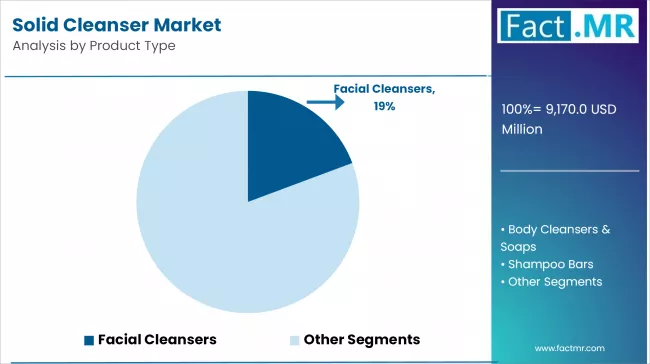
Solid Cleanser Market Analysis By Product Type | Source: Fact.MR
The body cleansers & soaps segment is the dominant and the most basic category in the solid cleanser market with a massive contribution to the revenue in the world. It is popular because of its universal attractiveness, convenience and the familiarity of consumers with bar soaps over an extended period which causes it to provide a gateway product in the adoption of solid eco-friendly cleansing solutions. This segment further has been enhanced by the increasing environmental awareness among consumers with more customers opting to use plastic-free, biodegradable packs instead of liquids body washes in plastic bottles.
There are also natural and organic formulations and moisturizing additives, and multifunctional cleansing properties that are contributing to product value and differentiation. This segment also enjoys extensive distribution channels, whether through the supermarkets or through specialty stores and online stores, which makes the segment accessible to the demographics.
With sustainability and wellness trends still having an impact on the personal care preferences, body cleansers & soaps can be seen as the basis of promoting the wider adoption of solid cleanser formats, which makes them a very important factor in the market development.
Nature Powers the Purity of the Solid Cleanser Revolution
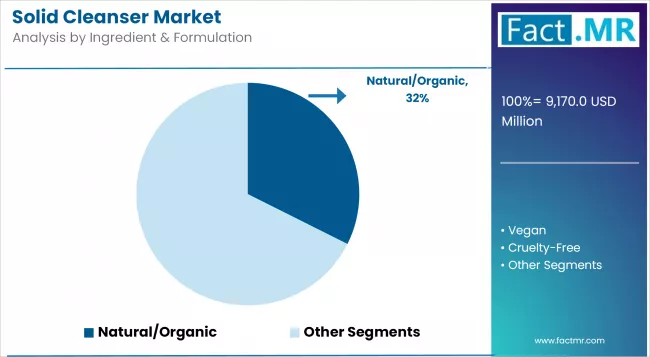
Solid Cleanser Market Analysis By Ingredient & Formulation | Source: Fact.MR
The solid cleanser market is being changed by the Natural and Organic segment which places sustainability, safety, and environmental conscious in the centre of the market. Customers are turning to choose products which do not contain any synthetic chemicals, parabens, and other harmful substances and prefer obtaining products based on botanical, plant, and organically certified sources. This trend does not only respond to the increasing health and wellness consciousness but is also in line with the global trend of environmentally friendly packaging and waterless formula.
Natural and organic solid cleansers have multifunctional qualities, with cleansing, hydrating and soothing skin capabilities, in a concentrated and low-waste formula. The storytelling, transparent sourcing, and certification are used to build consumer trust in brands in this segment, and the natural formulations are thus the main driver of market growth. Natural and organic products will continue to play a key role in innovation, product differentiation, and high positioning in the changing Solid Cleanser Market as regulatory oversight and consumerism demand continue to mount pressure.
Competitive Analysis
Key players in the Solid Cleanser market Ethique, Lush, Unilever Plc, Procter & Gamble (P&G), L’Oréal SA, Beiersdorf AG, Johnson & Johnson, Amorepacific Corporation, Shiseido Co., Ltd., The Estée Lauder Companies, Kao Corporation, Loli Beauty, Ruby’s Organics, True Botanicals, REN Clean Skincare
The solid cleanser market is an extremely competitive industry and is defined by the constant innovation, differentiation of its products and the dynamic consumer taste. To gain market share, companies are concentrating on sustainable formulations, natural and organic ingredients and provision of multifunctional products. The strategies may be to extend the distribution channels, to use e-commerce, and to increase brand awareness via marketing campaigns focusing on eco-friendliness and ethical behaviors.
Innovation of the product, including the active ingredient, vegan, and cruelty free formulations are the additional source of competitive advantage. Players in the market also invest in R&D in order to increase their performance, texture and taste appeal and manoeuvre regulatory issues, price wars and changing customer trends in order to remain relevant in this dynamic market place.
Recent Development
- In August 2024, MASSCON announced that the company has launched AllThatSolid(R), a new breed of solid-state personal care products, including shampoo, hair conditioner, facial cleanser, and body cleanser. AllThatSolid(R) by MASSCON offers single-use, tablet-sized personal care products with instant dissolution, enhanced hygiene, and zero-waste packaging. Their innovative soluble solid technologies outperform conventional bar products by 1500%.
- In May 2024, Johnson & Johnson Consumer Inc. patented a solid cleansing product that is comprised of a first surfactant (isethionate) and a second surfactant (betaine) that are free of sulfate-containing materials, wherein the first surfactant weight amount and the second surfactant weight amount are approximately equal to each other, wherein the combined weight amount of the first surfactant and the second surfactant is about 16% to about 20% by weight of the solid cleansing product; and a first and second buffering agent combined in which the weight amount is at least double the combined weight amount of the first surfactant and the second surfactant.
Fact.MR has provided detailed information about the price points of key manufacturers of Solid Cleanser Market positioned across regions, sales growth, production capacity, and speculative technological expansion, in the recently published report.
Methodology and Industry Tracking Approach
The 2025 report of Solid Cleanser in the world market by Fact.MR relies on the information gathered by 1,200 respondents (stakeholders) in 12 nations with maximum of 75 respondents in each country. Among them, 65 percent were final consumers such as individual purchasers, wellness individuals, and institutional procurement executives and the 35 percent one was the supply chain manager, sustainability advisor, and regulatory compliance specialist.
The fieldwork was carried out between September 2024 and August 2025 and was aimed at studying product adoption habits, formulation preferences, packaging sustainability, retail and e-commerce channel feasibility, and ingredient compliance criteria. The balanced calibration model provided the right representation in North America, Europe, and Asia.
The report has used more than 95 reliable sources such as industry reports, consumer surveys, retail audit, sustainability check, and product certification submissions. Triangulation protocols were used to provide high reliability data that gave accurate forecasts and actionable information to the stakeholders in the personal care ecosystem.
Fact.MR used strict analytical programs including multi-variable regression, scenario modeling in order to guarantee data robustness. Since the surveillance of the skincare and personal care area began in 2018, this report offers an elaborate roadmap of companies, which want to gain a competitive advantage, innovations, and sustainable development of the Solid Cleanser Market.
Segmentation
Segmentation of Solid Cleanser Market
-
By Product Type :
- Facial Cleansers
- Body Cleansers & Soaps
- Shampoo Bars
- Conditioner Bars
- Shaving Soaps
- Others
-
By Ingredient & Formulation :
- Natural/Organic
- Vegan
- Cruelty-Free
- Synthetic-Free/"Clean"
- Medicinal/Active
-
By Application :
- Daily cleansing
- Acne / oil control
- Makeup removal
- Exfoliation / deep cleansing
- Sensitive skin / barrier repair
-
Price Point :
- Economy
- Mid-Price
- Premium
-
By Distribution Channel :
- Online
- Specialty Store
- Supermarkets / hypermarkets
- Pharmacies / drugstores
- Others
-
By Region :
- North America
- Latin America
- Western Europe
- Eastern Europe
- East Asia
- South Asia & Pacific
- Middle East & Africa
Frequently Asked Questions
What was the Global Solid Cleanser Market Size Reported by Fact.MR for 2025?
Who are the Major Players Operating in the Solid Cleanser Market?
What is the Estimated Valuation of the Solid Cleanser Market in 2035?
What Value CAGR did the Solid Cleanser Market Exhibit Over the Last Five Years?
Who worked on this report


Preview the report firsthand - request a free sample
Free SampleGet the brochure for pricing and purchase details
Download PDF