- Market Value (2025): USD 870 Mn
- Estimated Value (2026): USD 980 Mn
- Forecast Value (2036): USD 3,268 Mn
- CAGR (2026-2036): 12.8%
What is the Refillable Household Cleaning Concentrates Market forecast to be worth by 2036?
USD 980 million in 2026 to USD 3,268 million by 2036, at 12.8% CAGR.
- The refillable household cleaning concentrates market reached USD 868.8 million in 2025.
- Demand is projected to increase from USD 980 million in 2026 to USD 3,268 million by 2036.
- The market is expected to expand at 12.8% CAGR from 2026 to 2036.
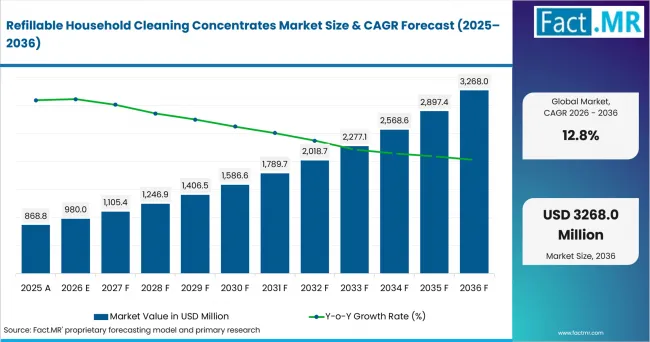
Refillable Household Cleaning Concentrates Market Value Analysis | Source: Fact.MR
What are the defining numbers behind Refillable Household Cleaning Concentrates Market growth?
- USD 2,288 million in absolute opportunity is expected between 2026 and 2036.
- The Dissolvable tablets/pods category accounts for 39.0% of Format in the refillable household cleaning concentrates market in 2026, equivalent to USD 382.2 million.
- The Multi-surface cleaners category accounts for 33.0% of Product in the refillable household cleaning concentrates market in 2026.
- The Online/DTC category accounts for 47.0% of Distribution in the refillable household cleaning concentrates market in 2026.
- Demand Drivers in the Market
- Refillable concentrate systems cut single-use plastic and shipped water dramatically, aligning with consumer sustainability priorities and retailer plastic-reduction commitments.
- Dissolvable tablet and pod formats remove the dosing and handling barriers of liquid refills, letting consumers reconstitute a full trigger spray from a lightweight tablet.
- Regulatory momentum around packaging waste, together with national plastic-reduction commitments, is pushing cleaning brands toward reuse and refill models.
- DTC pioneers have built subscription-led refill businesses that convert sustainability intent into recurring orders, and mainstream brands are now following into grocery shelves.
- Safer-chemistry certifications and concentrated-format efficacy improvements are addressing the performance and safety questions that once limited adoption.
- Key Segments Analyzed
- By Format: The Dissolvable tablets/pods category is projected to account for 39.0% of the refillable household cleaning concentrates market in 2026. Tablets and pods reduce shipping bulk and provide premeasured reconstitution in a reusable bottle.
- By Product: The Multi-surface cleaners category is projected to account for 33.0% of the refillable household cleaning concentrates market in 2026. Multi-surface cleaners have frequent household use and broad applicability across rooms and surfaces.
- By Distribution: The Online/DTC category is projected to account for 47.0% of the refillable household cleaning concentrates market in 2026. Online and direct-to-consumer channels support starter kits, instructions and recurring refill delivery.
- Analyst Opinion at Fact.MR
- Fact.MR opines, "The refill is only half of the product. Brands also have to design the bottle, dosing instruction and repeat-purchase route so the consumer gets the same concentration each time. Tablets simplify shipping and storage, while liquids can dissolve more quickly, but every format has to prove cleaning performance after reconstitution." - Shambhu Nath Jha, Principal Consultant at Fact.MR.
- Strategic Implications
- Brands that combine durable reusable bottles with tablet concentrates and clear dosing communication can convert price-sensitive households by lowering the per-clean cost below bottled sprays.
- Retailer refill and reuse fixtures are creating in-store education moments that complement DTC subscription models and extend the category to non-subscription shoppers.
- Safer-chemistry certification is becoming a purchase criterion for refill concentrates, rewarding brands with transparent ingredient disclosure and third-party verification.
- Product-range expansion beyond multi-surface into glass, bathroom, kitchen and floor concentrates is deepening household penetration of refill systems.
- Partnerships with grocers and mass retailers are shifting refill concentrates from a DTC niche into mainstream category fixtures, supported by retailer plastic targets.
How does the Refillable Household Cleaning Concentrates Market break down by segment?
Why does the Dissolvable tablets/pods category lead Format?
In 2026, the Dissolvable tablets/pods category is projected to account for 39.0% of Format within the refillable household cleaning concentrates market.
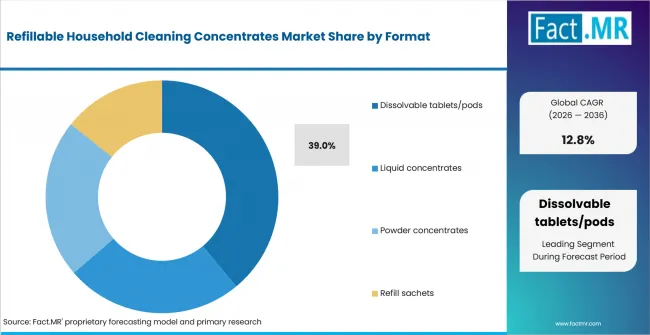
Refillable Household Cleaning Concentrates Market Analysis By Format | Source: Fact.MR
Dissolvable tablets and pods remove most shipped water and give the user a premeasured dose for a reusable bottle. The format reduces storage volume while limiting the measuring errors associated with free-pour concentrates.
Dissolution speed, residue and bottle compatibility determine the in-home experience. Liquid concentrates can reconstitute quickly, while powders and sachets give formulators different cost and packaging options.
Why does the Multi-surface cleaners category lead Product?
Within Product, the Multi-surface cleaners category is projected to hold a 33.0% share in the refillable household cleaning concentrates market in 2026.
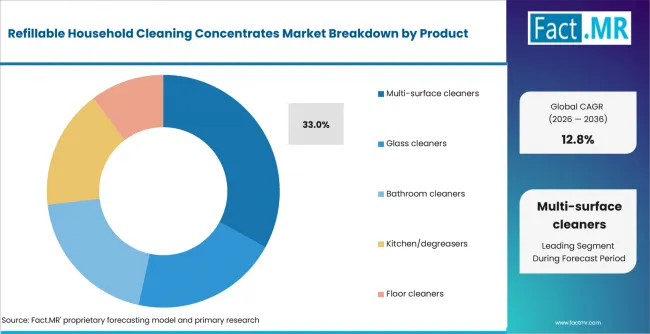
Refillable Household Cleaning Concentrates Market Analysis By Product | Source: Fact.MR
Multi-surface cleaners are used frequently and can replace several task-specific sprays in everyday household cleaning. A single reusable bottle therefore provides a simple starting point for a refill system.
The formulation has to work across common sealed surfaces without leaving residue or damaging finishes. Glass, bathroom and kitchen products create additional refill opportunities once the consumer trusts the core system.
Why does the Online/DTC category lead Distribution?
The Online/DTC category is expected to represent 47.0% of Distribution within the refillable household cleaning concentrates market in 2026.
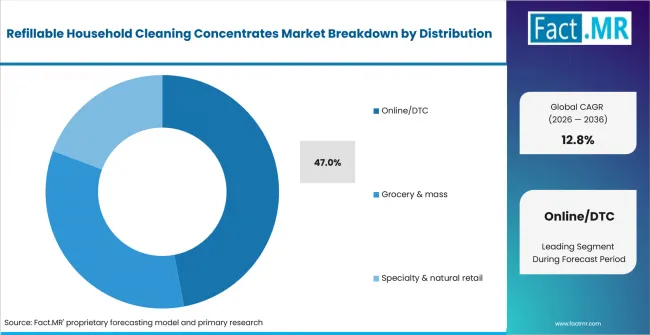
Refillable Household Cleaning Concentrates Market Analysis By Distribution | Source: Fact.MR
Online and direct-to-consumer channels can sell a starter bottle with instructions, then schedule compact refill deliveries. The model gives brands direct visibility into repeat purchase and product education.
Grocery and mass retail reduce the effort of finding a refill, but shelf space must accommodate both the starter system and replenishment. Specialty and natural stores provide an intermediate route for shoppers already interested in lower-waste products.
What is accelerating Refillable Household Cleaning Concentrates Market adoption, and what is holding it back?
Adoption is being driven by plastic-reduction commitments and convenient tablet or pod formats, while established cleaning habits, starter-kit costs and dosing or efficacy concerns can slow repeat purchase.
Drivers Impact Analysis
| Driver | (~) % Impact on CAGR | Geographic Relevance | Impact Timeline |
|---|---|---|---|
| Plastic-waste reduction commitments of brands and retailers | +1.7% | North America, Europe, Oceania | Near term |
| Dissolvable tablet and pod convenience in reconstitution | +1.4% | Global | Near term |
| Packaging-waste policy and national plastic-reduction commitments | +1.2% | Europe | Mid term |
| Safer-chemistry certification and efficacy improvements | +0.8% | North America, Europe | Mid term |
Source: Fact.MR analysis. Updated Aug 20, 2026
Opportunity Impact Analysis
| Opportunity | (~) % Impact on CAGR | Geographic Relevance | Impact Timeline |
|---|---|---|---|
| Grocery and mass-retail refill fixtures scaling the format | +1.3% | North America, Europe, Oceania | Mid term |
| DTC subscription models converting trial into recurring revenue | +1.0% | Global | Long term |
| Product-range expansion into glass, bathroom and floor concentrates | +0.7% | Global | Mid term |
Source: Fact.MR analysis. Updated Aug 20, 2026
Restraints Impact Analysis
| Restraint | (~) % Impact on CAGR | Geographic Relevance | Impact Timeline |
|---|---|---|---|
| Consumer habit and convenience inertia around ready-to-use sprays | -0.8% | Global | Near term |
| Higher upfront cost of reusable bottles and starter kits | -0.5% | Global | Mid term |
| Dosing-error perception and efficacy skepticism in early adopters | -0.4% | Global | Long term |
Source: Fact.MR analysis. Updated Aug 20, 2026
Which countries are scaling the Refillable Household Cleaning Concentrates Market through 2036?
- United States: The United States has an active refill concentrate market, with an established DTC pioneer base, subscription adoption and growing retailer refill programs.
- United Kingdom: Online grocery penetration and retailer packaging commitments create practical routes for cleaning refills. Tablet and pod systems benefit when starter bottles and recurring replenishment are easy to understand.
- Germany: Germany's packaging regulation and green consumer culture support refillable and concentrated cleaning formats.
- France: France's circular-economy regulation and retailer sustainability commitments are accelerating refill concentrate fixture adoption.
- Canada: Canada's alignment with US DTC trends and grocer plastic-reduction targets support refill system growth.
- Australia: Households are receptive to compact refill systems, while grocers and online brands are testing lower-waste cleaning formats. Adoption depends on simple dosing and clear evidence that reconstituted products perform like ready-to-use cleaners.
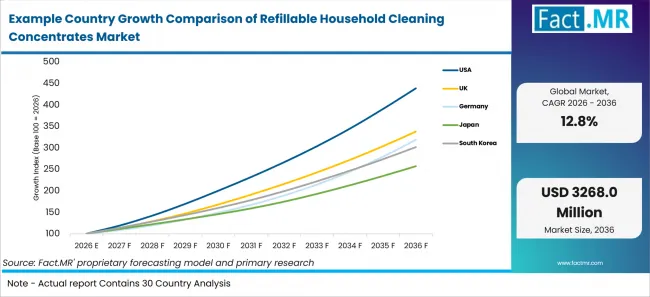
Example Country Growth Comparison Of Refillable Household Cleaning Concentrates Market | Source: Fact.MR
| Country | 2026 Share | CAGR (2026-2036) |
|---|---|---|
| United States | 33.0% | 13.5% |
| United Kingdom | 15.0% | 12.5% |
| Germany | 14.0% | 12.2% |
| France | 13.0% | 13.0% |
| Canada | 13.0% | 13.6% |
| Australia | 12.0% | 14.8% |
Source: Fact.MR analysis. Updated Aug 20, 2026
What is driving growth in the United States through 2036?
The market in the United States is projected to expand at a 13.5% CAGR from 2026 to 2036.
The United States has an established DTC refill pioneer base, subscription behavior and expanding retailer refill programs across grocery chains.
What is driving growth in the United Kingdom through 2036?
From 2026 to 2036, demand in the United Kingdom is forecast to grow at a 12.5% CAGR.
The United Kingdom's plastic-reduction awareness and online grocery adoption support demand for dissolvable tablet concentrates.
What is driving Germany's growth through 2036?
Germany is expected to record a 12.2% CAGR between 2026 and 2036.
Germany's packaging regulation and green consumer culture favor refillable formats, sustaining premium adoption and retailer buy-in.
What is driving France's growth through 2036?
Demand in France is forecast to rise at a 13.0% CAGR from 2026 to 2036.
France's circular-economy regulation and retailer sustainability commitments are accelerating refill fixture rollout across grocery formats.
What is driving Canada's growth through 2036?
A 13.6% CAGR is projected for Canada from 2026 to 2036.
Canada's DTC alignment and grocer plastic-reduction targets support refill system growth at retail and online.
What is driving Australia's growth through 2036?
Between 2026 and 2036, Australia is projected to post a 14.8% CAGR.
Environmental awareness, grocery refill programs and DTC participation support refill concentrate market activity in Australia.
Who leads the Refillable Household Cleaning Concentrates Market?
The competitive set includes refill-native brands and diversified household-care companies. Blueland and Cleancult are closely associated with reusable-container systems, while Grove Collaborative combines owned products with an established direct-to-consumer channel.
SC Johnson participates through Method and Ecover, and Procter & Gamble can bring formulation, distribution and brand scale to concentrated cleaning formats. Truman's competes through direct refill products aimed at reducing shipped water and disposable packaging.
Differentiation rests on cleaning efficacy, dissolution or dilution accuracy, bottle durability and refill availability. Subscription economics support online models, while grocery expansion requires simple shelf communication and a starter system that does not create excessive upfront friction.
Which companies are the key providers?
Key companies profiled include Blueland; Grove Collaborative; SC Johnson (Method and Ecover); Procter & Gamble; Cleancult; and Truman's.
- Blueland
- Grove Collaborative
- SC Johnson (Method and Ecover)
- Procter & Gamble
- Cleancult
- Truman's
Bibliography
- European Commission. Regulation (EU) 2025/40 on packaging and packaging waste.
- U.S. Environmental Protection Agency. Safer Choice Standard and Criteria.
- U.S. Environmental Protection Agency. Search Products that Meet the Safer Choice Standard.
- American Cleaning Institute. Publications on concentrated cleaning products and sustainable packaging.
- Ellen MacArthur Foundation. Global Commitment reporting on reusable and refillable packaging.
- United Nations Environment Programme. Reporting on plastic pollution and reusable packaging systems.
- Blueland. Multi-Surface Cleaner Starter Set and refill-tablet documentation.
- Grove Collaborative. Concentrated cleaning and refill-system documentation.
- SC Johnson. Method and Ecover refillable cleaning documentation.
- Procter & Gamble. Concentrated home-care and packaging disclosures.
- Cleancult. Refillable household-cleaning product documentation.
- Truman's. Household-cleaning concentrate documentation.
This Report Answers
- The report assesses refillable cleaning concentrates by refill format, cleaning task and sales channel.
- It compares tablet, liquid, powder and sachet routes within reusable-bottle systems.
- Country analysis considers packaging policy, direct-to-consumer adoption and retailer participation.
- The supplier review examines starter kits, refill logistics and the performance evidence supporting concentrated formulas.
- The scope excludes conventional ready-to-use cleaners and bulk institutional concentrates that are not sold through a household refill system.
What does the Refillable Household Cleaning Concentrates Market cover?
Refillable cleaning concentrate formats including dissolvable tablets and pods, liquid concentrates, powder concentrates and refill sachets for household cleaning.
Refillable concentrates for multi-surface, glass, bathroom, kitchen and degreaser, and floor cleaning distributed through online and direct-to-consumer, grocery and mass, and specialty and natural retail.
What is included in the scope?
Branded and private-label refillable concentrate systems, including reusable bottle starter kits, tablet and pod refills, and concentrate pouches and sachets.
Refillable cleaning concentrates sold in the tracked countries across DTC, grocery, mass, specialty and natural retail channels.
What is excluded from the scope?
Ready-to-use bottled sprays, laundry and dishwasher detergent concentrates, bulk institutional cleaning chemicals, and single-dose sachets for non-refill use.
Reusable bottle and dispenser hardware sold without concentrate refills, raw surfactant supply, and contract manufacturing services for refill brands.
How Was the Analysis Built?
The category is defined as household cleaners sold in a concentrated refill format for use with a reusable consumer container.
- Primary Research: Interviews focus on home-care formulators, retail buyers and direct-to-consumer operators evaluating dilution, repeat purchase and bottle reuse.
- Secondary Research: Packaging rules, EPA Safer Choice material, cleaning-industry publications and official company documentation inform the review.
- Market Sizing and Forecasting: Demand is modeled by refill format, product task, channel economics and realized consumer spending across the listed countries.
- Validation and Updates: Ready-to-use bottles and institutional concentrates without a household refill proposition are removed, and supplier participation is confirmed at product level.
Segmentation
What is the report's scope and coverage?
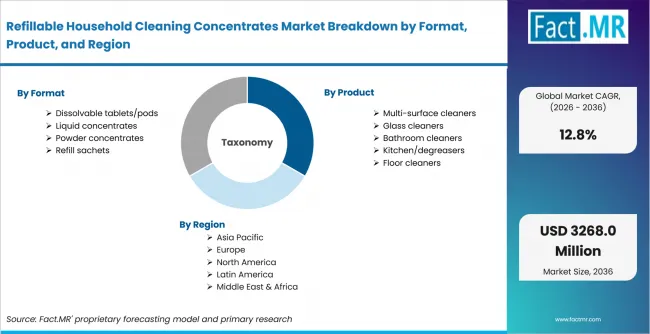
Refillable Household Cleaning Concentrates Market Breakdown By Format, Product, And Region | Source: Fact.MR
| Attribute | Details |
|---|---|
| Quantitative Units | USD 980 million in 2026 to USD 3,268 million by 2036 at 12.8% CAGR |
| Market Definition | Tablets, pods, powders, sachets and liquid concentrates reconstituted or dispensed through a reusable household-cleaning container. |
| Segments Covered | Format; Product; Distribution |
| Regions Covered | North America; Latin America; Europe; East Asia; South Asia and Oceania; Middle East and Africa |
| Countries Covered | United States; United Kingdom; Germany; France; Canada; Australia |
| Key Companies Profiled | Blueland; Grove Collaborative; SC Johnson (Method and Ecover); Procter & Gamble; Cleancult; Truman's |
| Forecast Period | 2026 to 2036 |
| Base Year | 2025 |
| Market Value, 2026 | USD 980 million |
| Market Value, 2036 | USD 3,268 million |
| CAGR, 2026-2036 | 12.8% |
| Absolute Opportunity | USD 2,288 million |
| Approach | Demand is modeled by refill format, product task, channel economics and realized consumer spending across the listed countries. |
Source: Fact.MR analysis. Updated Aug 20, 2026
How is the market segmented?
-
By Format
- Dissolvable tablets/pods
- Liquid concentrates
- Powder concentrates
- Refill sachets
-
By Product
- Multi-surface cleaners
- Glass cleaners
- Bathroom cleaners
- Kitchen/degreasers
- Floor cleaners
-
By Distribution
- Online/DTC
- Grocery & mass
- Specialty & natural retail
-
By Region
- North America
- Latin America
- Europe
- East Asia
- South Asia and Oceania
- Middle East and Africa
Frequently Asked Questions
What is the Refillable Household Cleaning Concentrates Market value in 2026?
At what CAGR is the market projected to grow?
The market is projected to expand at 12.8% CAGR from 2026 to 2036.
Which Format category has the leading share?
Which Product category has the leading share?
Which Distribution category has the leading share?
What CAGR is projected for Australia?
What is the primary demand driver?
What is the main restraint?
Which companies are active in the market?
Who worked on this report


Preview the report firsthand - request a free sample
Free SampleGet the brochure for pricing and purchase details
Download PDF