Refinery Biomass Hydrogen Tech Market

Refinery Biomass Hydrogen Tech Market Size and Share Forecast Outlook 2026 to 2036

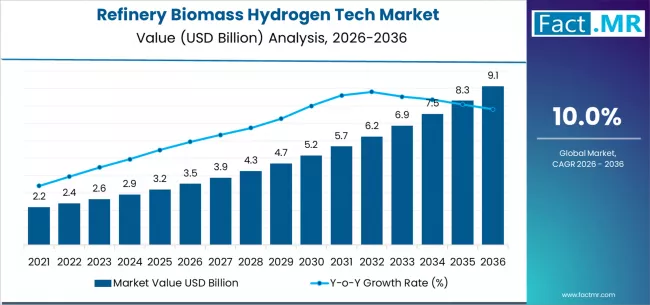
Refinery biomass hydrogen tech market is projected to grow from USD 3.5 billion in 2026 to USD 9.1 billion by 2036, at a CAGR of 10.0%. Gasification‑Based Hydrogen will dominate with a 38.7% market share, while refinery fuel hydrogen will lead the end‑useapplication segment with a 41.2% share.

Refinery Biomass Hydrogen Tech Market Forecast and Outlook 2026 to 2036

The global refinery biomass hydrogen technology market is emerging as a pivotal decarbonization lever for the petroleum refining sector, projected to expand from USD 3.52 billion in 2026 to USD 9.13 billion by 2036, advancing at a significant 10.0% CAGR.

Key Takeaways from the Refinery Biomass Hydrogen Tech Market

  • Market Value for 2026: USD 3.52 Billion
  • Market Value for 2036: USD 9.13 Billion
  • Forecast CAGR (2026-2036): 10.0%
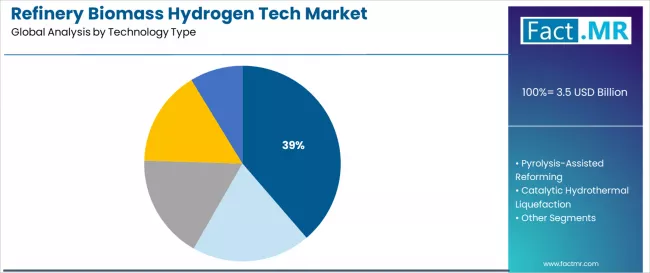
  • Leading Technology Type Segment (2026): Gasification-Based Hydrogen (39%)
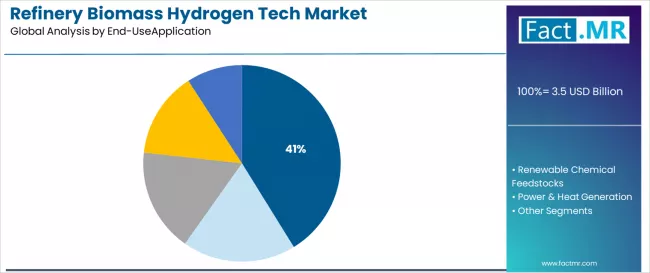
  • Leading End-Use Application Segment (2026): Refinery Fuel Hydrogen (41%)
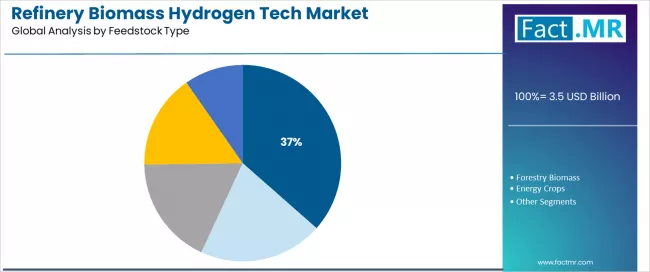
  • Leading Feedstock Type Segment (2026): Agricultural Residues (37%)
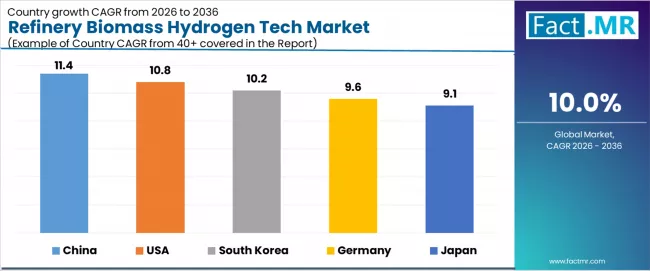
  • Key Growth Countries: China (11.40% CAGR), South Korea (10.20% CAGR), USA (10.80% CAGR), Germany (9.60% CAGR), Japan (9.10% CAGR)
  • Key Players in the Market: Air Liquide, Linde plc, Shell Catalysts & Technologies, Haldor Topsoe, Johnson Matthey

Refinery Biomass Hydrogen Tech Market Market Value Analysis

This robust growth is directly tied to refineries' urgent need to lower the carbon intensity of their operations and products, with biomass-derived hydrogen offering a pathway to reduce Scope 1 emissions and produce lower-carbon fuels.

Gasification-based hydrogen leads technology adoption with a 39% share, providing a scalable, thermochemical route to convert solid biomass into syngas and subsequently high-purity hydrogen. The primary end-use is for refinery fuel hydrogen (41%), displacing fossil-based hydrogen used in critical processes like hydrotreating and hydrocracking.

Agricultural residues are the dominant feedstock (37%), leveraging abundant, non-food biomass streams. The market's evolution is characterized by the integration of these technologies into existing refinery hydrogen networks, often through retrofits or dedicated greenfield units, supported by policy mechanisms valuing carbon credits and renewable fuel production.

Innovation is accelerating in pyrolysis and catalytic hydrothermal processes that handle wetter feedstocks more efficiently, broadening the viable biomass base. China (11.40% CAGR) and the USA (10.80% CAGR) are central to growth, driven by substantial government funding for clean hydrogen and the presence of large, technologically advanced refining sectors seeking sustainable transition strategies.

Metric

Metric Value
Market Value (2026) USD 3.52 Billion
Market Forecast Value (2036) USD 9.13 Billion
Forecast CAGR (2026-2036) 10.0%

Category

Category Segments
Technology Type Gasification-Based Hydrogen, Pyrolysis-Assisted Reforming, Catalytic Hydrothermal Liquefaction, Biological Hydrogen Production, Others
End-Use Application Refinery Fuel Hydrogen, Renewable Chemical Feedstocks, Power & Heat Generation, Bio-Hydrogen for Fuel Cells, Others
Feedstock Type Agricultural Residues, Forestry Biomass, Energy Crops, Organic Waste, Others
Region North America, Latin America, Western Europe, Eastern Europe, East Asia, South Asia & Pacific, MEA

Segmental Analysis

By Technology Type, Which Process Offers Scalable Integration with Existing Infrastructure?

Refinery Biomass Hydrogen Tech Market Analysis By Technology Type

Gasification-based hydrogen holds a leading 39% market share. This technology is favored for its maturity and ability to process diverse, low-cost solid biomass at large scale, producing a syngas that can be integrated into existing refinery hydrogen plants, such as steam methane reformers, with carbon capture, or purified in dedicated units.

Its technological readiness and potential for negative emissions when combined with carbon capture and storage (BECCS) make it the cornerstone technology for near-to-mid-term decarbonization of refinery hydrogen demand.

By End-Use Application, Where is the Immediate Decarbonization Pressure Greatest?

Refinery Biomass Hydrogen Tech Market Analysis By End Useapplication

Refinery fuel hydrogen constitutes the dominant application, accounting for 41% of the market. Hydrogen is a massive operational input in refineries for desulfurization and product upgrading.

Replacing conventionally produced hydrogen with biomass-derived hydrogen directly addresses a major portion of a refinery's operational emissions. This application offers a clear, quantifiable carbon reduction that aligns with regulatory mandates and corporate net-zero pledges, creating a strong, immediate incentive for investment.

By Feedstock Type, Which Source Balances Availability and Sustainability?

Refinery Biomass Hydrogen Tech Market Analysis By Feedstock Type

Agricultural residues, such as straw, husks, and stover, lead the feedstock segment with a 37% share. These materials are widely available as by-products of food production, avoiding land-use change controversies associated with dedicated energy crops. Their use promotes circularity within the agro-industrial sector.

Logistical challenges related to collection, transportation, and storage drive innovation in decentralized pre-processing and densification to make this feedstock economically viable for large-scale hydrogen production near refinery hubs.

What are the Drivers, Restraints, and Key Trends of the Refinery Biomass Hydrogen Tech Market?

The primary market driver is the combination of stringent carbon pricing mechanisms, low-carbon fuel standards, and government subsidies for clean hydrogen production, which are improving the economic case for biomass-derived hydrogen.

Refineries face mounting stakeholder pressure to future-proof their assets. The strategic need to produce lower-carbon intensity transportation fuels, such as renewable diesel and sustainable aviation fuel (SAF), which require substantial hydrogen inputs, further accelerates adoption.

A significant market restraint is the high capital intensity and technological complexity of building large-scale, integrated biomass gasification or liquefaction plants with the required reliability for refinery operations.

Securing long-term, cost-stable biomass feedstock contracts at the necessary scale can be challenging due to seasonal variability and competing uses. The lifecycle carbon accounting and sustainability certification of biomass feedstocks also require rigorous management to ensure genuine emissions benefits and avoid reputational risk.

Key trends include the development of hybrid systems that co-process biomass with waste plastics or fossil feedstocks in existing gasifiers to reduce risk and cost. There is a strong focus on advanced gas cleaning technologies to handle the complex contaminant profile of biomass-derived syngas and protect downstream catalysts.

Modular, skid-mounted biomass-to-hydrogen units are being developed for smaller-scale or distributed deployment. Furthermore, digital twin and AI optimization of these complex thermochemical processes are improving efficiency and operational predictability.

Analysis of the Refinery Biomass Hydrogen Tech Market by Key Countries

Refinery Biomass Hydrogen Tech Market Cagr Analysis By Country

Country CAGR (2026-2036)
China 11.40%
South Korea 10.20%
USA 10.80%
Germany 9.60%
Japan 9.10%

How is China's Policy-Driven Hydrogen Economy and Refining Scale Influencing Growth?

China's leading CAGR of 11.40% is driven by its national clean hydrogen strategy and the scale of its refining sector, the world's largest. Government mandates and subsidies are directing state-owned refiners to pilot and deploy low-carbon hydrogen technologies.

The vast domestic availability of agricultural and forestry residues provides a strategic feedstock advantage. Chinese engineering firms are aggressively developing and scaling gasification technology to reduce costs and establish technological leadership in this sector.

What is the Impact of South Korea's Hydrogen Roadmap and Industrial Conglomerate Investment?

South Korea's 10.20% growth is fueled by its ambitious national hydrogen roadmap and the active role of its major industrial conglomerates in the energy transition. These companies are investing across the hydrogen value chain, including biomass-to-hydrogen, to supply their affiliated refining and chemical operations.

The country's limited domestic biomass resources are driving investments in advanced pre-treatment and logistics, as well as overseas feedstock partnerships, to secure supply for its technology-driven approach.

Why does the USA's Refining Modernization and Renewable Fuel Demand Sustain Growth?

Refinery Biomass Hydrogen Tech Market Country Value Analysis

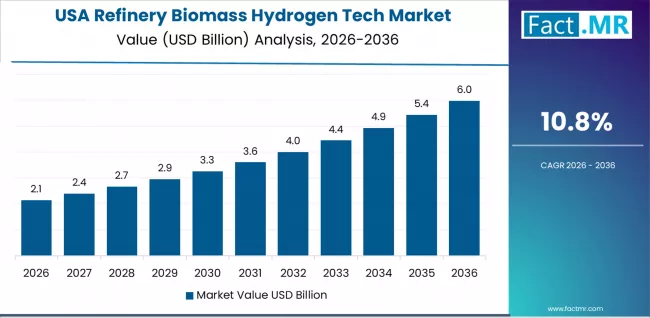
The USA's 10.80% growth is anchored in its extensive refining capacity, favorable Renewable Fuel Standard and state-level low-carbon fuel policies, and significant federal funding for clean hydrogen hubs.

Many refineries are transitioning into bio-refineries, producing renewable diesel and SAF, which creates a captive demand for low-carbon hydrogen. The abundant domestic supply of agricultural and woody biomass in regions like the Midwest and Southeast provides a strong feedstock base for project development.

How is Germany's Climate Law and Engineering Leadership Shaping the Market?

Germany's 9.60% CAGR is a direct consequence of its rigorous national climate targets and carbon pricing, which make decarbonizing industrial hydrogen economically imperative. German engineering companies are world leaders in high-efficiency gasification and syngas processing technology.

The market focuses on integrating biomass hydrogen with carbon capture to achieve negative emissions, and on developing solutions suitable for the region's feedstock mix, including forest residues and organic waste, within a tightly regulated environmental framework.

What Role does Japan's Energy Security and Technology Focus Play?

Japan's 9.10% growth is driven by its strategic goal of diversifying hydrogen supply chains for energy security and its advanced technology base. Japanese companies are investing in catalytic hydrothermal liquefaction and other advanced technologies suited for wet biomass feedstocks, which align with available resources.

Partnerships with resource-rich countries for biomass feedstock are a key component of its strategy, while domestic projects focus on demonstrating integrated systems for industrial decarbonization.

Competitive Landscape of the Refinery Biomass Hydrogen Tech Market

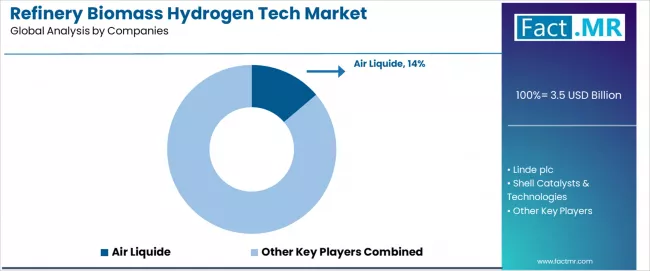
Refinery Biomass Hydrogen Tech Market Analysis By Company

Global industrial gas and engineering firms, catalyst specialists, and technology licensors define the competitive landscape. Competition centers on offering integrated technology packages including gasification, gas cleaning, shift conversion, and purification with guaranteed performance and efficiency metrics.

Success depends on to forming consortia with biomass suppliers, refinery operators, and off-takers to develop bankable projects, and to securing key reference plants that demonstrate reliable, large-scale operation. Companies are also competing to develop proprietary catalysts that are more resistant to biomass-derived syngas impurities.

Key Players in the Refinery Biomass Hydrogen Tech Market

  • Air Liquide
  • Linde plc
  • Shell Catalysts & Technologies
  • Haldor Topsoe
  • Johnson Matthey

Scope of Report

Items Values
Quantitative Units USD Billion
Technology Type Gasification-Based Hydrogen, Pyrolysis-Assisted Reforming, Catalytic Hydrothermal Liquefaction, Biological Hydrogen Production, Others
End-Use Application Refinery Fuel Hydrogen, Renewable Chemical Feedstocks, Power & Heat Generation, Bio-Hydrogen for Fuel Cells, Others
Feedstock Type Agricultural Residues, Forestry Biomass, Energy Crops, Organic Waste, Others
Key Countries China, South Korea, USA, Germany, Japan
Key Companies Air Liquide, Linde plc, Shell Catalysts & Technologies, Haldor Topsoe, Johnson Matthey
Additional Analysis Lifecycle carbon intensity analysis of different biomass pathways; techno-economic modeling of integrated biorefinery concepts; catalyst deactivation and management in biomass-derived syngas; impact of biomass feedstock pre-treatment on system efficiency; regulatory and certification frameworks for low-carbon hydrogen from biomass.

Market by Segments

  • Technology Type :

    • Gasification-Based Hydrogen
    • Pyrolysis-Assisted Reforming
    • Catalytic Hydrothermal Liquefaction
    • Biological Hydrogen Production
    • Others
  • End-Use Application :

    • Refinery Fuel Hydrogen
    • Renewable Chemical Feedstocks
    • Power & Heat Generation
    • Bio-Hydrogen for Fuel Cells
    • Others
  • Feedstock Type :

    • Agricultural Residues
    • Forestry Biomass
    • Energy Crops
    • Organic Waste
    • Others
  • Region :

    • North America

      • USA
      • Canada
    • Latin America

      • Brazil
      • Mexico
      • Argentina
      • Rest of Latin America
    • Western Europe

      • Germany
      • UK
      • France
      • Spain
      • Italy
      • BENELUX
      • Rest of Western Europe
    • Eastern Europe

      • Russia
      • Poland
      • Czech Republic
      • Rest of Eastern Europe
    • East Asia

      • China
      • Japan
      • South Korea
      • Rest of East Asia
    • South Asia & Pacific

      • India
      • ASEAN
      • Australia
      • Rest of South Asia & Pacific
    • MEA

      • Saudi Arabia
      • UAE
      • Turkiye
      • Rest of MEA

References

  • Aziz, M., & Darmawan, A. (2024). Hydrogen production from biomass gasification: A review of technology and sustainability assessment. International Journal of Hydrogen Energy, 49(15), 11234-11252.
  • Bridgwater, A. V. (2023). Review of fast pyrolysis of biomass and product upgrading. Biomass and Bioenergy, 158, 106356.
  • Hannula, I., & Kurkela, E. (2024). Hydrogen production via biomass gasification: A meta-analysis of techno-economic and environmental performance. Biomass Conversion and Biorefinery, 14(5), 6789-6805.
  • Heidenreich, S., & Foscolo, P. U. (2023). New concepts in biomass gasification. Progress in Energy and Combustion Science, 46, 72-95.
  • Huber, G. W., & Corma, A. (2024). Synergies between biorefineries and conventional refineries for the production of fuels and chemicals. Angewandte Chemie International Edition, 63(18), e202318754.
  • Molino, A., & Chianese, S. (2023). Biomass gasification technology: The state of the art overview. Journal of Energy Chemistry, 25(1), 10-25.
  • Robbiani, G., & van der Drift, B. (2024). Large-scale biomass gasification for production of sustainable hydrogen: Challenges and opportunities. Fuel Processing Technology, 252, 107982.
  • Sikarwar, V. S., & Pohorely, M. (2023). Progress in biomass gasification technique towards hydrogen production. Renewable and Sustainable Energy Reviews, 149, 111347.
  • Turn, S. Q., & Kinoshita, C. M. (2024). Hydrogen from biomass: Production, purification, and application in refineries. Wiley Interdisciplinary Reviews: Energy and Environment, 13(2), e510.
  • Zhang, Y., & Brown, T. R. (2023). Comparative techno-economic analysis of biofuels and hydrogen production from biomass. Biofuels, Bioproducts and Biorefining, 17(4), 912-928.

Table of Content

  1. Executive Summary
    • Global Market Outlook
    • Demand to side Trends
    • Supply to side Trends
    • Technology Roadmap Analysis
    • Analysis and Recommendations
  2. Market Overview
    • Market Coverage / Taxonomy
    • Market Definition / Scope / Limitations
  3. Market Background
    • Market Dynamics
      • Drivers
      • Restraints
      • Opportunity
      • Trends
    • Scenario Forecast
      • Demand in Optimistic Scenario
      • Demand in Likely Scenario
      • Demand in Conservative Scenario
    • Opportunity Map Analysis
    • Product Life Cycle Analysis
    • Supply Chain Analysis
    • Investment Feasibility Matrix
    • Value Chain Analysis
    • PESTLE and Porter’s Analysis
    • Regulatory Landscape
    • Regional Parent Market Outlook
    • Production and Consumption Statistics
    • Import and Export Statistics
  4. Global Market Analysis 2021 to 2025 and Forecast, 2026 to 2036
    • Historical Market Size Value (USD Million) Analysis, 2021 to 2025
    • Current and Future Market Size Value (USD Million) Projections, 2026 to 2036
      • Y to o to Y Growth Trend Analysis
      • Absolute $ Opportunity Analysis
  5. Global Market Pricing Analysis 2021 to 2025 and Forecast 2026 to 2036
  6. Global Market Analysis 2021 to 2025 and Forecast 2026 to 2036, By Technology Type
    • Introduction / Key Findings
    • Historical Market Size Value (USD Million) Analysis By Technology Type, 2021 to 2025
    • Current and Future Market Size Value (USD Million) Analysis and Forecast By Technology Type, 2026 to 2036
      • Gasification‑Based Hydrogen
      • Pyrolysis‑Assisted Reforming
      • Catalytic Hydrothermal Liquefaction
      • Biological HydrogenProduction
      • Others
    • Y to o to Y Growth Trend Analysis By Technology Type, 2021 to 2025
    • Absolute $ Opportunity Analysis By Technology Type, 2026 to 2036
  7. Global Market Analysis 2021 to 2025 and Forecast 2026 to 2036, By End‑UseApplication
    • Introduction / Key Findings
    • Historical Market Size Value (USD Million) Analysis By End‑UseApplication, 2021 to 2025
    • Current and Future Market Size Value (USD Million) Analysis and Forecast By End‑UseApplication, 2026 to 2036
      • Refinery Fuel Hydrogen
      • Renewable Chemical Feedstocks
      • Power & Heat Generation
      • Bio‑Hydrogen for Fuel Cells
      • Others
    • Y to o to Y Growth Trend Analysis By End‑UseApplication, 2021 to 2025
    • Absolute $ Opportunity Analysis By End‑UseApplication, 2026 to 2036
  8. Global Market Analysis 2021 to 2025 and Forecast 2026 to 2036, By Feedstock Type
    • Introduction / Key Findings
    • Historical Market Size Value (USD Million) Analysis By Feedstock Type, 2021 to 2025
    • Current and Future Market Size Value (USD Million) Analysis and Forecast By Feedstock Type, 2026 to 2036
      • Agricultural Residues
      • Forestry Biomass
      • Energy Crops
      • Organic Waste
      • Others
    • Y to o to Y Growth Trend Analysis By Feedstock Type, 2021 to 2025
    • Absolute $ Opportunity Analysis By Feedstock Type, 2026 to 2036
  9. Global Market Analysis 2021 to 2025 and Forecast 2026 to 2036, By Region
    • Introduction
    • Historical Market Size Value (USD Million) Analysis By Region, 2021 to 2025
    • Current Market Size Value (USD Million) Analysis and Forecast By Region, 2026 to 2036
      • North America
      • Latin America
      • Western Europe
      • Eastern Europe
      • East Asia
      • South Asia and Pacific
      • Middle East & Africa
    • Market Attractiveness Analysis By Region
  10. North America Market Analysis 2021 to 2025 and Forecast 2026 to 2036, By Country
    • Historical Market Size Value (USD Million) Trend Analysis By Market Taxonomy, 2021 to 2025
    • Market Size Value (USD Million) Forecast By Market Taxonomy, 2026 to 2036
      • By Country
        • USA
        • Canada
        • Mexico
      • By Technology Type
      • By End‑UseApplication
      • By Feedstock Type
    • Market Attractiveness Analysis
      • By Country
      • By Technology Type
      • By End‑UseApplication
      • By Feedstock Type
    • Key Takeaways
  11. Latin America Market Analysis 2021 to 2025 and Forecast 2026 to 2036, By Country
    • Historical Market Size Value (USD Million) Trend Analysis By Market Taxonomy, 2021 to 2025
    • Market Size Value (USD Million) Forecast By Market Taxonomy, 2026 to 2036
      • By Country
        • Brazil
        • Chile
        • Rest of Latin America
      • By Technology Type
      • By End‑UseApplication
      • By Feedstock Type
    • Market Attractiveness Analysis
      • By Country
      • By Technology Type
      • By End‑UseApplication
      • By Feedstock Type
    • Key Takeaways
  12. Western Europe Market Analysis 2021 to 2025 and Forecast 2026 to 2036, By Country
    • Historical Market Size Value (USD Million) Trend Analysis By Market Taxonomy, 2021 to 2025
    • Market Size Value (USD Million) Forecast By Market Taxonomy, 2026 to 2036
      • By Country
        • Germany
        • UK
        • Italy
        • Spain
        • France
        • Nordic
        • BENELUX
        • Rest of Western Europe
      • By Technology Type
      • By End‑UseApplication
      • By Feedstock Type
    • Market Attractiveness Analysis
      • By Country
      • By Technology Type
      • By End‑UseApplication
      • By Feedstock Type
    • Key Takeaways
  13. Eastern Europe Market Analysis 2021 to 2025 and Forecast 2026 to 2036, By Country
    • Historical Market Size Value (USD Million) Trend Analysis By Market Taxonomy, 2021 to 2025
    • Market Size Value (USD Million) Forecast By Market Taxonomy, 2026 to 2036
      • By Country
        • Russia
        • Poland
        • Hungary
        • Balkan & Baltic
        • Rest of Eastern Europe
      • By Technology Type
      • By End‑UseApplication
      • By Feedstock Type
    • Market Attractiveness Analysis
      • By Country
      • By Technology Type
      • By End‑UseApplication
      • By Feedstock Type
    • Key Takeaways
  14. East Asia Market Analysis 2021 to 2025 and Forecast 2026 to 2036, By Country
    • Historical Market Size Value (USD Million) Trend Analysis By Market Taxonomy, 2021 to 2025
    • Market Size Value (USD Million) Forecast By Market Taxonomy, 2026 to 2036
      • By Country
        • China
        • Japan
        • South Korea
      • By Technology Type
      • By End‑UseApplication
      • By Feedstock Type
    • Market Attractiveness Analysis
      • By Country
      • By Technology Type
      • By End‑UseApplication
      • By Feedstock Type
    • Key Takeaways
  15. South Asia and Pacific Market Analysis 2021 to 2025 and Forecast 2026 to 2036, By Country
    • Historical Market Size Value (USD Million) Trend Analysis By Market Taxonomy, 2021 to 2025
    • Market Size Value (USD Million) Forecast By Market Taxonomy, 2026 to 2036
      • By Country
        • India
        • ASEAN
        • Australia & New Zealand
        • Rest of South Asia and Pacific
      • By Technology Type
      • By End‑UseApplication
      • By Feedstock Type
    • Market Attractiveness Analysis
      • By Country
      • By Technology Type
      • By End‑UseApplication
      • By Feedstock Type
    • Key Takeaways
  16. Middle East & Africa Market Analysis 2021 to 2025 and Forecast 2026 to 2036, By Country
    • Historical Market Size Value (USD Million) Trend Analysis By Market Taxonomy, 2021 to 2025
    • Market Size Value (USD Million) Forecast By Market Taxonomy, 2026 to 2036
      • By Country
        • Kingdom of Saudi Arabia
        • Other GCC Countries
        • Turkiye
        • South Africa
        • Other African Union
        • Rest of Middle East & Africa
      • By Technology Type
      • By End‑UseApplication
      • By Feedstock Type
    • Market Attractiveness Analysis
      • By Country
      • By Technology Type
      • By End‑UseApplication
      • By Feedstock Type
    • Key Takeaways
  17. Key Countries Market Analysis
    • USA
      • Pricing Analysis
      • Market Share Analysis, 2025
        • By Technology Type
        • By End‑UseApplication
        • By Feedstock Type
    • Canada
      • Pricing Analysis
      • Market Share Analysis, 2025
        • By Technology Type
        • By End‑UseApplication
        • By Feedstock Type
    • Mexico
      • Pricing Analysis
      • Market Share Analysis, 2025
        • By Technology Type
        • By End‑UseApplication
        • By Feedstock Type
    • Brazil
      • Pricing Analysis
      • Market Share Analysis, 2025
        • By Technology Type
        • By End‑UseApplication
        • By Feedstock Type
    • Chile
      • Pricing Analysis
      • Market Share Analysis, 2025
        • By Technology Type
        • By End‑UseApplication
        • By Feedstock Type
    • Germany
      • Pricing Analysis
      • Market Share Analysis, 2025
        • By Technology Type
        • By End‑UseApplication
        • By Feedstock Type
    • UK
      • Pricing Analysis
      • Market Share Analysis, 2025
        • By Technology Type
        • By End‑UseApplication
        • By Feedstock Type
    • Italy
      • Pricing Analysis
      • Market Share Analysis, 2025
        • By Technology Type
        • By End‑UseApplication
        • By Feedstock Type
    • Spain
      • Pricing Analysis
      • Market Share Analysis, 2025
        • By Technology Type
        • By End‑UseApplication
        • By Feedstock Type
    • France
      • Pricing Analysis
      • Market Share Analysis, 2025
        • By Technology Type
        • By End‑UseApplication
        • By Feedstock Type
    • India
      • Pricing Analysis
      • Market Share Analysis, 2025
        • By Technology Type
        • By End‑UseApplication
        • By Feedstock Type
    • ASEAN
      • Pricing Analysis
      • Market Share Analysis, 2025
        • By Technology Type
        • By End‑UseApplication
        • By Feedstock Type
    • Australia & New Zealand
      • Pricing Analysis
      • Market Share Analysis, 2025
        • By Technology Type
        • By End‑UseApplication
        • By Feedstock Type
    • China
      • Pricing Analysis
      • Market Share Analysis, 2025
        • By Technology Type
        • By End‑UseApplication
        • By Feedstock Type
    • Japan
      • Pricing Analysis
      • Market Share Analysis, 2025
        • By Technology Type
        • By End‑UseApplication
        • By Feedstock Type
    • South Korea
      • Pricing Analysis
      • Market Share Analysis, 2025
        • By Technology Type
        • By End‑UseApplication
        • By Feedstock Type
    • Russia
      • Pricing Analysis
      • Market Share Analysis, 2025
        • By Technology Type
        • By End‑UseApplication
        • By Feedstock Type
    • Poland
      • Pricing Analysis
      • Market Share Analysis, 2025
        • By Technology Type
        • By End‑UseApplication
        • By Feedstock Type
    • Hungary
      • Pricing Analysis
      • Market Share Analysis, 2025
        • By Technology Type
        • By End‑UseApplication
        • By Feedstock Type
    • Kingdom of Saudi Arabia
      • Pricing Analysis
      • Market Share Analysis, 2025
        • By Technology Type
        • By End‑UseApplication
        • By Feedstock Type
    • Turkiye
      • Pricing Analysis
      • Market Share Analysis, 2025
        • By Technology Type
        • By End‑UseApplication
        • By Feedstock Type
    • South Africa
      • Pricing Analysis
      • Market Share Analysis, 2025
        • By Technology Type
        • By End‑UseApplication
        • By Feedstock Type
  18. Market Structure Analysis
    • Competition Dashboard
    • Competition Benchmarking
    • Market Share Analysis of Top Players
      • By Regional
      • By Technology Type
      • By End‑UseApplication
      • By Feedstock Type
  19. Competition Analysis
    • Competition Deep Dive
      • Air Liquide
        • Overview
        • Product Portfolio
        • Profitability by Market Segments (Product/Age /Sales Channel/Region)
        • Sales Footprint
        • Strategy Overview
          • Marketing Strategy
          • Product Strategy
          • Channel Strategy
      • Linde plc
      • Shell Catalysts & Technologies
      • Haldor Topsoe
      • Johnson Matthey
      • Others
  20. Assumptions & Acronyms Used
  21. Research Methodology

List Of Table

  • Table 1: Global Market Value (USD Million) Forecast by Region, 2021 to 2036
  • Table 2: Global Market Value (USD Million) Forecast by Technology Type, 2021 to 2036
  • Table 3: Global Market Value (USD Million) Forecast by End‑UseApplication, 2021 to 2036
  • Table 4: Global Market Value (USD Million) Forecast by Feedstock Type, 2021 to 2036
  • Table 5: North America Market Value (USD Million) Forecast by Country, 2021 to 2036
  • Table 6: North America Market Value (USD Million) Forecast by Technology Type, 2021 to 2036
  • Table 7: North America Market Value (USD Million) Forecast by End‑UseApplication, 2021 to 2036
  • Table 8: North America Market Value (USD Million) Forecast by Feedstock Type, 2021 to 2036
  • Table 9: Latin America Market Value (USD Million) Forecast by Country, 2021 to 2036
  • Table 10: Latin America Market Value (USD Million) Forecast by Technology Type, 2021 to 2036
  • Table 11: Latin America Market Value (USD Million) Forecast by End‑UseApplication, 2021 to 2036
  • Table 12: Latin America Market Value (USD Million) Forecast by Feedstock Type, 2021 to 2036
  • Table 13: Western Europe Market Value (USD Million) Forecast by Country, 2021 to 2036
  • Table 14: Western Europe Market Value (USD Million) Forecast by Technology Type, 2021 to 2036
  • Table 15: Western Europe Market Value (USD Million) Forecast by End‑UseApplication, 2021 to 2036
  • Table 16: Western Europe Market Value (USD Million) Forecast by Feedstock Type, 2021 to 2036
  • Table 17: Eastern Europe Market Value (USD Million) Forecast by Country, 2021 to 2036
  • Table 18: Eastern Europe Market Value (USD Million) Forecast by Technology Type, 2021 to 2036
  • Table 19: Eastern Europe Market Value (USD Million) Forecast by End‑UseApplication, 2021 to 2036
  • Table 20: Eastern Europe Market Value (USD Million) Forecast by Feedstock Type, 2021 to 2036
  • Table 21: East Asia Market Value (USD Million) Forecast by Country, 2021 to 2036
  • Table 22: East Asia Market Value (USD Million) Forecast by Technology Type, 2021 to 2036
  • Table 23: East Asia Market Value (USD Million) Forecast by End‑UseApplication, 2021 to 2036
  • Table 24: East Asia Market Value (USD Million) Forecast by Feedstock Type, 2021 to 2036
  • Table 25: South Asia and Pacific Market Value (USD Million) Forecast by Country, 2021 to 2036
  • Table 26: South Asia and Pacific Market Value (USD Million) Forecast by Technology Type, 2021 to 2036
  • Table 27: South Asia and Pacific Market Value (USD Million) Forecast by End‑UseApplication, 2021 to 2036
  • Table 28: South Asia and Pacific Market Value (USD Million) Forecast by Feedstock Type, 2021 to 2036
  • Table 29: Middle East & Africa Market Value (USD Million) Forecast by Country, 2021 to 2036
  • Table 30: Middle East & Africa Market Value (USD Million) Forecast by Technology Type, 2021 to 2036
  • Table 31: Middle East & Africa Market Value (USD Million) Forecast by End‑UseApplication, 2021 to 2036
  • Table 32: Middle East & Africa Market Value (USD Million) Forecast by Feedstock Type, 2021 to 2036

List Of Figures

  • Figure 1: Global Market Pricing Analysis
  • Figure 2: Global Market Value (USD Million) Forecast 2021 to 2036
  • Figure 3: Global Market Value Share and BPS Analysis by Technology Type, 2026 and 2036
  • Figure 4: Global Market Y to o to Y Growth Comparison by Technology Type, 2026 to 2036
  • Figure 5: Global Market Attractiveness Analysis by Technology Type
  • Figure 6: Global Market Value Share and BPS Analysis by End‑UseApplication, 2026 and 2036
  • Figure 7: Global Market Y to o to Y Growth Comparison by End‑UseApplication, 2026 to 2036
  • Figure 8: Global Market Attractiveness Analysis by End‑UseApplication
  • Figure 9: Global Market Value Share and BPS Analysis by Feedstock Type, 2026 and 2036
  • Figure 10: Global Market Y to o to Y Growth Comparison by Feedstock Type, 2026 to 2036
  • Figure 11: Global Market Attractiveness Analysis by Feedstock Type
  • Figure 12: Global Market Value (USD Million) Share and BPS Analysis by Region, 2026 and 2036
  • Figure 13: Global Market Y to o to Y Growth Comparison by Region, 2026 to 2036
  • Figure 14: Global Market Attractiveness Analysis by Region
  • Figure 15: North America Market Incremental Dollar Opportunity, 2026 to 2036
  • Figure 16: Latin America Market Incremental Dollar Opportunity, 2026 to 2036
  • Figure 17: Western Europe Market Incremental Dollar Opportunity, 2026 to 2036
  • Figure 18: Eastern Europe Market Incremental Dollar Opportunity, 2026 to 2036
  • Figure 19: East Asia Market Incremental Dollar Opportunity, 2026 to 2036
  • Figure 20: South Asia and Pacific Market Incremental Dollar Opportunity, 2026 to 2036
  • Figure 21: Middle East & Africa Market Incremental Dollar Opportunity, 2026 to 2036
  • Figure 22: North America Market Value Share and BPS Analysis by Country, 2026 and 2036
  • Figure 23: North America Market Value Share and BPS Analysis by Technology Type, 2026 and 2036
  • Figure 24: North America Market Y to o to Y Growth Comparison by Technology Type, 2026 to 2036
  • Figure 25: North America Market Attractiveness Analysis by Technology Type
  • Figure 26: North America Market Value Share and BPS Analysis by End‑UseApplication, 2026 and 2036
  • Figure 27: North America Market Y to o to Y Growth Comparison by End‑UseApplication, 2026 to 2036
  • Figure 28: North America Market Attractiveness Analysis by End‑UseApplication
  • Figure 29: North America Market Value Share and BPS Analysis by Feedstock Type, 2026 and 2036
  • Figure 30: North America Market Y to o to Y Growth Comparison by Feedstock Type, 2026 to 2036
  • Figure 31: North America Market Attractiveness Analysis by Feedstock Type
  • Figure 32: Latin America Market Value Share and BPS Analysis by Country, 2026 and 2036
  • Figure 33: Latin America Market Value Share and BPS Analysis by Technology Type, 2026 and 2036
  • Figure 34: Latin America Market Y to o to Y Growth Comparison by Technology Type, 2026 to 2036
  • Figure 35: Latin America Market Attractiveness Analysis by Technology Type
  • Figure 36: Latin America Market Value Share and BPS Analysis by End‑UseApplication, 2026 and 2036
  • Figure 37: Latin America Market Y to o to Y Growth Comparison by End‑UseApplication, 2026 to 2036
  • Figure 38: Latin America Market Attractiveness Analysis by End‑UseApplication
  • Figure 39: Latin America Market Value Share and BPS Analysis by Feedstock Type, 2026 and 2036
  • Figure 40: Latin America Market Y to o to Y Growth Comparison by Feedstock Type, 2026 to 2036
  • Figure 41: Latin America Market Attractiveness Analysis by Feedstock Type
  • Figure 42: Western Europe Market Value Share and BPS Analysis by Country, 2026 and 2036
  • Figure 43: Western Europe Market Value Share and BPS Analysis by Technology Type, 2026 and 2036
  • Figure 44: Western Europe Market Y to o to Y Growth Comparison by Technology Type, 2026 to 2036
  • Figure 45: Western Europe Market Attractiveness Analysis by Technology Type
  • Figure 46: Western Europe Market Value Share and BPS Analysis by End‑UseApplication, 2026 and 2036
  • Figure 47: Western Europe Market Y to o to Y Growth Comparison by End‑UseApplication, 2026 to 2036
  • Figure 48: Western Europe Market Attractiveness Analysis by End‑UseApplication
  • Figure 49: Western Europe Market Value Share and BPS Analysis by Feedstock Type, 2026 and 2036
  • Figure 50: Western Europe Market Y to o to Y Growth Comparison by Feedstock Type, 2026 to 2036
  • Figure 51: Western Europe Market Attractiveness Analysis by Feedstock Type
  • Figure 52: Eastern Europe Market Value Share and BPS Analysis by Country, 2026 and 2036
  • Figure 53: Eastern Europe Market Value Share and BPS Analysis by Technology Type, 2026 and 2036
  • Figure 54: Eastern Europe Market Y to o to Y Growth Comparison by Technology Type, 2026 to 2036
  • Figure 55: Eastern Europe Market Attractiveness Analysis by Technology Type
  • Figure 56: Eastern Europe Market Value Share and BPS Analysis by End‑UseApplication, 2026 and 2036
  • Figure 57: Eastern Europe Market Y to o to Y Growth Comparison by End‑UseApplication, 2026 to 2036
  • Figure 58: Eastern Europe Market Attractiveness Analysis by End‑UseApplication
  • Figure 59: Eastern Europe Market Value Share and BPS Analysis by Feedstock Type, 2026 and 2036
  • Figure 60: Eastern Europe Market Y to o to Y Growth Comparison by Feedstock Type, 2026 to 2036
  • Figure 61: Eastern Europe Market Attractiveness Analysis by Feedstock Type
  • Figure 62: East Asia Market Value Share and BPS Analysis by Country, 2026 and 2036
  • Figure 63: East Asia Market Value Share and BPS Analysis by Technology Type, 2026 and 2036
  • Figure 64: East Asia Market Y to o to Y Growth Comparison by Technology Type, 2026 to 2036
  • Figure 65: East Asia Market Attractiveness Analysis by Technology Type
  • Figure 66: East Asia Market Value Share and BPS Analysis by End‑UseApplication, 2026 and 2036
  • Figure 67: East Asia Market Y to o to Y Growth Comparison by End‑UseApplication, 2026 to 2036
  • Figure 68: East Asia Market Attractiveness Analysis by End‑UseApplication
  • Figure 69: East Asia Market Value Share and BPS Analysis by Feedstock Type, 2026 and 2036
  • Figure 70: East Asia Market Y to o to Y Growth Comparison by Feedstock Type, 2026 to 2036
  • Figure 71: East Asia Market Attractiveness Analysis by Feedstock Type
  • Figure 72: South Asia and Pacific Market Value Share and BPS Analysis by Country, 2026 and 2036
  • Figure 73: South Asia and Pacific Market Value Share and BPS Analysis by Technology Type, 2026 and 2036
  • Figure 74: South Asia and Pacific Market Y to o to Y Growth Comparison by Technology Type, 2026 to 2036
  • Figure 75: South Asia and Pacific Market Attractiveness Analysis by Technology Type
  • Figure 76: South Asia and Pacific Market Value Share and BPS Analysis by End‑UseApplication, 2026 and 2036
  • Figure 77: South Asia and Pacific Market Y to o to Y Growth Comparison by End‑UseApplication, 2026 to 2036
  • Figure 78: South Asia and Pacific Market Attractiveness Analysis by End‑UseApplication
  • Figure 79: South Asia and Pacific Market Value Share and BPS Analysis by Feedstock Type, 2026 and 2036
  • Figure 80: South Asia and Pacific Market Y to o to Y Growth Comparison by Feedstock Type, 2026 to 2036
  • Figure 81: South Asia and Pacific Market Attractiveness Analysis by Feedstock Type
  • Figure 82: Middle East & Africa Market Value Share and BPS Analysis by Country, 2026 and 2036
  • Figure 83: Middle East & Africa Market Value Share and BPS Analysis by Technology Type, 2026 and 2036
  • Figure 84: Middle East & Africa Market Y to o to Y Growth Comparison by Technology Type, 2026 to 2036
  • Figure 85: Middle East & Africa Market Attractiveness Analysis by Technology Type
  • Figure 86: Middle East & Africa Market Value Share and BPS Analysis by End‑UseApplication, 2026 and 2036
  • Figure 87: Middle East & Africa Market Y to o to Y Growth Comparison by End‑UseApplication, 2026 to 2036
  • Figure 88: Middle East & Africa Market Attractiveness Analysis by End‑UseApplication
  • Figure 89: Middle East & Africa Market Value Share and BPS Analysis by Feedstock Type, 2026 and 2036
  • Figure 90: Middle East & Africa Market Y to o to Y Growth Comparison by Feedstock Type, 2026 to 2036
  • Figure 91: Middle East & Africa Market Attractiveness Analysis by Feedstock Type
  • Figure 92: Global Market - Tier Structure Analysis
  • Figure 93: Global Market - Company Share Analysis

- FAQs -

How big is the refinery biomass hydrogen tech market in 2026?

The global refinery biomass hydrogen tech market is estimated to be valued at USD 3.5 billion in 2026.

What will be the size of refinery biomass hydrogen tech market in 2036?

The market size for the refinery biomass hydrogen tech market is projected to reach USD 9.1 billion by 2036.

How much will be the refinery biomass hydrogen tech market growth between 2026 and 2036?

The refinery biomass hydrogen tech market is expected to grow at a 10.0% CAGR between 2026 and 2036.

What are the key product types in the refinery biomass hydrogen tech market?

The key product types in refinery biomass hydrogen tech market are gasification‑based hydrogen, pyrolysis‑assisted reforming, catalytic hydrothermal liquefaction, biological hydrogenproduction and others.

Which end‑useapplication segment to contribute significant share in the refinery biomass hydrogen tech market in 2026?

In terms of end‑useapplication, refinery fuel hydrogen segment to command 41.2% share in the refinery biomass hydrogen tech market in 2026.
Refinery Biomass Hydrogen Tech Market