Remote Lockout Tool Market (2026 - 2036)
Remote Lockout Tool Market Size and Share Forecast Outlook 2026 to 2036
Core Findings
Remote Lockout Tool Market Forecast and Outlook 2026 to 2036
The remote lockout tool market is expected to be valued at USD 946.8 million in 2026, and projected to reach USD 1,542.2 million by 2036, advancing at a 5.0% CAGR.
Remote Lockout Tool Market Key Takeaways
- Remote Lockout Tool Market Value (2026): USD 946.8 million
- Remote Lockout Tool Market Forecast Value (2036): USD 1,542.2 million
- Remote Lockout Tool Market Forecast CAGR (2026-2036): 5.0%
- Leading Solution Type in Remote Lockout Tool Market: Smart Padlocks / Hasps (32.0%)
- Key Growth Region in Remote Lockout Tool Market: Asia Pacific
- Key Players in Remote Lockout Tool Market: Brady, Master Lock, Panduit, Emerson, Rockwell Automation, Honeywell, IDEAL Industries, Hubbell, Grace Technologies
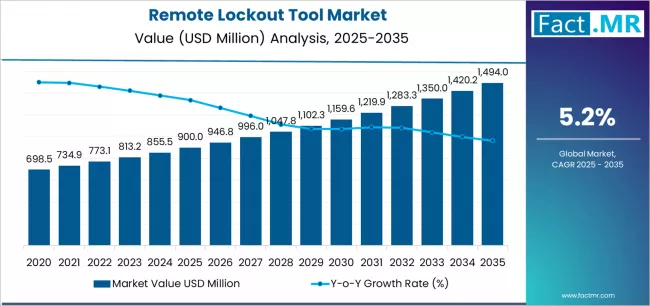
Demand growth is driven by enhanced safety protocols in industrial environments and regulations focused on hazardous energy control during maintenance activities. Manufacturers prioritize remote lockout tools to isolate equipment from a distance, ensuring operator safety and minimizing human error.
Adoption is strongest in industries like manufacturing, utilities, oil & gas, and chemicals, where the need for centralized safety management and regulatory compliance is critical. The shift from mechanical to digital lockout-tagout (LOTO) systems is propelled by technological advancements, such as smart padlocks, remote controllers, and wireless connectivity options like LTE/5G and Bluetooth. Emerging trends focus on the integration of remote lockout tools with industrial safety systems, providing enhanced visibility and real-time monitoring capabilities to improve compliance and reduce risks.
Remote Lockout Tool Market
| Metric | Value |
|---|---|
| Estimated Value in (2026E) | USD 946.8 million |
| Forecast Value in (2036F) | USD 1,542.2 million |
| Forecast CAGR (2026 to 2036) | 5.0% |
Category
| Category | Segments |
|---|---|
| Solution Type | Smart Padlocks / Hasps; Remote LOTO Controllers; Circuit / PLC Lockouts; Valve / Actuator Lockouts |
| Connectivity | Cellular (LTE / 5G); Bluetooth / NFC; Offline / Standalone; Wi-Fi |
| End Use | Manufacturing; Oil & Gas / Chemicals; Utilities; Facilities / Other |
| Compliance Program | OSHA-Driven; ISO / EN; Dual Compliance; Custom Programs |
| Region | North America; Europe; Asia Pacific; Latin America; Middle East & Africa |
Segmental Analysis
What Is the Impact of Solution Type on the Remote Lockout Tool Market?
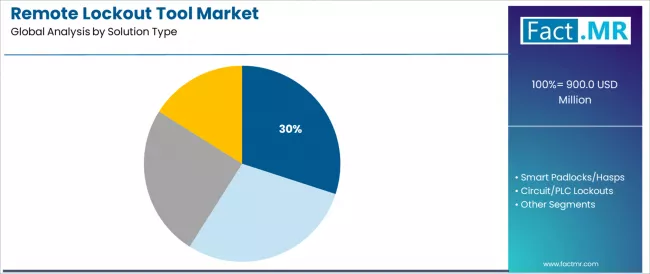
In the remote lockout tool market, solution type determines deployment flexibility, control scope, and suitability for distributed industrial assets. Smart padlocks and hasps account for a 32.0% share, driven by their ability to digitally secure equipment while enabling remote authorization and status verification. These solutions are widely applied across electrical panels, machinery access points, and maintenance zones where traditional lockout devices limit visibility. Integrated sensing and remote control capabilities support centralized safety management, aligning with industries adopting digital lockout tagout systems to reduce human error and improve compliance tracking.
How Does Connectivity Influence Adoption in the Remote Lockout Tool Market?
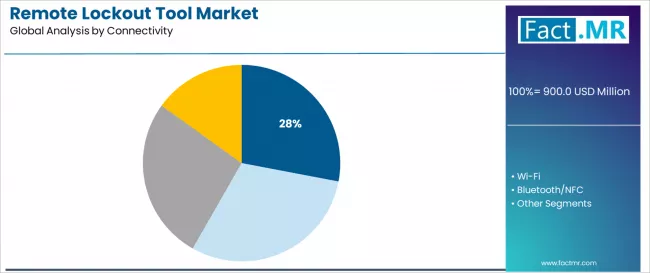
Connectivity plays a critical role by defining communication range, responsiveness, and reliability of remote lockout operations. Cellular connectivity using LTE or 5G holds a 30.0% share, reflecting its suitability for geographically dispersed industrial sites. This connectivity enables real time lock status updates and remote intervention without dependence on local networks. Adoption is strongest in utilities, energy facilities, and large manufacturing campuses where assets are spread across wide areas and uninterrupted safety control remains a core operational requirement.
What are the Drivers, Restraints, and Key Trends in the Remote Lockout Tool Market?
- Drivers: Demand for remote lockout tools is shaped by growing emphasis on workplace safety protocols, regulatory compliance, and the need to control hazardous energy during maintenance and servicing operations. Facilities in manufacturing, utilities, petrochemical, and transportation sectors specify remote lockout systems to isolate equipment and prevent unintended start-ups from a distance, reducing injury risk and aligning with occupational safety standards. Adoption is supported by integration with digital permits, asset management systems, and multi-site safety programmes that prioritize documented lockout/tagout (LOTO) procedures.
- Restraints: Adoption is constrained where capital budgets are limited and facilities prioritize lower-cost mechanical LOTO devices, especially in smaller shops or plants with infrequent maintenance cycles. Technical complexity in retrofitting remote lockout capabilities to legacy equipment, including interfacing with diverse control systems and power supplies, adds time and cost to deployment. User resistance can emerge where training and behavioural change are required to embed remote lockout practices into daily operations, affecting initial uptake and consistent usage.
- Trend 1: Development of wireless remote lockout tools that leverage encrypted communication and compact power sources to support rapid deployment without extensive wiring and reduce installation downtime.
- Trend 2: Increasing integration of remote lockout tools with digital safety platforms that record lockout events, authorizations and worker credentials, enabling audit trails and analytics that support continuous improvement in safety performance.
Analysis of the Remote Lockout Tool Market by Key Country
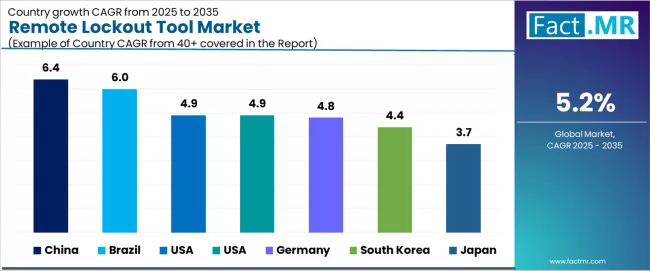
| Country | CAGR (%) |
|---|---|
| China | 6.4% |
| Brazil | 6.0% |
| USA | 5.2% |
| UK | 4.9% |
| Germany | 4.5% |
| South Korea | 4.2% |
| Japan | 3.7% |
The report covers an in-depth analysis of 40+ countries; top-performing countries are highlighted below.
What is driving growth of remote lockout tool demand in China?
Demand for remote lockout tools in China is expanding as industrial operators reinforce hazardous energy control across large facilities. Growth at 6.4% CAGR reflects rising automation in power generation, manufacturing, and infrastructure maintenance. Centralized operations benefit from remote isolation capabilities reducing on-site exposure. Regulatory enforcement of workplace safety standards supports technology adoption. Domestic suppliers offer scalable solutions aligned with cost-sensitive procurement. Demand remains concentrated within utilities, heavy manufacturing, and transport infrastructure projects requiring coordinated safety controls.
- Expansion of automated industrial facilities
- Enforcement of hazardous energy control standards
- Need for centralized safety management
- Availability of scalable domestic solutions
Why is Brazil seeing expansion in remote lockout tool adoption?
Remote lockout tool demand in Brazil is rising as safety practices mature across energy and industrial sectors. Growth at 6.0% CAGR reflects increased focus on reducing accident risk during maintenance activities. Utilities and process industries prioritize remote isolation to protect dispersed workforces. Regulatory oversight encourages documented lockout procedures. Equipment selection emphasizes robustness and ease of deployment across varied sites. Demand remains driven by domestic energy, mining, and industrial maintenance operations.
- Growth of utility and process industries
- Rising focus on maintenance safety
- Regulatory oversight of lockout procedures
- Preference for durable, field-ready tools
What factors are shaping remote lockout tool sales in the USA?
Sales of remote lockout tools in the USA are increasing as employers strengthen compliance with occupational safety regulations. Growth at 5.2% CAGR reflects adoption across manufacturing, utilities, and data centers. Engineering controls addressing hazardous energy isolation gain priority over procedural safeguards alone. Integration with digital safety systems improves auditability and response time. Demand centers on proven solutions meeting stringent certification requirements across regulated industries.
- Strict occupational safety compliance requirements
- Emphasis on engineering-based safety controls
- Integration with digital safety platforms
- Demand from regulated industrial environments
How is the UK supporting growth of remote lockout tool demand?
Remote lockout tool demand in the UK is advancing as industries emphasize risk reduction during maintenance and emergency response. Growth at 4.9% CAGR reflects adoption within utilities, transport infrastructure, and industrial facilities. Safety governance frameworks encourage remote isolation capabilities. Public sector and regulated operators prioritize documented control and verification. Demand remains concentrated within environments requiring consistent compliance and centralized oversight.
- Focus on maintenance risk reduction
- Adoption within utilities and transport sectors
- Emphasis on documented safety governance
- Demand from regulated operators
What is driving expansion of remote lockout tool demand in Germany?
Demand for remote lockout tools in Germany is rising as precision engineering and industrial operators align with stringent safety norms. Growth at 4.5% CAGR reflects integration within automated manufacturing and energy systems. Engineering standards prioritize fail-safe operation and system redundancy. Digital traceability and reliability influence purchasing decisions. Demand remains compliance-driven within industrial facilities requiring high operational discipline.
- Stringent industrial safety standards
- Integration with automated manufacturing systems
- Emphasis on fail-safe operation
- Need for digital traceability
How is South Korea shaping demand for remote lockout tools?
Remote lockout tool demand in South Korea is growing as industrial safety management evolves across manufacturing and energy sectors. Growth at 4.2% CAGR reflects adoption within automated plants and infrastructure operations. Employers seek remote isolation to protect workers during complex maintenance tasks. Export-oriented industries align safety practices with global standards. Demand focuses on compact, reliable systems supporting centralized control.
- Growth of automated industrial operations
- Focus on worker protection during maintenance
- Alignment with global safety standards
- Demand for compact control systems
What factors are influencing remote lockout tool demand in Japan?
Demand for remote lockout tools in Japan is expanding steadily as industries emphasize precision safety management. Growth at 3.7% CAGR reflects cautious adoption within manufacturing, utilities, and transport systems. Conservative investment behavior favors proven technologies with long-term reliability. Emphasis remains on integration with existing safety infrastructure and stable operation across critical facilities.
- Conservative technology adoption patterns
- Focus on precision safety management
- Integration with existing infrastructure
- Emphasis on long-term reliability
What Defines the Competitive Landscape for the Remote Lockout Tool Market Globally?
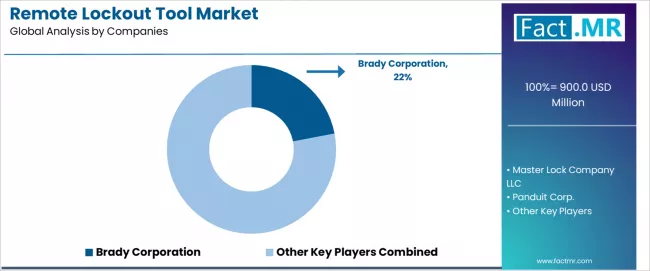
Global demand for remote lockout tools is shaped by stricter industrial safety regulations, expansion of automated facilities, and increased focus on zero-incident operations. Safety managers and maintenance teams evaluate solutions based on reliability of remote isolation, communication range, cybersecurity safeguards, and compatibility with electrical, pneumatic, and hydraulic systems. Assessment also includes ease of deployment during maintenance, integration with lockout-tagout procedures, and audit trail capability. Procurement behavior favors vendors offering standards-compliant solutions, scalable architectures, and proven deployment across multi-site industrial environments. Industry direction reflects transition from manual lockout devices toward digitally enabled, remotely verifiable safety control systems.
Brady holds leading positioning through comprehensive lockout-tagout portfolios extended into connected and remote safety solutions. Master Lock competes by leveraging strong brand recognition and expanding into smart and remote lockout technologies. Rockwell Automation maintains relevance through integration of remote lockout tools within broader industrial automation and safety control ecosystems. Panduit supports demand with networked safety and electrical infrastructure solutions aligned with remote isolation requirements. Honeywell participates by embedding remote lockout capabilities into industrial safety and control platforms serving high-risk sectors. Competitive differentiation centers on system reliability, compliance assurance, digital integration depth, and lifecycle safety support.
Key Players in the Remote Lockout Tool Market
- Brady
- Master Lock
- Panduit
- ABUS
- Emerson
- Rockwell Automation
- Honeywell
- IDEAL Industries
- Hubbell
- Grace Technologies
Bibliographies
- Occupational Safety and Health Administration. (2024). Control of hazardous energy (lockout/tagout): Compliance guidance for industrial maintenance and servicing operations. U.S. Department of Labor.
- International Organization for Standardization. (2024). ISO 45001: Occupational health and safety management systems - Requirements with guidance for use. ISO.
- International Electrotechnical Commission. (2024). IEC 60204‑1: Safety of machinery - Electrical equipment of machines. IEC.
- International Labour Organization. (2024). Occupational safety and health management in high‑risk industrial operations. ILO.
Scope of the Report
| Items | Values |
|---|---|
| Quantitative Units | USD million |
| Solution Type | Smart Padlocks / Hasps; Remote LOTO Controllers; Circuit / PLC Lockouts; Valve / Actuator Lockouts |
| Connectivity | Cellular (LTE / 5G); Bluetooth / NFC; Offline / Standalone; Wi-Fi |
| End Use | Manufacturing; Oil & Gas / Chemicals; Utilities; Facilities / Other |
| Compliance Program | OSHA-Driven; ISO / EN; Dual Compliance; Custom Programs |
| Regions Covered | Asia Pacific, Europe, North America, Latin America, Middle East & Africa |
| Countries Covered | China, Brazil, USA, UK, Germany, South Korea, Japan, and 40+ countries |
| Key Companies Profiled | Brady; Master Lock; Panduit; ABUS; Emerson; Rockwell Automation; Honeywell; IDEAL Industries; Hubbell; Grace Technologies |
| Additional Attributes | Dollar sales by solution type, connectivity, end use, and compliance program; rising adoption of connected lockout-tagout systems in high-risk industrial environments; integration of remote LOTO with PLCs, SCADA, and industrial safety systems; growing preference for cellular-enabled devices supporting centralized safety oversight; compliance-driven procurement aligned with OSHA and ISO safety mandates; expansion of digital safety programs across multi-site manufacturing and utility operations. |
Remote Lockout Tool Market Key Segment
-
Solution Type :
- Smart Padlocks / Hasps
- Remote LOTO Controllers
- Circuit / PLC Lockouts
- Valve / Actuator Lockouts
-
Connectivity :
- Cellular (LTE / 5G)
- Bluetooth / NFC
- Offline / Standalone
- Wi-Fi
-
End Use :
- Manufacturing
- Oil & Gas / Chemicals
- Utilities
- Facilities / Other
-
Compliance Program :
- OSHA-Driven
- ISO / EN
- Dual Compliance
- Custom Programs
-
Region :
- North America
- USA
- Canada
- Mexico
- Europe
- Germany
- UK
- France
- Italy
- Spain
- Nordic Countries
- BENELUX
- Rest of Europe
- Asia Pacific
- China
- Japan
- South Korea
- India
- Australia
- Rest of Asia Pacific
- Latin America
- Brazil
- Argentina
- Rest of Latin America
- Middle East and Africa
- Kingdom of Saudi Arabia
- United Arab Emirates
- South Africa
- Rest of Middle East and Africa
- Other Regions
- Oceania
- Central Asia
- Other Markets
- North America
Table of Content
- Executive Summary
- Global Market Outlook
- Demand to side Trends
- Supply to side Trends
- Technology Roadmap Analysis
- Analysis and Recommendations
- Market Overview
- Market Coverage / Taxonomy
- Market Definition / Scope / Limitations
- Research Methodology
- Chapter Orientation
- Analytical Lens and Working Hypotheses
- Market Structure, Signals, and Trend Drivers
- Benchmarking and Cross-market Comparability
- Market Sizing, Forecasting, and Opportunity Mapping
- Research Design and Evidence Framework
- Desk Research Programme (Secondary Evidence)
- Company Annual and Sustainability Reports
- Peer-reviewed Journals and Academic Literature
- Corporate Websites, Product Literature, and Technical Notes
- Earnings Decks and Investor Briefings
- Statutory Filings and Regulatory Disclosures
- Technical White Papers and Standards Notes
- Trade Journals, Industry Magazines, and Analyst Briefs
- Conference Proceedings, Webinars, and Seminar Materials
- Government Statistics Portals and Public Data Releases
- Press Releases and Reputable Media Coverage
- Specialist Newsletters and Curated Briefings
- Sector Databases and Reference Repositories
- FMR Internal Proprietary Databases and Historical Market Datasets
- Subscription Datasets and Paid Sources
- Social Channels, Communities, and Digital Listening Inputs
- Additional Desk Sources
- Expert Input and Fieldwork (Primary Evidence)
- Primary Modes
- Qualitative Interviews and Expert Elicitation
- Quantitative Surveys and Structured Data Capture
- Blended Approach
- Why Primary Evidence is Used
- Field Techniques
- Interviews
- Surveys
- Focus Groups
- Observational and In-context Research
- Social and Community Interactions
- Stakeholder Universe Engaged
- C-suite Leaders
- Board Members
- Presidents and Vice Presidents
- R&D and Innovation Heads
- Technical Specialists
- Domain Subject-matter Experts
- Scientists
- Physicians and Other Healthcare Professionals
- Governance, Ethics, and Data Stewardship
- Research Ethics
- Data Integrity and Handling
- Primary Modes
- Tooling, Models, and Reference Databases
- Desk Research Programme (Secondary Evidence)
- Data Engineering and Model Build
- Data Acquisition and Ingestion
- Cleaning, Normalisation, and Verification
- Synthesis, Triangulation, and Analysis
- Quality Assurance and Audit Trail
- Market Background
- Market Dynamics
- Drivers
- Restraints
- Opportunity
- Trends
- Scenario Forecast
- Demand in Optimistic Scenario
- Demand in Likely Scenario
- Demand in Conservative Scenario
- Opportunity Map Analysis
- Product Life Cycle Analysis
- Supply Chain Analysis
- Investment Feasibility Matrix
- Value Chain Analysis
- PESTLE and Porter’s Analysis
- Regulatory Landscape
- Regional Parent Market Outlook
- Production and Consumption Statistics
- Import and Export Statistics
- Market Dynamics
- Global Market Analysis 2021 to 2025 and Forecast, 2026 to 2036
- Historical Market Size Value (USD Million) Analysis, 2021 to 2025
- Current and Future Market Size Value (USD Million) Projections, 2026 to 2036
- Y to o to Y Growth Trend Analysis
- Absolute $ Opportunity Analysis
- Global Market Pricing Analysis 2021 to 2025 and Forecast 2026 to 2036
- Global Market Analysis 2021 to 2025 and Forecast 2026 to 2036, By Solution Type
- Introduction / Key Findings
- Historical Market Size Value (USD Million) Analysis By Solution Type , 2021 to 2025
- Current and Future Market Size Value (USD Million) Analysis and Forecast By Solution Type , 2026 to 2036
- Smart Padlocks / Hasps
- Remote LOTO Controllers
- Circuit / PLC Lockouts
- Valve / Actuator Lockouts
- Smart Padlocks / Hasps
- Y to o to Y Growth Trend Analysis By Solution Type , 2021 to 2025
- Absolute $ Opportunity Analysis By Solution Type , 2026 to 2036
- Global Market Analysis 2021 to 2025 and Forecast 2026 to 2036, By Connectivity
- Introduction / Key Findings
- Historical Market Size Value (USD Million) Analysis By Connectivity, 2021 to 2025
- Current and Future Market Size Value (USD Million) Analysis and Forecast By Connectivity, 2026 to 2036
- Cellular (LTE / 5G)
- Bluetooth / NFC
- Offline / Standalone
- Wi-Fi
- Cellular (LTE / 5G)
- Y to o to Y Growth Trend Analysis By Connectivity, 2021 to 2025
- Absolute $ Opportunity Analysis By Connectivity, 2026 to 2036
- Global Market Analysis 2021 to 2025 and Forecast 2026 to 2036, By End Use
- Introduction / Key Findings
- Historical Market Size Value (USD Million) Analysis By End Use, 2021 to 2025
- Current and Future Market Size Value (USD Million) Analysis and Forecast By End Use, 2026 to 2036
- Manufacturing
- Oil & Gas / Chemicals
- Utilities
- Facilities / Other
- Manufacturing
- Y to o to Y Growth Trend Analysis By End Use, 2021 to 2025
- Absolute $ Opportunity Analysis By End Use, 2026 to 2036
- Global Market Analysis 2021 to 2025 and Forecast 2026 to 2036, By Compliance Program
- Introduction / Key Findings
- Historical Market Size Value (USD Million) Analysis By Compliance Program, 2021 to 2025
- Current and Future Market Size Value (USD Million) Analysis and Forecast By Compliance Program, 2026 to 2036
- OSHA-Driven
- ISO / EN
- Dual Compliance
- Custom Programs
- OSHA-Driven
- Y to o to Y Growth Trend Analysis By Compliance Program, 2021 to 2025
- Absolute $ Opportunity Analysis By Compliance Program, 2026 to 2036
- Global Market Analysis 2021 to 2025 and Forecast 2026 to 2036, By Region
- Introduction
- Historical Market Size Value (USD Million) Analysis By Region, 2021 to 2025
- Current Market Size Value (USD Million) Analysis and Forecast By Region, 2026 to 2036
- North America
- Latin America
- Western Europe
- Eastern Europe
- East Asia
- South Asia and Pacific
- Middle East & Africa
- Market Attractiveness Analysis By Region
- North America Market Analysis 2021 to 2025 and Forecast 2026 to 2036, By Country
- Historical Market Size Value (USD Million) Trend Analysis By Market Taxonomy, 2021 to 2025
- Market Size Value (USD Million) Forecast By Market Taxonomy, 2026 to 2036
- By Country
- USA
- Canada
- Mexico
- By Solution Type
- By Connectivity
- By End Use
- By Compliance Program
- By Country
- Market Attractiveness Analysis
- By Country
- By Solution Type
- By Connectivity
- By End Use
- By Compliance Program
- Key Takeaways
- Latin America Market Analysis 2021 to 2025 and Forecast 2026 to 2036, By Country
- Historical Market Size Value (USD Million) Trend Analysis By Market Taxonomy, 2021 to 2025
- Market Size Value (USD Million) Forecast By Market Taxonomy, 2026 to 2036
- By Country
- Brazil
- Chile
- Rest of Latin America
- By Solution Type
- By Connectivity
- By End Use
- By Compliance Program
- By Country
- Market Attractiveness Analysis
- By Country
- By Solution Type
- By Connectivity
- By End Use
- By Compliance Program
- Key Takeaways
- Western Europe Market Analysis 2021 to 2025 and Forecast 2026 to 2036, By Country
- Historical Market Size Value (USD Million) Trend Analysis By Market Taxonomy, 2021 to 2025
- Market Size Value (USD Million) Forecast By Market Taxonomy, 2026 to 2036
- By Country
- Germany
- UK
- Italy
- Spain
- France
- Nordic
- BENELUX
- Rest of Western Europe
- By Solution Type
- By Connectivity
- By End Use
- By Compliance Program
- By Country
- Market Attractiveness Analysis
- By Country
- By Solution Type
- By Connectivity
- By End Use
- By Compliance Program
- Key Takeaways
- Eastern Europe Market Analysis 2021 to 2025 and Forecast 2026 to 2036, By Country
- Historical Market Size Value (USD Million) Trend Analysis By Market Taxonomy, 2021 to 2025
- Market Size Value (USD Million) Forecast By Market Taxonomy, 2026 to 2036
- By Country
- Russia
- Poland
- Hungary
- Balkan & Baltic
- Rest of Eastern Europe
- By Solution Type
- By Connectivity
- By End Use
- By Compliance Program
- By Country
- Market Attractiveness Analysis
- By Country
- By Solution Type
- By Connectivity
- By End Use
- By Compliance Program
- Key Takeaways
- East Asia Market Analysis 2021 to 2025 and Forecast 2026 to 2036, By Country
- Historical Market Size Value (USD Million) Trend Analysis By Market Taxonomy, 2021 to 2025
- Market Size Value (USD Million) Forecast By Market Taxonomy, 2026 to 2036
- By Country
- China
- Japan
- South Korea
- By Solution Type
- By Connectivity
- By End Use
- By Compliance Program
- By Country
- Market Attractiveness Analysis
- By Country
- By Solution Type
- By Connectivity
- By End Use
- By Compliance Program
- Key Takeaways
- South Asia and Pacific Market Analysis 2021 to 2025 and Forecast 2026 to 2036, By Country
- Historical Market Size Value (USD Million) Trend Analysis By Market Taxonomy, 2021 to 2025
- Market Size Value (USD Million) Forecast By Market Taxonomy, 2026 to 2036
- By Country
- India
- ASEAN
- Australia & New Zealand
- Rest of South Asia and Pacific
- By Solution Type
- By Connectivity
- By End Use
- By Compliance Program
- By Country
- Market Attractiveness Analysis
- By Country
- By Solution Type
- By Connectivity
- By End Use
- By Compliance Program
- Key Takeaways
- Middle East & Africa Market Analysis 2021 to 2025 and Forecast 2026 to 2036, By Country
- Historical Market Size Value (USD Million) Trend Analysis By Market Taxonomy, 2021 to 2025
- Market Size Value (USD Million) Forecast By Market Taxonomy, 2026 to 2036
- By Country
- Kingdom of Saudi Arabia
- Other GCC Countries
- Turkiye
- South Africa
- Other African Union
- Rest of Middle East & Africa
- By Solution Type
- By Connectivity
- By End Use
- By Compliance Program
- By Country
- Market Attractiveness Analysis
- By Country
- By Solution Type
- By Connectivity
- By End Use
- By Compliance Program
- Key Takeaways
- Key Countries Market Analysis
- USA
- Pricing Analysis
- Market Share Analysis, 2025
- By Solution Type
- By Connectivity
- By End Use
- By Compliance Program
- Canada
- Pricing Analysis
- Market Share Analysis, 2025
- By Solution Type
- By Connectivity
- By End Use
- By Compliance Program
- Mexico
- Pricing Analysis
- Market Share Analysis, 2025
- By Solution Type
- By Connectivity
- By End Use
- By Compliance Program
- Brazil
- Pricing Analysis
- Market Share Analysis, 2025
- By Solution Type
- By Connectivity
- By End Use
- By Compliance Program
- Chile
- Pricing Analysis
- Market Share Analysis, 2025
- By Solution Type
- By Connectivity
- By End Use
- By Compliance Program
- Germany
- Pricing Analysis
- Market Share Analysis, 2025
- By Solution Type
- By Connectivity
- By End Use
- By Compliance Program
- UK
- Pricing Analysis
- Market Share Analysis, 2025
- By Solution Type
- By Connectivity
- By End Use
- By Compliance Program
- Italy
- Pricing Analysis
- Market Share Analysis, 2025
- By Solution Type
- By Connectivity
- By End Use
- By Compliance Program
- Spain
- Pricing Analysis
- Market Share Analysis, 2025
- By Solution Type
- By Connectivity
- By End Use
- By Compliance Program
- France
- Pricing Analysis
- Market Share Analysis, 2025
- By Solution Type
- By Connectivity
- By End Use
- By Compliance Program
- India
- Pricing Analysis
- Market Share Analysis, 2025
- By Solution Type
- By Connectivity
- By End Use
- By Compliance Program
- ASEAN
- Pricing Analysis
- Market Share Analysis, 2025
- By Solution Type
- By Connectivity
- By End Use
- By Compliance Program
- Australia & New Zealand
- Pricing Analysis
- Market Share Analysis, 2025
- By Solution Type
- By Connectivity
- By End Use
- By Compliance Program
- China
- Pricing Analysis
- Market Share Analysis, 2025
- By Solution Type
- By Connectivity
- By End Use
- By Compliance Program
- Japan
- Pricing Analysis
- Market Share Analysis, 2025
- By Solution Type
- By Connectivity
- By End Use
- By Compliance Program
- South Korea
- Pricing Analysis
- Market Share Analysis, 2025
- By Solution Type
- By Connectivity
- By End Use
- By Compliance Program
- Russia
- Pricing Analysis
- Market Share Analysis, 2025
- By Solution Type
- By Connectivity
- By End Use
- By Compliance Program
- Poland
- Pricing Analysis
- Market Share Analysis, 2025
- By Solution Type
- By Connectivity
- By End Use
- By Compliance Program
- Hungary
- Pricing Analysis
- Market Share Analysis, 2025
- By Solution Type
- By Connectivity
- By End Use
- By Compliance Program
- Kingdom of Saudi Arabia
- Pricing Analysis
- Market Share Analysis, 2025
- By Solution Type
- By Connectivity
- By End Use
- By Compliance Program
- Turkiye
- Pricing Analysis
- Market Share Analysis, 2025
- By Solution Type
- By Connectivity
- By End Use
- By Compliance Program
- South Africa
- Pricing Analysis
- Market Share Analysis, 2025
- By Solution Type
- By Connectivity
- By End Use
- By Compliance Program
- USA
- Market Structure Analysis
- Competition Dashboard
- Competition Benchmarking
- Market Share Analysis of Top Players
- By Regional
- By Solution Type
- By Connectivity
- By End Use
- By Compliance Program
- Competition Analysis
- Competition Deep Dive
- Brady
- Overview
- Product Portfolio
- Profitability by Market Segments (Product/Age /Sales Channel/Region)
- Sales Footprint
- Strategy Overview
- Marketing Strategy
- Product Strategy
- Channel Strategy
- Master Lock
- Panduit
- ABUS
- Emerson
- Rockwell Automation
- Honeywell
- IDEAL Industries
- Hubbell
- Grace Technologies
- Brady
- Competition Deep Dive
- Assumptions & Acronyms Used
List Of Table
- Table 1: Global Market Value (USD Million) Forecast by Region, 2021 to 2036
- Table 2: Global Market Value (USD Million) Forecast by Solution Type , 2021 to 2036
- Table 3: Global Market Value (USD Million) Forecast by Connectivity, 2021 to 2036
- Table 4: Global Market Value (USD Million) Forecast by End Use, 2021 to 2036
- Table 5: Global Market Value (USD Million) Forecast by Compliance Program, 2021 to 2036
- Table 6: North America Market Value (USD Million) Forecast by Country, 2021 to 2036
- Table 7: North America Market Value (USD Million) Forecast by Solution Type , 2021 to 2036
- Table 8: North America Market Value (USD Million) Forecast by Connectivity, 2021 to 2036
- Table 9: North America Market Value (USD Million) Forecast by End Use, 2021 to 2036
- Table 10: North America Market Value (USD Million) Forecast by Compliance Program, 2021 to 2036
- Table 11: Latin America Market Value (USD Million) Forecast by Country, 2021 to 2036
- Table 12: Latin America Market Value (USD Million) Forecast by Solution Type , 2021 to 2036
- Table 13: Latin America Market Value (USD Million) Forecast by Connectivity, 2021 to 2036
- Table 14: Latin America Market Value (USD Million) Forecast by End Use, 2021 to 2036
- Table 15: Latin America Market Value (USD Million) Forecast by Compliance Program, 2021 to 2036
- Table 16: Western Europe Market Value (USD Million) Forecast by Country, 2021 to 2036
- Table 17: Western Europe Market Value (USD Million) Forecast by Solution Type , 2021 to 2036
- Table 18: Western Europe Market Value (USD Million) Forecast by Connectivity, 2021 to 2036
- Table 19: Western Europe Market Value (USD Million) Forecast by End Use, 2021 to 2036
- Table 20: Western Europe Market Value (USD Million) Forecast by Compliance Program, 2021 to 2036
- Table 21: Eastern Europe Market Value (USD Million) Forecast by Country, 2021 to 2036
- Table 22: Eastern Europe Market Value (USD Million) Forecast by Solution Type , 2021 to 2036
- Table 23: Eastern Europe Market Value (USD Million) Forecast by Connectivity, 2021 to 2036
- Table 24: Eastern Europe Market Value (USD Million) Forecast by End Use, 2021 to 2036
- Table 25: Eastern Europe Market Value (USD Million) Forecast by Compliance Program, 2021 to 2036
- Table 26: East Asia Market Value (USD Million) Forecast by Country, 2021 to 2036
- Table 27: East Asia Market Value (USD Million) Forecast by Solution Type , 2021 to 2036
- Table 28: East Asia Market Value (USD Million) Forecast by Connectivity, 2021 to 2036
- Table 29: East Asia Market Value (USD Million) Forecast by End Use, 2021 to 2036
- Table 30: East Asia Market Value (USD Million) Forecast by Compliance Program, 2021 to 2036
- Table 31: South Asia and Pacific Market Value (USD Million) Forecast by Country, 2021 to 2036
- Table 32: South Asia and Pacific Market Value (USD Million) Forecast by Solution Type , 2021 to 2036
- Table 33: South Asia and Pacific Market Value (USD Million) Forecast by Connectivity, 2021 to 2036
- Table 34: South Asia and Pacific Market Value (USD Million) Forecast by End Use, 2021 to 2036
- Table 35: South Asia and Pacific Market Value (USD Million) Forecast by Compliance Program, 2021 to 2036
- Table 36: Middle East & Africa Market Value (USD Million) Forecast by Country, 2021 to 2036
- Table 37: Middle East & Africa Market Value (USD Million) Forecast by Solution Type , 2021 to 2036
- Table 38: Middle East & Africa Market Value (USD Million) Forecast by Connectivity, 2021 to 2036
- Table 39: Middle East & Africa Market Value (USD Million) Forecast by End Use, 2021 to 2036
- Table 40: Middle East & Africa Market Value (USD Million) Forecast by Compliance Program, 2021 to 2036
List Of Figures
- Figure 1: Global Market Pricing Analysis
- Figure 2: Global Market Value (USD Million) Forecast 2021-2036
- Figure 3: Global Market Value Share and BPS Analysis by Solution Type , 2026 and 2036
- Figure 4: Global Market Y to o to Y Growth Comparison by Solution Type , 2026-2036
- Figure 5: Global Market Attractiveness Analysis by Solution Type
- Figure 6: Global Market Value Share and BPS Analysis by Connectivity, 2026 and 2036
- Figure 7: Global Market Y to o to Y Growth Comparison by Connectivity, 2026-2036
- Figure 8: Global Market Attractiveness Analysis by Connectivity
- Figure 9: Global Market Value Share and BPS Analysis by End Use, 2026 and 2036
- Figure 10: Global Market Y to o to Y Growth Comparison by End Use, 2026-2036
- Figure 11: Global Market Attractiveness Analysis by End Use
- Figure 12: Global Market Value Share and BPS Analysis by Compliance Program, 2026 and 2036
- Figure 13: Global Market Y to o to Y Growth Comparison by Compliance Program, 2026-2036
- Figure 14: Global Market Attractiveness Analysis by Compliance Program
- Figure 15: Global Market Value (USD Million) Share and BPS Analysis by Region, 2026 and 2036
- Figure 16: Global Market Y to o to Y Growth Comparison by Region, 2026-2036
- Figure 17: Global Market Attractiveness Analysis by Region
- Figure 18: North America Market Incremental Dollar Opportunity, 2026-2036
- Figure 19: Latin America Market Incremental Dollar Opportunity, 2026-2036
- Figure 20: Western Europe Market Incremental Dollar Opportunity, 2026-2036
- Figure 21: Eastern Europe Market Incremental Dollar Opportunity, 2026-2036
- Figure 22: East Asia Market Incremental Dollar Opportunity, 2026-2036
- Figure 23: South Asia and Pacific Market Incremental Dollar Opportunity, 2026-2036
- Figure 24: Middle East & Africa Market Incremental Dollar Opportunity, 2026-2036
- Figure 25: North America Market Value Share and BPS Analysis by Country, 2026 and 2036
- Figure 26: North America Market Value Share and BPS Analysis by Solution Type , 2026 and 2036
- Figure 27: North America Market Y to o to Y Growth Comparison by Solution Type , 2026-2036
- Figure 28: North America Market Attractiveness Analysis by Solution Type
- Figure 29: North America Market Value Share and BPS Analysis by Connectivity, 2026 and 2036
- Figure 30: North America Market Y to o to Y Growth Comparison by Connectivity, 2026-2036
- Figure 31: North America Market Attractiveness Analysis by Connectivity
- Figure 32: North America Market Value Share and BPS Analysis by End Use, 2026 and 2036
- Figure 33: North America Market Y to o to Y Growth Comparison by End Use, 2026-2036
- Figure 34: North America Market Attractiveness Analysis by End Use
- Figure 35: North America Market Value Share and BPS Analysis by Compliance Program, 2026 and 2036
- Figure 36: North America Market Y to o to Y Growth Comparison by Compliance Program, 2026-2036
- Figure 37: North America Market Attractiveness Analysis by Compliance Program
- Figure 38: Latin America Market Value Share and BPS Analysis by Country, 2026 and 2036
- Figure 39: Latin America Market Value Share and BPS Analysis by Solution Type , 2026 and 2036
- Figure 40: Latin America Market Y to o to Y Growth Comparison by Solution Type , 2026-2036
- Figure 41: Latin America Market Attractiveness Analysis by Solution Type
- Figure 42: Latin America Market Value Share and BPS Analysis by Connectivity, 2026 and 2036
- Figure 43: Latin America Market Y to o to Y Growth Comparison by Connectivity, 2026-2036
- Figure 44: Latin America Market Attractiveness Analysis by Connectivity
- Figure 45: Latin America Market Value Share and BPS Analysis by End Use, 2026 and 2036
- Figure 46: Latin America Market Y to o to Y Growth Comparison by End Use, 2026-2036
- Figure 47: Latin America Market Attractiveness Analysis by End Use
- Figure 48: Latin America Market Value Share and BPS Analysis by Compliance Program, 2026 and 2036
- Figure 49: Latin America Market Y to o to Y Growth Comparison by Compliance Program, 2026-2036
- Figure 50: Latin America Market Attractiveness Analysis by Compliance Program
- Figure 51: Western Europe Market Value Share and BPS Analysis by Country, 2026 and 2036
- Figure 52: Western Europe Market Value Share and BPS Analysis by Solution Type , 2026 and 2036
- Figure 53: Western Europe Market Y to o to Y Growth Comparison by Solution Type , 2026-2036
- Figure 54: Western Europe Market Attractiveness Analysis by Solution Type
- Figure 55: Western Europe Market Value Share and BPS Analysis by Connectivity, 2026 and 2036
- Figure 56: Western Europe Market Y to o to Y Growth Comparison by Connectivity, 2026-2036
- Figure 57: Western Europe Market Attractiveness Analysis by Connectivity
- Figure 58: Western Europe Market Value Share and BPS Analysis by End Use, 2026 and 2036
- Figure 59: Western Europe Market Y to o to Y Growth Comparison by End Use, 2026-2036
- Figure 60: Western Europe Market Attractiveness Analysis by End Use
- Figure 61: Western Europe Market Value Share and BPS Analysis by Compliance Program, 2026 and 2036
- Figure 62: Western Europe Market Y to o to Y Growth Comparison by Compliance Program, 2026-2036
- Figure 63: Western Europe Market Attractiveness Analysis by Compliance Program
- Figure 64: Eastern Europe Market Value Share and BPS Analysis by Country, 2026 and 2036
- Figure 65: Eastern Europe Market Value Share and BPS Analysis by Solution Type , 2026 and 2036
- Figure 66: Eastern Europe Market Y to o to Y Growth Comparison by Solution Type , 2026-2036
- Figure 67: Eastern Europe Market Attractiveness Analysis by Solution Type
- Figure 68: Eastern Europe Market Value Share and BPS Analysis by Connectivity, 2026 and 2036
- Figure 69: Eastern Europe Market Y to o to Y Growth Comparison by Connectivity, 2026-2036
- Figure 70: Eastern Europe Market Attractiveness Analysis by Connectivity
- Figure 71: Eastern Europe Market Value Share and BPS Analysis by End Use, 2026 and 2036
- Figure 72: Eastern Europe Market Y to o to Y Growth Comparison by End Use, 2026-2036
- Figure 73: Eastern Europe Market Attractiveness Analysis by End Use
- Figure 74: Eastern Europe Market Value Share and BPS Analysis by Compliance Program, 2026 and 2036
- Figure 75: Eastern Europe Market Y to o to Y Growth Comparison by Compliance Program, 2026-2036
- Figure 76: Eastern Europe Market Attractiveness Analysis by Compliance Program
- Figure 77: East Asia Market Value Share and BPS Analysis by Country, 2026 and 2036
- Figure 78: East Asia Market Value Share and BPS Analysis by Solution Type , 2026 and 2036
- Figure 79: East Asia Market Y to o to Y Growth Comparison by Solution Type , 2026-2036
- Figure 80: East Asia Market Attractiveness Analysis by Solution Type
- Figure 81: East Asia Market Value Share and BPS Analysis by Connectivity, 2026 and 2036
- Figure 82: East Asia Market Y to o to Y Growth Comparison by Connectivity, 2026-2036
- Figure 83: East Asia Market Attractiveness Analysis by Connectivity
- Figure 84: East Asia Market Value Share and BPS Analysis by End Use, 2026 and 2036
- Figure 85: East Asia Market Y to o to Y Growth Comparison by End Use, 2026-2036
- Figure 86: East Asia Market Attractiveness Analysis by End Use
- Figure 87: East Asia Market Value Share and BPS Analysis by Compliance Program, 2026 and 2036
- Figure 88: East Asia Market Y to o to Y Growth Comparison by Compliance Program, 2026-2036
- Figure 89: East Asia Market Attractiveness Analysis by Compliance Program
- Figure 90: South Asia and Pacific Market Value Share and BPS Analysis by Country, 2026 and 2036
- Figure 91: South Asia and Pacific Market Value Share and BPS Analysis by Solution Type , 2026 and 2036
- Figure 92: South Asia and Pacific Market Y to o to Y Growth Comparison by Solution Type , 2026-2036
- Figure 93: South Asia and Pacific Market Attractiveness Analysis by Solution Type
- Figure 94: South Asia and Pacific Market Value Share and BPS Analysis by Connectivity, 2026 and 2036
- Figure 95: South Asia and Pacific Market Y to o to Y Growth Comparison by Connectivity, 2026-2036
- Figure 96: South Asia and Pacific Market Attractiveness Analysis by Connectivity
- Figure 97: South Asia and Pacific Market Value Share and BPS Analysis by End Use, 2026 and 2036
- Figure 98: South Asia and Pacific Market Y to o to Y Growth Comparison by End Use, 2026-2036
- Figure 99: South Asia and Pacific Market Attractiveness Analysis by End Use
- Figure 100: South Asia and Pacific Market Value Share and BPS Analysis by Compliance Program, 2026 and 2036
- Figure 101: South Asia and Pacific Market Y to o to Y Growth Comparison by Compliance Program, 2026-2036
- Figure 102: South Asia and Pacific Market Attractiveness Analysis by Compliance Program
- Figure 103: Middle East & Africa Market Value Share and BPS Analysis by Country, 2026 and 2036
- Figure 104: Middle East & Africa Market Value Share and BPS Analysis by Solution Type , 2026 and 2036
- Figure 105: Middle East & Africa Market Y to o to Y Growth Comparison by Solution Type , 2026-2036
- Figure 106: Middle East & Africa Market Attractiveness Analysis by Solution Type
- Figure 107: Middle East & Africa Market Value Share and BPS Analysis by Connectivity, 2026 and 2036
- Figure 108: Middle East & Africa Market Y to o to Y Growth Comparison by Connectivity, 2026-2036
- Figure 109: Middle East & Africa Market Attractiveness Analysis by Connectivity
- Figure 110: Middle East & Africa Market Value Share and BPS Analysis by End Use, 2026 and 2036
- Figure 111: Middle East & Africa Market Y to o to Y Growth Comparison by End Use, 2026-2036
- Figure 112: Middle East & Africa Market Attractiveness Analysis by End Use
- Figure 113: Middle East & Africa Market Value Share and BPS Analysis by Compliance Program, 2026 and 2036
- Figure 114: Middle East & Africa Market Y to o to Y Growth Comparison by Compliance Program, 2026-2036
- Figure 115: Middle East & Africa Market Attractiveness Analysis by Compliance Program
- Figure 116: Global Market - Tier Structure Analysis
- Figure 117: Global Market - Company Share Analysis
- Frequently Asked Questions -
How big is the remote lockout tool market in 2026?
The remote lockout tool market is estimated to be valued at USD 946.8 million in 2026.
What will be the size of the remote lockout tool market by 2036?
The remote lockout tool market is projected to reach USD 1,542.2 million by 2036.
How fast is demand for remote lockout tools expected to grow during 2026 to 2036?
Demand for remote lockout tools is forecasted to grow at a 5.0?GR between 2026 and 2036.
Which solution type holds a leading share in the remote lockout tool market?
Smart padlocks/hasps hold a leading 32.0% share in the remote lockout tool market.
Which connectivity type dominates remote lockout tool demand?
Cellular connectivity (LTE/5G) dominates demand with a 30.0% share of the remote lockout tool market.