- Market Value (2025): USD 123.4 Mn
- Estimated Value (2026): USD 129.4 Mn
- Forecast Value (2036): USD 208.3 Mn
- CAGR (2026-2036): 4.9%
Rotary Brush Strainers (RBS) Market Forecast and Outlook 2026 to 2036
The rotary brush strainers market was valued at approximately USD 123.4 million in 2025 and USD 129.4 million in 2026. It is set to reach USD 208.3 million by 2036, registering a 4.9% CAGR during the 2026–2036 assessment period.
Water utilities, marine operators and process industries are placing greater emphasis on filtration systems that can remove suspended solids without interrupting operations. The U.S. Bureau of Reclamation's January 2026 technical manual identifies automatic, motor-operated self-cleaning strainers as an option for cooling-water systems where regular manual maintenance may be difficult. This operating requirement is strengthening the case for automated filtration across industrial and municipal installations.
Key Takeaways from the Rotary Brush Strainers (RBS) Market
- Sales of rotary brush strainers stood at approximately USD 123.4 million in 2025.
- Rotary Brush Strainers (RBS) Market Value (2026): USD 129.4 million.
- Rotary Brush Strainers (RBS) Market Forecast Value (2036): USD 208.3 million.
- Rotary Brush Strainers (RBS) Market CAGR (2026–2036): 4.9%.
- Leading Product Type: Automatic (48.3%).
- Key Market Participants: Eaton Corporation, Parker Hannifin Corporation, SPX FLOW Inc.; Alfa Laval AB; GEA Group AG and Pentair plc.
- Key Growth Regions: Germany, Brazil, United States; United Kingdom and Japan.
EU Urban Wastewater Treatment Directive entered into force on January 1, 2025. It introduces stricter treatment requirements, including quaternary treatment for micropollutants at larger wastewater facilities, with implementation deadlines extending through 2033–2045. Municipal infrastructure upgrades are creating additional opportunities for automated filtration systems.
Rotary Brush Strainers (RBS) Market Overview
| Metric | Value |
|---|---|
| Estimated Value (2025) | USD 123.4 million |
| Estimated Value (2026) | USD 129.4 million |
| Forecast Value (2036) | USD 208.3 million |
| CAGR (2026–2036) | 4.9% |
Source: Fact.MR analysis. Updated Nov 19, 2026
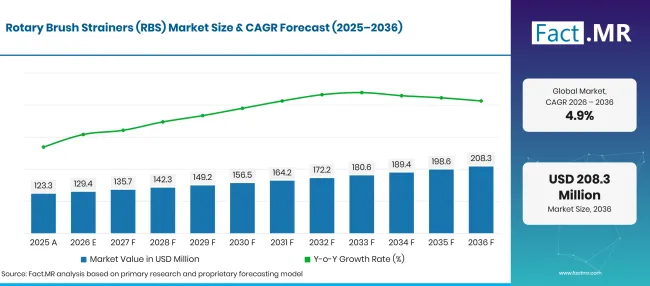
Rotary Brush Strainers Rbs Market Forecast Global | Source: Fact.MR
Category
| Category | Segments |
|---|---|
| Product Type | Automatic, Semi-Automatic, Manual |
| Application | Water Treatment, Industrial Processing, Food & Beverage; Pharmaceuticals; Others |
| End-User | Commercial, Municipal, Industrial |
| Distribution Channel | Direct Sales, Distributors, Online |
| Key Countries | Germany, Brazil, United States; United Kingdom; Japan |
Source: Fact.MR analysis. Updated Nov 19, 2026
Segmental Analysis
Why do automatic units lead product demand in the Rotary Brush Strainers Market?
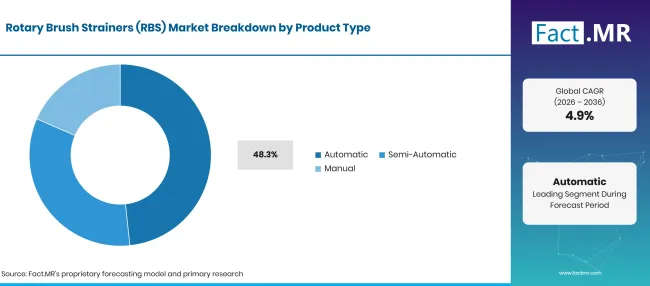
Rotary Brush Strainers Rbs Market Breakdown Product Type | Source: Fact.MR
In January 2026, the U.S. Bureau of Reclamation's technical manual identified automatic, motor-operated strainers as a practical option for cooling-water systems where frequent manual maintenance is difficult. This operating advantage explains why automatic rotary brush strainers account for 48.3% of market revenue in 2026, valued at approximately USD 62.5 million. Motor-driven cleaning mechanisms remove accumulated debris while filtration continues, making these units suitable for remote pumping stations and industrial facilities with limited maintenance access.
How is water treatment shaping application demand in the Rotary Brush Strainers Market?
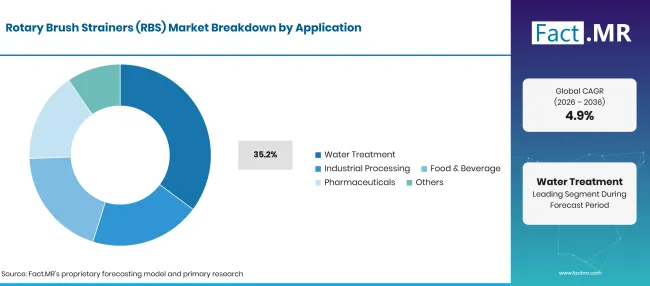
Rotary Brush Strainers Rbs Market Breakdown Application | Source: Fact.MR
Water treatment represents 35.2% of application revenue in 2026, equivalent to approximately USD 45.5 million. Raw water intakes, wastewater facilities and reuse plants use filtration to protect pumps, membranes and other downstream equipment from suspended solids. In December 2025, the U.S. Environmental Protection Agency announced a USD 347 million WIFIA loan for wastewater collection, treatment and water reclamation upgrades in Fort Worth, Texas. Such investments are creating additional opportunities for automated filtration across municipal water infrastructure.
Why do commercial users lead end-user demand in the Rotary Brush Strainers Market?
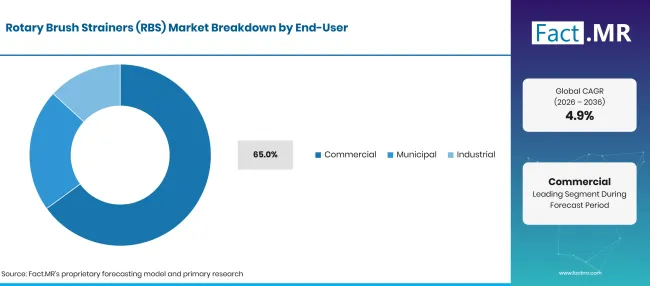
Rotary Brush Strainers Rbs Market Breakdown End User | Source: Fact.MR
Commercial facilities account for 65.0% of rotary brush strainer revenue in 2026, reaching approximately USD 84.1 million. Cooling towers, district energy networks, marine installations and commercial water systems operate for extended periods; making frequent manual filter cleaning inconvenient. A September 2025 U.S. Department of Energy publication on data centre efficiency discussed cooling towers as major water consumers and examined ways to improve their operation. This reinforces the importance of filtration in commercial cooling infrastructure.
Why does direct sales lead distribution in the Rotary Brush Strainers Market?
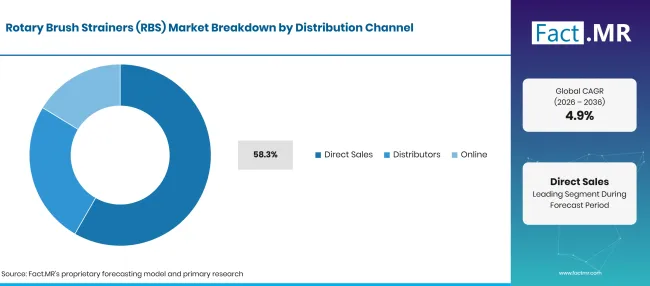
Rotary Brush Strainers Rbs Market Breakdown Distribution Channel | Source: Fact.MR
Direct sales account for 58.3% of rotary brush strainer revenue in 2026, valued at approximately USD 75.4 million. These systems often need to match specific flow capacities, filtration ratings, pressure conditions and installation layouts. Buyers prefer working directly with manufacturers when equipment selection involves technical discussions, commissioning and service arrangements. This purchasing pattern is particularly relevant to municipal treatment projects and industrial installations where standard catalogue specifications may not match operating requirements.
Rotary Brush Strainers (RBS) Market: Drivers, Restraints and Trends
Drivers: Expansion of Water Reuse and Industrial Cooling Systems
Water utilities and industrial facilities are investing in water reuse and recirculation because freshwater availability and operating costs are putting pressure on existing water systems. These processes need reliable filtration to prevent suspended solids from entering pumps, heat exchangers and treatment equipment. In December 2025, the U.S. EPA announced a USD 347 million WIFIA loan for wastewater treatment and water reclamation upgrades in Fort Worth, Texas. Such projects are creating wider opportunities for rotary brush strainers in municipal and industrial water networks.
Restraints: High Installation and Maintenance Costs
Rotary brush strainers involve higher initial investment than conventional basket strainers and basic backwash filters, making price-sensitive buyers hesitant to adopt them. Their dependence on motors, rotating brushes and electrical controls also increases maintenance needs, particularly when handling abrasive or heavily contaminated water. Brush replacement, power consumption and unexpected mechanical failures can further raise operating expenses, limiting adoption among smaller treatment facilities.
Trends: Greater Attention to Marine Ballast Water Filtration
Marine operators continue to focus on ballast water treatment compliance and the reliability of onboard filtration systems. In May 2026, the International Maritime Organization adopted the revised G4 guidelines for ballast water management and the preparation of ballast water management plans under resolution MEPC.409(84). This regulatory attention keeps marine water-treatment systems on the agenda for ship operators and creates opportunities for filtration equipment used in ballast water installations.
Trends: Digitalisation of Industrial and Municipal Water Operations
Water utilities and industrial operators are placing greater emphasis on real-time operating data to identify inefficiencies, reduce maintenance delays and manage water assets remotely. In May 2026, the U.S. Department of Energy recognised Navy teams for integrating smart-meter readings with facility-control systems to identify water leaks and energy-saving opportunities. Wider adoption of digital water management creates opportunities for the rotary brush strainers market through increased attention to connected filtration monitoring and automated maintenance planning.
Rotary Brush Strainers (RBS) Market Analysis by Key Country
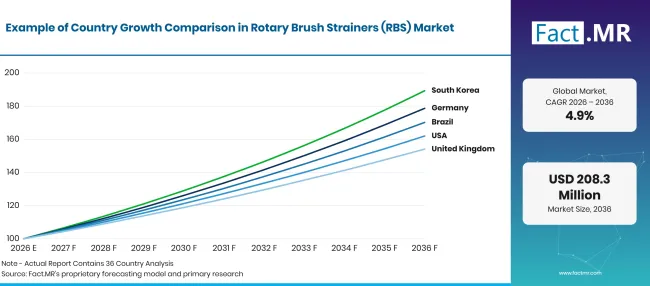
Rotary Brush Strainers Rbs Market Growth Index | Source: Fact.MR
| Country | CAGR (2026–2036) |
|---|---|
| Germany | 6.0% |
| Brazil | 5.5% |
| United States | 4.9% |
| United Kingdom | 4.4% |
| Japan | 3.9% |
Source: Fact.MR analysis. Updated Nov 19, 2026
What is driving rotary brush strainer demand in Germany?
Germany's rotary brush strainers market is set to expand at a 6.0% CAGR through 2036, supported by wastewater infrastructure renewal and stricter treatment standards.
The European Investment Bank's 2026 project record lists EUR 215 million in financing for Oldenburgisch-Ostfriesischer Wasserverband's 2026–2030 water and wastewater investment programme, covering 91 municipalities. Modernisation of treatment facilities, infrastructure rehabilitation and digital monitoring are creating opportunities for automated filtration in municipal water networks.
How is sanitation investment supporting rotary brush strainers in Brazil?
Brazil's sanitation expansion is creating opportunities for rotary brush strainers, with the market recording a 5.5% CAGR. On January 14, 2026, the Ministry of Cities reported that Novo PAC sanitation selections reached BRL 22.1 billion during 2025; with funding directed towards water supply; sewage treatment and drainage.
The expansion of municipal treatment facilities and new water intake infrastructure is increasing the need for reliable filtration. Private sanitation concessions are another important avenue for equipment sales.
How is infrastructure funding shaping rotary brush strainer sales in the United States?
Industrial water circulation and municipal treatment upgrades are keeping the US market active, where rotary brush strainers are set to grow at a 4.9% CAGR. In May 2025, the EPA published its FY2025 State Revolving Fund allocations under the Infrastructure Investment and Jobs Act.
These programmes finance drinking water and wastewater infrastructure improvements. Industrial cooling networks, water reuse facilities, wastewater treatment plants and municipal pumping stations are important application areas supporting equipment sales.
What is shaping rotary brush strainer demand in the United Kingdom?
A record £91.95 billion investment programme for water companies in England between 2025 and 2030 is creating opportunities for filtration equipment.
The Environment Agency's November 2026 environmental performance report confirms that £50.45 billion of this allocation is directed towards wastewater. This investment backdrop supports the UK's 4.4% CAGR for rotary brush strainers, particularly as treatment facilities upgrade existing assets and improve wastewater handling. Municipal treatment projects, pumping stations and industrial water systems are important sales areas.
Why is rotary brush strainer growth slower in Japan?
Japan's market is advancing at a relatively moderate 3.9% CAGR as replacement and infrastructure resilience projects take precedence over large-scale network expansion.
In January 2026, the Ministry of Land, Infrastructure; Transport and Tourism published a water and sewerage budget allocation of JPY 160.187 billion; compared with JPY 138.375 billion in FY2025. Ageing treatment facilities, disaster resilience measures and rehabilitation of existing networks are creating replacement opportunities for rotary brush strainers.
Competitive Landscape for Rotary Brush Strainers (RBS) Market
The rotary brush strainers market brings together large flow-control manufacturers and specialised filtration companies, each serving different operating requirements. Eaton, Parker Hannifin, Alfa Laval; GEA and Pentair draw on their broad equipment portfolios and service networks; while Krone Filtertechnik; Lenzing Technik; Filtration Group and Forsta focus on application-specific filtration systems.
Buyers pay close attention to cleaning performance, screen configuration, water loss during flushing and material durability. Marine water-treatment requirements and municipal wastewater upgrades are also influencing purchasing decisions. Technical approvals, installation experience and after-sales support play an important role when buyers compare manufacturers for long-term filtration projects.
Recent Developments
- On October 5, 2026, Alfa Laval AB announced plans to fully integrate Desmet into its operations; combining their capabilities in process engineering for the oils; fats and biofuel industries. The integration is scheduled for completion by July 2027.
- On March 2, 2026, SPX FLOW Inc. became part of ITT Inc. after ITT completed its acquisition of the company for approximately USD 4.775 billion. The acquisition expanded ITT's portfolio of fluid handling, separation and process technologies.
- On May 20, 2025, GEA Group AG entered into a strategic partnership with EEW to test and develop carbon capture technologies under real industrial conditions; with the aim of advancing solutions for industrial-scale applications.
Key Players in Rotary Brush Strainers (RBS) Market
Key companies profiled include Eaton Corporation; Parker Hannifin Corporation; SPX FLOW Inc.; Alfa Laval AB; GEA Group AG; Pentair plc; Krone Filtertechnik GmbH; Lenzing Technik GmbH; Filtration Group Corporation; and Forsta Filters Inc.
- Eaton Corporation
- Parker Hannifin Corporation
- SPX FLOW Inc.
- Alfa Laval AB
- GEA Group AG
- Pentair plc
- Krone Filtertechnik GmbH
- Lenzing Technik GmbH
- Filtration Group Corporation
- Forsta Filters Inc.
Bibliography
- European Investment Bank. (2026). OOWV water and wastewater investment programme.
- European Union. (2024). Directive (EU) 2024/3019 of the European Parliament and of the Council of 27 November 2024 concerning urban wastewater treatment (recast). Official Journal of the European Union.
- Environment Agency. (2026). Water and sewerage companies in England: Environmental performance report for 2025. GOV.UK.
- International Maritime Organization. (2026). BWM Convention and guidelines.
- International Maritime Organization. (2026). MEPC 2026–27: Resolutions adopted at the eighty-fourth session.
- Ministry of Cities, Brazil. (2026, January 14). Brasil tem ano de investimentos e avanços em saneamento básico [Brazil records a year of investment and progress in basic sanitation]. Governo Federal.
- Ministry of Land, Infrastructure, Transport and Tourism; Japan. (2025, January). Reiwa 7-nendo josuido kankei yosan no gaiyo [Overview of the FY2025 water and sewerage budget].
- Ministry of Land, Infrastructure, Transport and Tourism; Japan. (2026, January). Reiwa 8-nendo josuido kankei yosan no uchiwake [Breakdown of the FY2026 water and sewerage budget].
- U.S. Bureau of Reclamation. (2026, January). Facilities instructions, standards, and techniques: Volume 2-6; maintenance of auxiliary mechanical equipment. U.S. Department of the Interior.
- U.S. Department of Energy. (2025, September). Measurement and verification guidelines: Performance-based contracts, Version 5.0, data center addendum; Version 1.0. Federal Energy Management Program.
- U.S. Department of Energy. (2026, May 20). 2025 FEDS Spotlight honorees. Federal Energy Management Program.
- U.S. Environmental Protection Agency. (2025, May). FY2025 allotments tables.
- U.S. Environmental Protection Agency. (2025, December 15). EPA announces over $351 million to Fort Worth for water and recycling infrastructure projects.
Segmentation
Scope of Report
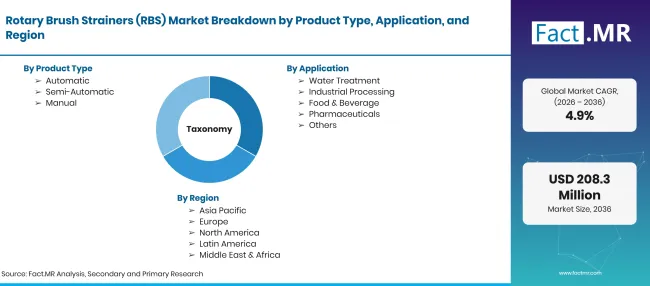
Rotary Brush Strainers Rbs Market Taxonomy | Source: Fact.MR
| Items | Values |
|---|---|
| Quantitative Units (2026) | USD 129.4 Million |
| Product Type | Automatic, Semi-Automatic, Manual |
| Application | Water Treatment, Industrial Processing, Food & Beverage; Pharmaceuticals; Others |
| End-User | Commercial, Municipal, Industrial |
| Distribution Channel | Direct Sales, Distributors, Online |
| Regions Covered | North America, Latin America, Europe; East Asia; South Asia and Pacific; Middle East & Africa |
| Countries Covered | United States, Germany, Japan; United Kingdom; Brazil and other countries |
| Key Companies Profiled | Eaton Corporation, Parker Hannifin Corporation, SPX FLOW Inc.; Alfa Laval AB; GEA Group AG; Pentair plc; Krone Filtertechnik GmbH; Lenzing Technik GmbH; Filtration Group Corporation; Forsta Filters Inc. |
| Additional Attributes | Dollar revenue in the Rotary Brush Strainers (RBS) Market is segmented by product type, application, end-user; distribution channel and region. |
Source: Fact.MR analysis. Updated Nov 19, 2026
Rotary Brush Strainers (RBS) Market by Segments
-
Product Type
- Automatic
- Semi-Automatic
- Manual
-
Application
- Water Treatment
- Industrial Processing
- Food & Beverage
- Pharmaceuticals
- Others
-
End-User
- Commercial
- Municipal
- Industrial
-
Distribution Channel
- Direct Sales
- Distributors
- Online
-
Region
- North America
- United States
- Canada
- Mexico
- Europe
- Germany
- United Kingdom
- France
- Italy
- Spain
- Rest of Europe
- Asia Pacific
- China
- India
- Japan
- South Korea
- Australia
- Rest of Asia Pacific
- Latin America
- Brazil
- Mexico
- Argentina
- Rest of Latin America
- Middle East & Africa
- GCC Countries
- South Africa
- Rest of Middle East & Africa
- North America
Frequently Asked Questions
How big is the global Rotary Brush Strainers (RBS) Market in 2026?
What will be the size of the Rotary Brush Strainers (RBS) Market by 2036?
How fast will the Rotary Brush Strainers (RBS) Market grow during the forecast period?
Which product type segment holds the largest share of the Rotary Brush Strainers (RBS) Market?
Who worked on this report


Preview the report firsthand - request a free sample
Free SampleGet the brochure for pricing and purchase details
Download PDF