- Market Value (2025): USD 16.3 Bn
- Estimated Value (2026): USD 17.2 Bn
- Forecast Value (2036): USD 28.5 Bn
- CAGR (2026-2036): 5.2%
Full Grain Leather Market Forecast and Outlook 2026 to 2036
The full grain leather market is projected to grow from USD 17.2 billion in 2026 to USD 28.5 billion by 2036. Demand for full grain leather is likely to grow at a CAGR of 5.2% over the forecast period.
Demand for full grain leather reflects how luxury, footwear and furniture brands favor hides that keep the natural grain and develop patina with use. Manufacturers are investing in traceability and lower-impact tanning. For example, Hermès reported 2024 revenue of about EUR 15.2 billion, with leather goods and saddlery its largest business. Demand for premium leather may expand the commercial opportunity for full grain leather during the forecast period.
Key Takeaways from the Full Grain Leather Market
- Sales of full grain leather stood at USD 16.3 billion in 2025
- Full Grain Leather Market Value (2026): USD 17.2 billion
- Full Grain Leather Market Forecast Value (2036): USD 28.5 billion
- Full Grain Leather Market Forecast CAGR (2026-2036): 5.2%
- Leading Product Type: Chrome-Tanned (46.8%)
- Key Market Participants: Horween Leather Company, S.B. Foot Tanning Company, Wickett & Craig of America, Hermann Oak Leather Co., J&FJ Baker & Co Ltd, Tärnsjö Garveri
- Key Growth Regions: Germany, Brazil, United States, United Kingdom, Japan
The EU Deforestation Regulation covers specified cattle-derived products, including leather. Following amendments in 2024 and 2025, its main obligations apply to medium and large operators from December 30, 2026, and to most micro and small operators from June 30, 2027. Demand for full grain leather is growing for traceable supply from certified tanneries. Suppliers of full grain leather are joining Leather Working Group audits and mapping hide origins. Suppliers will need to address hide traceability, finish and material quality to secure further orders.
Full Grain Leather Market
| Metric | Value |
|---|---|
| Estimated Value in (2026) | USD 17.2 billion |
| Forecast Value in (2036) | USD 28.5 billion |
| Forecast CAGR (2026 to 2036) | 5.2% |
Source: Fact.MR analysis. Updated Nov 19, 2026
Source: Fact.MR analysis.
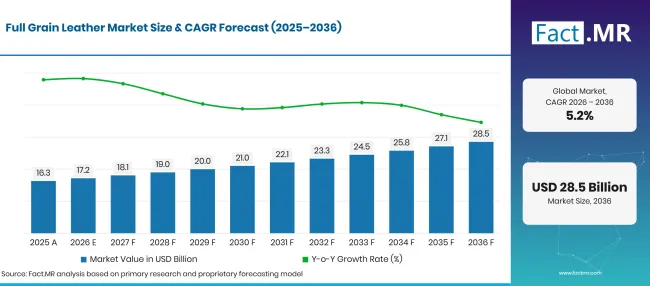
Full Grain Leather Market Forecast Global | Source: Fact.MR
Category
| Category | Segments |
|---|---|
| Product Type | Chrome-Tanned, Vegetable-Tanned, Others |
| Application | Footwear, Furniture, Automotive Interiors, Fashion Accessories, Others |
| Distribution Channel | Offline Retail, Online Retail |
| End-User | Residential, Commercial, Automotive, Others |
| Region | Germany; Brazil; United States; United Kingdom; Japan |
Source: Fact.MR analysis. Updated Nov 19, 2026
Source: Fact.MR analysis.
Segmental Analysis
Why does chrome-tanned leather lead product demand in the Full Grain Leather Market?
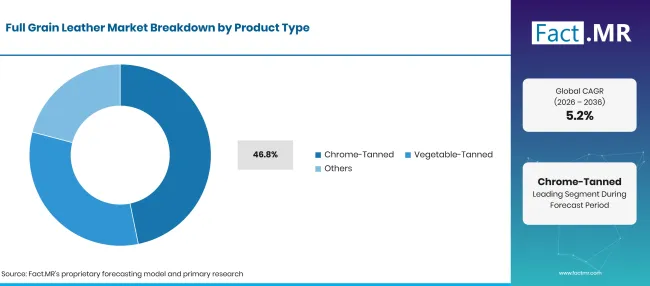
Full Grain Leather Market Breakdown Product Type | Source: Fact.MR
Chrome-tanned leather represents USD 8.0 billion in 2026, or 46.8% of full grain leather revenue. This is because chrome tanning is faster, cheaper and gives soft, colorfast hides for shoes and upholstery. Vegetable-tanned leather serves premium belts, saddlery and bags. Suppliers of full grain leather are improving chrome recovery and wastewater treatment. Product selection must account for hide traceability, finish and material quality.
Why does footwear lead application demand in the Full Grain Leather Market?
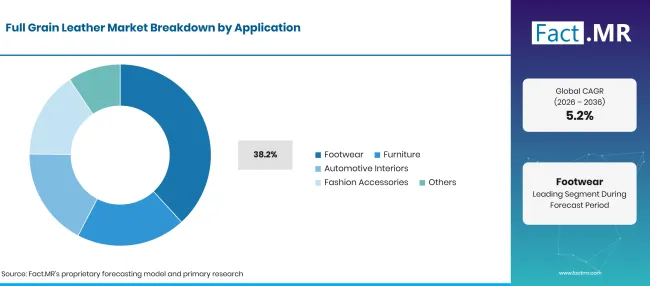
Full Grain Leather Market Breakdown Application | Source: Fact.MR
Footwear captures USD 6.6 billion in 2026, or 38.2% of application revenue. This is because dress, work and premium casual shoes rely on durable full grain uppers. Furniture and automotive interiors follow. Suppliers such as ECCO Leather and Horween supply branded footwear makers. Suppliers will need to address hide traceability, finish and material quality to secure further orders.
Why does offline retail lead distribution in the Full Grain Leather Market?
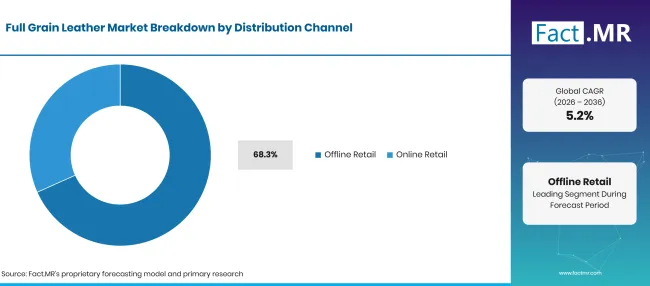
Full Grain Leather Market Breakdown Distribution Channel | Source: Fact.MR
Offline retail holds USD 11.7 billion in 2026, or 68.3% of revenue. This is because buyers want to feel grain, weight and finish before purchase and most hides move through tannery agents and leather merchants. Online sales grow for craft and small-batch makers. Suppliers are opening sample libraries. Follow-up orders will depend on hide quality, sourcing requirements and established trading relationships.
Why does the residential segment lead end-user demand in the Full Grain Leather Market?
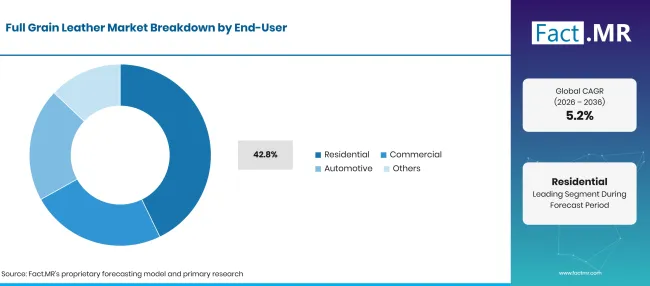
Full Grain Leather Market Breakdown End User | Source: Fact.MR
Residential end use accounts for 42.8% of revenue in 2026, about USD 7.3 billion, covering consumer footwear, bags and home furniture. Commercial and automotive buyers follow. Manufacturers are refining furniture-grade hides with protective finishes. Product selection must account for hide traceability, finish and material quality.
Full Grain Leather Market-Drivers, Restraints & Trends
Drivers:
Interest in full grain leather has increased as consumers favor long-lasting products over fast fashion. Suppliers of full grain leather are marketing durability and repairability. For example, heritage tanneries such as Horween, Wickett & Craig and Hermann Oak have built followings among premium boot and leather-goods makers. Suppliers will need to address hide traceability, finish and material quality to secure further orders.
Restraints:
Demand for full grain leather is limited by animal-welfare concerns, plant-based alternatives and hide supply tied to beef production. Automakers have shifted some interiors to leather-free materials. Customers will compare offerings on hide traceability, finish and material quality. Suppliers of full grain leather must prove environmental and welfare standards.
Trend:
Traceable and Certified Hides Demand for hides traceable to farm is rising under the EU Deforestation Regulation and brand commitments. Suppliers are using Leather Working Group certification and digital tracking. For tanneries and leather-goods brands, hide traceability, finish and material quality will influence the choice of supplier and product specification.
Full Grain Leather Market by Analysis by Key Country
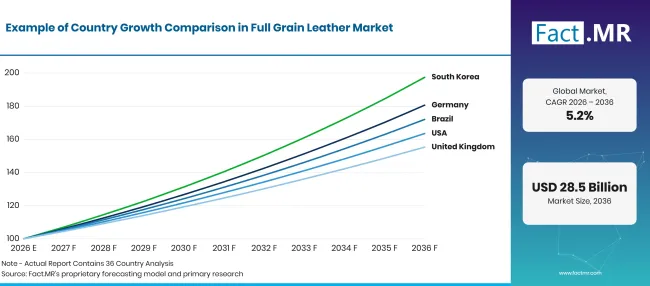
Full Grain Leather Market Growth Index | Source: Fact.MR
| Country | CAGR (2026-2036) |
|---|---|
| Germany | 6.1% |
| Brazil | 5.6% |
| United States | 5.0% |
| United Kingdom | 4.5% |
| Japan | 4.0% |
Source: Fact.MR analysis. Updated Nov 19, 2026
Source: Fact.MR analysis.
Why is Germany the fastest-growing market for full grain leather?
Demand for full grain leather in Germany is forecast to increase at a 6.1% CAGR through 2036, the fastest among the five countries.
Premium furniture and footwear manufacturers are placing greater importance on hide traceability and responsible sourcing ahead of EU deforestation requirements. German brands prefer certified European tanneries that maintain consistent material quality and documented supply chains. Suppliers are expanding audited sourcing arrangements and improving leather finishing processes. Purchasing decisions will reflect hide origin, surface quality, durability and compliance with sourcing standards set by premium product manufacturers.
How is the hide supply base supporting full grain leather in Brazil?
Sales of full grain leather in Brazil are set to rise at a 5.6% CAGR from 2026 to 2036, supported by the country's extensive cattle herd and established leather processing industry.
Brazilian tanneries supply finished leather to international footwear, furniture and accessories manufacturers. Export-oriented producers are strengthening hide traceability systems to meet European sourcing requirements. Investments in finishing equipment are helping manufacturers produce higher-value full grain leather with consistent surface characteristics. International buyers will assess hide origin, material quality, processing consistency and environmental compliance before placing orders with Brazilian suppliers.
What is shaping full grain leather sales in the United States?
Sales of full grain leather in the United States are forecast to expand at a 5.0% CAGR by 2036, supported by demand for heritage footwear, workwear and premium leather accessories.
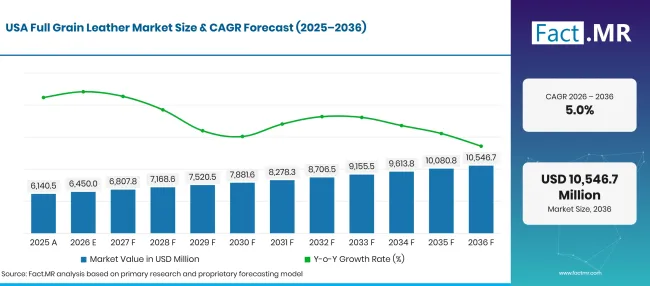
Full Grain Leather Market Forecast Usa | Source: Fact.MR
Established tanneries such as Horween and Wickett & Craig supply leather used by traditional bootmakers and independent goods manufacturers. Western boots and durable work footwear remain important applications. Smaller brands are reaching customers through direct online sales and specialized retail channels. Tanneries are focusing on consistent finishing, hide selection and material durability to meet the specifications of domestic leather product manufacturers.
What is shaping full grain leather demand in the United Kingdom?
Demand for full grain leather in the United Kingdom is set to advance at a 4.5% CAGR through 2036, supported by traditional shoemaking and premium leather goods production.
Northamptonshire footwear manufacturers continue to use full grain calf leather for welted shoes and other high-quality products. J&FJ Baker in Devon supplies oak-bark-tanned leather for specialized applications. British leather producers also serve export-oriented footwear brands and independent craft manufacturers. Buyers will prioritize hide traceability, surface consistency, finishing quality and long-term durability when selecting materials for premium footwear and accessories.
Why is full grain leather growth slower in Japan?
Demand for full grain leather in Japan is forecast to increase at a 4.0% CAGR from 2026 to 2036, the slowest among the five countries.
A mature consumer market and an aging population are limiting opportunities for volume expansion across conventional leather products. However, demand remains for premium footwear, handcrafted accessories and specialized leather goods. Tanning centers such as Himeji supply materials for domestic manufacturers and traditional craft businesses. Japanese suppliers are concentrating on premium finishes, consistent hide quality and specialized production techniques to serve customers seeking durable, high-value leather products.
Competitive Landscape for Full Grain Leather Market
Competition in the full grain leather market is divided between large integrated tanneries and heritage specialists. ECCO Leather and Italian tanneries such as Conceria Puccini Attilio and Conceria Tempesti compete on scale and finishing, while Horween, S.B. Foot, Wickett & Craig, Hermann Oak, J&FJ Baker and Tärnsjö Garveri compete on heritage and specialty tannages. Buyers select on grain quality, consistency, traceability and price.
From 2025 onward, competition shifted toward traceability and lower-impact tanning. the EU deforestation rules' upcoming compliance deadlines and brand targets increased attention to audited supply. An advantage may accrue to suppliers with certification and transparent sourcing as they seek to grow.
Recent Developments
- In September 2025, Horween Leather partnered with PLOTTER to launch Predator Amber leather binders, featuring an exclusive color developed for PLOTTER's Tokyo flagship store and natural aging characteristics for premium leather accessories.
- In August 2025, Florsheim launched a footwear collection developed with Horween Leather Company, featuring premium Essex leather across boots, sneakers and Oxford shoes, with natural grain characteristics and finishes designed to age naturally.
Key Players in Full Grain Leather Market
Key companies operating in the market include Horween Leather Company, S.B. Foot Tanning Company, Wickett & Craig of America, Hermann Oak Leather Co., J&FJ Baker & Co Ltd, Tärnsjö Garveri, Conceria Puccini Attilio, Conceria Tempesti, and ECCO Leather.
- Horween Leather Company
- S.B. Foot Tanning Company
- Wickett & Craig of America
- Hermann Oak Leather Co.
- J&FJ Baker & Co Ltd
- Tärnsjö Garveri
- Conceria Puccini Attilio
- Conceria Tempesti
- ECCO Leather
Scope of Report
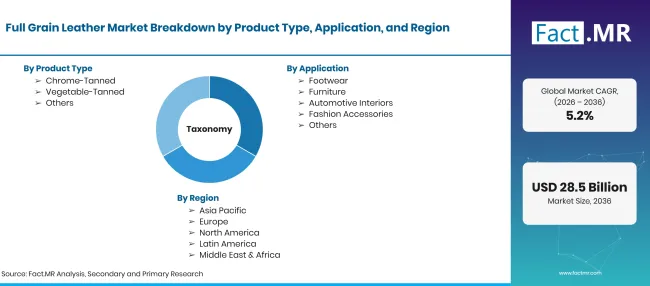
Full Grain Leather Market Taxonomy | Source: Fact.MR
| Items | Values |
|---|---|
| Quantitative Units (2026) | USD 17.16 Billion |
| Product Type | Chrome-Tanned, Vegetable-Tanned, Others |
| Application | Footwear, Furniture, Automotive Interiors, Fashion Accessories, Others |
| Distribution Channel | Offline Retail, Online Retail |
| End-User | Residential, Commercial, Automotive, Others |
| Regions Covered | North America, Latin America, Europe, East Asia, South Asia and Pacific, Middle East & Africa |
| Countries Covered | United States, Germany, Japan, United Kingdom, Brazil, and other countries |
| Key Companies Profiled | Horween Leather Company, S.B. Foot Tanning Company, Wickett & Craig of America, Hermann Oak Leather Co., J&FJ Baker & Co Ltd, Tärnsjö Garveri, Conceria Puccini Attilio, Conceria Tempesti, ECCO Leather |
| Additional Attributes | Dollar revenue in the Full Grain Leather Market is segmented by product type (chrome-tanned, vegetable-tanned); application (footwear, furniture, automotive interiors, fashion accessories); distribution channel (offline retail, online retail); end-user (residential, commercial, automotive) and region. |
Source: Fact.MR analysis. Updated Nov 19, 2026
Source: Fact.MR analysis.
Full Grain Leather Market by Segments
-
Product Type
- Chrome-Tanned
- Vegetable-Tanned
- Others
-
Application
- Footwear
- Furniture
- Automotive Interiors
- Fashion Accessories
- Others
-
Distribution Channel
- Offline Retail
- Online Retail
-
End-User
- Residential
- Commercial
- Automotive
- Others
-
Region:
- North America
- United States
- Canada
- Mexico
- Europe
- Germany
- United Kingdom
- France
- Italy
- Spain
- Rest of Europe
- Asia Pacific
- China
- India
- Japan
- South Korea
- Australia
- Rest of Asia Pacific
- Latin America
- Brazil
- Mexico
- Argentina
- Rest of Latin America
- Middle East & Africa
- GCC Countries
- South Africa
- Rest of Middle East & Africa
- North America
Bibliography
- European Commission. (2026, July 13). Commission updates product scope and digital tools to support implementation of EU Deforestation Regulation.
- Florsheim. (2025). Florsheim Horween collection: Fall 2025. Official collection announcement
- Hermès International. (2025, February 14). Outstanding results in 2024.
- Instituto Brasileiro de Geografia e Estatística. (2026, March 18). Em 2025, Brasil registra a maior produção de leite, couro e ovos da história; abate de bovinos, frangos e suínos também é recorde.
- Leather Working Group. (2025, December 16). Leather Working Group’s 2025 year in review.
- Ministry of Agriculture and Livestock. (2025, July 22). Abertura de mercado para couros e peles em cru do Brasil para a Coreia do Sul. Government of Brazil.
- Mendes Junior, B. de O. (2026, June). Couro e calçados. Caderno Setorial ETENE, 11(436). Banco do Nordeste do Brasil.
- PLOTTER. (2025, September 23). Introducing Predator Amber leather. Official product announcement
Frequently Asked Questions
How big is the global Full Grain Leather Market in 2026?
What will be the size of the Full Grain Leather Market by 2036?
How fast will the Full Grain Leather Market grow during the forecast period?
Which product type segment holds the largest share of the Full Grain Leather Market?
Who worked on this report


Preview the report firsthand - request a free sample
Free SampleGet the brochure for pricing and purchase details
Download PDF