- Market Value (2025): USD 166.0 Mn
- Estimated Value (2026): USD 173.9 Mn
- Forecast Value (2036): USD 277.4 Mn
- CAGR (2026-2036): 4.8%
What is the Runway Threshold Light Market forecast to be worth by 2036?
USD 173.9 million in 2026 to USD 277.4 million by 2036 at a 4.8% CAGR.
- Fact.MR estimates the runway threshold light market at USD 166.0 million for 2025, with most orders tied to runway rehabilitation contracts.
- By 2036, airport spending on threshold fixtures will total USD 277.4 million, against USD 173.9 million in 2026, as halogen fleets reach the end of their service life.
- A 4.8% CAGR from 2026 to 2036 reflects steady runway works funding, not a jump in new airport counts.
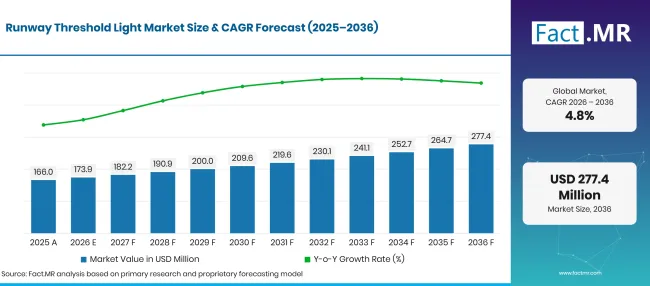
Runway Threshold Light Market Forecast Global | Source: Fact.MR
| Year | Basis | Market Value (USD million) |
|---|---|---|
| 2025 | Actual | 166.0 |
| 2026 | Estimate | 173.9 |
| 2036 | Forecast | 277.4 |
| CAGR 2026 to 2036 | Forecast period | 4.8% |
Source: Fact.MR analysis. Updated Oct 30, 2026
What are the defining numbers behind Runway Threshold Light Market growth?
The 2026 to 2036 period adds USD 103.5 million, drawn mainly from LED conversions and new runway builds.
- Demand Drivers in the Market
- Runway incursions keep visual aids high on regulator agendas. In September 2025, the U.S. Federal Aviation Administration asked industry for runway safety lighting that could be deployed and operational within two to three years [1]. Each new safety lighting layer brings fresh inspection of threshold and edge circuits on the same runway.
- Passenger traffic keeps runways busy and short of maintenance windows. Destatis, citing Eurostat, reported about 808.9 million departing air passengers in the EU in 2025, up 5% on 2024 [2]. Less time for night closures favors fixtures that need fewer lamp swaps.
- Halogen and LED often share a runway during phased renewals. Spain’s air navigation provider ENAIRE notified a renewal of Menorca Airport’s runway edge lighting in February 2026, with halogen and LED units in use together for about two weeks and completion estimated for February 2027 [3]. Threshold rows on such runways are usually converted in the same contract.
- Military airfields buy to their own specifications. Expeditionary and remote bases often prefer solar or low-power units, since cabling a temporary threshold is slow and costly.
- Key Segments Analyzed
- By Product Type: LED will hold 57.3% share in 2026, given that solid-state sources outlast halogen lamps many times over and trim maintenance crews’ runway time.
- By Application: Commercial Airports will account for 64.2% share in 2026 through high movement counts and instrument runways that need full threshold rows.
- By Installation Type: New Installation will capture 58.6% share in 2026, as greenfield airports and added runways buy complete lighting layouts in one package.
- Analyst Opinion at Fact.MR
- Shambhu Nath Jha, Principal Consultant at Fact.MR, states, “Airports rarely tender threshold lights on their own; they arrive inside runway resurfacing and lighting packages. That ties demand to public airport grants and runway closure schedules, which move slowly but predictably. Suppliers that certify LED fixtures to both FAA and ICAO specifications will win more of those packages.”
- Strategic Implications
- Fixture manufacturers should hold dual FAA and ICAO certification on their LED threshold range, since one tender may reference either standard.
- Airport engineers should plan threshold replacement alongside resurfacing, so fixtures go in during a closure the airport already accepts.
- Lighting contractors should bundle fixtures with isolating transformers, cabling and control upgrades, since grant-funded projects favor single-point delivery.
- Defense procurement teams should test solar and wireless threshold units for temporary fields where trenching a series circuit is impractical.
Germany heads the group at 5.5% CAGR, as busy hubs retire halogen fixtures between night closures. Brazil follows at 5.0%, with record traffic and federal money for regional airfield visual aids. A 4.6% pace in the United States rests on steady federal airport grants and runway safety work. The United Kingdom posts 4.1%, where rising passenger volumes press runway maintenance into short windows. Japan trails at 3.6%, with renewal work at mature airports carrying demand.
How does the Runway Threshold Light Market break down by segment?
LED will lead Product Type at 57.3%; Commercial Airports will head Application at 64.2%; and New Installation will top Installation Type at 58.6%.
Which Product Type leads?
LED fixtures take 57.3% of 2026 revenue.
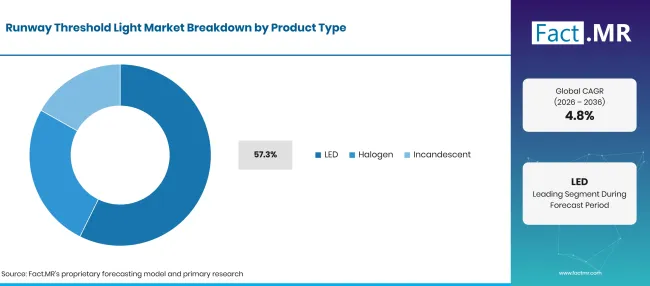
Runway Threshold Light Market Breakdown Product Type | Source: Fact.MR
| Product Type | Share (2026) |
|---|---|
| LED (Leading segment) | 57.3% |
| Other segments combined | 42.7%* |
| Total | 100.0% |
Source: Fact.MR analysis. Updated Oct 30, 2026
Maintenance crews need a clearance and an escort to reach a threshold row, so every lamp change costs runway time. LED fixtures go years without a source change and draw less power on the series circuit. Most suppliers now build them on chip-on-board LED modules sealed against jet blast and de-icing fluid. Halogen units remain on many older runways, where airports replace failed lamps in kind until a full conversion is funded. Incandescent fixtures are now rare and serve mainly small fields. Inset LED thresholds also share optics and housings with the wider LED lighting solution range that airports use across aprons and taxiways.
What supports Commercial Airports within Application?
Commercial Airports hold 64.2% of 2026 revenue.
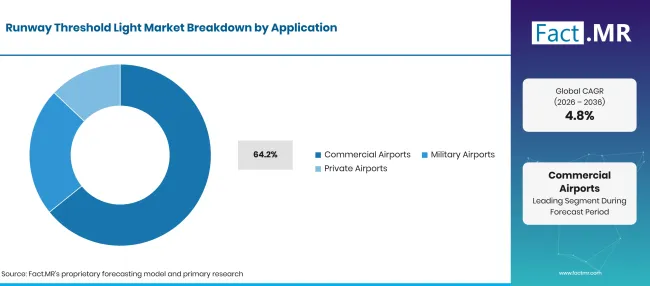
Runway Threshold Light Market Breakdown Application | Source: Fact.MR
| Application | Share (2026) |
|---|---|
| Commercial Airports (Leading segment) | 64.2% |
| Other segments combined | 35.8%* |
| Total | 100.0% |
Source: Fact.MR analysis. Updated Oct 30, 2026
Scheduled airports run instrument runways around the clock, and those runways need full threshold and wing bar rows to approved photometric limits. Federal grants in the United States fund much of this work. In July 2026, the FAA announced USD 1.776 billion in airport grants across 46 states, including runway and runway lighting rehabilitation at Baltimore/Washington International [4]. Military airports buy in smaller lots but specify rugged and portable units. Private and general aviation airfields often choose low-intensity or solar fixtures matched to visual runways.
How does Installation Type shape demand?
New Installation accounts for 58.6% of 2026 revenue.
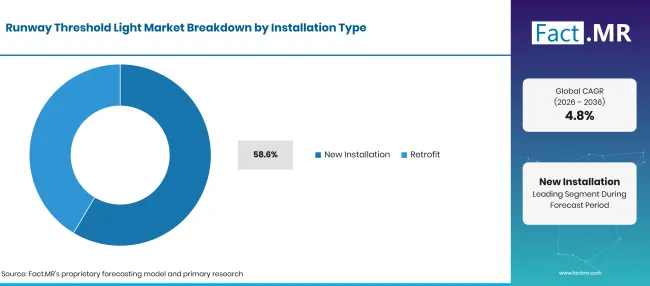
Runway Threshold Light Market Breakdown Installation Type | Source: Fact.MR
| Installation Type | Share (2026) |
|---|---|
| New Installation (Leading segment) | 58.6% |
| Other segments combined | 41.4%* |
| Total | 100.0% |
Source: Fact.MR analysis. Updated Oct 30, 2026
Greenfield airports and new runways order every fixture, transformer and cable at once, which lifts the value of each contract. Designers lay out thresholds together with edge, approach and LED lighting controller systems from the first drawing. Retrofit work grows as halogen fleets age. In September 2026, the FAA delivered USD 1.1 billion through 280 airport grants in 46 states and three territories, with eligible uses covering runways, signage and lighting [5]. Retrofit buyers also pay for halogen-free cable compounds when old series cables are replaced.
What is accelerating Runway Threshold Light Market adoption, and what is holding it back?
Federal airport grants, LED conversions and safety programs keep threshold orders flowing. Purchases slow when runway closures are hard to schedule or when airport capital budgets slip.
Drivers Impact Analysis
| DRIVER | (~) % IMPACT ON CAGR | GEOGRAPHIC RELEVANCE | IMPACT TIMELINE |
|---|---|---|---|
| Replacement of halogen threshold lights with LED fixtures | +1.5% | Global | Medium term (2-4 years) |
| New runway construction and greenfield airport projects | +1.1% | Middle East & Africa, South Asia & Pacific, Latin America | Long term (>= 4 years) |
| Public airport grants funding runway and lighting rehabilitation | +0.8% | North America, Western Europe | Short term (<= 2 years) |
| Runway safety programs that renew visual aids | +0.6% | North America, East Asia | Medium term (2-4 years) |
Source: Fact.MR analysis. Updated Oct 30, 2026
Opportunity Impact Analysis
| OPPORTUNITY | (~) % IMPACT ON CAGR | GEOGRAPHIC RELEVANCE | IMPACT TIMELINE |
|---|---|---|---|
| Retrofit kits that fit LED optics into existing inset bases | +0.8% | Western Europe, North America, East Asia | Short term (<= 2 years) |
| Solar and wireless threshold units for remote and military fields | +0.6% | Global | Medium term (2-4 years) |
| Monitored fixtures linked to lighting control systems | +0.5% | Global | Long term (>= 4 years) |
Source: Fact.MR analysis. Updated Oct 30, 2026
Restraints Impact Analysis
| RESTRAINT | (~) % IMPACT ON CAGR | GEOGRAPHIC RELEVANCE | IMPACT TIMELINE |
|---|---|---|---|
| Runway closure limits during installation at busy airports | -0.6% | Western Europe, North America | Short term (<= 2 years) |
| High upfront cost of full-runway lighting packages | -0.4% | Latin America, Middle East & Africa | Medium term (2-4 years) |
| Long certification cycles for new fixture designs | -0.3% | Global | Long term (>= 4 years) |
Source: Fact.MR analysis. Updated Oct 30, 2026
Which countries are scaling the Runway Threshold Light Market through 2036?
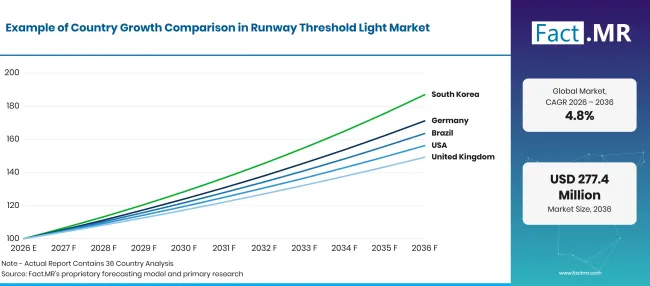
Runway Threshold Light Market Growth Index | Source: Fact.MR
| Country | CAGR (2026 to 2036) |
|---|---|
| Germany | 5.5% |
| Brazil | 5.0% |
| United States | 4.6% |
| United Kingdom | 4.1% |
| Japan | 3.6% |
Source: Fact.MR analysis. Updated Oct 30, 2026
What supports Germany’s adoption?
5.5% CAGR, driven by halogen-to-LED conversion at high-traffic hubs.
German airports work runways hard, which leaves little time for lamp changes. Destatis reported about 109.2 million departing air passengers in Germany in 2025, roughly 4% more than in 2024 [2]. Operators therefore favor LED threshold rows that can run for years between interventions. Fixture makers must also meet the EASA certification basis applied by German airport operators.
How is Brazil developing demand?
5.0% CAGR, backed by record passenger traffic and federal funding for regional airfields.
Brazilian aviation carried about 130 million passengers in 2025, according to the National Civil Aviation Secretariat [6]. The Ministry of Ports and Airports allocated about BRL 13.6 million in June 2025 for precision approach path indicators at 13 regional airports [7]. Regional upgrades of this kind often extend to threshold and edge rows on the same runway.
What is supporting the United States’ adoption?
4.6% CAGR, helped by federal airport grants and runway safety programs.
The FAA noted that its Runway Status Lights are installed at 20 airports and are costly to install, which prompted its 2025 call for cheaper options [1]. Airline traffic stays heavy, with U.S. carriers flying 81.2 million passengers in December 2025 alone [8]. Grant-backed resurfacing projects usually replace thresholds in the same closure.
How is the United Kingdom scaling demand?
4.1% CAGR, as rising traffic squeezes runway maintenance windows.
The Civil Aviation Authority reported a record 302 million passengers through UK airports in 2025, up 2% from 2024 [9]. Busy runways leave short overnight windows for lighting work, so airports favor long-life LED fixtures. Regional and business aviation airfields also renew lighting during resurfacing.
How does Japan perform?
3.6% CAGR, reflecting scheduled renewal at mature airports.
Domestic scheduled flights in Japan carried 112.5 million passengers in fiscal 2025, up 3.4%, according to the Ministry of Land, Infrastructure, Transport and Tourism [10]. In January 2026, the Tokyo Civil Aviation Bureau announced airfield lighting work on Haneda Airport’s Runway C, scheduled from late November 2025 to late March 2030 [11]. Work of this length shows how renewal at busy hubs proceeds in stages.
Who leads the Runway Threshold Light Market?
Supply splits between full-range airfield lighting groups and specialists. ADB SAFEGATE, TKH Airport Solutions and OCEM Airfield Technology sell threshold fixtures within complete runway packages that include regulators and control software, and they win on certification depth and integration. Eaton, through its Crouse-Hinds airfield range, and Flight Light Inc. compete strongly in FAA-specification tenders with inset and elevated threshold and end lights. Avlite targets remote and military fields with solar fixtures and, in September 2025, introduced its LCAMS control and monitoring system for solar, hybrid and wired lighting [12].
TKH reported in January 2026 that Vancouver International Airport had completed a halogen-to-LED conversion of its North Runway with its fixtures [13]. ATG Airports secured an airfield lighting control upgrade at Comodoro Rivadavia Airport in October 2026 [14]. Monitored fixtures and dual FAA and ICAO approval will shape who wins the next round of tenders.
Which companies are the key providers?
Key companies include ADB SAFEGATE; TKH Airport Solutions; OCEM Airfield Technology; Eaton (Crouse-Hinds); Flight Light Inc.; Avlite Systems; and ATG Airports.
- ADB SAFEGATE
- TKH Airport Solutions
- OCEM Airfield Technology
- Eaton (Crouse-Hinds)
- Flight Light Inc.
- Avlite Systems
- ATG Airports
Bibliography
- [1] Federal Aviation Administration. (2025, September 11). FAA Announces Request for Information for New Runway Lighting System to Bolster Runway Safety.
- [2] Statistisches Bundesamt (Destatis). (2026, August 11). EU-Flugverkehr 2025: Zahl der Passagiere auf Höchststand [EU air traffic 2025: Passenger numbers at a record high].
- [3] ENAIRE. (2026, February 19). MENORCA AD (LEMH): Renewal of the runway edge lighting system (AIP Supplement 20/26).
- [4] Federal Aviation Administration. (2026, July 2). Trump’s Transportation Secretary Sean P. Duffy Celebrates America’s 250th, Delivers $1.776 Billion to Upgrade Airports Across U.S..
- [5] Federal Aviation Administration. (2026, September 14). Trump’s Transportation Secretary Sean P. Duffy Delivers $1.1 Billion to Upgrade Airports, Including Equipping Runway Vehicles with Transmitters.
- [6] Agência Gov, Government of Brazil. (2026, January 28). Brasil recebe 6,1 milhões de visitantes internacionais por transporte aéreo em 2025 [Brazil receives 6.1 million international visitors by air in 2025].
- [7] Ministério de Portos e Aeroportos, Brazil. (2025, June 9). Governo Federal investe R$ 13,6 milhões para garantir a segurança em aeroportos regionais [Federal Government invests R$13.6 million to ensure safety at regional airports].
- [8] Bureau of Transportation Statistics. (2026, March 13). December 2025 U.S. Airline Traffic Data Down 2.6% from the Same Month Last Year.
- [9] UK Civil Aviation Authority. (2026, February 24). UK aviation officially breaks records with over 300m passenger journeys in 2025.
- [10] Ministry of Land, Infrastructure, Transport and Tourism, Japan. (2026, June 30).[Air Transport Statistics Annual Report FY2025: Summary].
- [11] Tokyo Civil Aviation Bureau, MLIT. (2026, January 8).[Airfield lighting maintenance work on Runway C at Tokyo International Airport].
- [12] Avlite Systems. (2025, September 30). Introducing LCAMS: The Future of Airfield Lighting Control & Monitoring.
- [13] TKH Airport Solutions. (2026, January 6). Vancouver International Airport completes their modernization with TKH Airport Solutions’ LED airfield lighting.
- [14] ATG Airports. (2026, October 22). ATG Airports Secures AGL Control System Upgrade at Comodoro Rivadavia Airport
This Report Answers
- How much airports will spend on threshold lights each year from 2026 to 2036.
- Why LED fixtures, commercial airports and new runway projects lead their segments in 2026.
- Which grant programs and safety initiatives set the timing of threshold orders.
- Where Germany, Brazil, the United States, the United Kingdom and Japan differ in growth and buying conditions.
- Which suppliers serve full runway packages and which focus on solar, military or FAA-specification niches.
What does the Runway Threshold Light Market cover?
Threshold lights show pilots where the landing surface starts, using green light toward the approach. Many units combine threshold and runway end functions, showing red toward the runway. Wing bars that extend the threshold sideways are also counted.
The study follows LED, halogen and incandescent fixtures at commercial, military and private airports. Demand is split between new runways and replacement on existing ones.
What is included in the scope?
Elevated and inset threshold and threshold/end fixtures sold for new runways fall within the scope. Replacement fixtures and LED retrofit kits for existing bases are also counted.
Solar and battery threshold units for temporary and remote fields are included. Fixture value counts the light, its optics and its integral mounting, and fittings comparable to the broader lighting fixture category are treated the same way.
What is excluded from the scope?
Runway edge, centerline, touchdown zone and approach lights sold as separate items are left out. Precision approach path indicators and taxiway lights are also outside the count.
Constant current regulators, cabling, civil works and installation labor are excluded. Photocells and light sensors bought for standalone control panels are excluded as well.
How Was the Analysis Built?
The analysis draws on 120+ sources, 35+ company portfolios, 25+ countries, and more than 20 industry interviews.
- Primary Research: Primary research includes discussions with manufacturers, service providers, technology developers, distributors, end users, and subject-matter experts. These conversations examine purchasing priorities, product adoption, operational challenges, approval requirements, competitive positioning, and the factors that influence wider market acceptance.
- Desk Research: Desk research covers government statistics, regulatory publications, company filings, trade data, technical studies, industry associations, standards, public policy, and other authoritative sources. Every source used in the analysis is documented in the bibliography.
- Market Sizing and Forecasting: Market estimates combine historical performance, demand indicators, pricing and volume trends, segment shares, company participation, country-level growth, adoption patterns, investment activity, and barriers to market expansion.
- Data Validation and Update Cycle: Findings are validated by comparing primary interviews with public data, company activity, regulatory changes, trade patterns, and industry developments. Regular updates review new product launches, capacity changes, partnerships, approvals, and shifts in commercial adoption.
Segmentation
What is the report’s scope and coverage?
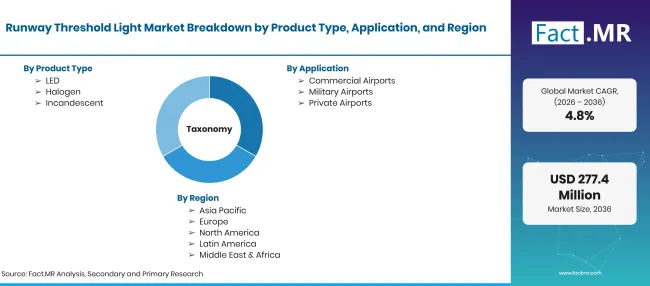
Runway Threshold Light Market Taxonomy | Source: Fact.MR
| Attribute | Details |
|---|---|
| Quantitative Units | USD million |
| Market Definition | Light fixtures that mark the start of the usable runway, in elevated and inset forms using LED, halogen or incandescent sources. Revenue is counted at fixture level for civil and military airfields. |
| Product Type | LED; Halogen; Incandescent |
| Application | Commercial Airports; Military Airports; Private Airports |
| Installation Type | New Installation; Retrofit |
| End-User | Civil Aviation; Military Aviation |
| Regions Covered | North America; Latin America; Western Europe; Eastern Europe; East Asia; South Asia & Pacific; Middle East & Africa |
| Countries Covered | Germany; Brazil; United States; United Kingdom; Japan |
| Companies Profiled | ADB SAFEGATE; TKH Airport Solutions; OCEM Airfield Technology; Eaton (Crouse-Hinds); Flight Light Inc.; Avlite Systems; ATG Airports |
| Forecast Period | 2026 to 2036 |
| Approach | Hybrid top-down and bottom-up approach using runway counts by airport class; threshold fixtures per runway end; replacement cycles by light source; airport grant and capital programs; and supplier portfolio review. |
Source: Fact.MR analysis. Updated Oct 30, 2026
How is the market segmented?
-
By Product Type
- LED
- Halogen
- Incandescent
-
By Application
- Commercial Airports
- Military Airports
- Private Airports
-
By Installation Type
- New Installation
- Retrofit
-
By End-User
- Civil Aviation
- Military Aviation
-
By Region
- North America
- Latin America
- Western Europe
- Eastern Europe
- East Asia
- South Asia & Pacific
- Middle East & Africa
Frequently Asked Questions
How big is the runway threshold light market in 2026?
What is the CAGR of the runway threshold light market from 2026 to 2036?
Which product type leads the runway threshold light market?
Which application leads the runway threshold light market?
Which installation type leads the runway threshold light market?
Which country will grow the most in the runway threshold light market?
Who are the main companies in the runway threshold light market?
Who worked on this report


Preview the report firsthand - request a free sample
Free SampleGet the brochure for pricing and purchase details
Download PDF