- Market Value (2025): USD 2222.6 Mn
- Estimated Value (2026): USD 2360.0 Mn
- Forecast Value (2036): USD 4300.0 Mn
- CAGR (2026-2036): 6.2%
What is the Halogen-Free Cable Compounds Market forecast to be worth by 2036?
USD 2,360.0 million in 2026 to USD 4,300.0 million by 2036, at 6.2% CAGR.
- The Cable Compounds Market crossed a valuation of USD 2,222.6 million in 2025 as cable manufacturers continued qualification work for low-smoke and halogen-free insulation and jacketing materials.
- Demand is projected to increase from USD 2,360.0 million in 2026 to USD 4,300.0 million by 2036.
- The market is forecast to record 6.2% CAGR from 2026 to 2036 as fire-safety requirements keep smoke release, flame spread, and acid-gas performance within cable material reviews.
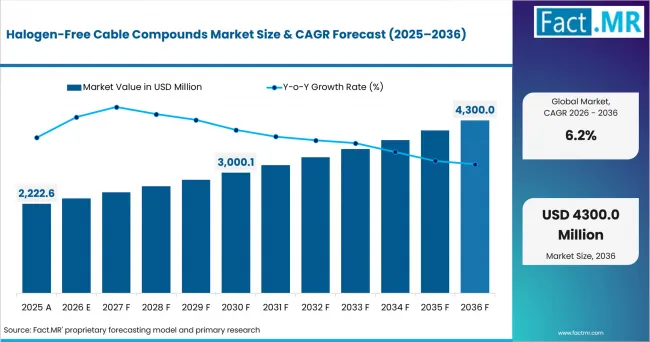
Halogen Free Cable Compounds Market Market Value Analysis | Source: Fact.MR
What are the defining numbers behind Halogen-Free Cable Compounds Market growth?
USD 1,940.0 million absolute opportunity by 2036, led by XLPE and Building wire.
- Demand Drivers in the Market
- Cable manufacturers need materials that release less smoke and fewer harmful gases during a fire. This is important for building, rail, data, and energy cables.
- Building wire producers also check whether a new material runs well on current extrusion lines and keeps the insulation even.
- Wire harness makers need materials that stay flexible and keep a good surface after bending, processing, and assembly.
- Energy and construction projects require clear test records before approval. Engineers use them to compare flame spread and smoke levels across different materials.
- Key Segments Analyzed
- By Polymer Base: XLPE is expected to hold 29% share in 2026 due to its use in cable insulation where crosslinking supports heat resistance and electrical performance.
- By Application: Building wire is projected to account for 33% share in 2026 because fire-safety review is closely linked to occupied buildings and enclosed spaces.
- By Performance: LSZH is anticipated to capture 32% share in 2026 through direct alignment with low-smoke and halogen-free cable requirements.
- By End User: Cable manufacturers are estimated to represent 28% share in 2026 since compound approval and processing control sit directly within cable production.
- By Voltage Class: Low voltage is forecast to account for 36% share in 2026 due to broad use across building, control, data, and equipment wiring.
- Analyst Opinion at Fact.MR
- Shambhu Nath Jha, Senior Analyst at Fact.MR, states, “Halogen-free cable compounds are assessed through processing evidence and fire-performance results. Companies that connect material data with extrusion support and application testing are better placed to move a grade from laboratory review into repeat production.”
- Strategic Implications
- Compound producers should validate XLPE and other polymer bases under the extrusion conditions used by cable manufacturers.
- Cable manufacturers should compare smoke, flame, mechanical, and processing results before replacing an approved insulation or jacketing grade.
- Distributors should keep technical data and test records ready for customers that need a faster document review before plant trials.
- Companies serving China and India should plan for local trial support because these countries record the two highest CAGRs in the country set.
Fire testing gives cable manufacturers a direct way to compare material behavior under defined conditions. Smoke release and acid-gas control therefore stay close to compound selection for building and transport cables. The same review applies to data networks and energy infrastructure.
Germany is anticipated to advance at a 7.1% CAGR by 2036 due to specification-led applications and established testing practices. Brazil is estimated to grow at 6.5%, while the United States is forecast to record a 5.9% CAGR through 2036.
How does the Halogen-Free Cable Compounds Market break down by segment?
XLPE leads at 29% by Polymer Base, while Building wire leads at 33% by Application in 2026.
What leads the Polymer Base segment?
XLPE holds 29% share in 2026.
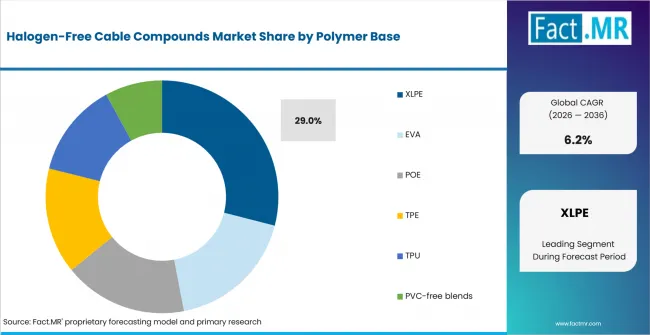
Halogen Free Cable Compounds Market Analysis By Polymer Base | Source: Fact.MR
XLPE is expected to hold 29% share in 2026 because it combines cable insulation use with heat resistance after crosslinking. EVA and POE remain part of the formulation set where flexibility and filler acceptance influence compound design. TPE and TPU serve applications that need softer handling or repeated movement. PVC-free blends provide another route where the material specification excludes halogenated systems.
The approval step depends on extrusion stability and finished-cable performance. A grade must process without avoidable surface defects and retain the electrical, mechanical, and fire properties required for the intended cable.
How does Application shape demand?
Building wire accounts for 33% share in 2026.
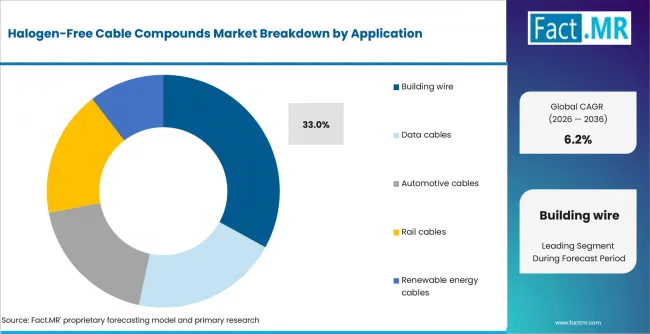
Halogen Free Cable Compounds Market Analysis By Application | Source: Fact.MR
Building wire is projected to account for 33% share in 2026 due to fire-safety requirements in occupied and enclosed spaces. Data cables need controlled smoke behavior alongside stable dimensions and signal-related construction needs. Automotive cables face heat, oil, movement, and space limits. Rail cables place added weight on smoke and toxicity performance, while renewable energy cables require durability across exposed or demanding operating conditions.
Building wire keeps the leading position because it combines high installation volume with direct code and specification review. Compound selection still depends on cable design, processing conditions, and the exact fire test required for the project.
Where is Performance demand strongest?
LSZH holds 32% share in 2026.
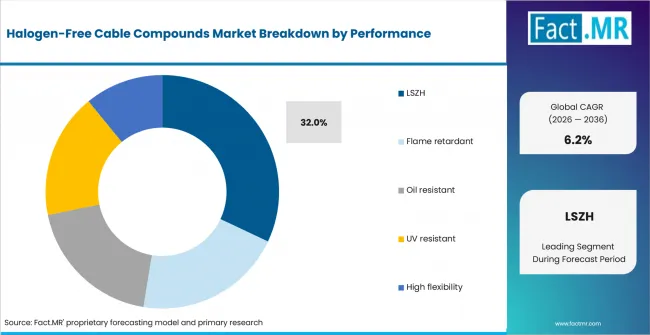
Halogen Free Cable Compounds Market Analysis By Performance | Source: Fact.MR
LSZH is anticipated to capture 32% share in 2026 since the segment directly addresses low-smoke and halogen-free cable specifications. Flame retardant grades cover applications where ignition resistance and flame spread are central. Oil resistant and UV resistant compounds serve cables exposed to oils, sunlight, or outdoor use. High flexibility grades support repeated bending and movement.
Performance claims need confirmation on the finished cable rather than the compound alone. Processing history, wall thickness, fillers, and cable construction can change the test result.
What supports End User adoption?
Cable manufacturers lead with 28% share in 2026.
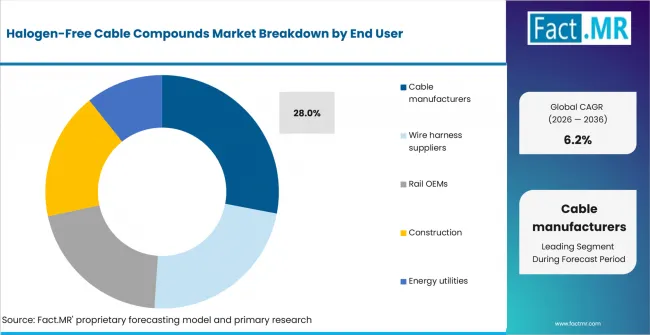
Halogen Free Cable Compounds Market Analysis By End User | Source: Fact.MR
Cable manufacturers are estimated to represent 28% share in 2026 because they control compound qualification and extrusion into the final product. Wire harness suppliers assess flexibility and assembly behavior. Rail OEMs work through project specifications and approved material lists. Construction and energy utilities focus on installation conditions, safety requirements, and service life.
Adoption moves faster when the compound producer supports plant trials and provides clear technical records. Repeat orders depend on stable processing and consistent performance from one production batch to the next.
Which Voltage Class dominates?
Low voltage accounts for 36% share in 2026.
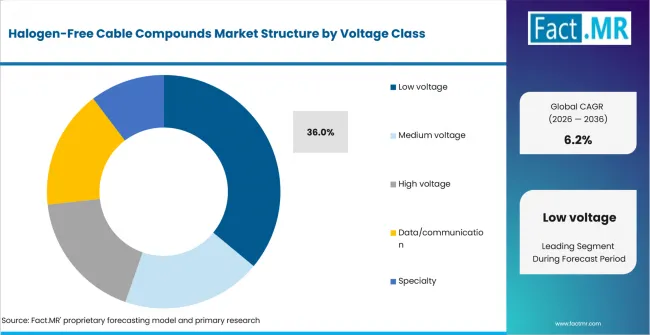
Halogen Free Cable Compounds Market Analysis By Voltage Class | Source: Fact.MR
Low voltage is forecast to account for 36% share in 2026 due to broad use in building wire, control cables, data connections, and equipment wiring. Medium voltage and high voltage compounds face stricter electrical and long-term performance requirements. Data/communication and Specialty classes cover constructions with separate flexibility, signal, heat, or environmental needs.
The leading share reflects the breadth of low-voltage cable use. Each cable construction still requires its own balance of electrical insulation, mechanical strength, flame performance, and process fit.
What is accelerating Halogen-Free Cable Compounds Market adoption, and what is holding it back?
Smoke-release control and fire-performance testing are anticipated to drive adoption. Qualification cost and process fit restrain the pace because cable manufacturers need evidence before replacing an approved material.
Drivers Impact Analysis
| DRIVER | (~) % IMPACT ON CAGR | GEOGRAPHIC RELEVANCE | IMPACT TIMELINE |
|---|---|---|---|
| Smoke release control in XLPE | +0.8% | China and export suppliers | Medium term (2-4 years) |
| Flame spread testing | +0.6% | Europe and North America | Short term (<= 2 years) |
| Building wire approval programs | +0.5% | Asia Pacific | Medium term (2-4 years) |
| Local support near cable makers | +0.4% | Global | Long term (>= 4 years) |
Source: Fact.MR analysis. Updated Jul 16, 2026
- Smoke release control in XLPE: Cable manufacturers can connect the material choice to a defined fire-performance target. The driver has greater weight when the same grade also meets extrusion and mechanical requirements.
- Flame spread testing: Project specifications often require evidence from recognized test methods. Clear results reduce uncertainty during technical review and grade comparison.
- Building wire approval programs: Building applications link compound choice to code and safety review. This creates recurring test work when cable designs or material grades change.
- Local support near cable makers: Plant-side technical help shortens the gap between laboratory data and production results. It is most useful during extrusion setup and first commercial runs.
Opportunity Impact Analysis
| OPPORTUNITY | (~) % IMPACT ON CAGR | GEOGRAPHIC RELEVANCE | IMPACT TIMELINE |
|---|---|---|---|
| Grades tuned for Building wire | +0.5% | Global | Medium term (2-4 years) |
| Application labs for Building wire | +0.4% | Asia Pacific and Europe | Short term (<= 2 years) |
| Rule-ready documentation | +0.4% | Europe and United Kingdom | Medium term (2-4 years) |
| Local trials with compounders | +0.3% | India and Brazil | Long term (>= 4 years) |
Source: Fact.MR analysis. Updated Jul 16, 2026
- Grades tuned for Building wire: Compound producers can adjust filler loading and processing behavior around insulation and jacketing needs. The commercial route depends on repeatable cable test results.
- Application labs for Building wire: Local labs help companies compare candidate grades before full plant trials. This reduces avoidable production disruption during early qualification.
- Rule-ready documentation: Technical files that organize composition, test results, and intended use make specification review easier. Clear records are especially useful in regulated building and transport applications.
- Local trials with compounders: Joint trials allow material producers and cable manufacturers to solve processing issues under actual equipment conditions. This supports a smoother move into regular production.
Restraints Impact Analysis
| RESTRAINT | (~) % IMPACT ON CAGR | GEOGRAPHIC RELEVANCE | IMPACT TIMELINE |
|---|---|---|---|
| Qualification cost | -0.4% | Global processors | Medium term (2-4 years) |
| Fit limits in Building wire | -0.3% | Global | Short term (<= 2 years) |
| Documentation burden | -0.3% | Europe and North America | Medium term (2-4 years) |
| Scale-up risk | -0.2% | High-volume plants | Long term (>= 4 years) |
Source: Fact.MR analysis. Updated Jul 16, 2026
- Qualification cost: Testing and plant trials use technical time and production capacity. Cable manufacturers may delay a change when the current grade already meets the specification.
- Fit limits in Building wire: A compound that meets one fire target may not match every cable design or extrusion line. Processing and cable construction therefore limit direct substitution.
- Documentation burden: Different projects can request separate records and test evidence. Smaller producers face more pressure when several national or customer specifications apply.
- Scale-up risk: Laboratory performance does not always transfer directly to high-output extrusion. Variation in mixing, moisture, temperature, and line speed can affect the finished cable.
Which countries are scaling Halogen-Free Cable Compounds Market fastest?
United States 5.9%, Germany 7.1%, Brazil 6.5%.
.webp "Top Country Growth Comparison Halogen Free Cable Compounds Market Cagr (2026 2036)")
Top Country Growth Comparison Halogen Free Cable Compounds Market Cagr (2026 2036) | Source: Fact.MR
Regional analysis covers North America, Europe, Asia Pacific, Latin America, and the Middle East & Africa.
| COUNTRY | CAGR |
|---|---|
| Germany | 7.1% |
| Brazil | 6.5% |
| United States | 5.9% |
Source: Fact.MR analysis. Updated Jul 16, 2026
What supports the Germany outlook?
7.1% CAGR, linked to specification-led cable applications and established testing practices.
Germany has established cable production for building, rail, automotive, and industrial applications where documentation and repeat test results guide material approval. Demand is anticipated to post a 7.1% CAGR by 2036 as compound changes continue to move through structured processing and fire-performance qualification.
What underpins Brazil’s growth?
6.5% CAGR, driven by cable demand and expanding local trial activity.
Brazil offers growing opportunities for halogen-free compounds in building and energy cables where smoke and flame performance form part of the product specification. The market is estimated to record a 6.5% CAGR through 2036 as local trials help manufacturers confirm processing fit and finished-cable performance before placing larger orders.
How is the United States developing demand?
5.9% CAGR, backed by fire testing and application-specific cable requirements.
United States cable manufacturers assess compound performance through recognized fire tests and customer-specific requirements across several cable classes. The market is forecast to post a 5.9% CAGR from 2026 to 2036 as continued demand for documented smoke and flame performance supports application-focused qualification work.
Who leads the Halogen-Free Cable Compounds Market?
Borealis and Avient lead direct halogen-free cable compound coverage, while HEXPOL and Teknor Apex strengthen custom compounding and application-specific formulation capabilities.
Borealis provides flame-retardant compounds for cable insulation and jacketing across power, automotive, building, and energy applications. Avient contributes low-smoke, non-halogen formulations for telecom, rail, marine, renewable energy, and building cables. Both companies compete on flame control, mechanical strength, extrusion performance, and the ability to meet finished-cable test requirements.
HEXPOL supports cable manufacturers through thermoplastic and thermoset compound capabilities, including halogen-free flame-retardant materials. Teknor Apex adds compounds for data, industrial, energy, rail, and infrastructure cables, with attention to flexibility, smoke performance, dimensional stability, and processing consistency. Dow brings polyethylene material expertise for wire and cable systems, while SABIC contributes a broad portfolio of polyolefins and engineering thermoplastics.
Competition through 2036 is expected to focus on verified smoke and flame performance, compatibility with existing extrusion lines, clear technical documentation, and support during laboratory and full-scale cable qualification.
Which companies are the key providers?
Borealis and Avient are key providers. HEXPOL and Teknor Apex are also profiled. Dow and SABIC complete the company set.
- Borealis
- Avient
- HEXPOL
- Teknor Apex
- Dow
- SABIC
Bibliography
- Avient Corporation. (2025, February 27). Avient expands flame retardant solutions portfolio for wire and cable with ECCOH XL 8054.
- HEXPOL AB. (2025, February 18). HEXPOL acquires 80 percent of the shares in Kabkom Kimya Sanayi ve Ticaret Anonim Şirketi.
- Borealis AG. (2025, October 9). Borealis expands XLPE production in Sweden to meet demand for cable insulation materials.
- European Commission. (2024). Construction Products Regulation.
- UL Solutions. (2024). Combustion and fire tests for plastics.
This Report Addresses
- The report provides strategic intelligence on the Halogen-Free Cable Compounds Market across Polymer Base and Application choices. It explains how cable processing, fire testing, and specification review shape commercial use.
- Segment analysis covers XLPE and Building wire as the 2026 share leaders. LSZH, Cable manufacturers, and Low voltage hold the leading positions across the remaining dimensions.
- Regional outlook evaluates Germany and India alongside the United Kingdom and the United States while China, Brazil, and 30+ countries complete the growth comparison.
- Competitive analysis profiles Borealis and Avient, followed by HEXPOL, Teknor Apex, Dow, and SABIC. The company view focuses on material coverage and support through cable approval.
- Use-case assessment covers Building wire and the adjacent applications within cable compounds and low-smoke halogen-free materials. The discussion separates compound-level performance from the evidence required for finished-cable approval.
What does the Halogen-Free Cable Compounds Market cover?
Halogen-free insulation and jacketing compounds used in cable applications where smoke, flame, and acid-gas performance form part of material selection.
The market covers XLPE, EVA, POE, TPE, TPU, and PVC-free blends sold for cable insulation or jacketing. Application coverage includes Building wire, Data cables, Automotive cables, Rail cables, and Renewable energy cables.
Commercial value comes from the compound’s defined role in cable production. General polymers remain outside the boundary unless they are formulated and sold for the cable functions included in this report.
What is included in the scope?
Cable jacketing and insulation compounds formulated without halogenated flame retardants for low-smoke and safer fire performance.
The scope includes all stated Polymer Base, Application, Performance, End User, and Voltage Class subsegments. It covers material sold with the technical data and application support needed for cable qualification and production.
What is excluded from the scope?
General polymer resins and equipment-only sales are outside the scope when no halogen-free cable compound function is included.
Finished cables are not counted as compound revenue. Commodity materials are excluded unless they are formulated and sold within the stated market definition for an included cable application.
How was the analysis built?
120+ sources, 40+ company portfolios, 25+ countries, 20+ interviews.
- Primary Research: Primary research includes discussions with manufacturers, service providers, technology developers, distributors, end users, procurement teams, and subject-matter experts. These conversations examine purchasing priorities, product adoption, operational challenges, approval requirements, competitive positioning, and the factors that influence wider market acceptance.
- Desk Research: Desk research covers government statistics, regulatory publications, company filings, trade data, technical studies, industry associations, standards, public policy, and other authoritative sources. Every source used in the analysis is documented in the bibliography.
- Market Sizing and Forecasting: Market estimates combine historical performance, demand indicators, pricing and volume trends, segment shares, company participation, country-level growth, adoption patterns, investment activity, and barriers to market expansion.
- Data Validation and Update Cycle: Findings are validated by comparing primary interviews with public data, company activity, regulatory changes, trade patterns, and industry developments. Regular updates review new product launches, capacity changes, partnerships, approvals, procurement trends, and shifts in commercial adoption.
Segmentation
What is the report’s scope and coverage?
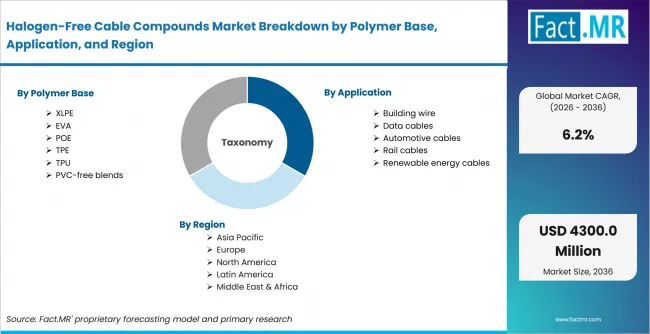
Halogen Free Cable Compounds Market Breakdown By Polymer Base, Application, And Region | Source: Fact.MR
| Attribute | Details |
|---|---|
| Quantitative Units | USD Million in 2026 to USD Million by 2036 at CAGR |
| Market Definition | Cable jacketing and insulation compounds formulated without halogenated flame retardants for low-smoke and safer fire performance. |
| Polymer Base | XLPE; EVA; POE; TPE; TPU; PVC-free blends |
| Application | Building wire; Data cables; Automotive cables; Rail cables; Renewable energy cables |
| Performance | LSZH; Flame retardant; Oil resistant; UV resistant; High flexibility |
| End User | Cable manufacturers; Wire harness suppliers; Rail OEMs; Construction; Energy utilities |
| Voltage Class | Low voltage; Medium voltage; High voltage; Data/communication; Specialty |
| Regions Covered | North America; Europe; Asia Pacific; Central and South America; Middle East and Africa |
| Countries Covered | Germany; Brazil; United States |
| Key Companies Profiled | Borealis; Avient; HEXPOL; Teknor Apex; Dow; SABIC |
| Forecast Period | 2026 to 2036 |
| Approach | Hybrid top-down and bottom-up approach using segment shares, country growth, company coverage, public references, and technical validation |
Source: Fact.MR analysis. Updated Jul 16, 2026
How is the market segmented?
-
By Polymer Base
- XLPE
- EVA
- POE
- TPE
- TPU
- PVC-free blends
-
By Application
- Building wire
- Data cables
- Automotive cables
- Rail cables
- Renewable energy cables
-
By Performance
- LSZH
- Flame retardant
- Oil resistant
- UV resistant
- High flexibility
-
By End User
- Cable manufacturers
- Wire harness suppliers
- Rail OEMs
- Construction
- Energy utilities
-
By Voltage Class
- Low voltage
- Medium voltage
- High voltage
- Data/communication
- Specialty
-
By Region
- North America
- United States
- Canada
- Europe
- Germany
- United Kingdom
- France
- Italy
- Spain
- Asia Pacific
- Japan
- South Korea
- Australia
- Central & South America
- Brazil
- Argentina
- Mexico
- Chile
- Middle East & Africa
- UAE
- Saudi Arabia
- South Africa
- North America
Frequently Asked Questions
Which Polymer Base leads the Halogen-Free Cable Compounds Market?
Which Application leads the Halogen-Free Cable Compounds Market?
Which Performance leads the Halogen-Free Cable Compounds Market?
Which End User leads the Halogen-Free Cable Compounds Market?
Which Voltage Class leads the Halogen-Free Cable Compounds Market?
What is the primary driver in the Halogen-Free Cable Compounds Market?
What is the main restraint in the Halogen-Free Cable Compounds Market?
Why is XLPE important?
Why do cable manufacturers continue testing halogen-free compounds?
Who worked on this report


Preview the report firsthand - request a free sample
Free SampleGet the brochure for pricing and purchase details
Download PDF